
Rigor and Relevance Framework To Examine Curriculum Instruction
- Slides: 37
Rigor and Relevance Framework To Examine Curriculum, Instruction, and Assessment
st 21 Century Skills for Success Strong Academics �Reading, Writing, Math, Science Career Skills �Workplace Attitudes & Ethics �Technology Skills Character Virtues �Honesty, Responsibility, Integrity
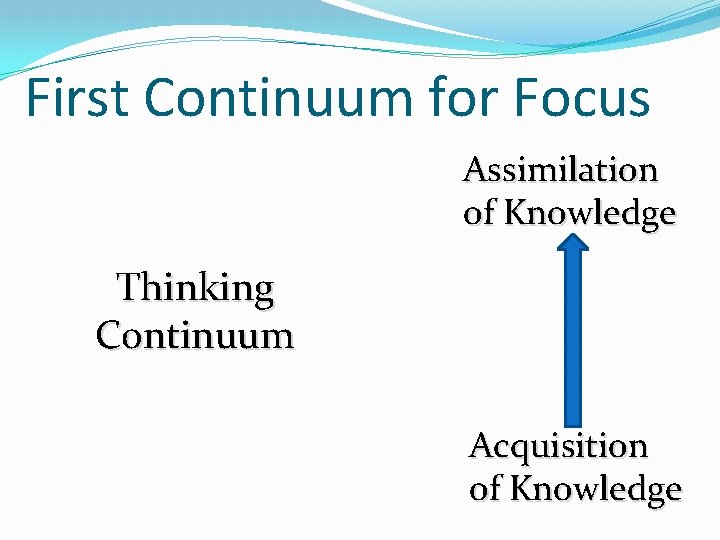
First Continuum for Focus Assimilation of Knowledge Thinking Continuum Acquisition of Knowledge
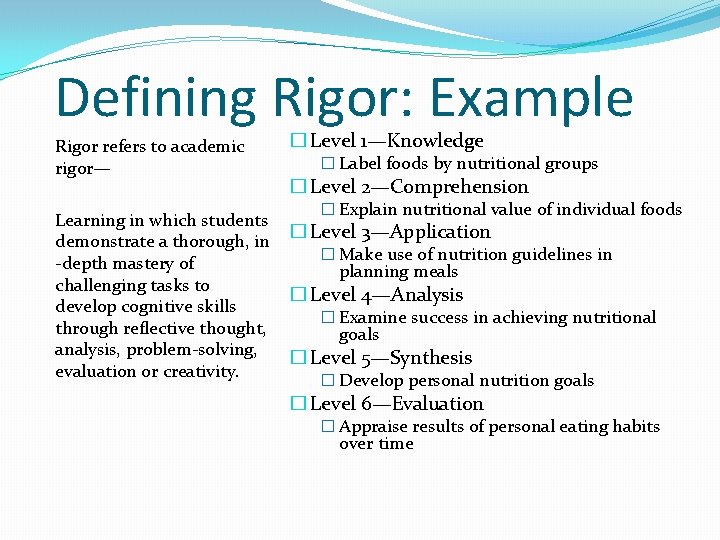
Defining Rigor: Example Rigor refers to academic rigor— Learning in which students demonstrate a thorough, in -depth mastery of challenging tasks to develop cognitive skills through reflective thought, analysis, problem-solving, evaluation or creativity. � Level 1—Knowledge � Label foods by nutritional groups � Level 2—Comprehension � Explain nutritional value of individual foods � Level 3—Application � Make use of nutrition guidelines in planning meals � Level 4—Analysis � Examine success in achieving nutritional goals � Level 5—Synthesis � Develop personal nutrition goals � Level 6—Evaluation � Appraise results of personal eating habits over time
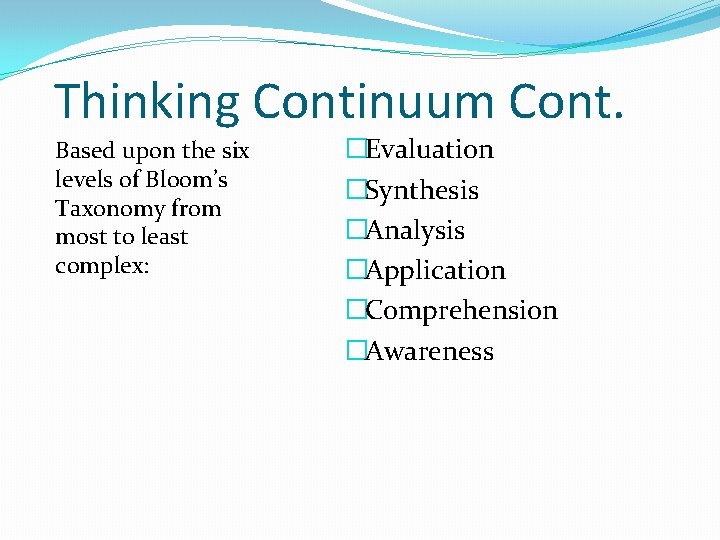
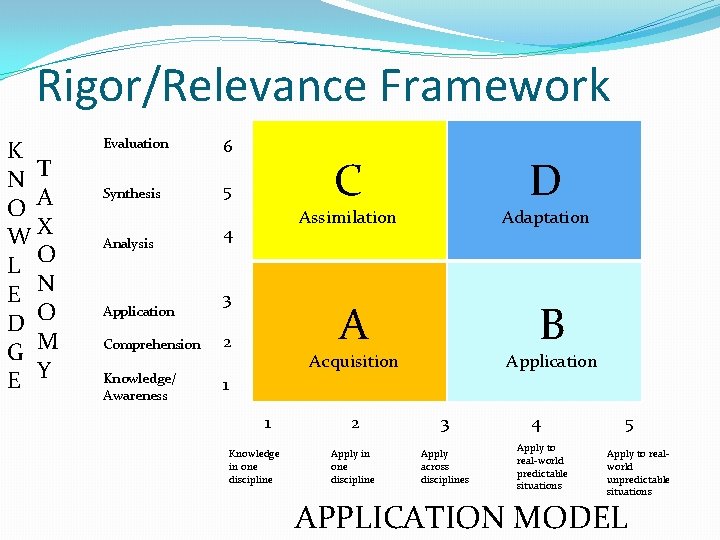
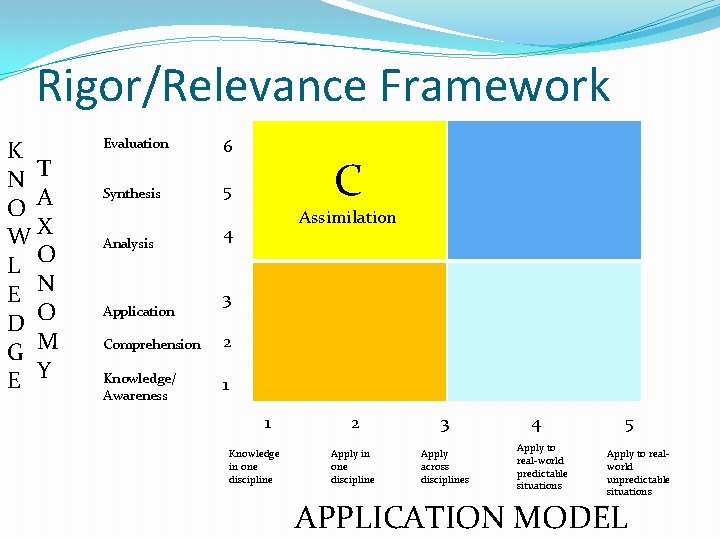
Thinking Continuum Cont. Based upon the six levels of Bloom’s Taxonomy from most to least complex: �Evaluation �Synthesis �Analysis �Application �Comprehension �Awareness
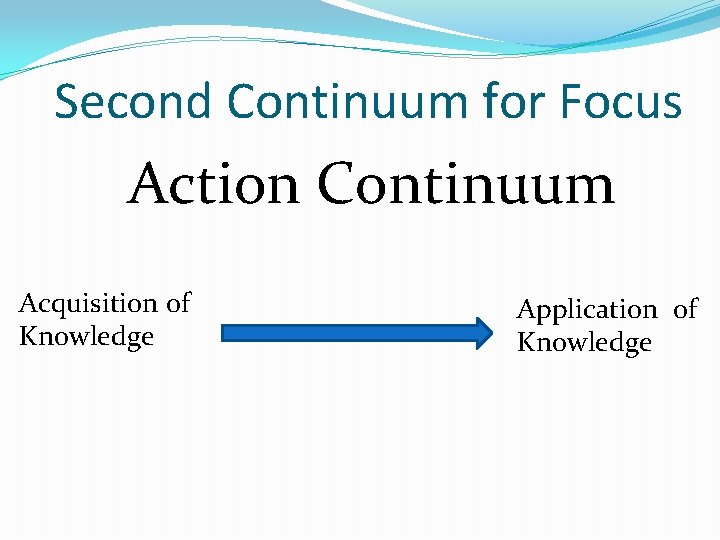
Second Continuum for Focus Action Continuum Acquisition of Knowledge Application of Knowledge
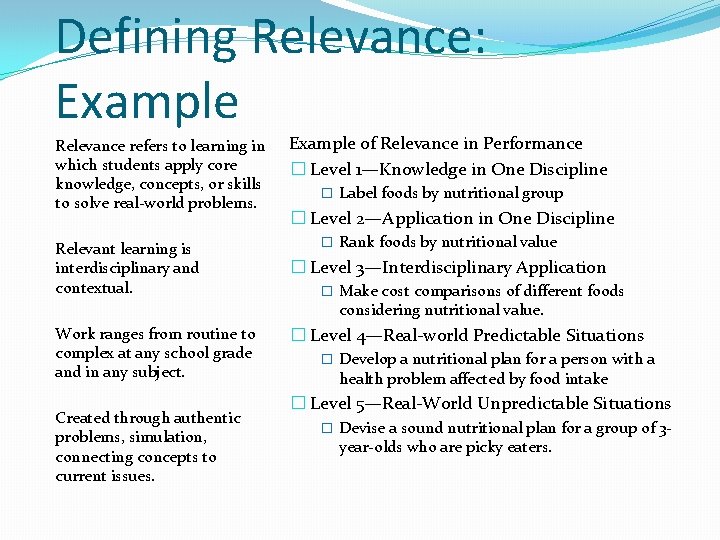
Defining Relevance: Example Relevance refers to learning in which students apply core knowledge, concepts, or skills to solve real-world problems. Relevant learning is interdisciplinary and contextual. Example of Relevance in Performance � Level 1—Knowledge in One Discipline � Label foods by nutritional group � Level 2—Application in One Discipline � Rank foods by nutritional value � Level 3—Interdisciplinary Application � Make cost comparisons of different foods considering nutritional value. Work ranges from routine to complex at any school grade and in any subject. Created through authentic problems, simulation, connecting concepts to current issues. � Level 4—Real-world Predictable Situations � Develop a nutritional plan for a person with a health problem affected by food intake � Level 5—Real-World Unpredictable Situations � Devise a sound nutritional plan for a group of 3 - year-olds who are picky eaters.
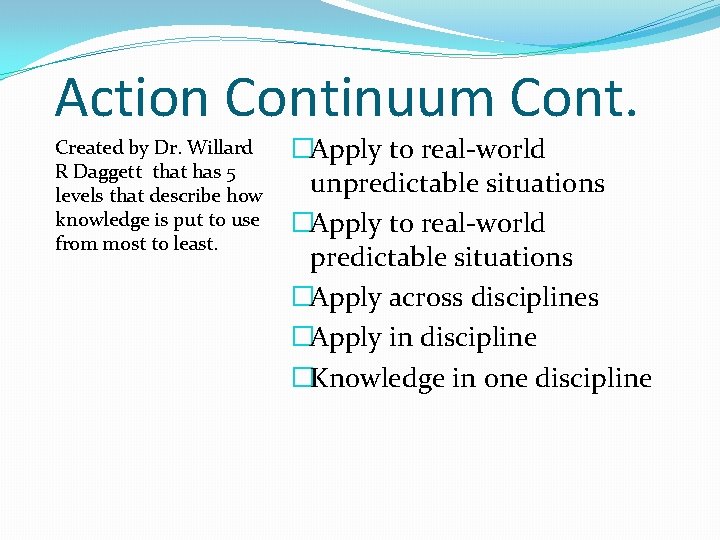
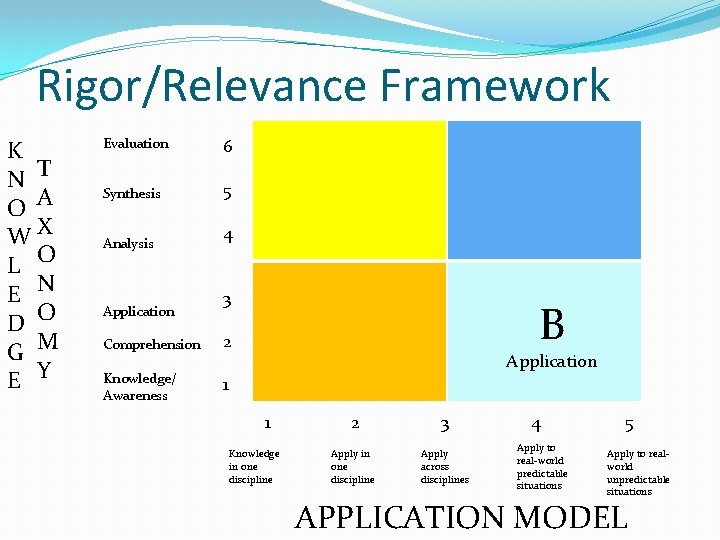
Action Continuum Cont. Created by Dr. Willard R Daggett that has 5 levels that describe how knowledge is put to use from most to least. �Apply to real-world unpredictable situations �Apply to real-world predictable situations �Apply across disciplines �Apply in discipline �Knowledge in one discipline
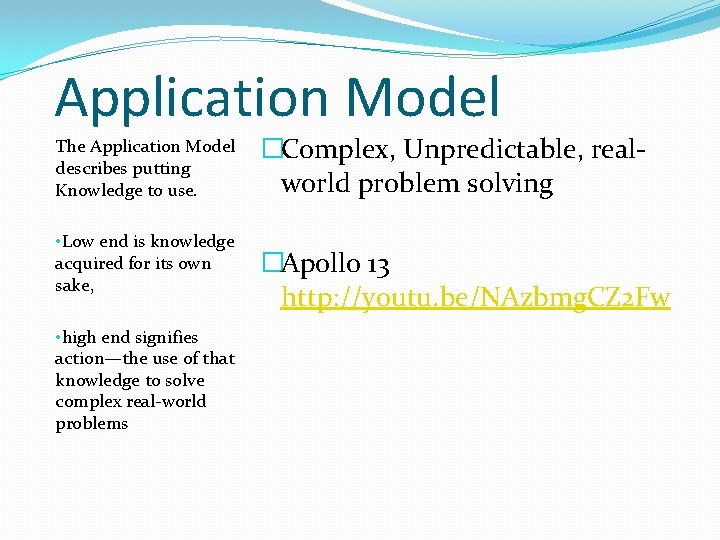
Application Model The Application Model describes putting Knowledge to use. • Low end is knowledge acquired for its own sake, • high end signifies action—the use of that knowledge to solve complex real-world problems �Complex, Unpredictable, realworld problem solving �Apollo 13 http: //youtu. be/NAzbmg. CZ 2 Fw
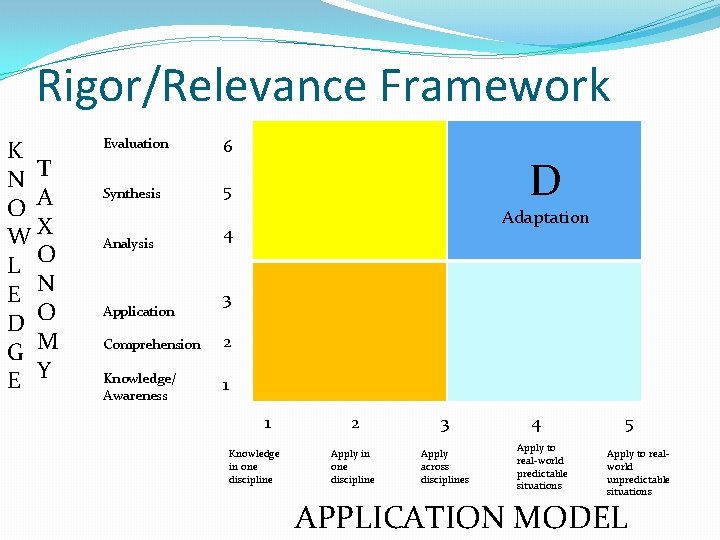
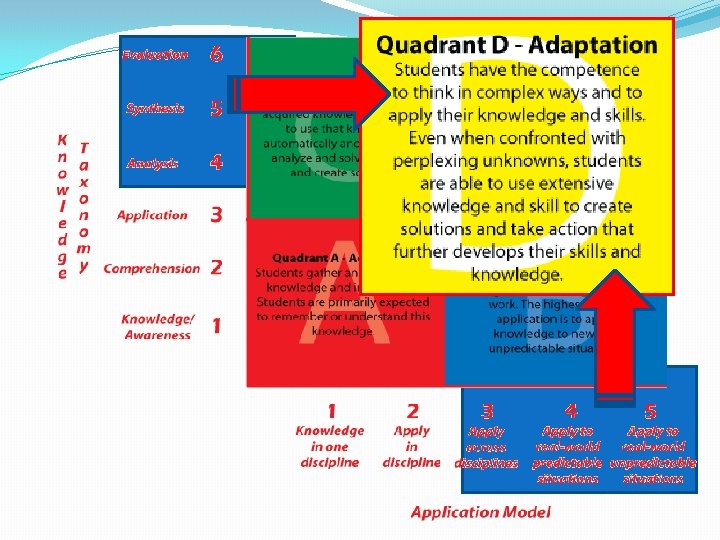
Rigor/Relevance Framework K N T O A WX L O E N D O G M E Y Evaluation 6 Synthesis 5 Analysis Application C Assimilation 4 3 Comprehension 2 Knowledge/ Awareness 1 D Adaptation A B Acquisition 1 Knowledge in one discipline Application 2 3 Apply in one discipline Apply across disciplines 4 Apply to real-world predictable situations 5 Apply to realworld unpredictable situations APPLICATION MODEL
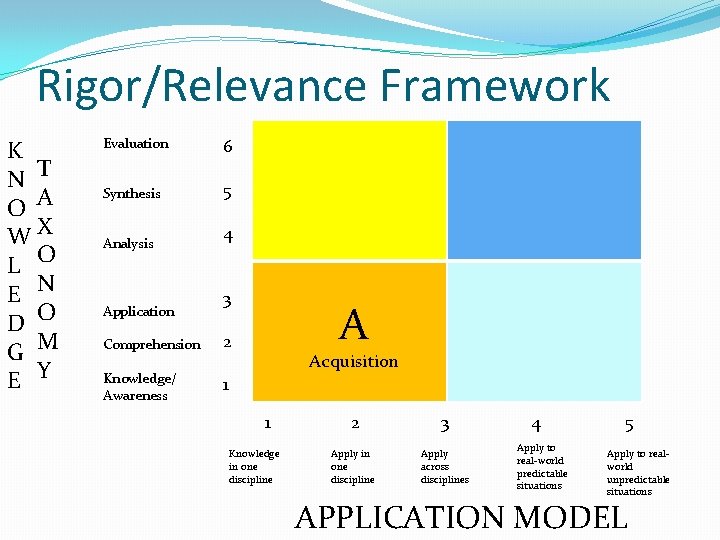
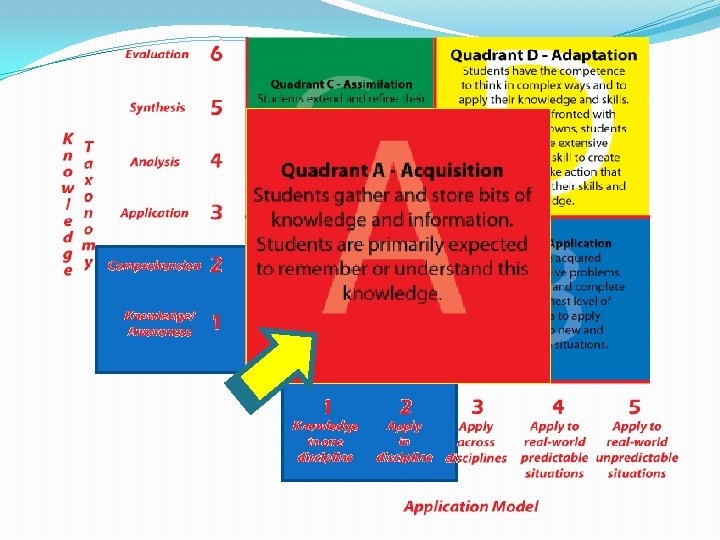
Rigor/Relevance Framework K N T O A WX L O E N D O G M E Y Evaluation 6 Synthesis 5 Analysis Application 4 3 Comprehension 2 Knowledge/ Awareness 1 A Acquisition 1 Knowledge in one discipline 2 3 Apply in one discipline Apply across disciplines 4 Apply to real-world predictable situations 5 Apply to realworld unpredictable situations APPLICATION MODEL
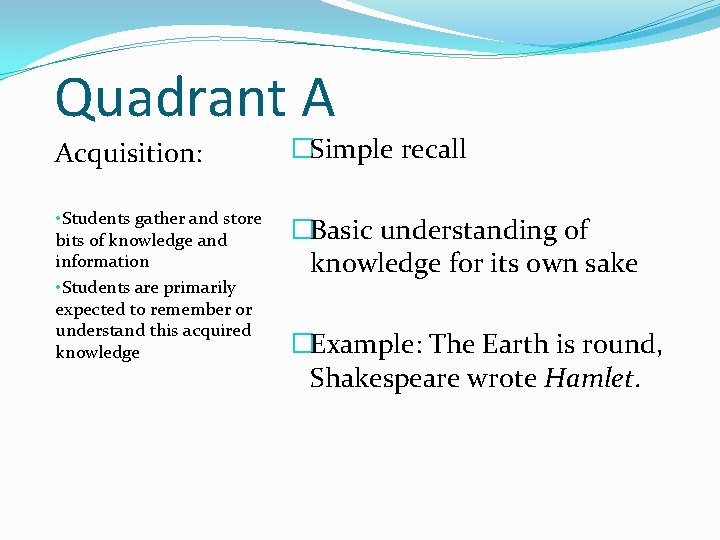
Quadrant A Acquisition: �Simple recall • Students gather and store bits of knowledge and information • Students are primarily expected to remember or understand this acquired knowledge �Basic understanding of knowledge for its own sake �Example: The Earth is round, Shakespeare wrote Hamlet.
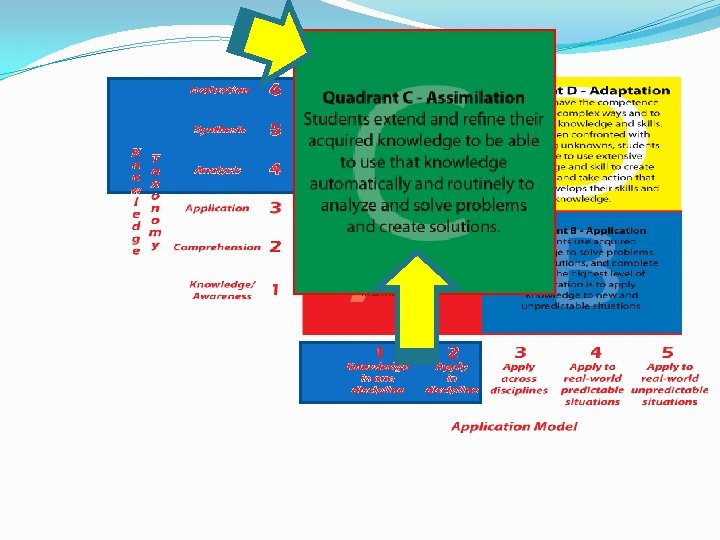
Rigor/Relevance Framework K N T O A WX L O E N D O G M E Y Evaluation 6 Synthesis 5 Analysis Application C Assimilation 4 3 Comprehension 2 Knowledge/ Awareness 1 1 Knowledge in one discipline 2 3 Apply in one discipline Apply across disciplines 4 Apply to real-world predictable situations 5 Apply to realworld unpredictable situations APPLICATION MODEL
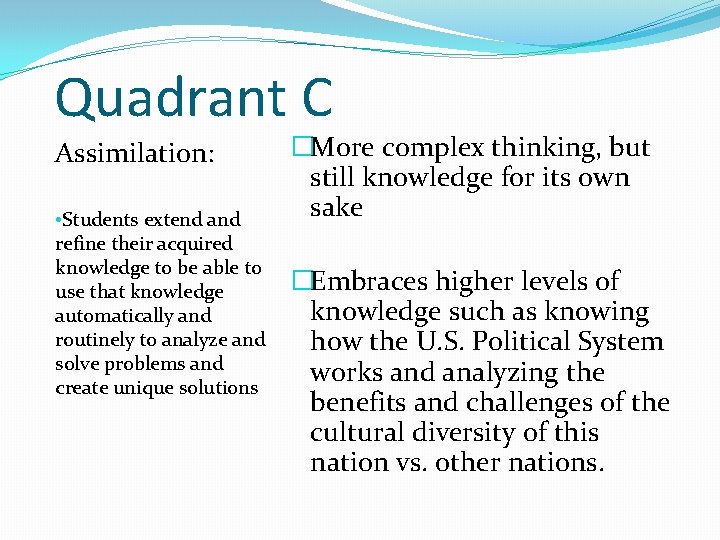
Quadrant C Assimilation: • Students extend and refine their acquired knowledge to be able to use that knowledge automatically and routinely to analyze and solve problems and create unique solutions �More complex thinking, but still knowledge for its own sake �Embraces higher levels of knowledge such as knowing how the U. S. Political System works and analyzing the benefits and challenges of the cultural diversity of this nation vs. other nations.
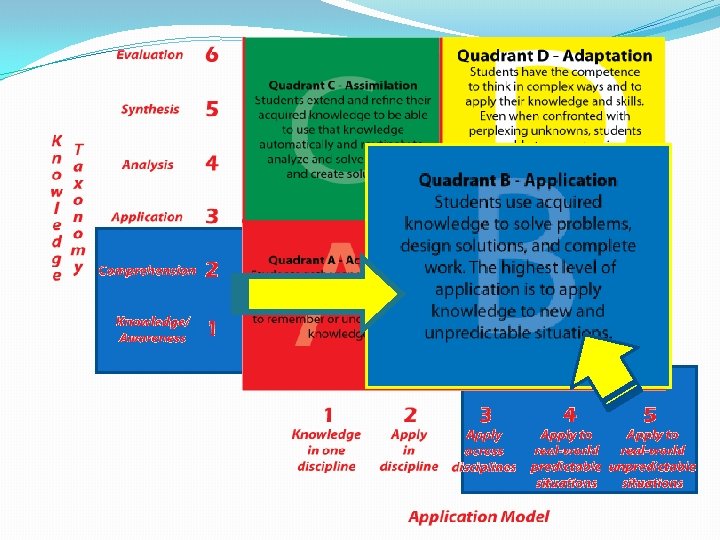
Rigor/Relevance Framework K N T O A WX L O E N D O G M E Y Evaluation 6 Synthesis 5 Analysis Application 4 3 Comprehension 2 Knowledge/ Awareness 1 B Application 1 Knowledge in one discipline 2 3 Apply in one discipline Apply across disciplines 4 Apply to real-world predictable situations 5 Apply to realworld unpredictable situations APPLICATION MODEL
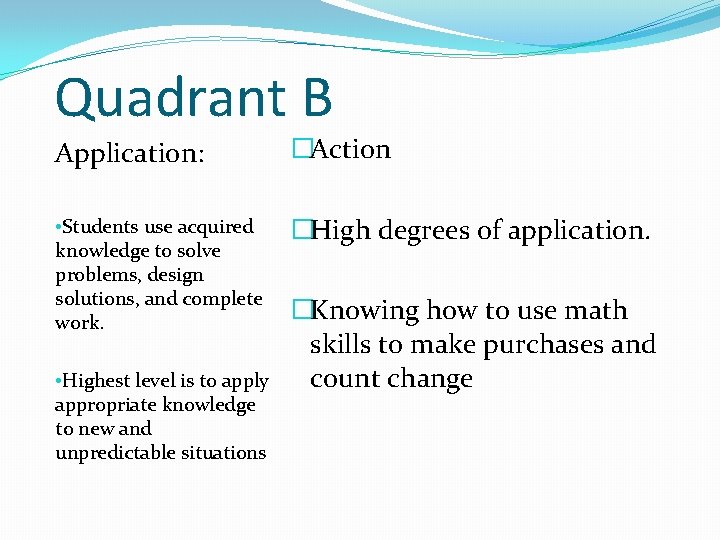
Quadrant B Application: �Action • Students use acquired knowledge to solve problems, design solutions, and complete work. �High degrees of application. • Highest level is to apply appropriate knowledge to new and unpredictable situations �Knowing how to use math skills to make purchases and count change
Rigor/Relevance Framework K N T O A WX L O E N D O G M E Y Evaluation 6 Synthesis 5 Analysis Application D Adaptation 4 3 Comprehension 2 Knowledge/ Awareness 1 1 Knowledge in one discipline 2 3 Apply in one discipline Apply across disciplines 4 Apply to real-world predictable situations 5 Apply to realworld unpredictable situations APPLICATION MODEL
Quadrant D Adaptation: • Students have the competence to think in complex ways and also apply knowledge and skills they have acquired • Even when confronted with perplexing unknowns, students are able to use extensive knowledge and skill to create solutions and take action that further develops their skills and knowledge. �Ability to access information in wide-area network systems �Ability to gather knowledge from a variety of sources to solve complex problem in the workplace
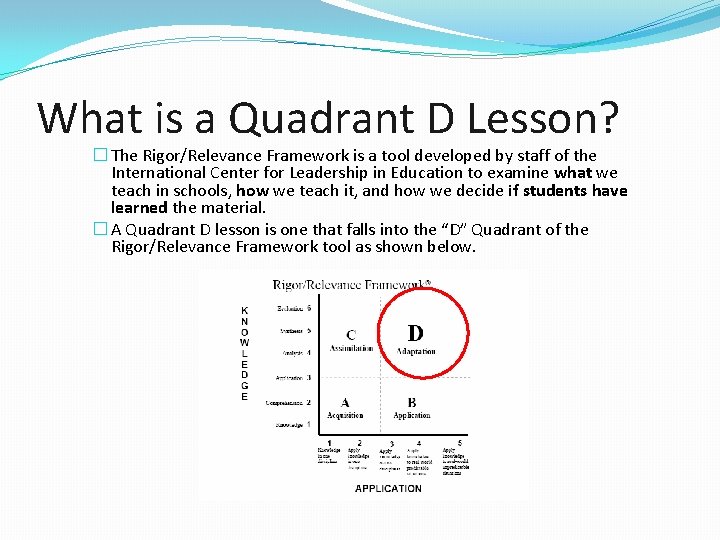
What is a Quadrant D Lesson? � The Rigor/Relevance Framework is a tool developed by staff of the International Center for Leadership in Education to examine what we teach in schools, how we teach it, and how we decide if students have learned the material. � A Quadrant D lesson is one that falls into the “D” Quadrant of the Rigor/Relevance Framework tool as shown below.
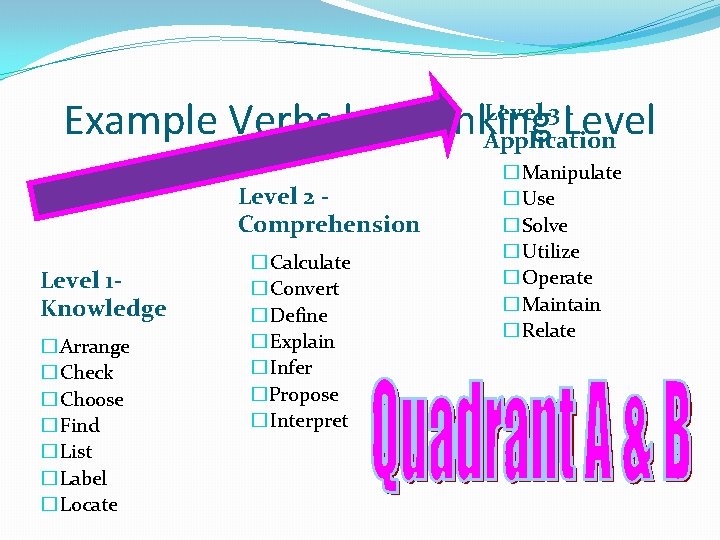
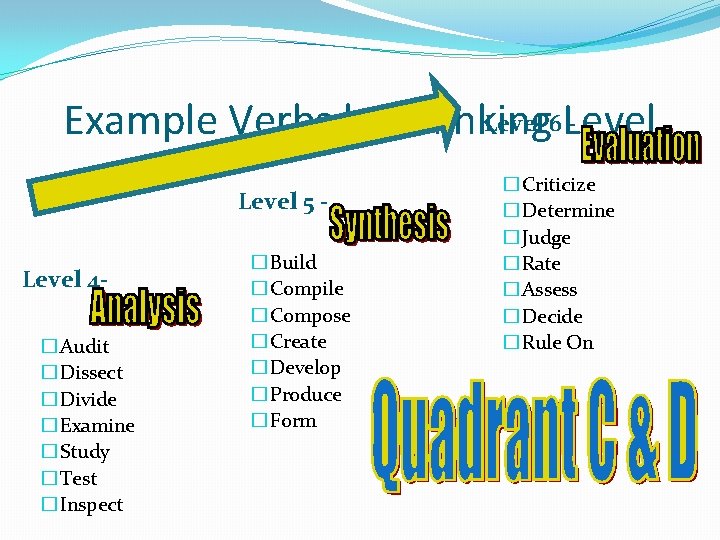
Example Verbs by Thinking Level 3 Application Level 2 Comprehension Level 1 Knowledge � Arrange � Check � Choose � Find � List � Label � Locate � Calculate � Convert � Define � Explain � Infer �Propose � Interpret � Manipulate � Use � Solve � Utilize � Operate � Maintain � Relate
Level 6 Level Example Verbs by Thinking Level 5 Level 4� Audit � Dissect � Divide � Examine � Study � Test � Inspect � Build � Compile � Compose � Create � Develop � Produce � Form � Criticize � Determine � Judge � Rate � Assess � Decide � Rule On
Three Most Important Qualities of a Quadrant D Lesson �Is the lesson I am teaching for application? o Acquiring knowledge to complete work to apply to something o o Is the lesson real world? Application is the same as it would be for adults in a job Standards for performance are the same for adult roles �Is there only one “right way” or can the end product be unique or unpredictable? o Are there multiple variables that will affect the product? o Is the outcome unpredictable or potentially different every time? o Are there unknown factors such as (environment, people, time)?
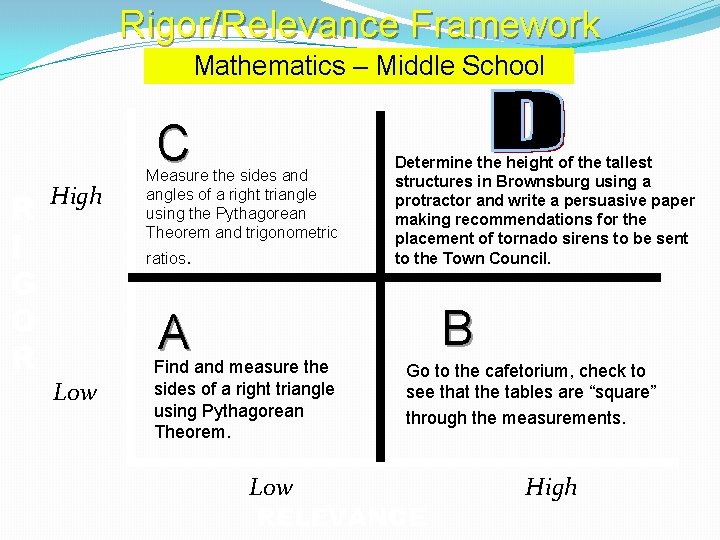
Rigor/Relevance Framework Mathematics – Middle School C R I G O R High Measure the sides and angles of a right triangle using the Pythagorean Theorem and trigonometric ratios. A Low Find and measure the sides of a right triangle using Pythagorean Theorem. Determine the height of the tallest structures in Brownsburg using a protractor and write a persuasive paper making recommendations for the placement of tornado sirens to be sent to the Town Council. B Go to the cafetorium, check to see that the tables are “square” through the measurements. Low RELEVANCE High
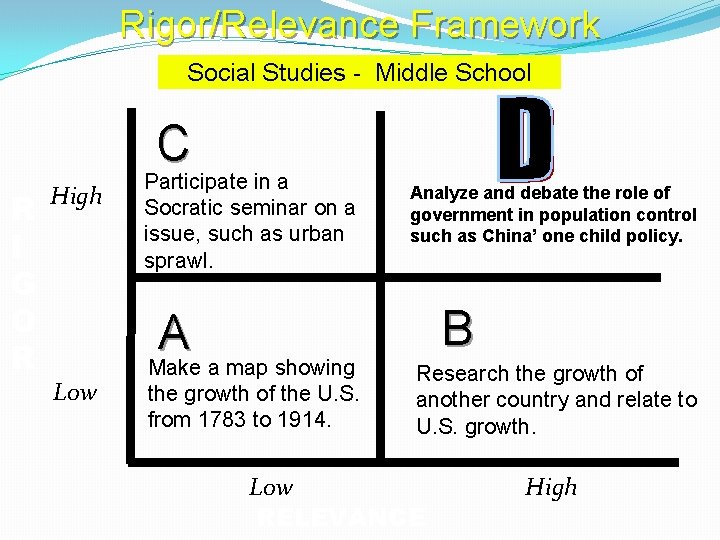
Rigor/Relevance Framework Social Studies - Middle School C R I G O R High Low Participate in a Socratic seminar on a issue, such as urban sprawl. A Make a map showing the growth of the U. S. from 1783 to 1914. Analyze and debate the role of government in population control such as China’ one child policy. B Research the growth of another country and relate to U. S. growth. Low RELEVANCE High
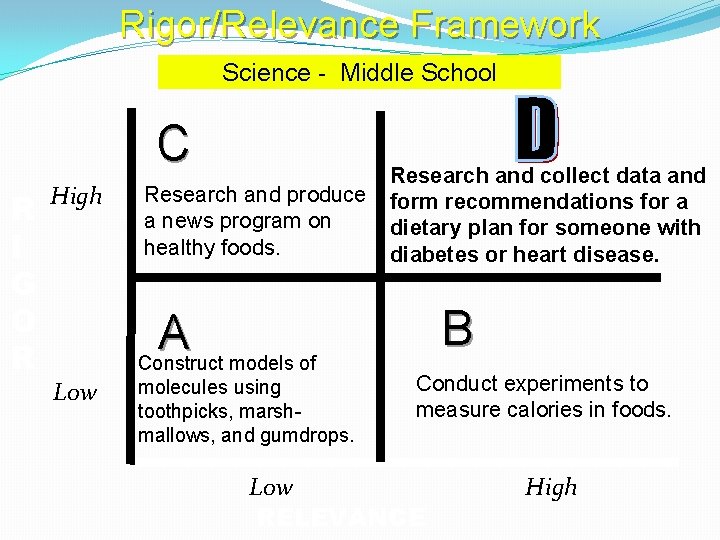
Rigor/Relevance Framework Science - Middle School C R I G O R High Research and produce a news program on healthy foods. A Construct models of Low molecules using toothpicks, marshmallows, and gumdrops. Research and collect data and form recommendations for a dietary plan for someone with diabetes or heart disease. B Conduct experiments to measure calories in foods. Low RELEVANCE High
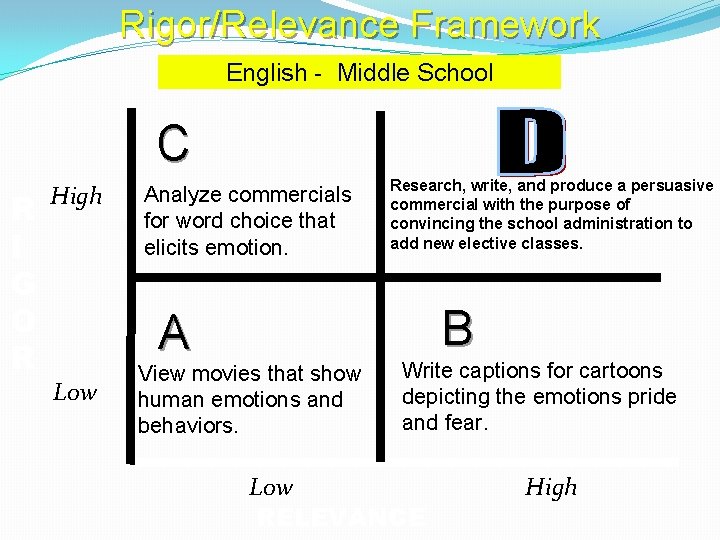
Rigor/Relevance Framework English - Middle School C R I G O R High Analyze commercials for word choice that elicits emotion. A Low Research, write, and produce a persuasive commercial with the purpose of convincing the school administration to add new elective classes. B View movies that show human emotions and behaviors. Write captions for cartoons depicting the emotions pride and fear. Low RELEVANCE High
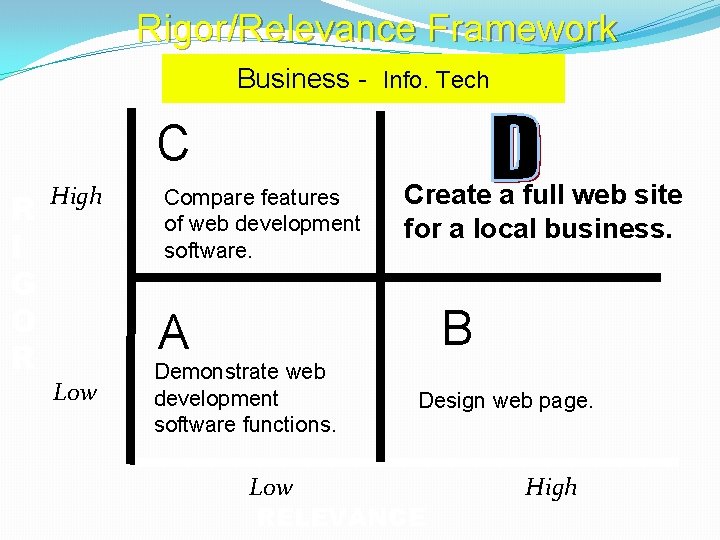
Rigor/Relevance Framework Business - Info. Tech C R I G O R High Compare features of web development software. Create a full web site for a local business. B A Low Demonstrate web development software functions. Design web page. Low RELEVANCE High
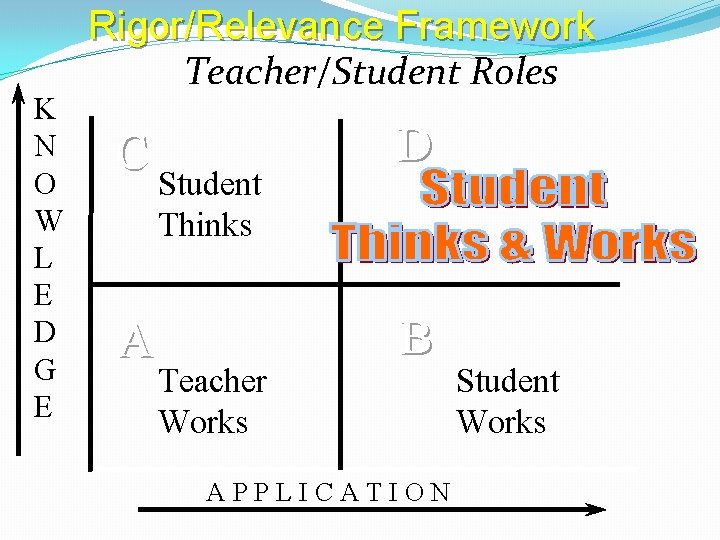
K N O W L E D G E Rigor/Relevance Framework Teacher/Student Roles C A Student Thinks Teacher Works D B APPLICATION Student Works
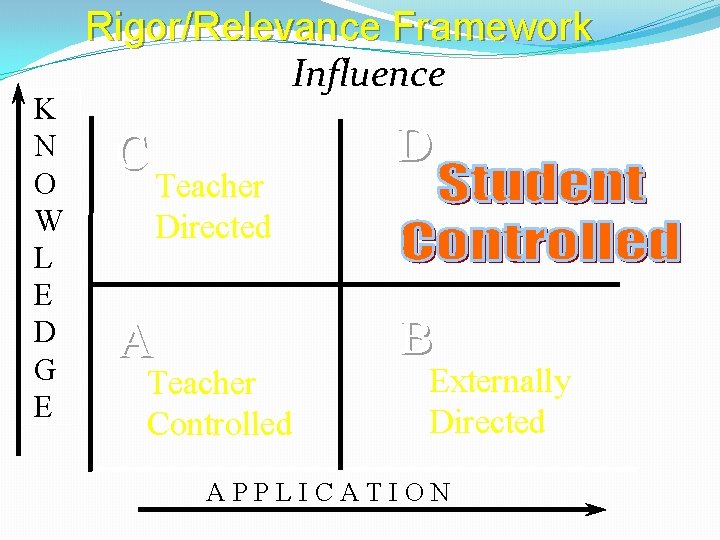
K N O W L E D G E Rigor/Relevance Framework Influence C A Teacher Directed Teacher Controlled D B Externally Directed APPLICATION
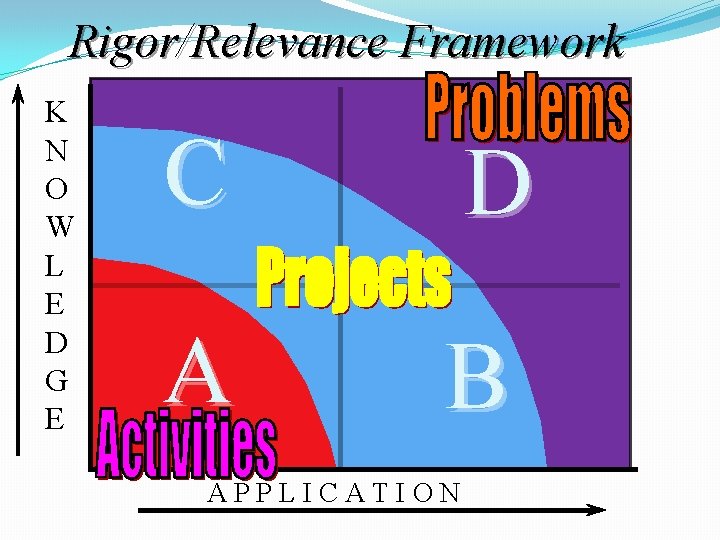
Rigor/Relevance Framework K N O W L E D G E C D A B APPLICATION
Why should I care about Quadrant D lessons? �Quadrant D lessons prepare students for life beyond school. �They prepare students for the work force and to be the leaders of tomorrow in the 21 st Century.
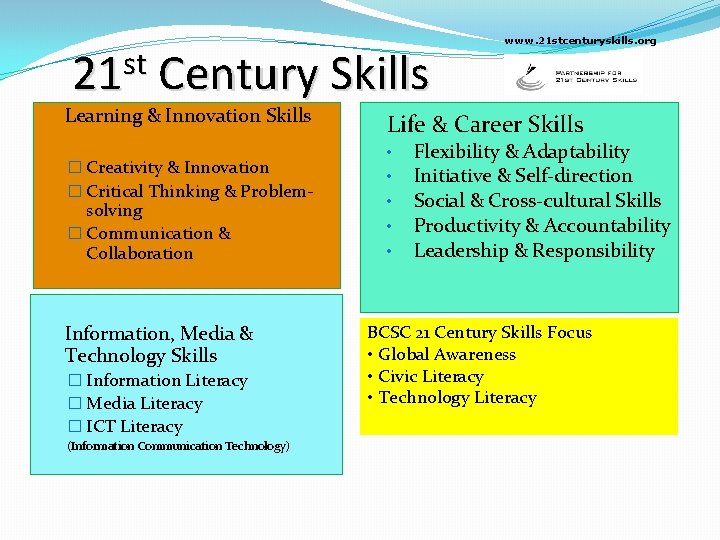
st 21 Century Skills Learning & Innovation Skills � Creativity & Innovation � Critical Thinking & Problem- solving � Communication & Collaboration Information, Media & Technology Skills � Information Literacy � Media Literacy � ICT Literacy (Information Communication Technology) www. 21 stcenturyskills. org Life & Career Skills • • • Flexibility & Adaptability Initiative & Self-direction Social & Cross-cultural Skills Productivity & Accountability Leadership & Responsibility BCSC 21 Century Skills Focus • Global Awareness • Civic Literacy • Technology Literacy
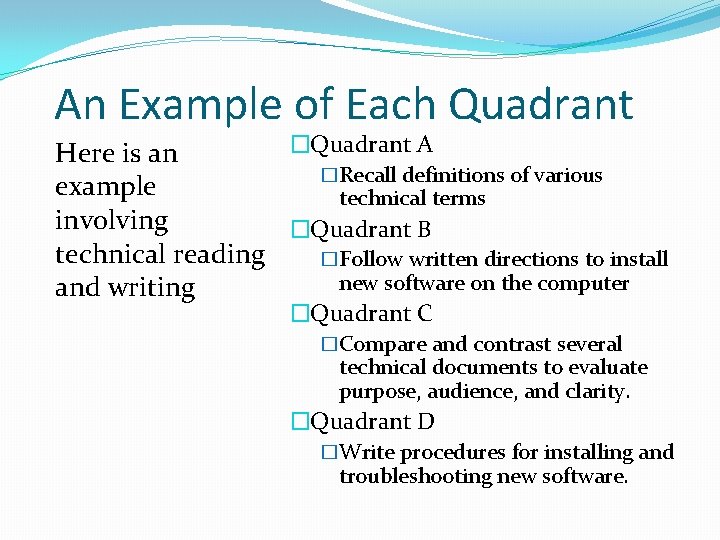
An Example of Each Quadrant �Quadrant A Here is an �Recall definitions of various example technical terms involving �Quadrant B technical reading �Follow written directions to install new software on the computer and writing �Quadrant C �Compare and contrast several technical documents to evaluate purpose, audience, and clarity. �Quadrant D �Write procedures for installing and troubleshooting new software.