
RIGOL Introduction to Radio Frequency Signals Understanding Time
- Slides: 21
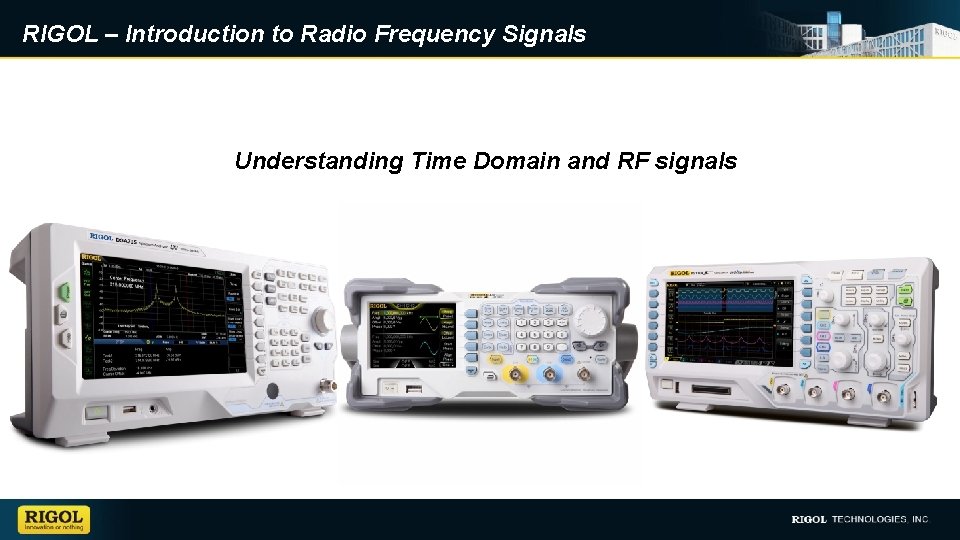
RIGOL – Introduction to Radio Frequency Signals Understanding Time Domain and RF signals
What we will learn in this lab section • Viewing basic RF signals in the time and frequency domain • Converting amplitude to power • Basic Modulation Schemes • Transmitting analog data • Analog Modulation • Analog Demodulation • Transmitting digital data • Simple Digital Modulation • Simple Digital Demodulation • Complex digital modulation schemes
Equipment we will be using in this lab • DG 1022 Z Waveform Generator • DS 1054 Z Oscilloscope • DSA 705 Spectrum Analyzer • 1 mono audio jack to BNC cable • 2 BNC cables • 1 BNC tee • 1 N-type to BNC Converter • 2 low frequency antennas (with male BNC connectors or adaptors) • USB stick with setup files that came with this lab
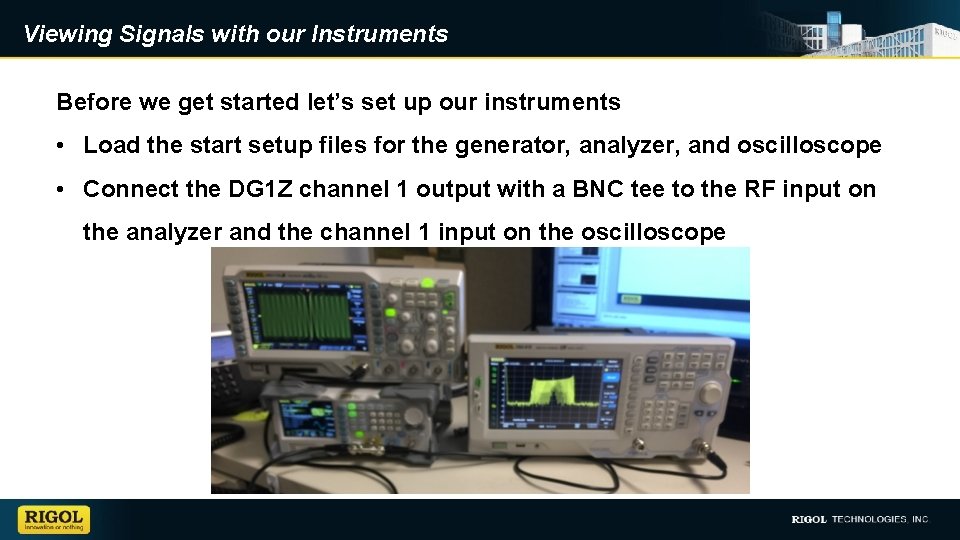
Viewing Signals with our Instruments Before we get started let’s set up our instruments • Load the start setup files for the generator, analyzer, and oscilloscope • Connect the DG 1 Z channel 1 output with a BNC tee to the RF input on the analyzer and the channel 1 input on the oscilloscope
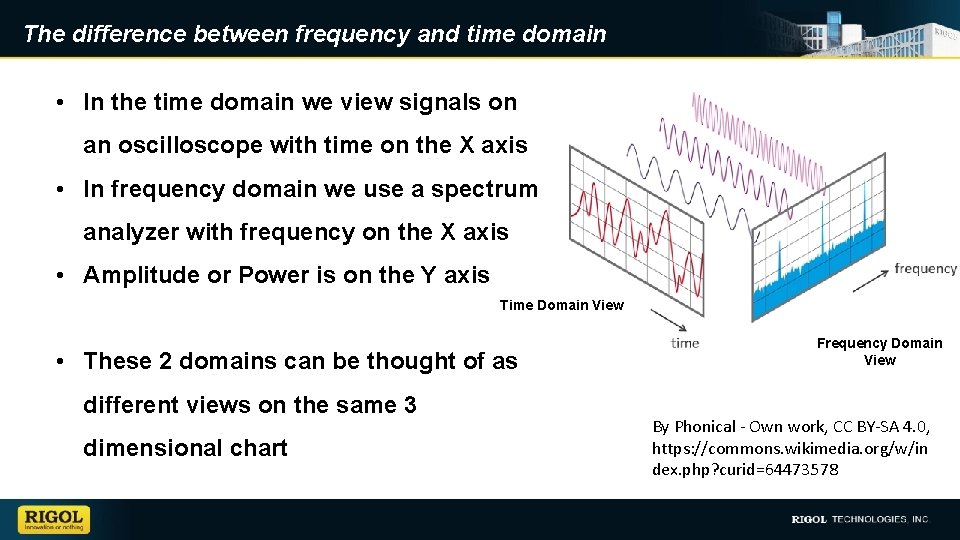
The difference between frequency and time domain • In the time domain we view signals on an oscilloscope with time on the X axis • In frequency domain we use a spectrum analyzer with frequency on the X axis • Amplitude or Power is on the Y axis Time Domain View • These 2 domains can be thought of as different views on the same 3 dimensional chart Frequency Domain View By Phonical - Own work, CC BY-SA 4. 0, https: //commons. wikimedia. org/w/in dex. php? curid=64473578
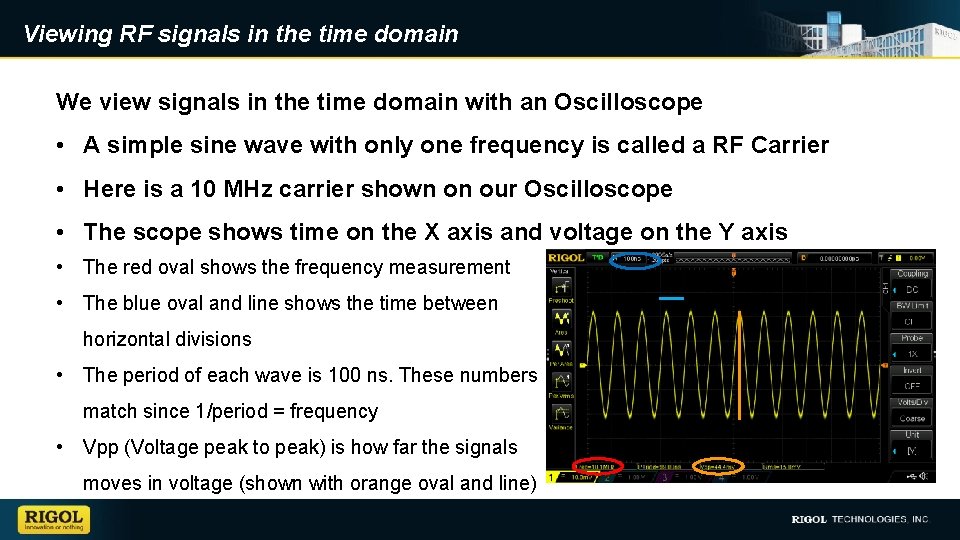
Viewing RF signals in the time domain We view signals in the time domain with an Oscilloscope • A simple sine wave with only one frequency is called a RF Carrier • Here is a 10 MHz carrier shown on our Oscilloscope • The scope shows time on the X axis and voltage on the Y axis • The red oval shows the frequency measurement • The blue oval and line shows the time between horizontal divisions • The period of each wave is 100 ns. These numbers match since 1/period = frequency • Vpp (Voltage peak to peak) is how far the signals moves in voltage (shown with orange oval and line)
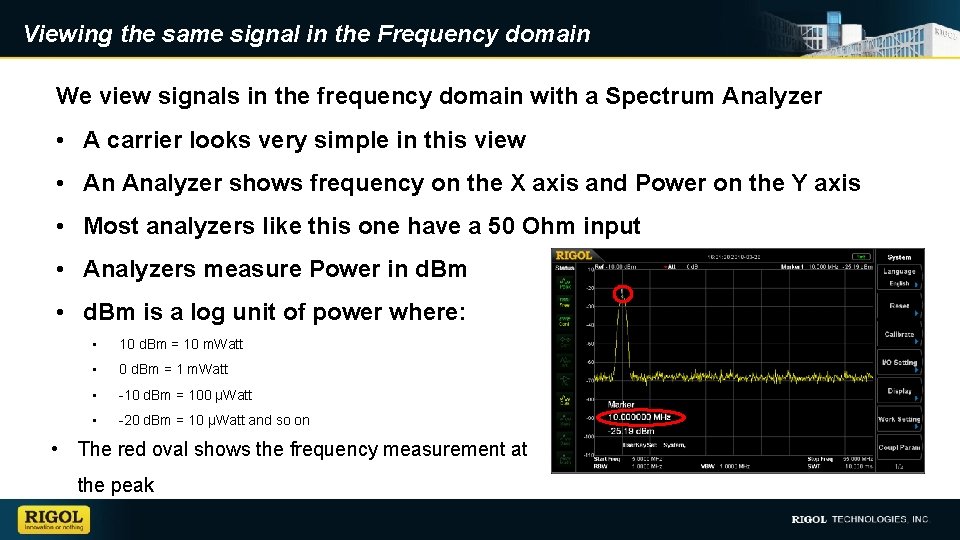
Viewing the same signal in the Frequency domain We view signals in the frequency domain with a Spectrum Analyzer • A carrier looks very simple in this view • An Analyzer shows frequency on the X axis and Power on the Y axis • Most analyzers like this one have a 50 Ohm input • Analyzers measure Power in d. Bm • d. Bm is a log unit of power where: • 10 d. Bm = 10 m. Watt • 0 d. Bm = 1 m. Watt • -10 d. Bm = 100 µWatt • -20 d. Bm = 10 µWatt and so on • The red oval shows the frequency measurement at the peak
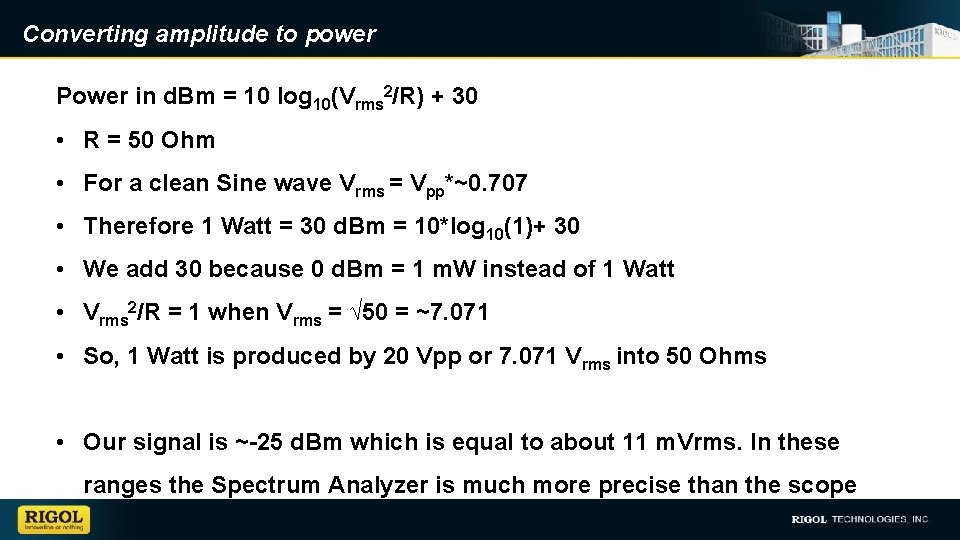
Converting amplitude to power Power in d. Bm = 10 log 10(Vrms 2/R) + 30 • R = 50 Ohm • For a clean Sine wave Vrms = Vpp*~0. 707 • Therefore 1 Watt = 30 d. Bm = 10*log 10(1)+ 30 • We add 30 because 0 d. Bm = 1 m. W instead of 1 Watt • Vrms 2/R = 1 when Vrms = √ 50 = ~7. 071 • So, 1 Watt is produced by 20 Vpp or 7. 071 Vrms into 50 Ohms • Our signal is ~-25 d. Bm which is equal to about 11 m. Vrms. In these ranges the Spectrum Analyzer is much more precise than the scope
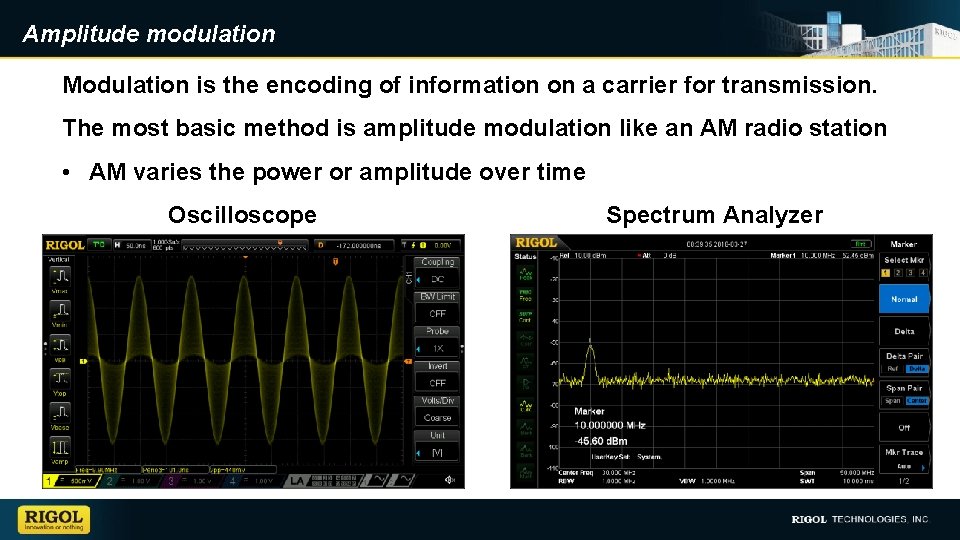
Amplitude modulation Modulation is the encoding of information on a carrier for transmission. The most basic method is amplitude modulation like an AM radio station • AM varies the power or amplitude over time Oscilloscope Spectrum Analyzer
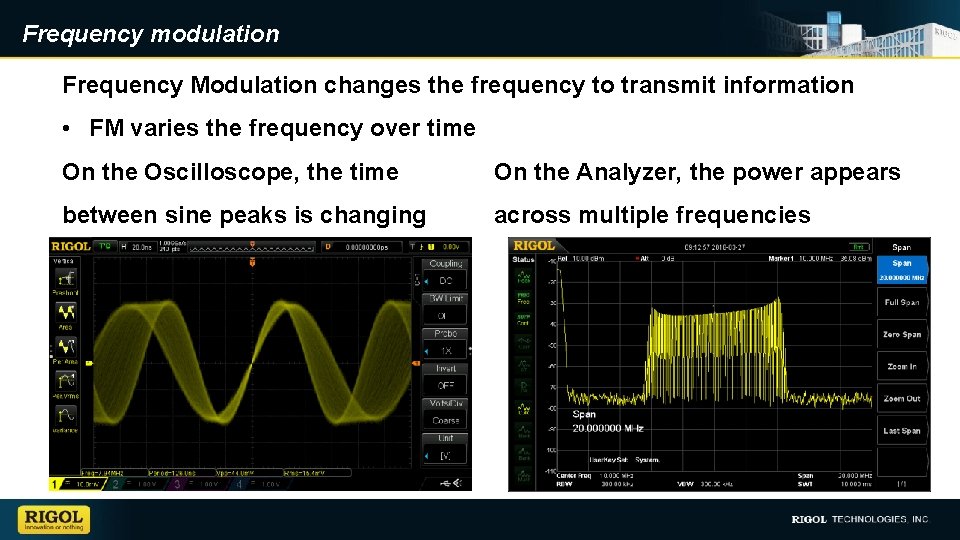
Frequency modulation Frequency Modulation changes the frequency to transmit information • FM varies the frequency over time On the Oscilloscope, the time On the Analyzer, the power appears between sine peaks is changing across multiple frequencies
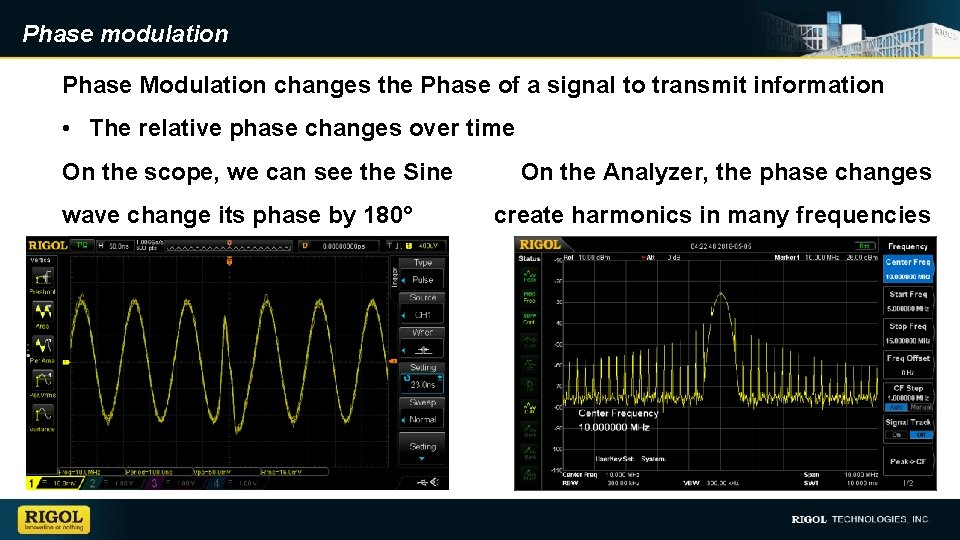
Phase modulation Phase Modulation changes the Phase of a signal to transmit information • The relative phase changes over time On the scope, we can see the Sine wave change its phase by 180° On the Analyzer, the phase changes create harmonics in many frequencies
Transmitting Analog Data Both AM and FM are easy to use for analog data because you can set multiple set points of amplitude or frequency to encode the analog signal • AM Experiment: connect a audio source (phone) to the DG 1 Z’s CH 1 ext mod input • Load the AM Tx setup files • Connect headphones or earbuds to the DSA jack • Listen to the audio transmitted via the cable • Switch the DG 1 Z and DSA to antennas. Static comes from amplitude distortion from the wireless transmission
Transmitting Analog Data • FM Experiment • Leave the connections • Load the FM Tx setup files • Listen to the audio transmitted via the cable and the antennas • Frequency is less effected by environmental changes such as range and interference. Once the amplitude is high enough and the deviation set correctly this signal should be clearer than the AM signal • The impact of interference and range is a main reason why FM radio stations tend to be clearer than AM radio stations
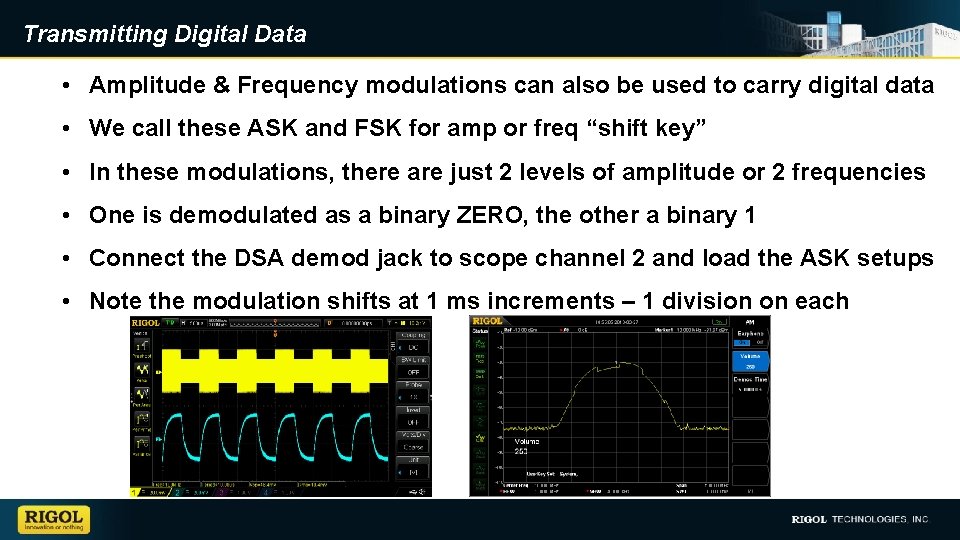
Transmitting Digital Data • Amplitude & Frequency modulations can also be used to carry digital data • We call these ASK and FSK for amp or freq “shift key” • In these modulations, there are just 2 levels of amplitude or 2 frequencies • One is demodulated as a binary ZERO, the other a binary 1 • Connect the DSA demod jack to scope channel 2 and load the ASK setups • Note the modulation shifts at 1 ms increments – 1 division on each
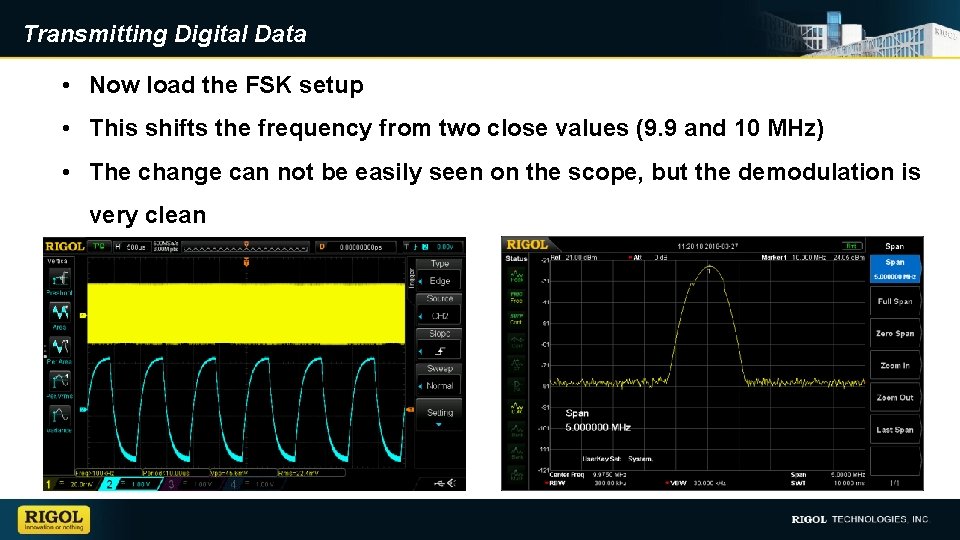
Transmitting Digital Data • Now load the FSK setup • This shifts the frequency from two close values (9. 9 and 10 MHz) • The change can not be easily seen on the scope, but the demodulation is very clean
Efficient use of spectrum • One key advantage to advanced modulation schemes is that they use spectrum much more efficiently • Much like our FSK signal that stayed within a narrow frequency range, modulations are optimized so that many signals can be sent along side each other in ‘channels’ • This is frequency division multiplexing or dividing the usable spectrum into frequency channels • Advanced signals may also use other types of multiplexing including time or phase to transmit more data in the available spectrum
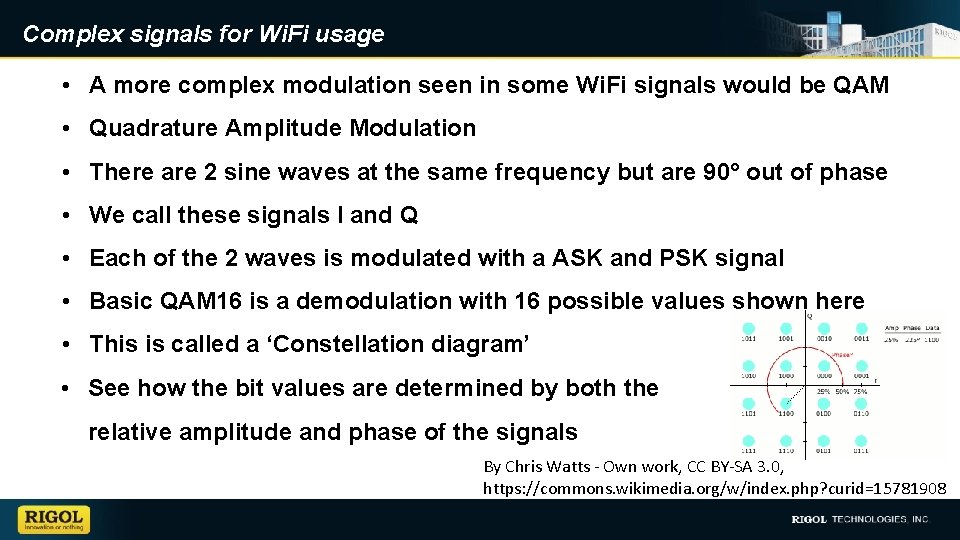
Complex signals for Wi. Fi usage • A more complex modulation seen in some Wi. Fi signals would be QAM • Quadrature Amplitude Modulation • There are 2 sine waves at the same frequency but are 90° out of phase • We call these signals I and Q • Each of the 2 waves is modulated with a ASK and PSK signal • Basic QAM 16 is a demodulation with 16 possible values shown here • This is called a ‘Constellation diagram’ • See how the bit values are determined by both the relative amplitude and phase of the signals By Chris Watts - Own work, CC BY-SA 3. 0, https: //commons. wikimedia. org/w/index. php? curid=15781908
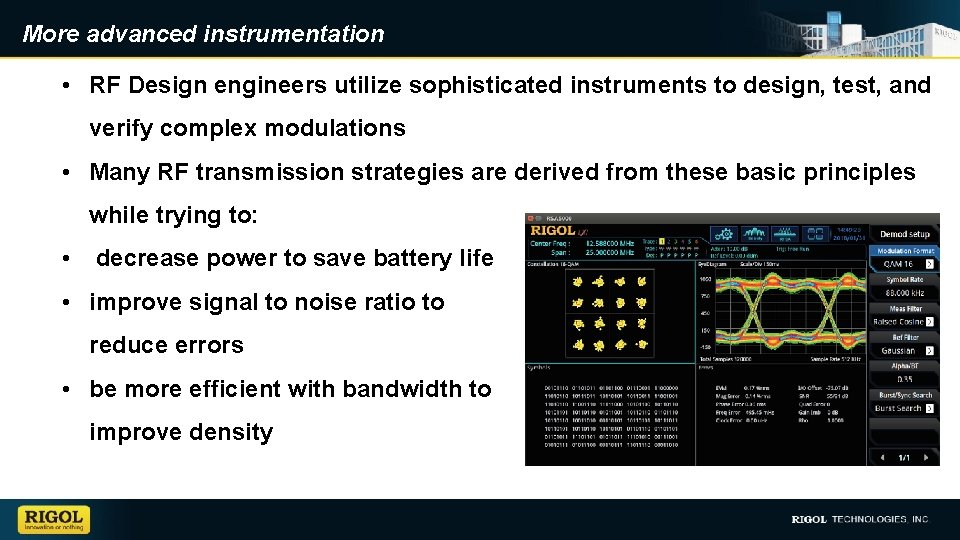
More advanced instrumentation • RF Design engineers utilize sophisticated instruments to design, test, and verify complex modulations • Many RF transmission strategies are derived from these basic principles while trying to: • decrease power to save battery life • improve signal to noise ratio to reduce errors • be more efficient with bandwidth to improve density
Monitoring the relationship between 2 signals with a scope • For this experiment, connect the 2 channels of the generator directly to channels 1 and 2 on the oscilloscope • First, load the XY_ask setup file for the scope • Then, load the ASK setup files for the generator and view the signal • Finally, load the PSK setup file for the generator and the XY_psk setup file for the scope and view the signal
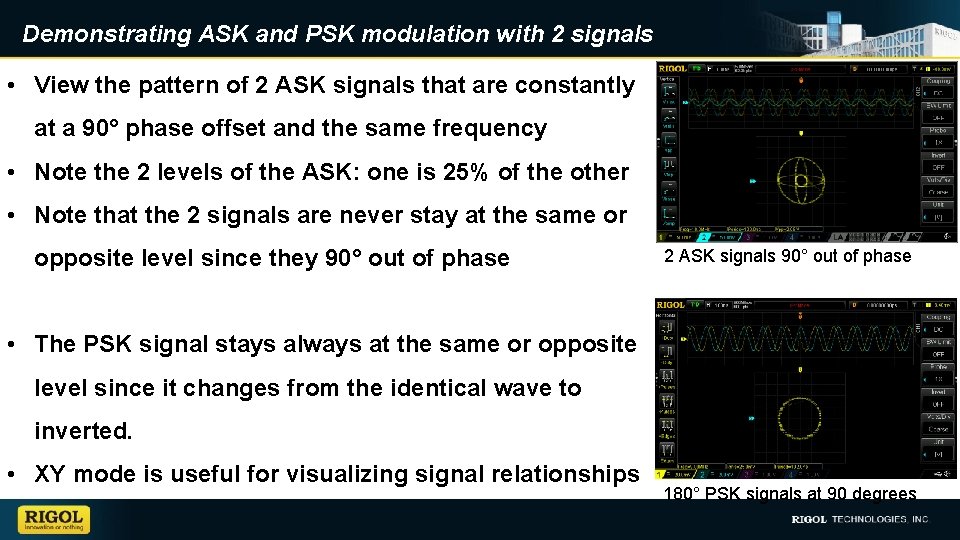
Demonstrating ASK and PSK modulation with 2 signals • View the pattern of 2 ASK signals that are constantly at a 90° phase offset and the same frequency • Note the 2 levels of the ASK: one is 25% of the other • Note that the 2 signals are never stay at the same or opposite level since they 90° out of phase 2 ASK signals 90° out of phase • The PSK signal stays always at the same or opposite level since it changes from the identical wave to inverted. • XY mode is useful for visualizing signal relationships 180° PSK signals at 90 degrees
Summary • RF signals transmit data by changing frequency, amplitude, and phase over time • These can be combined into complex, efficient modulation schemes • Analog modulations can transmit complex signals like audio • Digital modulations transmit binary data which is used in virtually all computer and electronic systems – Wi. Fi, Bluetooth, and Cellular are different types of digitally modulated signals for different purposes • Being able to think about signals in frequency or time domain is beneficial to engineers in a variety of fields