
Rights Interests and the Water Resource Crossing the


- Slides: 10
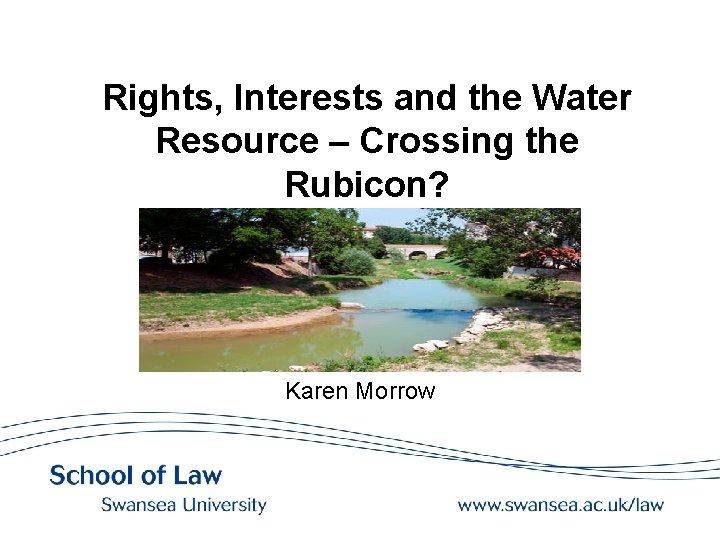
Rights, Interests and the Water Resource – Crossing the Rubicon? Karen Morrow
Introduction – Water Rights - Contexts • A long history – but a weak pedigree? • A unique (and stressed) resource with multiple uses prompting a myriad of potential claims, including: • Water and property law • Water and environmental law • Water and human rights law
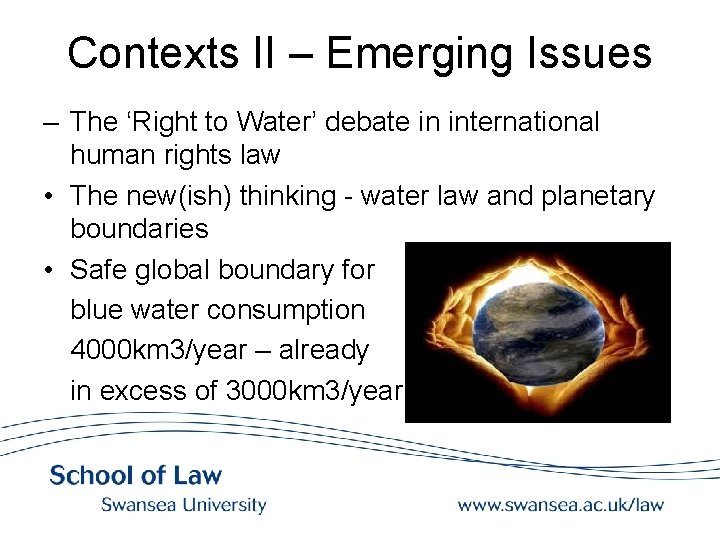
Contexts II – Emerging Issues – The ‘Right to Water’ debate in international human rights law • The new(ish) thinking - water law and planetary boundaries • Safe global boundary for blue water consumption 4000 km 3/year – already in excess of 3000 km 3/year
The Common Law - Riparian Rights – Extraction • Riparian rights – an adjunct to property (land) law – with ultimately problematic implications – Extraction, the orthodox view: Lord Cairn’s statement in Swindon Waterworks Co. Ltd v Wilts & Berks Canal Navigation Co Ltd L. R. 7 H. L. 697 at 703 approved by the House of Lords (notably in Lord Macnaghten’s obiter dictum) in Mc. Cartney v Lough Swilly Railway Co. Ltd [1904] AC 301 at 307
Riparian Rights (ii) Extraction Three possibilities: • Ordinary or primary purposes (domestic, cattle); • Extraordinary or secondary purposes provided they were: – reasonable; – connected with the riparian land; and – the water was restored to the watercourse ‘substantially undiminished in volume and unaltered in character’; and • Purposes foreign to or unconnected with the riparian tenement
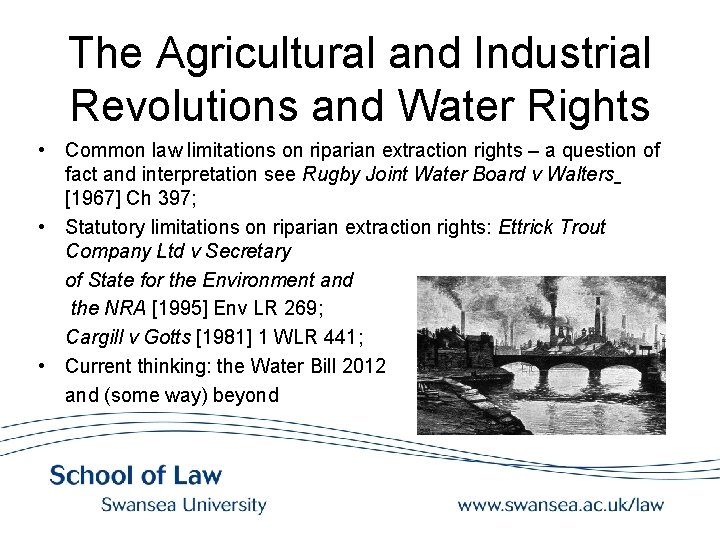
The Agricultural and Industrial Revolutions and Water Rights • Common law limitations on riparian extraction rights – a question of fact and interpretation see Rugby Joint Water Board v Walters [1967] Ch 397; • Statutory limitations on riparian extraction rights: Ettrick Trout Company Ltd v Secretary of State for the Environment and the NRA [1995] Env LR 269; Cargill v Gotts [1981] 1 WLR 441; • Current thinking: the Water Bill 2012 and (some way) beyond
Private Rights – Pollution I • The basic principle: Young & Co. v Bankier Distillery Co. [1893] AC 691 • Private Nuisance (and the Rule in Rylands v Fletcher): Cambridge Water (CW) v Eastern Counties Leather (ECL) [1994] 1 All ER 53; Transco Plc v Stockport Metropolitan Borough Council [2004] 2 AC 1. • Human Rights Act Claims: Marcic v Thames Water Utilities [2003] UKHL 66; Dobson and Others v TWU Limited [2009] EWCA Civ 28.
Private Rights - Pollution • The relationship between regulation and private rights in nuisance – Barr v Biffa Waste Services Ltd [2012] EWCA Civ 312 per Carnwath LJ: ‘The common law of nuisance has co-existed with statutory controls, albeit less sophisticated, since the 19 th century. There is no principle that the common law should "march with" a statutory scheme covering similar subject-matter. Short of express or implied statutory authority to commit a nuisance. . . , there is no basis, in principle or authority, for using such a statutory scheme to cut down private law rights. ’
A (much) more radical approach – Wild Law • Rights for Nature? Ecuador’s provision for the rights of nature in its 2008 constitution; Bolivia’s passing in 2010 of a Law of the Rights of Mother Earth • Rights for Rivers? Legal identity for the Whanganui River, New Zealand (2012)
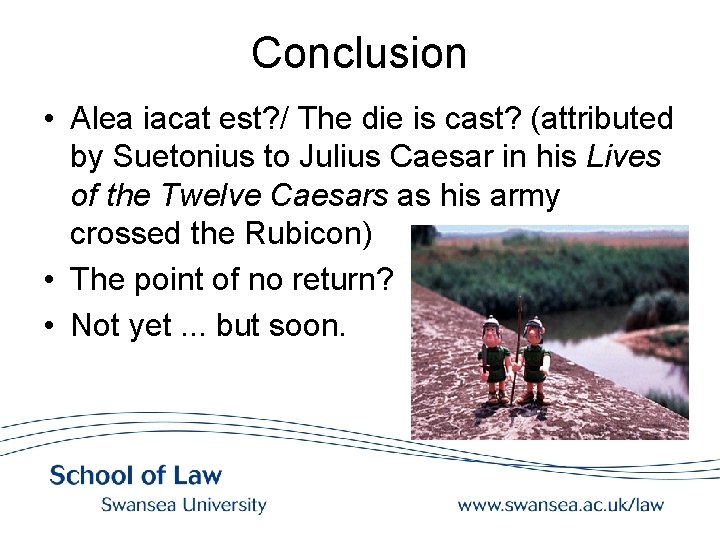
Conclusion • Alea iacat est? / The die is cast? (attributed by Suetonius to Julius Caesar in his Lives of the Twelve Caesars as his army crossed the Rubicon) • The point of no return? • Not yet. . . but soon.