
Right to Remain Silent Nyenlla Fontenot Where is
- Slides: 38
Right to Remain Silent Nyenlla Fontenot
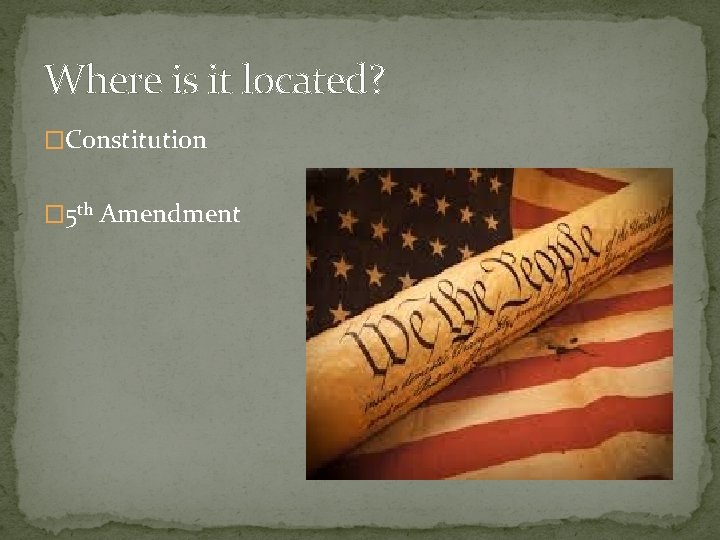
Where is it located? �Constitution � 5 th Amendment
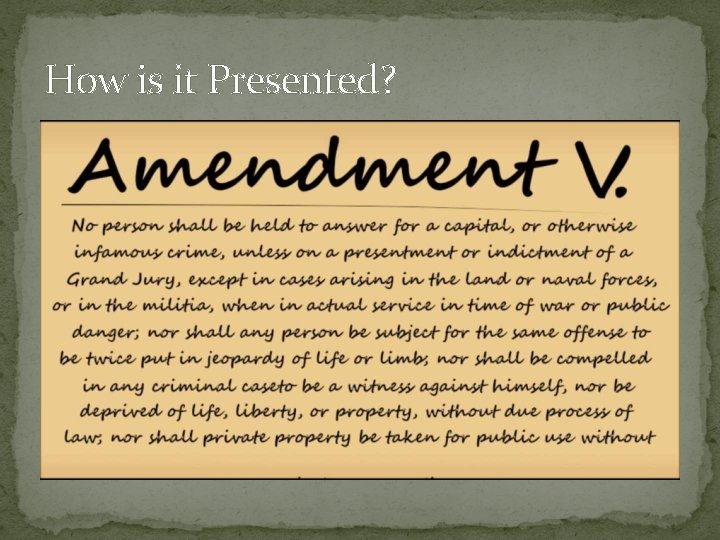
How is it Presented?
Star Chamber and High Commission �English court of law; at royal Palace of Westminster, �composed of Privy Councillors and common-law judges � to supplement the judicial activities of the common-law and equity courts in civil and criminal matters. �established to ensure the fair enforcement of laws prominent people. � ordinary courts would hesitate to convict them of their crimes.
Star Chamber cont. � Court sessions were held in public; witnesses and defendants were examined in secret. � Defendants were given prior notice of the charges against them, and had the right to be represented by an attorney. � Evidence was presented in writing. � Star Chamber evolved into a political weapon, a symbol of the misuse and abuse of power by the English monarchy and its courts.
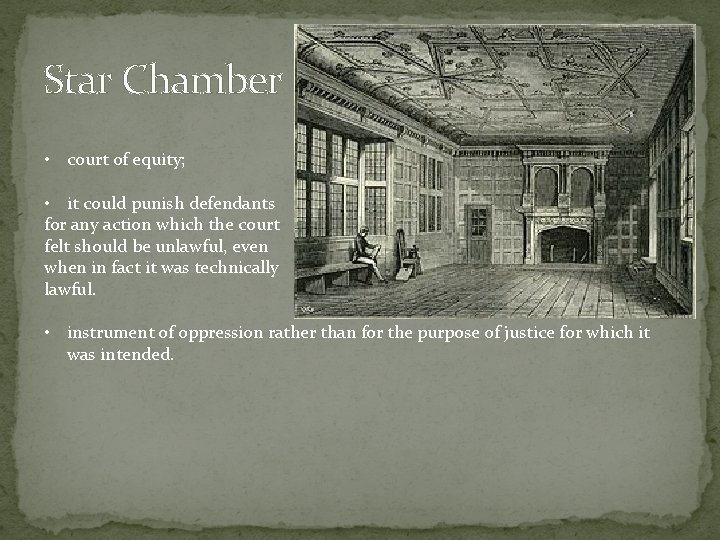
Star Chamber • court of equity; • it could punish defendants for any action which the court felt should be unlawful, even when in fact it was technically lawful. • instrument of oppression rather than for the purpose of justice for which it was intended.
History �Latin brocard nemo tenetur se ipsum accusare ('no man is bound to accuse himself') �dissidents who were prosecuted in the Star Chamber and High Commission of 16 th-century England �forced to make the ex officio oath without knowing what they were accused of.
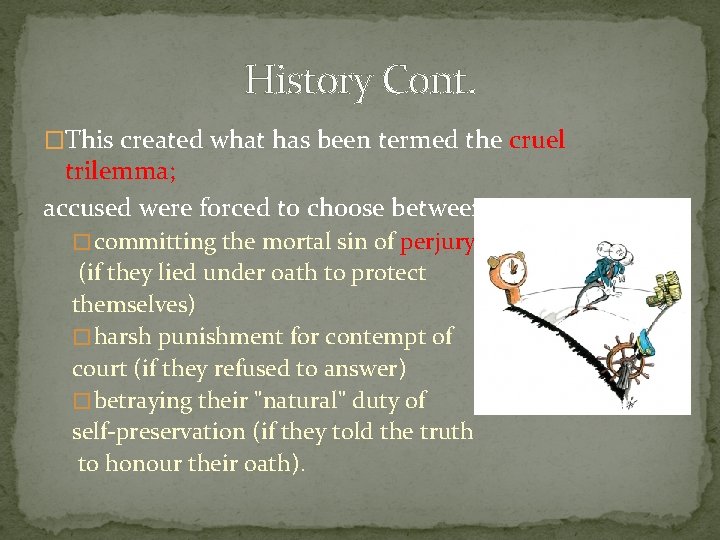
History Cont. �This created what has been termed the cruel trilemma; accused were forced to choose between: � committing the mortal sin of perjury (if they lied under oath to protect themselves) � harsh punishment for contempt of court (if they refused to answer) � betraying their "natural" duty of self-preservation (if they told the truth to honour their oath).
History Cont. �After the parliamentary revolutions of the late 17 th century, is said how the right to silence became established in the law �The rejection of the procedures of the Courts of Star Chamber and High Commission eventually resulted in the emergence of the principle �the right to silence was not always a practical reality for all accused in the English courts for some period afterwards.
Cont. � With limited access to legal counsel (often depending on the social status of the accused), a shifting standard of proof, and a system generally distrustful of silent defendants, a criminal accused who remained silent was often committing figurative or literal suicide. � In England, the practice of judicial questioning of accused persons at trial (as distinct from questioning prior to trial), did not really disappear until well into the 18 th century. � By the 19 th century, the accused was not allowed to give evidence on oath even if they wanted to –
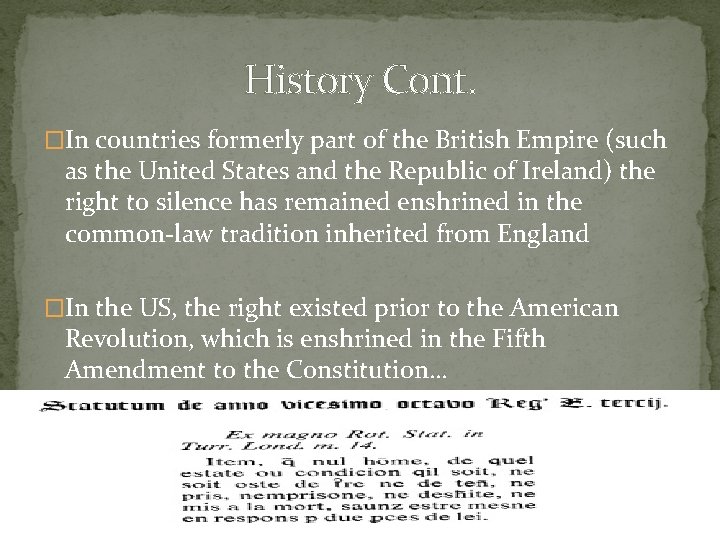
History Cont. �In countries formerly part of the British Empire (such as the United States and the Republic of Ireland) the right to silence has remained enshrined in the common-law tradition inherited from England �In the US, the right existed prior to the American Revolution, which is enshrined in the Fifth Amendment to the Constitution…
Chambers v. Florida (1940) � four black men convicted for the murder of a white, elderly local man, in Pompano Beach, Florida. � defendants were held without being able to see a lawyer or for a week. � After a week of questioning, and despite previous denials, the four co- defendants eventually confessed to the crime and were convicted of capital murder and sentenced to death. � Their appeals to the Florida Court of Appeals was rejected on the grounds that the jury had ruled the confessions had been given voluntarily. � By unanimous decision, delivered by Justice Hugo Black, the Court ruled in favor of the defendants, and overturned their convictions.
Ashcraft v. Tennessee (1944) � The defendant , E. E. Ashcraft, was charged with hiring John Ware to murder Ashcraft's wife, Zelma Ida Ashcraft. � Both confessed to the crimes and sentenced to 99 years in the state penitentiary. � Ware and Ashcraft appealed, claiming that their confessions were extorted from them. � Ware, a black man, claimed that he confessed because he feared mob violence. Ashcraft claimed he was threatened and abused. � The Supreme Court of Tennessee affirmed both men's convictions. � After making an "independent examination", the SCOTUS reversed both convictions.
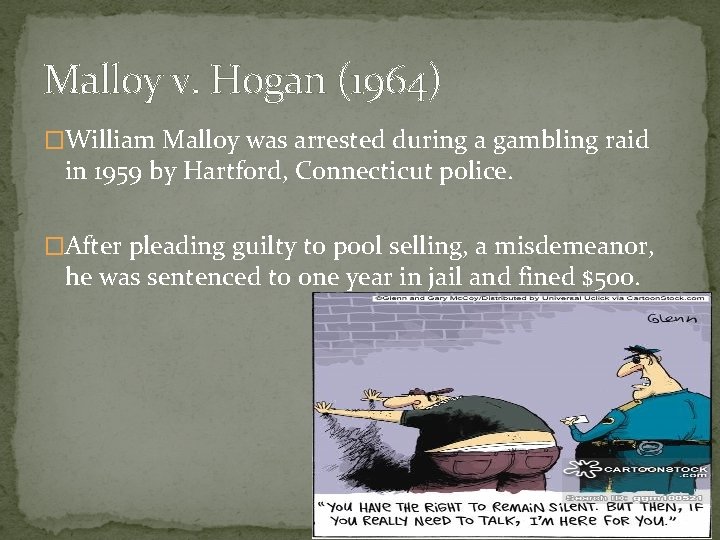
Malloy v. Hogan (1964) �William Malloy was arrested during a gambling raid in 1959 by Hartford, Connecticut police. �After pleading guilty to pool selling, a misdemeanor, he was sentenced to one year in jail and fined $500.
Cont. � a Superior Court appointed referee ordered Malloy to testify about gambling and other criminal activities in Hartford County. � Malloy refused, "on grounds it may tend to incriminate [him]" he was imprisoned for contempt and � Malloy filed a habeas corpus petition challenging his confinement. � the Supreme Court granted certiorari. � 5 -4 favor of yes; Fourteenth Amendment allows the federal government to enforce the first eight amendments on state governments.
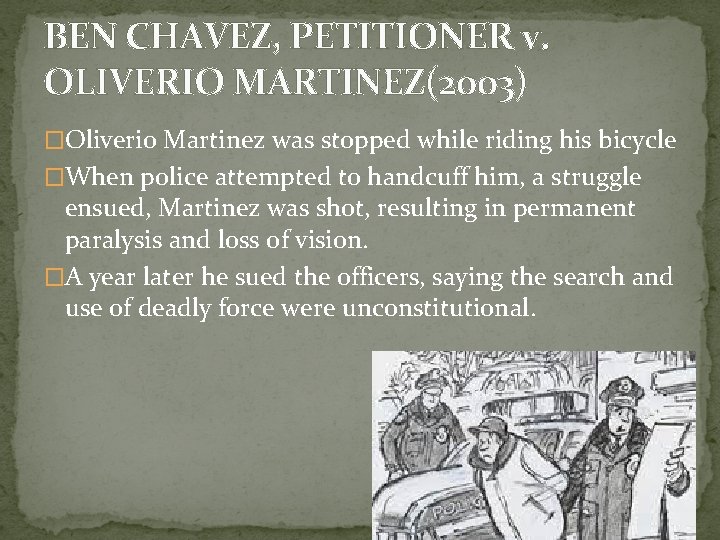
BEN CHAVEZ, PETITIONER v. OLIVERIO MARTINEZ(2003) �Oliverio Martinez was stopped while riding his bicycle �When police attempted to handcuff him, a struggle ensued, Martinez was shot, resulting in permanent paralysis and loss of vision. �A year later he sued the officers, saying the search and use of deadly force were unconstitutional.
Cont. �The officers introduced as evidence in their defense a taped confession obtained while Martinez was receiving medical treatment in the hospital �Martinez claimed that the tape could not be used as evidence because he had not been read his Miranda rights. The district court ruled with Martinez that the tape was inadmissible. � SCOTUS said it no to violation of the 5 th in a 6 -3 decision. they remanded the substantive due process portion of the question in a 5 -4 decision by Justice Souter to be addressed on remand
Missouri v. Seibert � Patrice Seibert was convicted of second degree murder for the death of 17 -year-old Donald Rector, who died in a fire � she had confessed, the officer took a short break from questioning, then read her Miranda rights and resumed questioning her after she waived those rights. � He prompted her to restate the confession that she had made earlier. Based on this second, Mirandized confession, Seibert was convicted. � She appealed, charging that the officer's intentional use of an un-Mirandized interrogation to get the initial confession made the later confession inadmissable. � Justice Souter announced the judgment SCOTUS and wrote for a plurality of four justices that the second confession was admissible only if the intermediate Miranda warnings were "effective enough to accomplish their object, " overturning the conviction.
ESCOBEDO v. ILLINOIS (1964) � Danny Escobedo arrested for killing his brother-in-law at 2: 30 am w/o warrant, taken to Chicago � � � police headquarters for questioning. Ten days later, he was arrested again. He asked to have his lawyer present. Escobedo’s attorney was in the police station on an unrelated matter and asked to see his client. As the police continued to interrogate Escobedo, they told him they had Di. Gerlando (who claimed that Escobedo killed his brother-in-law) in custody. For the rest of the questioning, Escobedo said things that would incriminate himself, his sister, and Di. Gerlando. At trial and appeal, Escobedo asked that all statements given prior to counsel with his lawyer be suppressed. Escobedo was convicted of murder. Escobedo appealed to the Illinois Supreme Court Illinois petitioned for rehearing and the court then affirmed the conviction. Escobedo appealed to the U. S. Supreme Court. The ACLU argued before the Court as amicus curiae favoring Escobedo… On appeal to the state Supreme Court, the question was… Was the refusal by police to honor Escobedo’s request for a lawyer a violation of his Sixth Amendment rights? 5 to 4 vote, overruled the conviction, the information was not admissible because it had been unlawfully obtained.
Majority Opinion � “Nothing we have said today affects the powers of the police to investigate "an unsolved crime, " Spano v. New York, 360 U. S. 315, 360 U. S. 327 (STEWART, J. , concurring), by gathering information from witnesses and by other "proper investigative efforts. " Haynes v. Washington, 373 U. S. 503, 373 U. S. 519. We hold only that, when the process shifts from investigatory to accusatory — when its focus is on the accused and its purpose is to elicit a confession — our adversary system begins to operate, and, under the circumstances here, the accused must be permitted to consult with his lawyer. The judgment of the Illinois Supreme Court is reversed, and the case remanded for proceedings not inconsistent with this opinion. Reversed and remanded. ”
Dissenting Opinion(White, joined by Stewart, Clark) � In Massiah v. United States, 377 U. S. 201, the Court held that, as of the date of the indictment, the prosecution is dissentitled to secure admissions from the accused. � “At the very least, the Court holds that, once the accused becomes a suspect and, presumably, is arrested, any admission made to the police thereafter is inadmissible in evidence unless the accused has waived his right to counsel. ” By abandoning the voluntary-involuntary test for admissibility of confessions, the Court seems driven by the notion that it is uncivilized law enforcement to use an accused's own admissions against him at his trial. I would not abandon the Court's prior cases defining with some care and analysis the circumstances requiring the presence or aid of counsel and substitute the amorphous and wholly unworkable principle that counsel is constitutionally required whenever he would or could be helpful. Obviously law enforcement officers can make mistakes and exceed their authority, as today's decision shows that even judges can do, but I have some what more faith than the Court evidently has in the ability and desire of prosecutors and of the power of the appellate courts to discern and correct such violations of the law. When the accused has not been informed of his rights at all, the Court characteristically and properly looks very closely at the surrounding circumstances.
Dissenting Opinion(Stewart) � Under our system of criminal justice, the institution of formal, meaningful judicial proceedings, by way of indictment, information, or arraignment, marks the point at which a criminal investigation has ended and adversary proceedings have commenced. The confession which the Court today holds inadmissible was a voluntary one. The Court says that what happened during this investigation "Affected" the trial. I had always supposed that the whole purpose of a police investigation of a murder was to "Affect" the trial of the murderer, and that it would be only an incompetent, unsuccessful, or corrupt investigation which would not do so. The Court further says that the Illinois police officers did not advise the petitioner of his "Constitutional rights" before he confessed to the murder. Supported by no stronger authority than its own rhetoric, the Court today converts a routine police investigation of an unsolved murder into a distorted analogue of a judicial trial. I think the Court perverts those precious constitutional guarantees, and frustrates the vital interests of society in preserving the legitimate and proper function of honest and purposeful police investigation.
Griffin v. California (1965) Edward Dean Griffin was convicted of the murder of Essie Mae Hodson before a jury in a California court. � Griffin had been invited into an apartment shared by Hodson and her boyfriend, Eddie Seay. � After going to bed, Seay was awakened by noise; he saw Griffin and Hodson struggling, and Hodson said Griffin had tried to force her to have sex. � After Seay locked Griffin outside the apartment, Griffin broke back into the apartment and struck Seay, who ran to a bar for help. � In the morning, a witness saw Griffin, coming out of a very large trash box in an alley about 300 feet from Hodson's apartment. � The witness found Hodson in the trash box, bleeding and apparently in shock. � Griffin, who already had multiple felony convictions, did not testify at the trial. � The judge, in his instructions to the jury, stated that a defendant has a constitutional right not to testify, and that this did not create a presumption of guilt, nor reduce the need for the prosecution to prove its case; but also stated to the jury: “As to any evidence or facts against him which the defendant can reasonably be expected to deny or explain because of facts within his knowledge, if he does not testify or if, though he does testify, he fails to deny or explain such evidence, the jury may take that failure into consideration as tending to indicate the truth of such evidence. ” � Griffin was convicted and sentenced to the death penalty. � The California Supreme Court affirmed the conviction. � SCOTUS granted certiorari to determine "whether comment on the failure to testify violated the Self-Incrimination Clause of the Fifth Amendment which we made applicable to the States by the Fourteenth in Malloy v. Hogan. “ � Yes, it violates the Fifth Amendment. Reversed. �
Majority Opinion(Douglas, joined by Black, Clark, Brennan, Goldberg) �What the jury may infer, given no help from the court, is one thing. What it may infer when the court solemnizes the silence of the accused into evidence against him is quite another. The right against selfincrimination of the Fifth Amendment is zealously guarded.
Dissenting Opinion(Stewart, joined by White) �The issue should be whether the defendant was “compelled” to testify against himself, which he was not.
Concurring Opinion(Harlan) � concurred"with great reluctance", agreeing with the Court that "within the federal judicial system the Fifth Amendment bars adverse comment by federal prosecutors and judges on a defendant's failure to take the stand in a criminal trial", but writing that this "no-comment" rule was a "non-fundamental" part of the Fifth Amendment, and that he would only apply it to the States because of the previous term's Malloy v. Hogan decision. State and federal courts need not run by the same rules and that cases such as Griffin showed that the practical tendency had been for the federal judiciary to override the state judiciary, which was contrary to the basic idea of federalism; and that he hoped "that the Court will eventually return to constitutional paths which, until recently, it has followed throughout its history. "
Oregon v. Elstad(1985) � In December 1981, the home of Mr. and Mrs. Gilbert Gross, in the town of Salem, Polk Country, Ore. , was burglarized. � Missing were art objects and furnishings valued at $150, 000. � A witness to the burglary contacted the Polk County Sheriff's Office, implicating respondent Michael Elstad, an 18 -year-old neighbor and friend of the Grosses' teenage son. � Officers Burke and Mc. Allister went to the home of respondent Elstad, with a warrant for his arrest. � Officer Mc. Allister asked respondent's mother to step into the kitchen. � Officer Burke remained with Elstad in the living room. � D was then taken to the station, Mirandized, and he waived his rights and made a voluntary written statement.
Majority Opinion �referred to these arguments of the dissenting justices, and noted that their reasoning did not include the fact that there had obviously not been any compulsion present in obtaining either of the two statements.
Dissenting Opinion(Brennan, joined by Marshall) �claimed that there was a refutable presumption that a confession obtained in violation of Miranda tainted subsequent confessions, and that the taint could not be dissipated solely by giving Miranda warnings. He argued that to resolve this case the practice of state courts should be examined. His view was that the practice justified application of the "cat out of the bag" presumption to this case, and therefore there had been a causal connection between the confession obtained in violation of Miranda and the subsequent confession preceded by the usual Miranda warnings.
Dissenting Opinion(Stevens) � objected to the Court's finding that there was no presumption of coercion in obtaining both confessions. It was an ill-founded conclusion, since Miranda regulated that both the state of custody and failure to administer Miranda warnings presumed presence of compulsion. He reasoned that the Court intended its holding to apply only to a narrow category of cases in which the first statement was obtained in uncoercive setting and had no influence on the second. He concluded that even such an exception was discordant with prior cases, and the attempt to identify its boundaries in future cases would breed confusion and uncertainty in the administration of criminal justice.
Berghuis v. Thompkins (2010) � Van Chester Thompkins was considered a suspect in a fatal shooting on January 10, 2000 � � � � � in Southfield, Michigan. After advising Thompkins of his Miranda rights, police officers interrogated him. The court record suggested that he had been almost completely silent during the 3 -hour interrogation Thompkins was asked in sequence - did he believe in God, did he pray to God, and did he pray to God to forgive him for shooting the victim. He answered "yes" to each of these. Thompkins made a motion to suppress his statements. The trial court denied his motion and Thompkins was found guilty by a jury and sentenced to life imprisonment without the possibility of parole. Thompkins appealed his conviction on grounds that included suppression of his admission… – but… Michigan Court of Appeals rejected Thompkins' Miranda claim. Thompkins then filed a writ of habeas corpus in federal District Court but it denied his request. However, the United States Court of Appeals for the Sixth Circuit reversed the District Court's decision, holding that the state court was unreasonable in finding an implied waiver of Thompkins’ right to remain silent. State petitioned to the Supreme Court; 5 -4 decision was made.
Majority Opinion(Kennedy, joined by Roberts, Scalia, Thomas, Alito) �“There was no good reason why the standard for invoking the Miranda right to remain silent and the Miranda right to counsel should differ. "Both protect. . . against compulsory self-incrimination. . . by requiring an interrogation to cease when either right is invoked". Making either of these statements would have ended the questions but the accused made neither of them. ”
Dissenting Opinion(Sotomayor, joined by Stevens, Ginsburg, Breyer) � "A valid waiver will not be presumed simply from the silence of the accused after warnings are given or simply from the fact that a confession was in fact eventually obtained [. . . ] the fact of lengthy interrogation. . . before a statement is made is strong evidence that the accused did not validly waive his rights. In these circumstances the fact that the individual eventually made a statement is consistent with the conclusion that the compelling influence of the interrogation finally forced him to do so. It is inconsistent with any notion of a voluntary relinquishment of the priviledge. “ and that Miranda and North Carolina v. Butler both agreed that: "a court must presume that a defendant did not waive his rights'; the prosecution bears a 'heavy burden' in attempting to demonstrate waiver; the fact of a 'lengthy interrogation' prior to obtaining statements is strong evidence' against a finding of valid waiver; mere silence in response to questioning is 'not enough'; and waiver may not be presumed 'simply from the fact that a confession was in fact eventually obtained'. "
Salinas v. Texas(2013) � In 1992, Houston police officers found two homicide victims. The investigation led officers to � � � Genovevo Salinas agreed to accompany the officers to the police station where he was questioned for about one hour. Salinas was not under arrest at this time and had not been read his Miranda rights. Salinas answered every question until an officer asked whether the shotgun shells found at the scene of the crime would match the gun found in Salinas' home. According to the officer, Salinas remained silent and demonstrated signs of deception. A ballistics analysis later matched Salinas' gun with the casings at the scene. Police also found a witness who said Salinas admitted to killing the victims. In 1993, Salinas was charged with the murders, but could not be located. 15 years later, Salinas was finally captured. At the second trial, the prosecution attempted to introduce evidence of Salinas' silence about the gun casings. Salinas objected, arguing that he could invoke his Fifth Amendment protection against selfincrimination whether he was in custody or not. The trial court admitted the evidence and Salinas was found guilty and sentenced to 20 years in prison and a $5, 000 fine. The Fourteenth Court of Appeals, Harris County, Texas affirmed, noting that the courts that have addressed this issue are divided. The Court of Criminal Appeals of Texas affirmed.
Majority Opinion(Alito, joined by Roberts and Kennedy �(Plurality decision) No. A witness generally must expressly invoke the Fifth Amendment privilege against self-incrimination in order to benefit from it.
Concurring Opinion(Thomas joined by Scalia) �argued that defendant’s claim should fail even if he invoked the privilege because the prosecutor’s comments regarding his pre-custodial silence did not compel him to give self-incriminating testimony.
Dissenting Opinion(Breyer joined by Ginsburg, Sotomayor, and Kagan) �stated that “no ritualistic formula is necessary to invoke the privilege” and that the circumstances of the case must be considered. The dissent argued that defendant did not need to expressly invoke the privilege because the questioning was in the context of a criminal investigation and the police made defendant, who was not represented by counsel, aware he was a suspect. Moreover, the question at issue was clearly designed to determine whether defendant was guilty.
� "Chavez v. Martinez. " Oyez. Chicago-Kent College of Law at Illinois Tech, n. d. Feb 15, � � � � � 2016. "Star Chamber. " Wikipedia. Wikimedia Foundation, 28 Jan. 2016. Web. 15 Feb. 2016. "SOUTHEASTERN COMMUNITY COLLEGE, Petitioner, v. Frances B. DAVIS. " LII / Legal Information Institute. Cornell Law School. Web. 15 Feb. 2016. "Find. Law's United States Supreme Court Case and Opinions. " Findlaw. FInd. Law. Web. 15 Feb. 2016. "Berghuis v. Thompkins. " Oyez. Chicago-Kent College of Law at Illinois Tech, n. d. Feb 15, 2016. "Malloy v. Hogan. " Oyez. Chicago-Kent College of Law at Illinois Tech, n. d. Feb 15, 2016. "Missouri v. Seibert. " Oyez. Chicago-Kent College of Law at Illinois Tech, n. d. Feb 15, 2016. Wikipedia contributors. "Missouri v. Seibert. " Wikipedia, The Free Encyclopedia, 3 Feb. 2015. Web. 15 Feb. 2016. "Escobedo v. Illinois. " LII / Legal Information Institute. Cornell Law School. Web. 15 Feb. 2016. "Stanford Law School - Robert Crown Law Library. " People v. Griffin. Standford Law School. Web. 15 Feb. 2016.