
RIGHT TO INFORMATION PPT 1 UNIT III Paper
- Slides: 5
RIGHT TO INFORMATION (PPT 1) (UNIT III) Paper: Development Communication Course: BJMC, Semester: II Institution: DSPMU, Ranchi Teacher: Sumedha Chaudhury
Introduction to RTI The Right to Information Act (RTI) is a law enacted by the Parliament of India to give every citizen of India a right to information. Passed by the Parliament on 15 June 2005, it came into force on 13 October 2005. The Act extends to the whole of India except the state of Jammu and Kashmir. The main aim of the Act is to provide the citizens the right to information which will enable them to have access to information that controlled by public authorities.
The Act seeks to promote transparency and accountability in the working of every public authority, besides providing for the constitution of Central Information Commission and State Information Commissions. It is constituted by a number of assumptions about information, right to information, accountability, transparency, governance, good governance, corruption and public authority.
Information is viewed as power. The term information has been derived from the Latin word 'formation'; form means giving shape to something and forming a pattern. Information adds something new to our awareness and removes vagueness of our ideas. This is incorporated in the governance agenda as a technique of enhancing citizen's participation in governance.
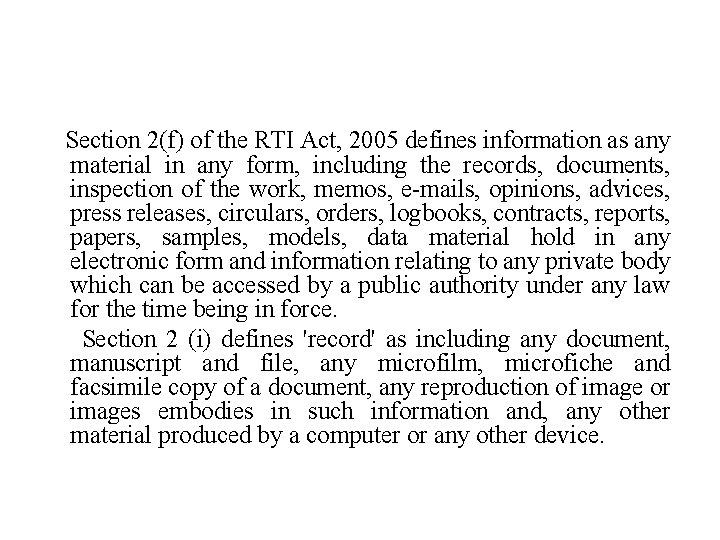
Section 2(f) of the RTI Act, 2005 defines information as any material in any form, including the records, documents, inspection of the work, memos, e-mails, opinions, advices, press releases, circulars, orders, logbooks, contracts, reports, papers, samples, models, data material hold in any electronic form and information relating to any private body which can be accessed by a public authority under any law for the time being in force. Section 2 (i) defines 'record' as including any document, manuscript and file, any microfilm, microfiche and facsimile copy of a document, any reproduction of image or images embodies in such information and, any other material produced by a computer or any other device.