
Right to a Jury Trial Brian Ehrenberg Email
Right to a Jury Trial Brian Ehrenberg Email: brian. ehrenbergjr@gmail. com Phone: 432 -557 -6774
Jury Trials • Rule 38 requires a party who desires a jury trial to file a written demand to the court and serve it to all the parties. • If a party does not make this demand within 14 days after service of the last pleading about the jury triable issue the party waives their right to a jury trial, • A judge, however, may order a jury trial if the waiver was nonintentional or if there is no compelling reason not to order a jury trial and the case is normally tried in front of a jury. • Once a demand for a jury has been made it can only be withdrawn if all parties consent.
Right to juries in diversity cases • Federal courts MUST permit a jury trial in diversity case.
Jury Size • In federal court cases a jury must have at least 6 jurors but no more than 12 jurors,
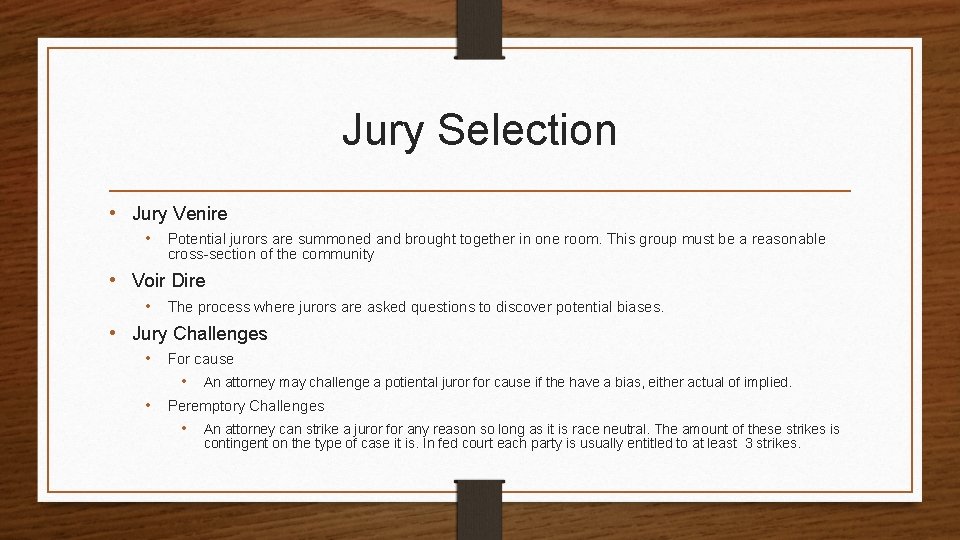
Jury Selection • Jury Venire • Potential jurors are summoned and brought together in one room. This group must be a reasonable cross-section of the community • Voir Dire • The process where jurors are asked questions to discover potential biases. • Jury Challenges • For cause • An attorney may challenge a potiental juror for cause if the have a bias, either actual of implied. • Peremptory Challenges • An attorney can strike a juror for any reason so long as it is race neutral. The amount of these strikes is contingent on the type of case it is. In fed court each party is usually entitled to at least 3 strikes.
Jury Instructions • At the close of evidence, or sooner at the courts discretion, a party may file proposed instructions. • If a party fails to submit this before the jury retires the issue is waived on appeal.
Important for jury questions • During deliberations jurors must not communicate with any nonjuror regarding the trial. Moreover, they can only take into the jury room all paper or exhibits in evidence and their own notes. • No outside help • No experiments in the jury room • No google searches • If any of that happens, then there is a new trial • Very heavily tested for jury questions!
Erie Doctrine Brian Ehrenberg Email: brian. ehrenbergjr@gmail. com Phone: 432 -557 -6774
Intro • When a state law claim is being held in federal court the court will use state substantive law and federal procedural law. • Remember: the state law you use is the state in which the court is located. • When a question of federal law is at issue then use federal law for both substance and procedure.
Substantive law • The following are always substantive for the purposes of the Erie Doctrine: • Statute of limitations • Choice of law • Elements of a claim or defense
Interpreting State Law • If a federal court must use state law, then they are bound use the same law as the highest court of the state would use. • If the supreme court of that state has made a decision that is on point with that issue, then the courts must follow it. • Appeals from these cases will be given a de novo review.
Quiz • 5 Questions • 2 Mins per Question(10 mins)
Question 1 • C • This is a federal question. Thus, the defendant can remove it because it could have been originally brought in a federal case.
Question 2 • A • federal rule 4 provides that summons and complaint may be served on an individual pursuant to the laws of the state in which the court is located.
Question 3 • C • Substantive law in diversity cases is based on the law of the state in which the court sits.
Question 4 • D • The legal representative of an estate will be deemed to have the same citizenship as the decedent.
Question 5 • A • Jurors can not conduct outside research and expermints
- Slides: 17