
Right of Way Appraisal Concepts HIGHEST AND BEST
Right of Way – Appraisal Concepts HIGHEST AND BEST USE & LARGER PARCEL Stephanie Marshall Right of Way Agent III – Butte District

Valentine’s Day Poem ROSES ARE RED VIOLETS ARE BLUE IF I HAVE TO STAND UP HERE AND DO THIS YOU’RE GOING TO PARTICIPATE TOO

Right of Way – Appraisal Concepts Highest and Best Use Larger Parcel Definition (Yellow Book) 4 Tests Purpose of identifying larger parcel Importance of H&B Use 3 Tests Common Errors in Appraisal Points to remember Examples
The Appraisal of Right of Way “The primary function of an appraisal for right of way purposes is to assist the acquiring agency in establishing just compensation. Under law, the payment of just compensation is required for the acquisition of private property for public use. ” -IRWA Principles of Right of Way, 4 th Ed. Ch. 11
Right of Way-Appraisal Concepts HIGHEST AND BEST USE
Highest and Best Use What is “Highest and Best Use” in Appraisal? Definition: According to the Uniform Standards of Professional Appraisal Practice, highest and best use is defined as: “The reasonably probable and legal use of property that is physically possible, appropriately supported, and financially feasible, and that results in the highest value”.
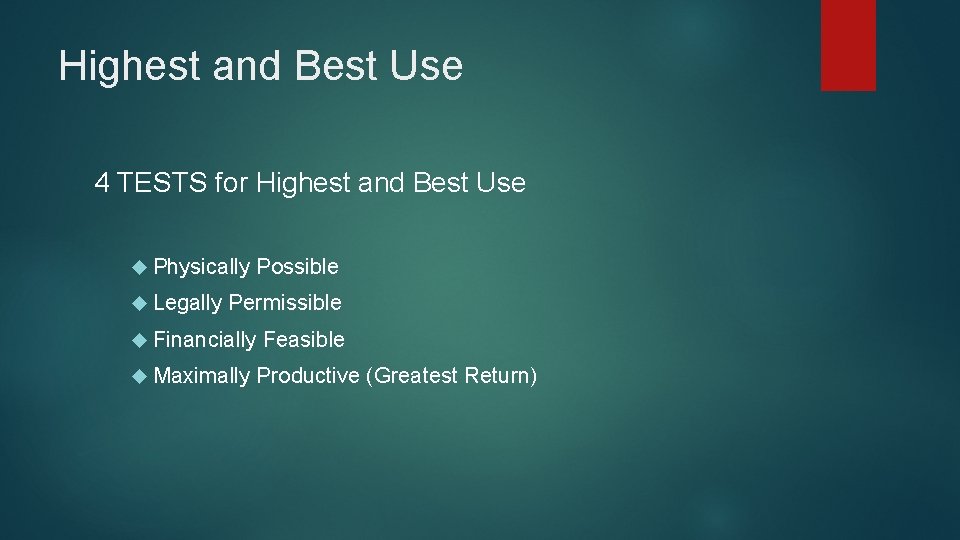
Highest and Best Use 4 TESTS for Highest and Best Use Physically Legally Possible Permissible Financially Maximally Feasible Productive (Greatest Return)

Highest and Best Use 1. Physically Possible: Consider things such as: • • • Size Shape Topography Frontage Depth Soil composition

Highest and Best Use 2. Legally Permissible: Consider things such as: • • • Zoning Ordinances State and Federal Laws Deed Restrictions Leases Subdivision restrictions
Highest and Best Use 3. Financially Feasible: Analysis of each use being considered. Determine the projected return as it relates to risk.
Highest and Best Use 4. Maximally Productive: Which use from among all uses that are physically possible, legally permissible, and financially feasible, will produce the highest rate of return to the property?
Highest and Best Use Why is the highest and best use of a property so important?
Highest and Best Use It is a principle that is universal in the valuation of real estate, not only in eminent domain The highest and best use determines the most profitable use of the site, which is key in determining “just compensation” Drives the selection of comparable sales based on use
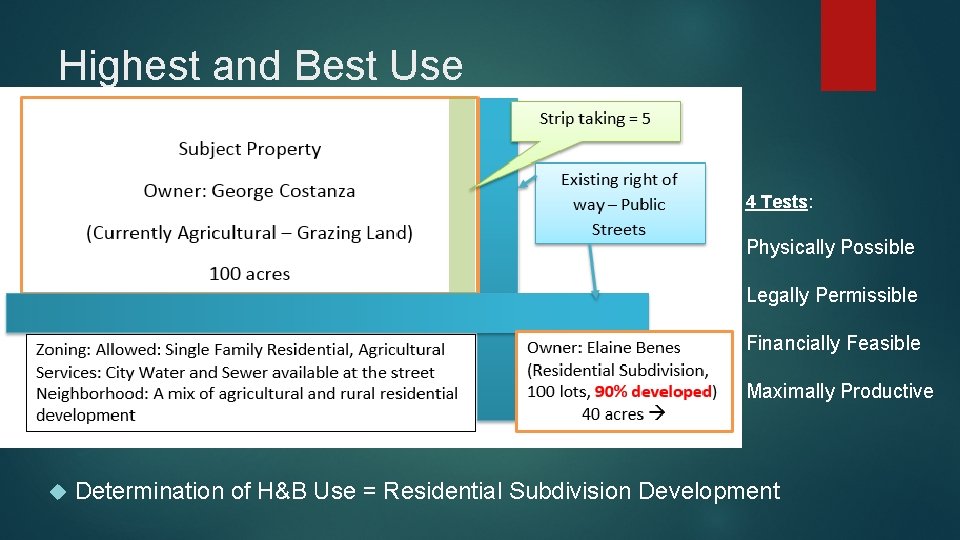
Highest and Best Use 4 Tests: Physically Possible Legally Permissible Financially Feasible Maximally Productive Determination of H&B Use = Residential Subdivision Development
Highest and Best Use Common Errors ”Most probable use” or “logical use for which there is a current market” is often overlooked Sufficient and sequential analysis: (Note: Legally permissible and physically are interchangeable – but must come before financially feasible and maximally productive). Note: It helps the reader to state each step of the analysis Timing – There must be a demand in the market to support the use http: //www. appraisalinstitute. org/assets/1/29/common-errors-issues_4 -14 -15. pdf
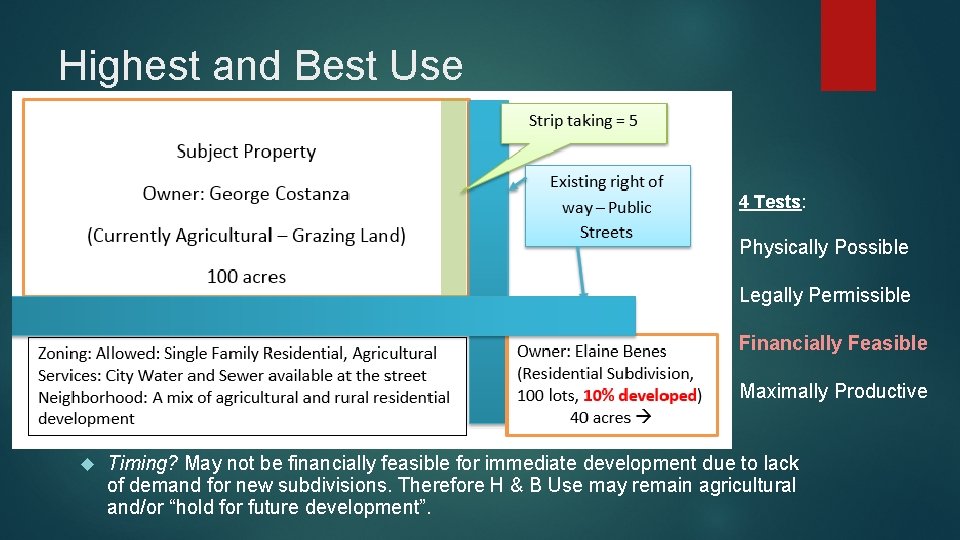
Highest and Best Use 4 Tests: Physically Possible Legally Permissible Financially Feasible Maximally Productive Timing? May not be financially feasible for immediate development due to lack of demand for new subdivisions. Therefore H & B Use may remain agricultural and/or “hold for future development”.
Right of Way-Appraisal Concepts LARGER PARCEL
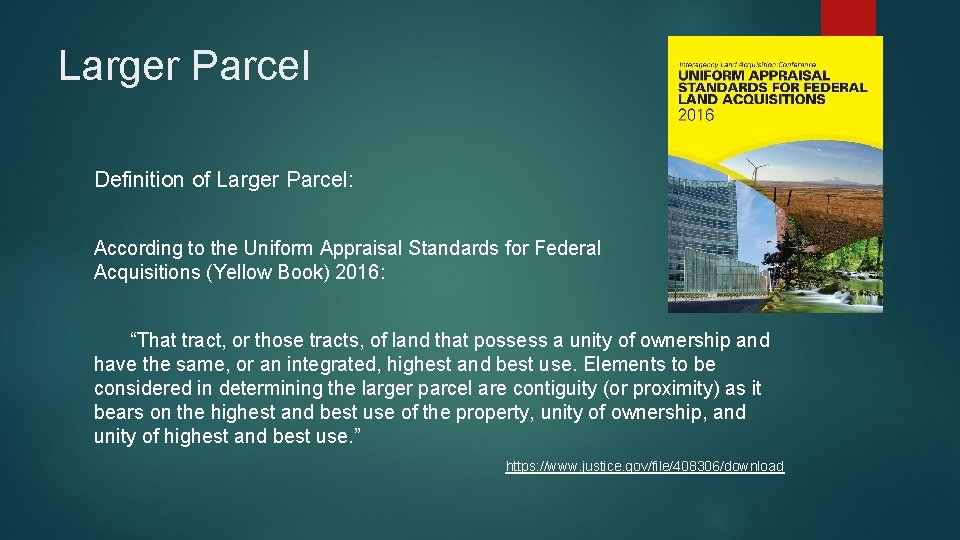
Larger Parcel Definition of Larger Parcel: According to the Uniform Appraisal Standards for Federal Acquisitions (Yellow Book) 2016: Land “That tract, or those tracts, of land that possess a unity of ownership and have the same, or an integrated, highest and best use. Elements to be considered in determining the larger parcel are contiguity (or proximity) as it bears on the highest and best use of the property, unity of ownership, and unity of highest and best use. ” https: //www. justice. gov/file/408306/download
Larger Parcel What is the Yellow Book? The Appraisal Foundation, in partnership with the US Department of Justice, is publisher of the Uniform Appraisal Standards for Federal Land Acquisitions, commonly known as the "Yellow Book. " The purpose of the Yellow Book is to promote fairness, uniformity, and efficiency in the appraisal of real property in federal land acquisitions. Source: https: //appraisalfoundation. org/i. MIS/TAF/Yellow_Book_New_Page. aspx
Larger Parcel Generally speaking, the principle of determining larger parcel means that the “entire property” before the taking should be appraised as it relates to the highest and best use.
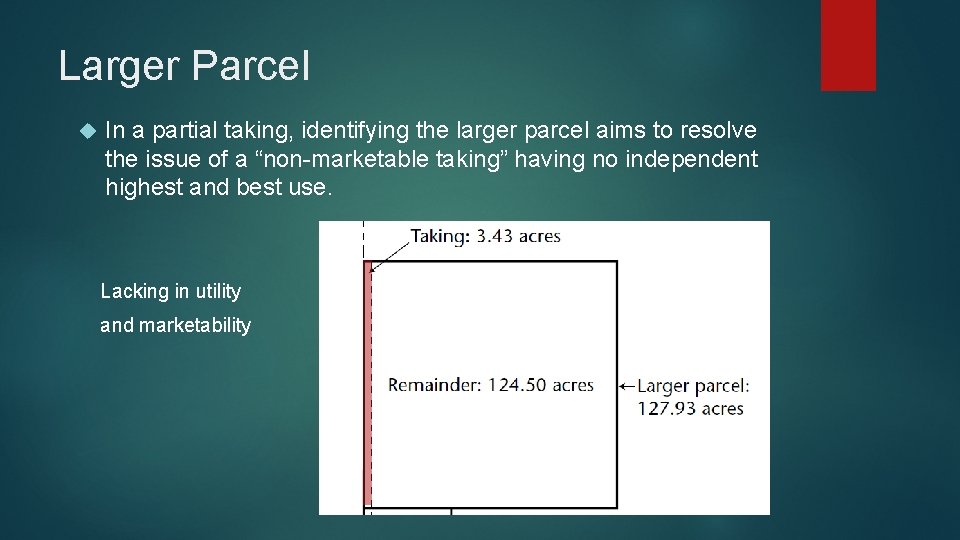
Larger Parcel In a partial taking, identifying the larger parcel aims to resolve the issue of a “non-marketable taking” having no independent highest and best use. Lacking in utility and marketability
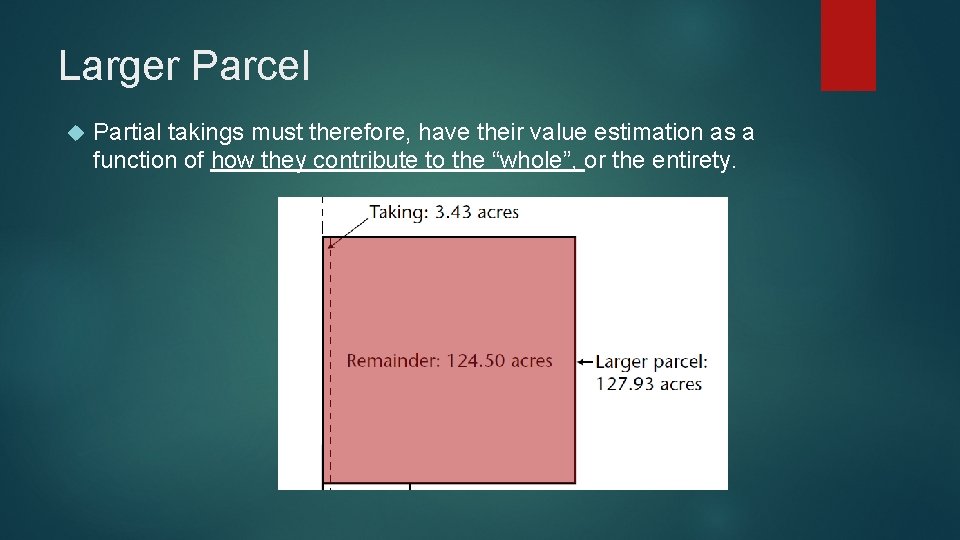
Larger Parcel Partial takings must therefore, have their value estimation as a function of how they contribute to the “whole”, or the entirety.
Larger Parcel 3 TESTS for Larger Parcel Unity of Title Contiguity Unity (or Proximity) as it bears on the Highest and Best Use of Use as it Relates to Highest and Best Use
Larger Parcel 1. Unity of Title: • Ownership and legal control
Larger Parcel 2. Contiguity (or Proximity): • Abutting or connected parcels, (or) • Separate but interdependent parcels
Larger Parcel 3. Unity of Use as it Relates to Highest and Best Use: • The parcel has a single use or one highest and best use
Larger Parcel All of the owner’s lands that qualify should be considered in order to determine the tract(s) that may be damaged or benefited by the acquisition. In practice: 1. The larger parcel is appraised BEFORE the acquisition 2. The value of the property AFTER the acquisition is determined 3. And the DIFFERENCE represents the “just compensation”; the total amount due to the property owner
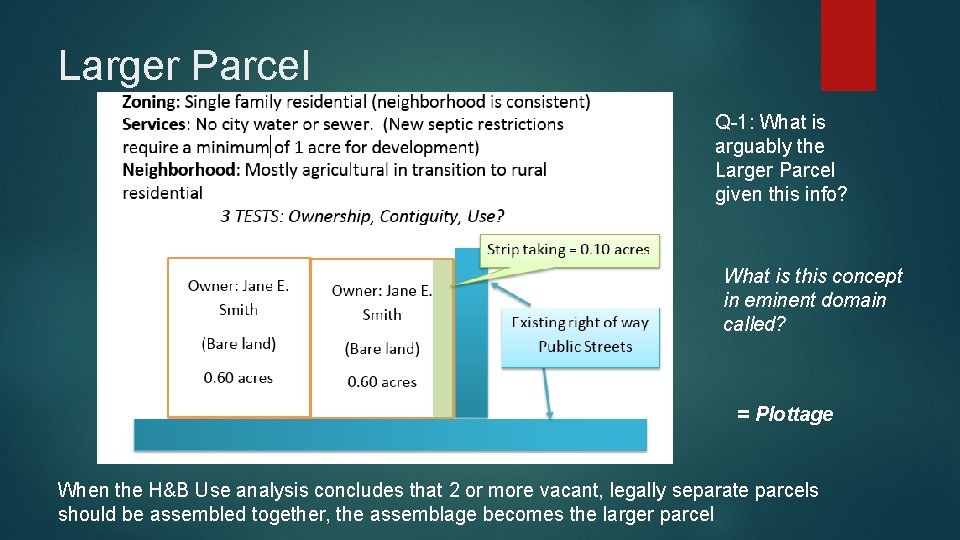
Larger Parcel Q-1: What is arguably the Larger Parcel given this info? What is this concept in eminent domain called? = Plottage When the H&B Use analysis concludes that 2 or more vacant, legally separate parcels should be assembled together, the assemblage becomes the larger parcel
Larger Parcel Plottage: Simplistically stated, an assemblage of vacant and unimproved contiguous parcels held in one ownership may have a greater value as a whole than the sum of their values as separate constituent parcels, and hence, plottage value may be considered in determining fair market value.
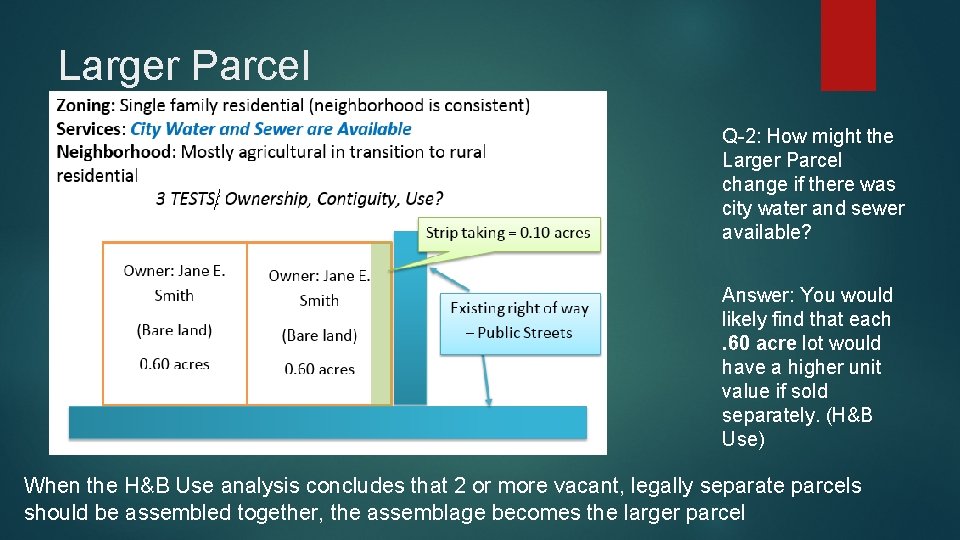
Larger Parcel Q-2: How might the Larger Parcel change if there was city water and sewer available? Answer: You would likely find that each. 60 acre lot would have a higher unit value if sold separately. (H&B Use) When the H&B Use analysis concludes that 2 or more vacant, legally separate parcels should be assembled together, the assemblage becomes the larger parcel
Larger Parcel Important to note: The practice of identifying a Larger Parcel is unique to eminent domain. The appraiser ultimately determines the larger parcel. Larger parcel is defined by the courts, and is not static. Our understanding continues to change as cases are brought forward.
Larger Parcel The determination of the larger parcel is essential to the appraiser’s conclusion of highest and best use In terms of parcel size and utility, the larger parcel drives the selection of comparable sales
Conclusion According to The IRWA Principles of Right of Way Acquisition, Volume 4: “The first step in the appraisal of a partial acquisition is to determine the larger parcel. ” It is a sub-analysis of the highest and best use This is the basis on which the entire analysis is formed
Conclusion Questions?
- Slides: 34