
Right Laparoscopic Radical Nephrectomy Ralph V Clayman MD
![Equipment Required · · · · · · Veress needle (14 G Surgineedle) [Autosuture]](https://slidetodoc.com/presentation_image/64d63f271e23eeb63e131989b6406ab4/image-3.jpg "Equipment Required · · · · · · Veress needle (14 G Surgineedle) [Autosuture]")






- Slides: 19
Right Laparoscopic Radical Nephrectomy Ralph V. Clayman, MD Professor of Urology University of California, Irvine
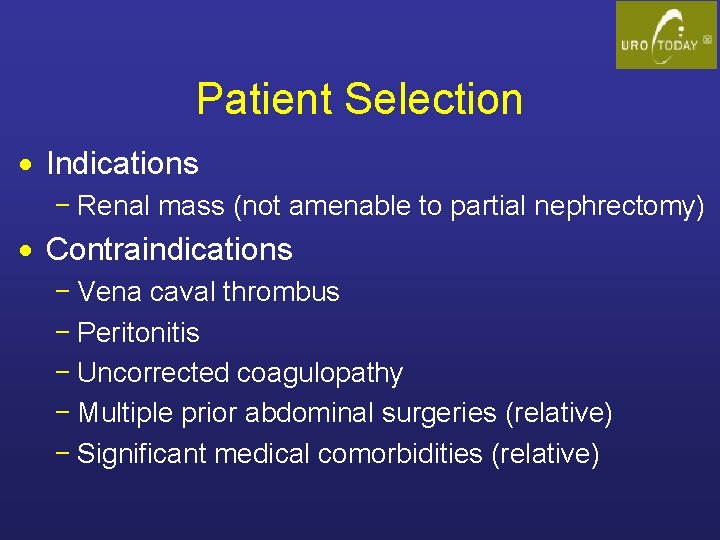
Patient Selection · Indications − Renal mass (not amenable to partial nephrectomy) · Contraindications − Vena caval thrombus − Peritonitis − Uncorrected coagulopathy − Multiple prior abdominal surgeries (relative) − Significant medical comorbidities (relative)
Equipment Required · · · · · · Veress needle (14 G Surgineedle) [Autosuture] Knife with #15 blade Kelly and Allis clamps Trocars: 12 mm (3), 5 mm (2) Laparoscopic camera with 30 Lens (have 5 mm 30 available) Argon Beam Coagulator Hook Electrocautery with Active Electrode Monitoring [Encision] Liga. Sure (5 mm) [Valleylab] Harmonic Shears-5 mm curved [Ethicon] Kuttner Dissectors: 5 mm Endo Peanut [Autosuture] 10 mm Endoscopic blunt cherry dissector [Ethicon] 5 mm atraumatic bowel forceps [Karl Storz] Laparoscopic Right Angle Clamp (5 mm and 10 mm) Endo. GIA stapler (45 mm vascular load, articulating handle) [Ethicon] Nezhat-Dorsey suction-irrigator [Davol] Grasping forceps with teeth (locking handle) (3) Endoholder (self-retaining retractor) [Codman] Floseal hemostatic collagen matrix [Baxter] Oxidized cellulose (Surgicel) Lap Sac (8”x 10”) entrapment sac with two tine introducer (Cook) Curved ring forceps for morcellation Suture: 0 -Vicryl, 4 -0 monocryl
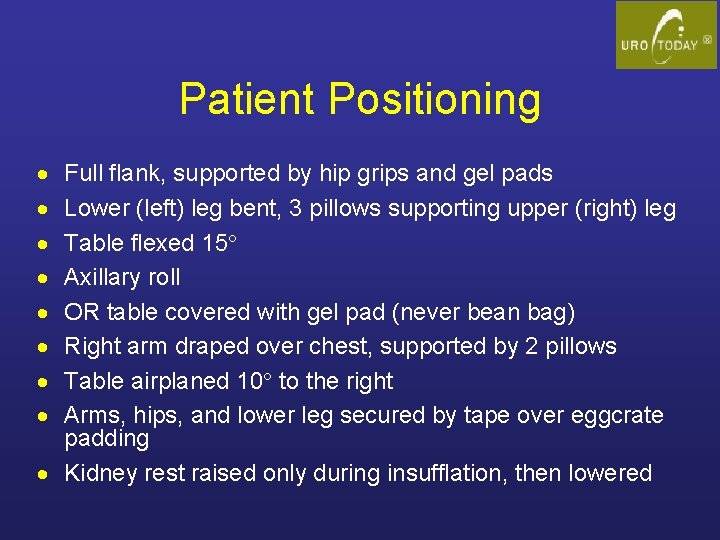
Patient Positioning · · · · Full flank, supported by hip grips and gel pads Lower (left) leg bent, 3 pillows supporting upper (right) leg Table flexed 15 Axillary roll OR table covered with gel pad (never bean bag) Right arm draped over chest, supported by 2 pillows Table airplaned 10 to the right Arms, hips, and lower leg secured by tape over eggcrate padding · Kidney rest raised only during insufflation, then lowered
Patient Positioning
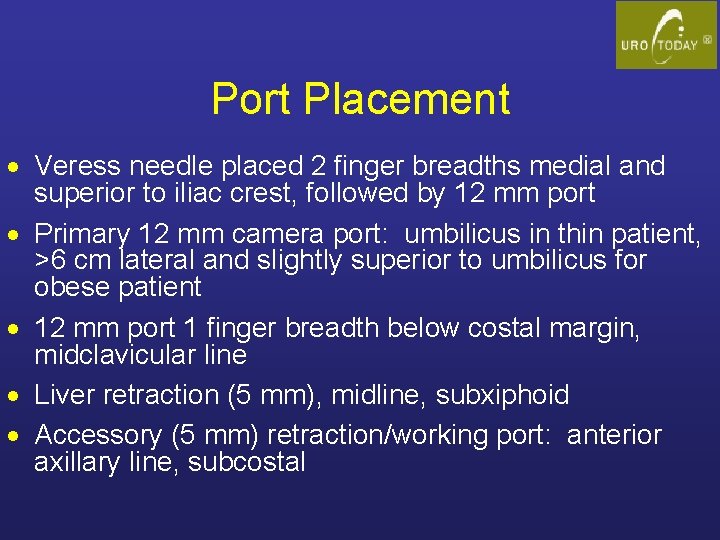
Port Placement · Veress needle placed 2 finger breadths medial and superior to iliac crest, followed by 12 mm port · Primary 12 mm camera port: umbilicus in thin patient, >6 cm lateral and slightly superior to umbilicus for obese patient · 12 mm port 1 finger breadth below costal margin, midclavicular line · Liver retraction (5 mm), midline, subxiphoid · Accessory (5 mm) retraction/working port: anterior axillary line, subcostal
Port Placement 5 mm accessory port Primary (12 mm) working ports Liver retraction (5 mm)
Steps of the procedure 1. 2. 3. 4. 5. 6. 7. 8. Placing the ports Mobilizing the colon Mobilizing the liver and upper pole Kocherizing the duodenum Freeing the lower pole Dissecting the hilum Dividing the ureter Placing the specimen in a Lap Sac for morcellation
1. Placing the ports
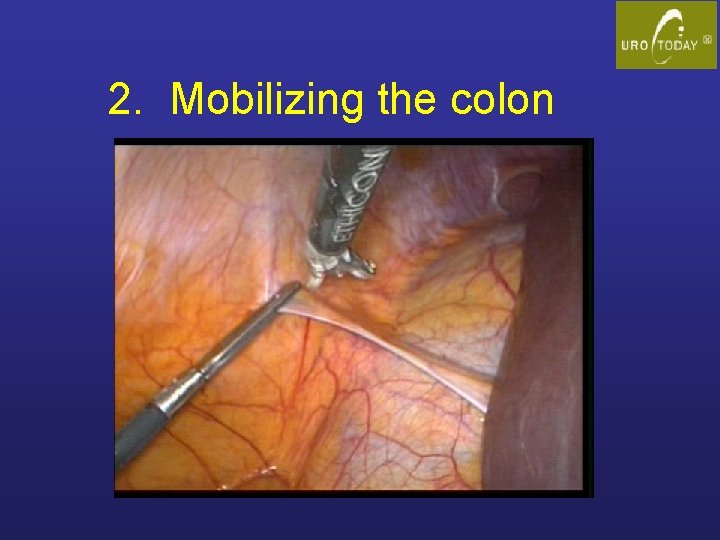
2. Mobilizing the colon
3. Mobilizing the liver and upper pole
4. Kocherizing the duodenum
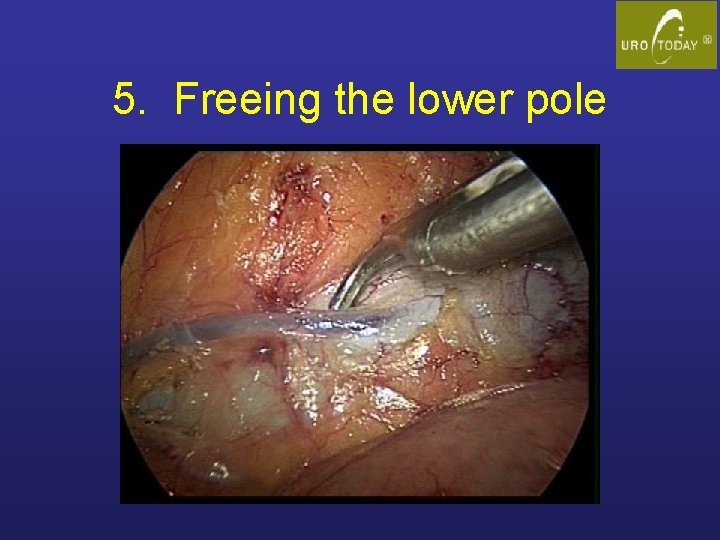
5. Freeing the lower pole
6. Dissecting the hilum
7. Dividing the ureter
8. Placing the specimen in a Lap Sac for morcellation
Technical points: Tips · Make sure to take down the triangular and posterior coronary hepatic ligaments in order to mobilize the liver cranially and medially and expose the vena cava. · The argon beam coagulator can stop small bleeders. · Make liberal use of Kuttners for dissection and retraction. They are especially useful around the hilum. · There is no “camera” port. The camera and instruments should be freely shifted between the 12 mm ports as necessary wherever exposure is the best. · 5 mm ports are “free”. If you are struggling, do not hesitate to place one to provide a better working angle.
Technical points: Caveats · When dissecting the midportion of the kidney medially, the first structure encountered will ALWAYS be the duodenum, not the vena cava. Temporarily lowering the pneumoperitoneum to 5 mm will help it to fill out. · The hook can be used to dissect on the anterior surface of the vena cava. When approaching the lower pole, beware the insertion of the gonadal vein on the anterolateral surface of the IVC · Take extreme precaution when morcellating to avoid tumor spillage: triple drapes, change of gowns/gloves, instillation of betadine in the wound.
Credits Surgeon: Ralph V. Clayman, MD Professor of Urology Chairman, Department of Urology UC Irvine Medical Center Orange, CA 92868 714 -456 -6782 RClayman@uci. edu First assistant and video editor: James F. Borin, MD Clinical Instructor Laparoscopy/Endourology fellow UC Irvine Medical Center 714 -456 -3431 JBorin@aya. yale. edu