
RIDGE PUSH PLATE DRIVING FORCE DUE TO COOLING

- Slides: 18
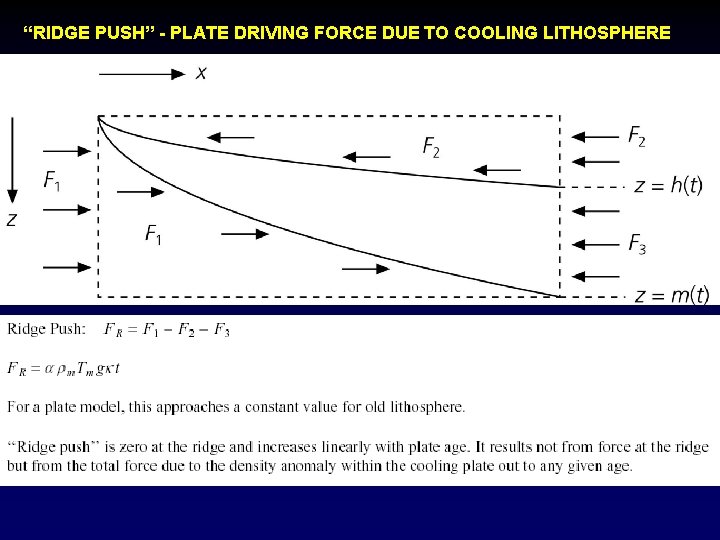
“RIDGE PUSH” - PLATE DRIVING FORCE DUE TO COOLING LITHOSPHERE
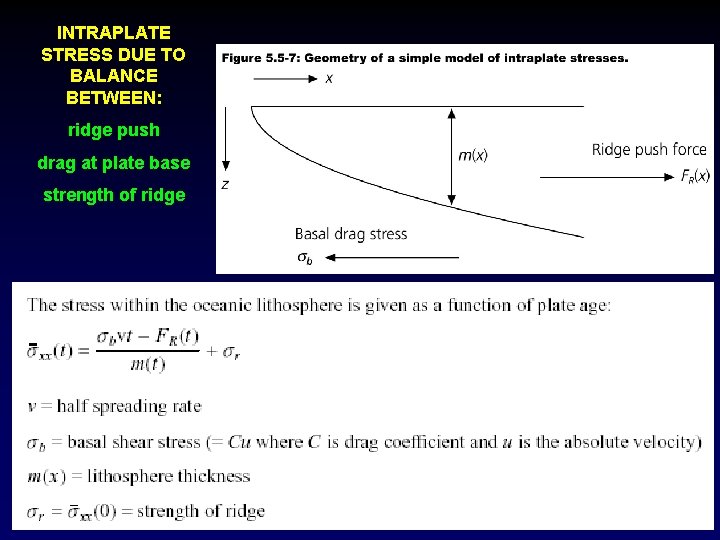
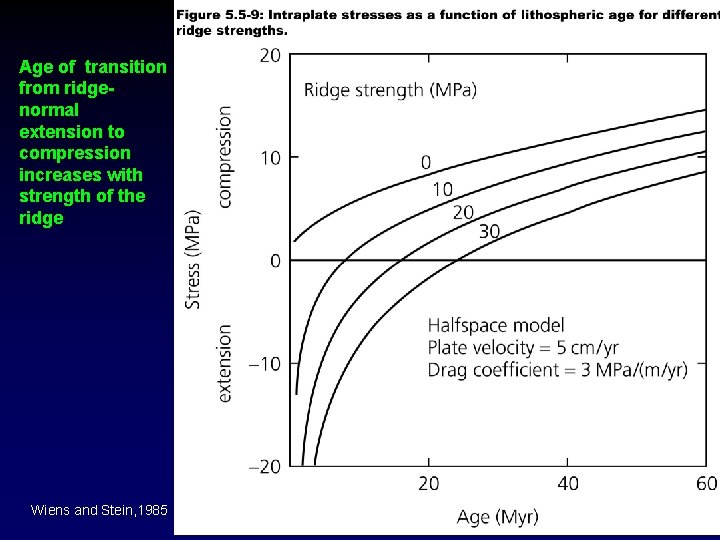
INTRAPLATE STRESS DUE TO BALANCE BETWEEN: ridge push drag at plate base strength of ridge
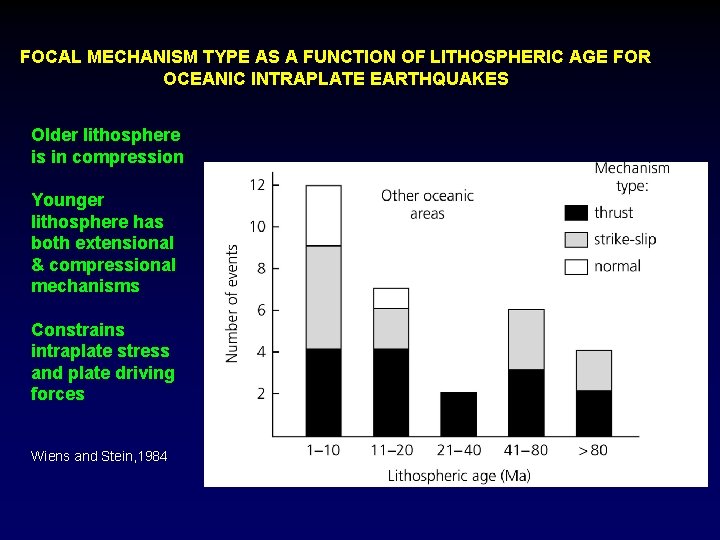
FOCAL MECHANISM TYPE AS A FUNCTION OF LITHOSPHERIC AGE FOR OCEANIC INTRAPLATE EARTHQUAKES Older lithosphere is in compression Younger lithosphere has both extensional & compressional mechanisms Constrains intraplate stress and plate driving forces Wiens and Stein, 1984
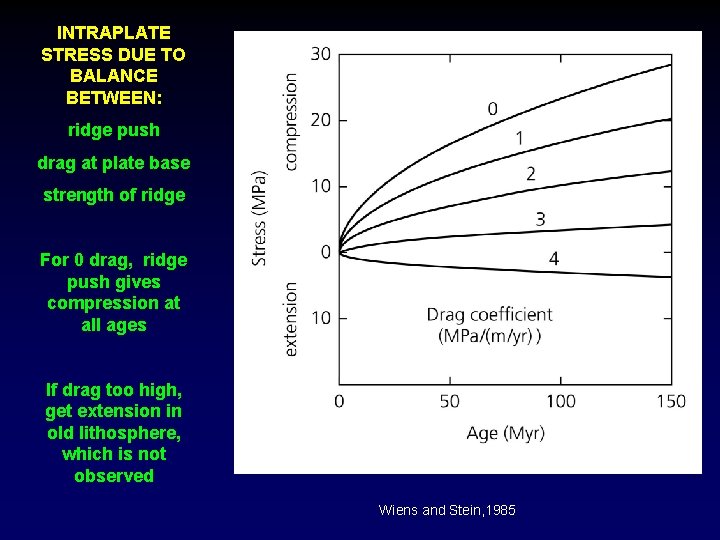
INTRAPLATE STRESS DUE TO BALANCE BETWEEN: ridge push drag at plate base strength of ridge For 0 drag, ridge push gives compression at all ages If drag too high, get extension in old lithosphere, which is not observed Wiens and Stein, 1985
Age of transition from ridgenormal extension to compression increases with strength of the ridge Wiens and Stein, 1985
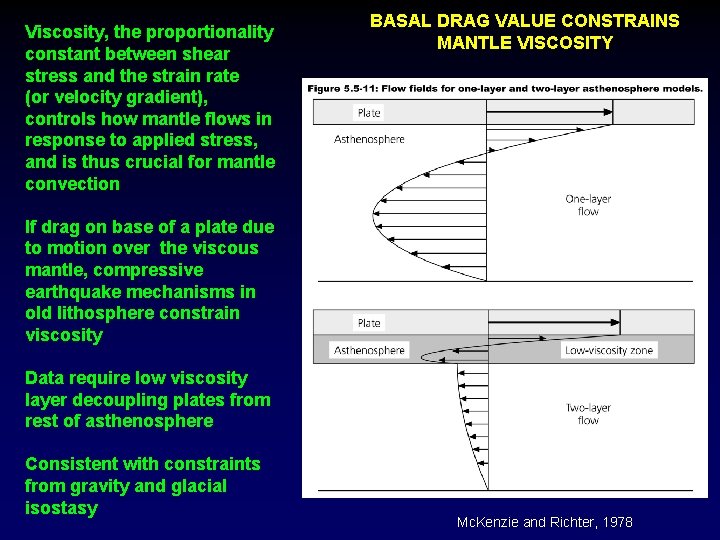
Viscosity, the proportionality constant between shear stress and the strain rate (or velocity gradient), controls how mantle flows in response to applied stress, and is thus crucial for mantle convection BASAL DRAG VALUE CONSTRAINS MANTLE VISCOSITY If drag on base of a plate due to motion over the viscous mantle, compressive earthquake mechanisms in old lithosphere constrain viscosity Data require low viscosity layer decoupling plates from rest of asthenosphere Consistent with constraints from gravity and glacial isostasy Mc. Kenzie and Richter, 1978
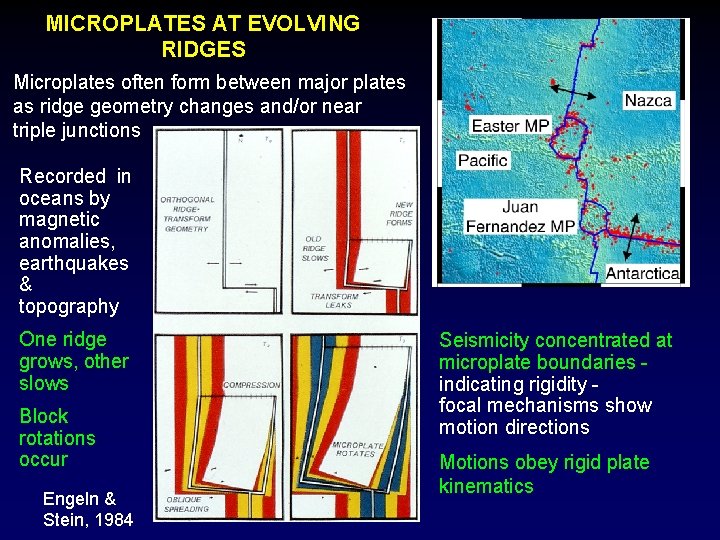
MICROPLATES AT EVOLVING RIDGES Microplates often form between major plates as ridge geometry changes and/or near triple junctions Recorded in oceans by magnetic anomalies, earthquakes & topography One ridge grows, other slows Block rotations occur Engeln & Stein, 1984 Seismicity concentrated at microplate boundaries indicating rigidity focal mechanisms show motion directions Motions obey rigid plate kinematics
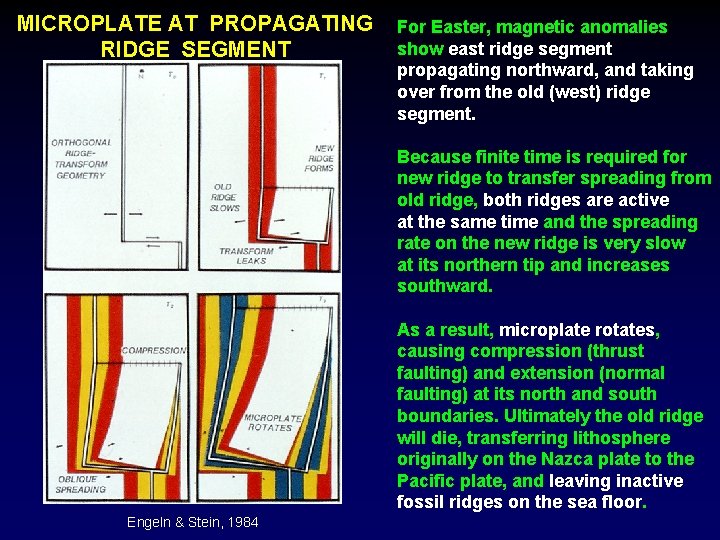
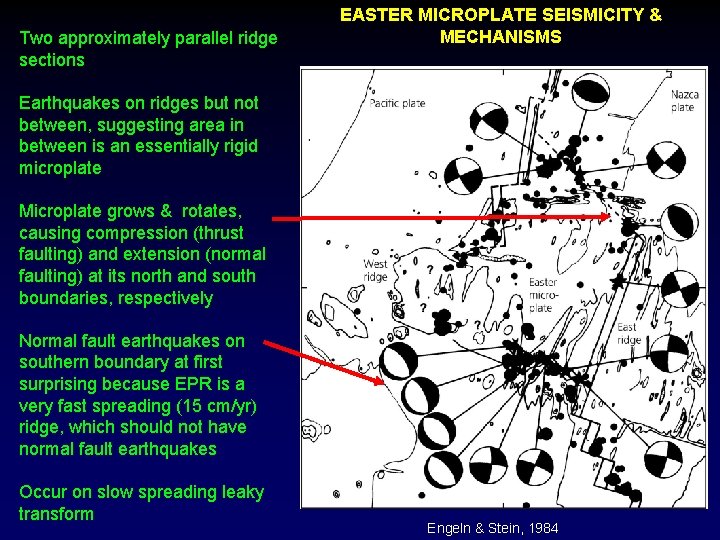
MICROPLATE AT PROPAGATING RIDGE SEGMENT For Easter, magnetic anomalies show east ridge segment propagating northward, and taking over from the old (west) ridge segment. Because finite time is required for new ridge to transfer spreading from old ridge, both ridges are active at the same time and the spreading rate on the new ridge is very slow at its northern tip and increases southward. As a result, microplate rotates, causing compression (thrust faulting) and extension (normal faulting) at its north and south boundaries. Ultimately the old ridge will die, transferring lithosphere originally on the Nazca plate to the Pacific plate, and leaving inactive fossil ridges on the sea floor. Engeln & Stein, 1984
Two approximately parallel ridge sections EASTER MICROPLATE SEISMICITY & MECHANISMS Earthquakes on ridges but not between, suggesting area in between is an essentially rigid microplate Microplate grows & rotates, causing compression (thrust faulting) and extension (normal faulting) at its north and south boundaries, respectively Normal fault earthquakes on southern boundary at first surprising because EPR is a very fast spreading (15 cm/yr) ridge, which should not have normal fault earthquakes Occur on slow spreading leaky transform Engeln & Stein, 1984
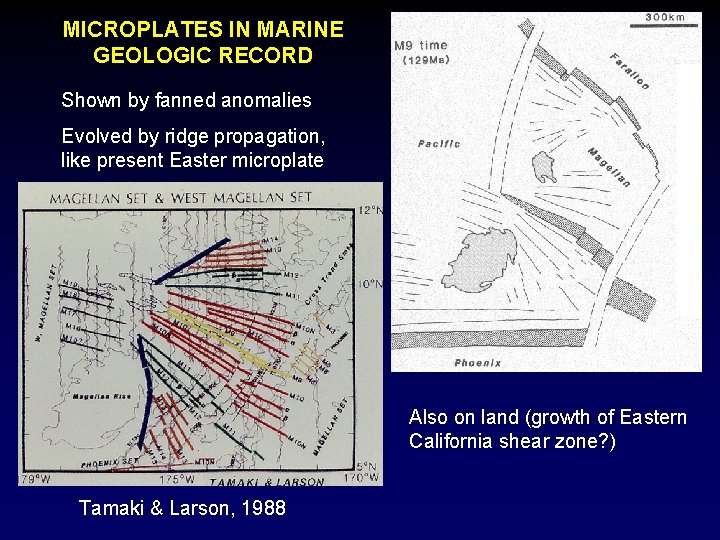
MICROPLATES IN MARINE GEOLOGIC RECORD Shown by fanned anomalies Evolved by ridge propagation, like present Easter microplate Also on land (growth of Eastern California shear zone? ) Tamaki & Larson, 1988
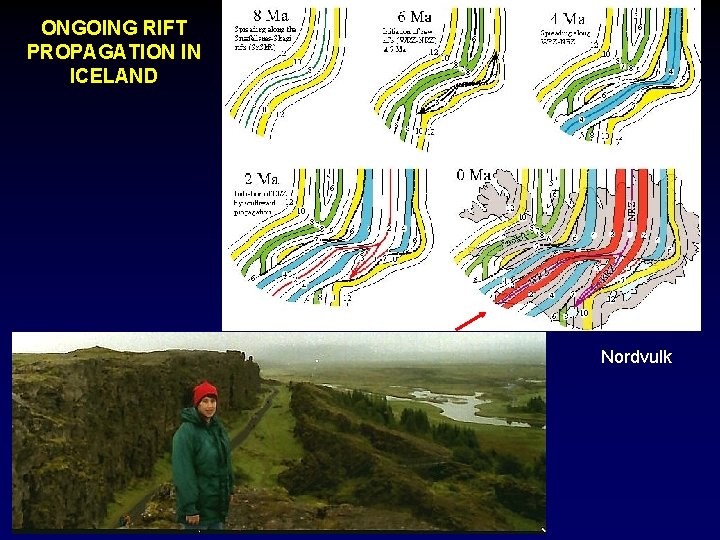
ONGOING RIFT PROPAGATION IN ICELAND Nordvulk
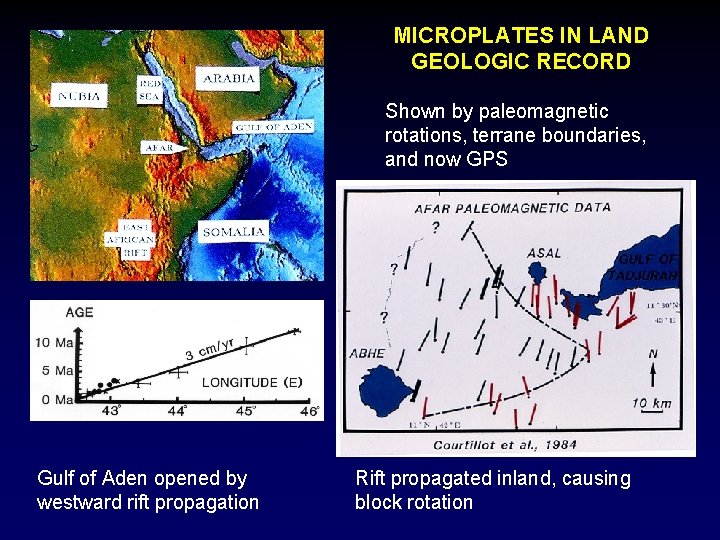
MICROPLATES IN LAND GEOLOGIC RECORD Shown by paleomagnetic rotations, terrane boundaries, and now GPS Gulf of Aden opened by westward rift propagation Rift propagated inland, causing block rotation
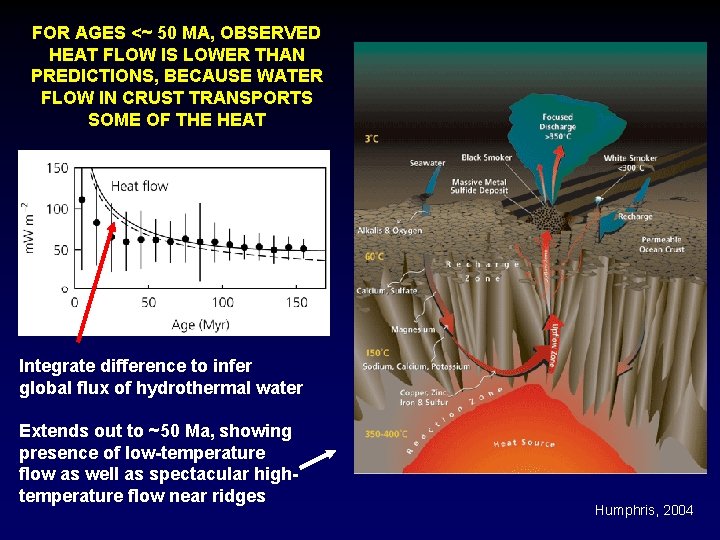
FOR AGES <~ 50 MA, OBSERVED HEAT FLOW IS LOWER THAN PREDICTIONS, BECAUSE WATER FLOW IN CRUST TRANSPORTS SOME OF THE HEAT Integrate difference to infer global flux of hydrothermal water Extends out to ~50 Ma, showing presence of low-temperature flow as well as spectacular hightemperature flow near ridges Humphris, 2004
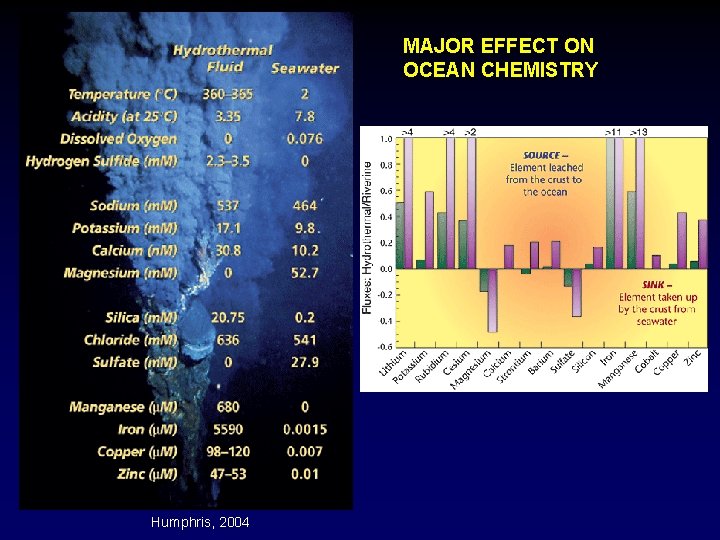
MAJOR EFFECT ON OCEAN CHEMISTRY Humphris, 2004
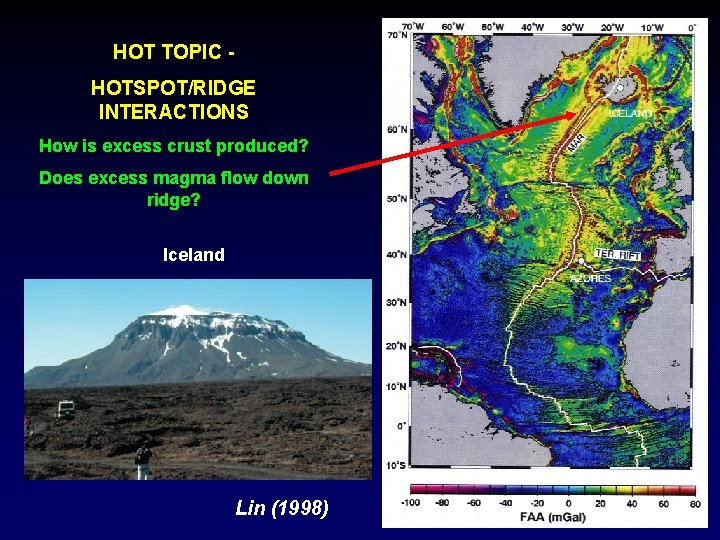
Hotspots and Mid-Ocean Ridges Lin (1998)
HOT TOPIC HOTSPOT/RIDGE INTERACTIONS How is excess crust produced? Does excess magma flow down ridge? Iceland Lin (1998)
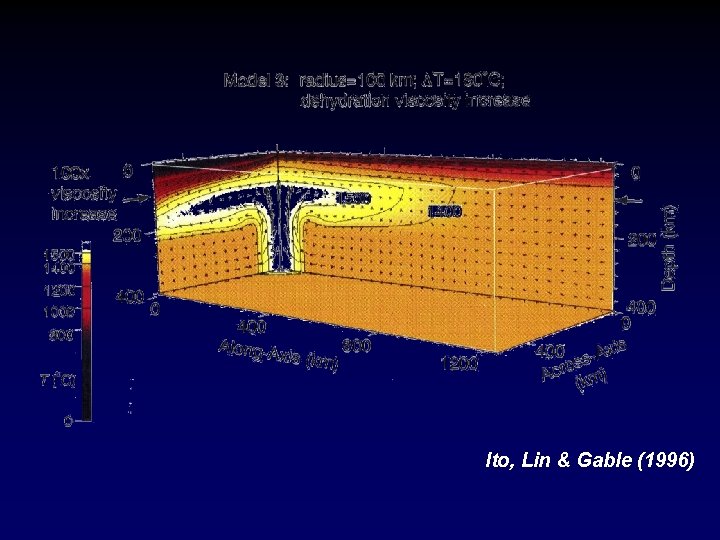
Ito, Lin & Gable (1996)
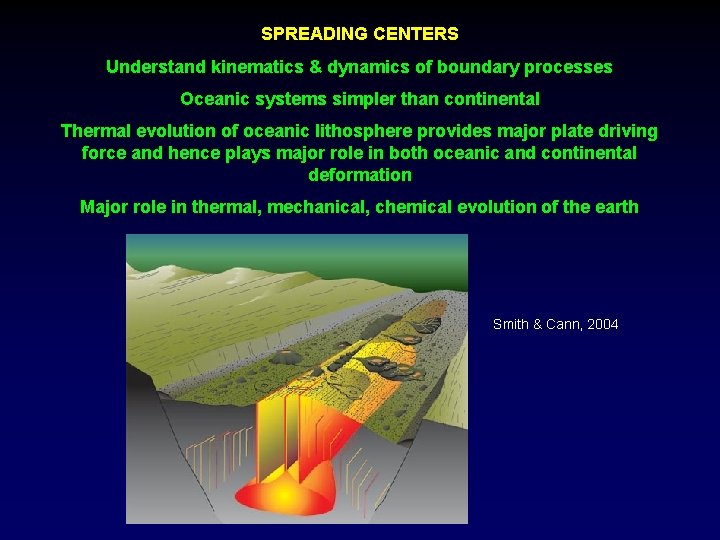
SPREADING CENTERS Understand kinematics & dynamics of boundary processes Oceanic systems simpler than continental Thermal evolution of oceanic lithosphere provides major plate driving force and hence plays major role in both oceanic and continental deformation Major role in thermal, mechanical, chemical evolution of the earth Smith & Cann, 2004