
Richard Nixon the Cold War 1968 1974 Essential
- Slides: 31
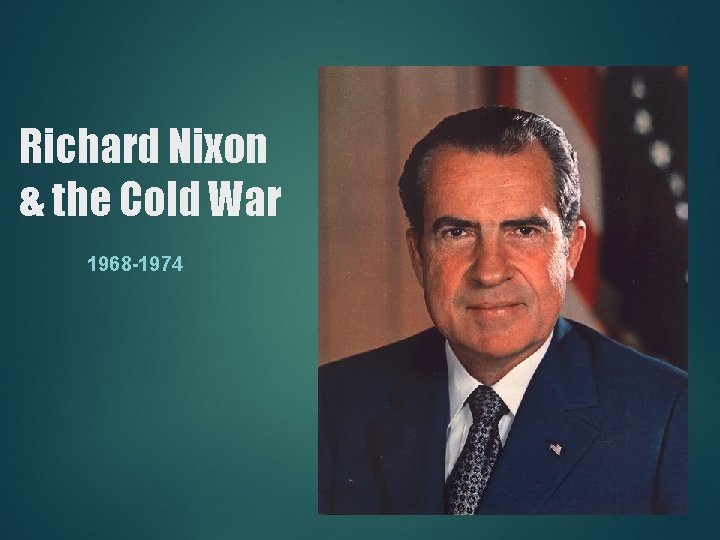
Richard Nixon & the Cold War 1968 -1974
Essential Question: How and why did public confidence and trust in government’s ability to solve social and economic problems decline in the 1970 s?
Nixon-Domestic Policy Southern strategy: realigned Republican party policies to attract blue collar workers and southern white conservatives; hoped to make the Republican Party a force in the South During reelection campaign of 1972, he cast himself as the spokesperson for Middle Americans, or the silent majority. He wanted to speak for the “non-shouters, the non-demonstrators”, the men and women who “work in America’s factories…run America’s businesses…serve in Government…provide most of the soldiers…and give life to the American Dream” Believed that Americans had grown tired of big government of LBJ’s Great Society But he felt that the American people still wanted government to address certain social ills (crime and pollution)
Nixon-Domestic Policy 1971 State of the Union Address--New Federalism—distribute powers/money from federal government to states to spend as they saw fit (revenue sharing) But he also sponsored many programs that increased the size and role of the federal government Occupational Safety and Health Administration (OSHA) created to regulate the workplace to ensure safety Drug Enforcement Administration (DEA) administers federal war against illegal drug Nixon founded the Environmental Protection Agency in 1970 as a response to the rising concern over conservation and pollution. The agency oversaw the passage of the Clean Air Act, Clean Water Act Proposed Family Assistance Plan: guarantee of $1, 600 to family of four, job training required; Didn’t pass, but he oversaw expansion of Medicare and Public housing
Nixon-Domestic Policy Nixon had to deal with troublesome economy U. S. economy began a period of recession and inflation at the same time after long period of economic prosperity during the 50 s and early 60 s Stagflation-baffled economists at the time, but had several causes: Increased federal budget deficit because of Vietnam War Rising foreign competition, which cost American jobs, especially in the steel and auto industry Rapid increase in the price of oil due to embargo by OPEC in 1973 (oil prices increased 400% in a single year); Nixon responded with 90 day freeze on prices and wages
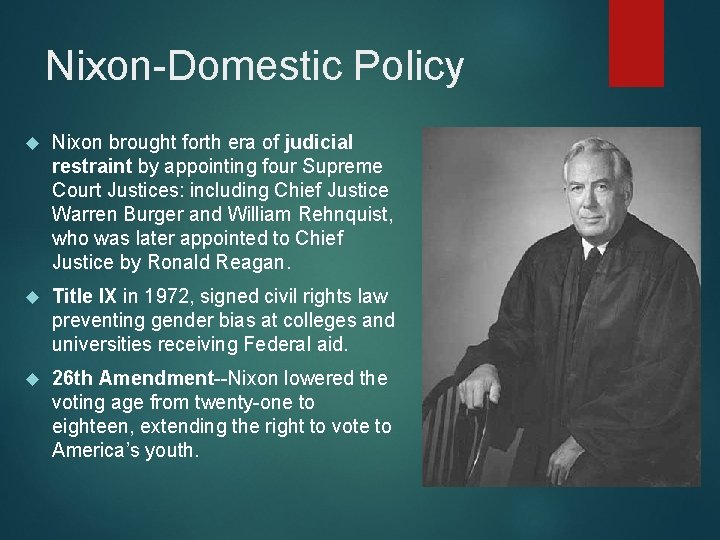
Nixon-Domestic Policy Nixon brought forth era of judicial restraint by appointing four Supreme Court Justices: including Chief Justice Warren Burger and William Rehnquist, who was later appointed to Chief Justice by Ronald Reagan. Title IX in 1972, signed civil rights law preventing gender bias at colleges and universities receiving Federal aid. 26 th Amendment--Nixon lowered the voting age from twenty-one to eighteen, extending the right to vote to America’s youth.
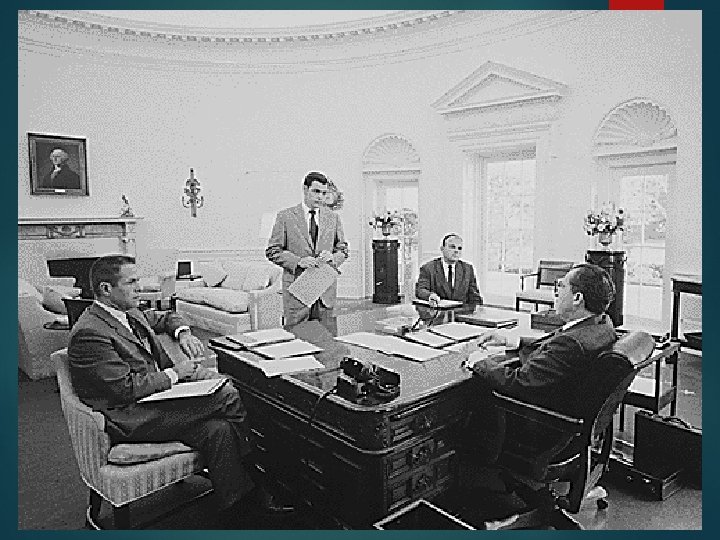
Richard Nixon’s Staff Although he had a reserved and remote personality, many Americans respected Nixon for his experience and service. Believing that the executive branch needed to be strong, Nixon gathered a close circle of trusted advisors around him.
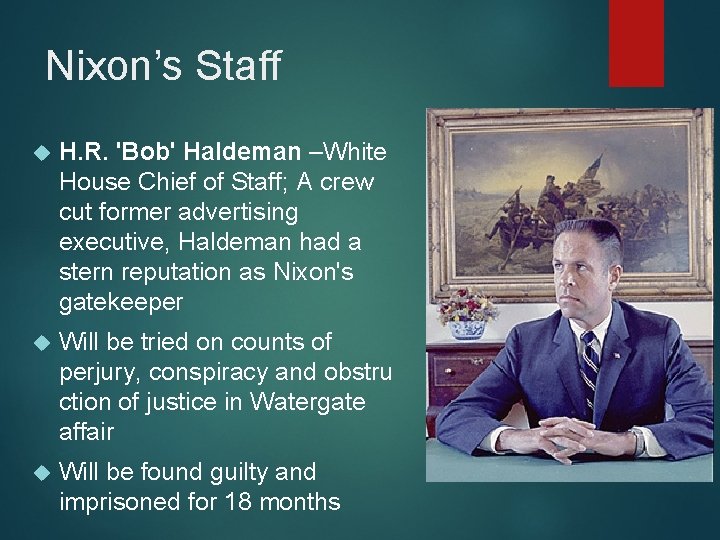
Nixon’s Staff H. R. 'Bob' Haldeman –White House Chief of Staff; A crew cut former advertising executive, Haldeman had a stern reputation as Nixon's gatekeeper Will be tried on counts of perjury, conspiracy and obstru ction of justice in Watergate affair Will be found guilty and imprisoned for 18 months
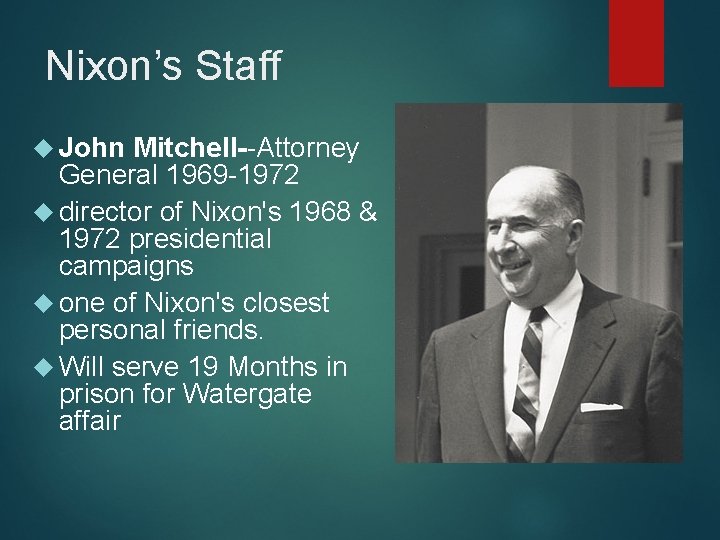
Nixon’s Staff John Mitchell--Attorney General 1969 -1972 director of Nixon's 1968 & 1972 presidential campaigns one of Nixon's closest personal friends. Will serve 19 Months in prison for Watergate affair
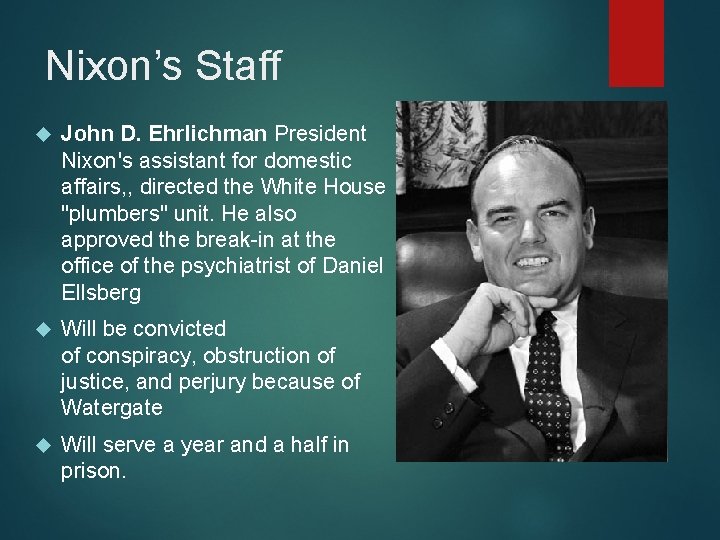
Nixon’s Staff John D. Ehrlichman President Nixon's assistant for domestic affairs, , directed the White House "plumbers" unit. He also approved the break-in at the office of the psychiatrist of Daniel Ellsberg Will be convicted of conspiracy, obstruction of justice, and perjury because of Watergate Will serve a year and a half in prison.
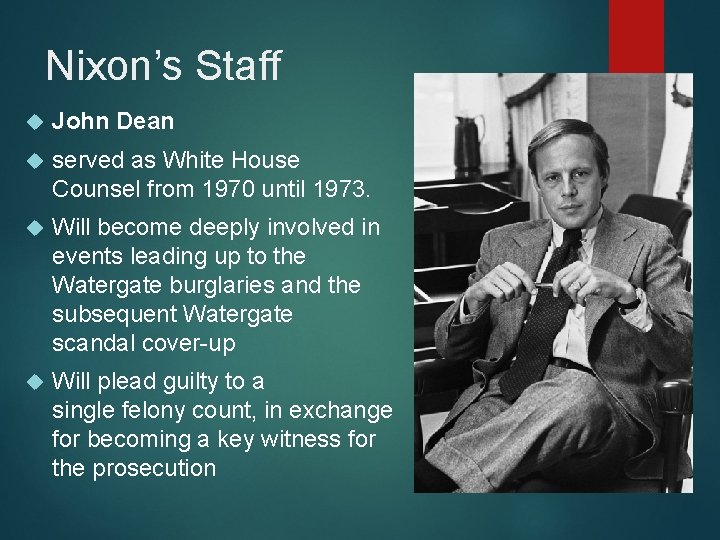
Nixon’s Staff John Dean served as White House Counsel from 1970 until 1973. Will become deeply involved in events leading up to the Watergate burglaries and the subsequent Watergate scandal cover-up Will plead guilty to a single felony count, in exchange for becoming a key witness for the prosecution
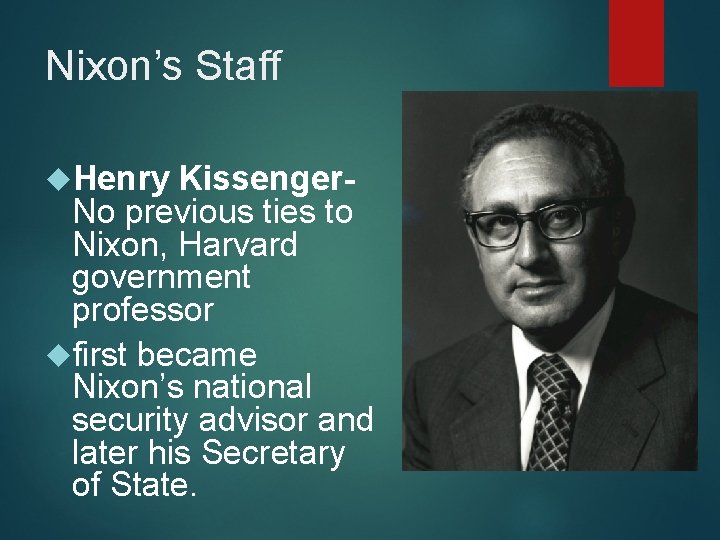
Nixon’s Staff Henry Kissenger. No previous ties to Nixon, Harvard government professor first became Nixon’s national security advisor and later his Secretary of State.
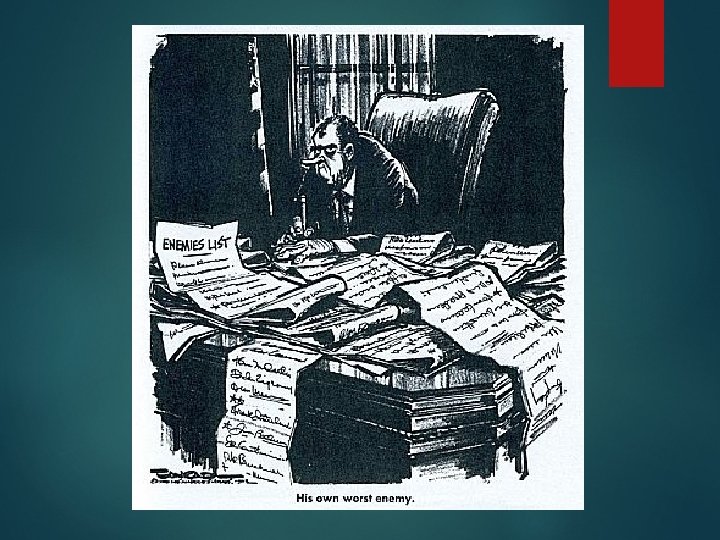
Battling Political Enemies Nixon’s suspicious and secretive nature caused the White House to operate as if it were surrounded by political enemies. One result of this mind-set was the creation of an “enemies list, ” a list of prominent people seen as unsympathetic to the administration. When someone in the National Security Council appeared to have leaked secret government information to the New York Times, Times Nixon ordered that wiretaps, wiretaps or listening devices, be installed on the telephones of some news reporters and members of his staff.
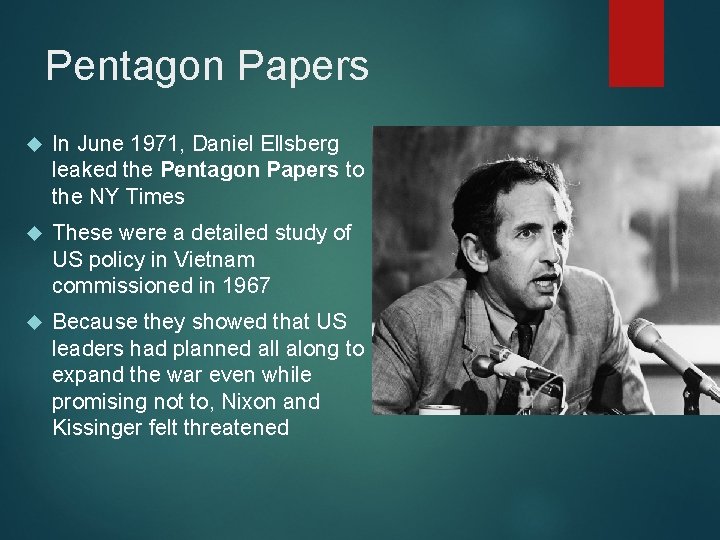
Pentagon Papers In June 1971, Daniel Ellsberg leaked the Pentagon Papers to the NY Times These were a detailed study of US policy in Vietnam commissioned in 1967 Because they showed that US leaders had planned all along to expand the war even while promising not to, Nixon and Kissinger felt threatened
Pentagon Papers President Nixon felt National Security was threatened. Nixon was successful in obtaining a court order to stop publication but New York Times filed a lawsuit citing free press issues Nixon ordered Ellsberg’s psychiatrist’s office burglarized looking for evidence to discredit him. Ellsberg was charged with 12 felony counts under the Espionage Act; Carried a maximum sentence of 115 years. The charges were against Ellsberg and Anthony Russo (who helped him photocopy the papers) Charges were dismissed in the fifth month of the trial on grounds of governmental misconduct due to illegal wiretapping and evidence tampering.
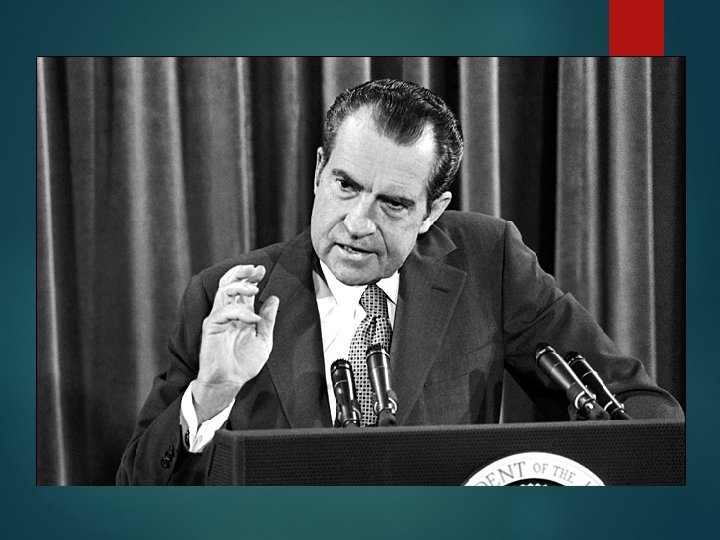
Watergate-Smoking Gun Recording of a meeting between President Nixon and his Chief of Staff, H. R. Haldeman, in the Oval Office on June 23, 1972. The release of the tape was ordered by the Supreme Court on July 24, 1974, in a case known as United States v. Nixon. The court’s decision was unanimous. President Nixon released the tape on August 5. It was one of three conversations he had with Haldeman six days after the Watergate break-in. The tapes prove that he ordered a cover-up of the Watergate burglary. Nixon announced his resignation on August 8. Smoking Gun
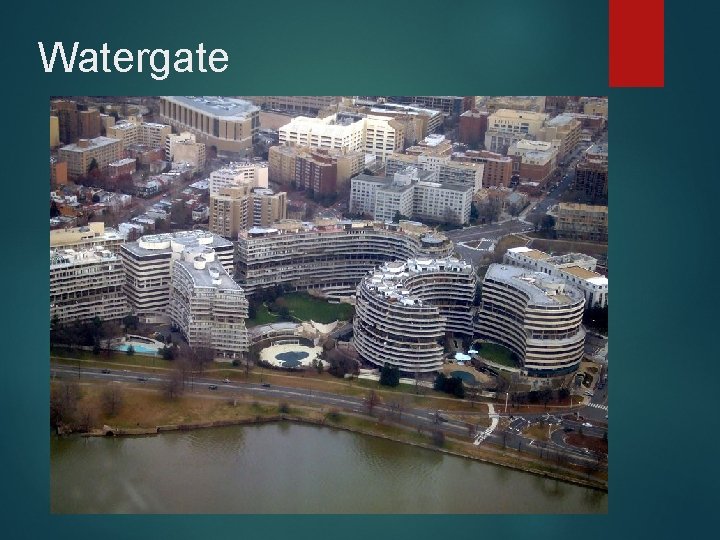
Watergate
The Watergate Break-In Ø Ø Ø There was break-in at the Democratic Headquarters located in the Watergate Hotel in Washington 5 burglars caught June 17, 1972, carrying cameras, wiretapping equipment and large amounts of cash Nixon administration denied any knowledge Burglars were convicted in January 1973 and, despite offers of $400 K in hush money from White House Counsel John Dean, one of the burglars, James Mc. Cord, started to talk Charged that the administration had been involved in the break in; had been funded by CREEP (the Committee to Reelect the President)
The Watergate Cover-up Although Nixon had not been involved in the break-in, he became involved in its cover-up. He illegally authorized the CIA to try to persuade the FBI to stop its investigation of the break-in, on the grounds that the matter involved “national security. ” Nixon advisors launched a scheme to bribe the Watergate defendants into silence, as well as coaching them on how to lie in court. During the months following the break-in, the incident was barely noticed by the public. Nixon won the 1972 election by a landslide. Created a showdown between all three branches of government—How far would Congress go to investigate the President? Would the courts demand that the President turn over information that may incriminate him? Would the president comply with any court order?
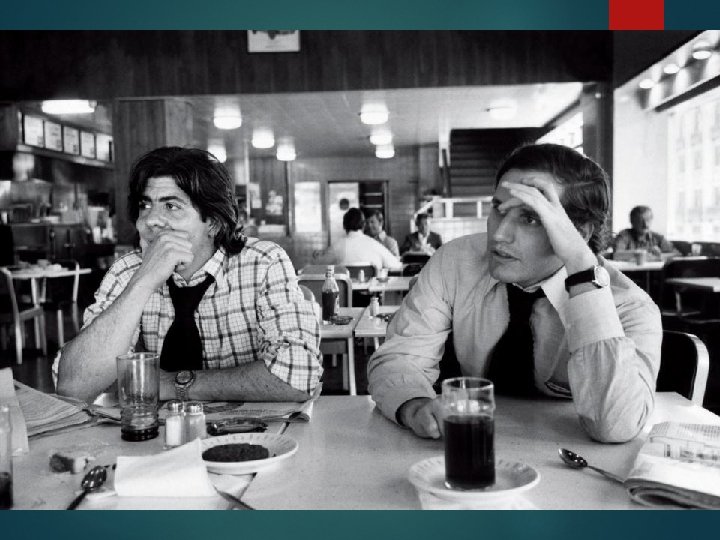
The Scandal Unfolds The Watergate Trial At the trial of the Watergate burglars in early 1973, all the defendants either plead guilty or were found guilty. The judge presiding over the trial was not convinced that the full story had been told. He sentenced the burglars to long prison terms, suggesting that their terms could be reduced if they cooperated with upcoming Senate hearings on Watergate. Woodward and Bernstein Two young Washington Post reporters, Bob Woodward and Carl Bernstein, were influential in tracking down information to uncover the Watergate story. Woodward and Bernstein believed that the White House would prove to be involved in the Watergate scandal.
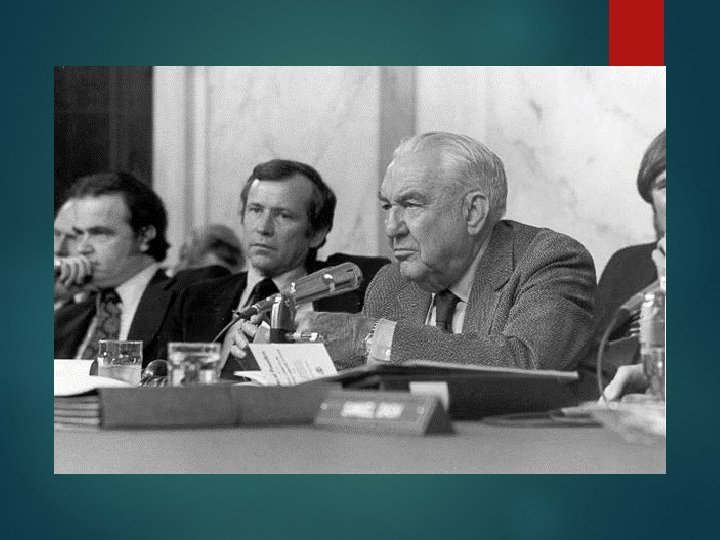
The Scandal Unfolds The Senate Investigates April 1973 -Nixon attempted to protect himself by forcing Bob Haldeman and John Ehrlichman to resign and firing John Dean May 1973 --Senate Select Committee on Presidential Campaign Activities began to investigate the Watergate affair; Chaired by NC Senator, Sam Ervin Special Prosecutor’s office created and Archibald Cox was named special prosecutor Millions of Americans watched the Senate hearings unfold on national television. June 1973 -Former White House council John Dean testifies that Nixon ordered the coverup
The Scandal Unfolds July 13 -During the Senate hearings, Alexander Butterfield, a former presidential assistant, revealed the existence of a secret taping system in the President’s office. July 1973 -Nixon refused to turn over the tapes to the special prosecutor and did so by claiming executive privilege. October 1973 -Saturday Night Massacre-Nixon tried to release summaries of tapes, but special prosecutor, Archibald Cox refused to accept the summaries; Nixon fired Cox which triggered other firings and resignations July 24, 1974, case of US v. Nixon, ruled that the tapes did not fall under the principle of executive privilege and ordered Nixon to turn them over.
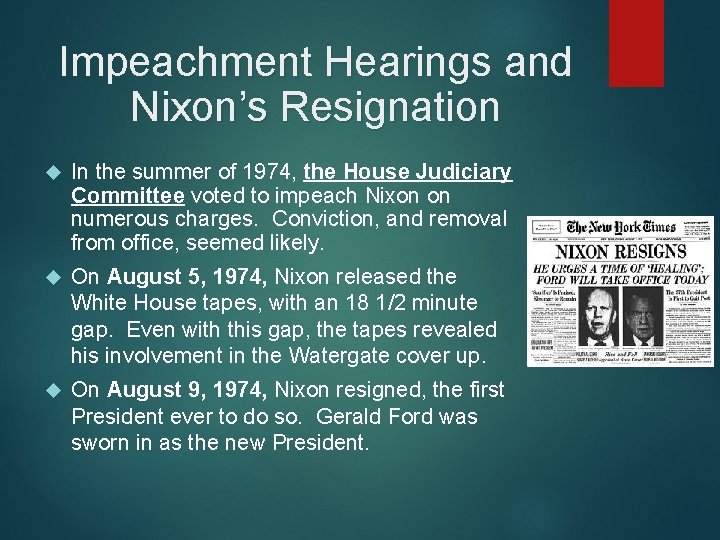
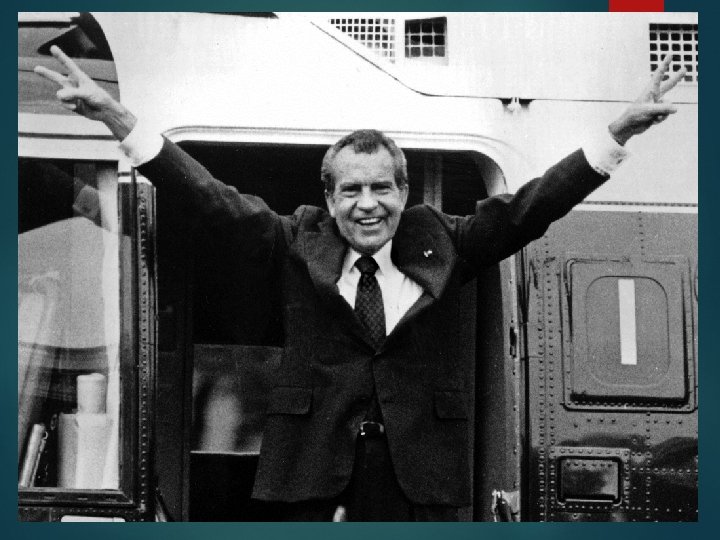
Impeachment Hearings and Nixon’s Resignation In the summer of 1974, the House Judiciary Committee voted to impeach Nixon on numerous charges. Conviction, and removal from office, seemed likely. On August 5, 1974, Nixon released the White House tapes, with an 18 1/2 minute gap. Even with this gap, the tapes revealed his involvement in the Watergate cover up. On August 9, 1974, Nixon resigned, the first President ever to do so. Gerald Ford was sworn in as the new President.
Richard Nixon A& E
Main Idea Activity Directions: For each set of terms develop a well defined main idea that expresses the relationship between the terms with each set. Group A SDS Free Speech Movement Counterculture The New Left Group B Moral Majority Sunbelt Televangelists The New Rights