
Richard M The impact of robots on productivity
Richard M. The impact of robots on productivity and employment
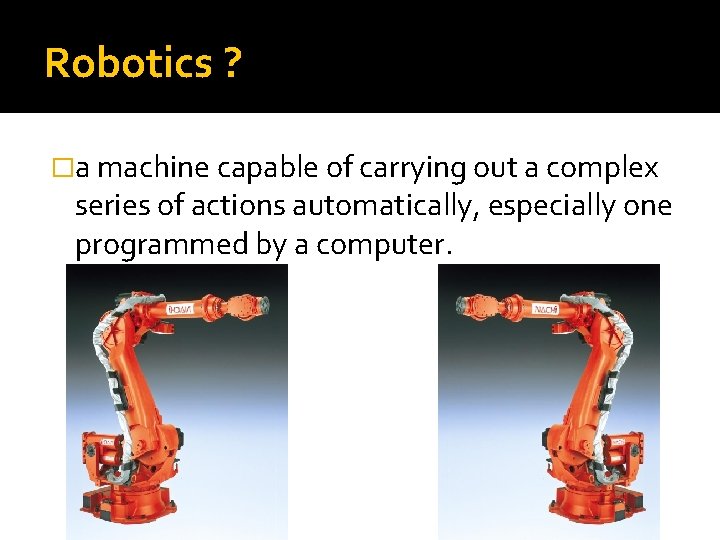
Robotics ? �a machine capable of carrying out a complex series of actions automatically, especially one programmed by a computer.
Applications �Robotic applications are almost limitless! �Robots can handle repetitive and tedious tasks such as: - spot welding - packing and sorting - when human involvement is too hazardous i. e. bomb removal
Growth � The International Federation of Robotics (IFR) estimates that over 2. 5 million industrial robots will be at work in 2019, representing an average annual growth rate of 12% between 2016 and 2019 � Sales projected a 15% increase in 2015 over the previous year.
Productivity �Used effectively, they enable companies to become or remain competitive. �enables large companies to increase their competitiveness through faster product development and delivery. �Robotic density showed annual growth of GDP and labor productivity between 1993 and 2007 by about 0. 37 and 0. 36 percent across 17 countries studied
Productivity ext. �A more recent study found that investment in robots contributed 10% of growth in GDP per capita in OCED countries from 1993 to 2016 �Mc. Kinsey Global Institute predicts that up to half of the total productivity growth needed to ensure a 2. 8% growth in GDP over the next 50 years will be driven by automation (Mc. Kinsey Global Institute 2017).
Employment Does automizing low paying jobs mean thinning the job market ? �places a premium on higher-skilled labor in the sectors in which automation has substituted for low skilled labor, but also may create new lower-skilled jobs in other sectors due to spillover effects
Employment ext. �‘While technology has potentially contributed to the loss of over 800, 000 lower-skilled jobs (in the UK) there is equally strong evidence to suggest that it has helped to create nearly 3. 5 million new higher-skilled ones in their place. ’ (Deloitte LLP 2015).
Reshoring initiative �The Reshore Initiative in 2015 plans to bring large firms back to the United States. By using technology as a cheaper labor force and doing so will bring an estimated 250, 000 jobs back to the U. S. and with it a rise in GDP
Conclusion �In conclusion, economies around the world are adopting robotic technologies at a rate expected to continue to climb. Statistically, the use of robotics in industry has had a huge effect on our and many countries Gross Domestic Product. Industry output has increased with the use of robotics and meeting demand for products is a much easier goal to reach.
- Slides: 10