
Richard K Min Circular Rhetoric and Paradox Exodus
- Slides: 44
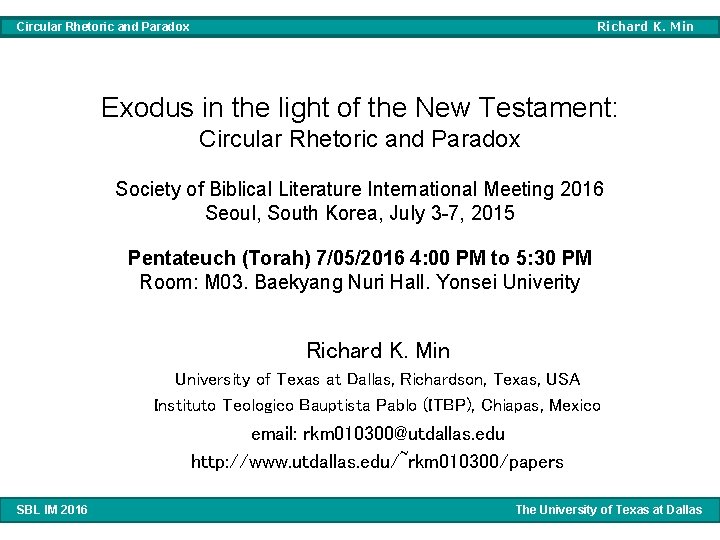
Richard K. Min Circular Rhetoric and Paradox Exodus in the light of the New Testament: Circular Rhetoric and Paradox Society of Biblical Literature International Meeting 2016 Seoul, South Korea, July 3 -7, 2015 Pentateuch (Torah) 7/05/2016 4: 00 PM to 5: 30 PM Room: M 03. Baekyang Nuri Hall. Yonsei Univerity Richard K. Min University of Texas at Dallas, Richardson, Texas, USA Instituto Teologico Bauptista Pablo (ITBP), Chiapas, Mexico email: rkm 010300@utdallas. edu http: //www. utdallas. edu/~rkm 010300/papers SBL IM 2016 The University of Texas at Dallas
Richard K. Min Circular Rhetoric and Paradox Acknowledgements • Gopal Gupta for his support and guidance for my study and research at University of Texas at Dallas. • Hyun. Gu Kim (Ko-Mex Mission, Mexico), Sam Underwood (FBC-FB), Sang-Jin Kim (GBC), Katy Barnwell (Wycliffe), Hosik Kim (Korean Bible University), Paul Miller (Gramcord), Se. June Hong (IBM), Dirk van der Merwe (U of South Africa), Yakhwee Tan (Westminster College) for their encouragement, support, and research opportunity. • Harry Hunt, Jr. (SWBTS), E. Earle Ellis (SWBTS), Carl F. H. Henry (WBS), John Grassmick (DTS), and Eugene Merrill (DTS) for my biblical and theological studies. • Cathy Drewry for Editorial Support. • Mi Min (my wife) for her support and encouragement, and being my first and best audience. SBL IM 2016 The University of Texas at Dallas
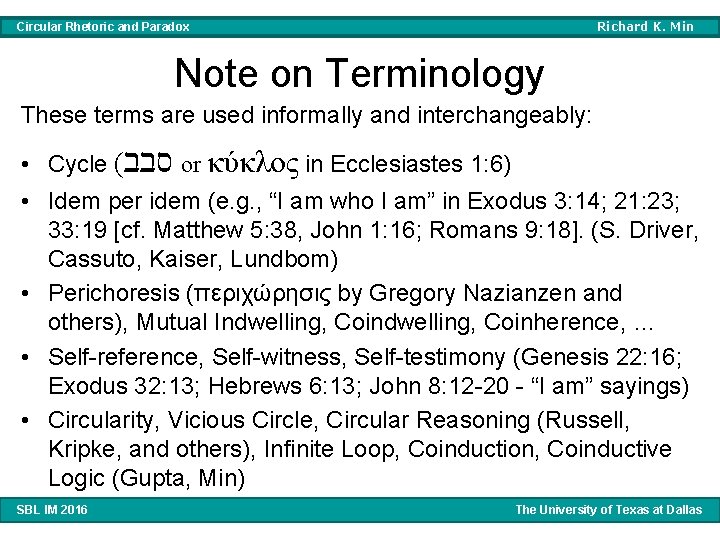
Richard K. Min Circular Rhetoric and Paradox Note on Terminology These terms are used informally and interchangeably: • Cycle ( סבב or κύκλος in Ecclesiastes 1: 6) • Idem per idem (e. g. , “I am who I am” in Exodus 3: 14; 21: 23; 33: 19 [cf. Matthew 5: 38, John 1: 16; Romans 9: 18]. (S. Driver, Cassuto, Kaiser, Lundbom) • Perichoresis (περιχώρησις by Gregory Nazianzen and others), Mutual Indwelling, Coinherence, … • Self-reference, Self-witness, Self-testimony (Genesis 22: 16; Exodus 32: 13; Hebrews 6: 13; John 8: 12 -20 - “I am” sayings) • Circularity, Vicious Circle, Circular Reasoning (Russell, Kripke, and others), Infinite Loop, Coinduction, Coinductive Logic (Gupta, Min) SBL IM 2016 The University of Texas at Dallas
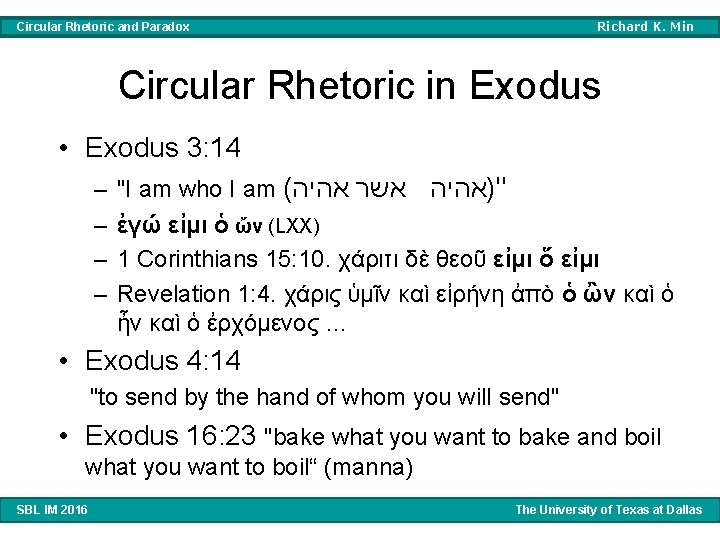
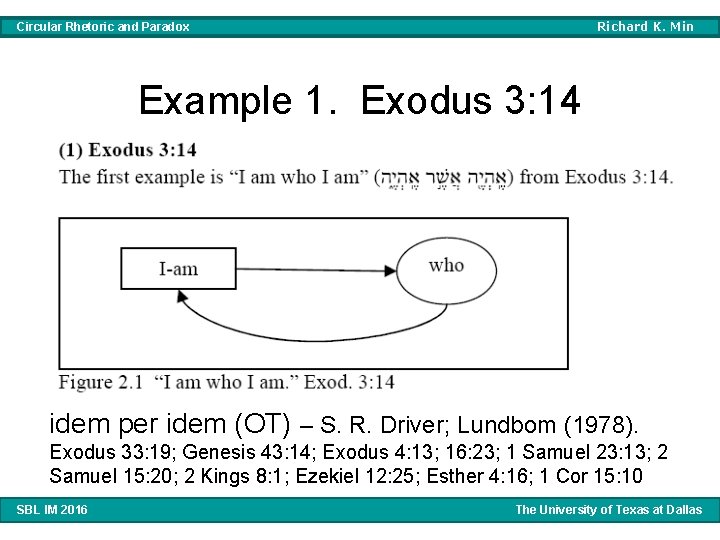
Richard K. Min Circular Rhetoric and Paradox Circular Rhetoric in Exodus • Exodus 3: 14 – – "I am who I am ( אהיה אשר ")אהיה ἐγώ εἰμι ὁ ὤν (LXX) 1 Corinthians 15: 10. χάριτι δὲ θεοῦ εἰμι ὅ εἰμι Revelation 1: 4. χάρις ὑμῖν καὶ εἰρήνη ἀπὸ ὁ ὢν καὶ ὁ ἦν καὶ ὁ ἐρχόμενος … • Exodus 4: 14 "to send by the hand of whom you will send" • Exodus 16: 23 "bake what you want to bake and boil what you want to boil“ (manna) SBL IM 2016 The University of Texas at Dallas
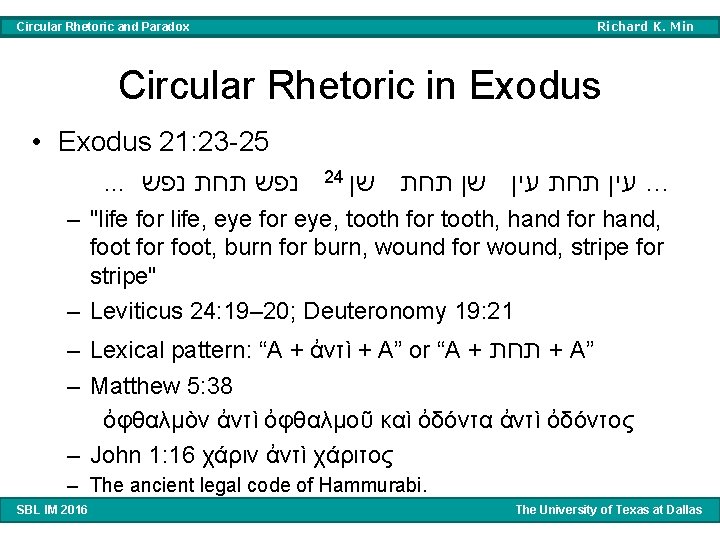
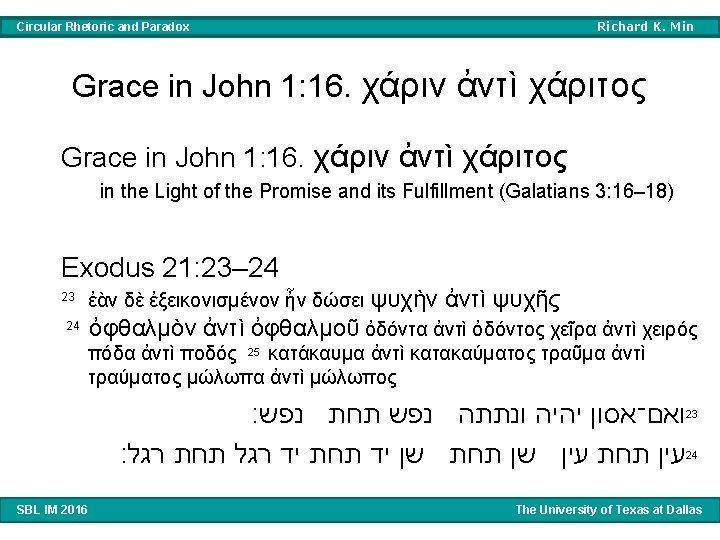
Circular Rhetoric and Paradox Richard K. Min Circular Rhetoric in Exodus • Exodus 21: 23 -25 … נפש תחת נפש 24 שן תחת שן עין תחת עין … – "life for life, eye for eye, tooth for tooth, hand for hand, foot for foot, burn for burn, wound for wound, stripe for stripe" – Leviticus 24: 19– 20; Deuteronomy 19: 21 – Lexical pattern: “A + ἀντὶ + A” or “A + תחת + A” – Matthew 5: 38 ὀφθαλμὸν ἀντὶ ὀφθαλμοῦ καὶ ὀδόντα ἀντὶ ὀδόντος – John 1: 16 χάριν ἀντὶ χάριτος – The ancient legal code of Hammurabi. SBL IM 2016 The University of Texas at Dallas
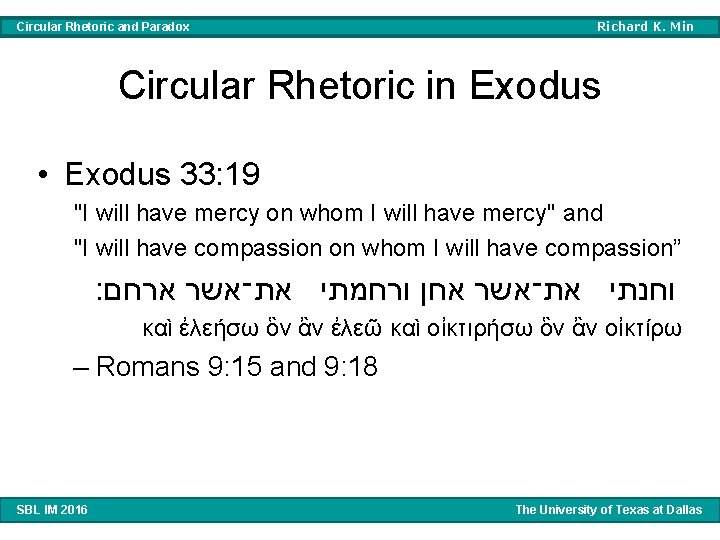
Circular Rhetoric and Paradox Richard K. Min Circular Rhetoric in Exodus • Exodus 33: 19 "I will have mercy on whom I will have mercy" and "I will have compassion on whom I will have compassion” ארחם׃ את־אשר ורחמתי אחן את־אשר וחנתי καὶ ἐλεήσω ὃν ἂν ἐλεῶ καὶ οἰκτιρήσω ὃν ἂν οἰκτίρω – Romans 9: 15 and 9: 18 SBL IM 2016 The University of Texas at Dallas
Richard K. Min Circular Rhetoric and Paradox Part 1 • Introduction and Background SBL IM 2016 The University of Texas at Dallas
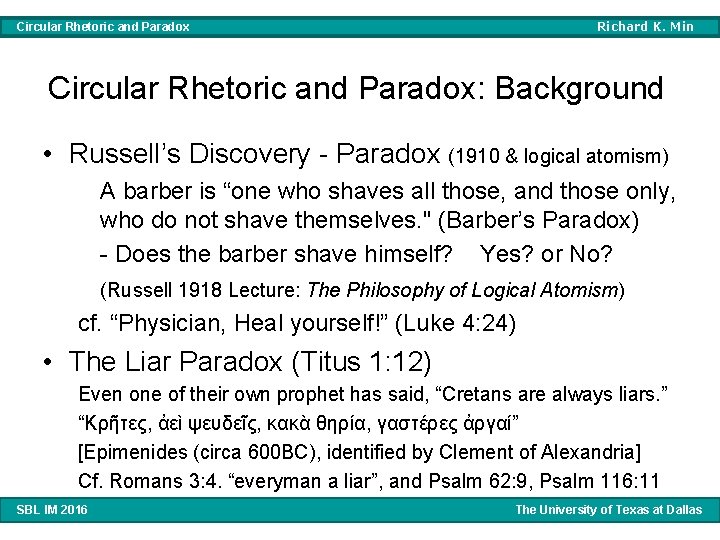
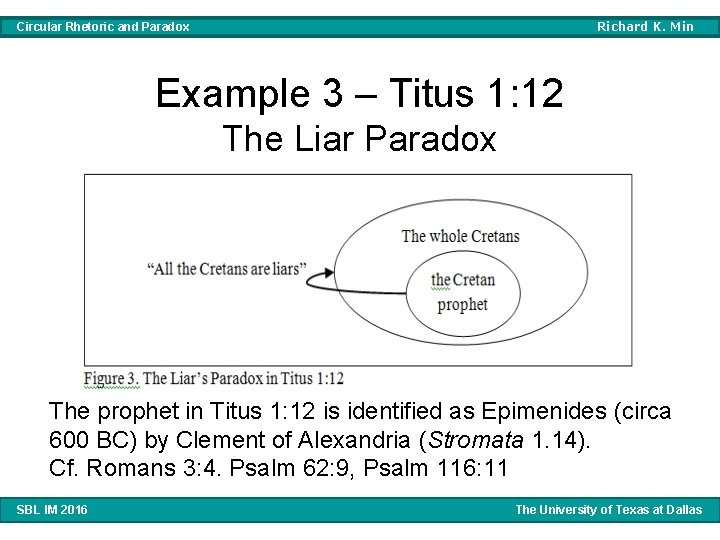
Richard K. Min Circular Rhetoric and Paradox: Background • Russell’s Discovery - Paradox (1910 & logical atomism) A barber is “one who shaves all those, and those only, who do not shave themselves. " (Barber’s Paradox) - Does the barber shave himself? Yes? or No? (Russell 1918 Lecture: The Philosophy of Logical Atomism) cf. “Physician, Heal yourself!” (Luke 4: 24) • The Liar Paradox (Titus 1: 12) Even one of their own prophet has said, “Cretans are always liars. ” “Κρῆτες, ἀεὶ ψευδεῖς, κακὰ θηρία, γαστέρες ἀργαί” [Epimenides (circa 600 BC), identified by Clement of Alexandria] Cf. Romans 3: 4. “everyman a liar”, and Psalm 62: 9, Psalm 116: 11 SBL IM 2016 The University of Texas at Dallas
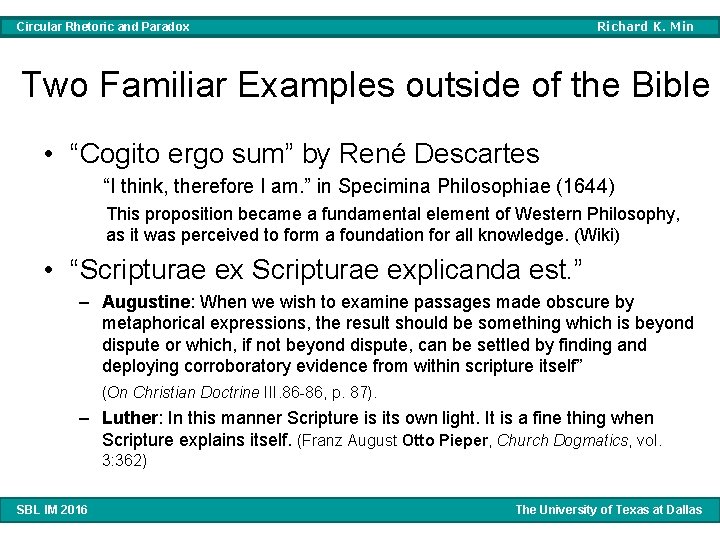
Richard K. Min Circular Rhetoric and Paradox Two Familiar Examples outside of the Bible • “Cogito ergo sum” by René Descartes “I think, therefore I am. ” in Specimina Philosophiae (1644) This proposition became a fundamental element of Western Philosophy, as it was perceived to form a foundation for all knowledge. (Wiki) • “Scripturae explicanda est. ” – Augustine: When we wish to examine passages made obscure by metaphorical expressions, the result should be something which is beyond dispute or which, if not beyond dispute, can be settled by finding and deploying corroboratory evidence from within scripture itself” (On Christian Doctrine III. 86 -86, p. 87). – Luther: In this manner Scripture is its own light. It is a fine thing when Scripture explains itself. (Franz August Otto Pieper, Church Dogmatics, vol. 3: 362) SBL IM 2016 The University of Texas at Dallas
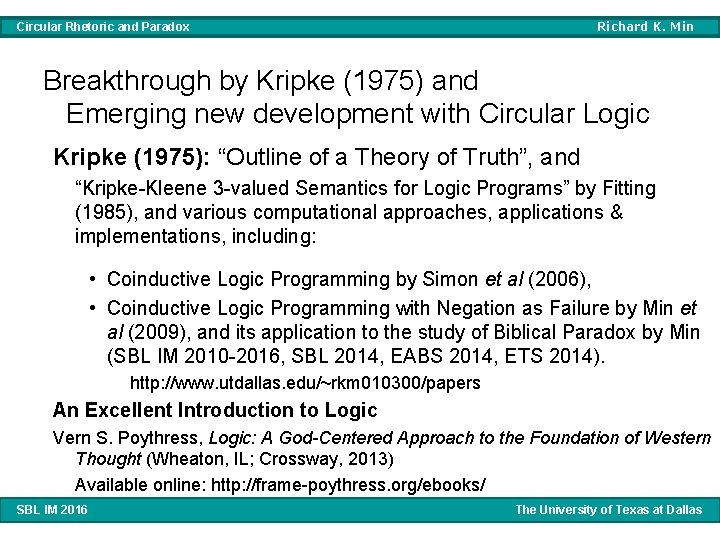
Richard K. Min Circular Rhetoric and Paradox Breakthrough by Kripke (1975) and Emerging new development with Circular Logic Kripke (1975): “Outline of a Theory of Truth”, and “Kripke-Kleene 3 -valued Semantics for Logic Programs” by Fitting (1985), and various computational approaches, applications & implementations, including: • Coinductive Logic Programming by Simon et al (2006), • Coinductive Logic Programming with Negation as Failure by Min et al (2009), and its application to the study of Biblical Paradox by Min (SBL IM 2010 -2016, SBL 2014, EABS 2014, ETS 2014). http: //www. utdallas. edu/~rkm 010300/papers An Excellent Introduction to Logic Vern S. Poythress, Logic: A God-Centered Approach to the Foundation of Western Thought (Wheaton, IL; Crossway, 2013) Available online: http: //frame-poythress. org/ebooks/ SBL IM 2016 The University of Texas at Dallas
Richard K. Min Circular Rhetoric and Paradox Part 2 • Survey - Selected Examples of Circular Rhetoric and Paradoxes in the Bible. – A few noteworthy examples & Structural Analysis SBL IM 2016 The University of Texas at Dallas
Richard K. Min Circular Rhetoric and Paradox Example 1. Exodus 3: 14 idem per idem (OT) – S. R. Driver; Lundbom (1978). Exodus 33: 19; Genesis 43: 14; Exodus 4: 13; 16: 23; 1 Samuel 23: 13; 2 Samuel 15: 20; 2 Kings 8: 1; Ezekiel 12: 25; Esther 4: 16; 1 Cor 15: 10 SBL IM 2016 The University of Texas at Dallas
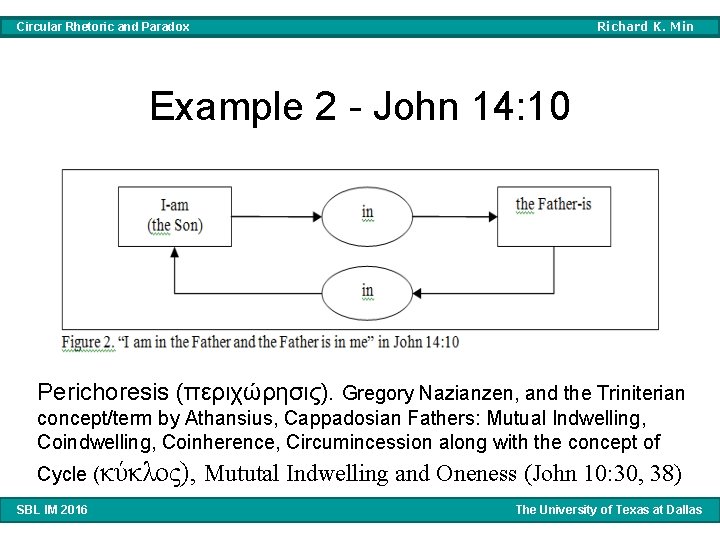
Richard K. Min Circular Rhetoric and Paradox Example 2 - John 14: 10 Perichoresis (περιχώρησις). Gregory Nazianzen, and the Triniterian concept/term by Athansius, Cappadosian Fathers: Mutual Indwelling, Coindwelling, Coinherence, Circumincession along with the concept of Cycle (κύκλος), SBL IM 2016 Mututal Indwelling and Oneness (John 10: 30, 38) The University of Texas at Dallas
Richard K. Min Circular Rhetoric and Paradox Example 3 – Titus 1: 12 The Liar Paradox The prophet in Titus 1: 12 is identified as Epimenides (circa 600 BC) by Clement of Alexandria (Stromata 1. 14). Cf. Romans 3: 4. Psalm 62: 9, Psalm 116: 11 SBL IM 2016 The University of Texas at Dallas
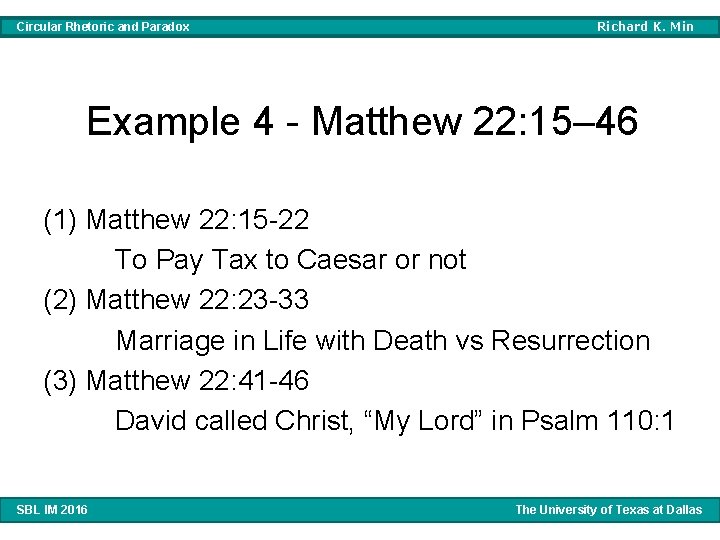
Circular Rhetoric and Paradox Richard K. Min Example 4 - Matthew 22: 15– 46 (1) Matthew 22: 15 -22 To Pay Tax to Caesar or not (2) Matthew 22: 23 -33 Marriage in Life with Death vs Resurrection (3) Matthew 22: 41 -46 David called Christ, “My Lord” in Psalm 110: 1 SBL IM 2016 The University of Texas at Dallas
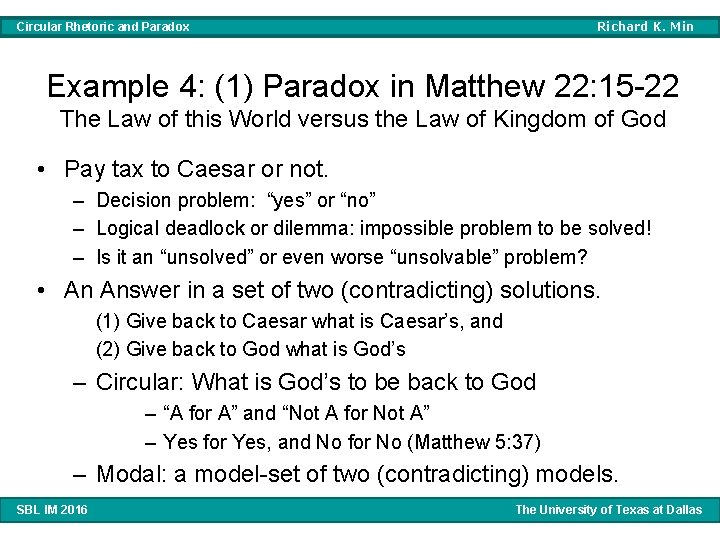
Richard K. Min Circular Rhetoric and Paradox Example 4: (1) Paradox in Matthew 22: 15 -22 The Law of this World versus the Law of Kingdom of God • Pay tax to Caesar or not. – Decision problem: “yes” or “no” – Logical deadlock or dilemma: impossible problem to be solved! – Is it an “unsolved” or even worse “unsolvable” problem? • An Answer in a set of two (contradicting) solutions. (1) Give back to Caesar what is Caesar’s, and (2) Give back to God what is God’s – Circular: What is God’s to be back to God – “A for A” and “Not A for Not A” – Yes for Yes, and No for No (Matthew 5: 37) – Modal: a model-set of two (contradicting) models. SBL IM 2016 The University of Texas at Dallas
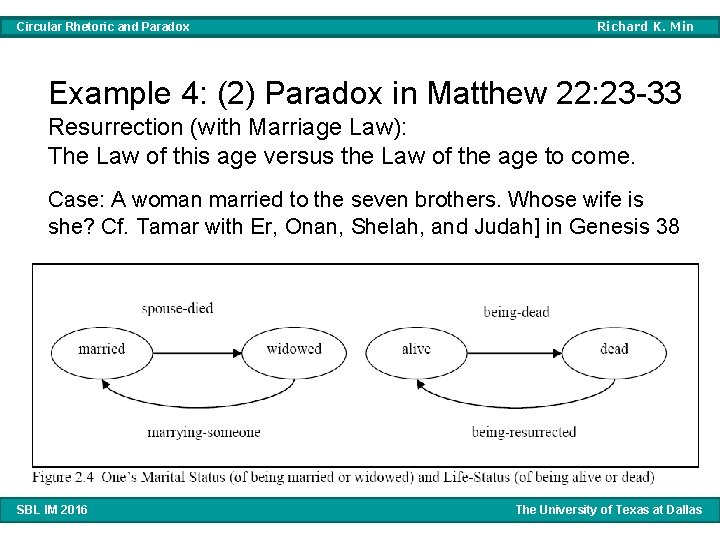
Circular Rhetoric and Paradox Richard K. Min Example 4: (2) Paradox in Matthew 22: 23 -33 Resurrection (with Marriage Law): The Law of this age versus the Law of the age to come. Case: A woman married to the seven brothers. Whose wife is she? Cf. Tamar with Er, Onan, Shelah, and Judah] in Genesis 38 SBL IM 2016 The University of Texas at Dallas
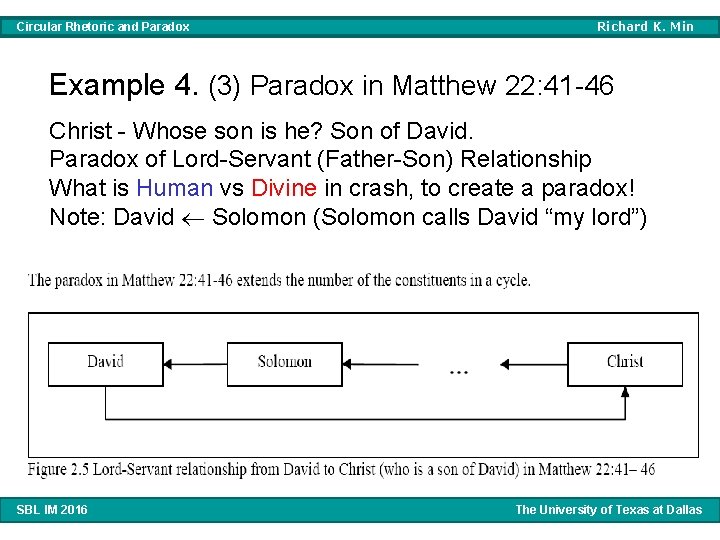
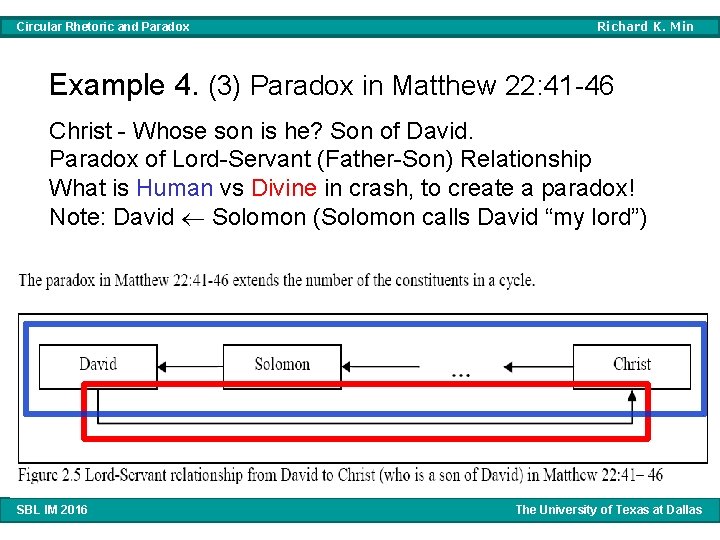
Circular Rhetoric and Paradox Richard K. Min Example 4. (3) Paradox in Matthew 22: 41 -46 Christ - Whose son is he? Son of David. Paradox of Lord-Servant (Father-Son) Relationship What is Human vs Divine in crash, to create a paradox! Note: David Solomon (Solomon calls David “my lord”) SBL IM 2016 The University of Texas at Dallas
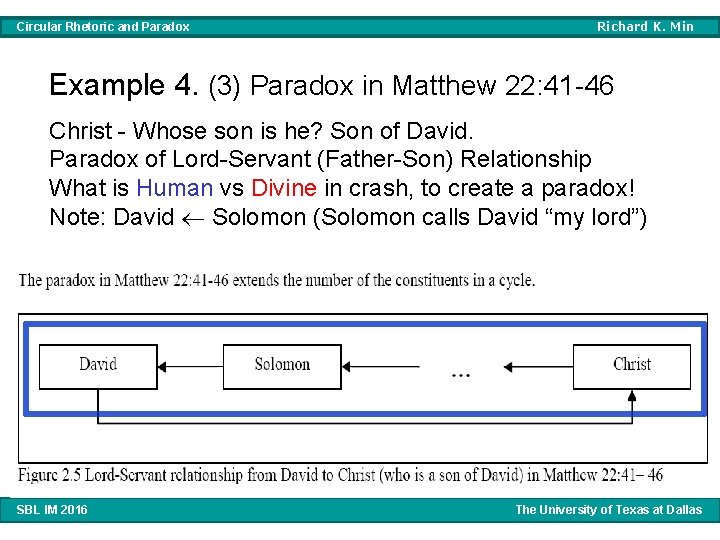
Circular Rhetoric and Paradox Richard K. Min Example 4. (3) Paradox in Matthew 22: 41 -46 Christ - Whose son is he? Son of David. Paradox of Lord-Servant (Father-Son) Relationship What is Human vs Divine in crash, to create a paradox! Note: David Solomon (Solomon calls David “my lord”) SBL IM 2016 The University of Texas at Dallas
Circular Rhetoric and Paradox Richard K. Min Example 4. (3) Paradox in Matthew 22: 41 -46 Christ - Whose son is he? Son of David. Paradox of Lord-Servant (Father-Son) Relationship What is Human vs Divine in crash, to create a paradox! Note: David Solomon (Solomon calls David “my lord”) SBL IM 2016 The University of Texas at Dallas
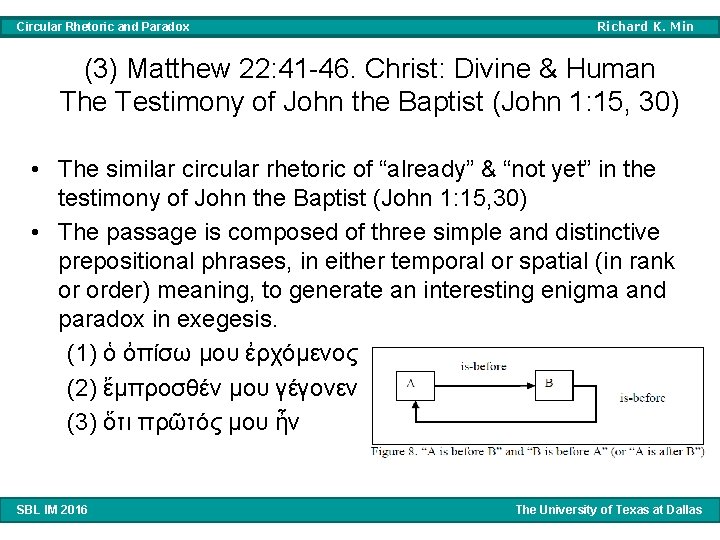
Circular Rhetoric and Paradox Richard K. Min (3) Matthew 22: 41 -46. Christ: Divine & Human The Testimony of John the Baptist (John 1: 15, 30) • The similar circular rhetoric of “already” & “not yet” in the testimony of John the Baptist (John 1: 15, 30) • The passage is composed of three simple and distinctive prepositional phrases, in either temporal or spatial (in rank or order) meaning, to generate an interesting enigma and paradox in exegesis. (1) ὁ ὀπίσω μου ἐρχόμενος (2) ἔμπροσθέν μου γέγονεν (3) ὅτι πρῶτός μου ἦν SBL IM 2016 The University of Texas at Dallas
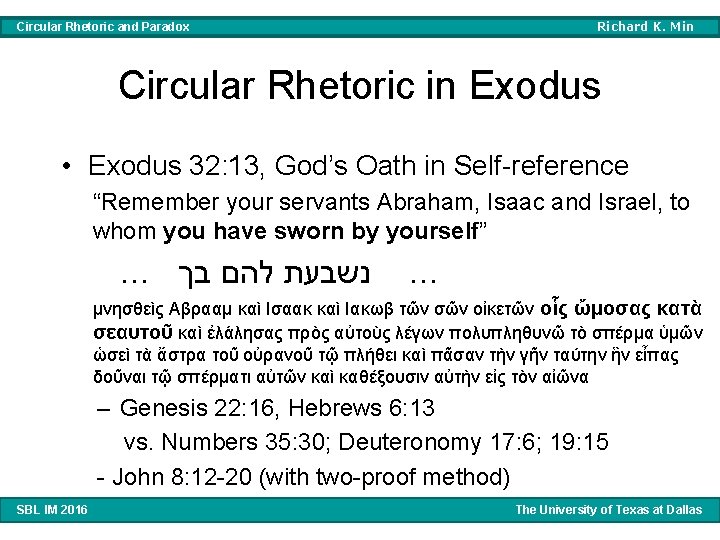
Circular Rhetoric and Paradox Richard K. Min Hebrews: A Masterpiece of Circular Rhetoric and Logic of Paradox in Action Paradox 1. The Son of God vs Melchizedek (Psalm 110: 1, 4; Hebrews 7: 3, 15). [Paradox of “Already” and “Not Yet”] Paradox 2. The oath of God, sworn by himself (Hebrews 6: 13; 7: 21). [Paradox of Self-Testimony] Paradox 3. According to the Scripture, as it is written, the Son of God has come to fulfill what had been written about himself (Psalm 40: 6– 8; Hebrews 10: 5– 9). [Paradox of Self-Reference: Son of God in Person and in Scripture referring to Himself in Scripture] Paradox 4. The Son of God as the High-Priest of God, offering Himself as the sacrifice (Hebrews 10: 8– 10). [Paradox of Mutual Reference] SBL IM 2016 The University of Texas at Dallas
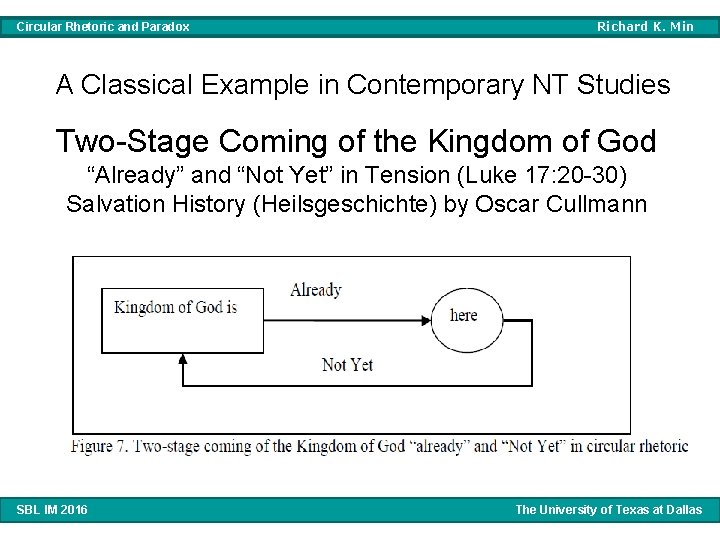
Circular Rhetoric and Paradox Richard K. Min A Classical Example in Contemporary NT Studies Two-Stage Coming of the Kingdom of God “Already” and “Not Yet” in Tension (Luke 17: 20 -30) Salvation History (Heilsgeschichte) by Oscar Cullmann SBL IM 2016 The University of Texas at Dallas
Richard K. Min Circular Rhetoric and Paradox A New Look at Matthew 22: 15 -46 • Four Questions (& Answers) in Form-critical classification • Midrash in Yelammedenu Midrash (Question-Answer) • W. G. Braude. Pesikta Rabbati 2 vols. (1968). • J. W. Bowker, ‘Speeches in Acts: A Study in Proem and Yelammedenu Form’ NTS 14 (1967 -1968) 96 -111. • E. Earle Ellis, ‘Midrashic Features in the Speeches of Acts’ (1970) 303 -312 • All dealing with non-conventional, non-classical logic – generating paradox, confusion, conflict, contradiction, dilemma – defying conventional logic or contemporary common-sense – dealing with circular, modal, or nonmonotonic logic • All very difficult problems in Sitz Im Leben – at least “very easy” to verify once a solution is given – A problem of verification (cf. Luke 5: 23; Daniel 2) SBL IM 2016 The University of Texas at Dallas
Richard K. Min Circular Rhetoric and Paradox A New Look at Matthew 22: 15 -46 • All dealing with Biblical Law & Legal Reasoning • thus the problems of Biblical Legal Reasoning (Halakoth) • Two Laws in Conflict – Matthew 22: 15 -22. Tax Law • the law of God vs the law of Caesar (this World) • Who is my Master (Matthew 6: 24)? Whose servant am I? – Matthew 22: 23 -33. Marriage (Family) Law • the law of Marriage (Mosaic Law) in this age vs. in the age to come • the old law to be perished (time-expired) vs. the new law in resurrection • Old Law vs. New Law (over the old law) – Matthew 22: 34 -40. Linear Order in the Laws (legal precedence) • Hierarchy of the Laws, legal authority, highest law, legal precedence and superseding law, to avoid circular paradox but provide a linear order – Matthew 22: 41 -46. Law of Inheritance (for Title of Lordship) • the law governing the Son of God in flesh vs. divine (Psalm 110: 1) SBL IM 2016 The University of Texas at Dallas
Richard K. Min Circular Rhetoric and Paradox Part 3 • Biblical & Exegetical Foundation of Circular Rhetoric and Logic of Paradox • Exodus in the light of New Testament SBL IM 2016 The University of Texas at Dallas
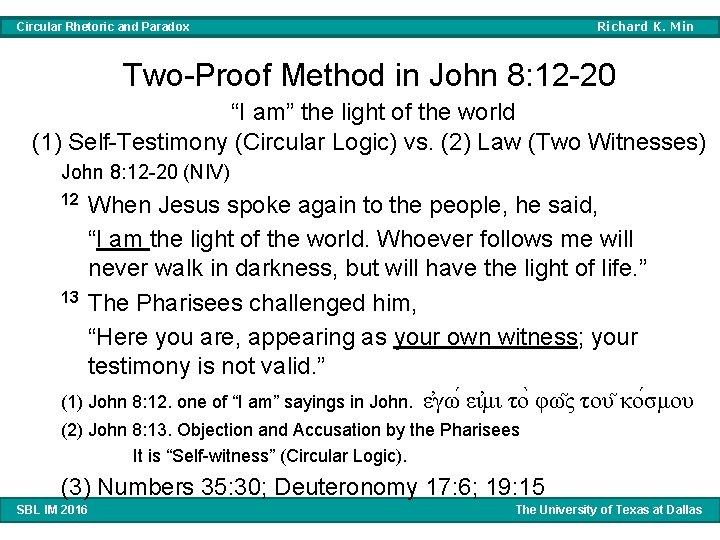
Richard K. Min Circular Rhetoric and Paradox Two-Proof Method in John 8: 12 -20 “I am” the light of the world (1) Self-Testimony (Circular Logic) vs. (2) Law (Two Witnesses) John 8: 12 -20 (NIV) When Jesus spoke again to the people, he said, “I am the light of the world. Whoever follows me will never walk in darkness, but will have the light of life. ” 13 The Pharisees challenged him, “Here you are, appearing as your own witness; your testimony is not valid. ” (1) John 8: 12. one of “I am” sayings in John. ε γω ει μι το φω ς του κο σμου 12 (2) John 8: 13. Objection and Accusation by the Pharisees It is “Self-witness” (Circular Logic). (3) Numbers 35: 30; Deuteronomy 17: 6; 19: 15 SBL IM 2016 The University of Texas at Dallas
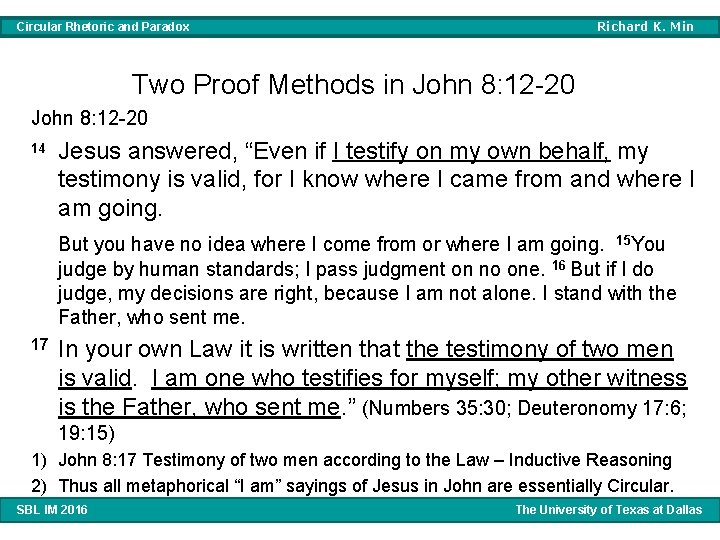
Richard K. Min Circular Rhetoric and Paradox Two Proof Methods in John 8: 12 -20 14 Jesus answered, “Even if I testify on my own behalf, my testimony is valid, for I know where I came from and where I am going. But you have no idea where I come from or where I am going. 15 You judge by human standards; I pass judgment on no one. 16 But if I do judge, my decisions are right, because I am not alone. I stand with the Father, who sent me. 17 In your own Law it is written that the testimony of two men is valid. I am one who testifies for myself; my other witness is the Father, who sent me. ” (Numbers 35: 30; Deuteronomy 17: 6; 19: 15) 1) John 8: 17 Testimony of two men according to the Law – Inductive Reasoning 2) Thus all metaphorical “I am” sayings of Jesus in John are essentially Circular. SBL IM 2016 The University of Texas at Dallas
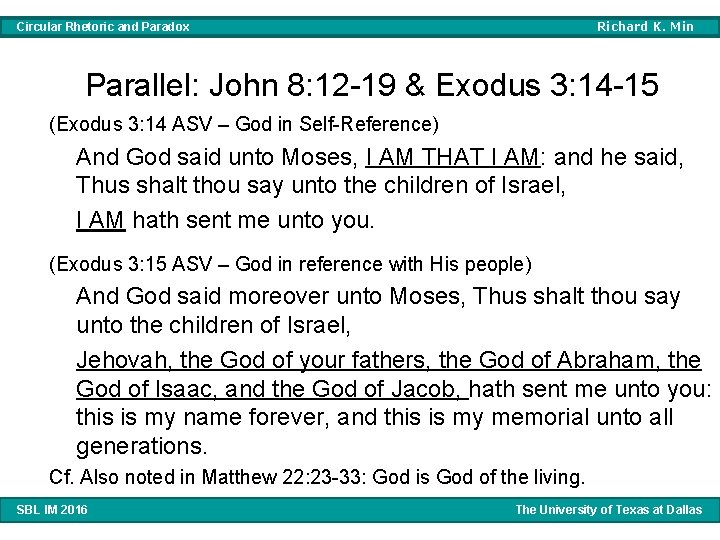
Richard K. Min Circular Rhetoric and Paradox Parallel: John 8: 12 -19 & Exodus 3: 14 -15 (Exodus 3: 14 ASV – God in Self-Reference) And God said unto Moses, I AM THAT I AM: and he said, Thus shalt thou say unto the children of Israel, I AM hath sent me unto you. (Exodus 3: 15 ASV – God in reference with His people) And God said moreover unto Moses, Thus shalt thou say unto the children of Israel, Jehovah, the God of your fathers, the God of Abraham, the God of Isaac, and the God of Jacob, hath sent me unto you: this is my name forever, and this is my memorial unto all generations. Cf. Also noted in Matthew 22: 23 -33: God is God of the living. SBL IM 2016 The University of Texas at Dallas
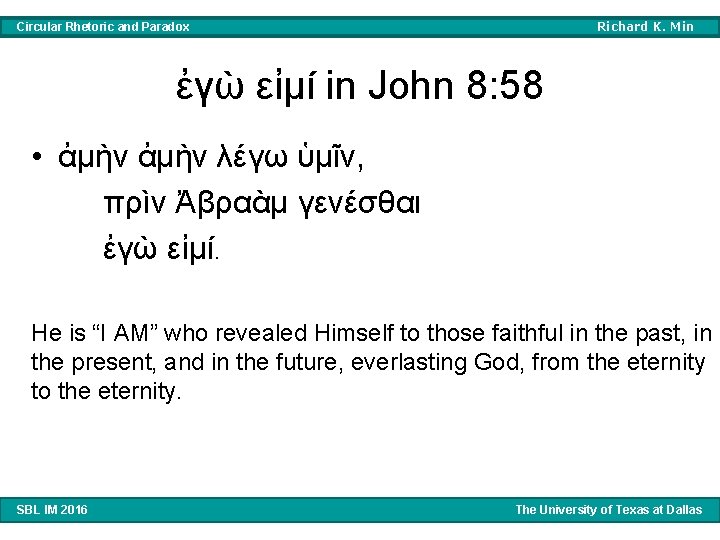
Richard K. Min Circular Rhetoric and Paradox ἐγὼ εἰμί in John 8: 58 • ἀμὴν λέγω ὑμῖν, πρὶν Ἀβραὰμ γενέσθαι ἐγὼ εἰμί. He is “I AM” who revealed Himself to those faithful in the past, in the present, and in the future, everlasting God, from the eternity to the eternity. SBL IM 2016 The University of Texas at Dallas
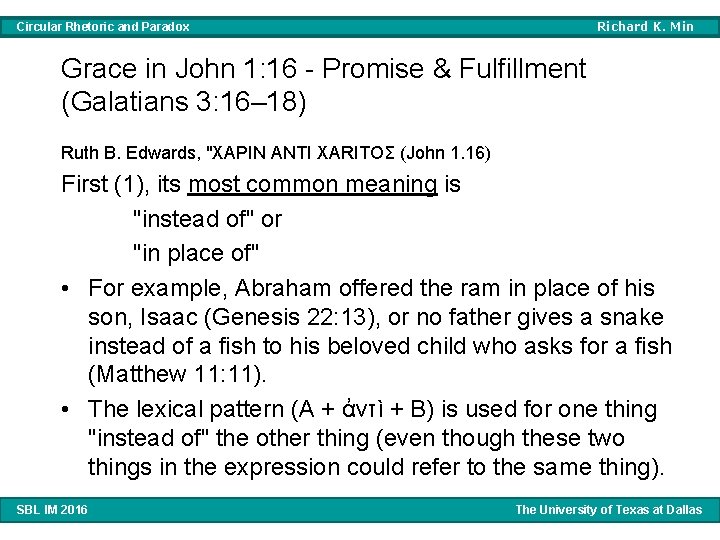
Richard K. Min Circular Rhetoric and Paradox Grace in John 1: 16 - Promise & Fulfillment (Galatians 3: 16– 18) Ruth B. Edwards, "XAPIN ANTI XARITOΣ (John 1. 16) First (1), its most common meaning is "instead of" or "in place of" • For example, Abraham offered the ram in place of his son, Isaac (Genesis 22: 13), or no father gives a snake instead of a fish to his beloved child who asks for a fish (Matthew 11: 11). • The lexical pattern (A + ἀντὶ + B) is used for one thing "instead of" the other thing (even though these two things in the expression could refer to the same thing). SBL IM 2016 The University of Texas at Dallas
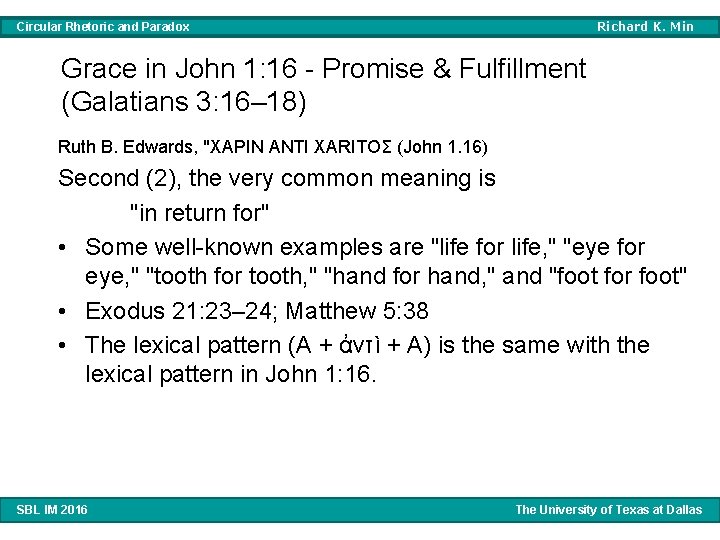
Richard K. Min Circular Rhetoric and Paradox Grace in John 1: 16 - Promise & Fulfillment (Galatians 3: 16– 18) Ruth B. Edwards, "XAPIN ANTI XARITOΣ (John 1. 16) Second (2), the very common meaning is "in return for" • Some well-known examples are "life for life, " "eye for eye, " "tooth for tooth, " "hand for hand, " and "foot for foot" • Exodus 21: 23– 24; Matthew 5: 38 • The lexical pattern (A + ἀντὶ + A) is the same with the lexical pattern in John 1: 16. SBL IM 2016 The University of Texas at Dallas
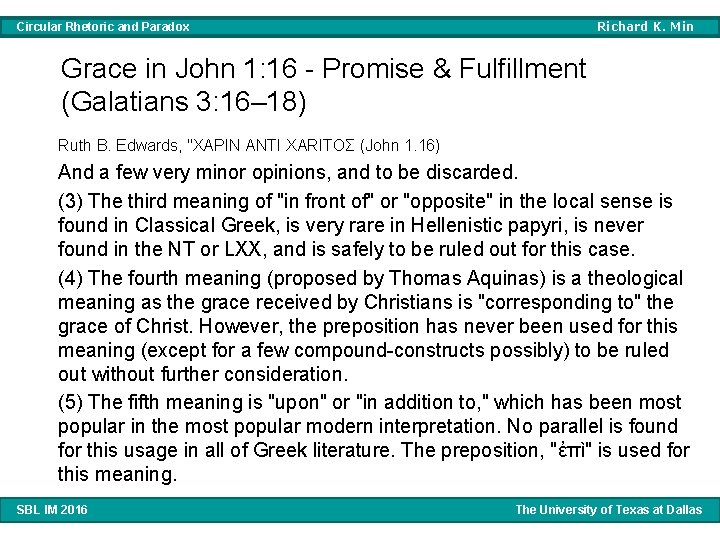
Richard K. Min Circular Rhetoric and Paradox Grace in John 1: 16 - Promise & Fulfillment (Galatians 3: 16– 18) Ruth B. Edwards, "XAPIN ANTI XARITOΣ (John 1. 16) And a few very minor opinions, and to be discarded. (3) The third meaning of "in front of" or "opposite" in the local sense is found in Classical Greek, is very rare in Hellenistic papyri, is never found in the NT or LXX, and is safely to be ruled out for this case. (4) The fourth meaning (proposed by Thomas Aquinas) is a theological meaning as the grace received by Christians is "corresponding to" the grace of Christ. However, the preposition has never been used for this meaning (except for a few compound-constructs possibly) to be ruled out without further consideration. (5) The fifth meaning is "upon" or "in addition to, " which has been most popular in the most popular modern interpretation. No parallel is found for this usage in all of Greek literature. The preposition, "ἐπὶ" is used for this meaning. SBL IM 2016 The University of Texas at Dallas
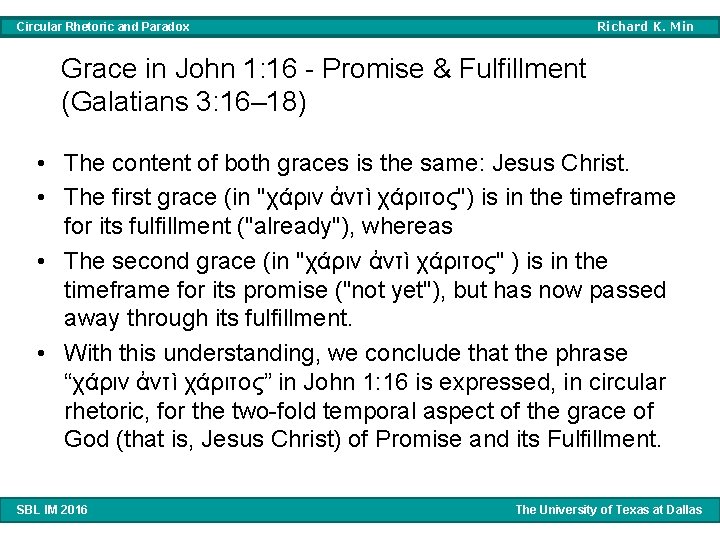
Richard K. Min Circular Rhetoric and Paradox Grace in John 1: 16 - Promise & Fulfillment (Galatians 3: 16– 18) • The content of both graces is the same: Jesus Christ. • The first grace (in "χάριν ἀντὶ χάριτος") is in the timeframe for its fulfillment ("already"), whereas • The second grace (in "χάριν ἀντὶ χάριτος" ) is in the timeframe for its promise ("not yet"), but has now passed away through its fulfillment. • With this understanding, we conclude that the phrase “χάριν ἀντὶ χάριτος” in John 1: 16 is expressed, in circular rhetoric, for the two-fold temporal aspect of the grace of God (that is, Jesus Christ) of Promise and its Fulfillment. SBL IM 2016 The University of Texas at Dallas
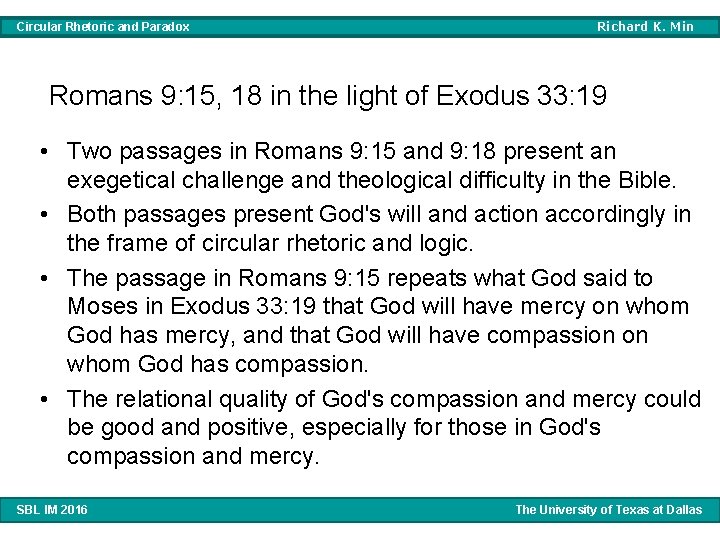
Circular Rhetoric and Paradox Richard K. Min Romans 9: 15, 18 in the light of Exodus 33: 19 • Two passages in Romans 9: 15 and 9: 18 present an exegetical challenge and theological difficulty in the Bible. • Both passages present God's will and action accordingly in the frame of circular rhetoric and logic. • The passage in Romans 9: 15 repeats what God said to Moses in Exodus 33: 19 that God will have mercy on whom God has mercy, and that God will have compassion on whom God has compassion. • The relational quality of God's compassion and mercy could be good and positive, especially for those in God's compassion and mercy. SBL IM 2016 The University of Texas at Dallas
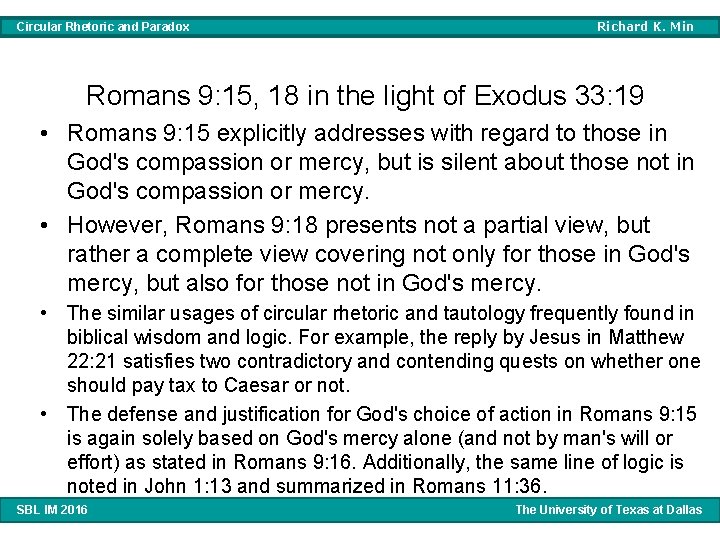
Circular Rhetoric and Paradox Richard K. Min Romans 9: 15, 18 in the light of Exodus 33: 19 • Romans 9: 15 explicitly addresses with regard to those in God's compassion or mercy, but is silent about those not in God's compassion or mercy. • However, Romans 9: 18 presents not a partial view, but rather a complete view covering not only for those in God's mercy, but also for those not in God's mercy. • The similar usages of circular rhetoric and tautology frequently found in biblical wisdom and logic. For example, the reply by Jesus in Matthew 22: 21 satisfies two contradictory and contending quests on whether one should pay tax to Caesar or not. • The defense and justification for God's choice of action in Romans 9: 15 is again solely based on God's mercy alone (and not by man's will or effort) as stated in Romans 9: 16. Additionally, the same line of logic is noted in John 1: 13 and summarized in Romans 11: 36. SBL IM 2016 The University of Texas at Dallas
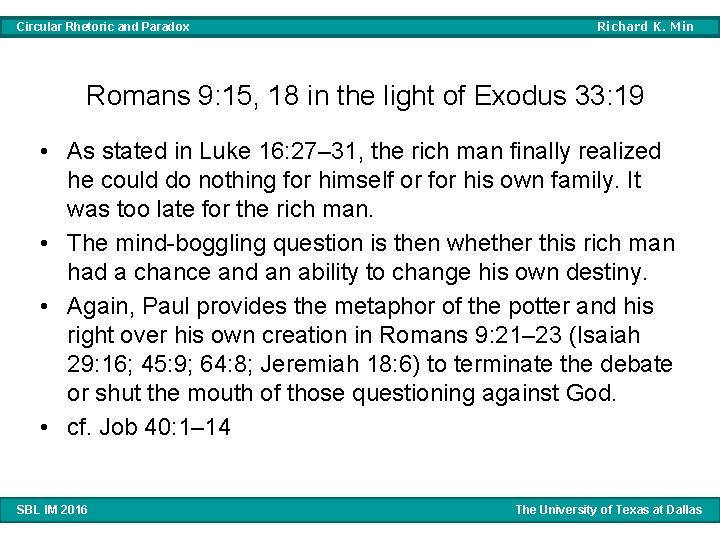
Circular Rhetoric and Paradox Richard K. Min Romans 9: 15, 18 in the light of Exodus 33: 19 • As stated in Luke 16: 27– 31, the rich man finally realized he could do nothing for himself or for his own family. It was too late for the rich man. • The mind-boggling question is then whether this rich man had a chance and an ability to change his own destiny. • Again, Paul provides the metaphor of the potter and his right over his own creation in Romans 9: 21– 23 (Isaiah 29: 16; 45: 9; 64: 8; Jeremiah 18: 6) to terminate the debate or shut the mouth of those questioning against God. • cf. Job 40: 1– 14 SBL IM 2016 The University of Texas at Dallas
Richard K. Min Circular Rhetoric and Paradox Part 4 • Circular Rhetoric and Logic of Paradox • A New Critical Method SBL IM 2016 The University of Texas at Dallas
Circular Rhetoric and Paradox Richard K. Min A Semantic Difference with Circular Logic • Induction and its Semantics – Here we say “infinite” or “eternal” – but it has no meaning in the frame of Induction or Inductive Logic (in this conventional “finite” worldview). • Coindcution and its Semantics (extending induction) Example: The “chicken or egg” problem (1) a chicken comes out of an egg, (2) an egg comes out of a chicken, and (3) the reproductive cycle between chicken and egg goes on forever. Inductive Logic: No answer Coinductive Logic: 4 possible answers { No answer, Chicken, Egg, Chicken and Egg } SBL IM 2016 The University of Texas at Dallas
Richard K. Min Circular Rhetoric and Paradox A New Critical Method • Circular Rhetoric and Logic of Paradoxes To make sense and do a valid and sound exegesis. Otherwise, to treat it meaningless or invalid, or to treat as if it is not there • There are so many and so predominant in the Bible And each case/its presence simply cannot to be ignored or silenced. • Once understood and applied correctly, it truly makes sense objectively and logical Matthew 22: 15 -46, John 8: 12 -20 with Exodus 3: 14 -15 • To construct a coherent, consistent, and unifying framework in exegesis and its application (and no need of “post-liberal theology or narrative theology”, deconstructionism or “story-telling” [as one may argue that these biblical passages have no valid logic or an objective truth, and thus treat them metaphorically, subjectively, . . . ] SBL IM 2016 The University of Texas at Dallas
Richard K. Min Circular Rhetoric and Paradox Afterword by Solomon 13 Now all has been heard; here is the conclusion of the matter: Fear God and keep his commandments, for this is the duty of all mankind. 14 For God will bring every deed into judgment, including every hidden thing, whether it is good or evil. (Ecclesiastes 12: 13 -14 NIV) SBL IM 2016 The University of Texas at Dallas