
Richard K Min Circular Rhetoric and Biblical Paradox
Richard K. Min Circular Rhetoric and Biblical Paradox A New Biblical Insight and Framework for the Early Christian Doctrine and Understanding [Circular Rhetoric and Paradox] Society of Biblical Literature International Meeting 2016 Seoul, South Korea, July 3 -7, 2016 Biblical Interpretation in Early Christianity: Apostolic and Related Early Christian Literature 7/07/2016 Thursday 9: 00 AM to 10: 30 AM Room: M 02 - Baekyang Nuri Hall D. Jeffrey Bingham, Wheaton College, Presiding Richard K. Min University of Texas at Dallas, Richardson, Texas, USA Instituto Teologico Bauptista Pablo (ITBP), Chiapas, Mexico email: rkm 010300@utdallas. edu http: //www. utdallas. edu/~rkm 010300/papers SBL IM 2016 The University of Texas at Dallas
Richard K. Min Circular Rhetoric and Biblical Paradox Acknowledgements • Gopal Gupta for his support and guidance for my study and research at University of Texas at Dallas. • Hyun. Gu Kim (Ko-Mex Mission, Mexico), Sam Underwood (FBC-FB), Sang-Jin Kim (GBC), Katy Barnwell (Wycliffe), Hosik Kim (Korean Bible University), Paul Miller (Gramcord), Se. June Hong (IBM), Dirk van der Merwe (U of South Africa), Yakhwee Tan (Westminster College) for their encouragement, support, and research opportunity. • Harry Hunt, Jr. (SWBTS), E. Earle Ellis (SWBTS), Carl F. H. Henry (WBS), John Grassmick (DTS), and Eugene Merrill (DTS) for my biblical and theological studies. • Cathy Drewry for Editorial Support. • Mi Min (my wife) for her support and encouragement, and being my first and best audience. SBL IM 2016 The University of Texas at Dallas
Richard K. Min Circular Rhetoric and Biblical Paradox Note on Terminology Terms & Concepts used here informally and interchangeably: • Cycle ( [ סבב κύκλος] in Ecclesiastes 1: 6) • Idem per idem (e. g. , “I am who I am” in Exodus 3: 14; 21: 23; 33: 19 [cf. Matthew 5: 38, John 1: 16; Romans 9: 18]. (S. Driver, Cassuto, Kaiser, Lundbom 1978) • Perichoresis (περιχώρησις by Gregory Nazianzen and others), Mutual Indwelling, Coinherence, … • Self-reference, Self-witness, Self-testimony (Genesis 22: 16; Exodus 32: 13; Hebrews 6: 13; John 8: 12 -20 - “I am” sayings) • Circularity, Vicious Circle, Circular Reasoning (Russell, Kripke, and others), Infinite Loop, Coinduction, Coinductive Logic (Gupta, Min) in Computational Logic SBL IM 2016 The University of Texas at Dallas
Richard K. Min Circular Rhetoric and Biblical Paradox Part 1 • Introduction and Background SBL IM 2016 The University of Texas at Dallas
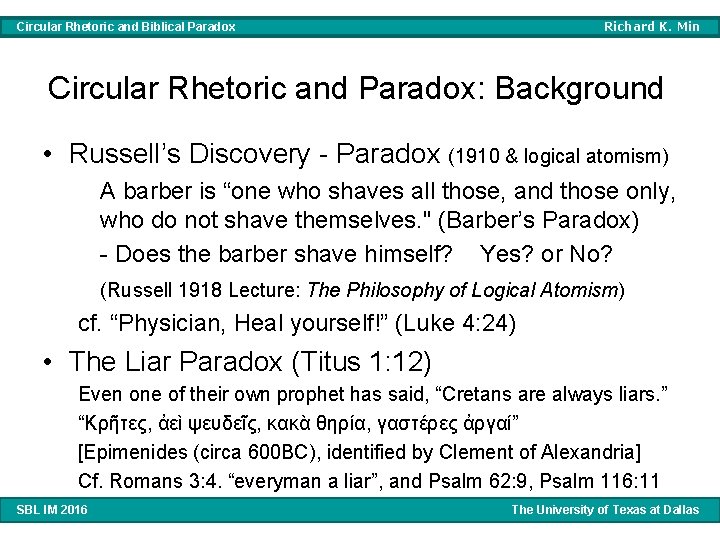
Richard K. Min Circular Rhetoric and Biblical Paradox Circular Rhetoric and Paradox: Background • Russell’s Discovery - Paradox (1910 & logical atomism) A barber is “one who shaves all those, and those only, who do not shave themselves. " (Barber’s Paradox) - Does the barber shave himself? Yes? or No? (Russell 1918 Lecture: The Philosophy of Logical Atomism) cf. “Physician, Heal yourself!” (Luke 4: 24) • The Liar Paradox (Titus 1: 12) Even one of their own prophet has said, “Cretans are always liars. ” “Κρῆτες, ἀεὶ ψευδεῖς, κακὰ θηρία, γαστέρες ἀργαί” [Epimenides (circa 600 BC), identified by Clement of Alexandria] Cf. Romans 3: 4. “everyman a liar”, and Psalm 62: 9, Psalm 116: 11 SBL IM 2016 The University of Texas at Dallas

Richard K. Min Circular Rhetoric and Biblical Paradox Two Familiar Examples outside of the Bible • “Cogito ergo sum” by René Descartes “I think, therefore I am. ” in Specimina Philosophiae (1644) This proposition became a fundamental element of Western Philosophy, as it was perceived to form a foundation for all knowledge. (Wiki) • “Scripturae explicanda est. ” – Augustine: When we wish to examine passages made obscure by metaphorical expressions, the result should be something which is beyond dispute or which, if not beyond dispute, can be settled by finding and deploying corroboratory evidence from within scripture itself” (On Christian Doctrine III. 86 -86, p. 87). – Luther: In this manner Scripture is its own light. It is a fine thing when Scripture explains itself. (Franz August Otto Pieper, Church Dogmatics, vol. 3: 362) SBL IM 2016 The University of Texas at Dallas
Richard K. Min Circular Rhetoric and Biblical Paradox Breakthrough by Kripke (1975) and Emerging new development with Circular Logic Kripke (1975): “Outline of a Theory of Truth”, and “Kripke-Kleene 3 -valued Semantics for Logic Programs” by Fitting (1985), and various computational approaches, applications & implementations, including: • Coinductive Logic Programming by Simon et al (2006), • Coinductive Logic Programming with Negation as Failure by Min et al (2009), and its application to the study of Biblical Paradox by Min (SBL IM 2010 -2016, SBL 2014, EABS 2014, ETS 2014). http: //www. utdallas. edu/~rkm 010300/papers An Excellent Introduction to Logic by Poythress Vern S. Poythress, Logic: A God-Centered Approach to the Foundation of Western Thought (Wheaton, IL; Crossway, 2013) Available online: http: //frame-poythress. org/ebooks/ SBL IM 2016 The University of Texas at Dallas
Richard K. Min Circular Rhetoric and Biblical Paradox Part 2 • Survey - Selected Examples in the Bible Circular Rhetoric and Paradox SBL IM 2016 The University of Texas at Dallas
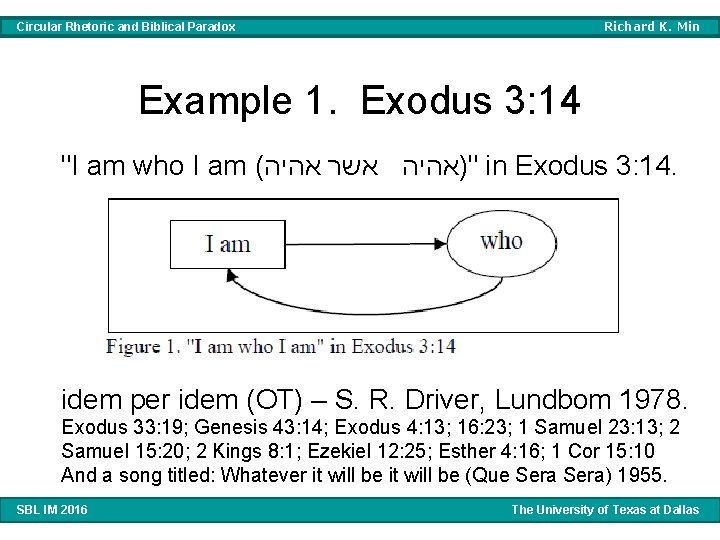
Richard K. Min Circular Rhetoric and Biblical Paradox Example 1. Exodus 3: 14 "I am who I am ( ")אהיה אשר אהיה in Exodus 3: 14. idem per idem (OT) – S. R. Driver, Lundbom 1978. Exodus 33: 19; Genesis 43: 14; Exodus 4: 13; 16: 23; 1 Samuel 23: 13; 2 Samuel 15: 20; 2 Kings 8: 1; Ezekiel 12: 25; Esther 4: 16; 1 Cor 15: 10 And a song titled: Whatever it will be (Que Sera) 1955. SBL IM 2016 The University of Texas at Dallas
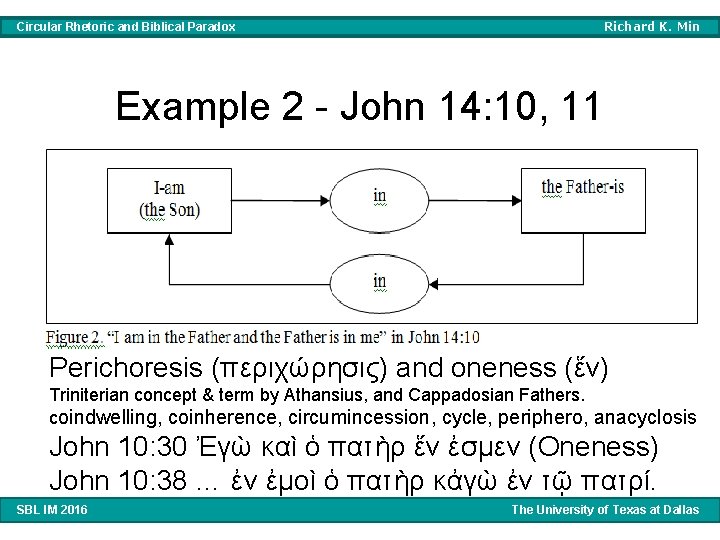
Circular Rhetoric and Biblical Paradox Richard K. Min Example 2 - John 14: 10, 11 Perichoresis (περιχώρησις) and oneness (ἕν) Triniterian concept & term by Athansius, and Cappadosian Fathers. coindwelling, coinherence, circumincession, cycle, periphero, anacyclosis John 10: 30 Ἐγὼ καὶ ὁ πατὴρ ἕν ἐσμεν (Oneness) John 10: 38 … ἐν ἐμοὶ ὁ πατὴρ κἀγὼ ἐν τῷ πατρί. SBL IM 2016 The University of Texas at Dallas
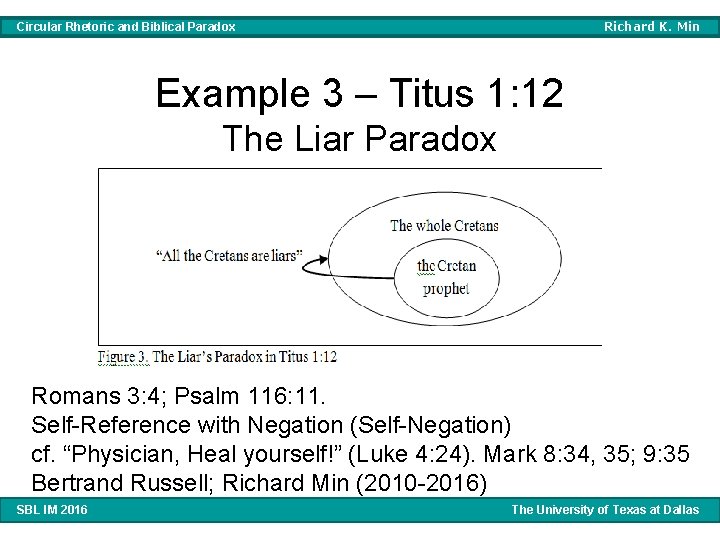
Richard K. Min Circular Rhetoric and Biblical Paradox Example 3 – Titus 1: 12 The Liar Paradox Romans 3: 4; Psalm 116: 11. Self-Reference with Negation (Self-Negation) cf. “Physician, Heal yourself!” (Luke 4: 24). Mark 8: 34, 35; 9: 35 Bertrand Russell; Richard Min (2010 -2016) SBL IM 2016 The University of Texas at Dallas
Circular Rhetoric and Biblical Paradox Richard K. Min Example 4 Three Paradoxes in Matthew 22: 15– 46 (1) Matthew 22: 15 -22 To Pay Tax to Caesar or not (2) Matthew 22: 23 -33 Marriage vs Resurrection (3) Matthew 22: 41 -46 David called Christ, “My Lord” in Psalm 110: 1 SBL IM 2016 The University of Texas at Dallas
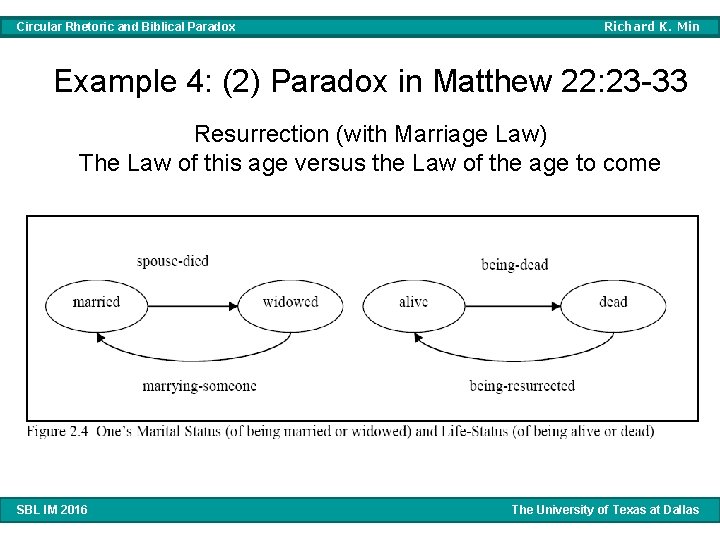
Circular Rhetoric and Biblical Paradox Richard K. Min Example 4: (2) Paradox in Matthew 22: 23 -33 Resurrection (with Marriage Law) The Law of this age versus the Law of the age to come SBL IM 2016 The University of Texas at Dallas
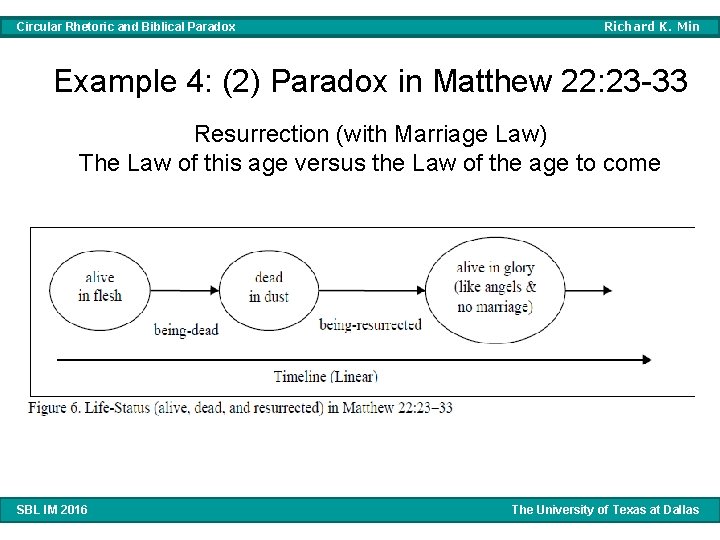
Circular Rhetoric and Biblical Paradox Richard K. Min Example 4: (2) Paradox in Matthew 22: 23 -33 Resurrection (with Marriage Law) The Law of this age versus the Law of the age to come SBL IM 2016 The University of Texas at Dallas
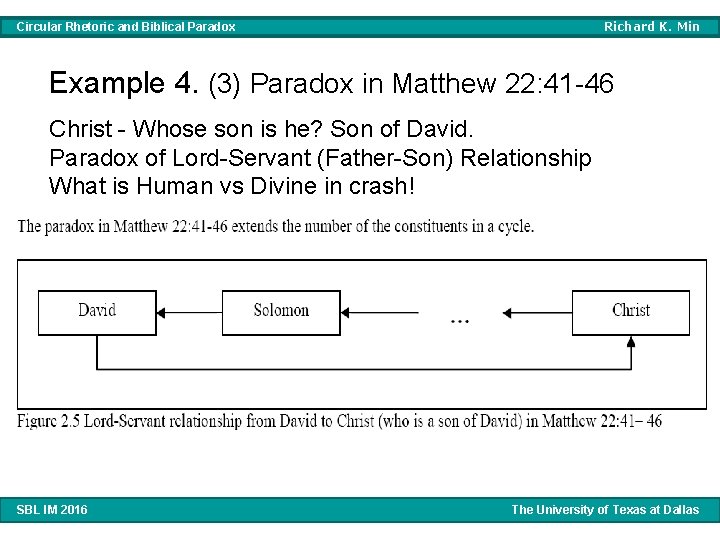
Richard K. Min Circular Rhetoric and Biblical Paradox Example 4. (3) Paradox in Matthew 22: 41 -46 Christ - Whose son is he? Son of David. Paradox of Lord-Servant (Father-Son) Relationship What is Human vs Divine in crash! SBL IM 2016 The University of Texas at Dallas
Richard K. Min Circular Rhetoric and Biblical Paradox Two Proof Methods in John 8: 12 -20 “I am” the light of the world (1) Circular Logic (Self-Testimony) vs. (2) Law (Two Witnesses) John 8: 12 -20 (NIV) 12 When Jesus spoke again to the people, he said, “I am the light of the world. Whoever follows me will never walk in darkness, but will have the light of life. ” 13 The Pharisees challenged him, “Here you are, appearing as your own witness; your testimony is not valid. ” (1) John 8: 12. one of “I am” sayings in John. ε γω ει μι το φω ς του κο σμου (2) John 8: 13. Objection and Accusation by the Pharisees It is “Self-witness” (Circular Reasoning). SBL IM 2016 The University of Texas at Dallas
Richard K. Min Circular Rhetoric and Biblical Paradox Two Proof Methods in John 8: 12 -20 (NIV) 14 Jesus answered, “Even if I testify on my own behalf, my testimony is valid, for I know where I came from and where I am going. But you have no idea where I come from or where I am going. 15 You judge by human standards; I pass judgment on no one. 16 But if I do judge, my decisions are right, because I am not alone. I stand with the Father, who sent me. 17 18 In your own Law it is written that the testimony of two men is valid. I am one who testifies for myself; my other witness is the Father, who sent me. ” 1) John 8: 12 “I am …” as Self-Testimony – Circular or Coinductive Reasoning 2) John 8: 17 Testimony of two men according to the Law – Inductive Reasoning 3) Thus all metaphorical “I am” sayings of Jesus in John are essentially Circular. SBL IM 2016 The University of Texas at Dallas
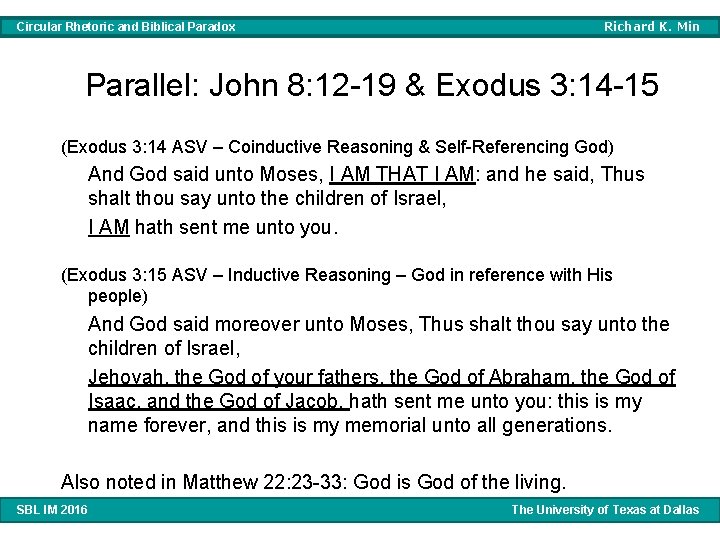
Richard K. Min Circular Rhetoric and Biblical Paradox Parallel: John 8: 12 -19 & Exodus 3: 14 -15 (Exodus 3: 14 ASV – Coinductive Reasoning & Self-Referencing God) And God said unto Moses, I AM THAT I AM: and he said, Thus shalt thou say unto the children of Israel, I AM hath sent me unto you. (Exodus 3: 15 ASV – Inductive Reasoning – God in reference with His people) And God said moreover unto Moses, Thus shalt thou say unto the children of Israel, Jehovah, the God of your fathers, the God of Abraham, the God of Isaac, and the God of Jacob, hath sent me unto you: this is my name forever, and this is my memorial unto all generations. Also noted in Matthew 22: 23 -33: God is God of the living. SBL IM 2016 The University of Texas at Dallas
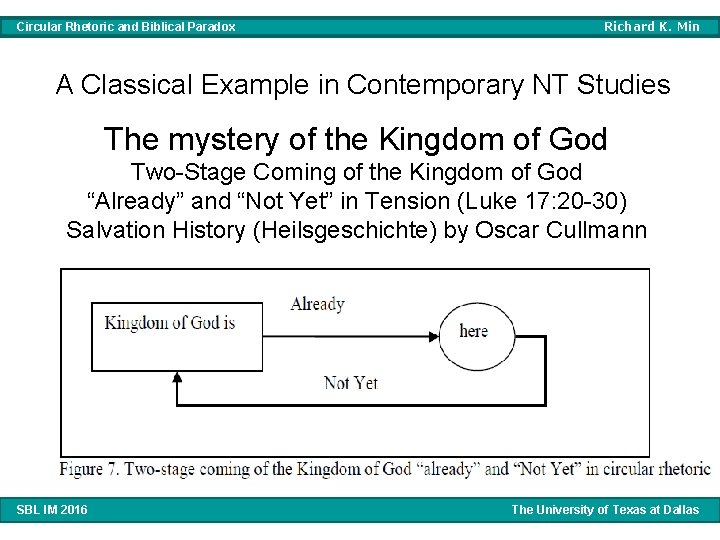
Circular Rhetoric and Biblical Paradox Richard K. Min A Classical Example in Contemporary NT Studies The mystery of the Kingdom of God Two-Stage Coming of the Kingdom of God “Already” and “Not Yet” in Tension (Luke 17: 20 -30) Salvation History (Heilsgeschichte) by Oscar Cullmann SBL IM 2016 The University of Texas at Dallas
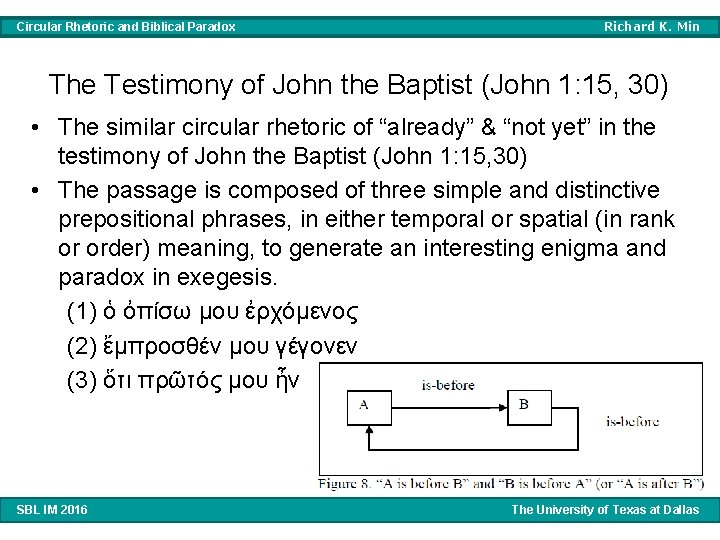
Circular Rhetoric and Biblical Paradox Richard K. Min The Testimony of John the Baptist (John 1: 15, 30) • The similar circular rhetoric of “already” & “not yet” in the testimony of John the Baptist (John 1: 15, 30) • The passage is composed of three simple and distinctive prepositional phrases, in either temporal or spatial (in rank or order) meaning, to generate an interesting enigma and paradox in exegesis. (1) ὁ ὀπίσω μου ἐρχόμενος (2) ἔμπροσθέν μου γέγονεν (3) ὅτι πρῶτός μου ἦν SBL IM 2016 The University of Texas at Dallas
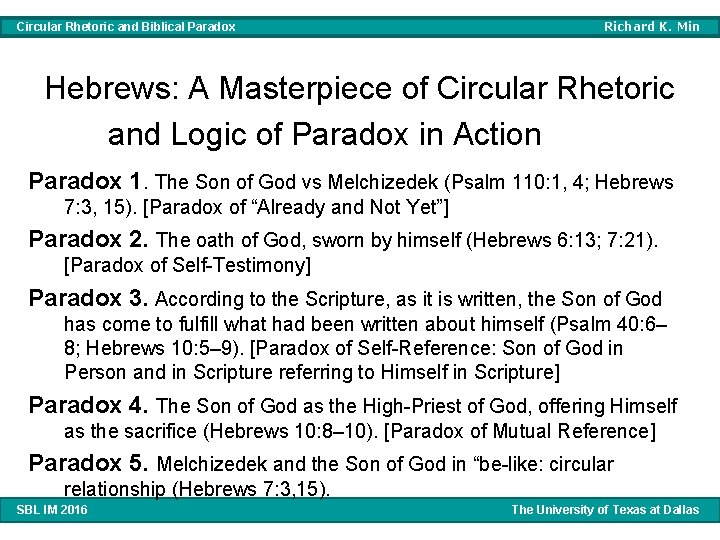
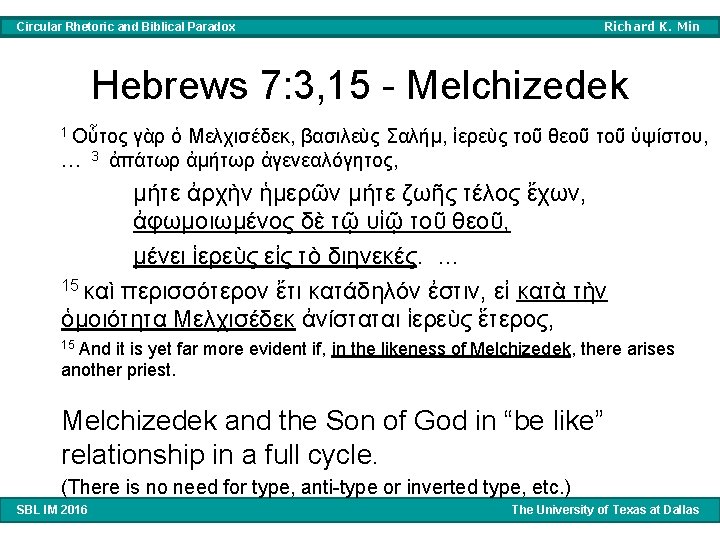
Circular Rhetoric and Biblical Paradox Richard K. Min Hebrews: A Masterpiece of Circular Rhetoric and Logic of Paradox in Action Paradox 1. The Son of God vs Melchizedek (Psalm 110: 1, 4; Hebrews 7: 3, 15). [Paradox of “Already and Not Yet”] Paradox 2. The oath of God, sworn by himself (Hebrews 6: 13; 7: 21). [Paradox of Self-Testimony] Paradox 3. According to the Scripture, as it is written, the Son of God has come to fulfill what had been written about himself (Psalm 40: 6– 8; Hebrews 10: 5– 9). [Paradox of Self-Reference: Son of God in Person and in Scripture referring to Himself in Scripture] Paradox 4. The Son of God as the High-Priest of God, offering Himself as the sacrifice (Hebrews 10: 8– 10). [Paradox of Mutual Reference] Paradox 5. Melchizedek and the Son of God in “be-like: circular relationship (Hebrews 7: 3, 15). SBL IM 2016 The University of Texas at Dallas
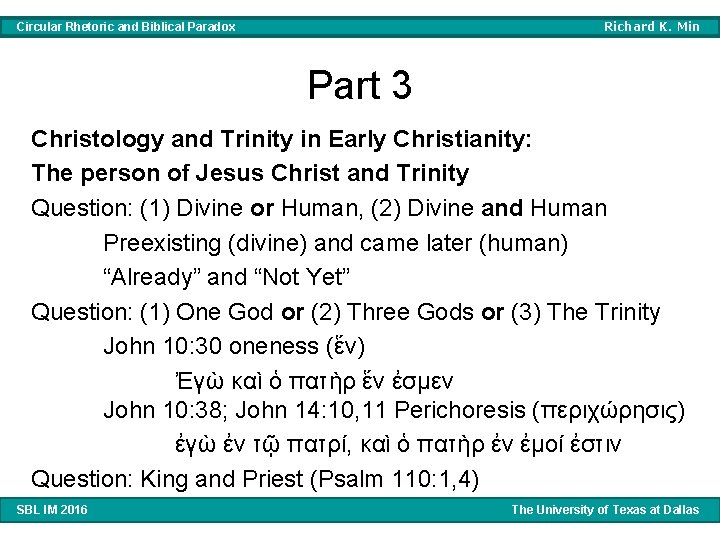
Richard K. Min Circular Rhetoric and Biblical Paradox Part 3 Christology and Trinity in Early Christianity: The person of Jesus Christ and Trinity Question: (1) Divine or Human, (2) Divine and Human Preexisting (divine) and came later (human) “Already” and “Not Yet” Question: (1) One God or (2) Three Gods or (3) The Trinity John 10: 30 oneness (ἕν) Ἐγὼ καὶ ὁ πατὴρ ἕν ἐσμεν John 10: 38; John 14: 10, 11 Perichoresis (περιχώρησις) ἐγὼ ἐν τῷ πατρί, καὶ ὁ πατὴρ ἐν ἐμοί ἐστιν Question: King and Priest (Psalm 110: 1, 4) SBL IM 2016 The University of Texas at Dallas
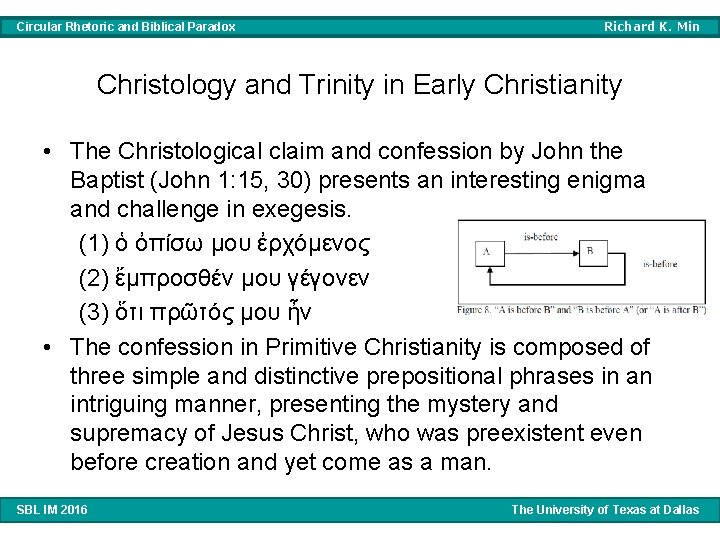
Circular Rhetoric and Biblical Paradox Richard K. Min Christology and Trinity in Early Christianity • The Christological claim and confession by John the Baptist (John 1: 15, 30) presents an interesting enigma and challenge in exegesis. (1) ὁ ὀπίσω μου ἐρχόμενος (2) ἔμπροσθέν μου γέγονεν (3) ὅτι πρῶτός μου ἦν • The confession in Primitive Christianity is composed of three simple and distinctive prepositional phrases in an intriguing manner, presenting the mystery and supremacy of Jesus Christ, who was preexistent even before creation and yet come as a man. SBL IM 2016 The University of Texas at Dallas
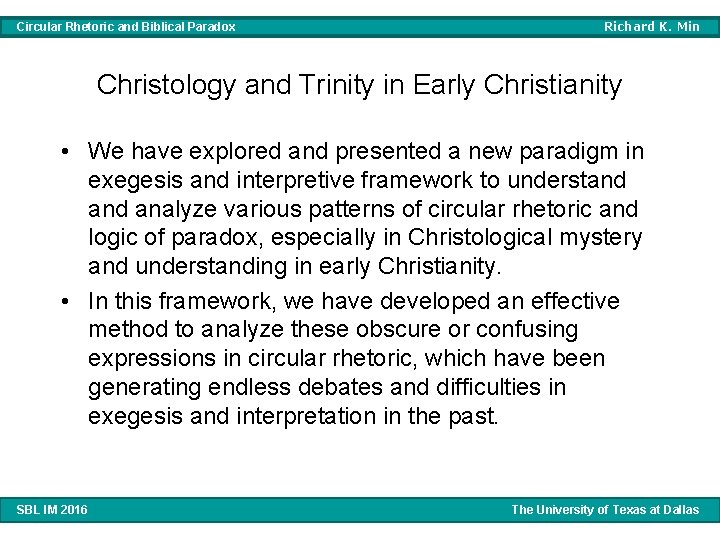
Circular Rhetoric and Biblical Paradox Richard K. Min Christology and Trinity in Early Christianity • We have explored and presented a new paradigm in exegesis and interpretive framework to understand analyze various patterns of circular rhetoric and logic of paradox, especially in Christological mystery and understanding in early Christianity. • In this framework, we have developed an effective method to analyze these obscure or confusing expressions in circular rhetoric, which have been generating endless debates and difficulties in exegesis and interpretation in the past. SBL IM 2016 The University of Texas at Dallas
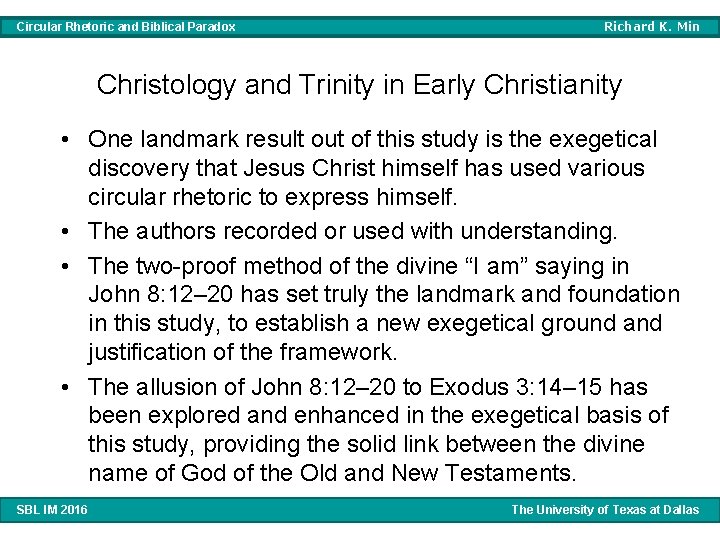
Circular Rhetoric and Biblical Paradox Richard K. Min Christology and Trinity in Early Christianity • One landmark result out of this study is the exegetical discovery that Jesus Christ himself has used various circular rhetoric to express himself. • The authors recorded or used with understanding. • The two-proof method of the divine “I am” saying in John 8: 12– 20 has set truly the landmark and foundation in this study, to establish a new exegetical ground and justification of the framework. • The allusion of John 8: 12– 20 to Exodus 3: 14– 15 has been explored and enhanced in the exegetical basis of this study, providing the solid link between the divine name of God of the Old and New Testaments. SBL IM 2016 The University of Texas at Dallas
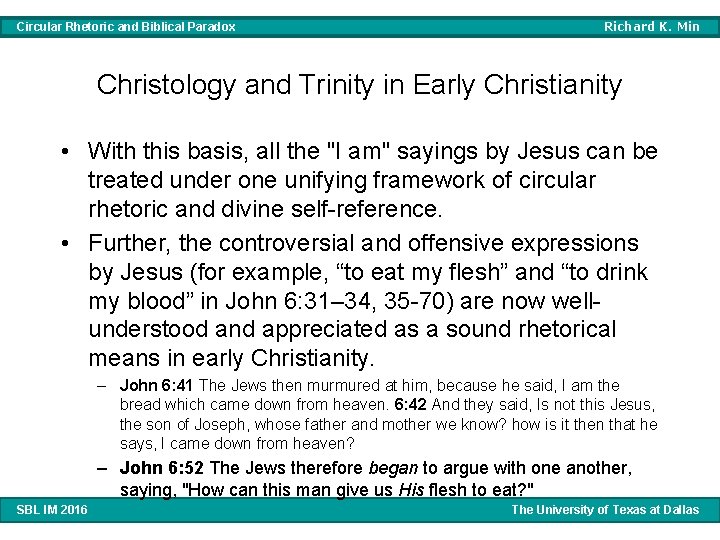
Circular Rhetoric and Biblical Paradox Richard K. Min Christology and Trinity in Early Christianity • With this basis, all the "I am" sayings by Jesus can be treated under one unifying framework of circular rhetoric and divine self-reference. • Further, the controversial and offensive expressions by Jesus (for example, “to eat my flesh” and “to drink my blood” in John 6: 31– 34, 35 -70) are now wellunderstood and appreciated as a sound rhetorical means in early Christianity. – John 6: 41 The Jews then murmured at him, because he said, I am the bread which came down from heaven. 6: 42 And they said, Is not this Jesus, the son of Joseph, whose father and mother we know? how is it then that he says, I came down from heaven? – John 6: 52 The Jews therefore began to argue with one another, saying, "How can this man give us His flesh to eat? " SBL IM 2016 The University of Texas at Dallas
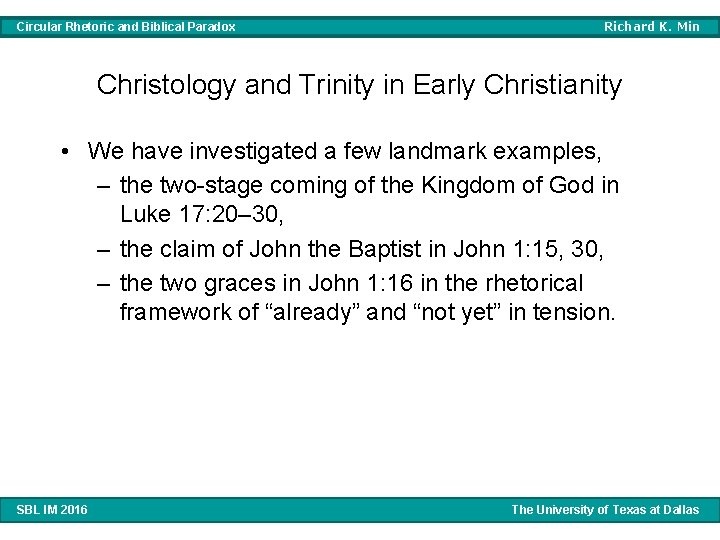
Circular Rhetoric and Biblical Paradox Richard K. Min Christology and Trinity in Early Christianity • We have investigated a few landmark examples, – the two-stage coming of the Kingdom of God in Luke 17: 20– 30, – the claim of John the Baptist in John 1: 15, 30, – the two graces in John 1: 16 in the rhetorical framework of “already” and “not yet” in tension. SBL IM 2016 The University of Texas at Dallas
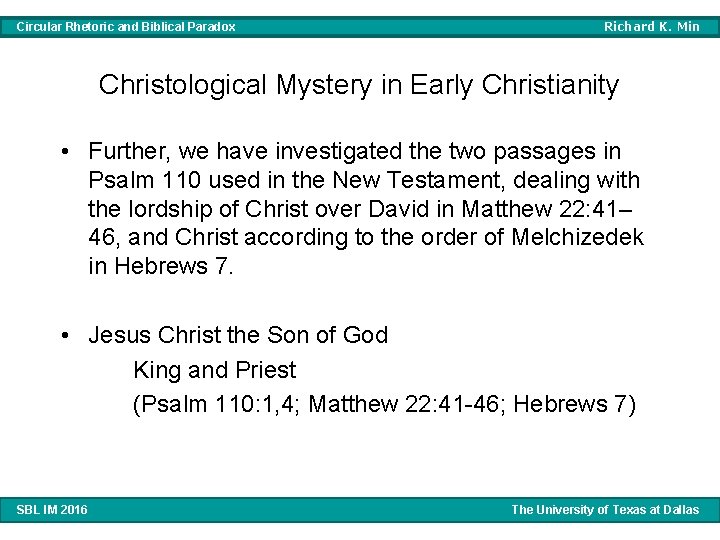
Circular Rhetoric and Biblical Paradox Richard K. Min Christological Mystery in Early Christianity • Further, we have investigated the two passages in Psalm 110 used in the New Testament, dealing with the lordship of Christ over David in Matthew 22: 41– 46, and Christ according to the order of Melchizedek in Hebrews 7. • Jesus Christ the Son of God King and Priest (Psalm 110: 1, 4; Matthew 22: 41 -46; Hebrews 7) SBL IM 2016 The University of Texas at Dallas
Richard K. Min Circular Rhetoric and Biblical Paradox Christology and Trinity in Early Christianity Melchizedek • The significance and mystery about Melchizedek (Genesis 14, Psalm 110, and Hebrews 7) has been surmounted throughout the centuries, well before the time of Jesus Christ, and continues even to the present days (noted by Hughes 1977). • Melchizedek came with bread and wine and blessed Abraham, and Abraham offered him a tithe (Genesis 14: 18– 20; Hebrews 7: 4, 7). • References to Melchizedek have been abundant since early Christianity. SBL IM 2016 The University of Texas at Dallas
Richard K. Min Circular Rhetoric and Biblical Paradox Christology and Trinity in Early Christianity Melchizedek • One challenging question is whether Melchizedek is a human being, an elevated supra-human being, an angelic being, or God himself. • Being asked, Jerome consults and reports that many reliable church authors (Irenaeus, Hippolytus, Eusebius of Caesarea, Eusebius of Emesa, Apollinaris, and Eustathius) in their unified opinion assert Melchizedek as a human being, who lived in the land of Canaan, and was the king of Jerusalem at the time of Abraham. • Additionally, Jerome notes that Origen and his student Didymus considered Melchizedek as an angelic being. SBL IM 2016 The University of Texas at Dallas
Richard K. Min Circular Rhetoric and Biblical Paradox Christology and Trinity in Early Christianity Melchizedek • The conclusion of Jerome and the other orthodox theologians is also affirmed by Cyril of Alexandria. • Ambrose considered Melchizedek as God or the Son of God. Epiphanius reports various gnostic sects of heresy usually identify Melchizedek (not as a human being) with the Holy Spirit or the Son of God. • For example, Melchizedek is identified with the Holy Spirit in the teaching of Theodotus who lived in the second century. SBL IM 2016 The University of Texas at Dallas
Richard K. Min Circular Rhetoric and Biblical Paradox Christology and Trinity in Early Christianity Melchizedek • Hierax, who is one of the disciples of Origen, identifies Melchizedek with the Holy Spirit who appeared in a theophany. • Epiphanius notes a gnostic sect, which identifies Melchizedek with the Son of God. To summarize, the mystery on Melchizedek has been generating a wide range of opinions and confusion from early Christianity, Judaism, and Gnosticism, and continues to be the most important topic and issue of all. Birger A. Pearson, "Melchizedek in Early Judaism, Christianity, and Gnosticism, " in Biblical Figures Outside off the Bible, ed. Michael E. Stone and Theodore A. Bergren (Harrisburg, PA: Trinity Press International, 1998), 176– 202; Frank Williams, The Panarion of Epiphanius of Salamis, Books II and III (Sects 47– 80, De Fide) (Leiden: Brill, 1990); and Philip Edgcumbe Hughes, A Commentary on the Epistle to the Hebrews (Grand Rapids: Eerdmans, 1971), 237– 45. SBL IM 2016 The University of Texas at Dallas
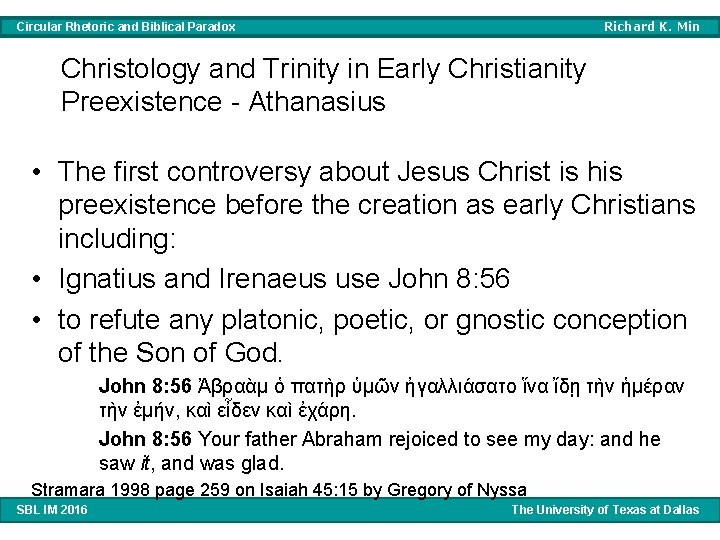
Richard K. Min Circular Rhetoric and Biblical Paradox Christology and Trinity in Early Christianity Preexistence - Athanasius • The first controversy about Jesus Christ is his preexistence before the creation as early Christians including: • Ignatius and Irenaeus use John 8: 56 • to refute any platonic, poetic, or gnostic conception of the Son of God. John 8: 56 Ἀβραὰμ ὁ πατὴρ ὑμῶν ἠγαλλιάσατο ἵνα ἴδῃ τὴν ἡμέραν τὴν ἐμήν, καὶ εἶδεν καὶ ἐχάρη. John 8: 56 Your father Abraham rejoiced to see my day: and he saw it, and was glad. Stramara 1998 page 259 on Isaiah 45: 15 by Gregory of Nyssa SBL IM 2016 The University of Texas at Dallas
Richard K. Min Circular Rhetoric and Biblical Paradox Christology and Trinity in Early Christianity Preexistence - Athanasius • The second controversy is the incarnation and humanaspect of Jesus Christ, for example, by Athanasius paraphrasing the work of Irenaeus. • Further Athanasius notes a full and perfect revelation of God in Christ, and the distinction of the three persons within the one Godhead as necessary and eternal. Stramara 1998 page 259 on Isaiah 45: 15 by Gregory of Nyssa SBL IM 2016 The University of Texas at Dallas
Richard K. Min Circular Rhetoric and Biblical Paradox Christology and Trinity in Early Christianity Preexistence – Gregory of Nazianzus • Gregory of Nazianzus offers an insight remark on the mechanics of the generation of the Son and the procession of the Holy Spirit, potentially to place him or any other into madness for prying into the mystery of God or inquiring too closely into God's private matter. Stramara 1998 page 259 on Isaiah 45: 15 by Gregory of Nyssa SBL IM 2016 The University of Texas at Dallas
Richard K. Min Circular Rhetoric and Biblical Paradox Christology and Trinity in Early Christianity Trinity (Arius Controversy) • For the Trinitarian controversy, the main passage has been the mutual indwelling relationship (John 14: 10– 11), along with the oneness relationship (John 10: 30; 17: 11, 22). • Understanding the doctrine of the Trinity and its importance in early Christianity, the mutual indwelling or mutual containing relationship has been used as one major scriptural basis to support the Trinitarian claim. • The expression is used by Athanasius extensively against Arius, essentially providing the foundational basis for three persons in one God, coexisting in one another. Stramara 1998 page 259 on Isaiah 45: 15 by Gregory of Nyssa SBL IM 2016 The University of Texas at Dallas
Richard K. Min Circular Rhetoric and Biblical Paradox Christology and Trinity in Early Christianity Trinity (Perichoresis – Gregory of Nazianzus) • The term perichoresis (περιχώρησις) is used by Gregory of Nazianzus to express the mutual indwelling relationship of the three persons of the God. • The concept of perichoresis with the concept of oneness provides theological basis to assert the three divine persons, fully equal in Being with their indivisible nature. Stramara 1998 page 259 on Isaiah 45: 15 by Gregory of Nyssa SBL IM 2016 The University of Texas at Dallas
Richard K. Min Circular Rhetoric and Biblical Paradox Christology and Trinity in Early Christianity Gregory of Nyssa • Gregory of Nyssa provides another rich and intriguing terms and account of the Trinitarian perichoresis. • Gregory of Nyssa uses the verb form five times with the word “cycle” (κύκλος) even though the credit for the first user of the term perichoresis goes to Gregory of Nazianzus. • Citing John 10: 38 and 17: 21, Gregory of Nyssa provides a rich rhetoric for the Trinity, with these terms, to express that the Father dwells in the Son, the Son dwells in the Father, and the Father in the Son substantiates the Son's eternity. Stramara 1998 page 259 on Isaiah 45: 15 by Gregory of Nyssa SBL IM 2016 The University of Texas at Dallas
Richard K. Min Circular Rhetoric and Biblical Paradox Christology and Trinity in Early Christianity Gregory of Nyssa • Further he asserts that the Son had never or ever will be non-existent. The Persons in the Trinity contain each other fully as "the One" in his entirety dwells in "the Other" without "the One" being super-abounding or diminishing "the Other. " • As Gregory of Nissa notes, there is a paradox in this mystery of the Trinity as each Person of the Trinity is contained and containing, citing Isaiah 45: 15 as Gregory of Nissa understood for God (the savior of Israel) dwells within God (You). Stramara 1998 page 259 on Isaiah 45: 15 by Gregory of Nyssa SBL IM 2016 The University of Texas at Dallas
Richard K. Min Circular Rhetoric and Biblical Paradox Christology and Trinity in Early Christianity Gregory of Nyssa • In Romans 16: 25– 27, Paul speaks about the revelation of the mystery, which was hidden for a long time, but now revealed—the Gospel of Jesus Christ. • Indeed, this letter (Romans) presents abundant examples in circular rhetoric as we surveyed and investigated. • Many of them are still in debates since the early church fathers. • SBL IM 2016 Stramara 1998 page 259 on Isaiah 45: 15 by Gregory of Nyssa The University of Texas at Dallas
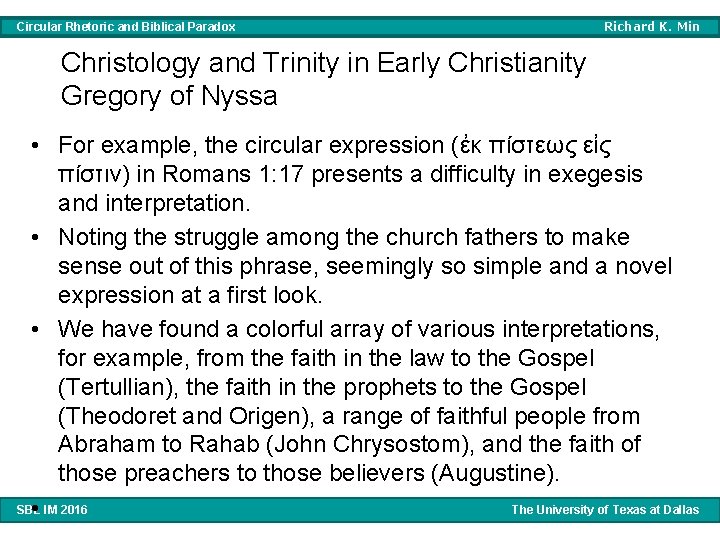
Circular Rhetoric and Biblical Paradox Richard K. Min Christology and Trinity in Early Christianity Gregory of Nyssa • For example, the circular expression (ἐκ πίστεως εἰς πίστιν) in Romans 1: 17 presents a difficulty in exegesis and interpretation. • Noting the struggle among the church fathers to make sense out of this phrase, seemingly so simple and a novel expression at a first look. • We have found a colorful array of various interpretations, for example, from the faith in the law to the Gospel (Tertullian), the faith in the prophets to the Gospel (Theodoret and Origen), a range of faithful people from Abraham to Rahab (John Chrysostom), and the faith of those preachers to those believers (Augustine). SBL The University of Texas at Dallas • IM 2016
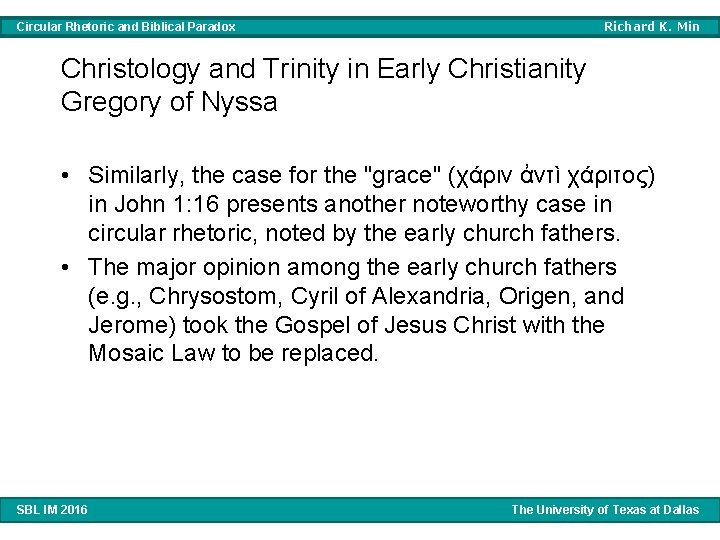
Richard K. Min Circular Rhetoric and Biblical Paradox Christology and Trinity in Early Christianity Gregory of Nyssa • Similarly, the case for the "grace" (χάριν ἀντὶ χάριτος) in John 1: 16 presents another noteworthy case in circular rhetoric, noted by the early church fathers. • The major opinion among the early church fathers (e. g. , Chrysostom, Cyril of Alexandria, Origen, and Jerome) took the Gospel of Jesus Christ with the Mosaic Law to be replaced. SBL IM 2016 The University of Texas at Dallas
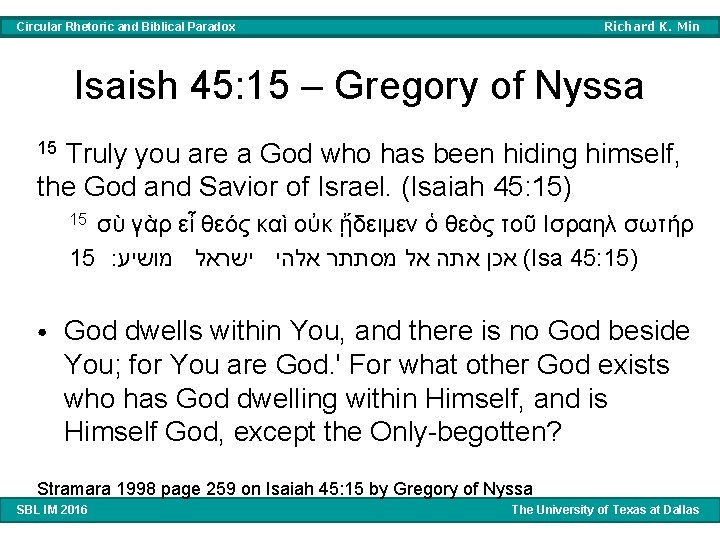
Richard K. Min Circular Rhetoric and Biblical Paradox Isaish 45: 15 – Gregory of Nyssa Truly you are a God who has been hiding himself, the God and Savior of Israel. (Isaiah 45: 15) 15 σὺ γὰρ εἶ θεός καὶ οὐκ ᾔδειμεν ὁ θεὸς τοῦ Ισραηλ σωτήρ 15 ( אכן אתה אל מסתתר אלהי ישראל מושיע׃ Isa 45: 15) 15 ● God dwells within You, and there is no God beside You; for You are God. ' For what other God exists who has God dwelling within Himself, and is Himself God, except the Only-begotten? Stramara 1998 page 259 on Isaiah 45: 15 by Gregory of Nyssa SBL IM 2016 The University of Texas at Dallas
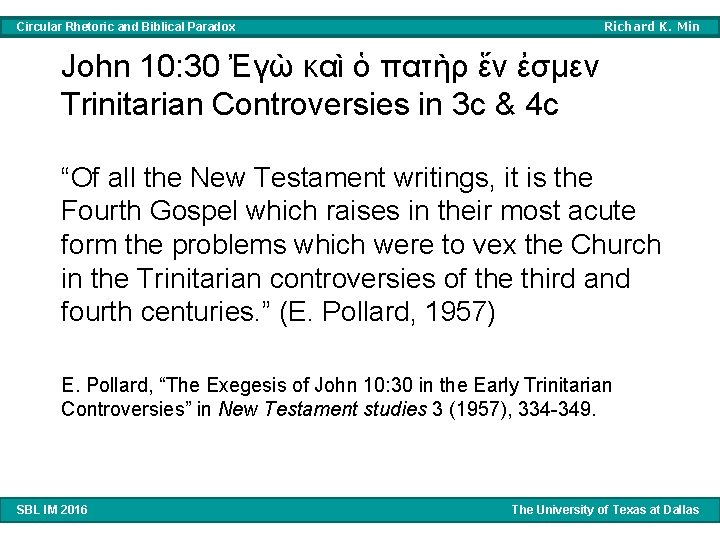
Richard K. Min Circular Rhetoric and Biblical Paradox John 10: 30 Ἐγὼ καὶ ὁ πατὴρ ἕν ἐσμεν Trinitarian Controversies in 3 c & 4 c “Of all the New Testament writings, it is the Fourth Gospel which raises in their most acute form the problems which were to vex the Church in the Trinitarian controversies of the third and fourth centuries. ” (E. Pollard, 1957) E. Pollard, “The Exegesis of John 10: 30 in the Early Trinitarian Controversies” in New Testament studies 3 (1957), 334 -349. SBL IM 2016 The University of Texas at Dallas
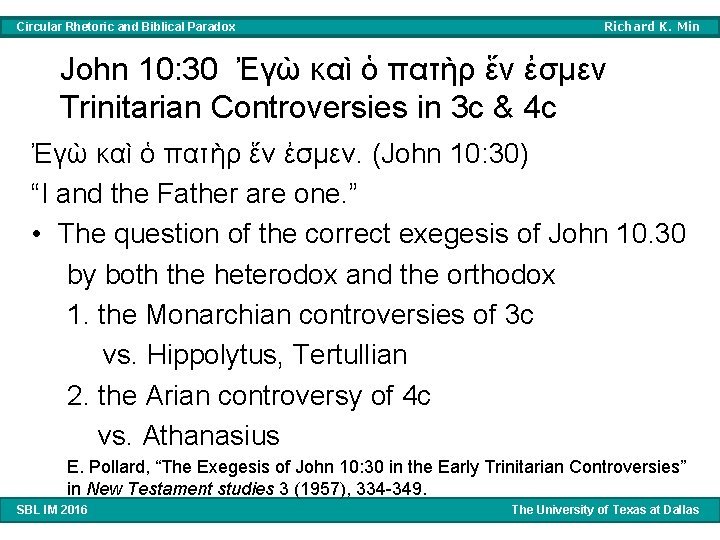
Circular Rhetoric and Biblical Paradox Richard K. Min John 10: 30 Ἐγὼ καὶ ὁ πατὴρ ἕν ἐσμεν Trinitarian Controversies in 3 c & 4 c Ἐγὼ καὶ ὁ πατὴρ ἕν ἐσμεν. (John 10: 30) “I and the Father are one. ” • The question of the correct exegesis of John 10. 30 by both the heterodox and the orthodox 1. the Monarchian controversies of 3 c vs. Hippolytus, Tertullian 2. the Arian controversy of 4 c vs. Athanasius E. Pollard, “The Exegesis of John 10: 30 in the Early Trinitarian Controversies” in New Testament studies 3 (1957), 334 -349. SBL IM 2016 The University of Texas at Dallas
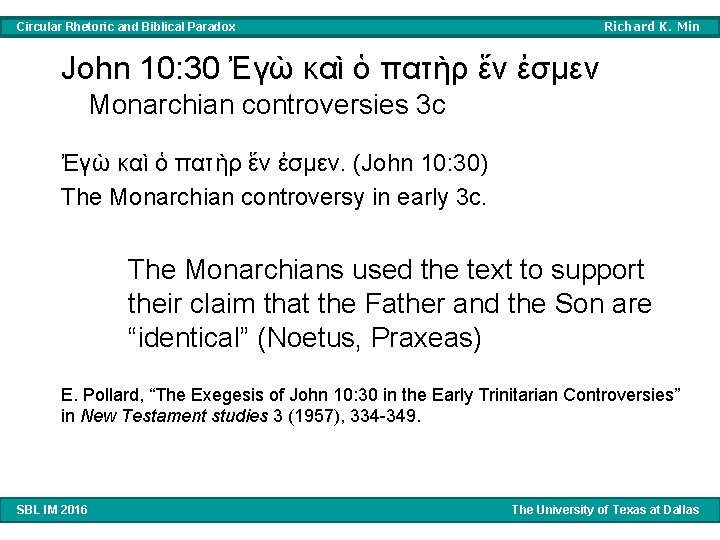
Richard K. Min Circular Rhetoric and Biblical Paradox John 10: 30 Ἐγὼ καὶ ὁ πατὴρ ἕν ἐσμεν Monarchian controversies 3 c Ἐγὼ καὶ ὁ πατὴρ ἕν ἐσμεν. (John 10: 30) The Monarchian controversy in early 3 c. The Monarchians used the text to support their claim that the Father and the Son are “identical” (Noetus, Praxeas) E. Pollard, “The Exegesis of John 10: 30 in the Early Trinitarian Controversies” in New Testament studies 3 (1957), 334 -349. SBL IM 2016 The University of Texas at Dallas
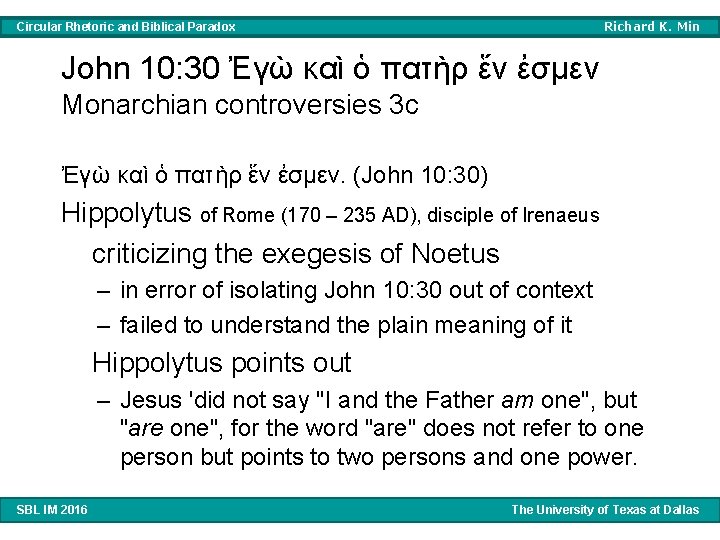
Richard K. Min Circular Rhetoric and Biblical Paradox John 10: 30 Ἐγὼ καὶ ὁ πατὴρ ἕν ἐσμεν Monarchian controversies 3 c Ἐγὼ καὶ ὁ πατὴρ ἕν ἐσμεν. (John 10: 30) Hippolytus of Rome (170 – 235 AD), disciple of Irenaeus criticizing the exegesis of Noetus – in error of isolating John 10: 30 out of context – failed to understand the plain meaning of it Hippolytus points out – Jesus 'did not say "I and the Father am one", but "are one", for the word "are" does not refer to one person but points to two persons and one power. SBL IM 2016 The University of Texas at Dallas
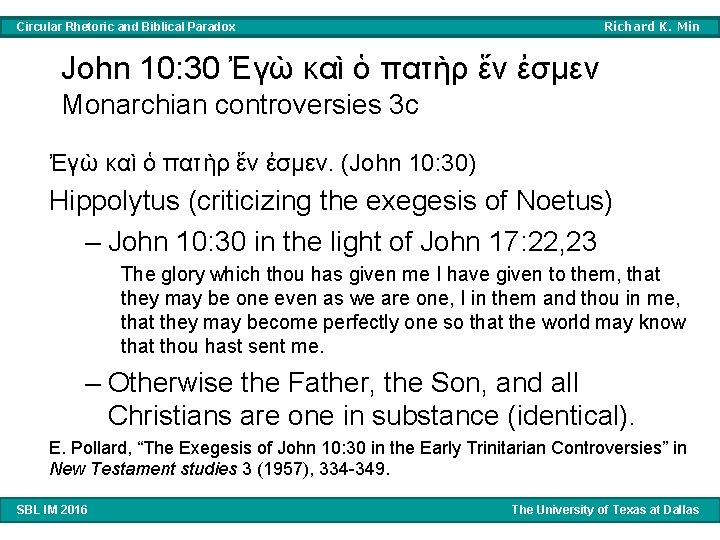
Richard K. Min Circular Rhetoric and Biblical Paradox John 10: 30 Ἐγὼ καὶ ὁ πατὴρ ἕν ἐσμεν Monarchian controversies 3 c Ἐγὼ καὶ ὁ πατὴρ ἕν ἐσμεν. (John 10: 30) Hippolytus (criticizing the exegesis of Noetus) – John 10: 30 in the light of John 17: 22, 23 The glory which thou has given me I have given to them, that they may be one even as we are one, I in them and thou in me, that they may become perfectly one so that the world may know that thou hast sent me. – Otherwise the Father, the Son, and all Christians are one in substance (identical). E. Pollard, “The Exegesis of John 10: 30 in the Early Trinitarian Controversies” in New Testament studies 3 (1957), 334 -349. SBL IM 2016 The University of Texas at Dallas
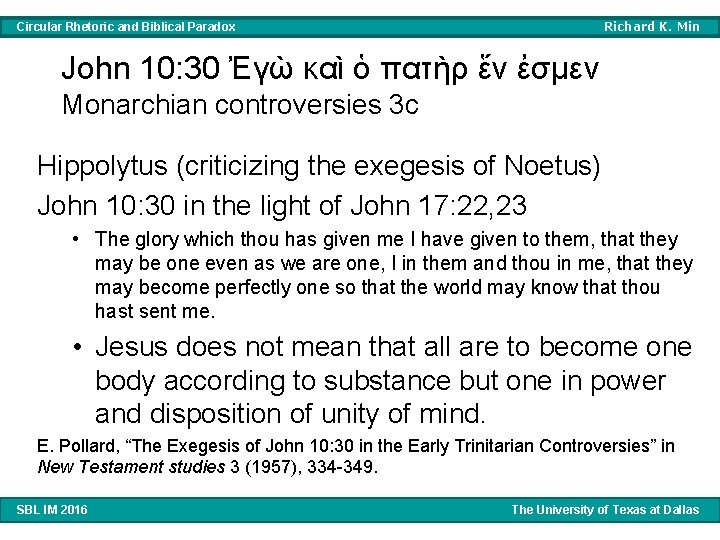
Richard K. Min Circular Rhetoric and Biblical Paradox John 10: 30 Ἐγὼ καὶ ὁ πατὴρ ἕν ἐσμεν Monarchian controversies 3 c Hippolytus (criticizing the exegesis of Noetus) John 10: 30 in the light of John 17: 22, 23 • The glory which thou has given me I have given to them, that they may be one even as we are one, I in them and thou in me, that they may become perfectly one so that the world may know that thou hast sent me. • Jesus does not mean that all are to become one body according to substance but one in power and disposition of unity of mind. E. Pollard, “The Exegesis of John 10: 30 in the Early Trinitarian Controversies” in New Testament studies 3 (1957), 334 -349. SBL IM 2016 The University of Texas at Dallas
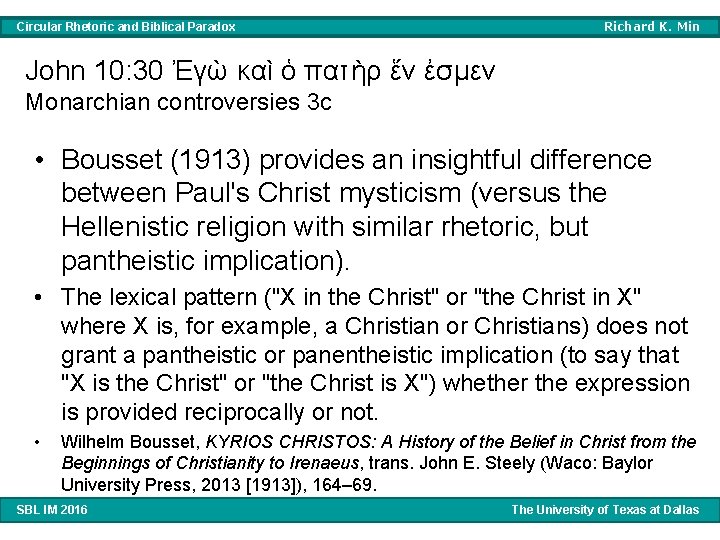
Circular Rhetoric and Biblical Paradox Richard K. Min John 10: 30 Ἐγὼ καὶ ὁ πατὴρ ἕν ἐσμεν Monarchian controversies 3 c • Bousset (1913) provides an insightful difference between Paul's Christ mysticism (versus the Hellenistic religion with similar rhetoric, but pantheistic implication). • The lexical pattern ("X in the Christ" or "the Christ in X" where X is, for example, a Christian or Christians) does not grant a pantheistic or panentheistic implication (to say that "X is the Christ" or "the Christ is X") whether the expression is provided reciprocally or not. • Wilhelm Bousset, KYRIOS CHRISTOS: A History of the Belief in Christ from the Beginnings of Christianity to Irenaeus, trans. John E. Steely (Waco: Baylor University Press, 2013 [1913]), 164– 69. SBL IM 2016 The University of Texas at Dallas
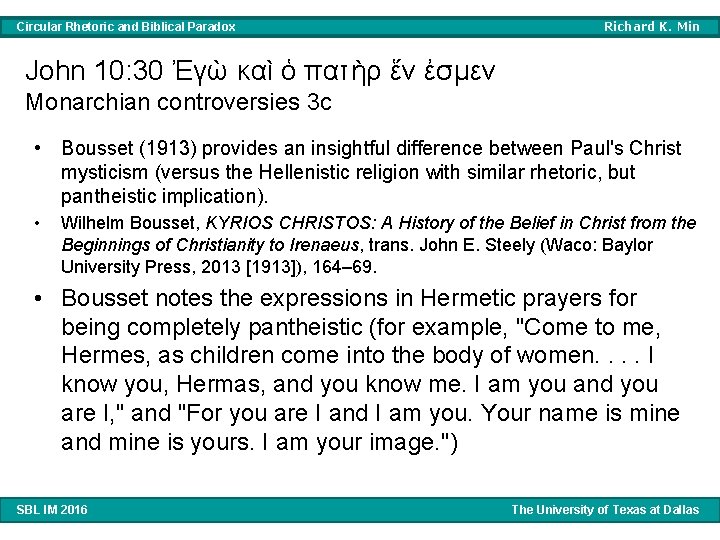
Circular Rhetoric and Biblical Paradox Richard K. Min John 10: 30 Ἐγὼ καὶ ὁ πατὴρ ἕν ἐσμεν Monarchian controversies 3 c • Bousset (1913) provides an insightful difference between Paul's Christ mysticism (versus the Hellenistic religion with similar rhetoric, but pantheistic implication). • Wilhelm Bousset, KYRIOS CHRISTOS: A History of the Belief in Christ from the Beginnings of Christianity to Irenaeus, trans. John E. Steely (Waco: Baylor University Press, 2013 [1913]), 164– 69. • Bousset notes the expressions in Hermetic prayers for being completely pantheistic (for example, "Come to me, Hermes, as children come into the body of women. . I know you, Hermas, and you know me. I am you and you are I, " and "For you are I and I am you. Your name is mine and mine is yours. I am your image. ") SBL IM 2016 The University of Texas at Dallas
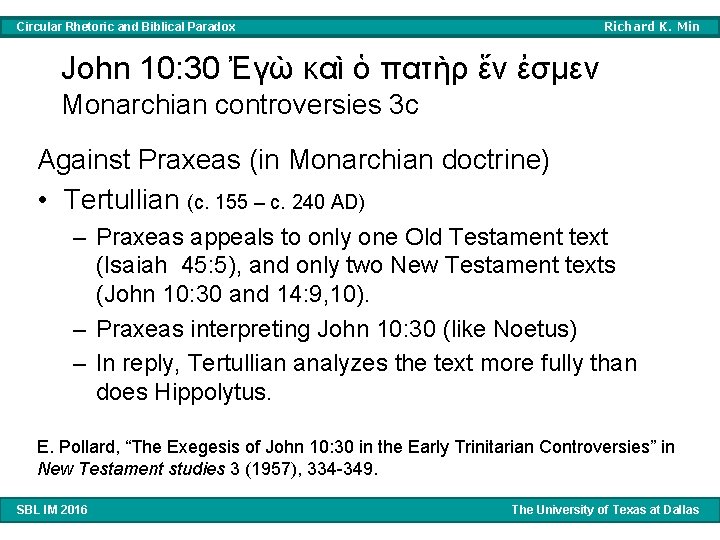
Richard K. Min Circular Rhetoric and Biblical Paradox John 10: 30 Ἐγὼ καὶ ὁ πατὴρ ἕν ἐσμεν Monarchian controversies 3 c Against Praxeas (in Monarchian doctrine) • Tertullian (c. 155 – c. 240 AD) – Praxeas appeals to only one Old Testament text (Isaiah 45: 5), and only two New Testament texts (John 10: 30 and 14: 9, 10). – Praxeas interpreting John 10: 30 (like Noetus) – In reply, Tertullian analyzes the text more fully than does Hippolytus. E. Pollard, “The Exegesis of John 10: 30 in the Early Trinitarian Controversies” in New Testament studies 3 (1957), 334 -349. SBL IM 2016 The University of Texas at Dallas
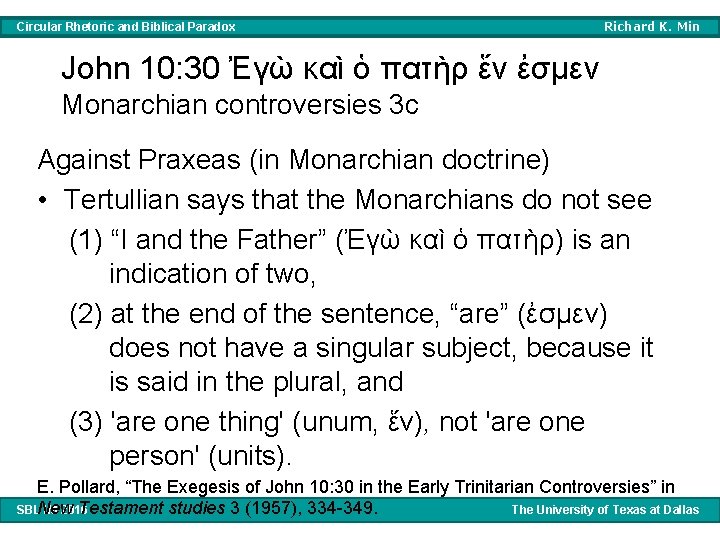
Circular Rhetoric and Biblical Paradox Richard K. Min John 10: 30 Ἐγὼ καὶ ὁ πατὴρ ἕν ἐσμεν Monarchian controversies 3 c Against Praxeas (in Monarchian doctrine) • Tertullian says that the Monarchians do not see (1) “I and the Father” (Ἐγὼ καὶ ὁ πατὴρ) is an indication of two, (2) at the end of the sentence, “are” (ἐσμεν) does not have a singular subject, because it is said in the plural, and (3) 'are one thing' (unum, ἕν), not 'are one person' (units). E. Pollard, “The Exegesis of John 10: 30 in the Early Trinitarian Controversies” in Testament studies 3 (1957), 334 -349. SBLNew IM 2016 The University of Texas at Dallas
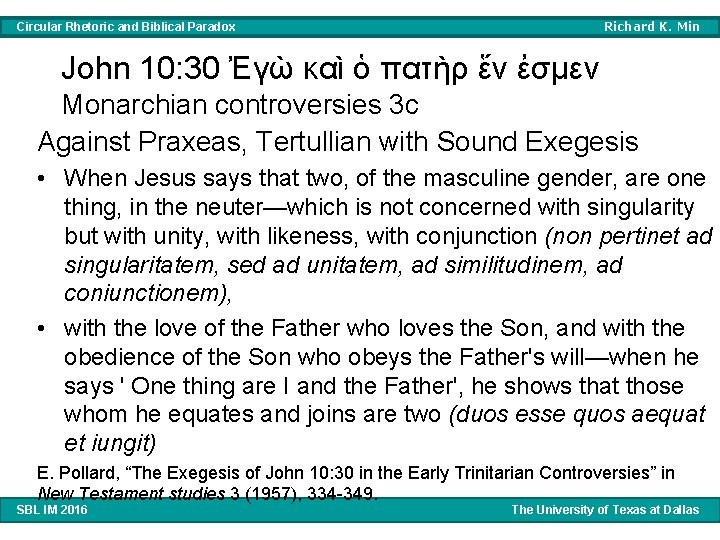
Richard K. Min Circular Rhetoric and Biblical Paradox John 10: 30 Ἐγὼ καὶ ὁ πατὴρ ἕν ἐσμεν Monarchian controversies 3 c Against Praxeas, Tertullian with Sound Exegesis • When Jesus says that two, of the masculine gender, are one thing, in the neuter—which is not concerned with singularity but with unity, with likeness, with conjunction (non pertinet ad singularitatem, sed ad unitatem, ad similitudinem, ad coniunctionem), • with the love of the Father who loves the Son, and with the obedience of the Son who obeys the Father's will—when he says ' One thing are I and the Father', he shows that those whom he equates and joins are two (duos esse quos aequat et iungit) E. Pollard, “The Exegesis of John 10: 30 in the Early Trinitarian Controversies” in New Testament studies 3 (1957), 334 -349. SBL IM 2016 The University of Texas at Dallas
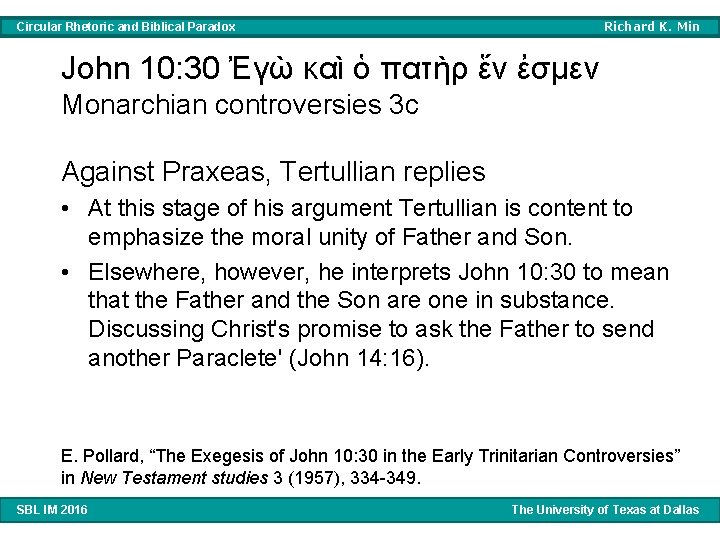
Richard K. Min Circular Rhetoric and Biblical Paradox John 10: 30 Ἐγὼ καὶ ὁ πατὴρ ἕν ἐσμεν Monarchian controversies 3 c Against Praxeas, Tertullian replies • At this stage of his argument Tertullian is content to emphasize the moral unity of Father and Son. • Elsewhere, however, he interprets John 10: 30 to mean that the Father and the Son are one in substance. Discussing Christ's promise to ask the Father to send another Paraclete' (John 14: 16). E. Pollard, “The Exegesis of John 10: 30 in the Early Trinitarian Controversies” in New Testament studies 3 (1957), 334 -349. SBL IM 2016 The University of Texas at Dallas
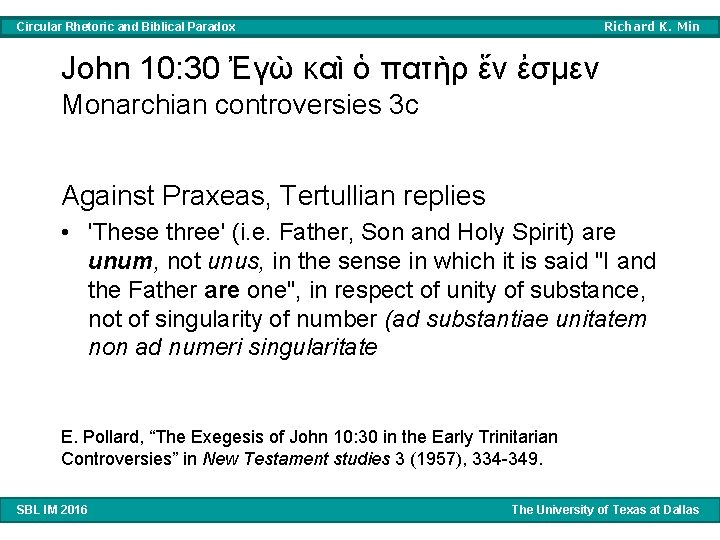
Richard K. Min Circular Rhetoric and Biblical Paradox John 10: 30 Ἐγὼ καὶ ὁ πατὴρ ἕν ἐσμεν Monarchian controversies 3 c Against Praxeas, Tertullian replies • 'These three' (i. e. Father, Son and Holy Spirit) are unum, not unus, in the sense in which it is said "I and the Father are one", in respect of unity of substance, not of singularity of number (ad substantiae unitatem non ad numeri singularitate E. Pollard, “The Exegesis of John 10: 30 in the Early Trinitarian Controversies” in New Testament studies 3 (1957), 334 -349. SBL IM 2016 The University of Texas at Dallas
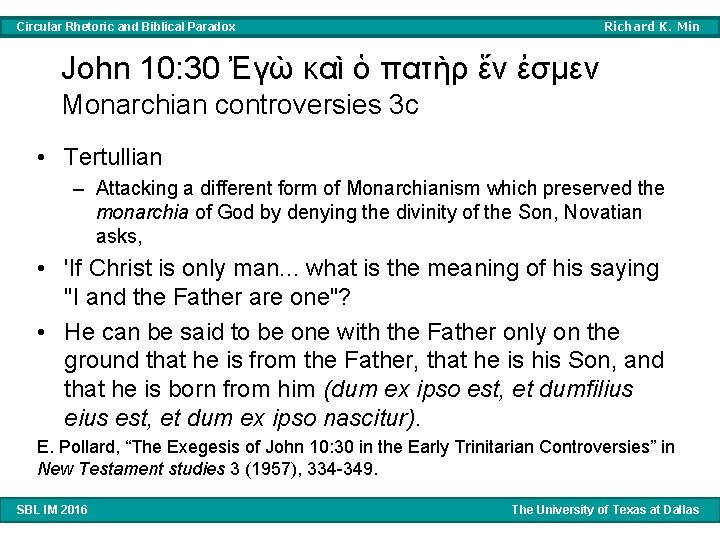
Richard K. Min Circular Rhetoric and Biblical Paradox John 10: 30 Ἐγὼ καὶ ὁ πατὴρ ἕν ἐσμεν Monarchian controversies 3 c • Tertullian – Attacking a different form of Monarchianism which preserved the monarchia of God by denying the divinity of the Son, Novatian asks, • 'If Christ is only man. . . what is the meaning of his saying "I and the Father are one"? • He can be said to be one with the Father only on the ground that he is from the Father, that he is his Son, and that he is born from him (dum ex ipso est, et dumfilius est, et dum ex ipso nascitur). E. Pollard, “The Exegesis of John 10: 30 in the Early Trinitarian Controversies” in New Testament studies 3 (1957), 334 -349. SBL IM 2016 The University of Texas at Dallas
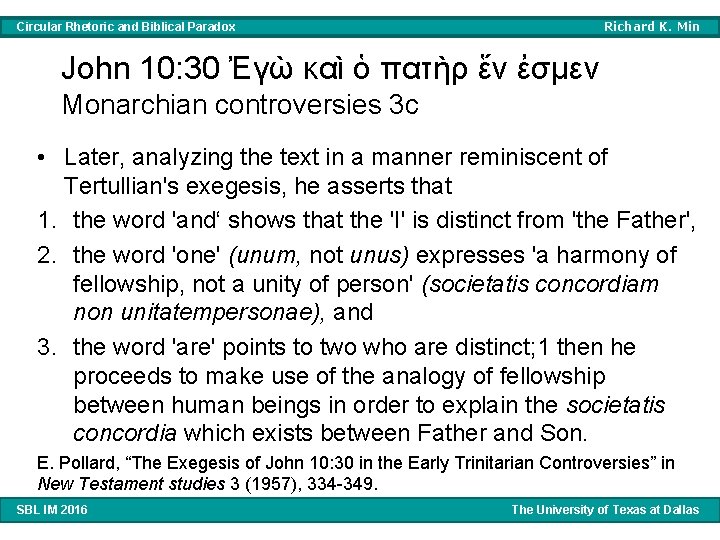
Richard K. Min Circular Rhetoric and Biblical Paradox John 10: 30 Ἐγὼ καὶ ὁ πατὴρ ἕν ἐσμεν Monarchian controversies 3 c • Later, analyzing the text in a manner reminiscent of Tertullian's exegesis, he asserts that 1. the word 'and‘ shows that the 'I' is distinct from 'the Father', 2. the word 'one' (unum, not unus) expresses 'a harmony of fellowship, not a unity of person' (societatis concordiam non unitatempersonae), and 3. the word 'are' points to two who are distinct; 1 then he proceeds to make use of the analogy of fellowship between human beings in order to explain the societatis concordia which exists between Father and Son. E. Pollard, “The Exegesis of John 10: 30 in the Early Trinitarian Controversies” in New Testament studies 3 (1957), 334 -349. SBL IM 2016 The University of Texas at Dallas
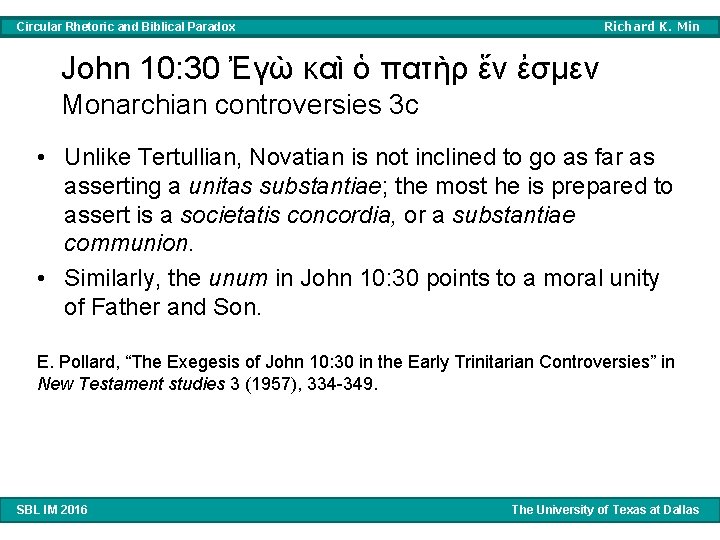
Richard K. Min Circular Rhetoric and Biblical Paradox John 10: 30 Ἐγὼ καὶ ὁ πατὴρ ἕν ἐσμεν Monarchian controversies 3 c • Unlike Tertullian, Novatian is not inclined to go as far as asserting a unitas substantiae; the most he is prepared to assert is a societatis concordia, or a substantiae communion. • Similarly, the unum in John 10: 30 points to a moral unity of Father and Son. E. Pollard, “The Exegesis of John 10: 30 in the Early Trinitarian Controversies” in New Testament studies 3 (1957), 334 -349. SBL IM 2016 The University of Texas at Dallas
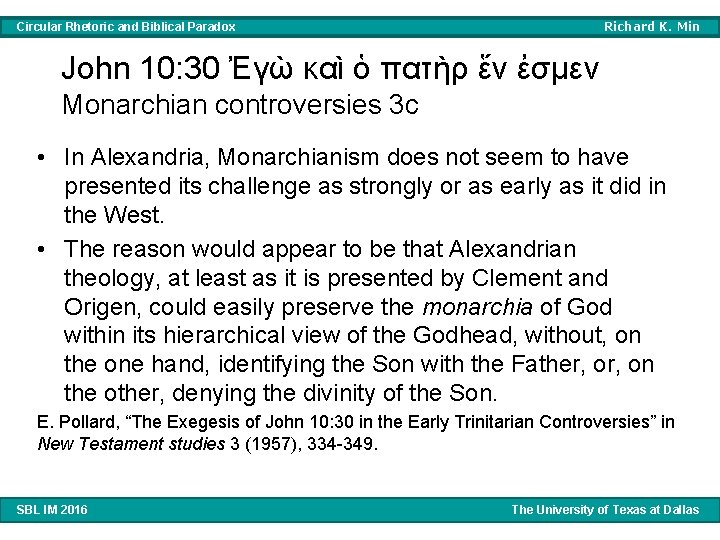
Richard K. Min Circular Rhetoric and Biblical Paradox John 10: 30 Ἐγὼ καὶ ὁ πατὴρ ἕν ἐσμεν Monarchian controversies 3 c • In Alexandria, Monarchianism does not seem to have presented its challenge as strongly or as early as it did in the West. • The reason would appear to be that Alexandrian theology, at least as it is presented by Clement and Origen, could easily preserve the monarchia of God within its hierarchical view of the Godhead, without, on the one hand, identifying the Son with the Father, on the other, denying the divinity of the Son. E. Pollard, “The Exegesis of John 10: 30 in the Early Trinitarian Controversies” in New Testament studies 3 (1957), 334 -349. SBL IM 2016 The University of Texas at Dallas
Richard K. Min Circular Rhetoric and Biblical Paradox John 10: 30 Ἐγὼ καὶ ὁ πατὴρ ἕν ἐσμεν Monarchian controversies 3 c • Clement hardly seems to be aware of the challenge of Monarchianism, while Origen argues against it only in passing and does not appear to treat it as a serious challenge. E. Pollard, “The Exegesis of John 10: 30 in the Early Trinitarian Controversies” in New Testament studies 3 (1957), 334 -349. SBL IM 2016 The University of Texas at Dallas
Richard K. Min Circular Rhetoric and Biblical Paradox John 10: 30 Ἐγὼ καὶ ὁ πατὴρ ἕν ἐσμεν Monarchian controversies 3 c • In contra Celsum (8. 12), Origen quotes John 10: 30 as proof that Christians are not ditheists, as Celsus asserts, but believe in a single God, an interpretation which, taken by itself, is close to the Monarchianism of Noetus and Praxeas. • E. Pollard, “The Exegesis of John 10: 30 in the Early Trinitarian Controversies” in New Testament studies 3 (1957), 334 -349. SBL IM 2016 The University of Texas at Dallas
Richard K. Min Circular Rhetoric and Biblical Paradox John 10: 30 Ἐγὼ καὶ ὁ πατὴρ ἕν ἐσμεν Monarchian controversies 3 c • Origen • In his Commentary on St John, however, in opposition to Monarchianism, he asserts the distinction between the Father and the Son by appealing to John 17: 3 and to the distinction between the Father and the Son. • αὕτη δέ ἐστιν ἡ αἰώνιος ζωὴ ἵνα γινώσκωσιν σὲ τὸν μόνον ἀληθινὸν θεὸν καὶ ὃν ἀπέστειλας Ἰησοῦν Χριστόν. E. Pollard, “The Exegesis of John 10: 30 in the Early Trinitarian Controversies” in New Testament studies 3 (1957), 334 -349. SBL IM 2016 The University of Texas at Dallas
Circular Rhetoric and Biblical Paradox Richard K. Min John 10: 30 Ἐγὼ καὶ ὁ πατὴρ ἕν ἐσμεν Monarchian controversies 3 c • Origen - His commentary on John 10: 30 is lost, but twice at least in his extant works he expounds the saying: • (i) when discussing John 4: 34, 'My meal is to do the will of him that sent me‘. • Origen argues that 'the will of God was in the will of the Son and the will of the Son became the same as the will of the Father, in order that there might no longer be two wills but one will. • The unity of will was the reason for the Son's saying: "I and the Father are one. " Here, then, Origen interprets the ἕν as a unity of will, i. e. a moral unity. E. Pollard, “The Exegesis of John 10: 30 in the Early Trinitarian Controversies” in SBLNew IM 2016 The University of Texas at Dallas Testament studies 3 (1957), 334 -349.
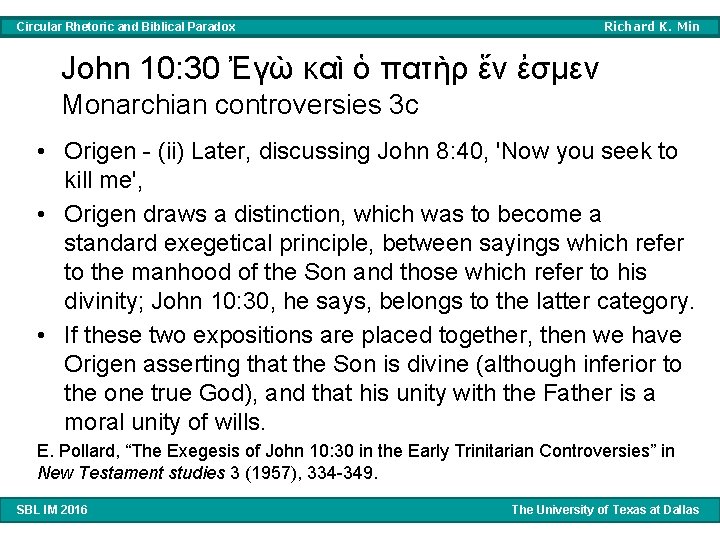
Richard K. Min Circular Rhetoric and Biblical Paradox John 10: 30 Ἐγὼ καὶ ὁ πατὴρ ἕν ἐσμεν Monarchian controversies 3 c • Origen - (ii) Later, discussing John 8: 40, 'Now you seek to kill me', • Origen draws a distinction, which was to become a standard exegetical principle, between sayings which refer to the manhood of the Son and those which refer to his divinity; John 10: 30, he says, belongs to the latter category. • If these two expositions are placed together, then we have Origen asserting that the Son is divine (although inferior to the one true God), and that his unity with the Father is a moral unity of wills. E. Pollard, “The Exegesis of John 10: 30 in the Early Trinitarian Controversies” in New Testament studies 3 (1957), 334 -349. SBL IM 2016 The University of Texas at Dallas
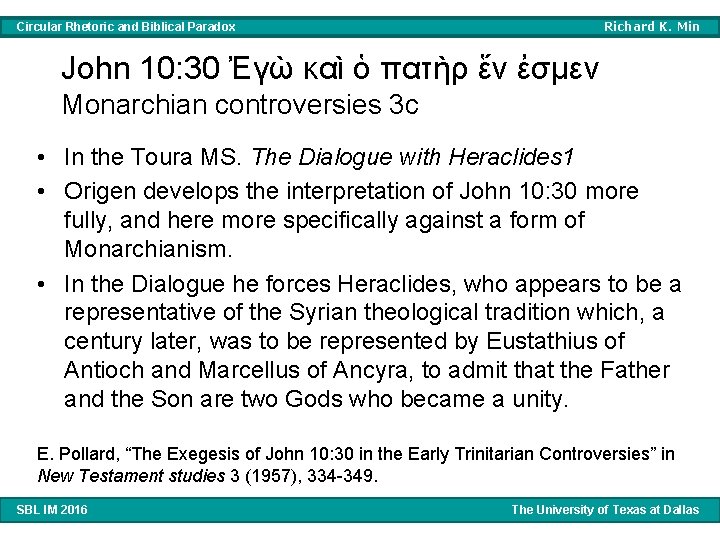
Richard K. Min Circular Rhetoric and Biblical Paradox John 10: 30 Ἐγὼ καὶ ὁ πατὴρ ἕν ἐσμεν Monarchian controversies 3 c • In the Toura MS. The Dialogue with Heraclides 1 • Origen develops the interpretation of John 10: 30 more fully, and here more specifically against a form of Monarchianism. • In the Dialogue he forces Heraclides, who appears to be a representative of the Syrian theological tradition which, a century later, was to be represented by Eustathius of Antioch and Marcellus of Ancyra, to admit that the Father and the Son are two Gods who became a unity. E. Pollard, “The Exegesis of John 10: 30 in the Early Trinitarian Controversies” in New Testament studies 3 (1957), 334 -349. SBL IM 2016 The University of Texas at Dallas
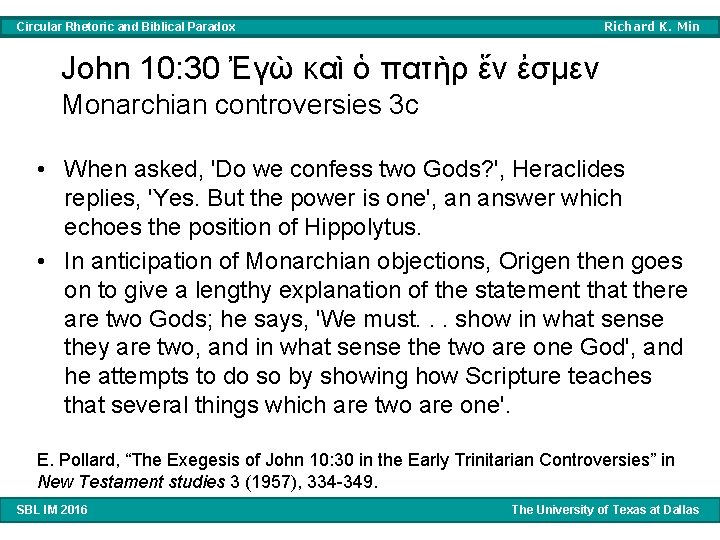
Richard K. Min Circular Rhetoric and Biblical Paradox John 10: 30 Ἐγὼ καὶ ὁ πατὴρ ἕν ἐσμεν Monarchian controversies 3 c • When asked, 'Do we confess two Gods? ', Heraclides replies, 'Yes. But the power is one', an answer which echoes the position of Hippolytus. • In anticipation of Monarchian objections, Origen then goes on to give a lengthy explanation of the statement that there are two Gods; he says, 'We must. . . show in what sense they are two, and in what sense the two are one God', and he attempts to do so by showing how Scripture teaches that several things which are two are one'. E. Pollard, “The Exegesis of John 10: 30 in the Early Trinitarian Controversies” in New Testament studies 3 (1957), 334 -349. SBL IM 2016 The University of Texas at Dallas
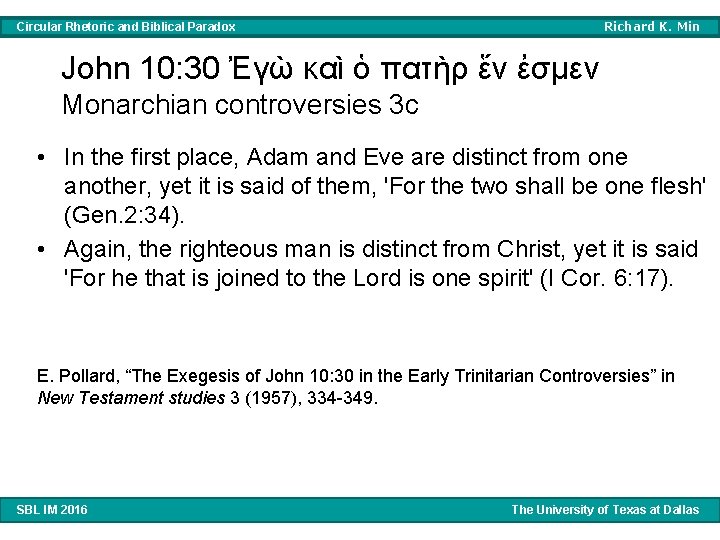
Richard K. Min Circular Rhetoric and Biblical Paradox John 10: 30 Ἐγὼ καὶ ὁ πατὴρ ἕν ἐσμεν Monarchian controversies 3 c • In the first place, Adam and Eve are distinct from one another, yet it is said of them, 'For the two shall be one flesh' (Gen. 2: 34). • Again, the righteous man is distinct from Christ, yet it is said 'For he that is joined to the Lord is one spirit' (I Cor. 6: 17). E. Pollard, “The Exegesis of John 10: 30 in the Early Trinitarian Controversies” in New Testament studies 3 (1957), 334 -349. SBL IM 2016 The University of Texas at Dallas
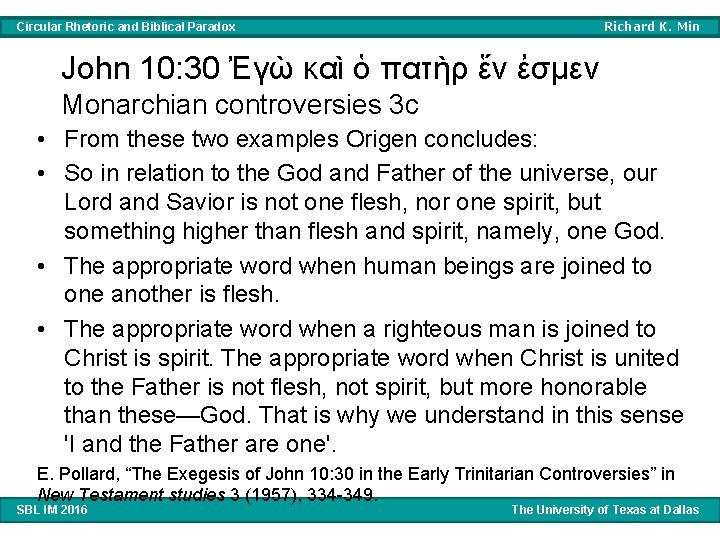
Richard K. Min Circular Rhetoric and Biblical Paradox John 10: 30 Ἐγὼ καὶ ὁ πατὴρ ἕν ἐσμεν Monarchian controversies 3 c • From these two examples Origen concludes: • So in relation to the God and Father of the universe, our Lord and Savior is not one flesh, nor one spirit, but something higher than flesh and spirit, namely, one God. • The appropriate word when human beings are joined to one another is flesh. • The appropriate word when a righteous man is joined to Christ is spirit. The appropriate word when Christ is united to the Father is not flesh, not spirit, but more honorable than these—God. That is why we understand in this sense 'I and the Father are one'. E. Pollard, “The Exegesis of John 10: 30 in the Early Trinitarian Controversies” in New Testament studies 3 (1957), 334 -349. SBL IM 2016 The University of Texas at Dallas
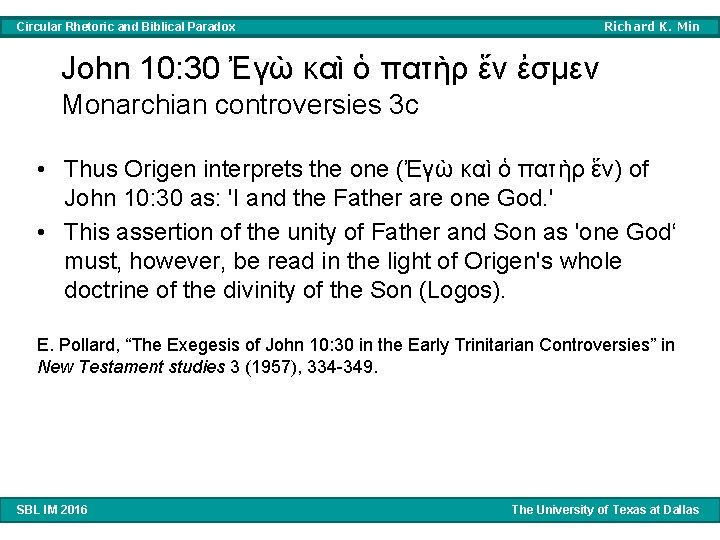
Richard K. Min Circular Rhetoric and Biblical Paradox John 10: 30 Ἐγὼ καὶ ὁ πατὴρ ἕν ἐσμεν Monarchian controversies 3 c • Thus Origen interprets the one (Ἐγὼ καὶ ὁ πατὴρ ἕν) of John 10: 30 as: 'I and the Father are one God. ' • This assertion of the unity of Father and Son as 'one God‘ must, however, be read in the light of Origen's whole doctrine of the divinity of the Son (Logos). E. Pollard, “The Exegesis of John 10: 30 in the Early Trinitarian Controversies” in New Testament studies 3 (1957), 334 -349. SBL IM 2016 The University of Texas at Dallas
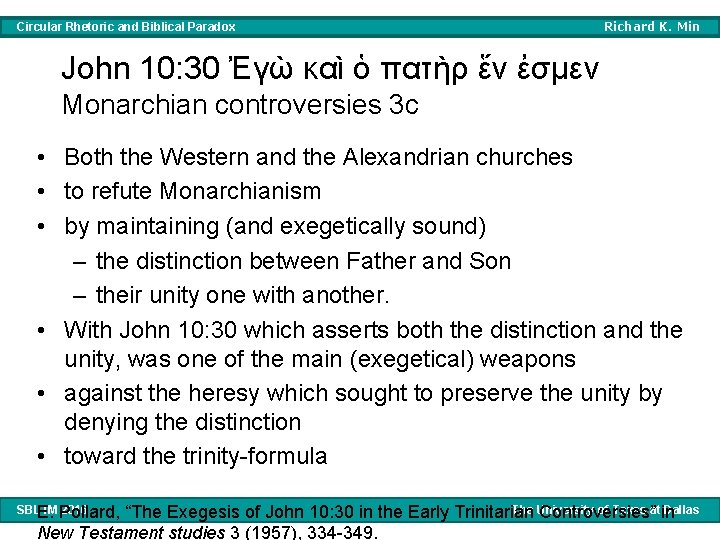
Circular Rhetoric and Biblical Paradox Richard K. Min John 10: 30 Ἐγὼ καὶ ὁ πατὴρ ἕν ἐσμεν Monarchian controversies 3 c • Both the Western and the Alexandrian churches • to refute Monarchianism • by maintaining (and exegetically sound) – the distinction between Father and Son – their unity one with another. • With John 10: 30 which asserts both the distinction and the unity, was one of the main (exegetical) weapons • against the heresy which sought to preserve the unity by denying the distinction • toward the trinity-formula SBLE. IM Pollard, 2016 The University of Texas atin Dallas “The Exegesis of John 10: 30 in the Early Trinitarian Controversies” New Testament studies 3 (1957), 334 -349.
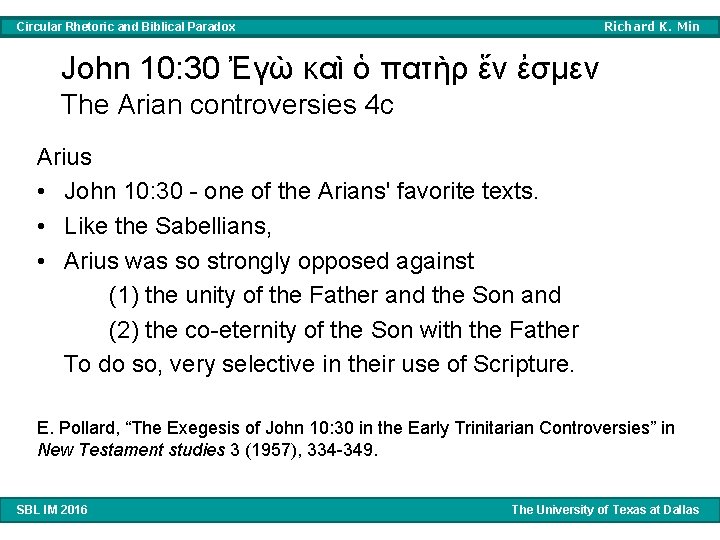
Richard K. Min Circular Rhetoric and Biblical Paradox John 10: 30 Ἐγὼ καὶ ὁ πατὴρ ἕν ἐσμεν The Arian controversies 4 c Arius • John 10: 30 - one of the Arians' favorite texts. • Like the Sabellians, • Arius was so strongly opposed against (1) the unity of the Father and the Son and (2) the co-eternity of the Son with the Father To do so, very selective in their use of Scripture. E. Pollard, “The Exegesis of John 10: 30 in the Early Trinitarian Controversies” in New Testament studies 3 (1957), 334 -349. SBL IM 2016 The University of Texas at Dallas
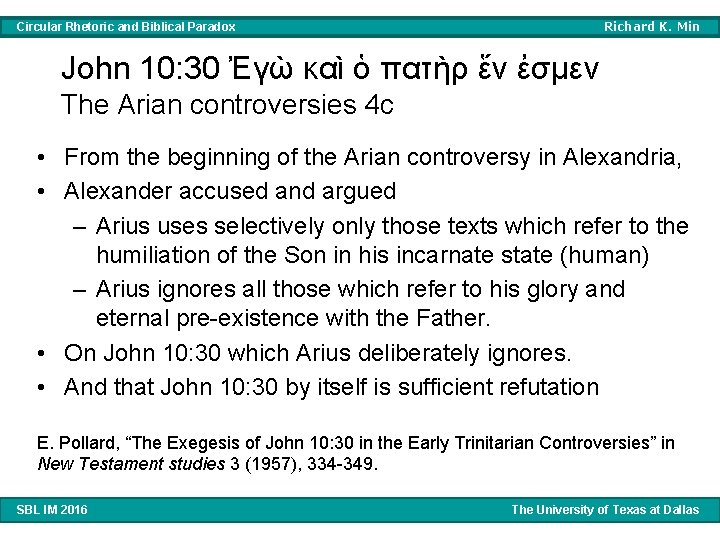
Richard K. Min Circular Rhetoric and Biblical Paradox John 10: 30 Ἐγὼ καὶ ὁ πατὴρ ἕν ἐσμεν The Arian controversies 4 c • From the beginning of the Arian controversy in Alexandria, • Alexander accused and argued – Arius uses selectively only those texts which refer to the humiliation of the Son in his incarnate state (human) – Arius ignores all those which refer to his glory and eternal pre-existence with the Father. • On John 10: 30 which Arius deliberately ignores. • And that John 10: 30 by itself is sufficient refutation E. Pollard, “The Exegesis of John 10: 30 in the Early Trinitarian Controversies” in New Testament studies 3 (1957), 334 -349. SBL IM 2016 The University of Texas at Dallas
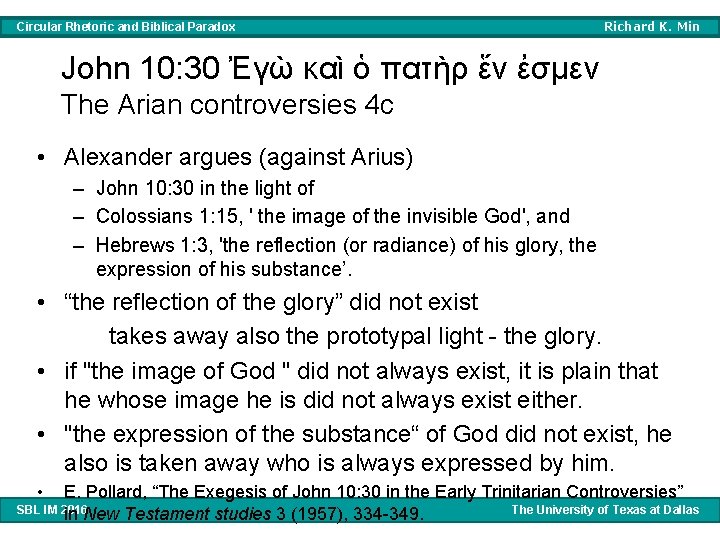
Circular Rhetoric and Biblical Paradox Richard K. Min John 10: 30 Ἐγὼ καὶ ὁ πατὴρ ἕν ἐσμεν The Arian controversies 4 c • Alexander argues (against Arius) – John 10: 30 in the light of – Colossians 1: 15, ' the image of the invisible God', and – Hebrews 1: 3, 'the reflection (or radiance) of his glory, the expression of his substance’. • “the reflection of the glory” did not exist takes away also the prototypal light - the glory. • if "the image of God " did not always exist, it is plain that he whose image he is did not always exist either. • "the expression of the substance“ of God did not exist, he also is taken away who is always expressed by him. • E. Pollard, “The Exegesis of John 10: 30 in the Early Trinitarian Controversies” SBL IM 2016 The University of Texas at Dallas in New Testament studies 3 (1957), 334 -349.
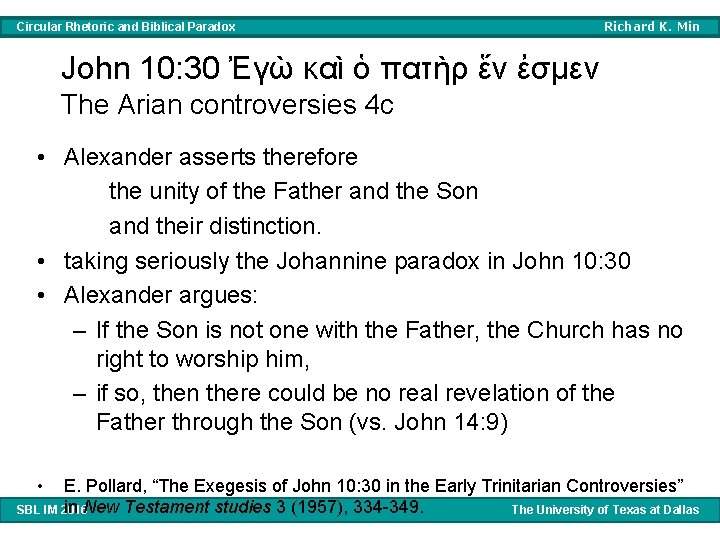
Circular Rhetoric and Biblical Paradox Richard K. Min John 10: 30 Ἐγὼ καὶ ὁ πατὴρ ἕν ἐσμεν The Arian controversies 4 c • Alexander asserts therefore the unity of the Father and the Son and their distinction. • taking seriously the Johannine paradox in John 10: 30 • Alexander argues: – If the Son is not one with the Father, the Church has no right to worship him, – if so, then there could be no real revelation of the Father through the Son (vs. John 14: 9) • E. Pollard, “The Exegesis of John 10: 30 in the Early Trinitarian Controversies” in New Testament studies 3 (1957), 334 -349. SBL IM 2016 The University of Texas at Dallas
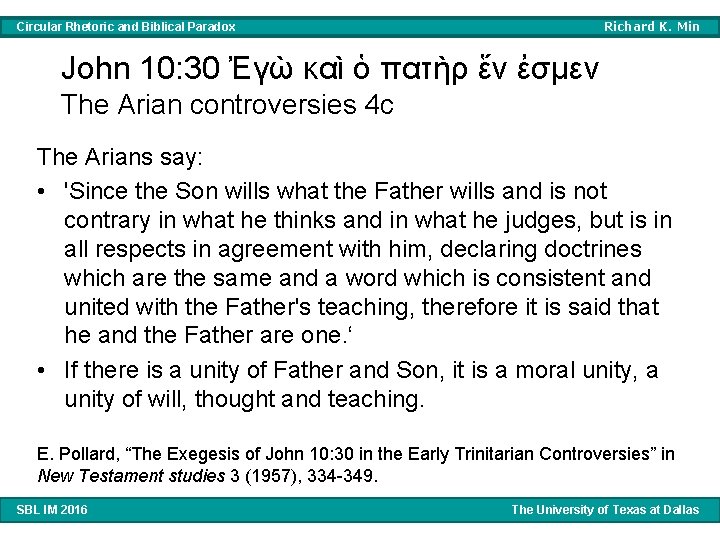
Richard K. Min Circular Rhetoric and Biblical Paradox John 10: 30 Ἐγὼ καὶ ὁ πατὴρ ἕν ἐσμεν The Arian controversies 4 c The Arians say: • 'Since the Son wills what the Father wills and is not contrary in what he thinks and in what he judges, but is in all respects in agreement with him, declaring doctrines which are the same and a word which is consistent and united with the Father's teaching, therefore it is said that he and the Father are one. ‘ • If there is a unity of Father and Son, it is a moral unity, a unity of will, thought and teaching. E. Pollard, “The Exegesis of John 10: 30 in the Early Trinitarian Controversies” in New Testament studies 3 (1957), 334 -349. SBL IM 2016 The University of Texas at Dallas
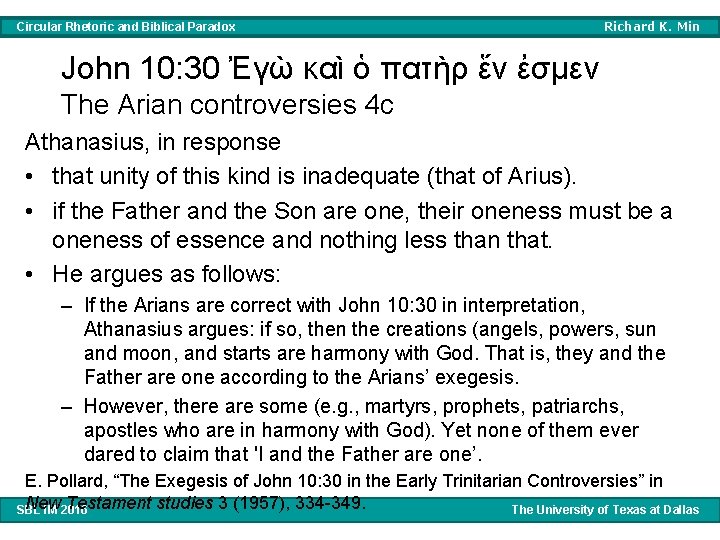
Circular Rhetoric and Biblical Paradox Richard K. Min John 10: 30 Ἐγὼ καὶ ὁ πατὴρ ἕν ἐσμεν The Arian controversies 4 c Athanasius, in response • that unity of this kind is inadequate (that of Arius). • if the Father and the Son are one, their oneness must be a oneness of essence and nothing less than that. • He argues as follows: – If the Arians are correct with John 10: 30 in interpretation, Athanasius argues: if so, then the creations (angels, powers, sun and moon, and starts are harmony with God. That is, they and the Father are one according to the Arians’ exegesis. – However, there are some (e. g. , martyrs, prophets, patriarchs, apostles who are in harmony with God). Yet none of them ever dared to claim that 'I and the Father are one’. E. Pollard, “The Exegesis of John 10: 30 in the Early Trinitarian Controversies” in New Testament studies 3 (1957), 334 -349. SBL IM 2016 The University of Texas at Dallas
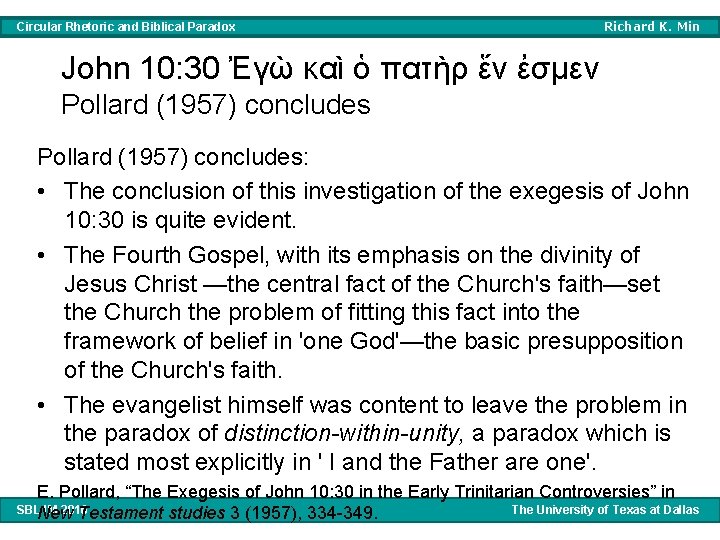
Circular Rhetoric and Biblical Paradox Richard K. Min John 10: 30 Ἐγὼ καὶ ὁ πατὴρ ἕν ἐσμεν Pollard (1957) concludes: • The conclusion of this investigation of the exegesis of John 10: 30 is quite evident. • The Fourth Gospel, with its emphasis on the divinity of Jesus Christ —the central fact of the Church's faith—set the Church the problem of fitting this fact into the framework of belief in 'one God'—the basic presupposition of the Church's faith. • The evangelist himself was content to leave the problem in the paradox of distinction-within-unity, a paradox which is stated most explicitly in ' I and the Father are one'. E. Pollard, “The Exegesis of John 10: 30 in the Early Trinitarian Controversies” in SBLNew IM 2016 The University of Texas at Dallas Testament studies 3 (1957), 334 -349.
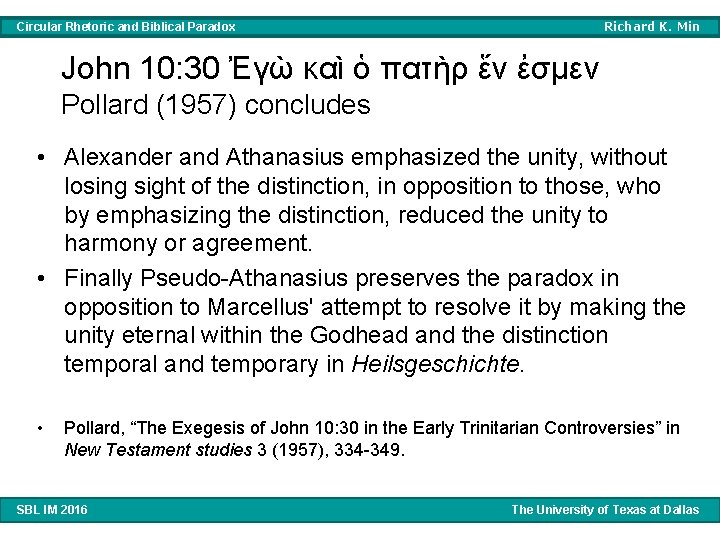
Richard K. Min Circular Rhetoric and Biblical Paradox John 10: 30 Ἐγὼ καὶ ὁ πατὴρ ἕν ἐσμεν Pollard (1957) concludes • Alexander and Athanasius emphasized the unity, without losing sight of the distinction, in opposition to those, who by emphasizing the distinction, reduced the unity to harmony or agreement. • Finally Pseudo-Athanasius preserves the paradox in opposition to Marcellus' attempt to resolve it by making the unity eternal within the Godhead and the distinction temporal and temporary in Heilsgeschichte. • Pollard, “The Exegesis of John 10: 30 in the Early Trinitarian Controversies” in New Testament studies 3 (1957), 334 -349. SBL IM 2016 The University of Texas at Dallas
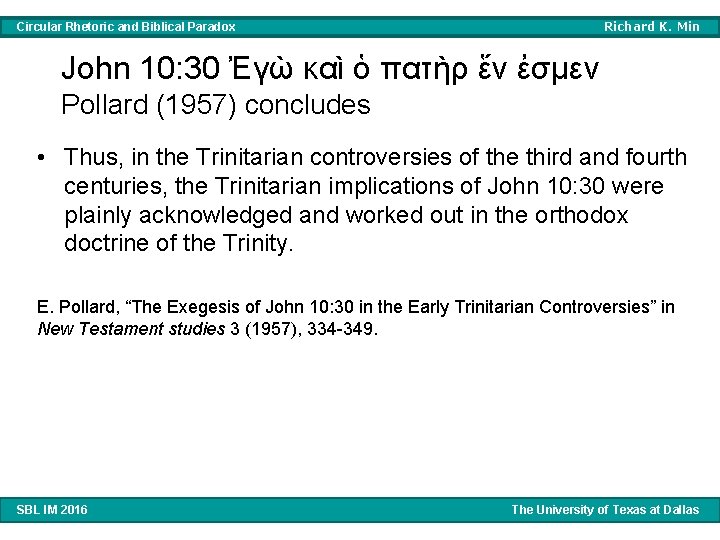
Richard K. Min Circular Rhetoric and Biblical Paradox John 10: 30 Ἐγὼ καὶ ὁ πατὴρ ἕν ἐσμεν Pollard (1957) concludes • Thus, in the Trinitarian controversies of the third and fourth centuries, the Trinitarian implications of John 10: 30 were plainly acknowledged and worked out in the orthodox doctrine of the Trinity. E. Pollard, “The Exegesis of John 10: 30 in the Early Trinitarian Controversies” in New Testament studies 3 (1957), 334 -349. SBL IM 2016 The University of Texas at Dallas
Circular Rhetoric and Biblical Paradox Richard K. Min John 10: 30 Ἐγὼ καὶ ὁ πατὴρ ἕν ἐσμεν The Arian controversies 4 c • Alexander and Athanasius emphasized the unity, without losing sight of the distinction, in opposition to those, who by emphasizing the distinction, reduced the unity to harmony or agreement. • Finally Pseudo-Athanasius preserves the paradox in opposition to Marcellus' attempt to resolve it by making the unity eternal within the Godhead and the distinction temporal and temporary in Heilsgeschichte. • Thus, in the Trinitarian controversies of the third and fourth centuries, the Trinitarian implications of John 10: 30 were plainly acknowledged and worked out in the orthodox doctrine of the Trinity. SBL IM 2016 The University of Texas at Dallas E. Pollard, “The Exegesis of John 10: 30 in the Early Trinitarian Controversies” in
Richard K. Min Circular Rhetoric and Biblical Paradox Part 4 • Circular Rhetoric and Paradox • A New Critical Method SBL IM 2016 The University of Texas at Dallas
Circular Rhetoric and Biblical Paradox Richard K. Min A Semantic Difference with Circular Logic • Induction and its Semantics – Here we say “infinite” or “eternal” – but it has no meaning in the frame of Induction or Inductive Logic (in this conventional “finite” worldview). • Coindcution and its Semantics (extending induction) Example: The “chicken or egg” problem (1) a chicken comes out of an egg, (2) an egg comes out of a chicken, and (3) the reproductive cycle between chicken and egg goes on forever. Inductive Logic: No answer Coinductive Logic: 4 possible answers { No answer, Chicken, Egg, Chicken and Egg } SBL IM 2016 The University of Texas at Dallas
Circular Rhetoric and Biblical Paradox Richard K. Min A Semantic Difference with Circular Logic • Bousset (1913) provides an insightful difference between Paul's Christ mysticism (versus the Hellenistic religion with similar rhetoric, but pantheistic implication). • The lexical pattern ("X in the Christ" or "the Christ in X" where X is, for example, a Christian or Christians) does not grant a pantheistic or panentheistic implication (to say that "X is the Christ" or "the Christ is X") whether the expression is provided reciprocally or not. • Wilhelm Bousset, KYRIOS CHRISTOS: A History of the Belief in Christ from the Beginnings of Christianity to Irenaeus, trans. John E. Steely (Waco: Baylor University Press, 2013 [1913]), 164– 69. Bousset notes the expressions in Hermetic prayers for being completely pantheistic (for example, "Come to me, Hermes, as children come into the body of women. . I know you, Hermas, and you know me. I am you and you are I, " and "For you are I and I am you. Your name is mine and mine is yours. I am your image. ") SBL IM 2016 The University of Texas at Dallas
Richard K. Min Circular Rhetoric and Biblical Paradox A New Critical Method • Circular Rhetoric and Logic of Paradoxes To make sense and do a valid and sound exegesis. Otherwise, to treat it meaningless or invalid, or to treat as if it is not there • There are so many and so predominant in the Bible And each case/its presence simply cannot to be ignored or silenced. • Once understood and applied correctly, it truly makes sense objectively and logical Matthew 22: 15 -46, John 8: 12 -20 with Exodus 3: 14 -15 • To construct a coherent, consistent, and unifying framework in exegesis and its application (and no need of “post-liberal theology or narrative theology”, deconstructionism or “story-telling” [as one may argue that these biblical passages have no valid logic or an objective truth, and thus treat them metaphorically, subjectively, . . . ] SBL IM 2016 The University of Texas at Dallas
Richard K. Min Circular Rhetoric and Biblical Paradox Afterword by Solomon 13 Now all has been heard; here is the conclusion of the matter: Fear God and keep his commandments, for this is the duty of all mankind. 14 For God will bring every deed into judgment, including every hidden thing, whether it is good or evil. (Ecclesiastes 12: 13 -14 NIV) SBL IM 2016 The University of Texas at Dallas
- Slides: 87