
Ribozymes RNA Enzymes Function Patrick Young Function Ribozymes
Ribozymes: RNA Enzymes Function Patrick Young
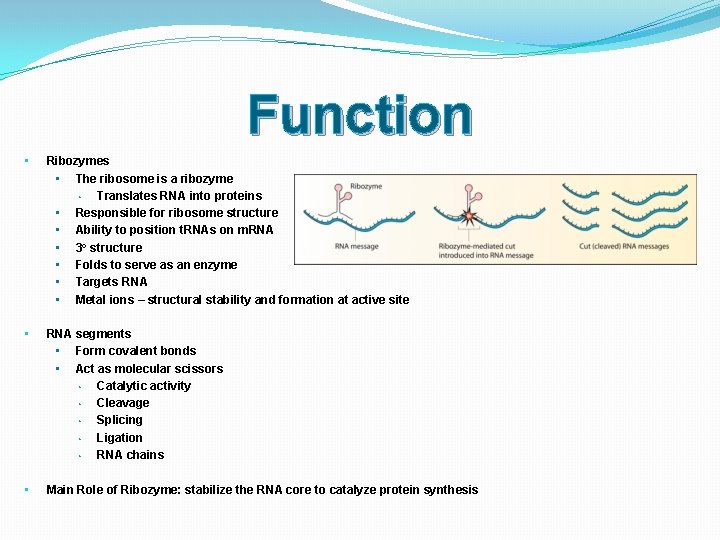
Function • Ribozymes • The ribosome is a ribozyme • Translates RNA into proteins • Responsible for ribosome structure • Ability to position t. RNAs on m. RNA • 3 o structure • Folds to serve as an enzyme • Targets RNA • Metal ions – structural stability and formation at active site • RNA segments • Form covalent bonds • Act as molecular scissors • Catalytic activity • Cleavage • Splicing • Ligation • RNA chains • Main Role of Ribozyme: stabilize the RNA core to catalyze protein synthesis
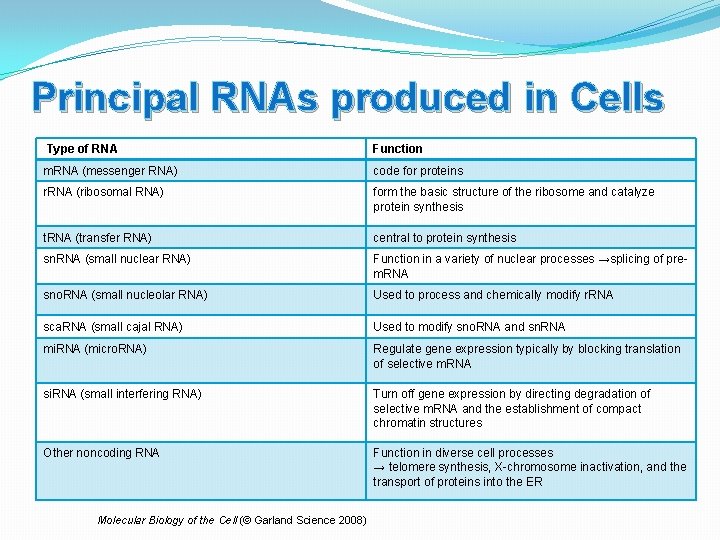
Principal RNAs produced in Cells Type of RNA Function m. RNA (messenger RNA) code for proteins r. RNA (ribosomal RNA) form the basic structure of the ribosome and catalyze protein synthesis t. RNA (transfer RNA) central to protein synthesis sn. RNA (small nuclear RNA) Function in a variety of nuclear processes →splicing of prem. RNA sno. RNA (small nucleolar RNA) Used to process and chemically modify r. RNA sca. RNA (small cajal RNA) Used to modify sno. RNA and sn. RNA mi. RNA (micro. RNA) Regulate gene expression typically by blocking translation of selective m. RNA si. RNA (small interfering RNA) Turn off gene expression by directing degradation of selective m. RNA and the establishment of compact chromatin structures Other noncoding RNA Function in diverse cell processes → telomere synthesis, X-chromosome inactivation, and the transport of proteins into the ER Molecular Biology of the Cell (© Garland Science 2008)
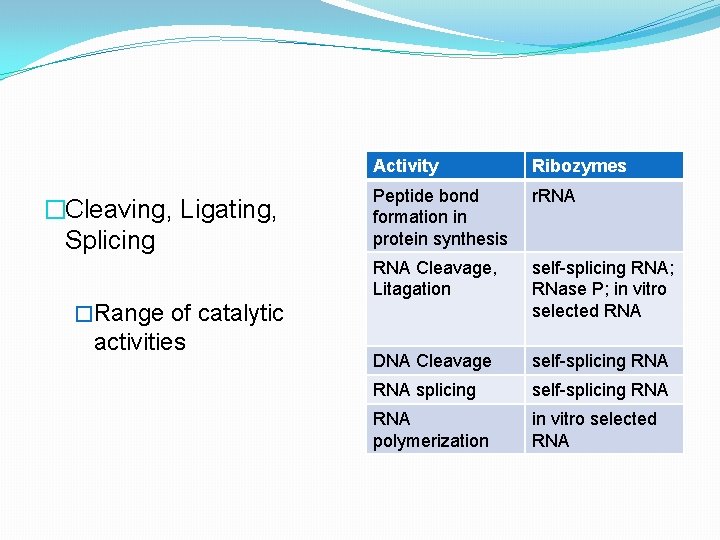
�Cleaving, Ligating, Splicing Activity Ribozymes Peptide bond formation in protein synthesis r. RNA Cleavage, Litagation self-splicing RNA; RNase P; in vitro selected RNA DNA Cleavage self-splicing RNA splicing self-splicing RNA polymerization in vitro selected RNA �Range of catalytic activities
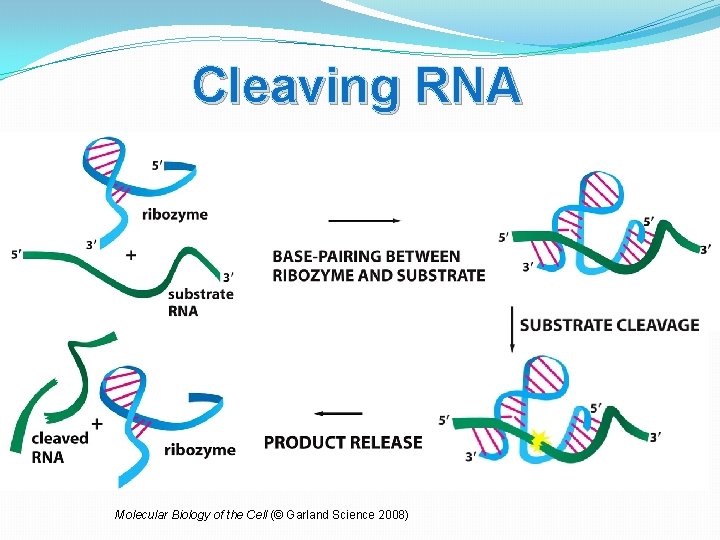
Cleaving RNA Molecular Biology of the Cell (© Garland Science 2008)
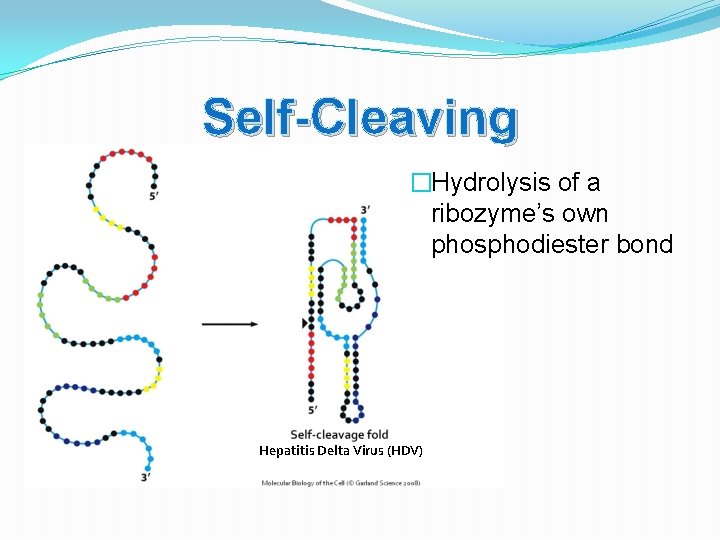
Self-Cleaving �Hydrolysis of a ribozyme’s own phosphodiester bond Hepatitis Delta Virus (HDV)
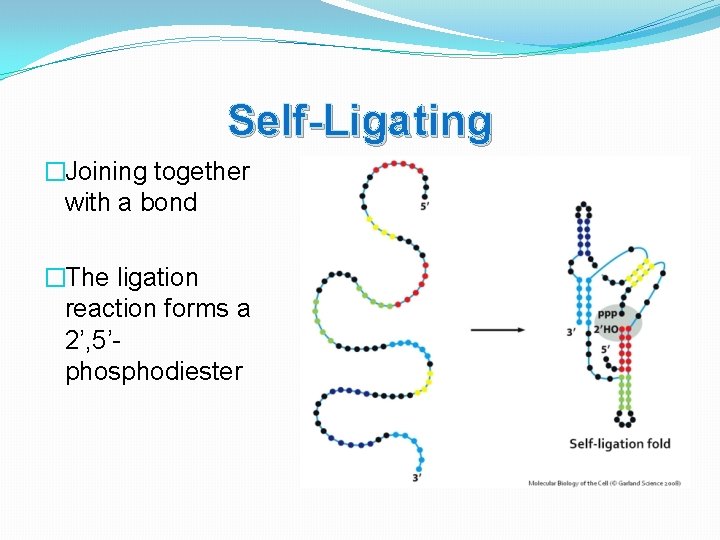
Self-Ligating �Joining together with a bond �The ligation reaction forms a 2’, 5’phosphodiester
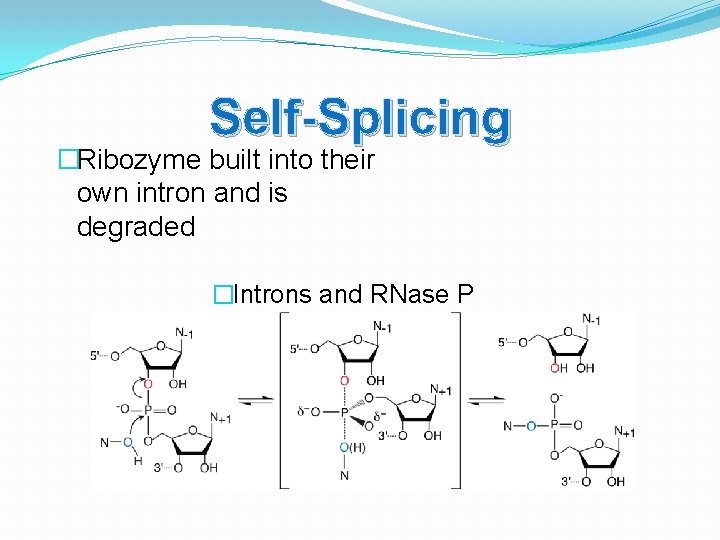
Self-Splicing �Ribozyme built into their own intron and is degraded �Introns and RNase P
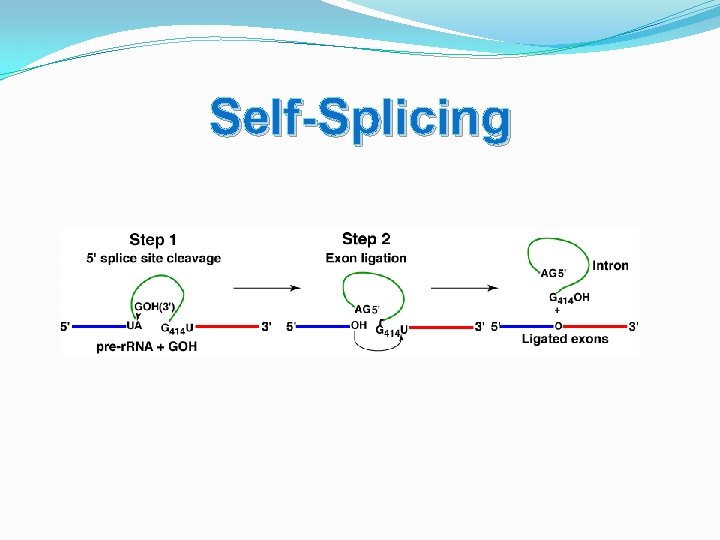
Self-Splicing
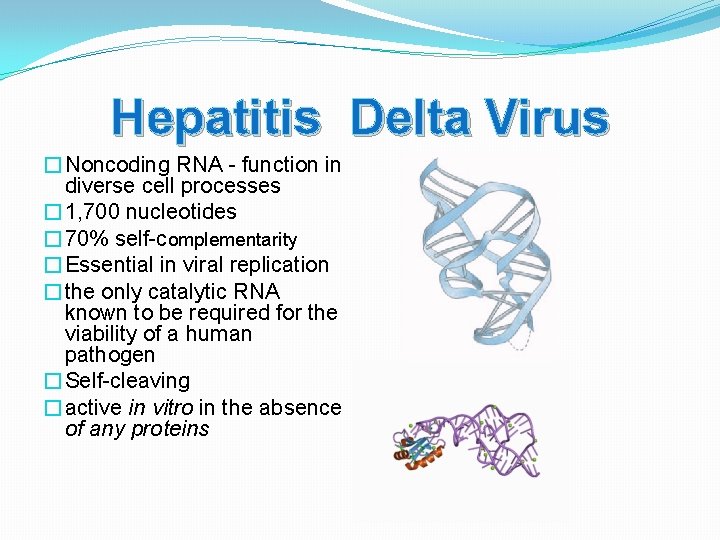
Hepatitis Delta Virus �Noncoding RNA - function in diverse cell processes � 1, 700 nucleotides � 70% self-complementarity �Essential in viral replication �the only catalytic RNA known to be required for the viability of a human pathogen �Self-cleaving �active in vitro in the absence of any proteins
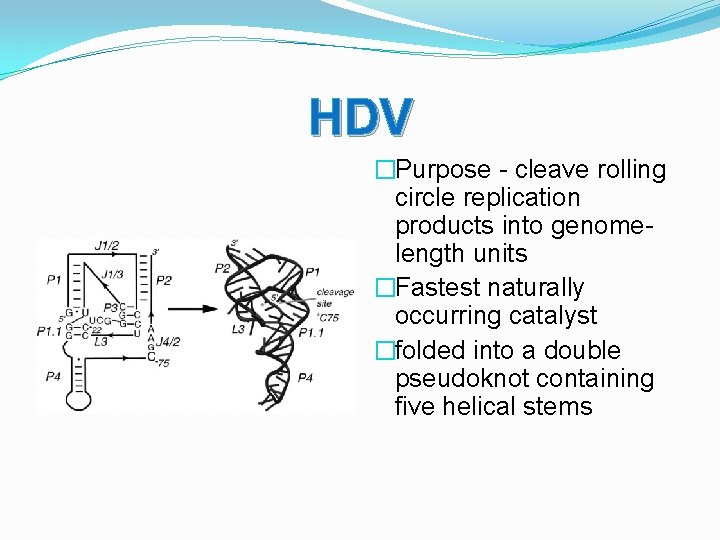
HDV �Purpose - cleave rolling circle replication products into genomelength units �Fastest naturally occurring catalyst �folded into a double pseudoknot containing five helical stems
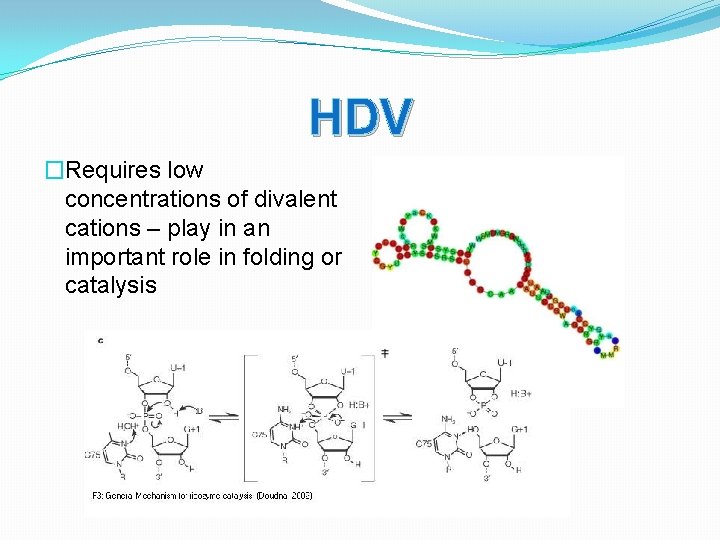
HDV �Requires low concentrations of divalent cations – play in an important role in folding or catalysis
References � Alberts, Bruce, John H. Wilson, and Tim Hunt. Molecular Biology of the Cell. New York: Garland Science, 2008. Print. � Doherty, Elizabeth A. , and Jennifer A. Doudna. "Ribozyme Structures and Mechanisms. " Annual Review: Biophysics and Biomolecular Structure 30 (2001): 457 -75. Print. � Ferre´ -D’Amare, Adrian R. "Crystal Structure of a Hepatitis Delta. " Nature, 8 Oct. 1998. Web. <http: //cmgm. stanford. edu/biochem 201/Papers/doudna. pdf>. � Flugel, Rolf M. Chirality and Life a Short Introduction to the Early Phases of Chemical Evolution. Berlin: Springer, 2011. 23 -27. Print. � Reyes, Roberto. "Ribozymes: Molecular Scissors for Investigating Genetic Function. " Mad. Sci. Net: The 24 -hour Exploding Laboratory. University of Washington School of Medicine. Web. 16 Nov. 2011. <http: //www. madsci. org/dtm/ribozyme. html>. � Web. 19 Nov. 2011. <http: //www. pubmed. gov>.
- Slides: 13