
Ribosomes and Endoplasmic Reticulum Presentation Khaled Nassman Mirana
Ribosomes and Endoplasmic Reticulum Presentation Khaled Nassman Mirana Cao
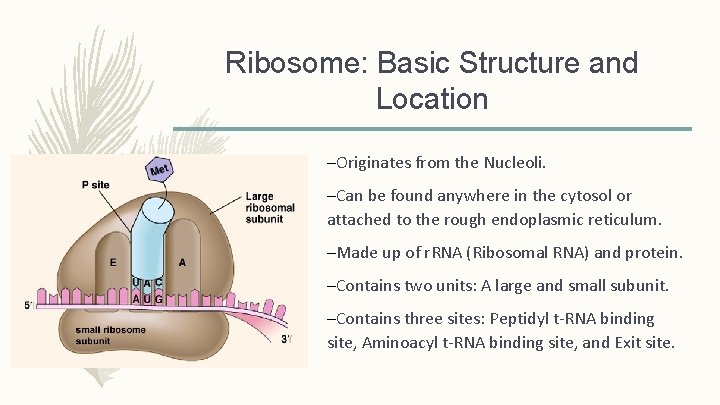
Ribosome: Basic Structure and Location –Originates from the Nucleoli. –Can be found anywhere in the cytosol or attached to the rough endoplasmic reticulum. –Made up of r. RNA (Ribosomal RNA) and protein. –Contains two units: A large and small subunit. –Contains three sites: Peptidyl t-RNA binding site, Aminoacyl t-RNA binding site, and Exit site.

Ribosome: Function –Specializes in protein synthesis. –How is it created? 1. m. RNA binds between the small and large ribosomal units. 2. Specific amino acids are needed depending on the codon sequence. (t. RNA contains anticodon that fits onto m. RNA). 3. t. RNA binds to the A site with an amino acid attached. 4. Moves down to the P site where the t. RNA holds the amino acid chain ( Bond is formed between the amino acids of the A and P sites). 5. t. RNA is released from the E site. 6. m. RNA moves down the ribosome, forming a polypeptide chain that assembles into a protein in the tertiary structure (polypeptides are created with the start codon (AUG) and is released by the UGA, UAA, or UAG codon).
Ribosome: Fun Facts –A human cell can contain up to 10 million ribosomes. –About 30 trillion cells in a grown human body. – 10, 000 x 30, 000, 000 = 3 x e²⁰ ribosomes.

Where are Ribosomes? Free? Or attached to somewhere?
- Slides: 5