
Rhythm Principle of Design What is Rhythm Definition
- Slides: 10
Rhythm Principle of Design
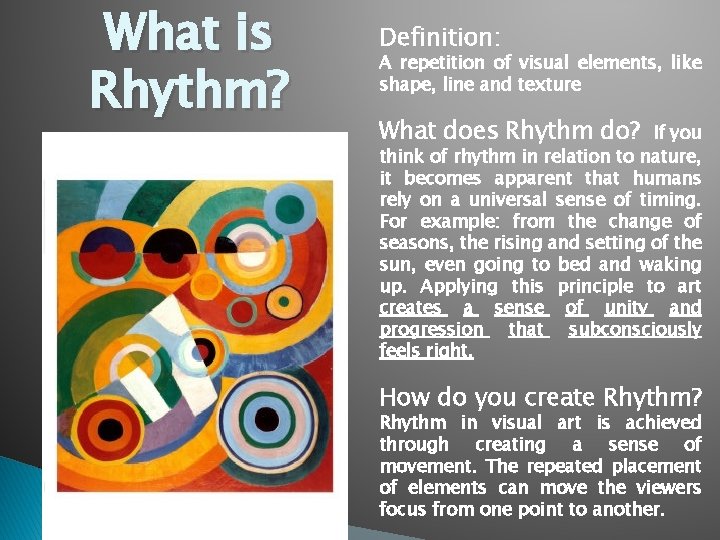
What is Rhythm? Definition: A repetition of visual elements, like shape, line and texture What does Rhythm do? If you think of rhythm in relation to nature, it becomes apparent that humans rely on a universal sense of timing. For example: from the change of seasons, the rising and setting of the sun, even going to bed and waking up. Applying this principle to art creates a sense of unity and progression that subconsciously feels right. How do you create Rhythm? Rhythm in visual art is achieved through creating a sense of movement. The repeated placement of elements can move the viewers focus from one point to another.
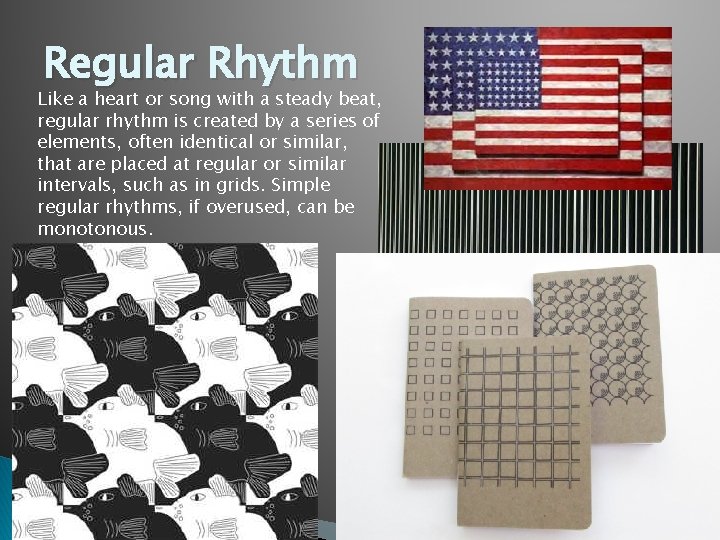
Regular Rhythm Like a heart or song with a steady beat, regular rhythm is created by a series of elements, often identical or similar, that are placed at regular or similar intervals, such as in grids. Simple regular rhythms, if overused, can be monotonous.
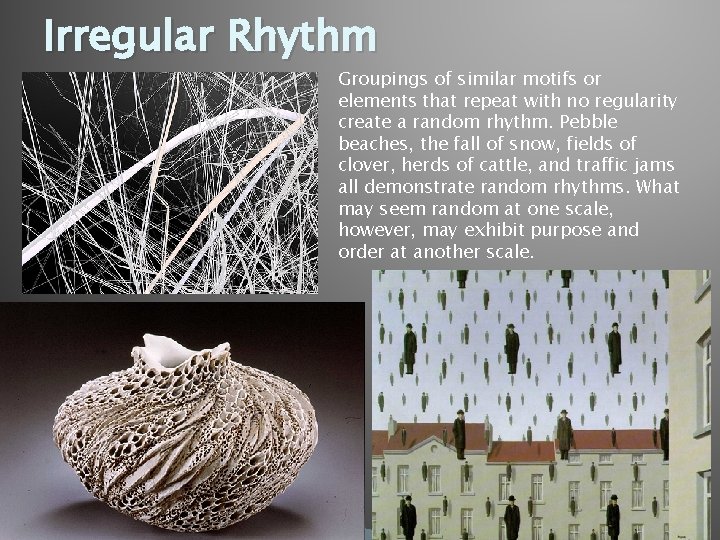
Irregular Rhythm Groupings of similar motifs or elements that repeat with no regularity create a random rhythm. Pebble beaches, the fall of snow, fields of clover, herds of cattle, and traffic jams all demonstrate random rhythms. What may seem random at one scale, however, may exhibit purpose and order at another scale.
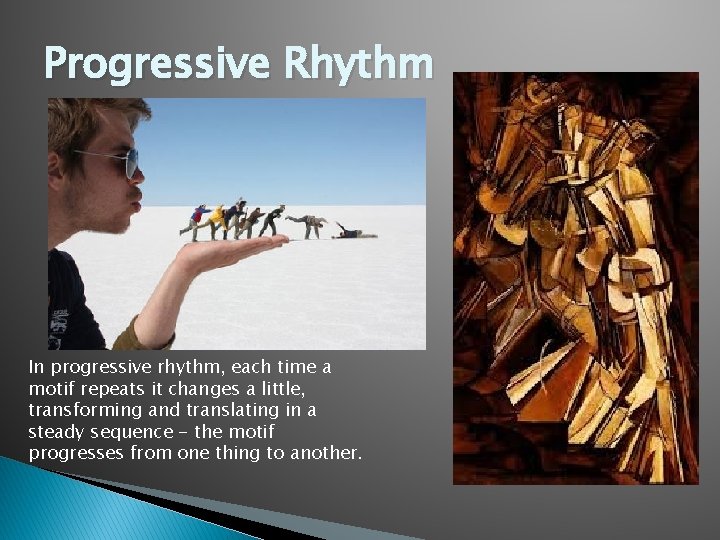
Progressive Rhythm In progressive rhythm, each time a motif repeats it changes a little, transforming and translating in a steady sequence - the motif progresses from one thing to another.
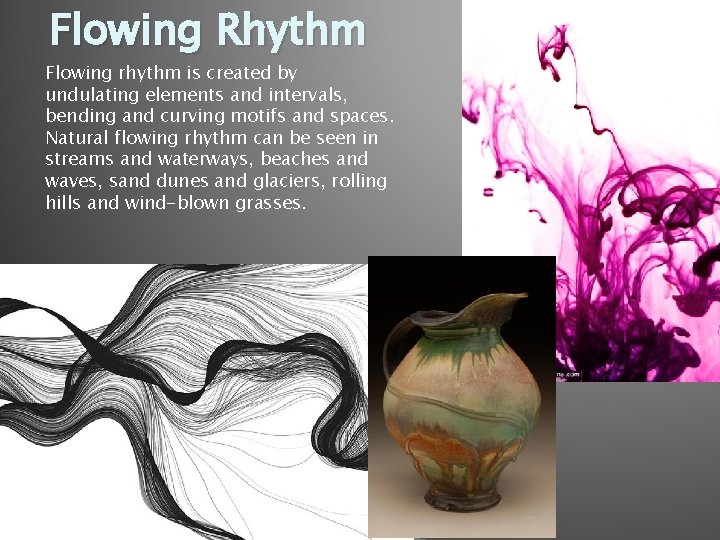
Flowing Rhythm Flowing rhythm is created by undulating elements and intervals, bending and curving motifs and spaces. Natural flowing rhythm can be seen in streams and waterways, beaches and waves, sand dunes and glaciers, rolling hills and wind-blown grasses.
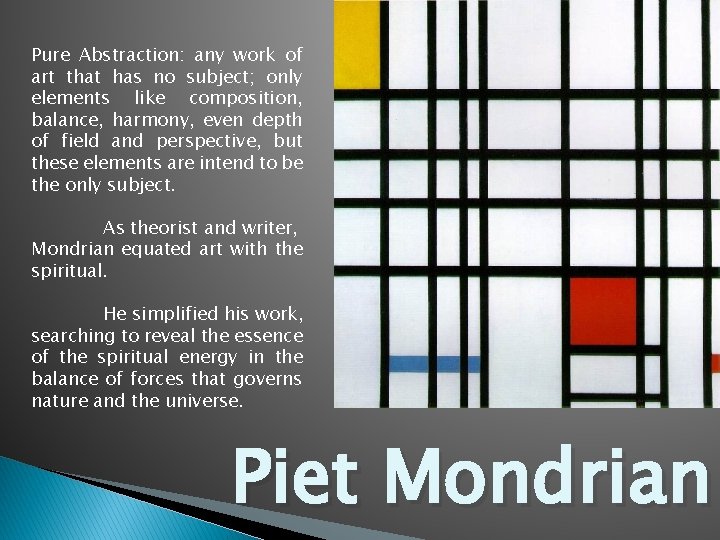
Pure Abstraction: any work of art that has no subject; only elements like composition, balance, harmony, even depth of field and perspective, but these elements are intend to be the only subject. As theorist and writer, Mondrian equated art with the spiritual. He simplified his work, searching to reveal the essence of the spiritual energy in the balance of forces that governs nature and the universe. Piet Mondrian
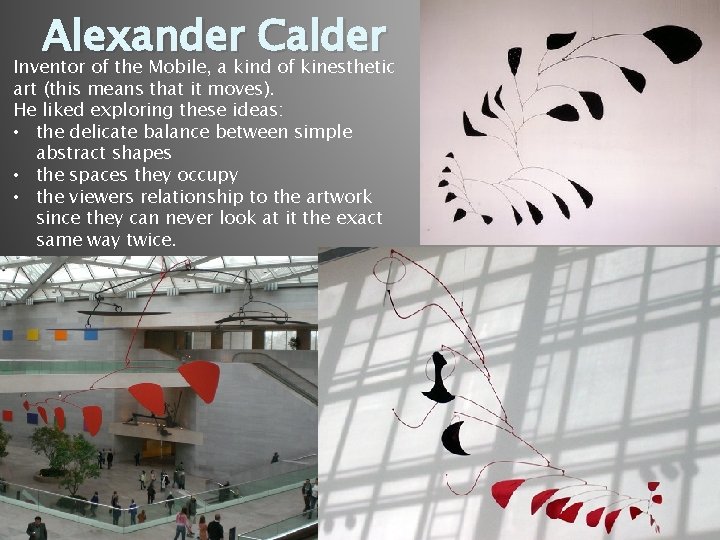
Alexander Calder Inventor of the Mobile, a kind of kinesthetic art (this means that it moves). He liked exploring these ideas: • the delicate balance between simple abstract shapes • the spaces they occupy • the viewers relationship to the artwork since they can never look at it the exact same way twice.
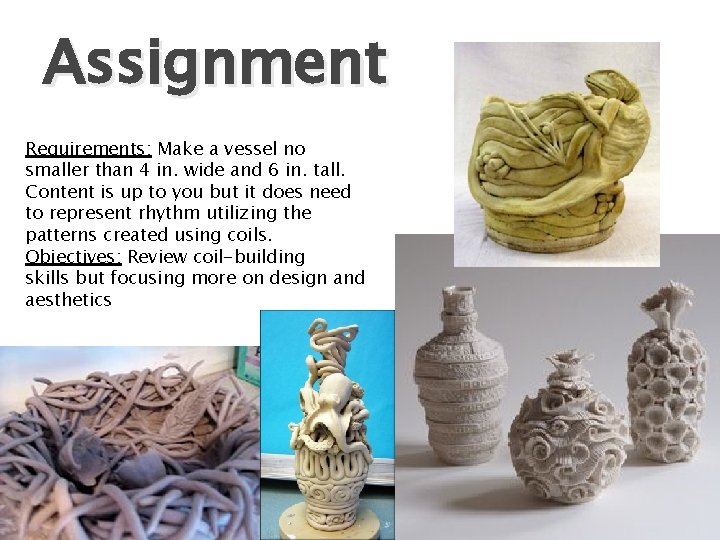
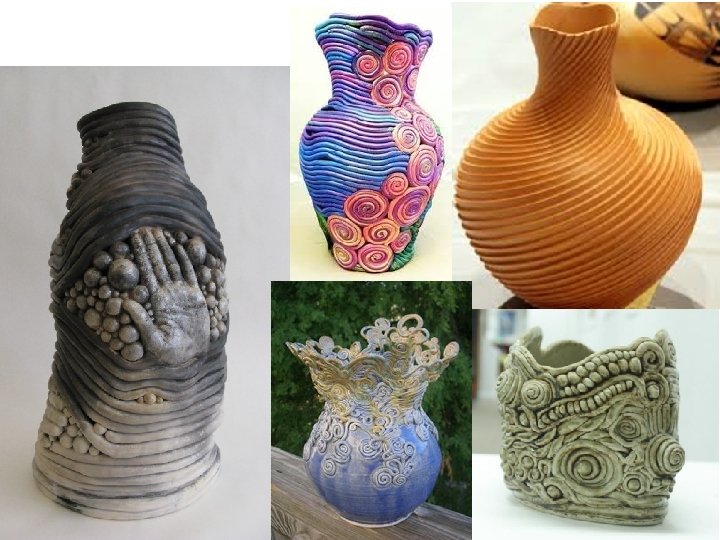
Assignment Requirements: Make a vessel no smaller than 4 in. wide and 6 in. tall. Content is up to you but it does need to represent rhythm utilizing the patterns created using coils. Objectives: Review coil-building skills but focusing more on design and aesthetics