
RHODOCOCCUS FASCIANS A RARE CAUSE OF MENINGITIS IN
- Slides: 11
RHODOCOCCUS FASCIANS - A RARE CAUSE OF MENINGITIS IN A HUMAN HOST Kiran Motwani
Introduction • Rhodococcus species are obligate aerobes, gram-positive bacilli and partially acid-fast because of their mycolic acidcontaining cell wall. • They are isolated from a variety of sources including soil, ground water, plants and animals. • The microbe is generally considered to have low pathogenicity, however has been known to cause disease in immunocompromised hosts. • Transmission is by inhalation, ingestion or inoculation of the organism, usually from soil.
Patient Case – 76 year old male • Prior to hospitalization – living in Dominican Republic. Admitted to a hospital there for dehydration, severe diarrhea, and weakness. Patient transferred to USA for further assessment. • Admitted to an outside hospital for altered mental status - confusion, slurred speech, visual hallucinations and ambulatory dysfunction • MRI brain - concerning for meningitis. Received empiric ceftriaxone & ampicillin. No lumbar puncture was performed on initial evaluation.
Patient Case – 76 year old male • Further work-up revealed a ruptured pseudoaneurysm of ascending aorta and hemorrhagic pericardial effusion • Transferred to UMMC 48 hours later • Underwent an aortic aneurysm repair with a graft placement. He remained hemodynamically stable; however, 7 days post-operation there was no improvement in his mental status despite antibiotics.
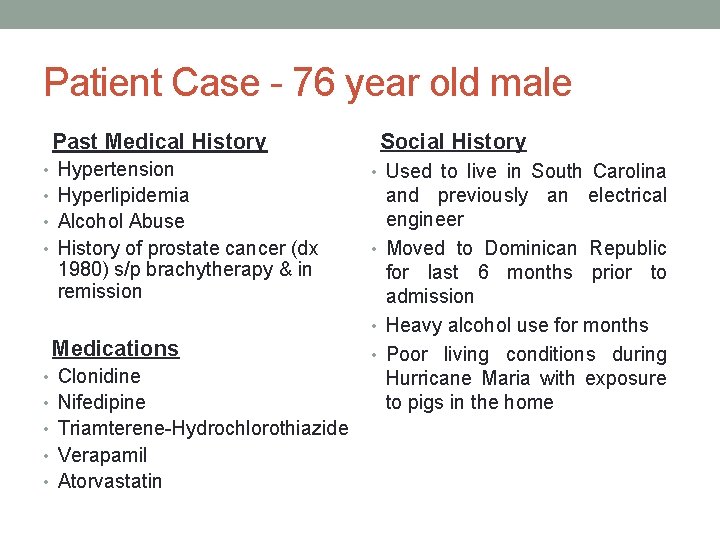
Patient Case - 76 year old male Past Medical History Social History • Hypertension • Used to live in South Carolina • Hyperlipidemia and previously an electrical engineer • Moved to Dominican Republic for last 6 months prior to admission • Heavy alcohol use for months • Poor living conditions during Hurricane Maria with exposure to pigs in the home • Alcohol Abuse • History of prostate cancer (dx 1980) s/p brachytherapy & in remission Medications • Clonidine • Nifedipine • Triamterene-Hydrochlorothiazide • Verapamil • Atorvastatin
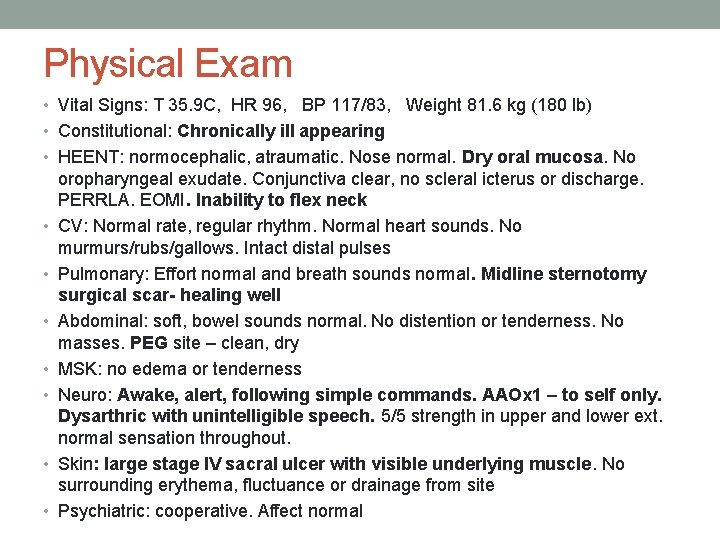
Physical Exam • Vital Signs: T 35. 9 C, HR 96, BP 117/83, Weight 81. 6 kg (180 lb) • Constitutional: Chronically ill appearing • HEENT: normocephalic, atraumatic. Nose normal. Dry oral mucosa. No • • oropharyngeal exudate. Conjunctiva clear, no scleral icterus or discharge. PERRLA. EOMI. Inability to flex neck CV: Normal rate, regular rhythm. Normal heart sounds. No murmurs/rubs/gallows. Intact distal pulses Pulmonary: Effort normal and breath sounds normal. Midline sternotomy surgical scar- healing well Abdominal: soft, bowel sounds normal. No distention or tenderness. No masses. PEG site – clean, dry MSK: no edema or tenderness Neuro: Awake, alert, following simple commands. AAOx 1 – to self only. Dysarthric with unintelligible speech. 5/5 strength in upper and lower ext. normal sensation throughout. Skin: large stage IV sacral ulcer with visible underlying muscle. No surrounding erythema, fluctuance or drainage from site Psychiatric: cooperative. Affect normal
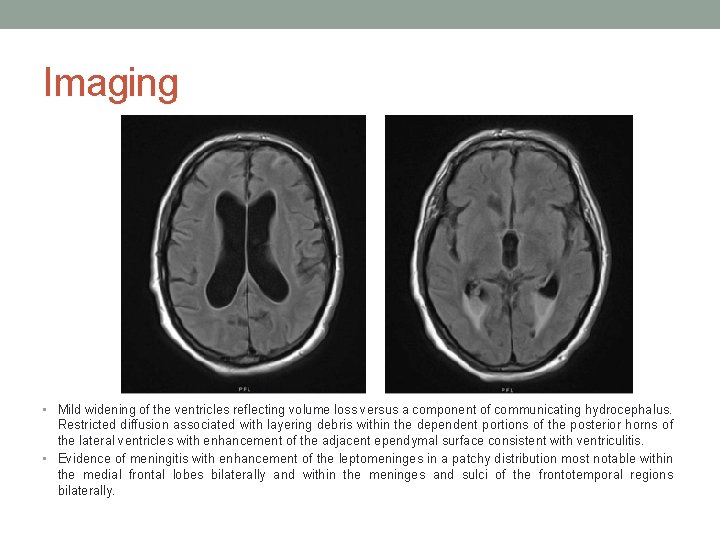
Imaging • Mild widening of the ventricles reflecting volume loss versus a component of communicating hydrocephalus. Restricted diffusion associated with layering debris within the dependent portions of the posterior horns of the lateral ventricles with enhancement of the adjacent ependymal surface consistent with ventriculitis. • Evidence of meningitis with enhancement of the leptomeninges in a patchy distribution most notable within the medial frontal lobes bilaterally and within the meninges and sulci of the frontotemporal regions bilaterally.
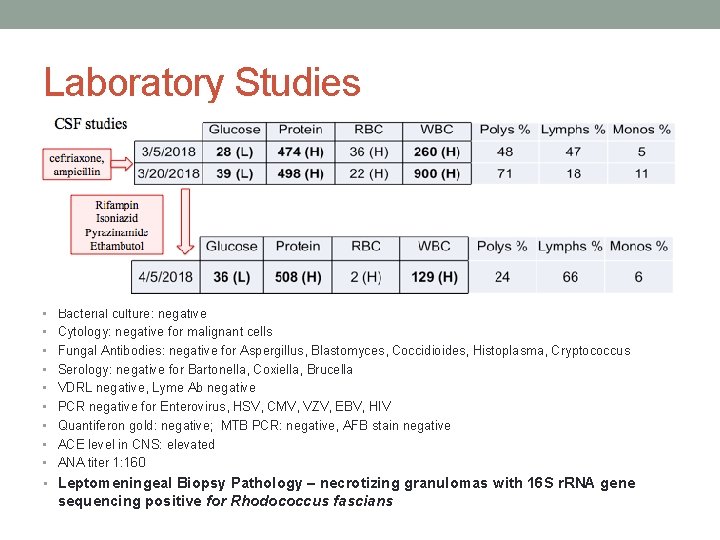
Laboratory Studies • Bacterial culture: negative • Cytology: negative for malignant cells • Fungal Antibodies: negative for Aspergillus, Blastomyces, Coccidioides, Histoplasma, Cryptococcus • Serology: negative for Bartonella, Coxiella, Brucella • VDRL negative, Lyme Ab negative • PCR negative for Enterovirus, HSV, CMV, VZV, EBV, HIV • Quantiferon gold: negative; MTB PCR: negative, AFB stain negative • ACE level in CNS: elevated • ANA titer 1: 160 • Leptomeningeal Biopsy Pathology – necrotizing granulomas with 16 S r. RNA gene sequencing positive for Rhodococcus fascians
Hospital Course • Started on a 3 -drug regimen with vancomycin, meropenem, and azithromycin for an 8 -week course. • Follow up MRI showed improvement in leptomeningeal enhancement and decreased ventricular enhancement. • The patient’s mental status and neurologic function improved however did not return quite to baseline. He was much more conversant, following commands and able to independently perform his activities of daily living, however he continued to have difficulty with short term and long term memory
Discussion • Rhodococcus fascians is a rare cause of meningitis and not easily identified with routine microbial testing. • Recognizing lack of improvement in disease course in an immunocompromised patient should lead providers to consider alternate pathologies and seek further testing with 16 S r. RNA gene sequencing. • 16 S r. RNA gene sequencing provides genus identification in >90% of cases and species identification 65 -83% of the time. 1 -14% of isolates remain unidentified after testing. • Treatment regimens are currently unknown due to the rarity of the disease. Vancomycin, rifampicin, quinolones, aminoglycosides, carbapenems, and macrolides are effective. A 2 -3 drug regimen is recommended. Treatment courses can be 2 -8 weeks and up to 6 total months.
References 1. Austin MC, Hallstrand TS, Hoogestraat DR, et al. Rhodococcus fascians infection after haematopoietic cell transplantation: not just a plant pathogen? . JMM Case Rep. 2016; 3(2): 1 -4. 2. De. Marais PL, Kocka FE. Rhodococcus meningitis in an immunocompetent host. Clin Infect Dis 1995; 20: 167 -9. 3. Janda JM, Abbott SL. 16 S r. RNA gene sequencing for bacterial identification in the diagnostic laboratory: pluses, perils, and pitfalls. J Clin Microbiol 2007; 45: 2761 -4. Stutman RE, Reboli A. Rhodococci. Infect Dis Adv 2017. Retrieved Apr 27, 2019 from https: //www. infectiousdiseaseadvisor. com/home/decisionsupport-in-medicine/infectious-diseases/rhodococci/