
RHETORICAL MODES WHAT ARE RHETORICAL MODES Different methods

- Slides: 34
RHETORICAL MODES
WHAT ARE RHETORICAL MODES? § Different methods of writing which an author incorporates into her/his writing to make it more effective § Writers utilize various modes to their advantage (to make an essay stronger) – and for their readers (to help them better connect with the essay) § Modes work together in a text; however, a primary mode is always present. For example, a narrative essay (primary mode) will always utilize description (secondary).
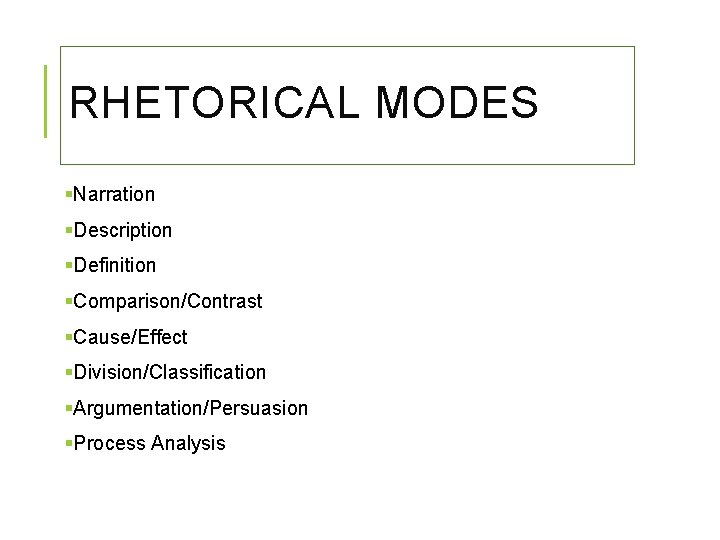
RHETORICAL MODES §Narration §Description §Definition §Comparison/Contrast §Cause/Effect §Division/Classification §Argumentation/Persuasion §Process Analysis
NARRATION § Tells the story or several related stories of what happened, the specific events that happened, and the people who were involved § The story can be a means to an end, the dominant pattern of development, or can provide support for a claim or thesis § Provides organized facts and details, utilizing chronological (time) order • Flashback: disrupts the chronology of a story, returns to an earlier moment in time to make the present more clear • Flash-forward: disrupts the chronology of a story, moves forward in time § May employ first, second or third person point-of-view
NARRATION Purposes: • To introduce or illustrate a complicated subject (personal anecdote) • To analyze an issue or theme (an entire essay) • To report the actions and describe the feelings of people in a situation (autobiography, history, fiction) Audience: • How much information do they need (details/summaries/both) • What do they know? • What do they expect? Strategies: • Order • Conflict • Plot • Pace • Details • Point of view
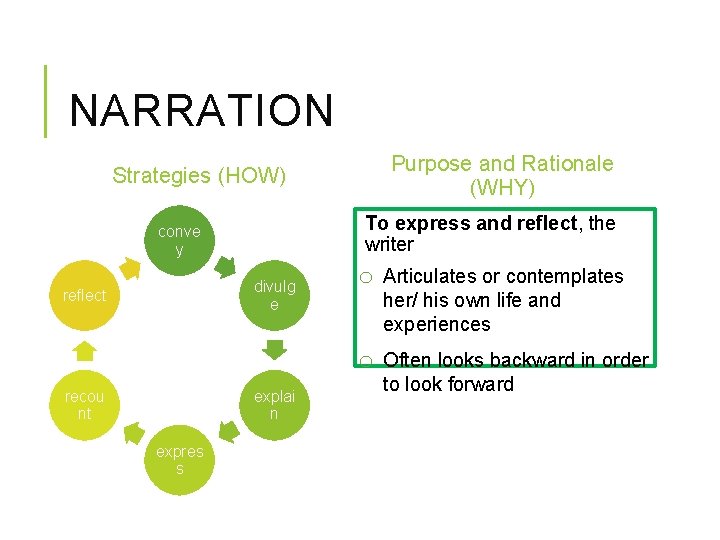
NARRATION Purpose and Rationale (WHY) Strategies (HOW) To express and reflect, the writer conve y divulg e reflect recou nt explai n expres s o Articulates or contemplates her/ his own life and experiences o Often looks backward in order to look forward
DESCRIPTION § Describes a person, a place, an object or an idea § Expressed in vivid language so the audience can imagine/visualize/sense it § Uses the senses (sight, smell, hearing, taste, and touch) to convey an image or represent an idea
DESCRIPTION Ø A richly rendered description freezes a subject in time, evoking sights, smells, sounds, textures, and tastes in such a way that readers become one with the writer’s world. Ø Description can either be a supportive technique that develops part of an essay or it can be the dominant technique used throughout an essay.
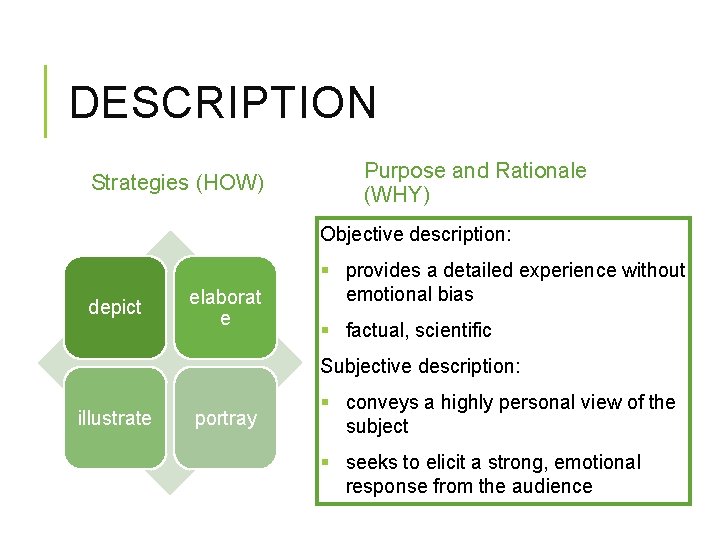
DESCRIPTION Strategies (HOW) Purpose and Rationale (WHY) Objective description: depict elaborat e § provides a detailed experience without emotional bias § factual, scientific Subjective description: illustrate portray § conveys a highly personal view of the subject § seeks to elicit a strong, emotional response from the audience
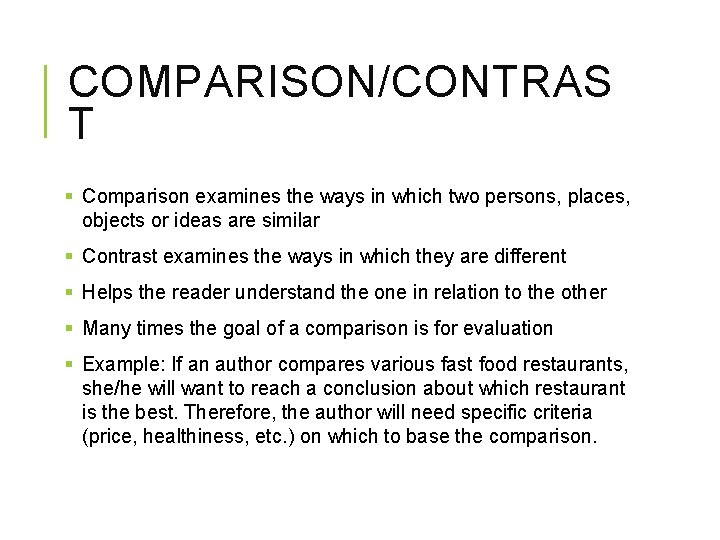
COMPARISON/CONTRAS T § Comparison examines the ways in which two persons, places, objects or ideas are similar § Contrast examines the ways in which they are different § Helps the reader understand the one in relation to the other § Many times the goal of a comparison is for evaluation § Example: If an author compares various fast food restaurants, she/he will want to reach a conclusion about which restaurant is the best. Therefore, the author will need specific criteria (price, healthiness, etc. ) on which to base the comparison.
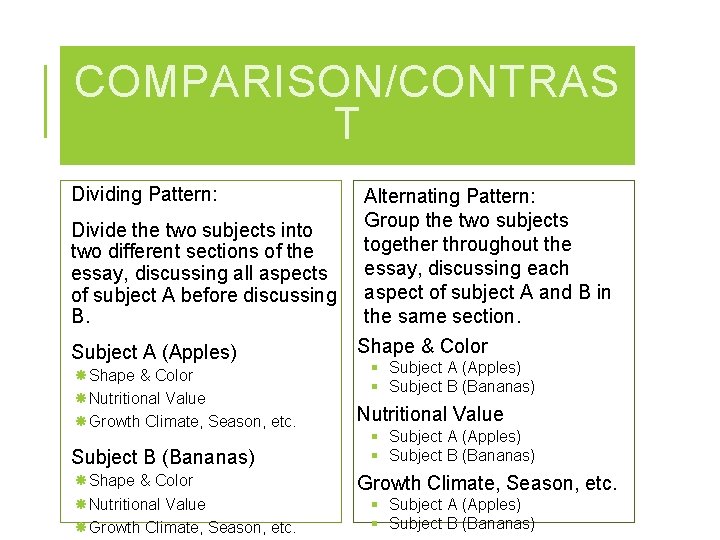
COMPARISON/CONTRAS T Dividing Pattern: Subject A (Apples) Alternating Pattern: Group the two subjects together throughout the essay, discussing each aspect of subject A and B in the same section. Shape & Color Nutritional Value Growth Climate, Season, etc. Nutritional Value Divide the two subjects into two different sections of the essay, discussing all aspects of subject A before discussing B. Subject B (Bananas) Shape & Color Nutritional Value Growth Climate, Season, etc. § Subject A (Apples) § Subject B (Bananas) Growth Climate, Season, etc. § Subject A (Apples) § Subject B (Bananas)
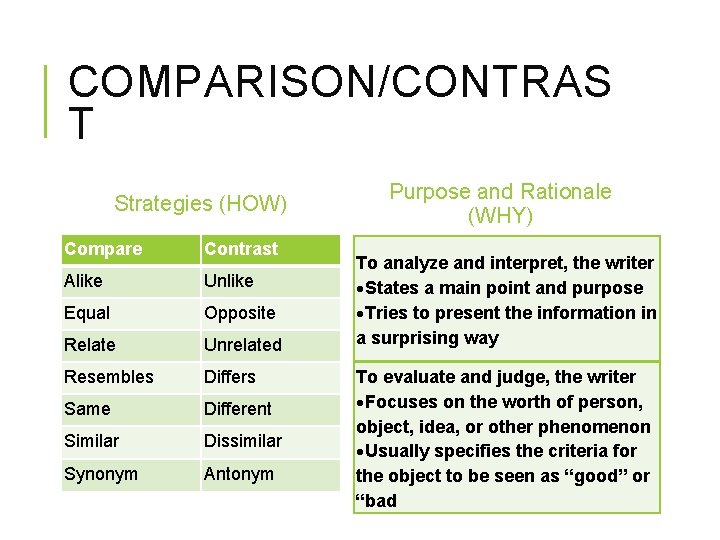
COMPARISON/CONTRAS T Strategies (HOW) Compare Contrast Alike Unlike Equal Opposite Relate Unrelated Resembles Differs Same Different Similar Dissimilar Synonym Antonym Purpose and Rationale (WHY) To analyze and interpret, the writer States a main point and purpose Tries to present the information in a surprising way To evaluate and judge, the writer Focuses on the worth of person, object, idea, or other phenomenon Usually specifies the criteria for the object to be seen as “good” or “bad
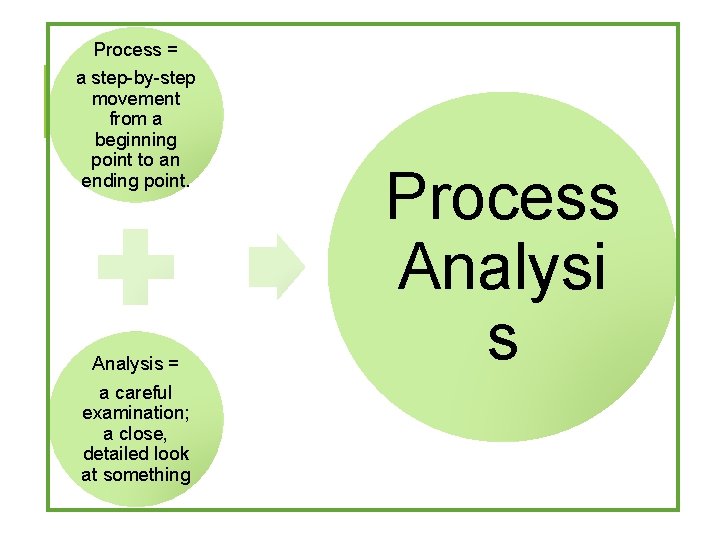
Process = a step-by-step movement from a beginning point to an ending point. Analysis = a careful examination; a close, detailed look at something Process Analysi s
PROCESS ANALYSIS § Clarifies the steps or sequence involved in executing a task § Describes how a particular event occurs or how something works § Explains how to solve a problem § A Process Analysis essay is similar to instructions: • Self-help books are process analysis • Cookbooks are process analysis
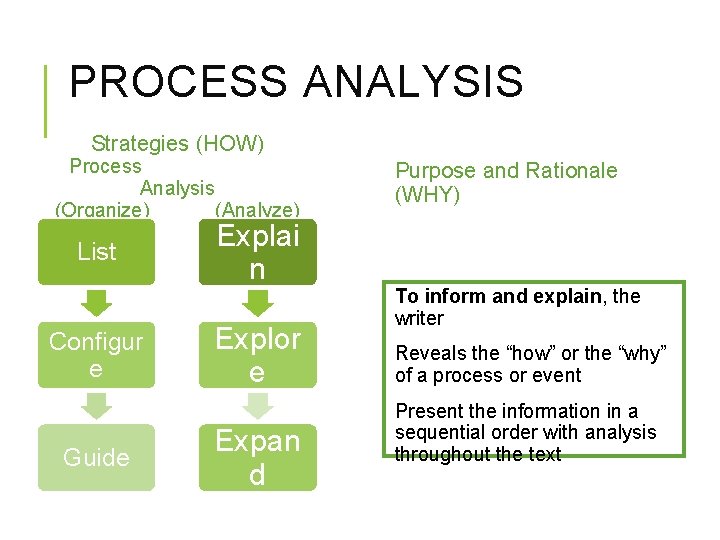
PROCESS ANALYSIS Strategies (HOW) Process Analysis (Organize) (Analyze) List Configur e Guide Explai n Explor e Expan d Purpose and Rationale (WHY) To inform and explain, the writer Reveals the “how” or the “why” of a process or event Present the information in a sequential order with analysis throughout the text
DIVISION/CLASSIFICATIO N §gathers items, ideas, or information into types, kinds, or categories according to a single basis of division §Division/Classification essays often also use Definition §Example: You might start with a paper about sports and divide it up into three particular sports – baseball, football, and basketball. You could then classify these sports by their popularity in the American culture.
DIVISIONCLASSIFICATION a way of thinking that allows us to make sense of a complex world using systems, categories, or sorting mechanisms Division and Classification are separate processes, but they complement each other
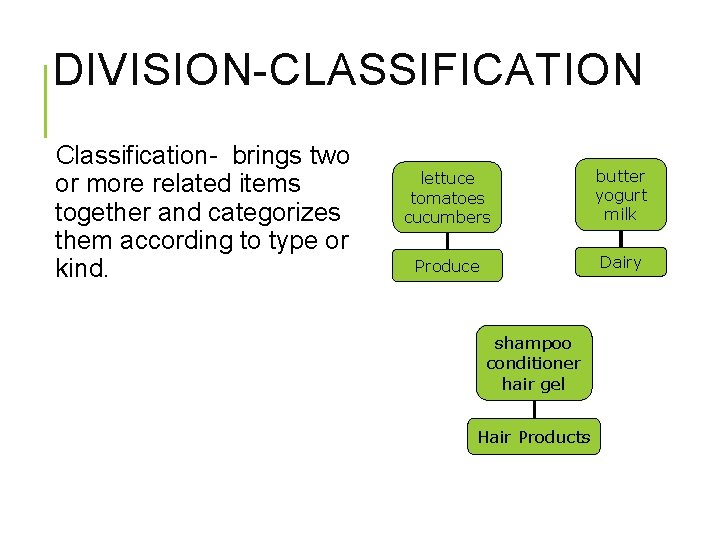
DIVISION-CLASSIFICATION Classification- brings two or more related items together and categorizes them according to type or kind. lettuce tomatoes cucumbers butter yogurt milk Produce Dairy shampoo conditioner hair gel Hair Products
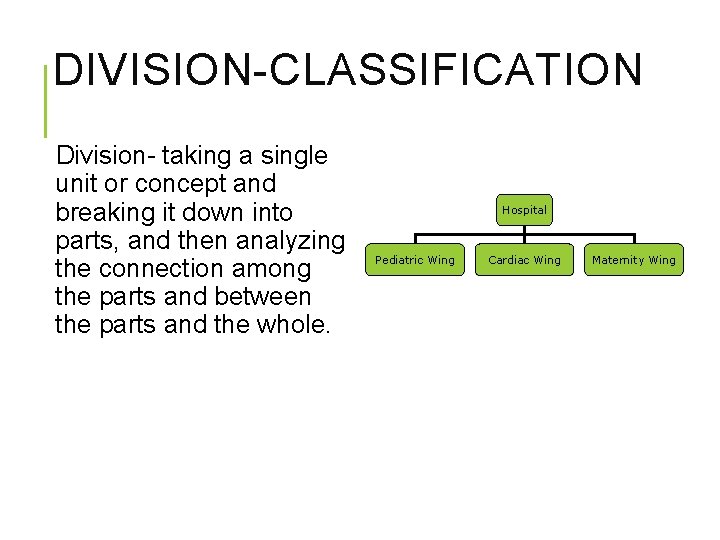
DIVISION-CLASSIFICATION Division- taking a single unit or concept and breaking it down into parts, and then analyzing the connection among the parts and between the parts and the whole. Hospital Pediatric Wing Cardiac Wing Maternity Wing
DIVISION Division, or analysis, breaks a thing down into parts so that (typically in a later essay like the argument/position paper), they can be restructured to form something new, or a synthesis (can you spot an important six-letter word hiding within “synthesis”? ). Every time you outline, you do a division, breaking the essay down into all of its constituent parts (as in classification, failure to discuss all the parts results in an incomplete division paper, stocked only with isolated examples). While classifications are separate, even disparate items brought together under some common denominator, divisions are much more explicitly parts of a single whole Example: Discussing the key components of a championship sports team, for instance, would be a division; for that matter, discussing the components of a successful division essay is also division.
DIVISION Division Structure: I. Introduction States thesis (idea or object to be analyzed, and to what end) II. Body Renders the parts, in separate paragraphs, with examples and with transitional materials to provide a sense of their interrelatedness III. Conclusion Restates the parts of thesis and (the significance—see Classification outline, part III) attempts a synthesis or new understanding of the constituent parts
DEFINITION §Explains the meaning of a word, object, concept, type of person, place, or phenomenon §Clarity, complex, controversial §Beyond synonyms or brief dictionary definitions
WHY THE DEFINITION ESSAY? PURPOSE To establish meaning and provide common understanding To motivate people to accept a particular point of view
TYPES OF DEFINITIONS Standard Regulatory Evolving Qualifying Cultural Personal
DEFINITION-STANDARD Universal meaning and rarely subject to change mammal virus tornado
DEFINITIONREGULATORY Officially designated terms that are subject to change Companies, organizations, courts can change/interpret/define meanings full-time student work place injury experimental procedure
DEFINITION-EVOLVING Change over time due to cultural values, community standards, government policies, or scientific research. Child abuse Mental retardation
DEFINITION-QUALIFYING Limits the meaning of abstract subjects slander vs. witty remark heavy vs. obese crude, inappropriate comments vs. sexual harassment
DEFINITION-CULTURAL Shaped by history, values, experiences, attitudes of a national, ethnic, or religious group
DEFINITION-PERSONAL Expresses an individual’s viewpoints or attitudes
DEFINITION-IDEAS ON APPROACHES Challenge a widely accepted definition Qualities and/or attributes of a subject Establish boundaries Distinguish between closely related ideas
STRATEGIES FOR ESTABLISHING DEFINITIONS Use synonyms Provide descriptions Give examples Draw comparisons to more familiar ideas Provide a revised meaning Linguistic origin Negation-what it is not Stipulative-special restrictions on it
CAUSE/EFFECT §Examines why something happened or what its consequences were or will be §Refers to a direct relationship between events §Answers the question "why did something happen, and/or what results did it have? "
ARGUMENTATION §Also known as Persuasion §Involves the development of the writer's own argument §Sometimes involves using outside sources and references to other writers §The primary function of Argumentation is for the writer to articulate his/her opinion about the issue being discussed.