
RHETORICAL MODES A Rhetorical Mode is a strategy
- Slides: 13
RHETORICAL MODES A Rhetorical Mode is a strategy, a way or method of presenting a subject through writing or speech. Rhetorical modes help develop ideas, order them according to certain patterns, and also achieve a particular effect in the reader.
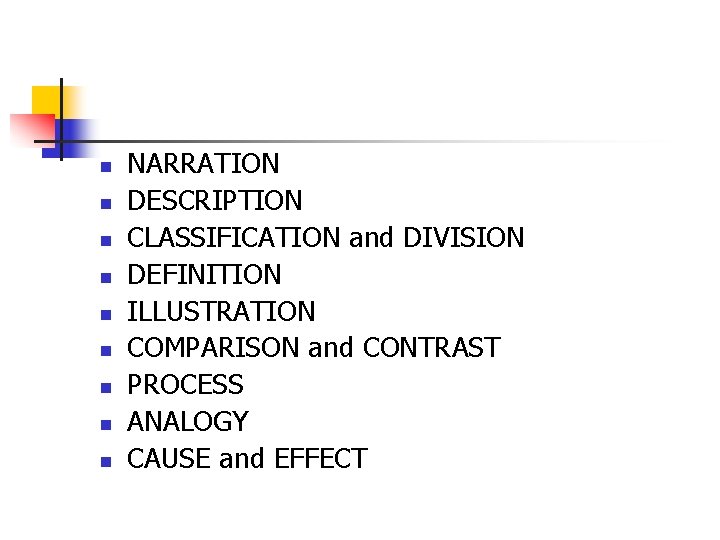
n n n n n NARRATION DESCRIPTION CLASSIFICATION and DIVISION DEFINITION ILLUSTRATION COMPARISON and CONTRAST PROCESS ANALOGY CAUSE and EFFECT
NARRATION Narration is used to present events in the past, the present, or even the imagined future. Your narrative may: v focus on the facts, as, for example, in presenting historical background v recreate an experience for readers, as in a personal essay v tell an anecdote to introduce a discussion or illustrate a point v envision images of the future, as in a proposal for a new policy or project
DESCRIPTION Description is used to create images of a place or object, sketch a person’s character, or provide images that evoke and share a feeling. v v Subjective description: emphasizes the emotional impact of scenes, as in a personal essay Objective description: sticks to the physical details, as in a scientific or technical report
CLASSIFICATION / DIVISION n Classification is a useful way of grouping individual entities into identifiable categories based on their similarities. It offers an opportunity to explore similarities within groups and explain the differences and relationships between groups.
CLASSIFICATION / DIVISION n Division breaks a whole entity into its parts, and offers a chance to explain that entity or subject in detail and to highlight the relationships of its parts.
DEFINITION When introducing a term or concept to the readers, the writer must, clearly and accurately, define it. v Synonym – offer a word or expression that has the same or v Example - offer and example that has all central or typical v Stipulation - when no fixed or standard definition is available nearly the same meaning characteristics of the term we want to define and when some arbitrary specification is necessary to fix the meaning of a key term in the essay
ILLUSTRATION n The Rhetorical Mode of Illustration refers to the use of detailed examples to make abstract or general ideas or concepts more concrete and specific.
COMPARISON and CONTRAST n A Comparison and Contrast essay or paragraph explores the similarities and differences between two or more items, ideas, trends, works, etc. When we compare, we point out the similarities between two items, and when we contrast, we show their differences.
COMPARISON and CONTRAST In arranging comparison paragraphs you can employ: v subject-by-subject organization - discuss each subject in its entirety v point-by-point organization – examine each comparable feature for first one subject and then the other
PROCESS n We use the Rhetorical Mode of Process when we need to provide readers with directions or explain how a mechanism or procedure works. To explain such processes effectively, label the steps or stages clearly, and present the explanation in chronological order.
ANALOGY An Analogy compares topics that at first glance seem quite different. A well-chosen analogy can make unfamiliar or technical information seem more commonplace and understandable. To be effective, an analogy must be familiar to the reader, and its features or functions must be congruent with those of the target.
CAUSE and EFFECT n The Cause and Effect strategy is employed when we need to trace the causes of a particular event or situation, to describe its effects, or both. Logical fallacy: Post Hoc, Ergo Propter Hoc – after this therefore because of this Claims about causation are based simply on an observed temporal sequence MAIMON, PERITZ, YANCEY THE NEW Mc. GRAW-HILL HAND BOOK 2007