
Rhetorical Devices Terms and Examples Alliteration The repetition
- Slides: 28
Rhetorical Devices Terms and Examples
Alliteration The repetition of beginning consonant sounds in several consecutive or neighboring words. “I speak tonight for the dignity of man and the destiny of democracy. ” —President Lyndon B. Johnson, “The American Promise”
Allusion A reference to a mythological, literary, or historical person, place or thing. “So it was at Lexington and Concord. So it was a century ago at Appomattox. So it was last week in Selma, Alabama. ” —President Lyndon B. Johnson, “The American Promise”
Analogy A comparison between two things intended to show they are alike. “President Roosevelt showed us that a man who could barely lift himself out of a wheelchair could still lift a nation out of despair. ” —Christopher Reeve, Speech on Americans with Disabilities Act
Anaphora The repetition of the same word or group of words at the beginning of successive clauses; it helps to establish a strong rhythm and produces a powerful emotional effect. “And what sort of soldiers are those you are to lead? Are they reliable? Are they brave? Are they capable of victory? ” —General Douglas Mac. Arthur, “Duty, Honor, Country”
Anecdote A short account of a particular incident or event, especially of an interesting or amusing nature. “During my rehabilitation, I met a young man named Gregory Patterson. When he was innocently driving through Newark, N. J. , a stray bullet from a gang shooting went through his car window—right into his neck—and severed his spinal cord. Five years ago, he might have died. Today, because of research, he’s alive. ” —Christopher Reeve, Speech on Americans with Disabilities Act
Antithesis A device in which two opposite ideas are put together in a sentence to achieve a contrasting effect. “They are your rallying points: to build courage when courage seems to fail; to regain faith when there seems to be little cause for faith; to create hope when hope becomes forlorn. ” —General Douglas Mac. Arthur, “Duty, Honor, Country”
Asyndeton (ah-SIN-di-ton) The deliberate omission of conjunctions in a series of related words, phrases, or clauses. “We’ve seen the unfurling of flags, the lighting of candles, the giving of blood, the saying of prayers—in English, Hebrew, and Arabic. ” —President George W. Bush, Address to Congress
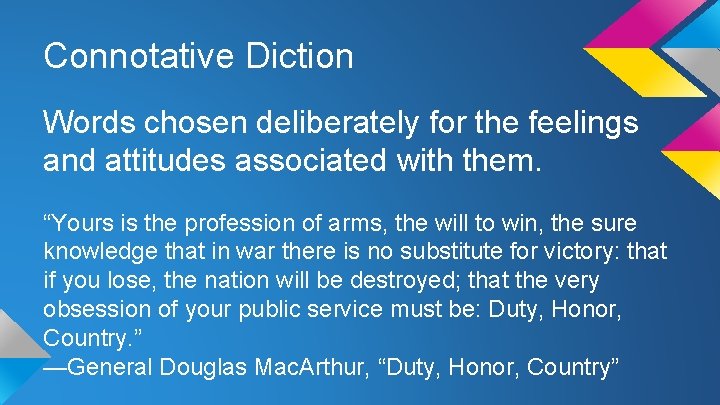
Connotative Diction Words chosen deliberately for the feelings and attitudes associated with them. “Yours is the profession of arms, the will to win, the sure knowledge that in war there is no substitute for victory: that if you lose, the nation will be destroyed; that the very obsession of your public service must be: Duty, Honor, Country. ” —General Douglas Mac. Arthur, “Duty, Honor, Country”
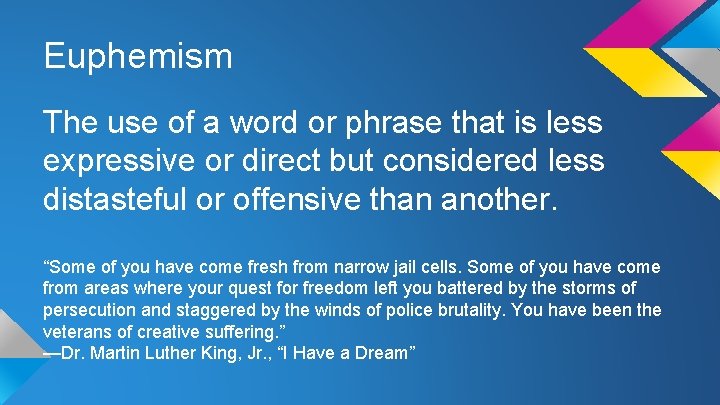
Euphemism The use of a word or phrase that is less expressive or direct but considered less distasteful or offensive than another. “Some of you have come fresh from narrow jail cells. Some of you have come from areas where your quest for freedom left you battered by the storms of persecution and staggered by the winds of police brutality. You have been the veterans of creative suffering. ” —Dr. Martin Luther King, Jr. , “I Have a Dream”
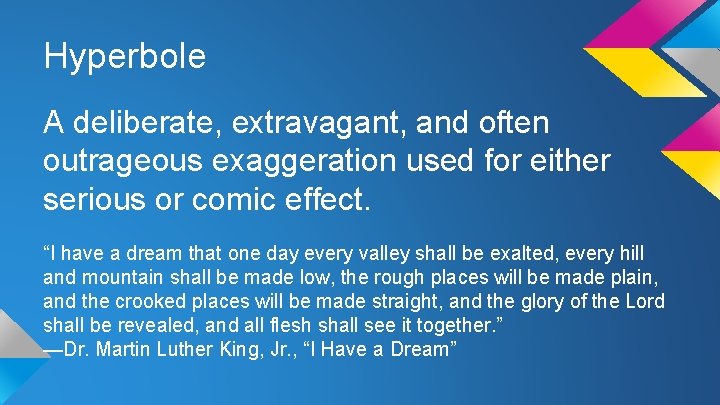
Hyperbole A deliberate, extravagant, and often outrageous exaggeration used for either serious or comic effect. “I have a dream that one day every valley shall be exalted, every hill and mountain shall be made low, the rough places will be made plain, and the crooked places will be made straight, and the glory of the Lord shall be revealed, and all flesh shall see it together. ” —Dr. Martin Luther King, Jr. , “I Have a Dream”
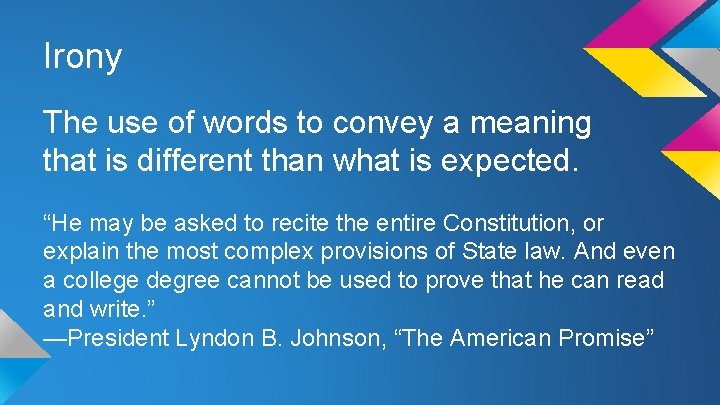
Irony The use of words to convey a meaning that is different than what is expected. “He may be asked to recite the entire Constitution, or explain the most complex provisions of State law. And even a college degree cannot be used to prove that he can read and write. ” —President Lyndon B. Johnson, “The American Promise”
Jargon The language, especially the vocabulary, peculiar to a particular trade, profession, or group. Political - POTUS Online - LOL, hashtag Education - Scaffolding
Juxtaposition A device in which normally unassociated ideas, words, or phrases are placed next to one another, often creating an effect of surprise and wit. “There, long-suffering men and women peacefully protested the denial of their rights as Americans. Many were brutally assaulted. ” —President Lyndon B. Johnson, “The American Promise”
Metaphor A comparison of two unlike things not using like or as. “And, if a beachhead of cooperation may push back the jungle of suspicion, let both sides join in creating a new endeavor…. ” —President John F. Kennedy Inaugural Address
Oxymoron A form of paradox that combines a pair of opposite terms into a single unusual expression. “He was now sufficiently composed to order a funeral of modest magnificence, suitable at once to the rank of a Nouradin’s profession, and the reputation of his wealth. ” —Samuel Johnson, “The history of Almamoulin the son of Nouradin, ” The Rambler
Paradox A statement containing contradictory elements that may appear illogical, impossible, or absurd but which actually have a coherent meaning that reveals a hidden truth. “You can save money by spending it. ”
Parallelism A grammatical or structural arrangement of words, phrases, sentences, or paragraphs so that elements of equal importance are equally developed and similarly phrased. “Let every nation know, whether it wishes us well or ill, that we shall pay any price, bear any burden, meet any hardship, support any friend, oppose any foe, to assure the survival and the success of liberty. ” —President John F. Kennedy, Inaugural Address
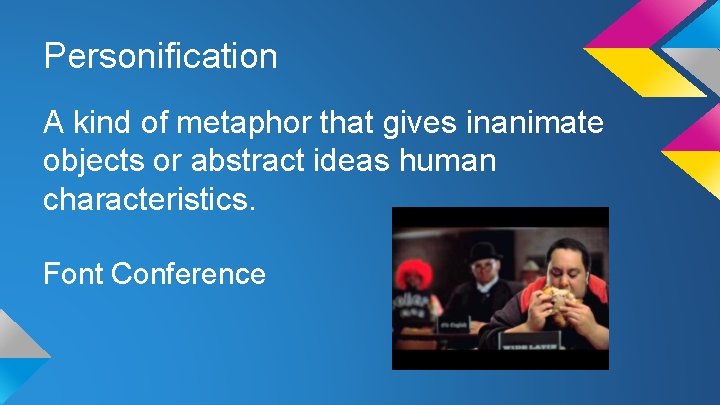
Personification A kind of metaphor that gives inanimate objects or abstract ideas human characteristics. Font Conference
Polysyndeton The deliberate use of many conjunctions for special emphasis—to highlight quantity or mass of detail or to create a flowing, continuous sentence pattern; it slows the pace of the sentence. “Rarely are we met with a challenge, not to our growth or abundance, our welfare, or our security, but rather to the values and the purposes and the meaning of our beloved Nation. ” —President Lyndon B. Johnson, “The American Promise”
Repetition A device in which words, sounds, and ideas are used more than once to enhance rhythm and to create emphasis. “There is no Negro problem. There is no Southern problem. There is no Northern problem. There is only an American problem. And we are met here tonight as Americans—not as Democrats or Republicans—we are met here as Americans to solve that problem. ” —President Lyndon B. Johnson, “The American Promise”
Rhetorical Fragment A sentence fragment used deliberately for a persuasive purpose or to create a desired effect. “Another new study to be presented by U. S. Navy researchers later this week warns it could happen in as little as 7 years. Seven years from now. ” —Vice President Al Gore, Nobel Peace Prize Acceptance Speech
Rhetorical Question A question asked solely to produce an effect or to make an assertion and not to elicit a reply. “And what sort of soldiers are those you are to lead? Are they reliable? Are they brave? Are they capable of victory? ” —General Douglas Mac. Arthur, “Duty, Honor, Country”
Rhetorical Shift A turn, a change, or a movement in a text resulting from an epiphany, realization, or insight gained by the speaker or writer. “You now face a new world—a world of change. The thrust into outer space of the satellite, spheres, and missiles mark the beginning of another epoch in the long story of mankind. ” —General Douglas Mac. Arthur, “Duty, Honor, Country”
Simile A stated comparison of two different things or ideas through the use of the words like or as. “Float like a butterfly, sting like a bee. ” Muhammad Ali
Statistics Numerical facts or data used as evidence. “Right now, for example, about a quarter-million Americans have a spinal cord injury. Our government spends about $8. 7 billion a year just maintaining these members of our family. But we spend only $40 million a year on research that would actually improve the quality of their lives, get them off public assistance, or even cure them. ” —Christopher Reeve, Speech on Americans with Disabilities Act
Testimonial A statement in support of a particular truth, fact, or claim. “I have beside me up here millions of people who are living and standing straight and erect, and knowing something about dignity without being cold and aloof, knowing something about being contained with being unapproachable—people who have learned something from Coretta Scott King. ” —Dr. Maya Angelou, Funeral Oration for Coretta Scott King
Understatement A kind of irony that deliberately represents something as being much less than it really is. “I am not unmindful that some of you have come here out of great trials and tribulations. Some of you have come fresh from narrow jail cells. Some of you have come from areas where your quest for freedom left you battered by the storms of persecution and staggered by the winds of police brutality. ” —Dr. Martin Luther King, Jr. , “I Have a Dream”