
Rhetorical Analysis What is rhetoric The study of



- Slides: 19
Rhetorical Analysis
What is rhetoric? � The study of effective speaking ________ and _________ in order to persuade Rhetorical Analysis
What is rhetorical analysis? � What A � It it’s NOT: _________of a literary or scholarly work IS: Requiring you to apply your critical reading skills in order to “_____________” a text � The goal is to articulate _____ the author writes to achieve their purpose, reach their audience, argue their position, and establish their persona. Rhetorical Analysis
How does this differ from literary analysis? � In literary analysis, you are analyzing a different set of literary elements that help to shape the story’s _______ or _________. ◦ ◦ Characterization Plot Setting Simile, metaphor, personification � In a rhetorical analysis, we are examining the author’s ________ for writing the piece in the first place and the argument he or she is trying to make ◦ Some of the same devices are examined (as well as new ones) —but for different reasons ◦ Instead of shaping the story, we look at how these devices ______________________.
Sample Rhetorical Analysis Prompt � After reading “Letter from Birmingham Jail” by Martin Luther King, Jr. , write an essay in which you describe the rhetorical purpose of the letter and analyze its stylistic, narrative, and persuasive devices.
How do I analyze rhetoric? � Analyze the strategies the author uses to achieve his or her _______ or ______ of writing their piece ◦ Different authors have different goals ◦ As a result, they will use different writing _________ to achieve those goals. Rhetorical Analysis
Step #1 � Read the article carefully and _________ what you have read. � Use a highlighter to identify key passages or important facts Rhetorical Analysis
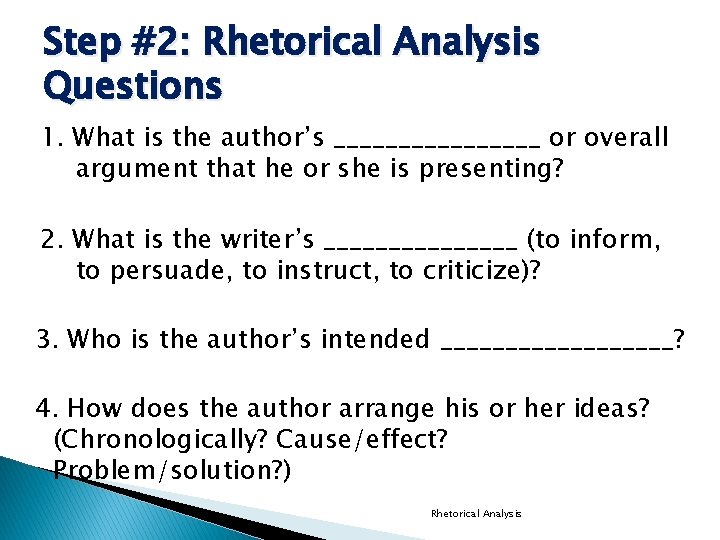
Step #2: Rhetorical Analysis Questions 1. What is the author’s ________ or overall argument that he or she is presenting? 2. What is the writer’s ________ (to inform, to persuade, to instruct, to criticize)? 3. Who is the author’s intended _________? 4. How does the author arrange his or her ideas? (Chronologically? Cause/effect? Problem/solution? ) Rhetorical Analysis
Step #2: Rhetorical Analysis Questions 5. How does the writer use _________? (Word choice, arrangement, accuracy, formal vs. informal, technical vs. slang) 6. Does the writer use __________? Quotations? Why? 7. Are important terms __________? 8. What is the sentence structure of text? (Are there fragments, run-ons? Is it declarative, imperative, exclamatory? What effect does this have? 9. Does the writer use _____________ to create an effect? (Italics, underlining, parentheses? Which ones are used and how? Rhetorical Analysis
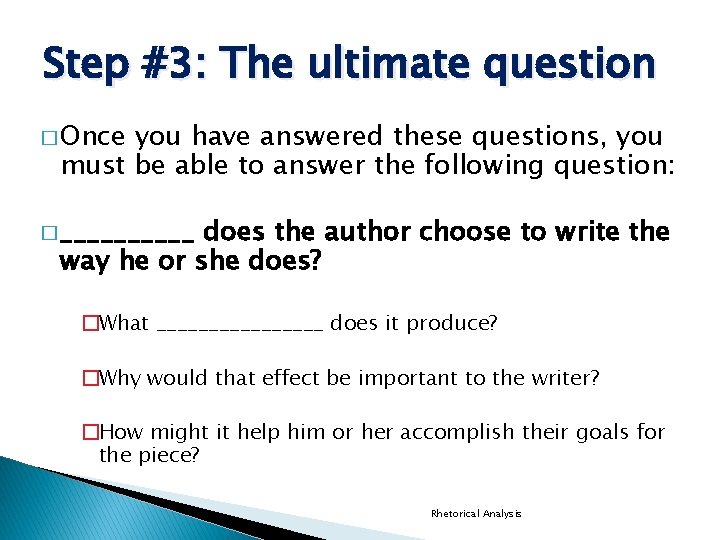
Step #3: The ultimate question � Once you have answered these questions, you must be able to answer the following question: � _____ does the author choose to write the way he or she does? �What ________ does it produce? �Why would that effect be important to the writer? �How might it help him or her accomplish their goals for the piece? Rhetorical Analysis
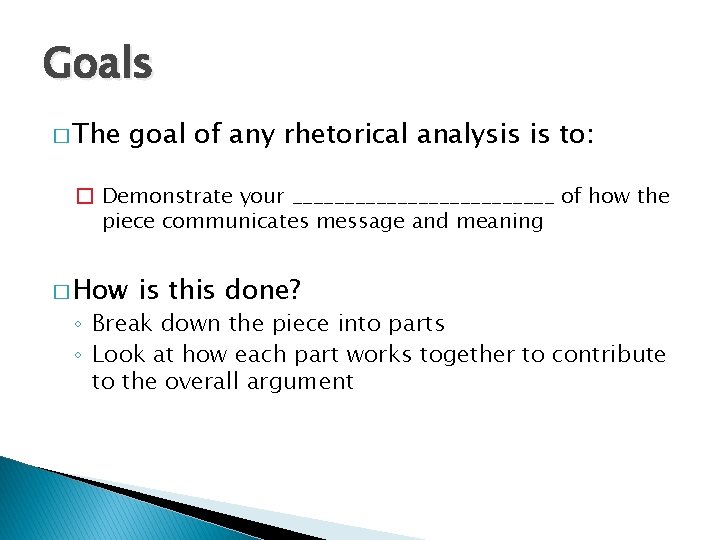
Goals � The goal of any rhetorical analysis is to: � Demonstrate your _____________ of how the piece communicates message and meaning � How is this done? ◦ Break down the piece into parts ◦ Look at how each part works together to contribute to the overall argument
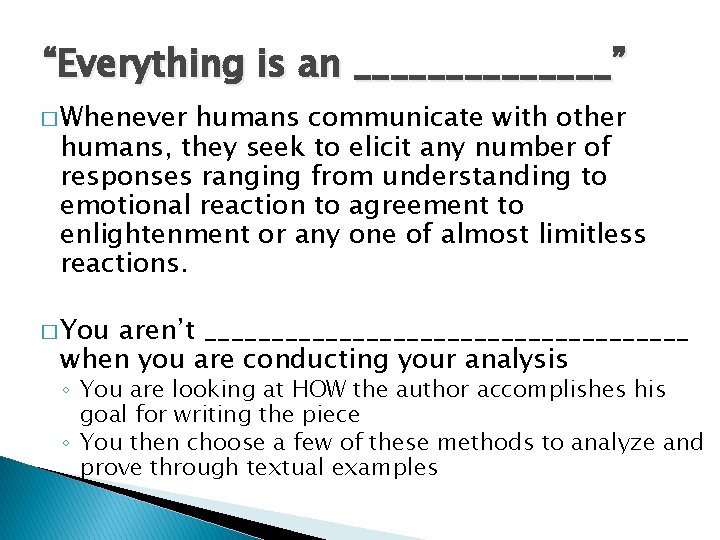
“Everything is an _______” � Whenever humans communicate with other humans, they seek to elicit any number of responses ranging from understanding to emotional reaction to agreement to enlightenment or any one of almost limitless reactions. � You aren’t __________________ when you are conducting your analysis ◦ You are looking at HOW the author accomplishes his goal for writing the piece ◦ You then choose a few of these methods to analyze and prove through textual examples
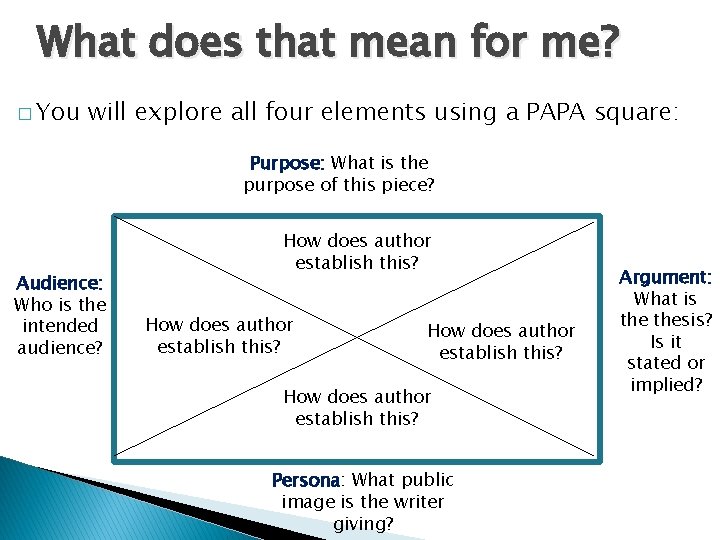
What does that mean for me? � You will explore all four elements using a PAPA square: Purpose: What is the purpose of this piece? Audience: Who is the intended audience? How does author establish this? Persona: What public image is the writer giving? Argument: What is thesis? Is it stated or implied?
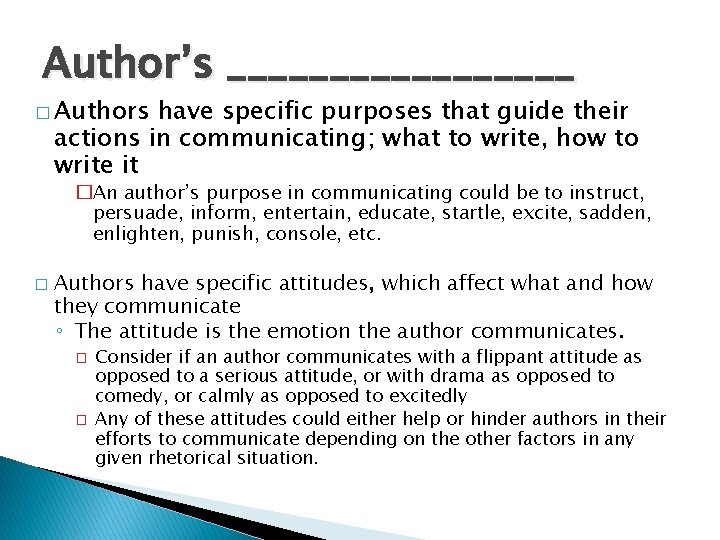
Author’s _________ � Authors have specific purposes that guide their actions in communicating; what to write, how to write it �An author’s purpose in communicating could be to instruct, persuade, inform, entertain, educate, startle, excite, sadden, enlighten, punish, console, etc. � Authors have specific attitudes, which affect what and how they communicate ◦ The attitude is the emotion the author communicates. � � Consider if an author communicates with a flippant attitude as opposed to a serious attitude, or with drama as opposed to comedy, or calmly as opposed to excitedly Any of these attitudes could either help or hinder authors in their efforts to communicate depending on the other factors in any given rhetorical situation.
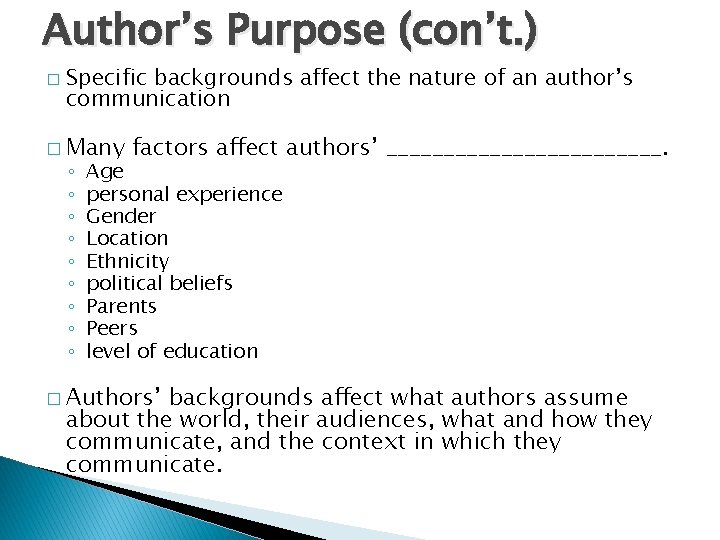
Author’s Purpose (con’t. ) � Specific backgrounds affect the nature of an author’s communication � Many ◦ ◦ ◦ ◦ ◦ factors affect authors’ ____________. Age personal experience Gender Location Ethnicity political beliefs Parents Peers level of education � Authors’ backgrounds affect what authors assume about the world, their audiences, what and how they communicate, and the context in which they communicate.
__________ � Like authors, audiences are unavoidably human beings whose particular activities are also affected by specific purposes, specific attitudes, and specific backgrounds. � Audiences also have ◦ A purpose for reading, listening, viewing, etc. ◦ Attitudes they possess while reading ◦ Backgrounds that influence them
_________ � The persona can be separate distinct from the author � It is the ________ chosen by the author for a particular artistic purpose. ◦ The persona may be a character in the work or merely an unnamed narrator; but, insofar as the manner and style of expression in the work exhibit taste, prejudice, emotion, or other characteristics of a human personality, the work may be said to be in the voice of a persona.
___________ � An author’s argument is the opinion or belief that he or she wants to persuade readers to believe � How do you discover the argument? ◦ Locate thesis, whether it is directly stated or implied. ◦ What are the author’s assumptions? What is he or she taking for granted? ◦ What kind of support is being used? Is it relevant to the argument? ◦ Is the author biased?
How does the author establish all four? � In the center of the PAPA square, you will make note of the types of arguments and devices used to persuade” ◦ ◦ ◦ Ethos Pathos Logos Rhetorical devices Literary devices