
Rhetorical Analysis Examining Arguments to Determine Effectiveness Informed
- Slides: 16
Rhetorical Analysis Examining Arguments to Determine Effectiveness
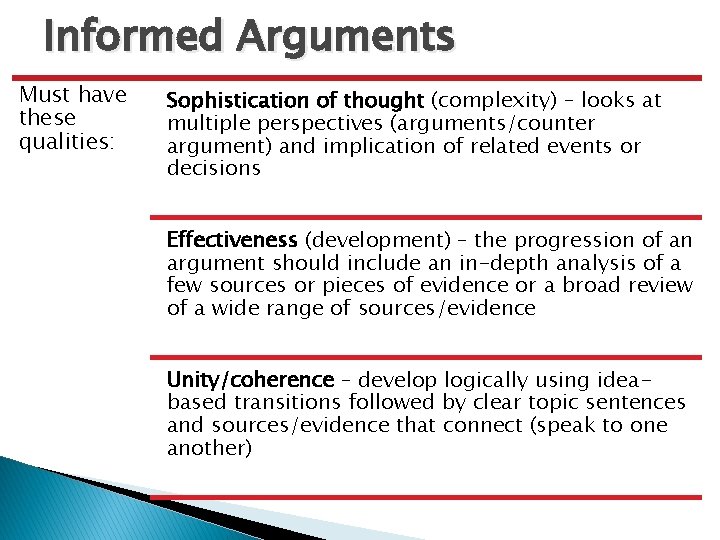
Informed Arguments Must have these qualities: Sophistication of thought (complexity) – looks at multiple perspectives (arguments/counter argument) and implication of related events or decisions Effectiveness (development) – the progression of an argument should include an in-depth analysis of a few sources or pieces of evidence or a broad review of a wide range of sources/evidence Unity/coherence – develop logically using ideabased transitions followed by clear topic sentences and sources/evidence that connect (speak to one another)
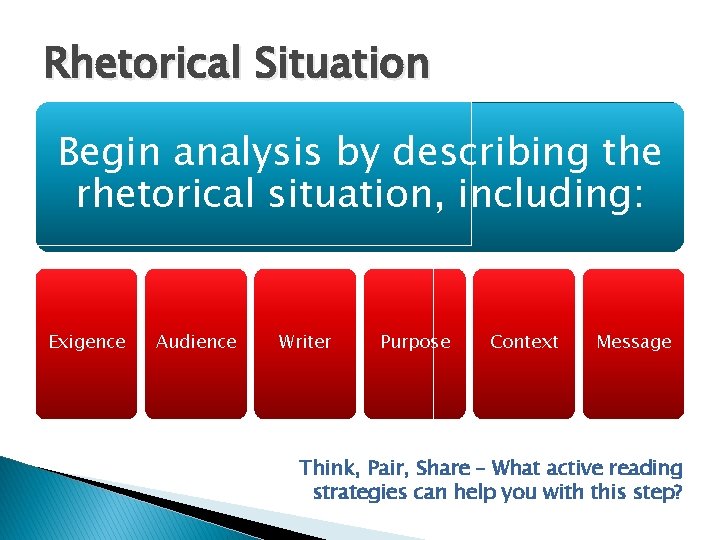
Rhetorical Situation Begin analysis by describing the rhetorical situation, including: Exigence Audience Writer Purpose Context Message Think, Pair, Share – What active reading strategies can help you with this step?
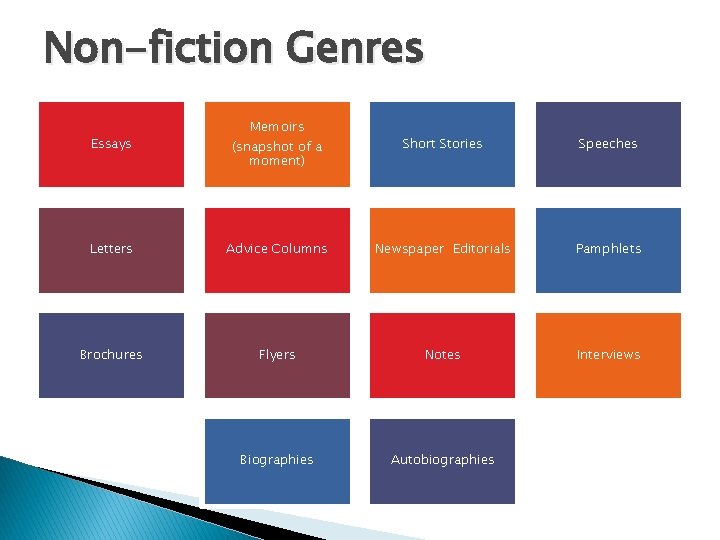
Non-fiction Genres Essays Memoirs (snapshot of a moment) Short Stories Speeches Letters Advice Columns Newspaper Editorials Pamphlets Brochures Flyers Notes Interviews Biographies Autobiographies
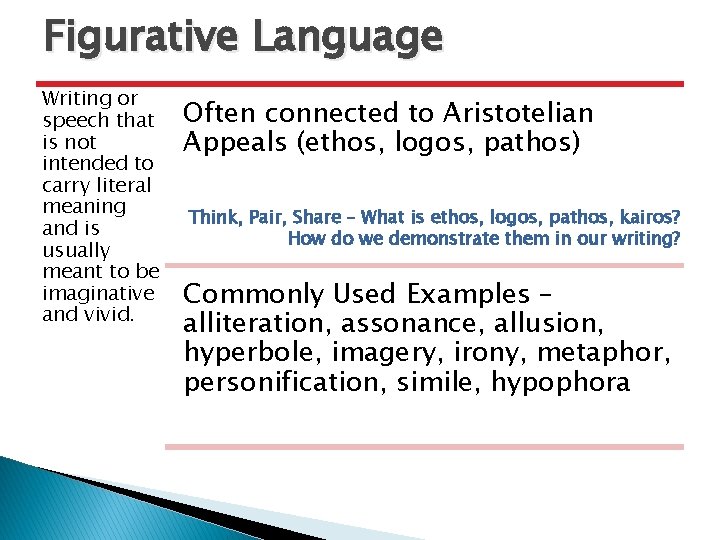
Figurative Language Writing or speech that is not intended to carry literal meaning and is usually meant to be imaginative and vivid. Often connected to Aristotelian Appeals (ethos, logos, pathos) Think, Pair, Share – What is ethos, logos, pathos, kairos? How do we demonstrate them in our writing? Commonly Used Examples – alliteration, assonance, allusion, hyperbole, imagery, irony, metaphor, personification, simile, hypophora
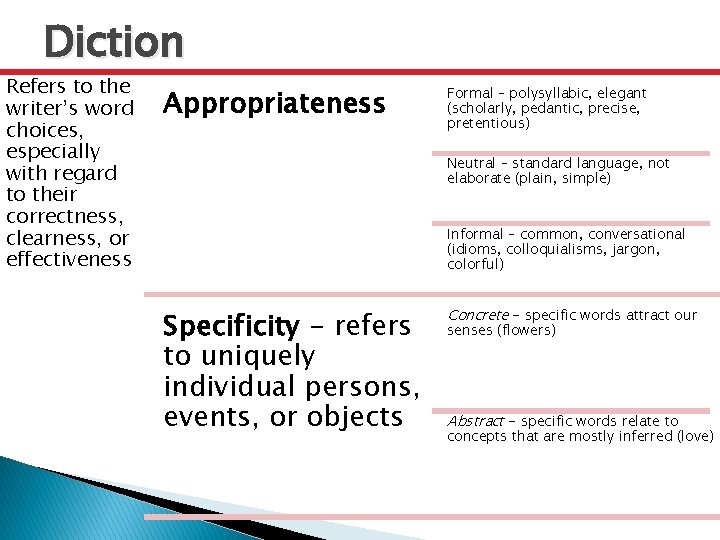
Diction Refers to the writer’s word choices, especially with regard to their correctness, clearness, or effectiveness Appropriateness Formal – polysyllabic, elegant (scholarly, pedantic, precise, pretentious) Neutral – standard language, not elaborate (plain, simple) Informal – common, conversational (idioms, colloquialisms, jargon, colorful) Specificity - refers to uniquely individual persons, events, or objects Concrete - specific words attract our senses (flowers) Abstract - specific words relate to concepts that are mostly inferred (love)
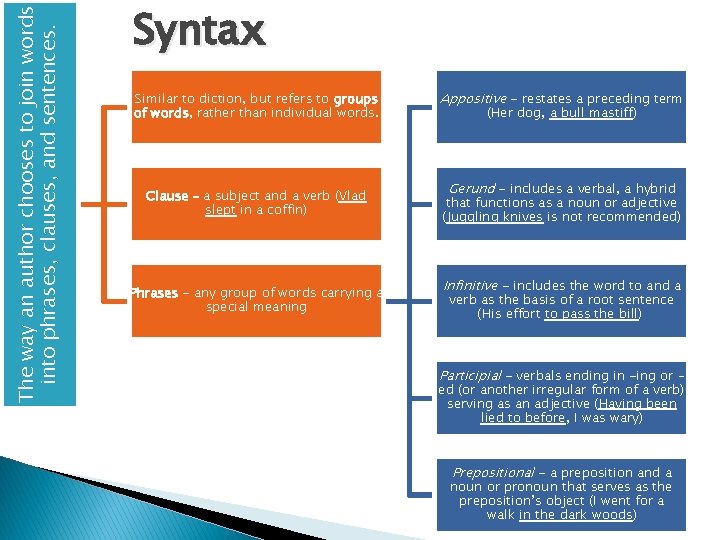
The way an author chooses to join words into phrases, clauses, and sentences. Syntax Similar to diction, but refers to groups of words, rather than individual words. Clause – a subject and a verb (Vlad slept in a coffin) Phrases - any group of words carrying a special meaning Appositive - restates a preceding term (Her dog, a bull mastiff) Gerund - includes a verbal, a hybrid that functions as a noun or adjective (Juggling knives is not recommended) Infinitive - includes the word to and a verb as the basis of a root sentence (His effort to pass the bill) Participial - verbals ending in -ing or – ed (or another irregular form of a verb) serving as an adjective (Having been lied to before, I was wary) Prepositional - a preposition and a noun or pronoun that serves as the preposition’s object (I went for a walk in the dark woods)
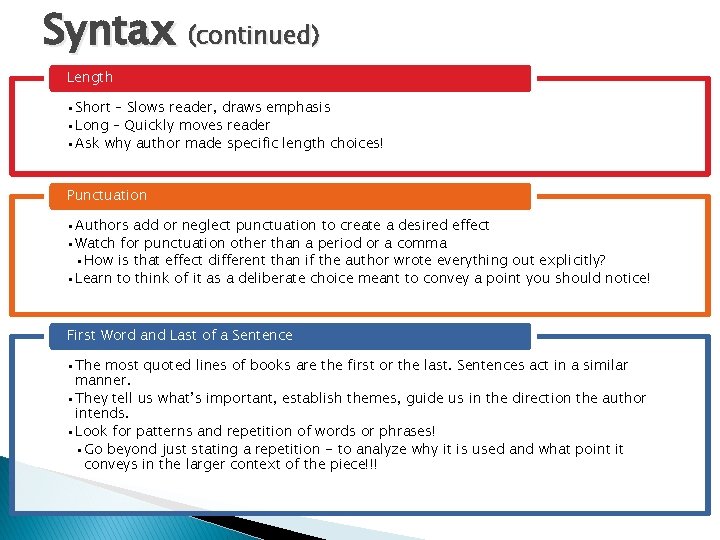
Syntax (continued) Length • Short – Slows reader, draws emphasis • Long – Quickly moves reader • Ask why author made specific length choices! Punctuation • Authors add or neglect punctuation to create a desired effect • Watch for punctuation other than a period or a comma • How is that effect different than if the author wrote everything out explicitly? • Learn to think of it as a deliberate choice meant to convey a point you should notice! First Word and Last of a Sentence • The most quoted lines of books are the first or the last. Sentences act in a similar manner. • They tell us what’s important, establish themes, guide us in the direction the author intends. • Look for patterns and repetition of words or phrases! • Go beyond just stating a repetition - to analyze why it is used and what point it conveys in the larger context of the piece!!!
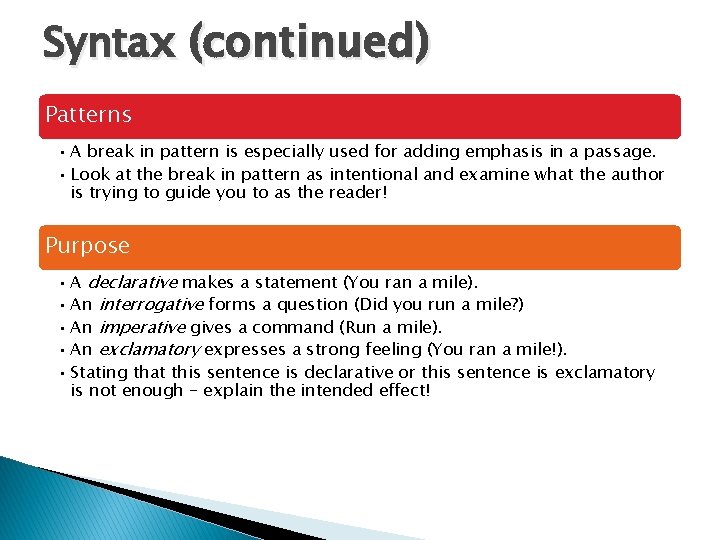
Syntax (continued) Patterns • A break in pattern is especially used for adding emphasis in a passage. • Look at the break in pattern as intentional and examine what the author is trying to guide you to as the reader! Purpose • A declarative makes a statement (You ran a mile). • An interrogative forms a question (Did you run a mile? ) • An imperative gives a command (Run a mile). • An exclamatory expresses a strong feeling (You ran a mile!). • Stating that this sentence is declarative or this sentence is exclamatory is not enough – explain the intended effect!
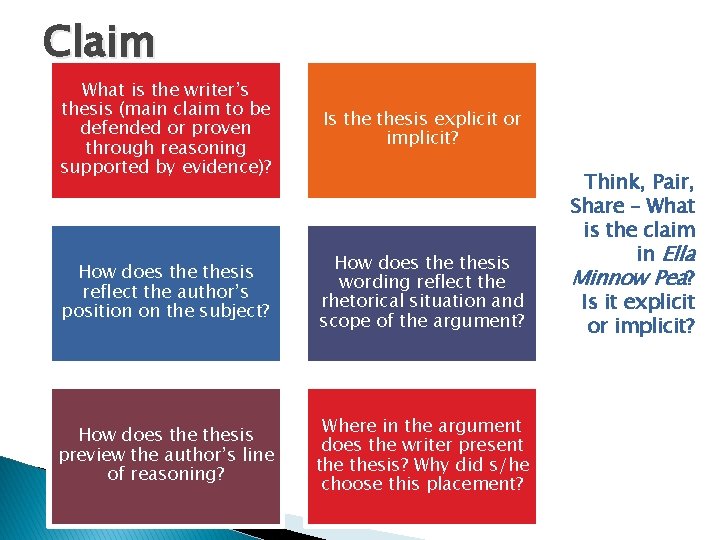
Claim What is the writer’s thesis (main claim to be defended or proven through reasoning supported by evidence)? Is thesis explicit or implicit? How does thesis reflect the author’s position on the subject? How does thesis wording reflect the rhetorical situation and scope of the argument? How does thesis preview the author’s line of reasoning? Where in the argument does the writer present thesis? Why did s/he choose this placement? Think, Pair, Share – What is the claim in Ella Minnow Pea? Is it explicit or implicit?
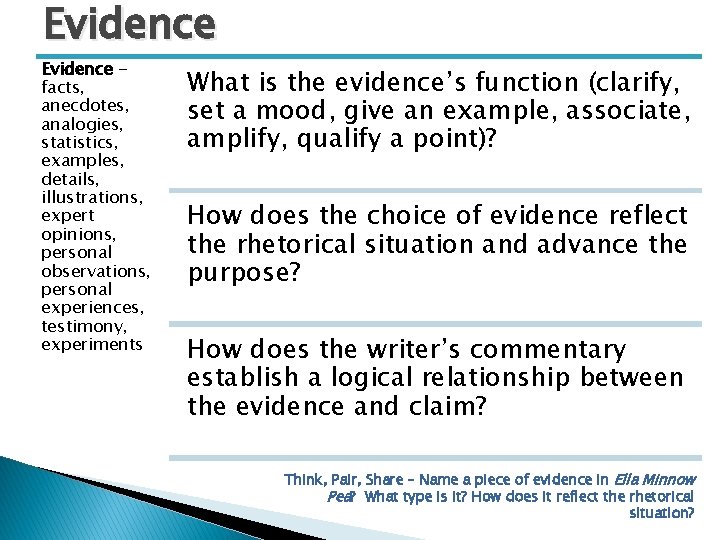
Evidence facts, anecdotes, analogies, statistics, examples, details, illustrations, expert opinions, personal observations, personal experiences, testimony, experiments What is the evidence’s function (clarify, set a mood, give an example, associate, amplify, qualify a point)? How does the choice of evidence reflect the rhetorical situation and advance the purpose? How does the writer’s commentary establish a logical relationship between the evidence and claim? Think, Pair, Share – Name a piece of evidence in Ella Minnow Pea? What type is it? How does it reflect the rhetorical situation?
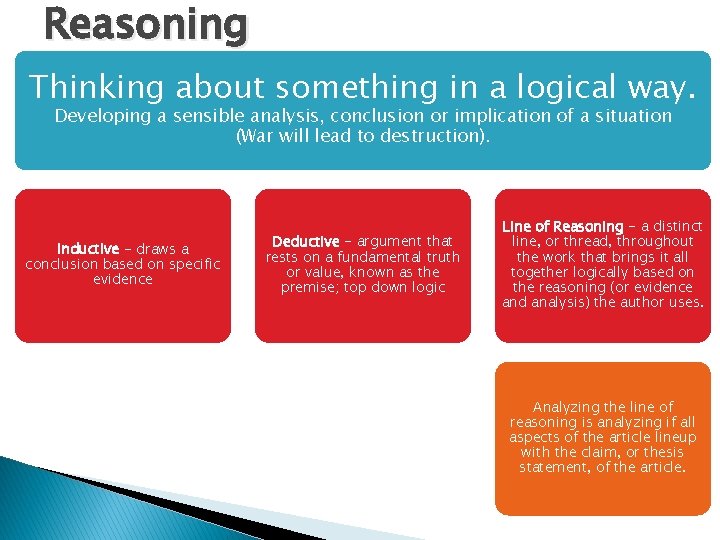
Reasoning Thinking about something in a logical way. Developing a sensible analysis, conclusion or implication of a situation (War will lead to destruction). Inductive - draws a conclusion based on specific evidence Deductive - argument that rests on a fundamental truth or value, known as the premise; top down logic Line of Reasoning - a distinct line, or thread, throughout the work that brings it all together logically based on the reasoning (or evidence and analysis) the author uses. Analyzing the line of reasoning is analyzing if all aspects of the article lineup with the claim, or thesis statement, of the article.
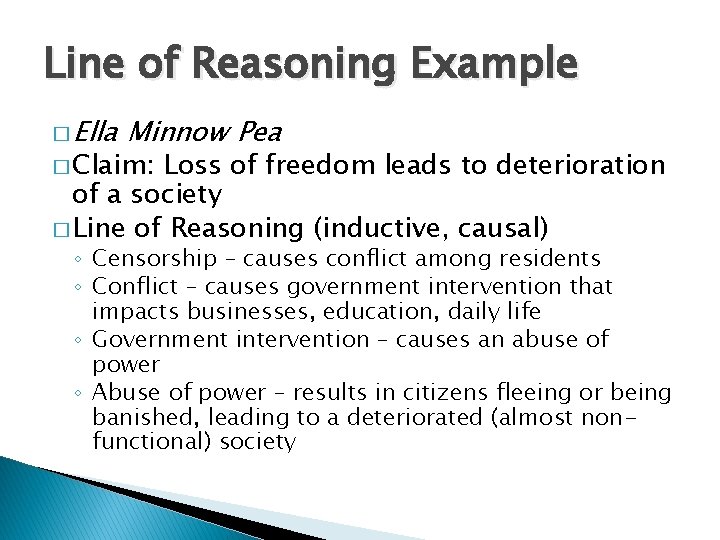
Line of Reasoning Example � Ella Minnow Pea � Claim: Loss of freedom leads to deterioration of a society � Line of Reasoning (inductive, causal) ◦ Censorship – causes conflict among residents ◦ Conflict – causes government intervention that impacts businesses, education, daily life ◦ Government intervention – causes an abuse of power ◦ Abuse of power – results in citizens fleeing or being banished, leading to a deteriorated (almost nonfunctional) society
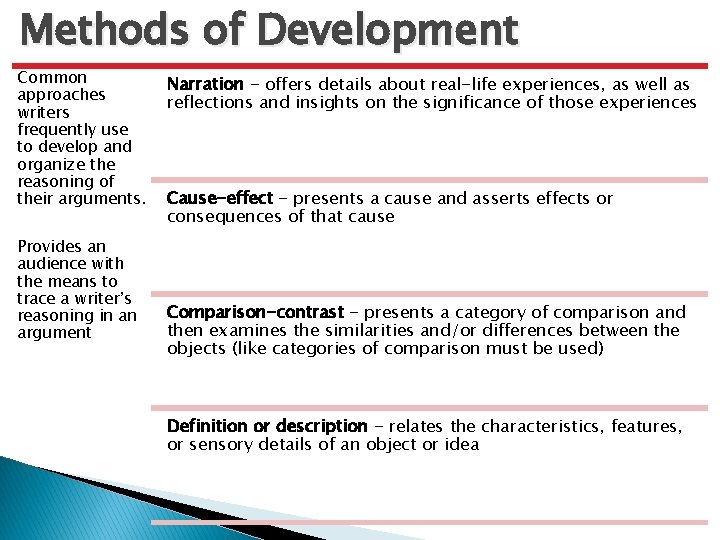
Methods of Development Common approaches writers frequently use to develop and organize the reasoning of their arguments. Provides an audience with the means to trace a writer’s reasoning in an argument Narration - offers details about real-life experiences, as well as reflections and insights on the significance of those experiences Cause-effect - presents a cause and asserts effects or consequences of that cause Comparison-contrast - presents a category of comparison and then examines the similarities and/or differences between the objects (like categories of comparison must be used) Definition or description - relates the characteristics, features, or sensory details of an object or idea
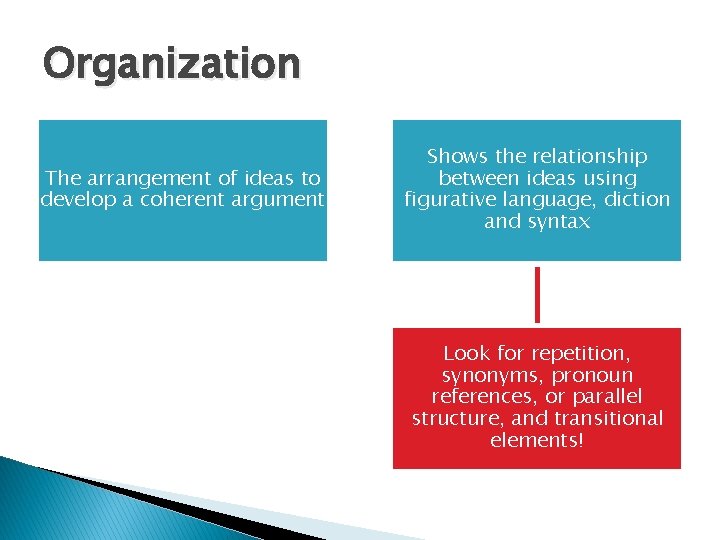
Organization The arrangement of ideas to develop a coherent argument Shows the relationship between ideas using figurative language, diction and syntax Look for repetition, synonyms, pronoun references, or parallel structure, and transitional elements!
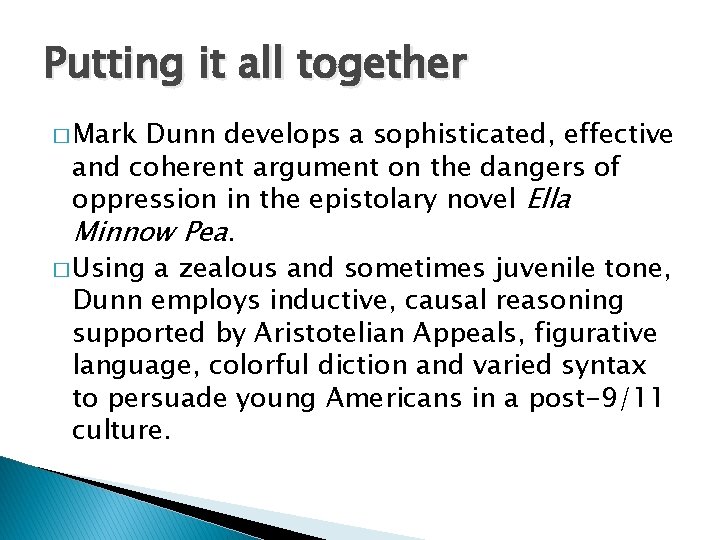
Putting it all together � Mark Dunn develops a sophisticated, effective and coherent argument on the dangers of oppression in the epistolary novel Ella Minnow Pea. � Using a zealous and sometimes juvenile tone, Dunn employs inductive, causal reasoning supported by Aristotelian Appeals, figurative language, colorful diction and varied syntax to persuade young Americans in a post-9/11 culture.