
RHESSysA Regional HydroEcological Simulation System Rachel Powers RHESSys
- Slides: 9
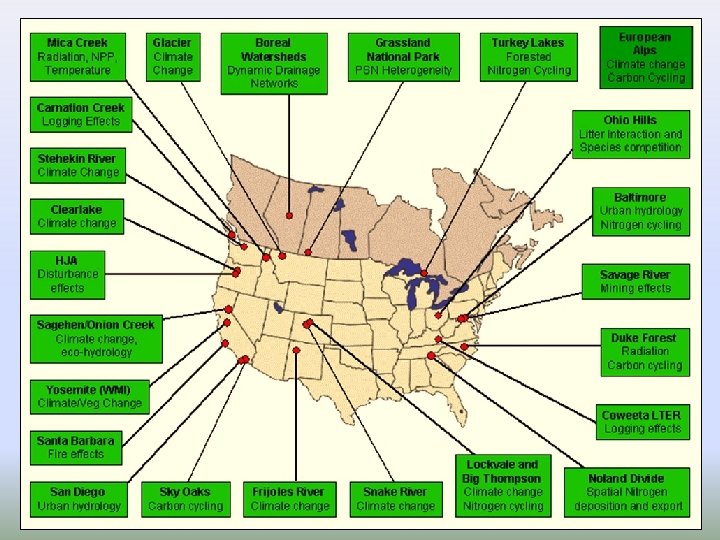
RHESSys-A Regional Hydro-Ecological Simulation System Rachel Powers • RHESSys – Bren School of Environmental Science & Management, UC Santa Barbara – http: //fiesta. bren. ucsb. edu/~rhessys/ • RHESSys is a GIS-based, hydro-ecological modelling framework designed to simulate carbon, water, and nutrient fluxes. RHESSys is able to model feedbacks between hydrology and ecosystem carbon and nutrient cycling, including the growth of vegetation. • Key Assumptions TOPMODEL relationships are based on the assumption that saturated hydraulic conductivity varies exponentially with depth, that water table gradients can be approximated by local topographic slope, and that steady-state flux is achieved within the modeling time step. • Temporal/Spatial Scale – RHESSys utilizes a daily to multi-decadal temporal scale. – At the finest scale, patches are typically defined on the order of meters squared, while basins (km 2) define the largest scale.
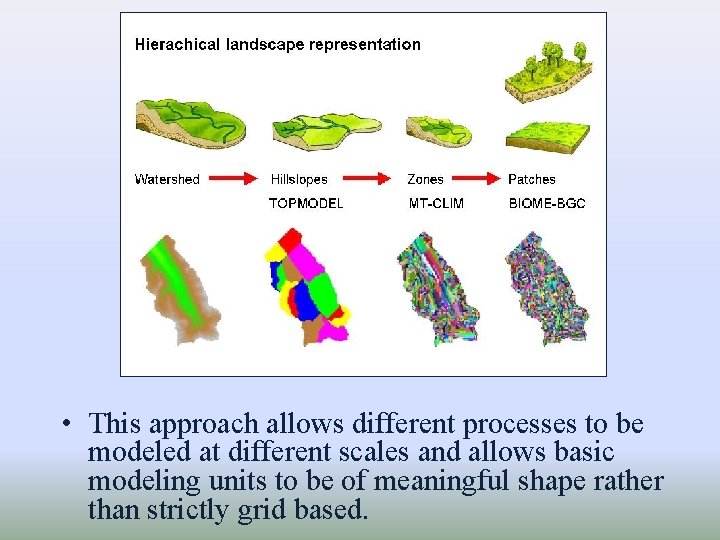
Models within RHESSys • RHESSys was developed in the early 1990 s by adding a spatially explicit landscape and the MT-CLIM microclimate model to the existing FOREST-BGC framework. • MTN-CLIM: Internal estimation of most meteorological variables, including incoming radiation. • TOPMODEL: Applied at the hillslope level. • DHSVM: Applied at the basin level, since it can include some limited streamflow routing. • An ecophysiological model is adapted from BIOMEBGC to estimate carbon, water and potentially nitrogen fluxes from different canopy cover types.
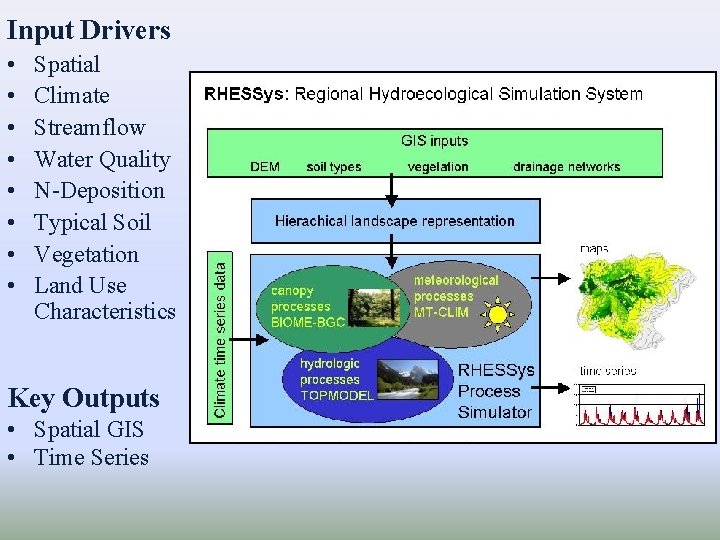
Input Drivers • • Spatial Climate Streamflow Water Quality N-Deposition Typical Soil Vegetation Land Use Characteristics Key Outputs • Spatial GIS • Time Series
• This approach allows different processes to be modeled at different scales and allows basic modeling units to be of meaningful shape rather than strictly grid based.
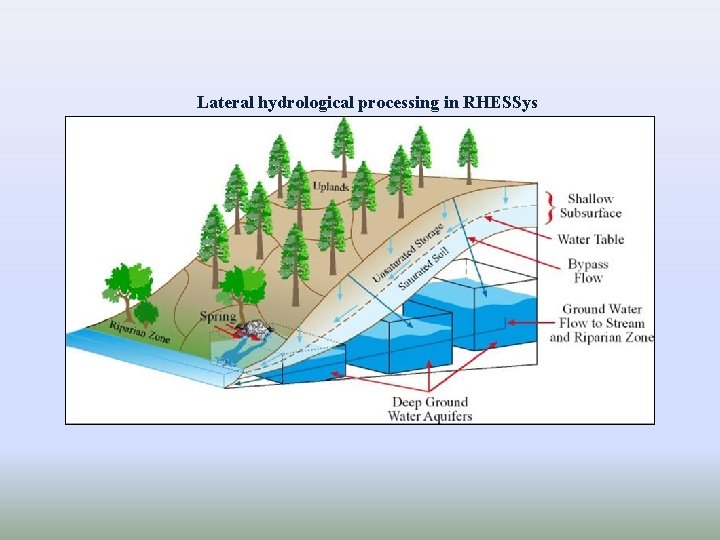
Lateral hydrological processing in RHESSys
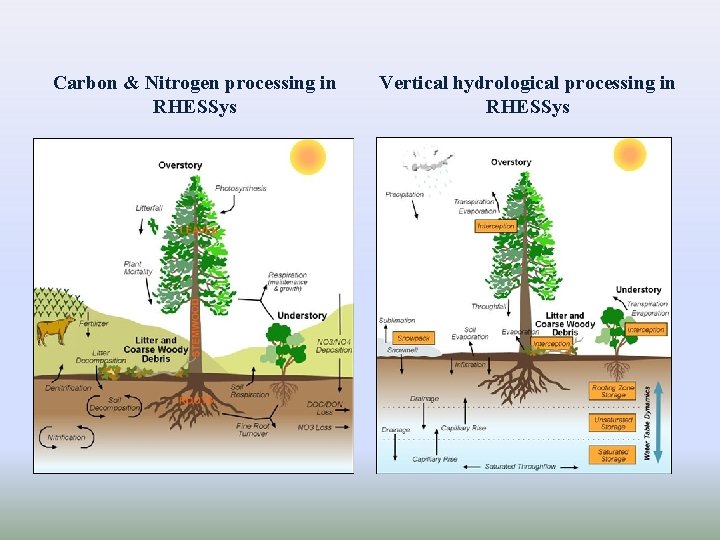
Carbon & Nitrogen processing in RHESSys Vertical hydrological processing in RHESSys
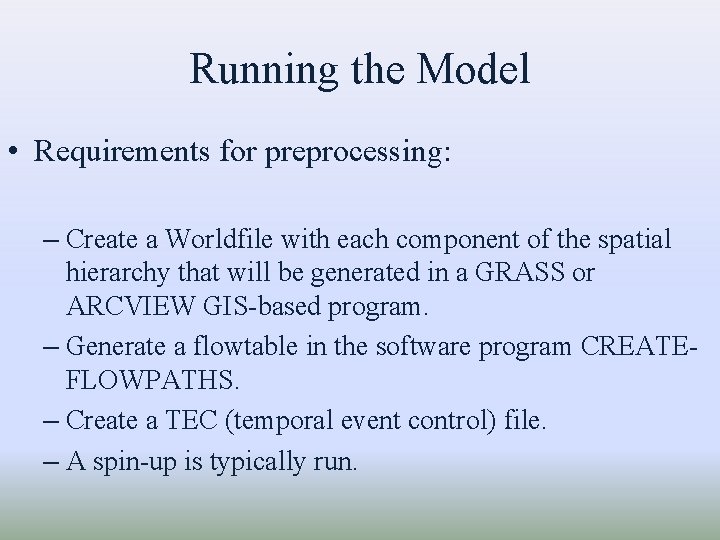
Running the Model • Requirements for preprocessing: – Create a Worldfile with each component of the spatial hierarchy that will be generated in a GRASS or ARCVIEW GIS-based program. – Generate a flowtable in the software program CREATEFLOWPATHS. – Create a TEC (temporal event control) file. – A spin-up is typically run.
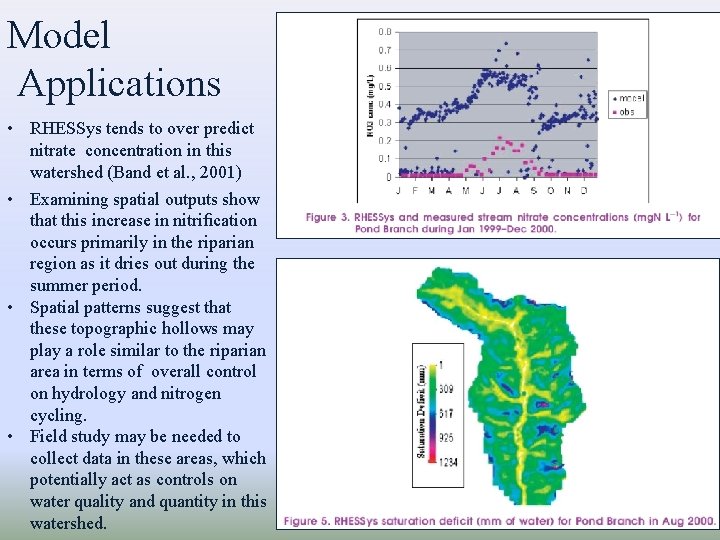
Model Applications • RHESSys tends to over predict nitrate concentration in this watershed (Band et al. , 2001) • Examining spatial outputs show that this increase in nitrification occurs primarily in the riparian region as it dries out during the summer period. • Spatial patterns suggest that these topographic hollows may play a role similar to the riparian area in terms of overall control on hydrology and nitrogen cycling. • Field study may be needed to collect data in these areas, which potentially act as controls on water quality and quantity in this watershed.