
Rheometry Part 2 Introduction to the Rheology of








- Slides: 63
Rheometry Part 2 Introduction to the Rheology of Complex Fluids Dr. Aldo Acevedo - ERC SOPS 1
Rheometry l Making measurements of rheological material functions l To measure a material function, an experiment must be designed to produce the kinematics pescribed in th edefinition of the material function, then measure the stress components needed and calculate the material function. Dr. Aldo Acevedo - ERC SOPS 2
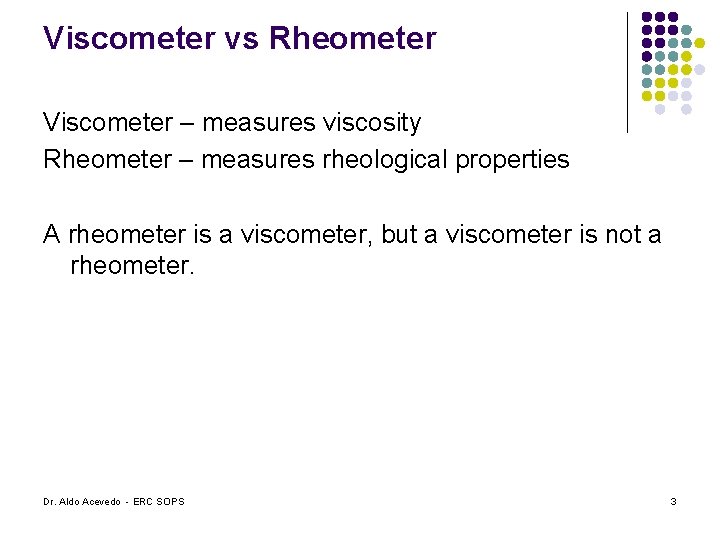
Viscometer vs Rheometer Viscometer – measures viscosity Rheometer – measures rheological properties A rheometer is a viscometer, but a viscometer is not a rheometer. Dr. Aldo Acevedo - ERC SOPS 3
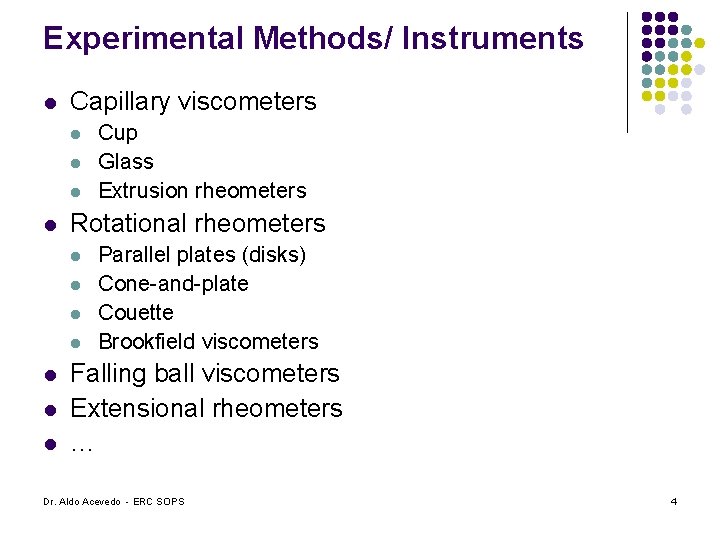
Experimental Methods/ Instruments l Capillary viscometers l l Rotational rheometers l l l l Cup Glass Extrusion rheometers Parallel plates (disks) Cone-and-plate Couette Brookfield viscometers Falling ball viscometers Extensional rheometers … Dr. Aldo Acevedo - ERC SOPS 4
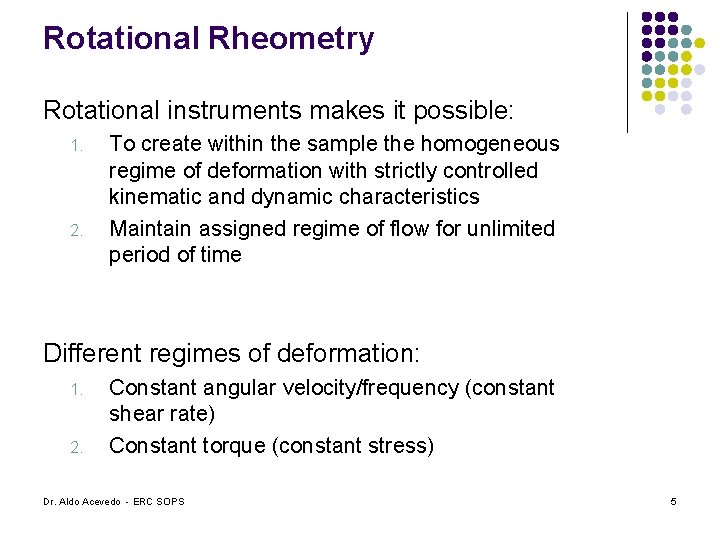
Rotational Rheometry Rotational instruments makes it possible: 1. 2. To create within the sample the homogeneous regime of deformation with strictly controlled kinematic and dynamic characteristics Maintain assigned regime of flow for unlimited period of time Different regimes of deformation: 1. 2. Constant angular velocity/frequency (constant shear rate) Constant torque (constant stress) Dr. Aldo Acevedo - ERC SOPS 5
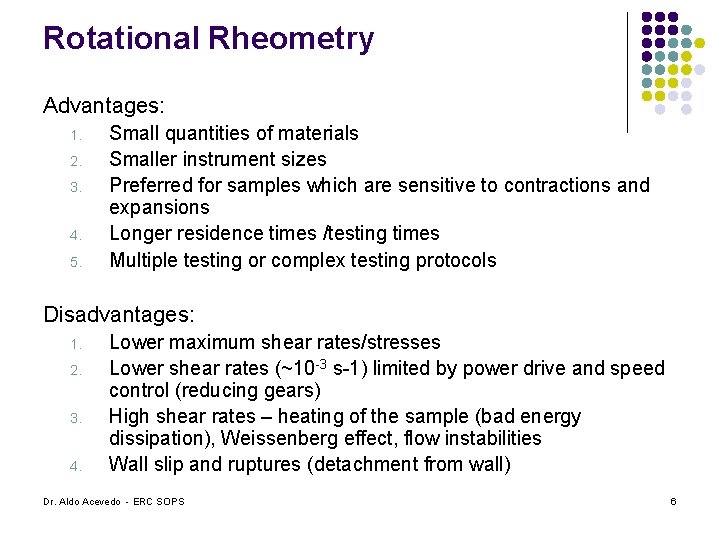
Rotational Rheometry Advantages: 1. 2. 3. 4. 5. Small quantities of materials Smaller instrument sizes Preferred for samples which are sensitive to contractions and expansions Longer residence times /testing times Multiple testing or complex testing protocols Disadvantages: 1. 2. 3. 4. Lower maximum shear rates/stresses Lower shear rates (~10 -3 s-1) limited by power drive and speed control (reducing gears) High shear rates – heating of the sample (bad energy dissipation), Weissenberg effect, flow instabilities Wall slip and ruptures (detachment from wall) Dr. Aldo Acevedo - ERC SOPS 6
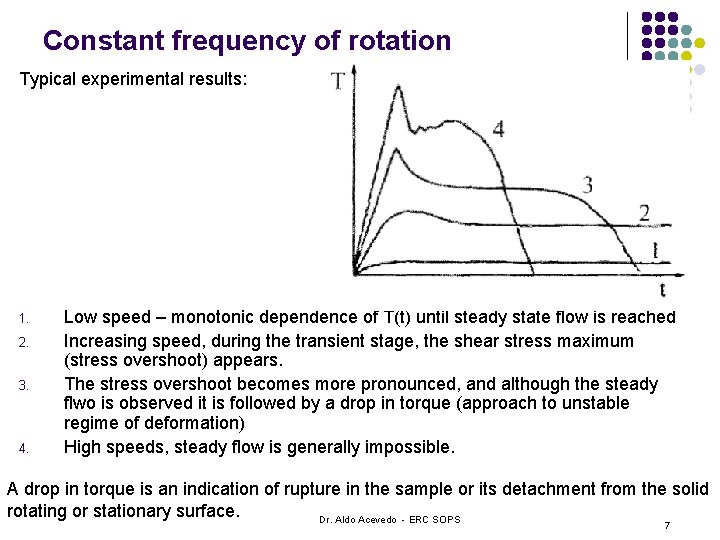
Constant frequency of rotation Typical experimental results: 1. 2. 3. 4. Low speed – monotonic dependence of T(t) until steady state flow is reached Increasing speed, during the transient stage, the shear stress maximum (stress overshoot) appears. The stress overshoot becomes more pronounced, and although the steady flwo is observed it is followed by a drop in torque (approach to unstable regime of deformation) High speeds, steady flow is generally impossible. A drop in torque is an indication of rupture in the sample or its detachment from the solid rotating or stationary surface. Dr. Aldo Acevedo - ERC SOPS 7
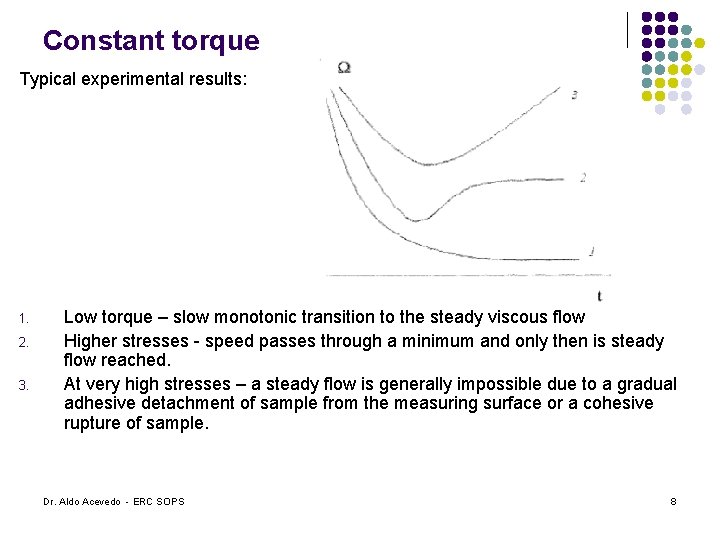
Constant torque Typical experimental results: 1. 2. 3. Low torque – slow monotonic transition to the steady viscous flow Higher stresses - speed passes through a minimum and only then is steady flow reached. At very high stresses – a steady flow is generally impossible due to a gradual adhesive detachment of sample from the measuring surface or a cohesive rupture of sample. Dr. Aldo Acevedo - ERC SOPS 8
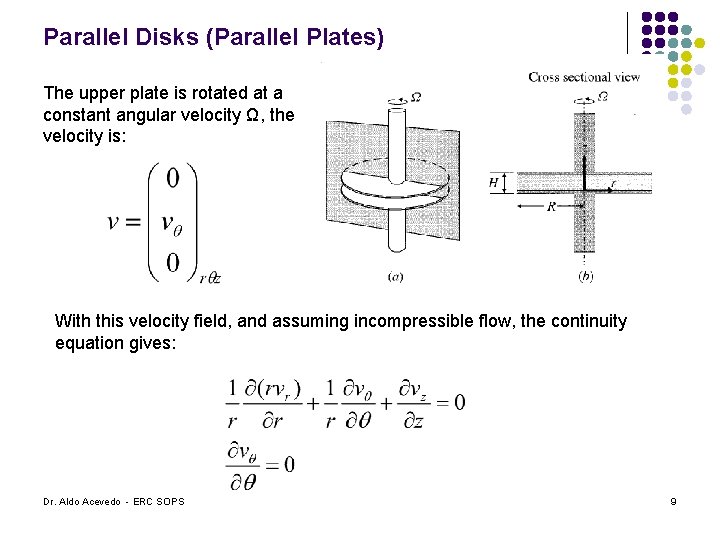
Parallel Disks (Parallel Plates) The upper plate is rotated at a constant angular velocity Ω, the velocity is: With this velocity field, and assuming incompressible flow, the continuity equation gives: Dr. Aldo Acevedo - ERC SOPS 9
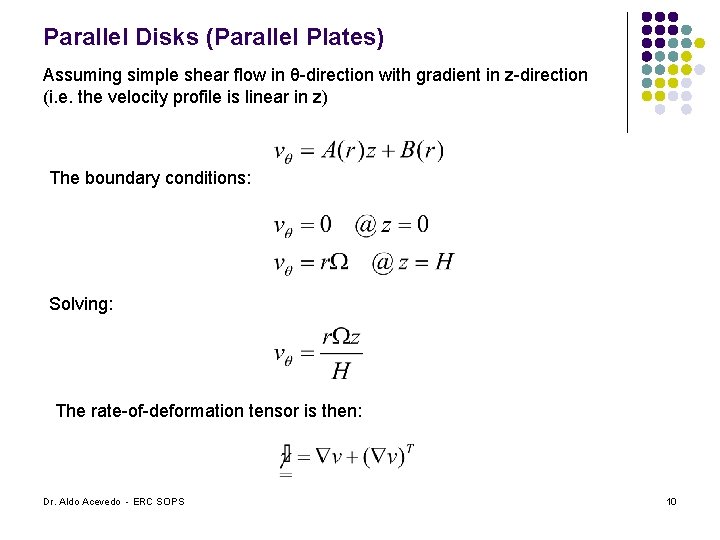
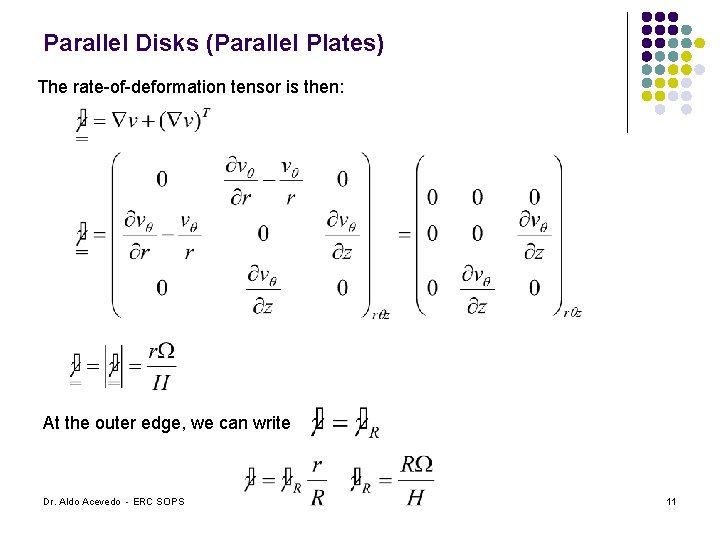
Parallel Disks (Parallel Plates) Assuming simple shear flow in θ-direction with gradient in z-direction (i. e. the velocity profile is linear in z) The boundary conditions: Solving: The rate-of-deformation tensor is then: Dr. Aldo Acevedo - ERC SOPS 10
Parallel Disks (Parallel Plates) The rate-of-deformation tensor is then: At the outer edge, we can write Dr. Aldo Acevedo - ERC SOPS 11
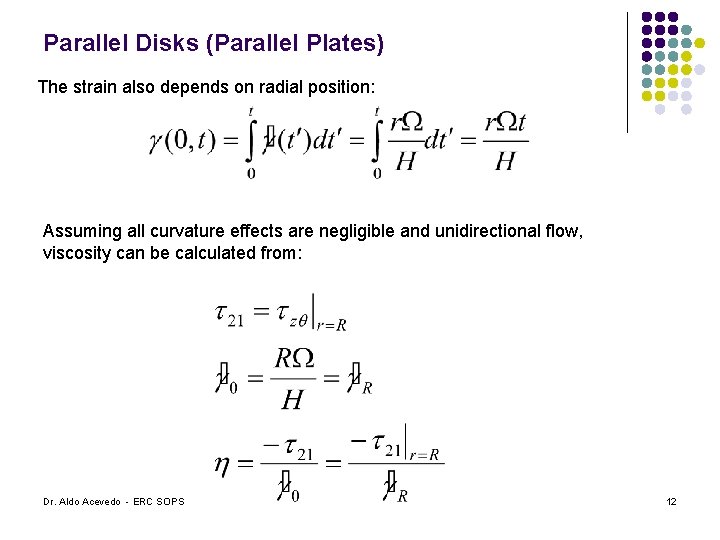
Parallel Disks (Parallel Plates) The strain also depends on radial position: Assuming all curvature effects are negligible and unidirectional flow, viscosity can be calculated from: Dr. Aldo Acevedo - ERC SOPS 12
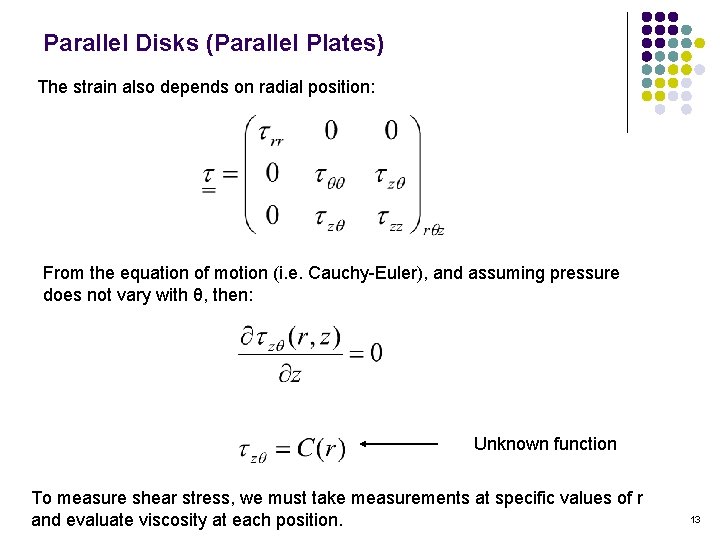
Parallel Disks (Parallel Plates) The strain also depends on radial position: From the equation of motion (i. e. Cauchy-Euler), and assuming pressure does not vary with θ, then: Unknown function To measure shear stress, we must take measurements at specific values of r and evaluate viscosity at each position. 13
Parallel Disks (Parallel Plates) Although it is possible to measure stress, it is easier to measure the total torque required to turn the upper disk The viscosity at any value of r can be written as: Rewritting in terms of viscosity, then: Dr. Aldo Acevedo - ERC SOPS 14
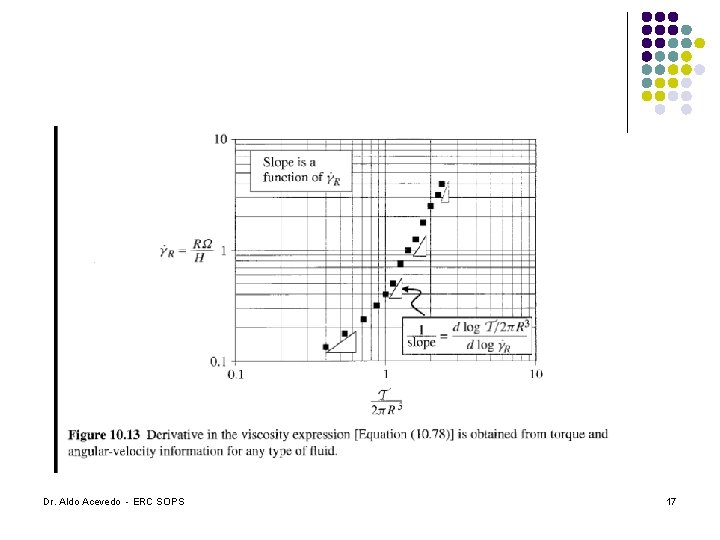
Parallel Disks (Parallel Plates) Now we need an expression of viscosity in terms of torque: First, lets change variable from r to shear rate Now to eliminate the integral, we differentiate both sides by the shear rate at the rim and using Leibnitz rule: 0 Dr. Aldo Acevedo - ERC SOPS 15
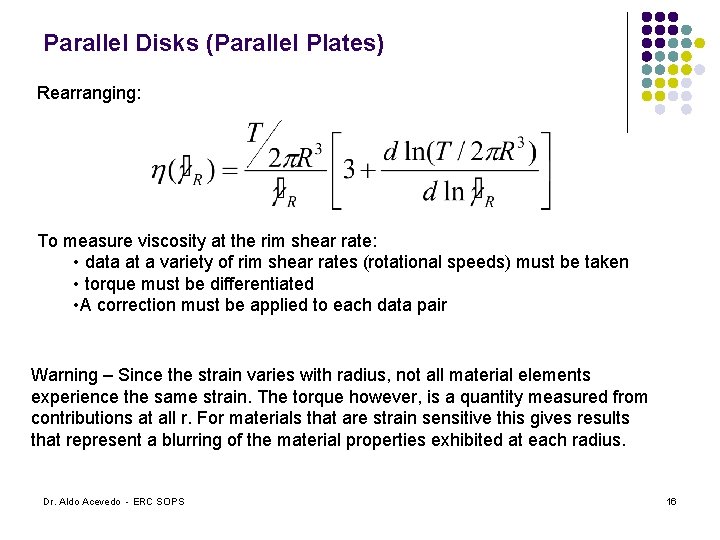
Parallel Disks (Parallel Plates) Rearranging: To measure viscosity at the rim shear rate: • data at a variety of rim shear rates (rotational speeds) must be taken • torque must be differentiated • A correction must be applied to each data pair Warning – Since the strain varies with radius, not all material elements experience the same strain. The torque however, is a quantity measured from contributions at all r. For materials that are strain sensitive this gives results that represent a blurring of the material properties exhibited at each radius. Dr. Aldo Acevedo - ERC SOPS 16
Dr. Aldo Acevedo - ERC SOPS 17
Parallel Disks (Parallel Plates) It is also popular for SAOS where the results are: SAOS material functions for parallel disk apparatus Dr. Aldo Acevedo - ERC SOPS 18
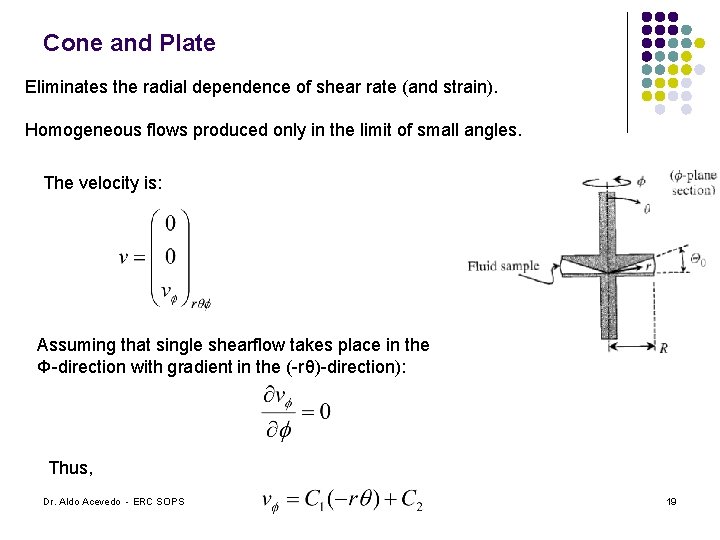
Cone and Plate Eliminates the radial dependence of shear rate (and strain). Homogeneous flows produced only in the limit of small angles. The velocity is: Assuming that single shearflow takes place in the Φ-direction with gradient in the (-rθ)-direction): Thus, Dr. Aldo Acevedo - ERC SOPS 19
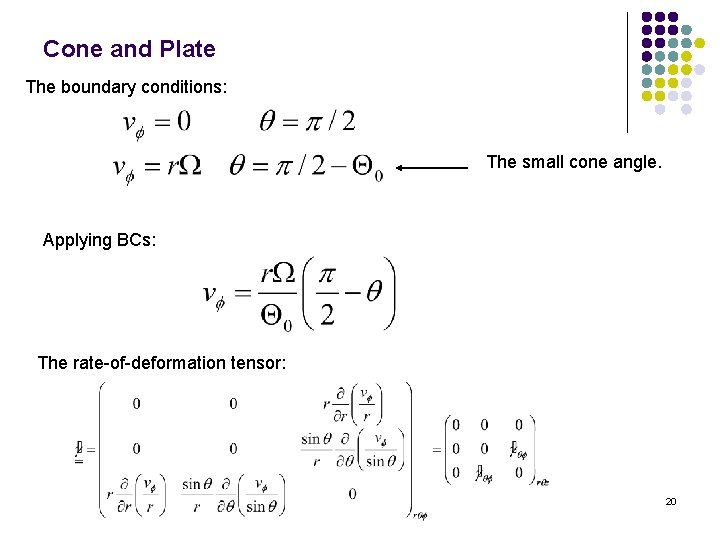
Cone and Plate The boundary conditions: The small cone angle. Applying BCs: The rate-of-deformation tensor: 20
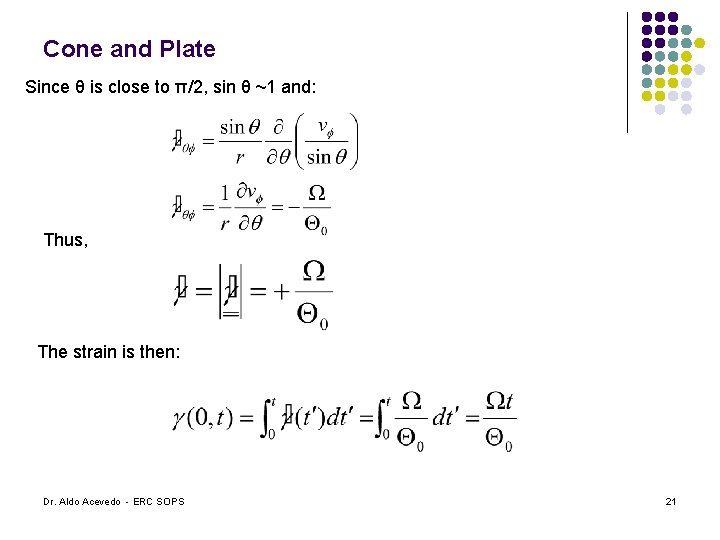
Cone and Plate Since θ is close to π/2, sin θ ~1 and: Thus, The strain is then: Dr. Aldo Acevedo - ERC SOPS 21
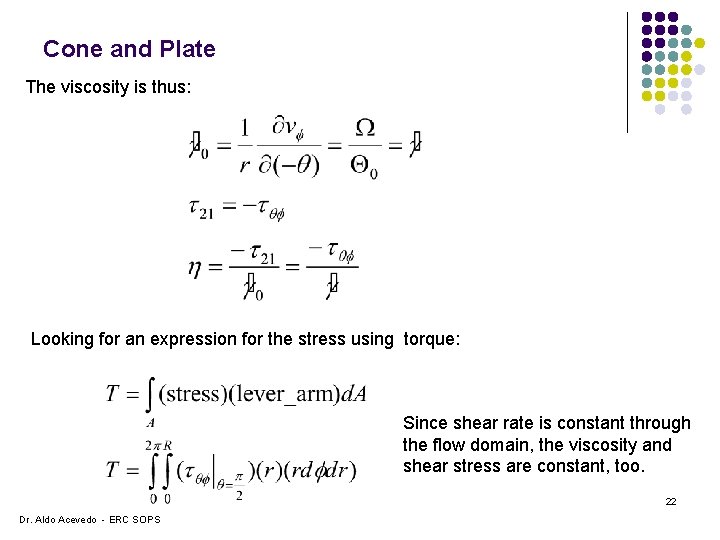
Cone and Plate The viscosity is thus: Looking for an expression for the stress using torque: Since shear rate is constant through the flow domain, the viscosity and shear stress are constant, too. 22 Dr. Aldo Acevedo - ERC SOPS
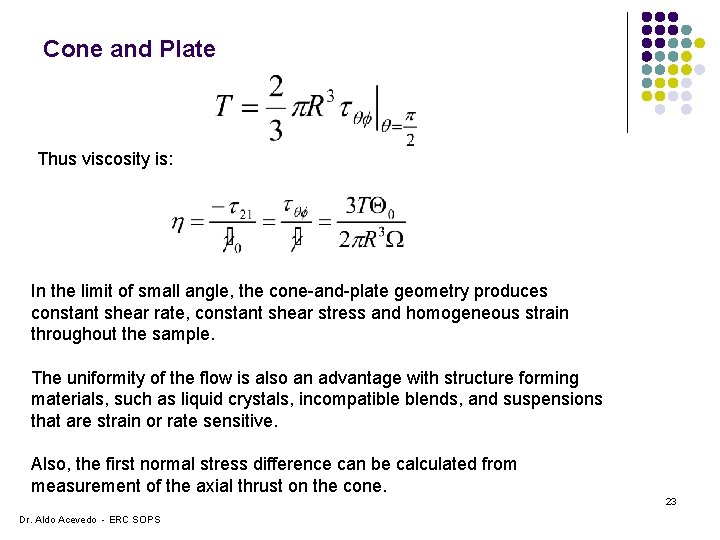
Cone and Plate Thus viscosity is: In the limit of small angle, the cone-and-plate geometry produces constant shear rate, constant shear stress and homogeneous strain throughout the sample. The uniformity of the flow is also an advantage with structure forming materials, such as liquid crystals, incompatible blends, and suspensions that are strain or rate sensitive. Also, the first normal stress difference can be calculated from measurement of the axial thrust on the cone. 23 Dr. Aldo Acevedo - ERC SOPS
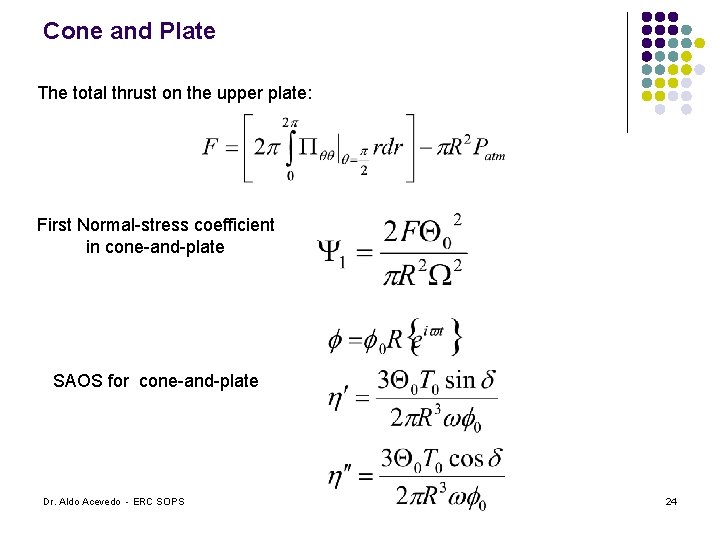
Cone and Plate The total thrust on the upper plate: First Normal-stress coefficient in cone-and-plate SAOS for cone-and-plate Dr. Aldo Acevedo - ERC SOPS 24
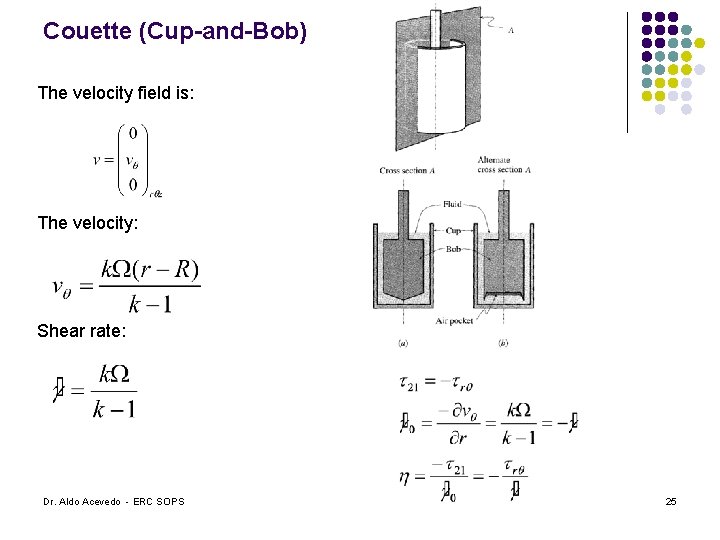
Couette (Cup-and-Bob) The velocity field is: The velocity: Shear rate: Dr. Aldo Acevedo - ERC SOPS 25
Couette (Cup-and-Bob) Torque: Viscosity in Couette flow (bob turning): Advantages: • Large contact area boosts the torque signal. Disadvantages: • Limited to modest rotational speeds due to instabilities due to inertia or elasticity. Dr. Aldo Acevedo - ERC SOPS 26
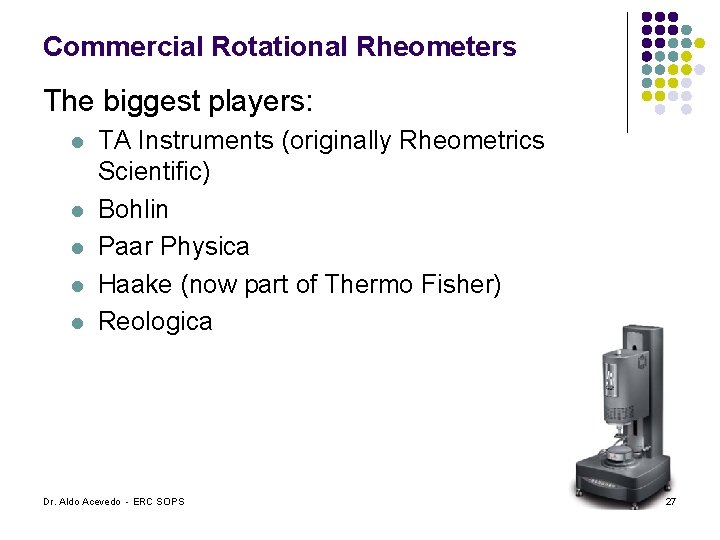
Commercial Rotational Rheometers The biggest players: l l l TA Instruments (originally Rheometrics Scientific) Bohlin Paar Physica Haake (now part of Thermo Fisher) Reologica Dr. Aldo Acevedo - ERC SOPS 27
The toppings… l Many other attachments or options may be used in rotational rheometers. These provide additional tests or independent measurements of data on the structure of fluids. l l l Magnetorheological cells Electrorheological cells Optical Attachments UV- and Photo- Curing accessories Dielectric Analysis Dr. Aldo Acevedo - ERC SOPS 28
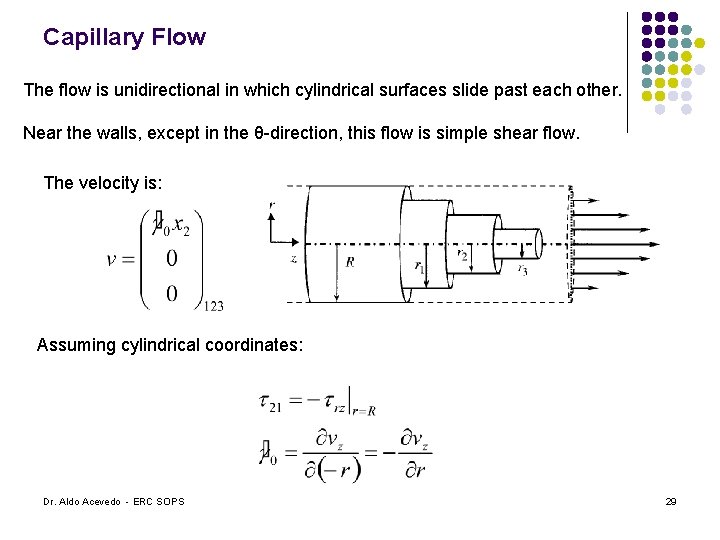
Capillary Flow The flow is unidirectional in which cylindrical surfaces slide past each other. Near the walls, except in the θ-direction, this flow is simple shear flow. The velocity is: Assuming cylindrical coordinates: Dr. Aldo Acevedo - ERC SOPS 29
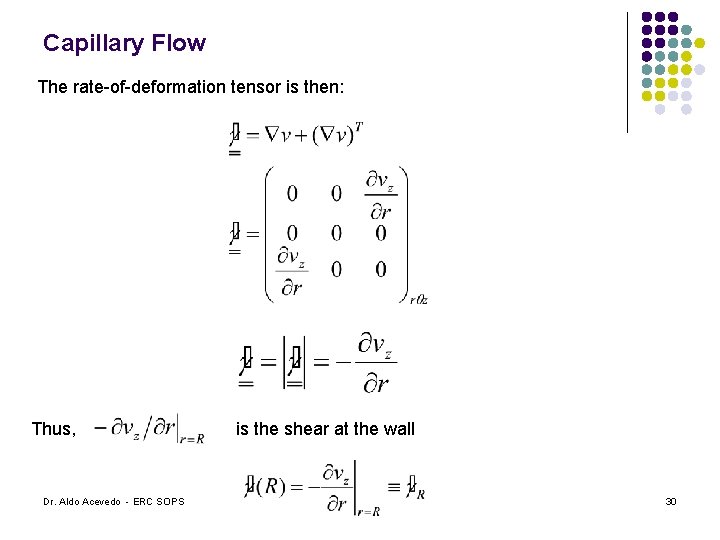
Capillary Flow The rate-of-deformation tensor is then: Thus, Dr. Aldo Acevedo - ERC SOPS is the shear at the wall 30
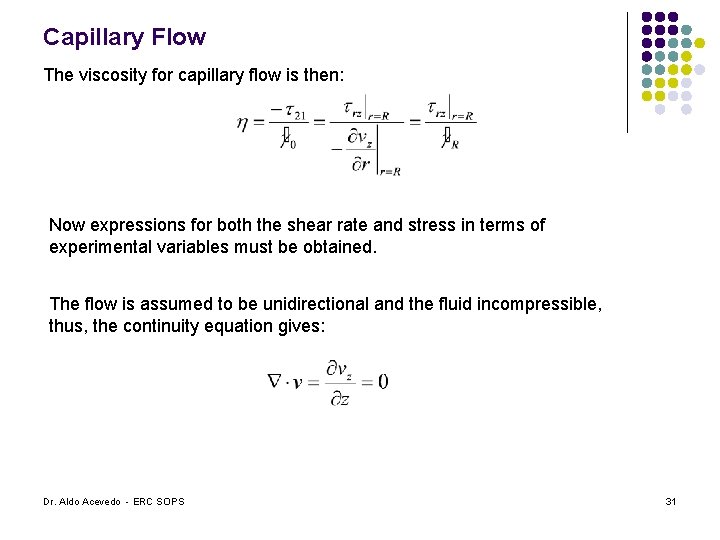
Capillary Flow The viscosity for capillary flow is then: Now expressions for both the shear rate and stress in terms of experimental variables must be obtained. The flow is assumed to be unidirectional and the fluid incompressible, thus, the continuity equation gives: Dr. Aldo Acevedo - ERC SOPS 31
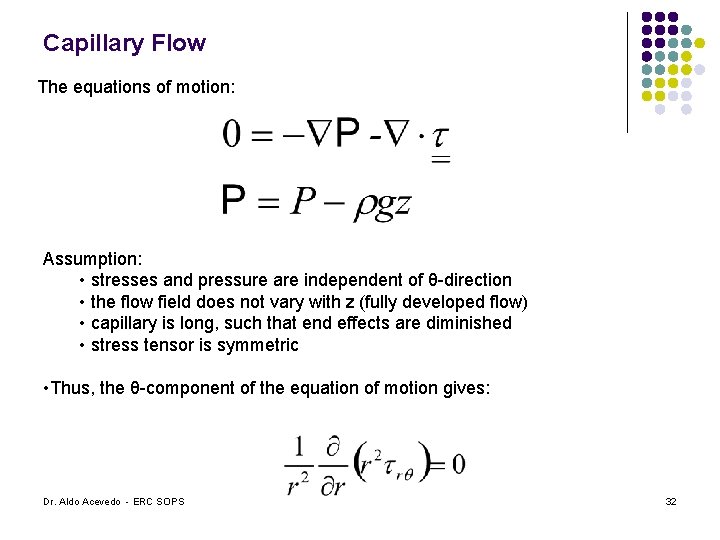
Capillary Flow The equations of motion: Assumption: • stresses and pressure are independent of θ-direction • the flow field does not vary with z (fully developed flow) • capillary is long, such that end effects are diminished • stress tensor is symmetric • Thus, the θ-component of the equation of motion gives: Dr. Aldo Acevedo - ERC SOPS 32
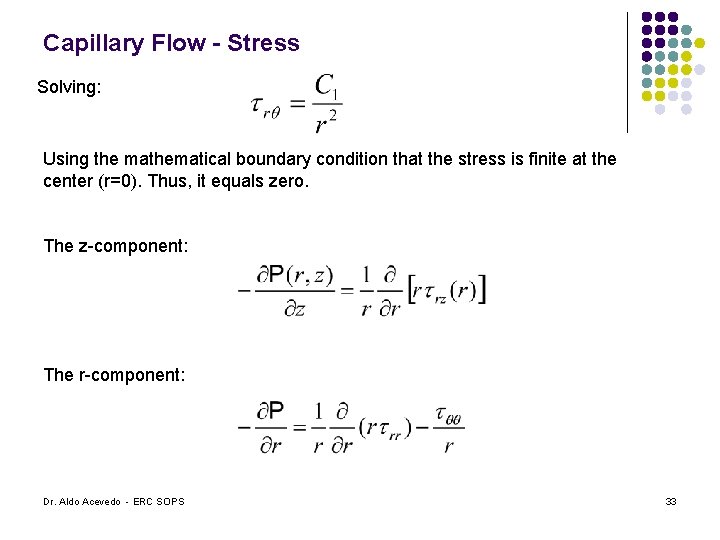
Capillary Flow - Stress Solving: Using the mathematical boundary condition that the stress is finite at the center (r=0). Thus, it equals zero. The z-component: The r-component: Dr. Aldo Acevedo - ERC SOPS 33
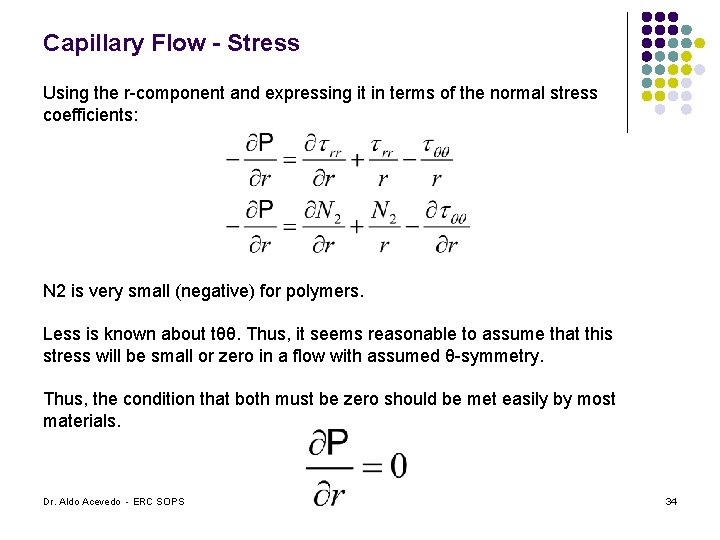
Capillary Flow - Stress Using the r-component and expressing it in terms of the normal stress coefficients: N 2 is very small (negative) for polymers. Less is known about tθθ. Thus, it seems reasonable to assume that this stress will be small or zero in a flow with assumed θ-symmetry. Thus, the condition that both must be zero should be met easily by most materials. Dr. Aldo Acevedo - ERC SOPS 34
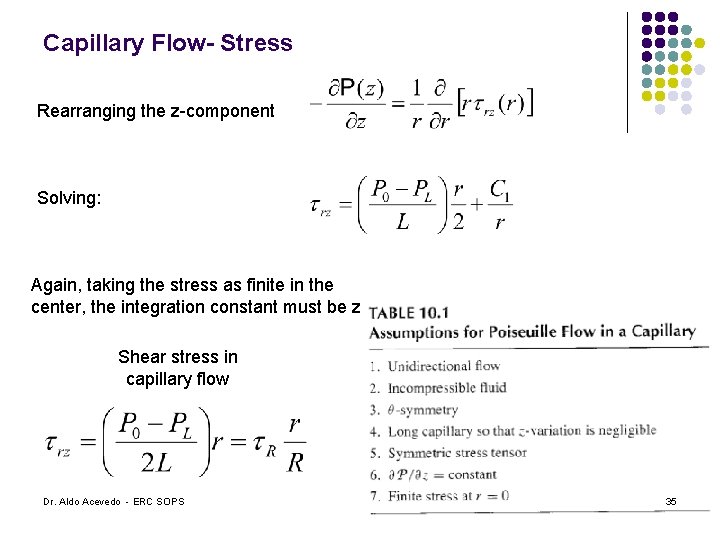
Capillary Flow- Stress Rearranging the z-component Solving: Again, taking the stress as finite in the center, the integration constant must be zero. Shear stress in capillary flow Dr. Aldo Acevedo - ERC SOPS 35
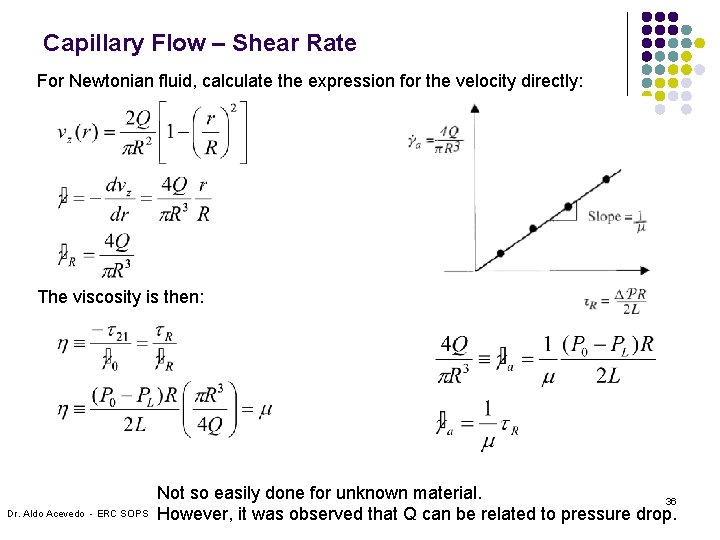
Capillary Flow – Shear Rate For Newtonian fluid, calculate the expression for the velocity directly: The viscosity is then: Dr. Aldo Acevedo - ERC SOPS Not so easily done for unknown material. 36 However, it was observed that Q can be related to pressure drop.
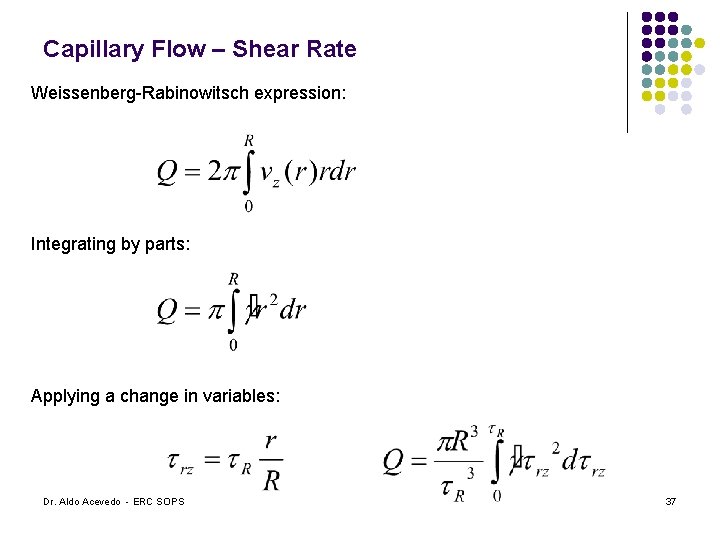
Capillary Flow – Shear Rate Weissenberg-Rabinowitsch expression: Integrating by parts: Applying a change in variables: Dr. Aldo Acevedo - ERC SOPS 37
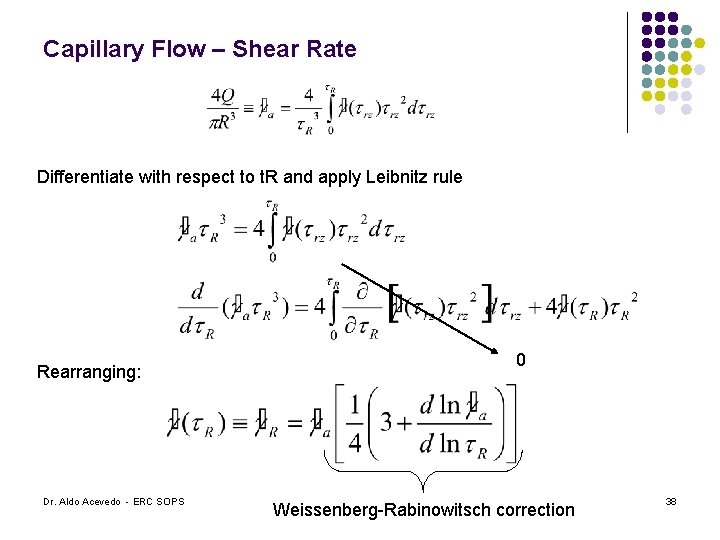
Capillary Flow – Shear Rate Differentiate with respect to t. R and apply Leibnitz rule Rearranging: Dr. Aldo Acevedo - ERC SOPS 0 Weissenberg-Rabinowitsch correction 38
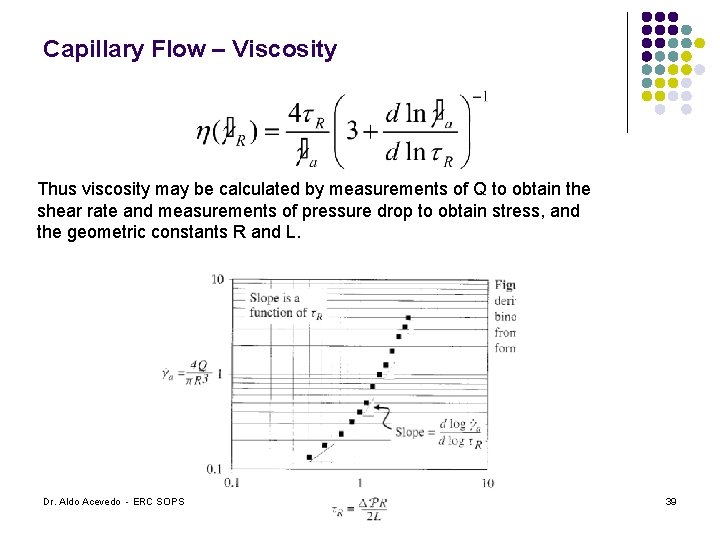
Capillary Flow – Viscosity Thus viscosity may be calculated by measurements of Q to obtain the shear rate and measurements of pressure drop to obtain stress, and the geometric constants R and L. Dr. Aldo Acevedo - ERC SOPS 39
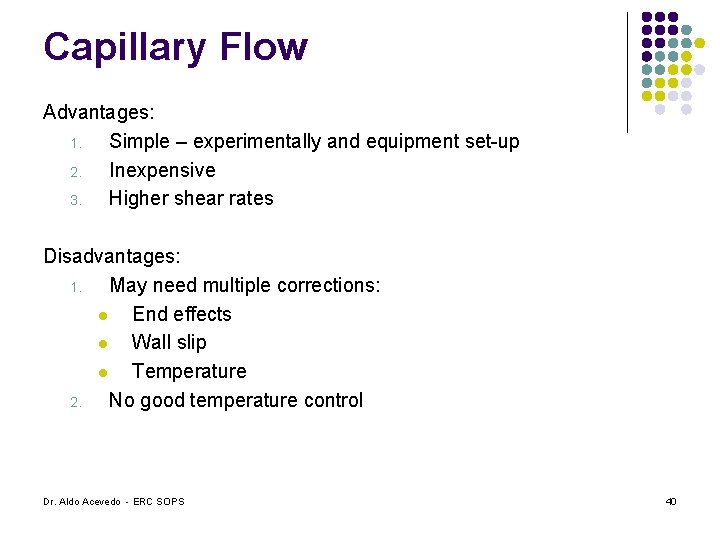
Capillary Flow Advantages: 1. Simple – experimentally and equipment set-up 2. Inexpensive 3. Higher shear rates Disadvantages: 1. May need multiple corrections: l End effects l Wall slip l Temperature 2. No good temperature control Dr. Aldo Acevedo - ERC SOPS 40
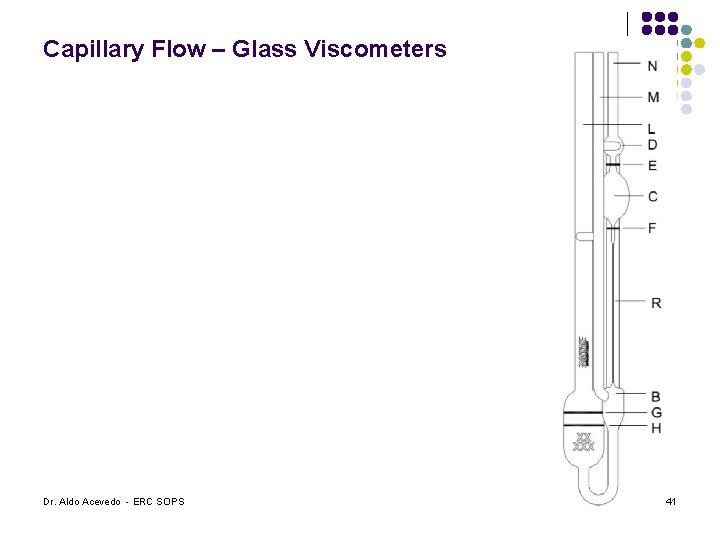
Capillary Flow – Glass Viscometers Dr. Aldo Acevedo - ERC SOPS 41
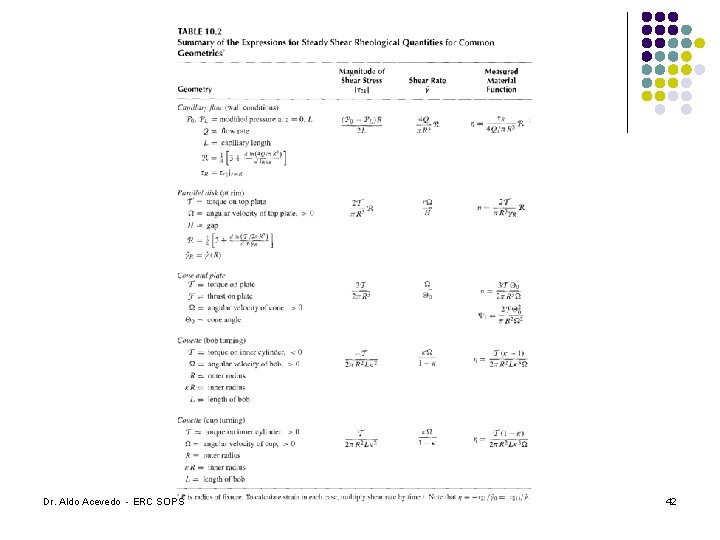
Dr. Aldo Acevedo - ERC SOPS 42
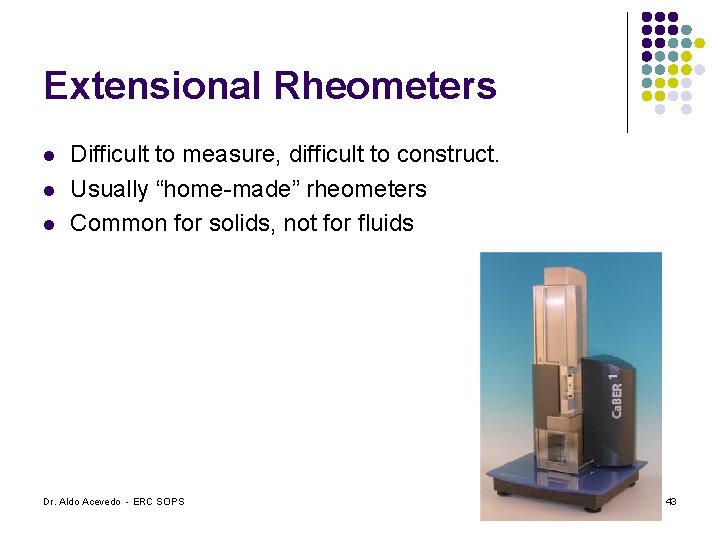
Extensional Rheometers l l l Difficult to measure, difficult to construct. Usually “home-made” rheometers Common for solids, not for fluids Dr. Aldo Acevedo - ERC SOPS 43
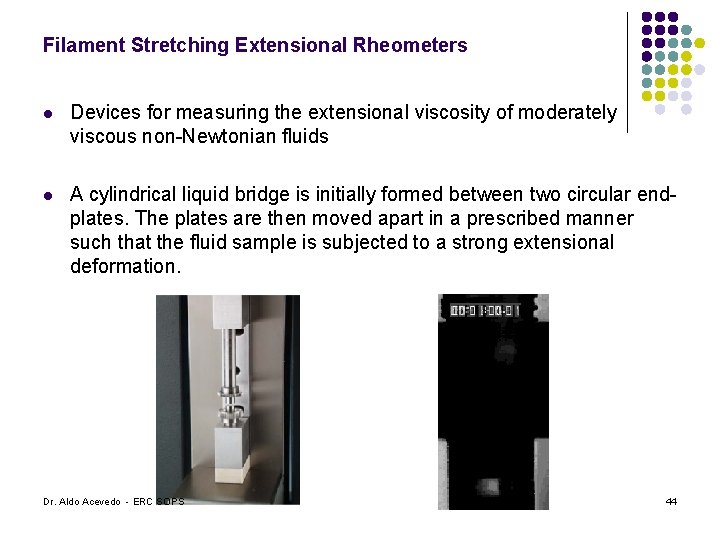
Filament Stretching Extensional Rheometers l Devices for measuring the extensional viscosity of moderately viscous non-Newtonian fluids l A cylindrical liquid bridge is initially formed between two circular endplates. The plates are then moved apart in a prescribed manner such that the fluid sample is subjected to a strong extensional deformation. Dr. Aldo Acevedo - ERC SOPS 44
Filament Stretching Extensional Rheometers l The kinematics closely approximate those of an ideal homogeneous uniaxial elongation. l The evolution in the tensile stress (measured mechanically) and the molecular conformation (measured optically) can be followed as functions of the rate of stretching and the total strain imposed. l Extensional flows are irrotational and extremely efficient at unraveling flexible macromolecules or orienting rigid molecules. l If it was possible to maintain the flow field, all molecules would eventually be fully extended and aligned. Mc. Kinley and Sridhar, “Filament-Stretching Rheometry of Complex Fluids”, Annual Reviews of Fluid Mechanics, 34 375 -415 (2002) Dr. Aldo Acevedo - ERC SOPS 45
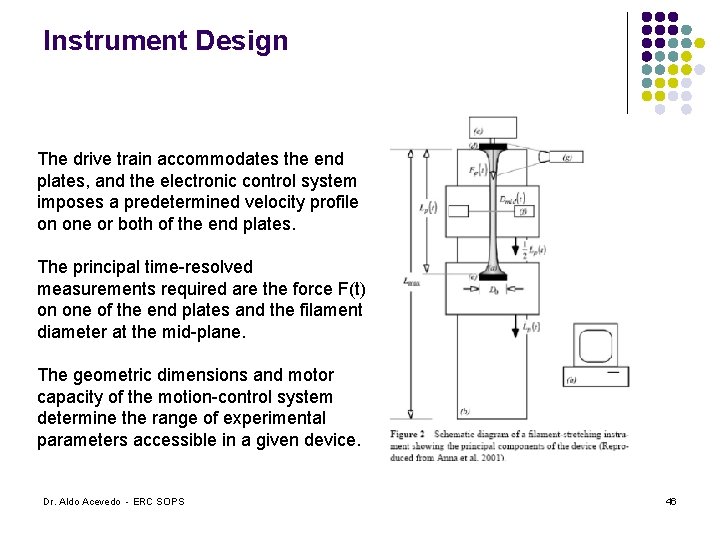
Instrument Design The drive train accommodates the end plates, and the electronic control system imposes a predetermined velocity profile on one or both of the end plates. The principal time-resolved measurements required are the force F(t) on one of the end plates and the filament diameter at the mid-plane. The geometric dimensions and motor capacity of the motion-control system determine the range of experimental parameters accessible in a given device. Dr. Aldo Acevedo - ERC SOPS 46
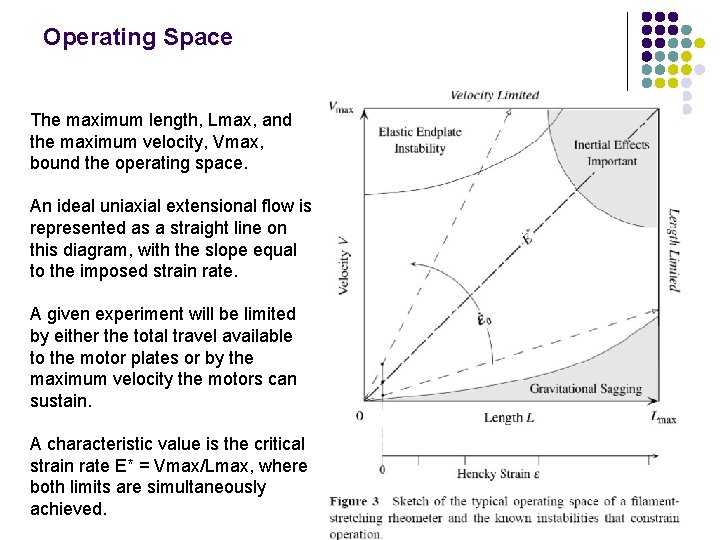
Operating Space The maximum length, Lmax, and the maximum velocity, Vmax, bound the operating space. An ideal uniaxial extensional flow is represented as a straight line on this diagram, with the slope equal to the imposed strain rate. A given experiment will be limited by either the total travel available to the motor plates or by the maximum velocity the motors can sustain. A characteristic value is the critical strain rate E* = Vmax/Lmax, where both limits are simultaneously achieved.
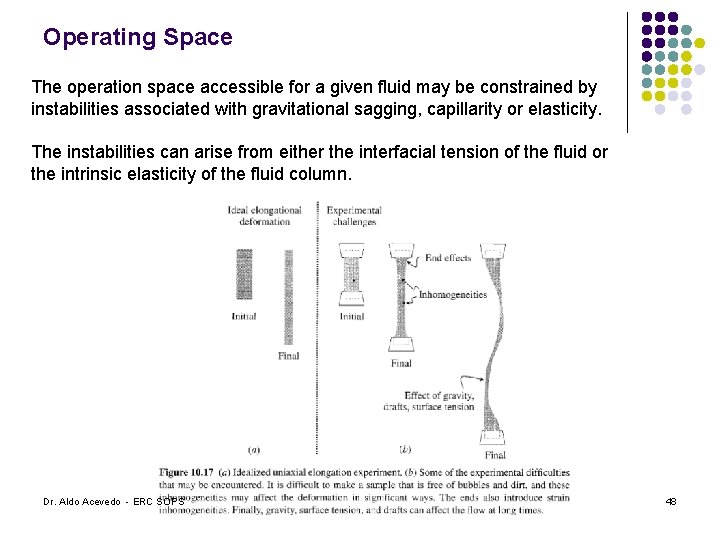
Operating Space The operation space accessible for a given fluid may be constrained by instabilities associated with gravitational sagging, capillarity or elasticity. The instabilities can arise from either the interfacial tension of the fluid or the intrinsic elasticity of the fluid column. Dr. Aldo Acevedo - ERC SOPS 48
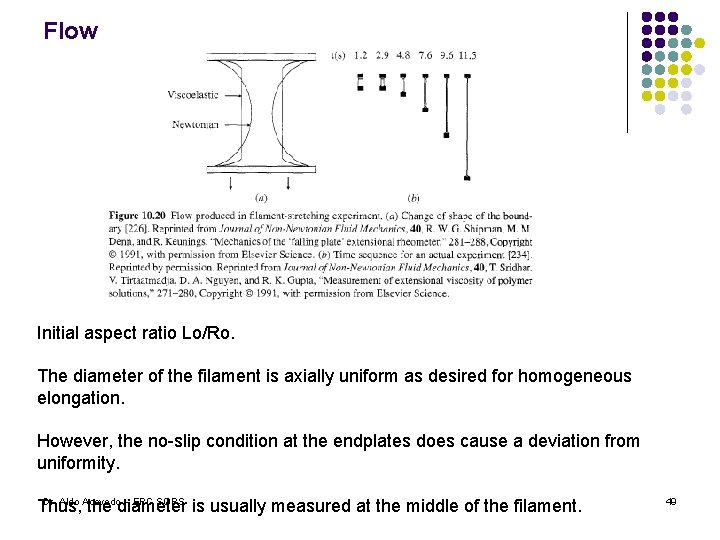
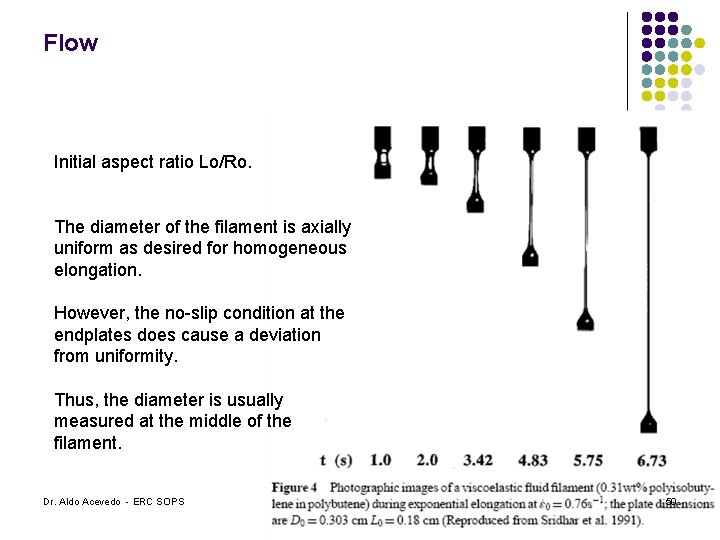
Flow Initial aspect ratio Lo/Ro. The diameter of the filament is axially uniform as desired for homogeneous elongation. However, the no-slip condition at the endplates does cause a deviation from uniformity. Dr. Aldo Acevedo - ERC SOPS Thus, the diameter is usually measured at the middle of the filament. 49
Flow Initial aspect ratio Lo/Ro. The diameter of the filament is axially uniform as desired for homogeneous elongation. However, the no-slip condition at the endplates does cause a deviation from uniformity. Thus, the diameter is usually measured at the middle of the filament. Dr. Aldo Acevedo - ERC SOPS 50
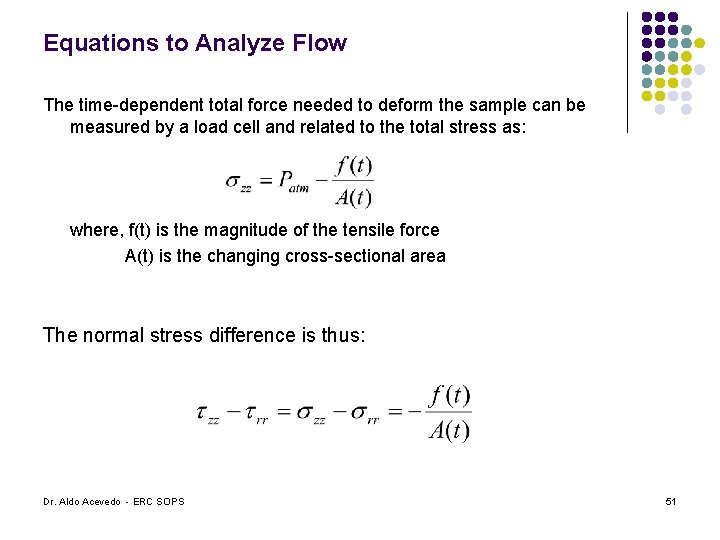
Equations to Analyze Flow The time-dependent total force needed to deform the sample can be measured by a load cell and related to the total stress as: where, f(t) is the magnitude of the tensile force A(t) is the changing cross-sectional area The normal stress difference is thus: Dr. Aldo Acevedo - ERC SOPS 51
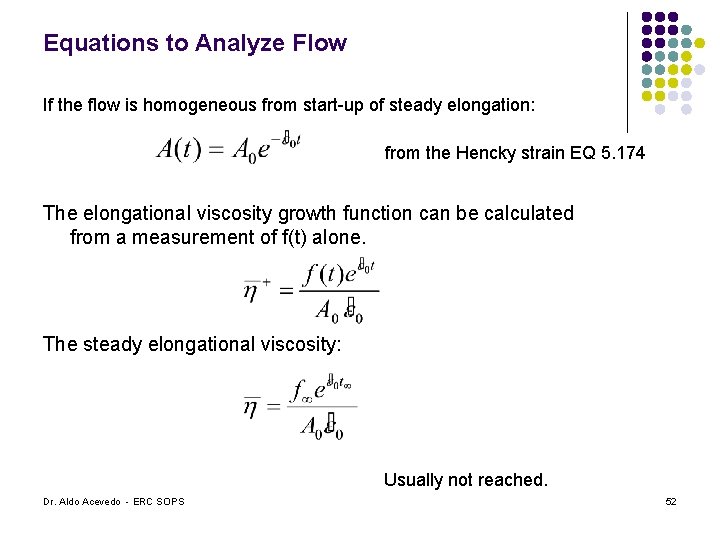
Equations to Analyze Flow If the flow is homogeneous from start-up of steady elongation: from the Hencky strain EQ 5. 174 The elongational viscosity growth function can be calculated from a measurement of f(t) alone. The steady elongational viscosity: Usually not reached. Dr. Aldo Acevedo - ERC SOPS 52
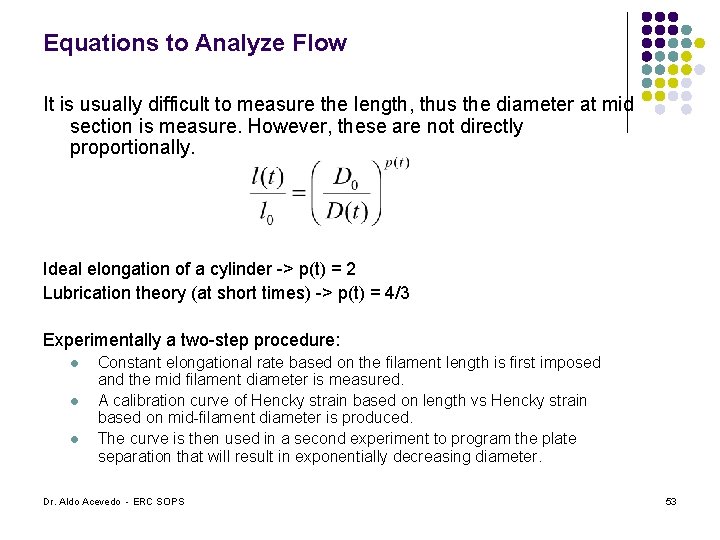
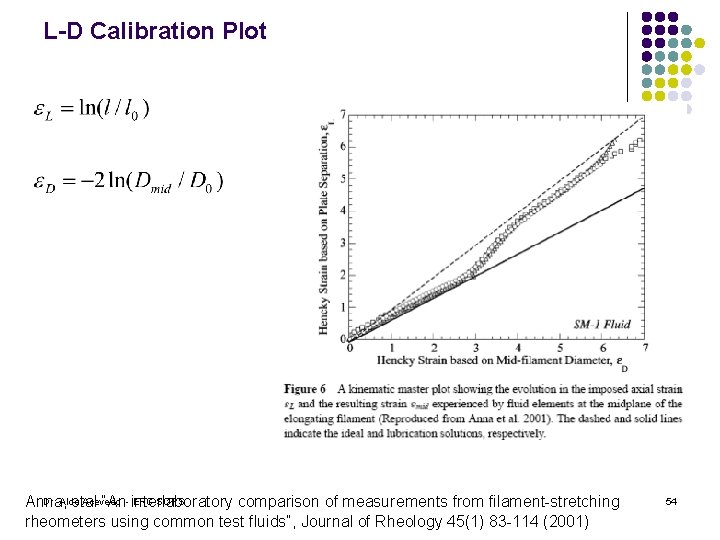
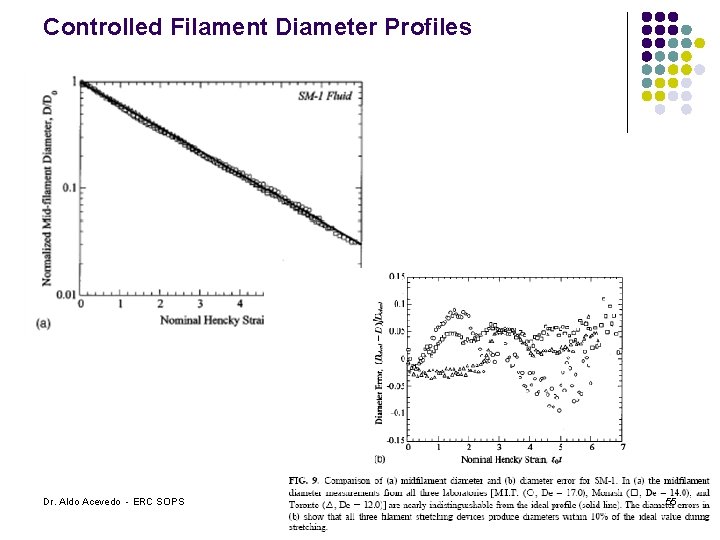
Equations to Analyze Flow It is usually difficult to measure the length, thus the diameter at mid section is measure. However, these are not directly proportionally. Ideal elongation of a cylinder -> p(t) = 2 Lubrication theory (at short times) -> p(t) = 4/3 Experimentally a two-step procedure: l l l Constant elongational rate based on the filament length is first imposed and the mid filament diameter is measured. A calibration curve of Hencky strain based on length vs Hencky strain based on mid-filament diameter is produced. The curve is then used in a second experiment to program the plate separation that will result in exponentially decreasing diameter. Dr. Aldo Acevedo - ERC SOPS 53
L-D Calibration Plot Dr. Aldo Acevedo ERC SOPS Anna, etal “An- interlaboratory comparison of measurements from filament-stretching rheometers using common test fluids”, Journal of Rheology 45(1) 83 -114 (2001) 54
Controlled Filament Diameter Profiles Dr. Aldo Acevedo - ERC SOPS 55
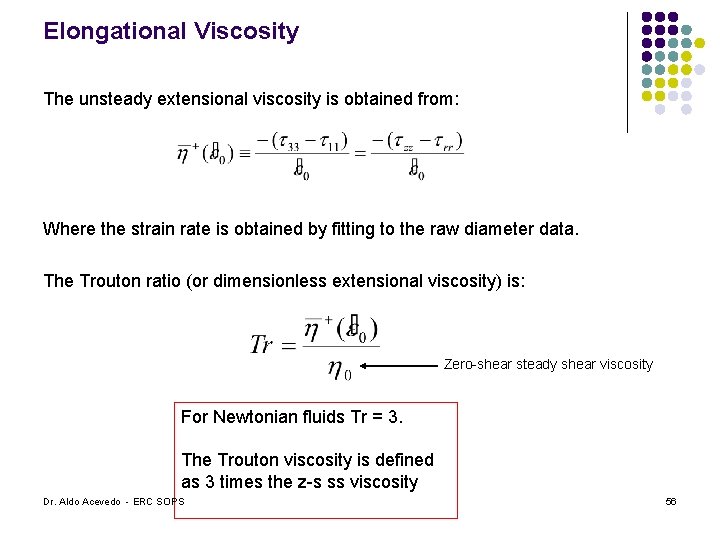
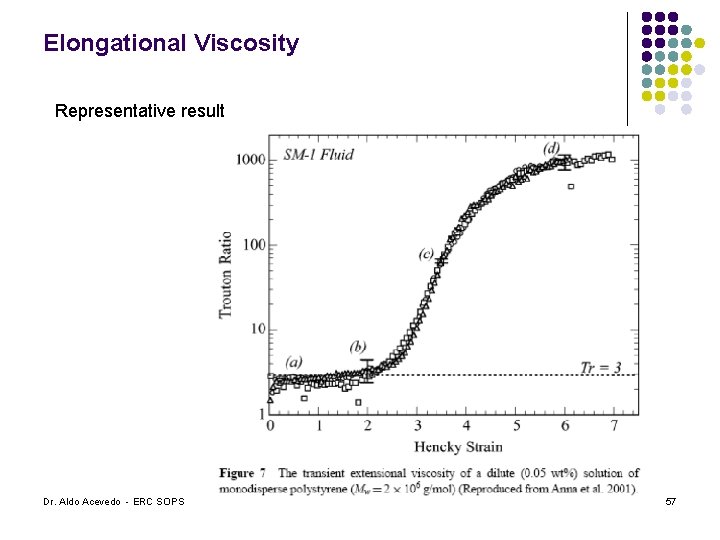
Elongational Viscosity The unsteady extensional viscosity is obtained from: Where the strain rate is obtained by fitting to the raw diameter data. The Trouton ratio (or dimensionless extensional viscosity) is: Zero-shear steady shear viscosity For Newtonian fluids Tr = 3. The Trouton viscosity is defined as 3 times the z-s ss viscosity Dr. Aldo Acevedo - ERC SOPS 56
Elongational Viscosity Representative result Dr. Aldo Acevedo - ERC SOPS 57
Pros and Cons Advantages: l The sample starts from a well defined initial rest state. l Except near the ends, the strain of each material element is the same. Disadvantages l The deformation near the ends is not homogeneous uniaxial extension. l At short times there is an induction period during which a secondary flow occurs near the plates due to gravitational and surface tension forces. l Elongational rates calculated based on length differ from those calculated on radius. Dr. Aldo Acevedo - ERC SOPS 58
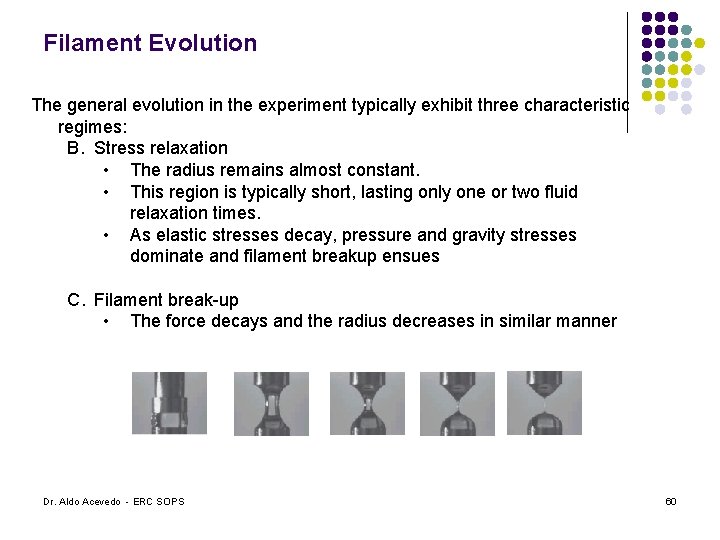
Filament Evolution The general evolution in the experiment typically exhibit three characteristic regimes: A. Filament elongation • the radius decreases exponentially • At short times (early strains) there is a solvent-dominated peak in the force followed by a steady decline due to the exponential decrease in the cross-sectional area. • Intermediate times (or strains) the force begins to increase again owing to the strain hardening in the tensile stress. Since the area decreases, an increase in the force indicates that the stress is increasing faster that the exponential of the strain. • At very large strains, a second maximm in the force may be observved after th eextensional stresses saturate and the extensional viscosity of the fluid recahes steady-state. Dr. Aldo Acevedo - ERC SOPS 59
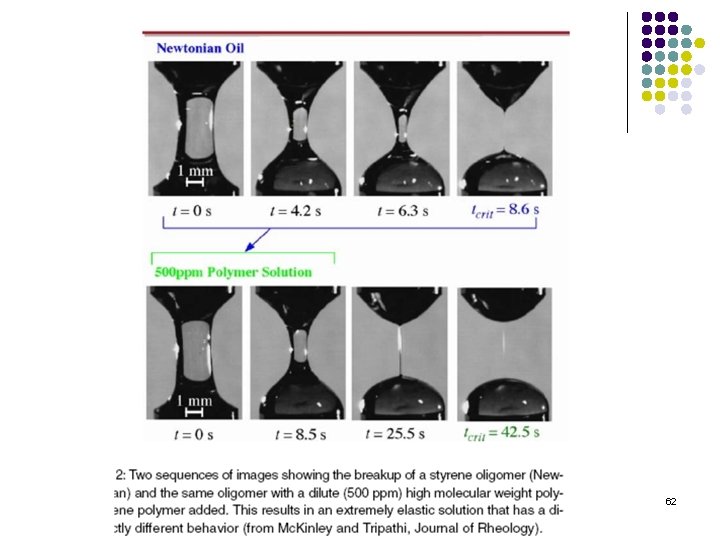
Filament Evolution The general evolution in the experiment typically exhibit three characteristic regimes: B. Stress relaxation • The radius remains almost constant. • This region is typically short, lasting only one or two fluid relaxation times. • As elastic stresses decay, pressure and gravity stresses dominate and filament breakup ensues C. Filament break-up • The force decays and the radius decreases in similar manner Dr. Aldo Acevedo - ERC SOPS 60
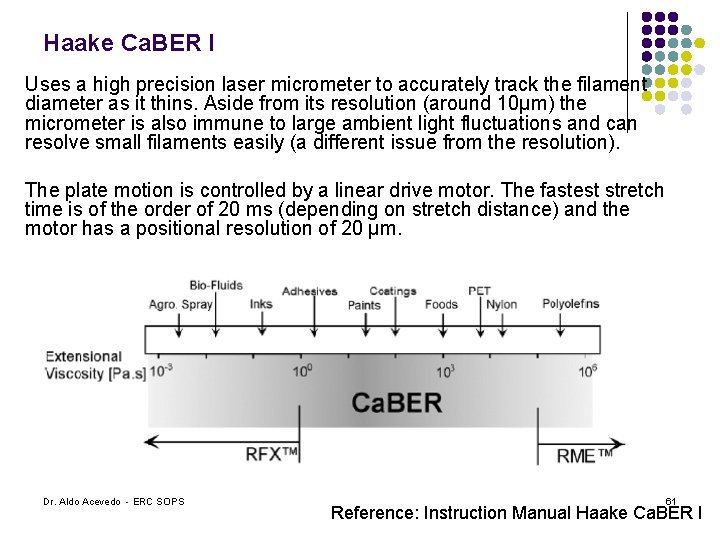
Haake Ca. BER I Uses a high precision laser micrometer to accurately track the filament diameter as it thins. Aside from its resolution (around 10μm) the micrometer is also immune to large ambient light fluctuations and can resolve small filaments easily (a different issue from the resolution). The plate motion is controlled by a linear drive motor. The fastest stretch time is of the order of 20 ms (depending on stretch distance) and the motor has a positional resolution of 20 μm. Dr. Aldo Acevedo - ERC SOPS 61 Reference: Instruction Manual Haake Ca. BER I
62
References l l Faith Morrison, “Understanding Rheology, ” Oxford University Press (2001) Malkin, A. Y. & A. I. Isayev, “Rheology: Concepts, Methods & Applications, ” Chem. Tec Publishing, Toronto (2006) Dr. Aldo Acevedo - ERC SOPS 63