
RFID Sensor Nodes RFID tag powered by solar
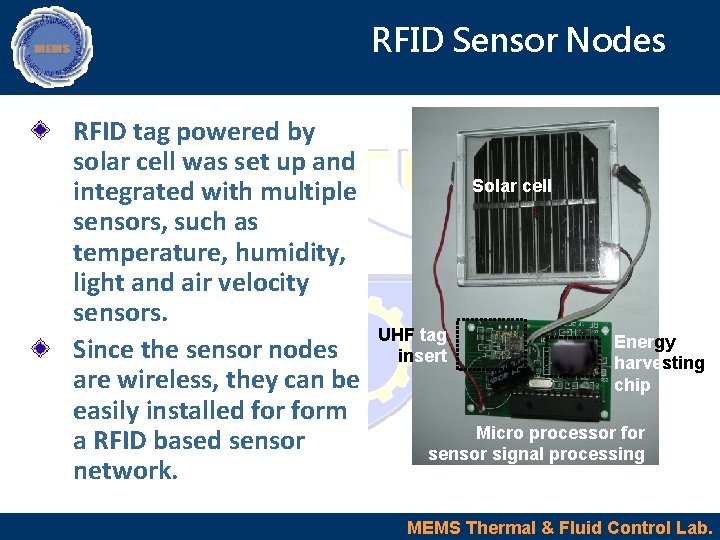
RFID Sensor Nodes RFID tag powered by solar cell was set up and integrated with multiple sensors, such as temperature, humidity, light and air velocity sensors. Since the sensor nodes are wireless, they can be easily installed form a RFID based sensor network. Solar cell UHF tag insert Energy harvesting chip Micro processor for sensor signal processing MEMS Thermal & Fluid Control Lab.
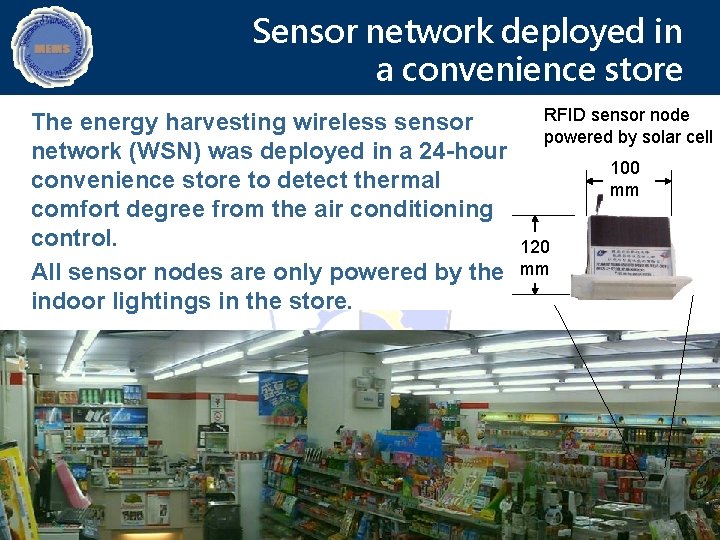
Sensor network deployed in a convenience store The energy harvesting wireless sensor network (WSN) was deployed in a 24 -hour convenience store to detect thermal comfort degree from the air conditioning control. All sensor nodes are only powered by the indoor lightings in the store. RFID sensor node powered by solar cell 100 mm 120 mm MEMS Thermal & Fluid Control Lab.
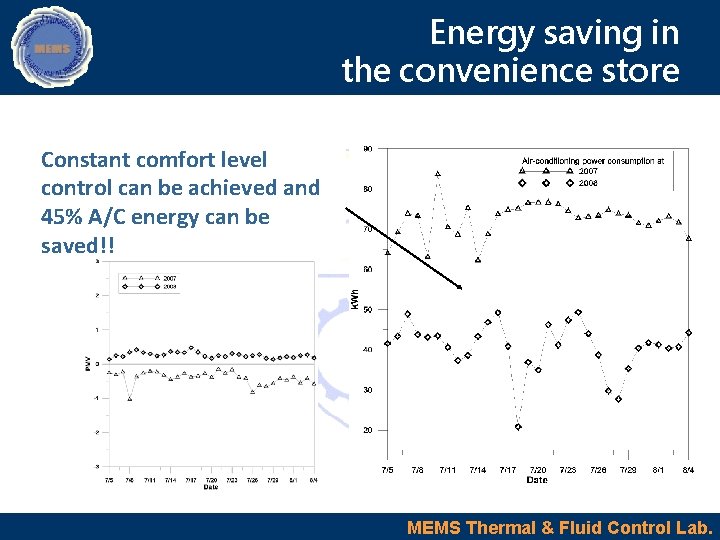
Energy saving in the convenience store Constant comfort level control can be achieved and 45% A/C energy can be saved!! MEMS Thermal & Fluid Control Lab.
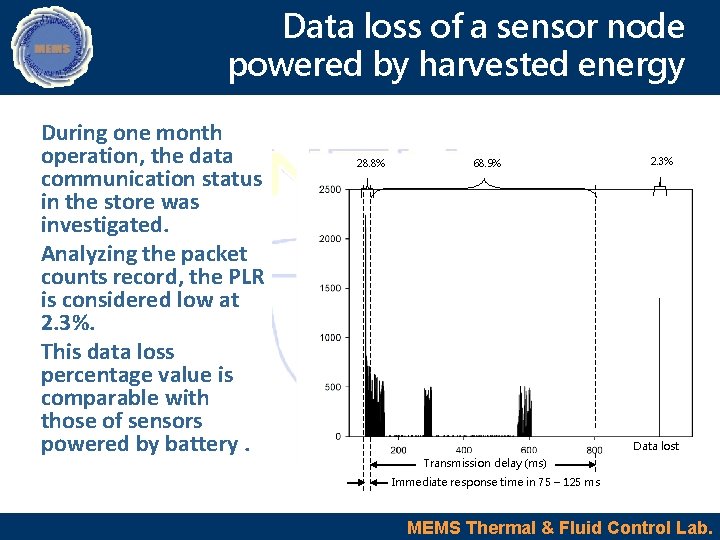
Data loss of a sensor node powered by harvested energy During one month operation, the data communication status in the store was investigated. Analyzing the packet counts record, the PLR is considered low at 2. 3%. This data loss percentage value is comparable with those of sensors powered by battery. 28. 8% 68. 9% 2. 3% Data lost Transmission delay (ms) Immediate response time in 75 – 125 ms MEMS Thermal & Fluid Control Lab.
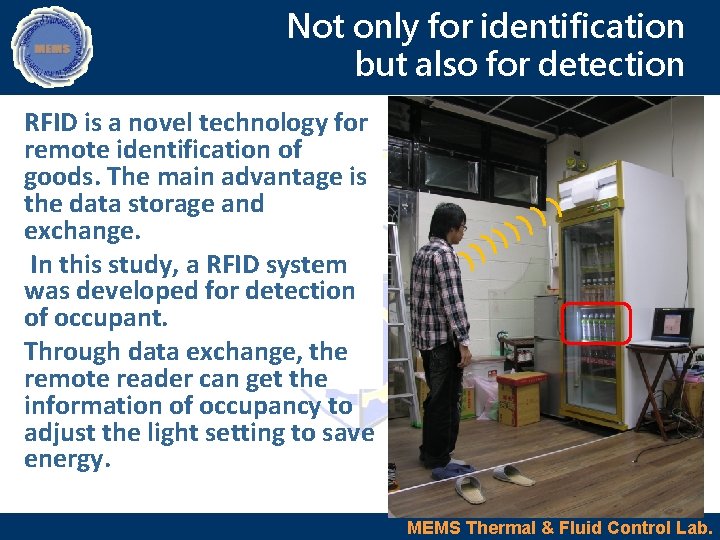
Not only for identification but also for detection RFID is a novel technology for remote identification of goods. The main advantage is the data storage and exchange. In this study, a RFID system was developed for detection of occupant. Through data exchange, the remote reader can get the information of occupancy to adjust the light setting to save energy. MEMS Thermal & Fluid Control Lab.
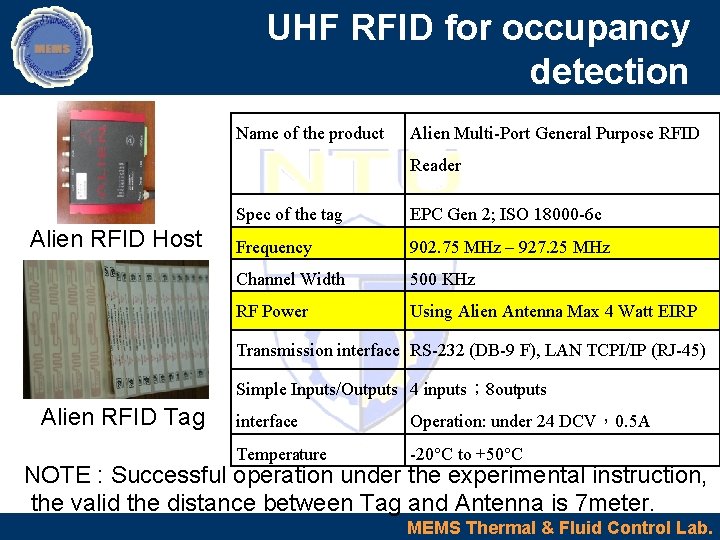
UHF RFID for occupancy detection Name of the product Alien Multi-Port General Purpose RFID Reader Alien RFID Host Spec of the tag EPC Gen 2; ISO 18000 -6 c Frequency 902. 75 MHz – 927. 25 MHz Channel Width 500 KHz RF Power Using Alien Antenna Max 4 Watt EIRP Transmission interface RS-232 (DB-9 F), LAN TCPI/IP (RJ-45) Simple Inputs/Outputs 4 inputs; 8 outputs Alien RFID Tag interface Operation: under 24 DCV,0. 5 A Temperature -20°C to +50°C NOTE : Successful operation under the experimental instruction, the valid the distance between Tag and Antenna is 7 meter. MEMS Thermal & Fluid Control Lab.
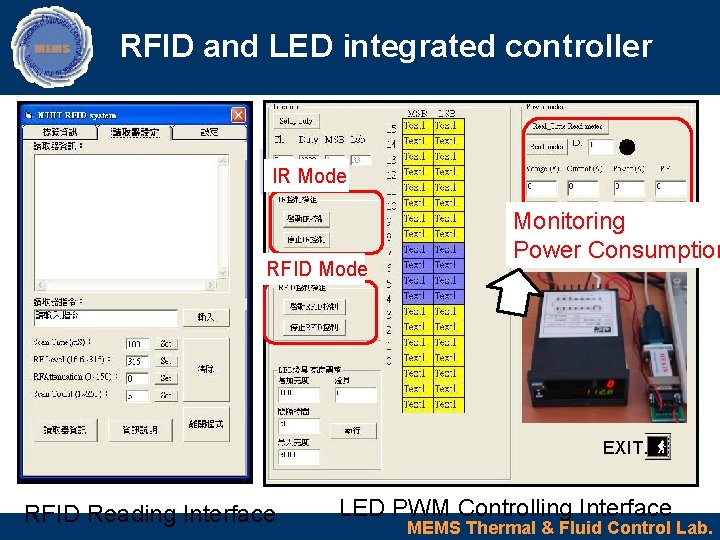
RFID and LED integrated controller IR Mode RFID Mode Monitoring Power Consumption EXIT. RFID Reading Interface LED PWM Controlling Interface MEMS Thermal & Fluid Control Lab.
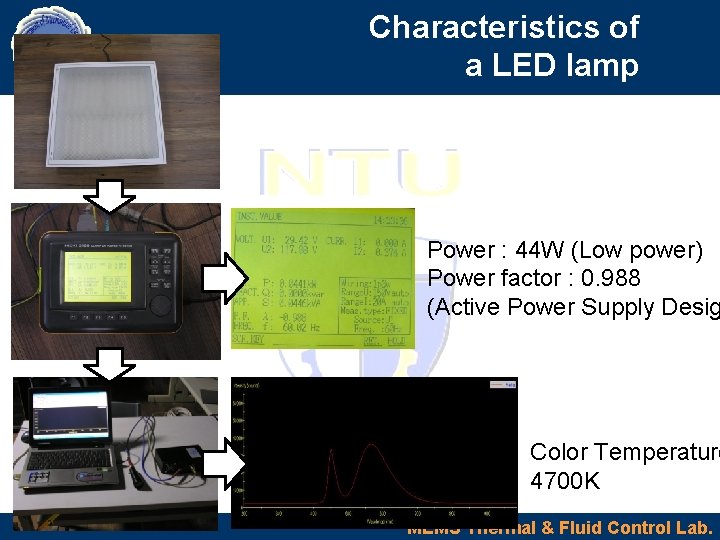
Characteristics of a LED lamp Power : 44 W (Low power) Power factor : 0. 988 (Active Power Supply Desig Color Temperature 4700 K MEMS Thermal & Fluid Control Lab.
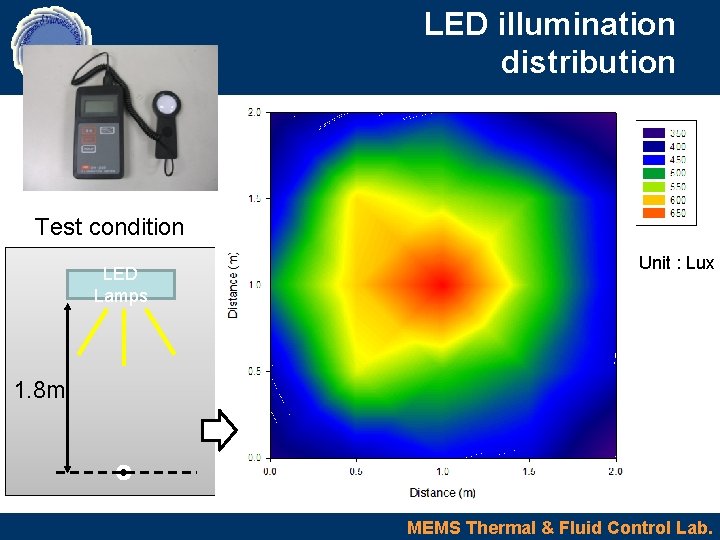
LED illumination distribution Test condition LED Lamps Unit : Lux 1. 8 m MEMS Thermal & Fluid Control Lab.
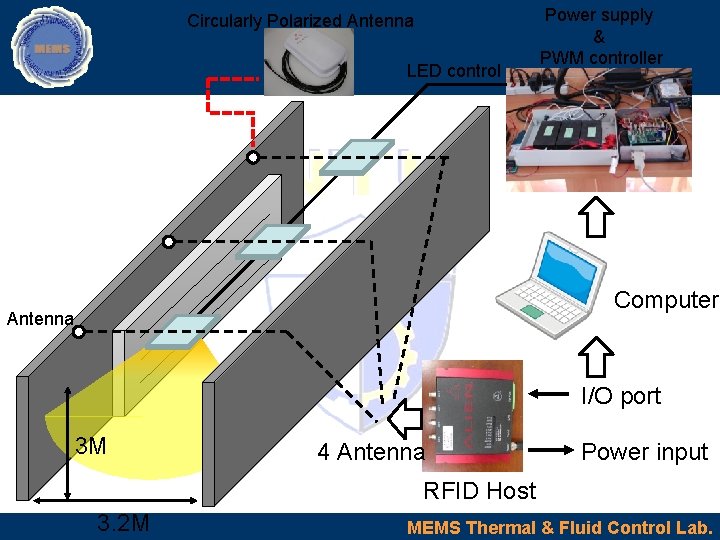
Circularly Polarized Antenna LED control Power supply & PWM controller Computer Antenna I/O port 3 M 4 Antenna Power input RFID Host 3. 2 M MEMS Thermal & Fluid Control Lab.
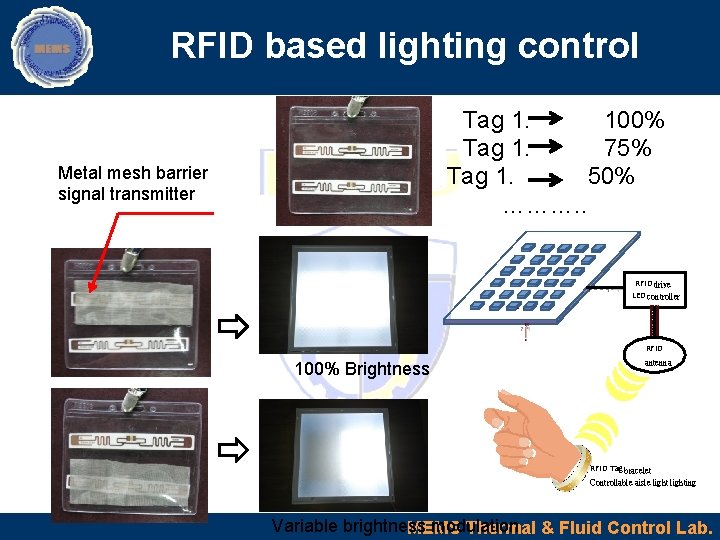
RFID based lighting control Tag 1. 100% Tag 1. 75% Tag 1. 50% ………. . Metal mesh barrier signal transmitter RFID drive LED controller RFID 100% Brightness antenna RFID Tag bracelet Controllable aisle lighting Variable brightness modulation MEMS Thermal & Fluid Control Lab.
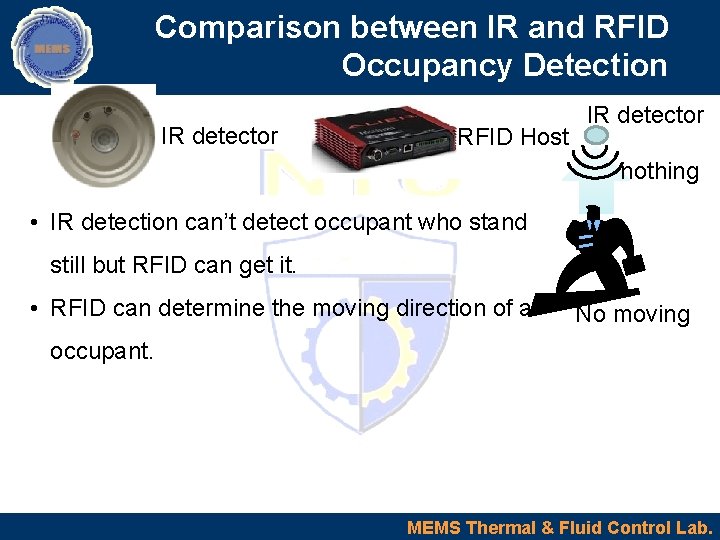
Comparison between IR and RFID Occupancy Detection IR detector RFID Host IR detector nothing • IR detection can’t detect occupant who stand still but RFID can get it. • RFID can determine the moving direction of a No moving occupant. MEMS Thermal & Fluid Control Lab.
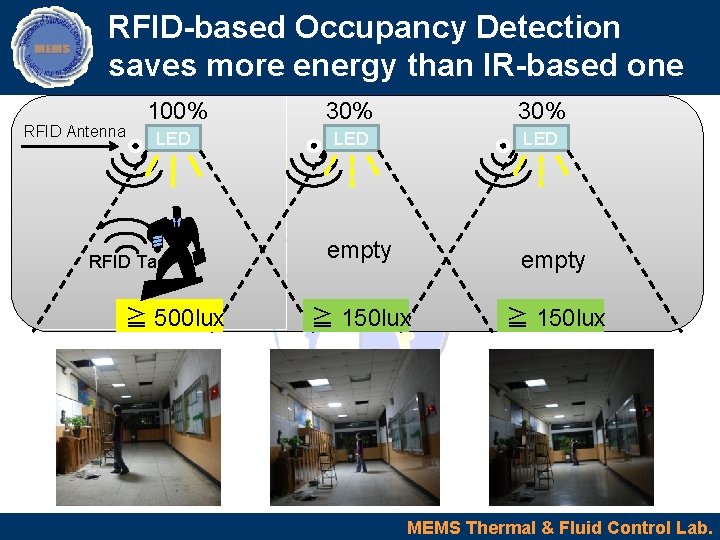
RFID-based Occupancy Detection saves more energy than IR-based one RFID Antenna 100% 30% LED LED RFID Tag ≧ 500 lux empty ≧ 150 lux MEMS Thermal & Fluid Control Lab.
Conclusions Based on backscatter coupling, used for RFID, zero communication power of the sensor node can be achieved. Through energy harvesting technology, the sensor and related circuits can be enabled. The whole new RFID based sensor networks was demonstrated and employed to record customers’ comfort degree in a store. The RFID based sensor networks can work as good as the battery powered system. MEMS Thermal & Fluid Control Lab.
Conclusions (conti-) Comparing with the well known protocol – ISO 802. 15. 4, or so called Zig. Bee, the RFID based sensor node communication has the advantage on furthermore reducing the power demands. However, different from Zig. Bee with routing algorithm, RFID based communication is only suitable for the applications of small scale sensor node deployment such like in a store or in your living room. MEMS Thermal & Fluid Control Lab.
Conclusions (conti-) A UHF RFID reader can detect occupants over 7 meters away. A LED lighting system combined with RFID can be used to adjust brightness in different zones and to reach the purpose of energy saving. The “deploy and forget” scenario was demonstrated by RFID-based sensor networks with energy harvesting chips. There is no need to worry about the replacement of battery. MEMS Thermal & Fluid Control Lab.
- Slides: 16