
RFID Overview n n n n What is
- Slides: 20
RF-ID Overview n n n n What is RFID? Components. Block diagram & Working. Frequency Ranges. EPC Code. Advantages & Disadvantages. Applications.
What is RF-ID? n n n Radio Frequency Identification. RF-ID is an technology that use Radio. Frequency waves to transfer data between a reader and movable item for detection, tracking or identification purpose. RFID is also called dedicated short range communication (DSRC).
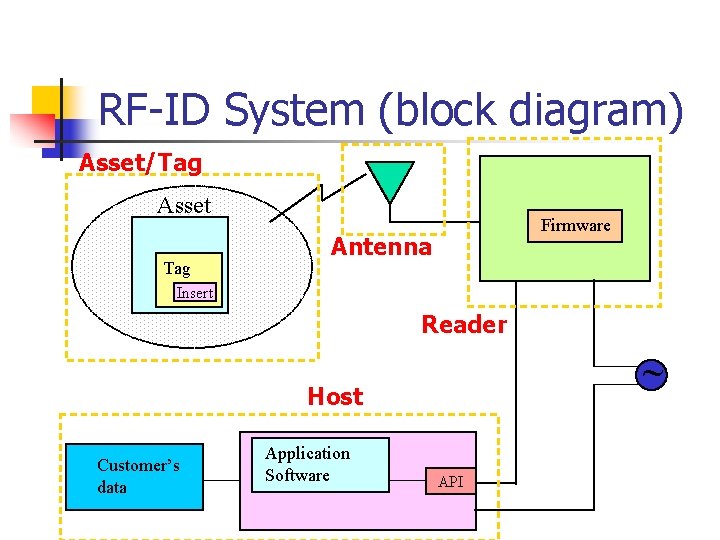
RF-ID Components n n An antenna or coil. A transponder (RF tag) electronically programmed with unique information. A antenna and transceiver together also know as interrogator or reader. Host Computer & Appropriate software.
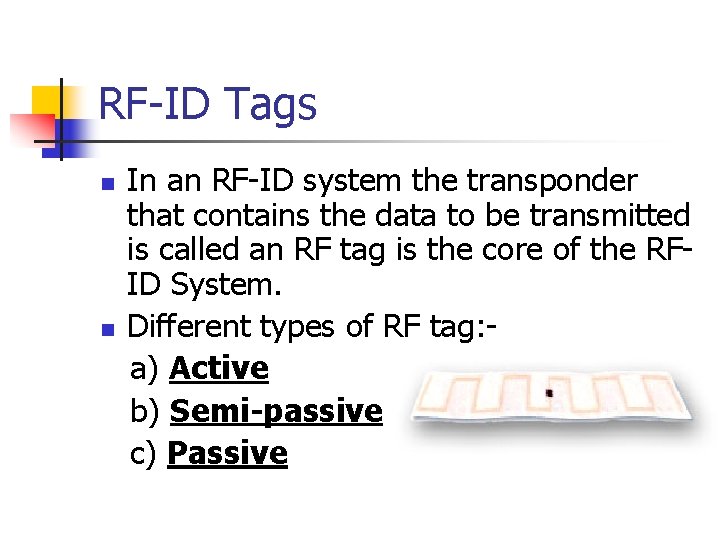
RF-ID Tags n n In an RF-ID system the transponder that contains the data to be transmitted is called an RF tag is the core of the RFID System. Different types of RF tag: a) Active b) Semi-passive c) Passive
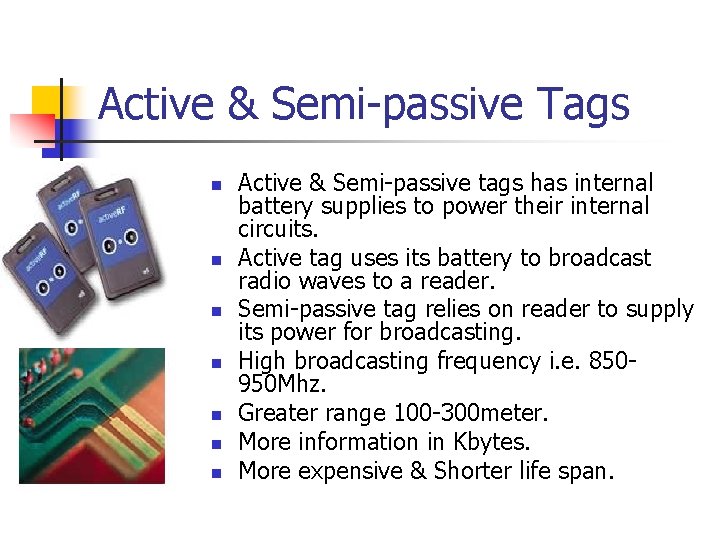
Active & Semi-passive Tags n n n n Active & Semi-passive tags has internal battery supplies to power their internal circuits. Active tag uses its battery to broadcast radio waves to a reader. Semi-passive tag relies on reader to supply its power for broadcasting. High broadcasting frequency i. e. 850950 Mhz. Greater range 100 -300 meter. More information in Kbytes. More expensive & Shorter life span.
Passive Tags n n n Passive RFID tags rely entirely on reader as their power source. This tag is powered by electromagnetic field generated in doorways, reflecting back a weak signal containing data. These can be read upto 20 feet away.
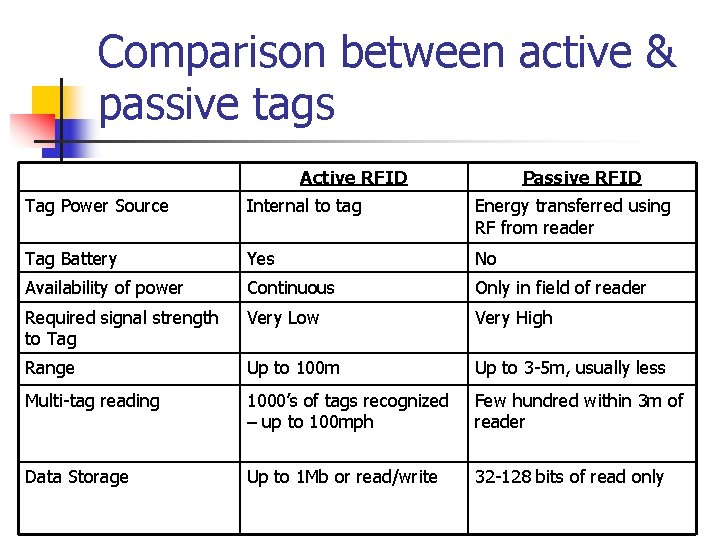
Comparison between active & passive tags Active RFID Passive RFID Tag Power Source Internal to tag Energy transferred using RF from reader Tag Battery Yes No Availability of power Continuous Only in field of reader Required signal strength to Tag Very Low Very High Range Up to 100 m Up to 3 -5 m, usually less Multi-tag reading 1000’s of tags recognized – up to 100 mph Few hundred within 3 m of reader Data Storage Up to 1 Mb or read/write 32 -128 bits of read only
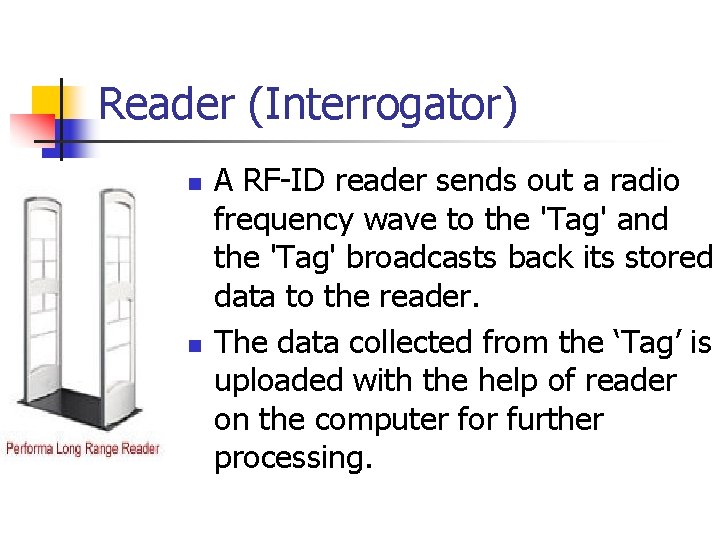
Reader (Interrogator) n n A RF-ID reader sends out a radio frequency wave to the 'Tag' and the 'Tag' broadcasts back its stored data to the reader. The data collected from the ‘Tag’ is uploaded with the help of reader on the computer for further processing.
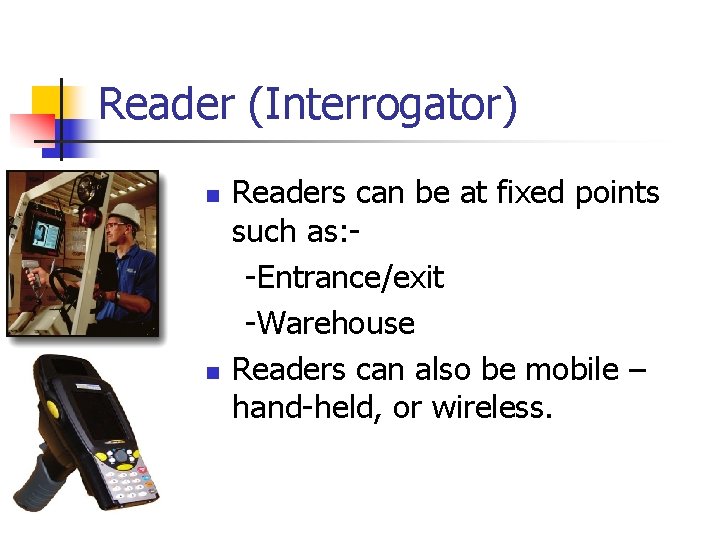
Reader (Interrogator) n n Readers can be at fixed points such as: -Entrance/exit -Warehouse Readers can also be mobile – hand-held, or wireless.
RF-ID System (block diagram) Asset/Tag Asset Tag Firmware Antenna Insert Reader TCP/IP Host Customer’s data Application Software ~ Power API
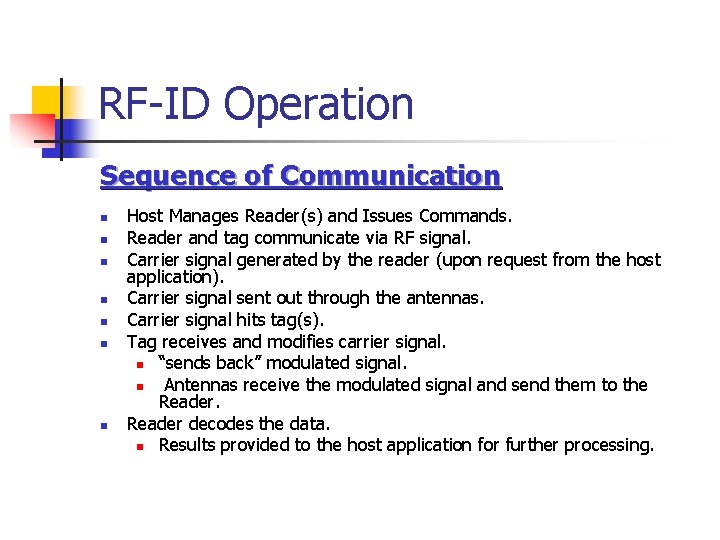
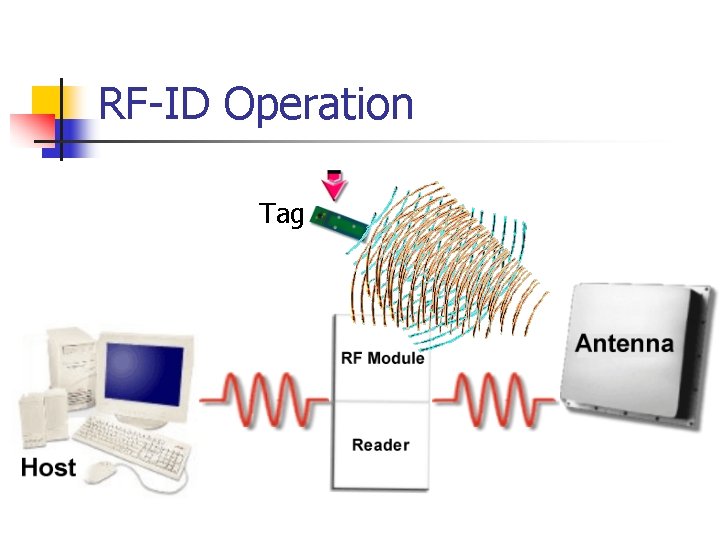
RF-ID Operation Sequence of Communication n n n Host Manages Reader(s) and Issues Commands. Reader and tag communicate via RF signal. Carrier signal generated by the reader (upon request from the host application). Carrier signal sent out through the antennas. Carrier signal hits tag(s). Tag receives and modifies carrier signal. n “sends back” modulated signal. n Antennas receive the modulated signal and send them to the Reader decodes the data. n Results provided to the host application for further processing.
RF-ID Operation Tag
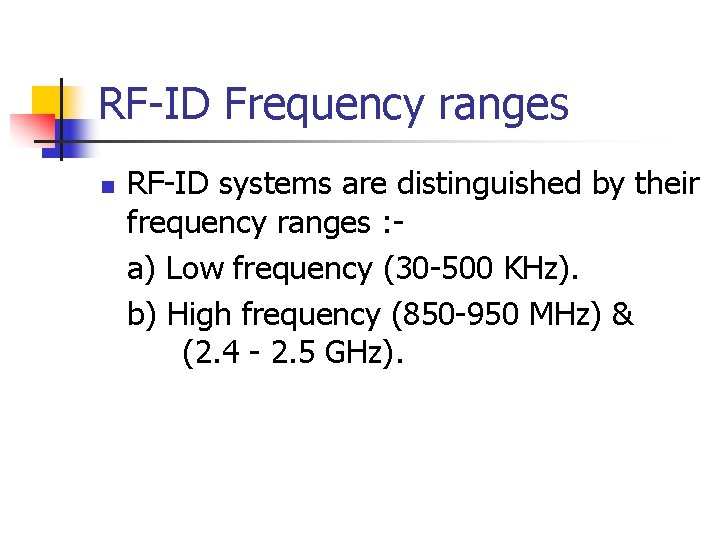
RF-ID Frequency ranges n RF-ID systems are distinguished by their frequency ranges : a) Low frequency (30 -500 KHz). b) High frequency (850 -950 MHz) & (2. 4 - 2. 5 GHz).
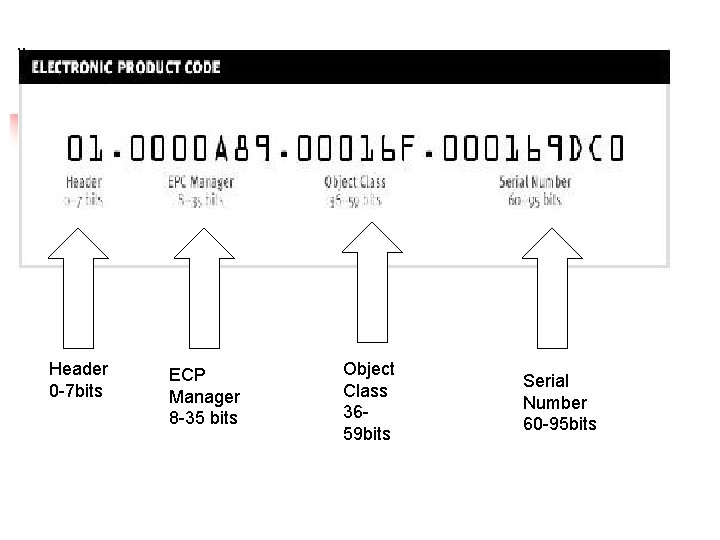
The EPC Code n n n The objective of the Electronic Product Code (EPC) is to provide unique identification of physical objects. The EPC will be used to address and access individual objects from the computer network. It is of total 95 bits.
Header 0 -7 bits ECP Manager 8 -35 bits Object Class 3659 bits Serial Number 60 -95 bits
Advantages n n n Penetrates materials well (water, tissue, wood, aluminum). Good non-line-of-sight communication (except for conductive, "lossy" materials). Less than 100 milliseconds. No contact. Simultaneous read of multiple items.
Disadvantages n n Does not penetrate or transmit around metals (iron, steel). Accidental eating of tags in food. Shielding of tags accidentally or deliberately so the product is not paid at the checkout. Radiation laws and Perception.
Applications n n n n Airline Baggage Tracking. Vehicle Security System. Hotel Room Access. Live stock Tracking. Parcel Shipping System. Valuable Asset Tracking. Toll System.
Presented by. Vishal R Mahale. Aakash Bhatiya. Deepak Kukreja. -12 march 2009