
RFID case 1 RFID and VCV Value Chain
- Slides: 17
RFID case 1: RFID and VCV (Value Chain Visibility) in Airbus Business Prof. Kesheng Wang Knowledge Discovery Laboratory (KDL) Department of Production and Quality Engineering, NTNU IPK, NTNU 1 1/10/2022
Outlines n n n Airbus corporate challenges History of RFID in Airbus Introduction to Visibility The Value Chain Visibility Program Some examples Conclusion SIO 3060 Ch. 31, CI in IMS, IPK, NTNU 1/10/2022
Airbus Corporate Challenges n n n 18 design/manufacturing/assembly sites across the world Exchange rate pressure New aircraft programs (A 380, A 400 M, A 350, A 320 NEO) Production rate increase Clear focus on enterprise eco-efficiency Constant pressure for continuous improvement and innovation KDL seminar 2010, IPK, NTNU 349 1/10/2022
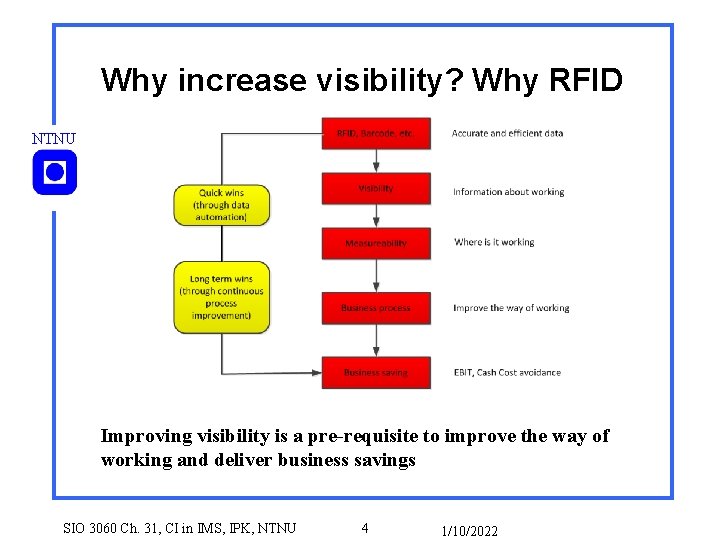
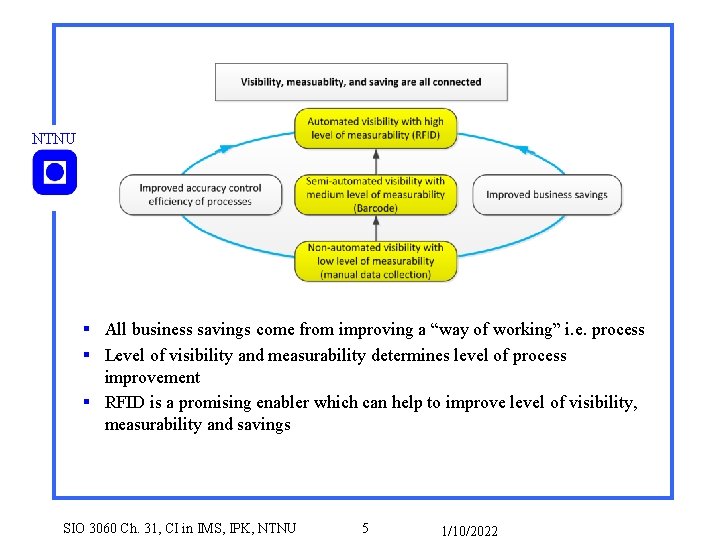
Why increase visibility? Why RFID NTNU Improving visibility is a pre-requisite to improve the way of working and deliver business savings SIO 3060 Ch. 31, CI in IMS, IPK, NTNU 4 1/10/2022
NTNU § All business savings come from improving a “way of working” i. e. process § Level of visibility and measurability determines level of process improvement § RFID is a promising enabler which can help to improve level of visibility, measurability and savings SIO 3060 Ch. 31, CI in IMS, IPK, NTNU 5 1/10/2022
History of RFID in Airbus Started piloting the RFID technology as early as the year 2000. n By 2006, 15 projects across Airbus. (Separated) n In 2007, VCV program was taken to lunch a company-wide program. n SIO 3060 Ch. 31, CI in IMS, IPK, NTNU 649 1/10/2022
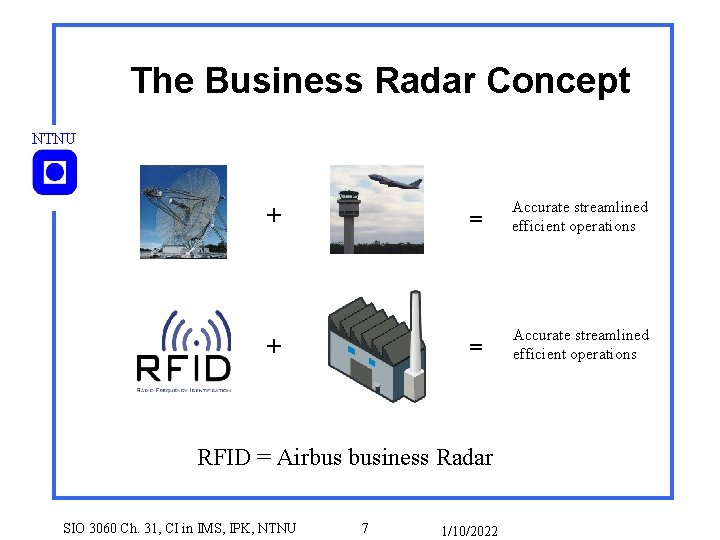
The Business Radar Concept NTNU + + = Accurate streamlined efficient operations RFID = Airbus business Radar SIO 3060 Ch. 31, CI in IMS, IPK, NTNU 7 1/10/2022
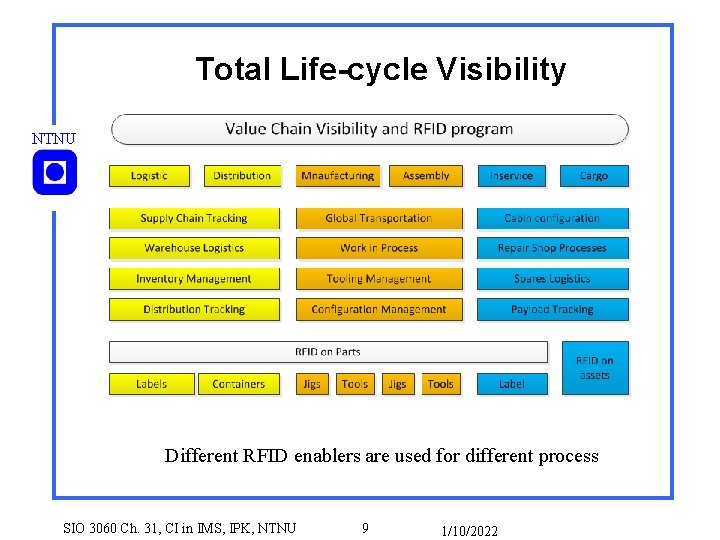
What is VCV and RFID? Company approach to improve business processes through better visibility n Scope is focused on big picture; Airbus value chain not functional islands n RFID is seen as a key enabler to improve visibility & business processes n Airbus is taking an integrated and Value chain approach for the application of RFID across its business processes n SIO 3060 Ch. 31, CI in IMS, IPK, NTNU 849 1/10/2022
Total Life-cycle Visibility NTNU Different RFID enablers are used for different process SIO 3060 Ch. 31, CI in IMS, IPK, NTNU 9 1/10/2022
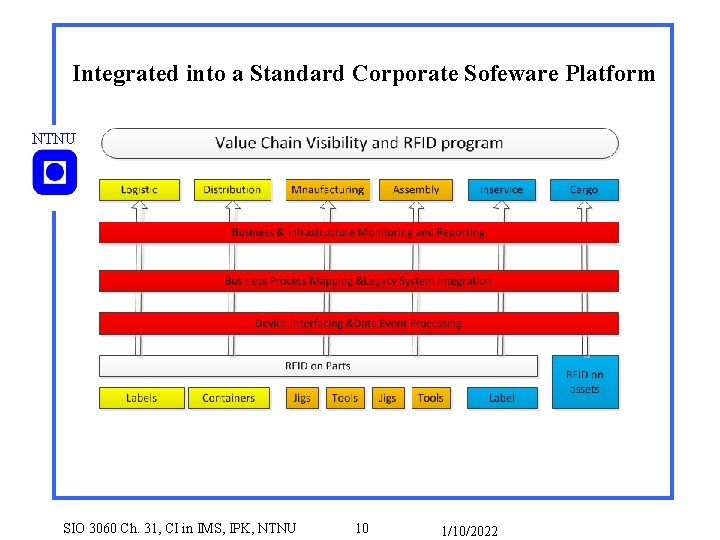
Integrated into a Standard Corporate Sofeware Platform NTNU SIO 3060 Ch. 31, CI in IMS, IPK, NTNU 10 1/10/2022
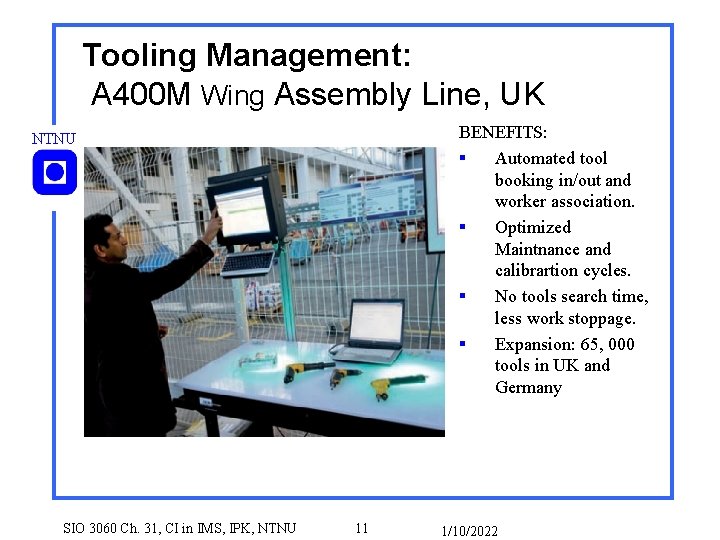
Tooling Management: A 400 M Wing Assembly Line, UK BENEFITS: § Automated tool booking in/out and worker association. § Optimized Maintnance and calibrartion cycles. § No tools search time, less work stoppage. § Expansion: 65, 000 tools in UK and Germany NTNU SIO 3060 Ch. 31, CI in IMS, IPK, NTNU 11 1/10/2022
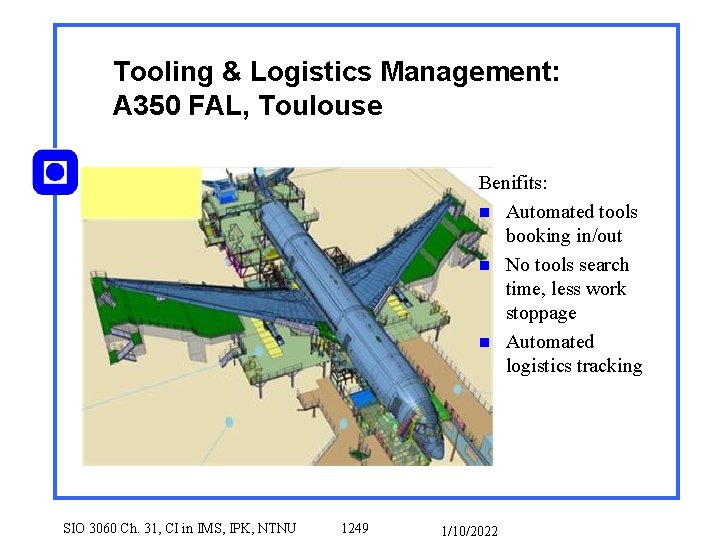
Tooling & Logistics Management: A 350 FAL, Toulouse Benifits: n Automated tools booking in/out n No tools search time, less work stoppage n Automated logistics tracking SIO 3060 Ch. 31, CI in IMS, IPK, NTNU 1249 1/10/2022
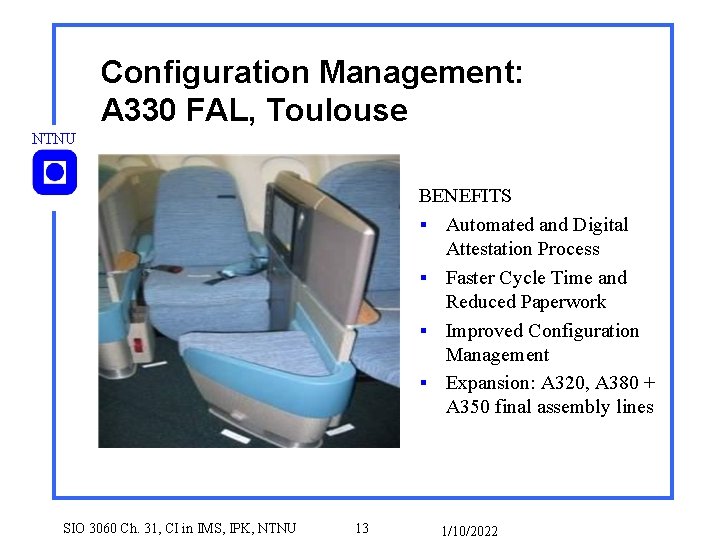
Configuration Management: A 330 FAL, Toulouse NTNU BENEFITS § Automated and Digital Attestation Process § Faster Cycle Time and Reduced Paperwork § Improved Configuration Management § Expansion: A 320, A 380 + A 350 final assembly lines SIO 3060 Ch. 31, CI in IMS, IPK, NTNU 13 1/10/2022
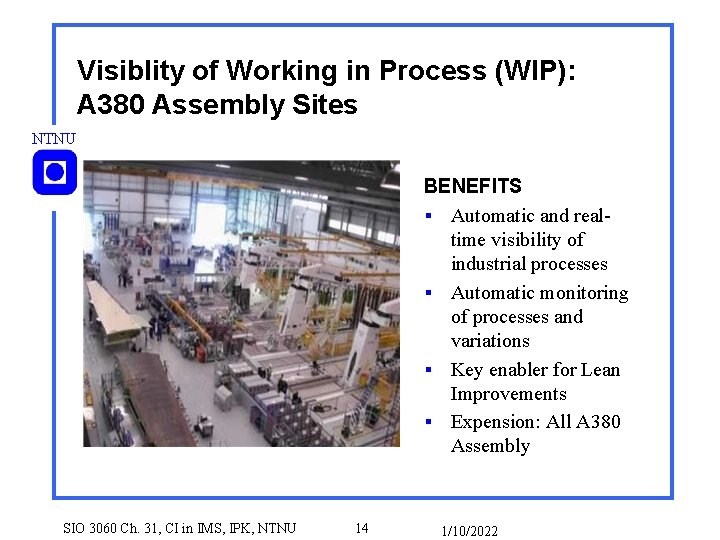
Visiblity of Working in Process (WIP): A 380 Assembly Sites NTNU BENEFITS § Automatic and realtime visibility of industrial processes § Automatic monitoring of processes and variations § Key enabler for Lean Improvements § Expension: All A 380 Assembly SIO 3060 Ch. 31, CI in IMS, IPK, NTNU 14 1/10/2022
In-service configuration, Repair and Maintenance Reminder of Scope n A 350 XWB target is 3000 parts / 700 part numbers per aircraft n All parts that are serialized, line replaceable, repairable or with a life limit Why is Airbus doing this? n Strong confirmed interest from 34 airlines/MROs n Validated studies with airlines/MRO confirm multi €M savings per actor First A 350 XWB: Technology Maturity and Readiness Tests n RFID parts for MSN 1 have been delivered by OEMs + successfully tested n All involved OEMs are on track for first customer aircraft (MSN 4) The use of RFID part marking on A 350 XWB will help enable benefit for all actors across the value chain SIO 3060 Ch. 31, CI in IMS, IPK, NTNU 1549 1/10/2022
NEXT STEPS: In-Service Configuration, Repair and Maintenance NTNU Continue support to supply chain partners • Interoperability assessment of multiple RFID system components • Chips, tag, readers and software Guidance and Support to Airlines • Answer customer questions and provide early adopter support • Share Airbus experience and guide technology use cases RFID Beyond A 350 XWB deployments • Decision taken to expand RFID tags on parts on all Airbus aircraft • Life-vest & seats across Airbus fleet (2013) 1 st aircraft manufacturer to introduce RFID on its aircraft (A 350 XWB) 1 st aircraft manufacturer to introduce RFID across fleet (A 320/330/380) SIO 3060 Ch. 31, CI in IMS, IPK, NTNU 16 1/10/2022
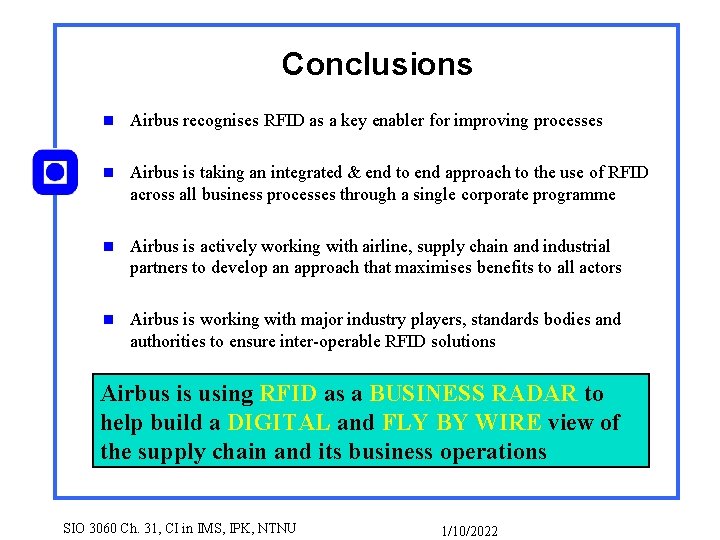
Conclusions n Airbus recognises RFID as a key enabler for improving processes n Airbus is taking an integrated & end to end approach to the use of RFID across all business processes through a single corporate programme n Airbus is actively working with airline, supply chain and industrial partners to develop an approach that maximises benefits to all actors n Airbus is working with major industry players, standards bodies and authorities to ensure inter-operable RFID solutions Airbus is using RFID as a BUSINESS RADAR to help build a DIGITAL and FLY BY WIRE view of the supply chain and its business operations SIO 3060 Ch. 31, CI in IMS, IPK, NTNU 1/10/2022