
RFC Editor Tutorial IETF 67 San Diego California
![RFCs n n RFC document series n Begun by Steve Crocker [RFC 3] and](https://slidetodoc.com/presentation_image_h/8e3ea8bf8d8db99bf847ab50edd0f923/image-4.jpg "RFCs n n RFC document series n Begun by Steve Crocker [RFC 3] and")
- Slides: 73
RFC Editor Tutorial IETF 67 San Diego, California 5 November 20069 July 2006
Overview of this Tutorial 1. Background: The RFC Series and the RFC Editor 2. The Publication Process 3. Contents of an RFC 4. How to Write an RFC 5. Conclusion 5 November 2006 RFC Editor 2
1. The RFC Series n Earliest document series to be published online. n 1969 – today: 36 years old. n 4500+ documents. n An ARCHIVAL series: RFCs are forever! n A comprehensive record of Internet technical history 5 November 2006 RFC Editor 3
RFCs n n RFC document series n Begun by Steve Crocker [RFC 3] and Jon Postel in 1969. n Informal memos, technical specs, and much more. Jon Postel quickly became the RFC Editor. n n n 28 years: 1970 until his death in 1998. He established and maintained the consistent style and editorial quality of the RFC series. Jon was a 2 -finger typist. 5 November 2006 RFC Editor 4
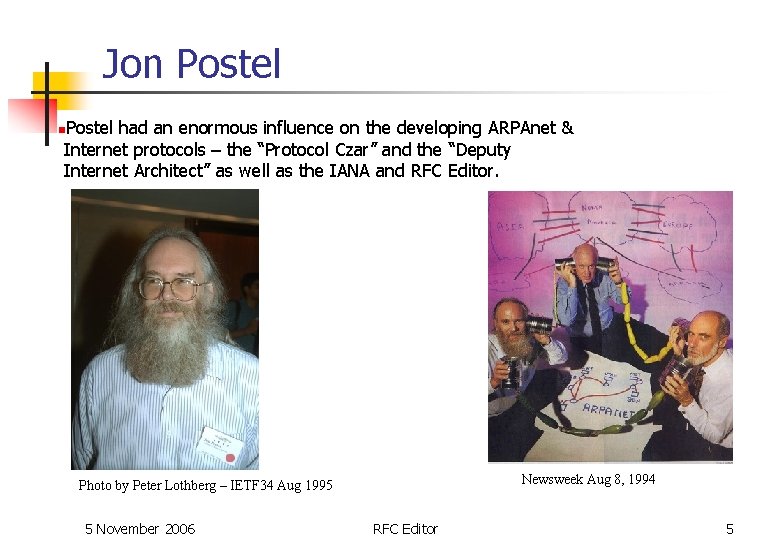
Jon Postel had an enormous influence on the developing ARPAnet & Internet protocols – the “Protocol Czar” and the “Deputy Internet Architect” as well as the IANA and RFC Editor. n Newsweek Aug 8, 1994 Photo by Peter Lothberg – IETF 34 Aug 1995 5 November 2006 RFC Editor 5
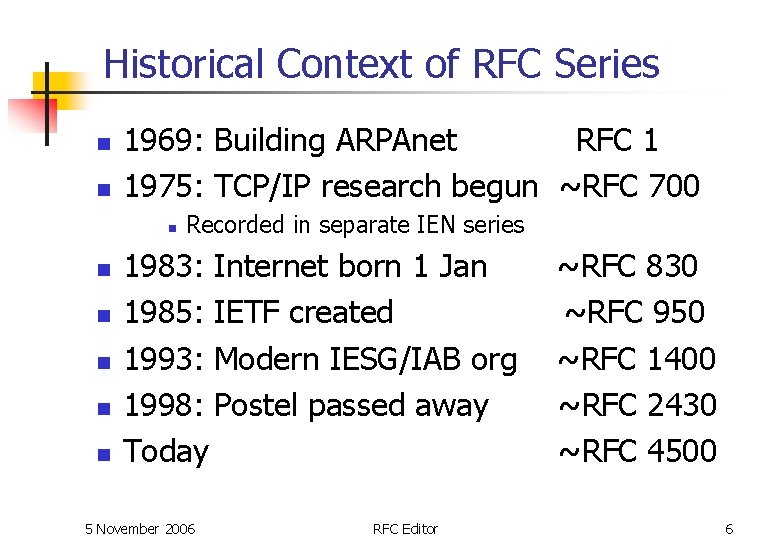
Historical Context of RFC Series n n 1969: Building ARPAnet RFC 1 1975: TCP/IP research begun ~RFC 700 n n n Recorded in separate IEN series 1983: Internet born 1 Jan ~RFC 830 1985: IETF created ~RFC 950 1993: Modern IESG/IAB org ~RFC 1400 1998: Postel passed away ~RFC 2430 Today ~RFC 4500 5 November 2006 RFC Editor 6
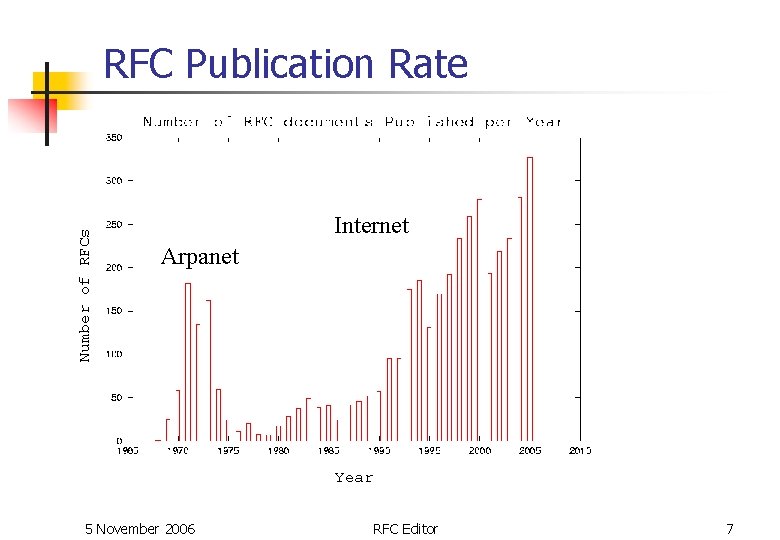
Number of RFCs RFC Publication Rate Internet Arpanet Year 5 November 2006 RFC Editor 7
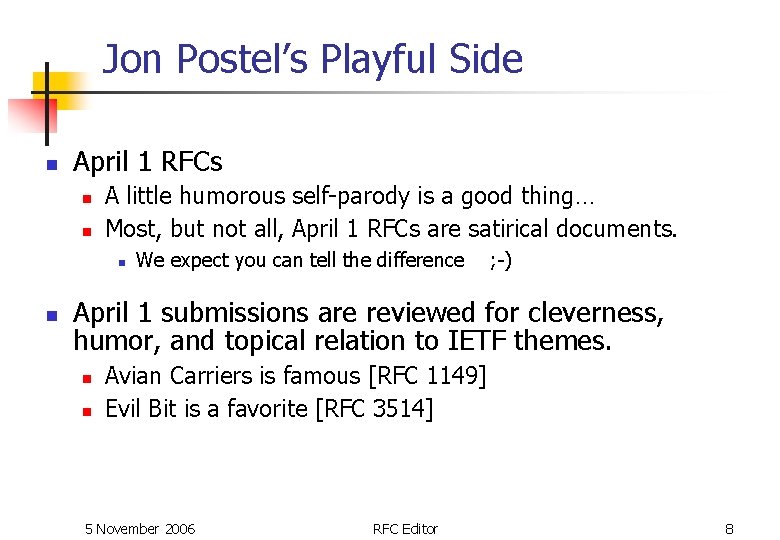
Jon Postel’s Playful Side n April 1 RFCs n n A little humorous self-parody is a good thing… Most, but not all, April 1 RFCs are satirical documents. n n We expect you can tell the difference ; -) April 1 submissions are reviewed for cleverness, humor, and topical relation to IETF themes. n n Avian Carriers is famous [RFC 1149] Evil Bit is a favorite [RFC 3514] 5 November 2006 RFC Editor 8
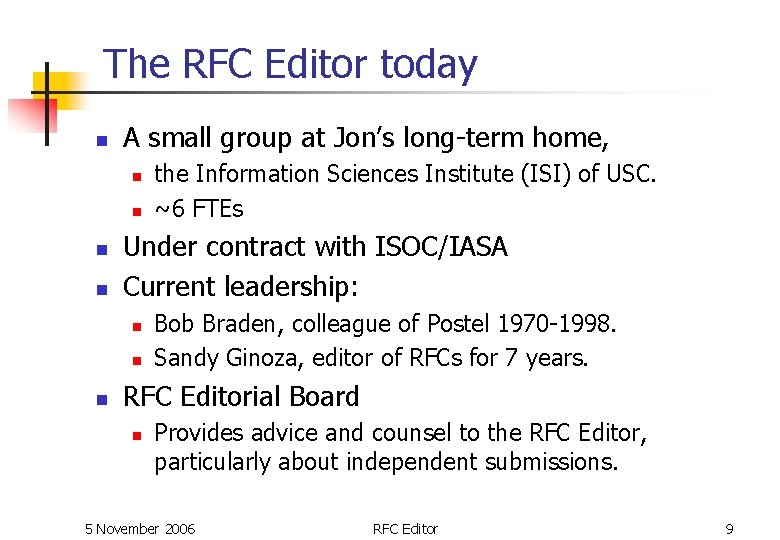
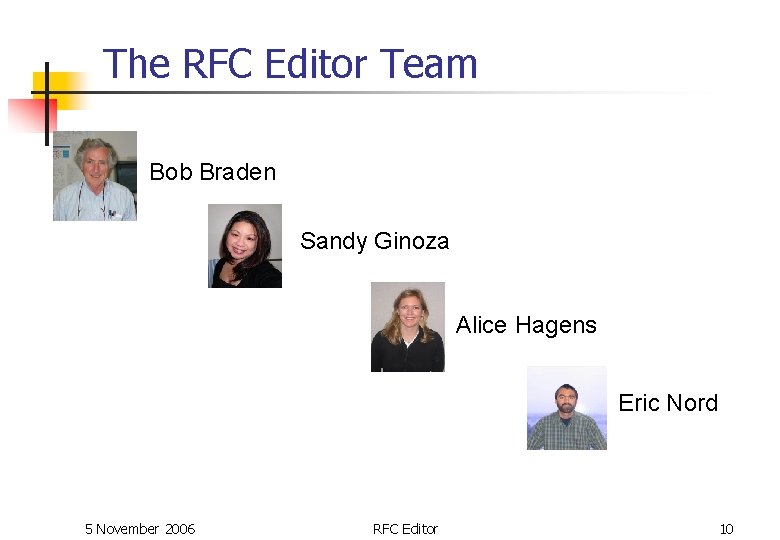
The RFC Editor today n A small group at Jon’s long-term home, n n Under contract with ISOC/IASA Current leadership: n n n the Information Sciences Institute (ISI) of USC. ~6 FTEs Bob Braden, colleague of Postel 1970 -1998. Sandy Ginoza, editor of RFCs for 7 years. RFC Editorial Board n Provides advice and counsel to the RFC Editor, particularly about independent submissions. 5 November 2006 RFC Editor 9
The RFC Editor Team Bob Braden Sandy Ginoza Alice Hagens Eric Nord 5 November 2006 RFC Editor 10
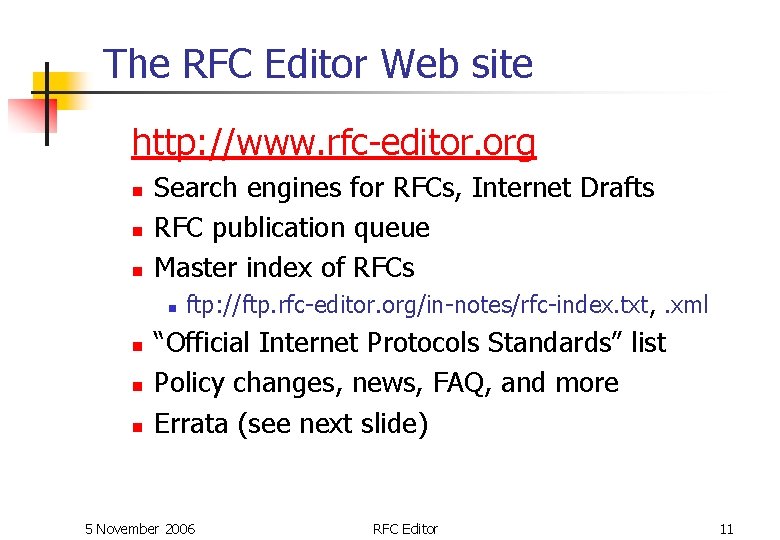
The RFC Editor Web site http: //www. rfc-editor. org n n n Search engines for RFCs, Internet Drafts RFC publication queue Master index of RFCs n n ftp: //ftp. rfc-editor. org/in-notes/rfc-index. txt, . xml “Official Internet Protocols Standards” list Policy changes, news, FAQ, and more Errata (see next slide) 5 November 2006 RFC Editor 11
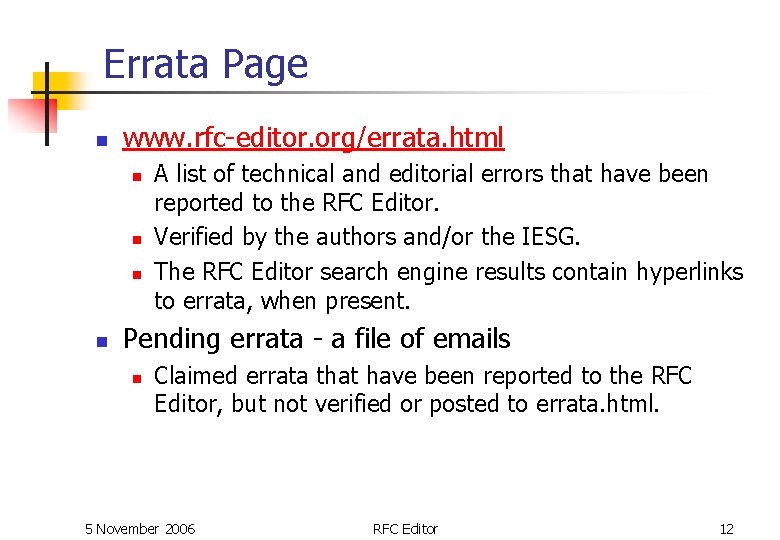
Errata Page n www. rfc-editor. org/errata. html n n A list of technical and editorial errors that have been reported to the RFC Editor. Verified by the authors and/or the IESG. The RFC Editor search engine results contain hyperlinks to errata, when present. Pending errata - a file of emails n Claimed errata that have been reported to the RFC Editor, but not verified or posted to errata. html. 5 November 2006 RFC Editor 12
RFCs and the IETF n It was natural to adapt the existing RFC series to publication of Internet standards specifications. n Informally: mid 1980 s n Formally: RFC 1602 (1994), RFC 2026 (1996) 5 November 2006 RFC Editor 13
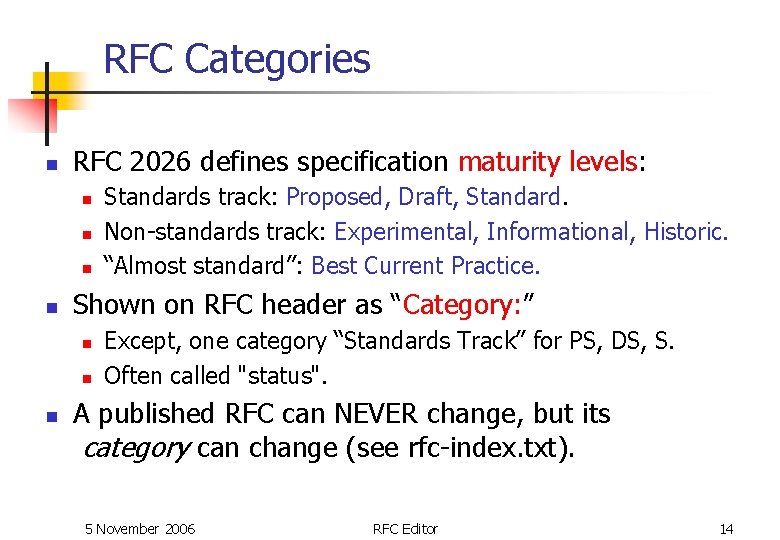
RFC Categories n RFC 2026 defines specification maturity levels: n n Shown on RFC header as “Category: ” n n n Standards track: Proposed, Draft, Standard. Non-standards track: Experimental, Informational, Historic. “Almost standard”: Best Current Practice. Except, one category “Standards Track” for PS, DS, S. Often called "status". A published RFC can NEVER change, but its category can change (see rfc-index. txt). 5 November 2006 RFC Editor 14
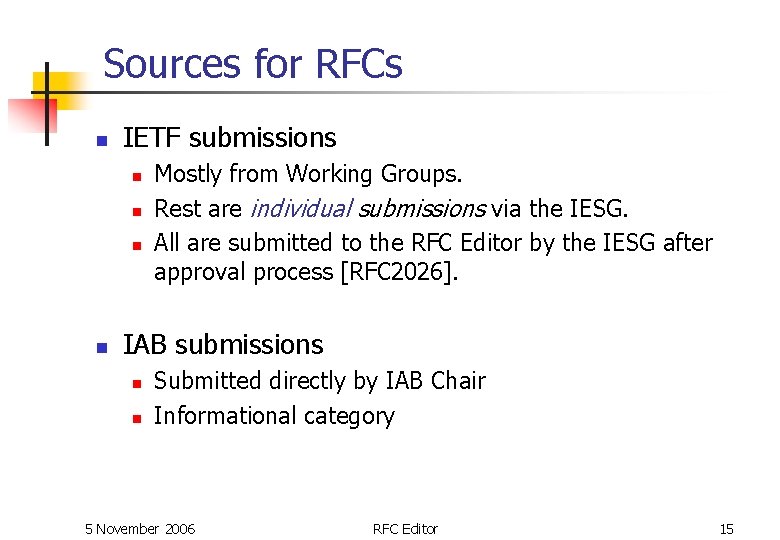
Sources for RFCs n IETF submissions n n Mostly from Working Groups. Rest are individual submissions via the IESG. All are submitted to the RFC Editor by the IESG after approval process [RFC 2026]. IAB submissions n n Submitted directly by IAB Chair Informational category 5 November 2006 RFC Editor 15
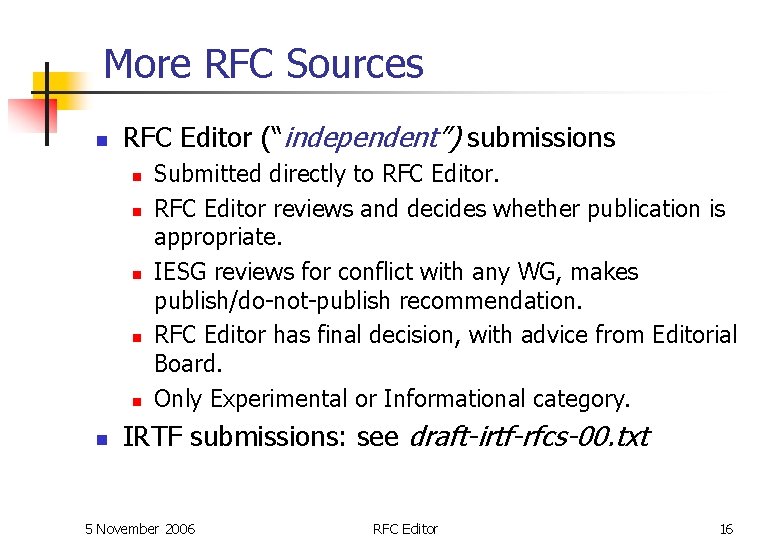
More RFC Sources n RFC Editor (“independent”) submissions n n n Submitted directly to RFC Editor reviews and decides whether publication is appropriate. IESG reviews for conflict with any WG, makes publish/do-not-publish recommendation. RFC Editor has final decision, with advice from Editorial Board. Only Experimental or Informational category. IRTF submissions: see draft-irtf-rfcs-00. txt 5 November 2006 RFC Editor 16
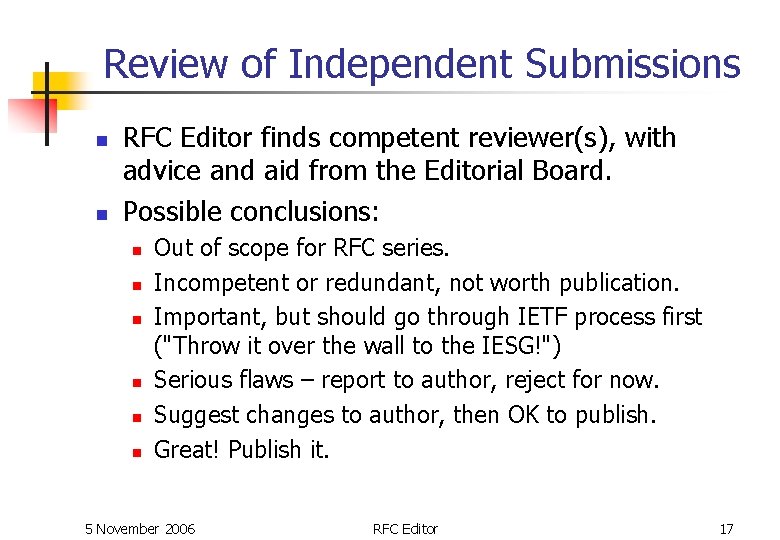
Review of Independent Submissions n n RFC Editor finds competent reviewer(s), with advice and aid from the Editorial Board. Possible conclusions: n n n Out of scope for RFC series. Incompetent or redundant, not worth publication. Important, but should go through IETF process first ("Throw it over the wall to the IESG!") Serious flaws – report to author, reject for now. Suggest changes to author, then OK to publish. Great! Publish it. 5 November 2006 RFC Editor 17
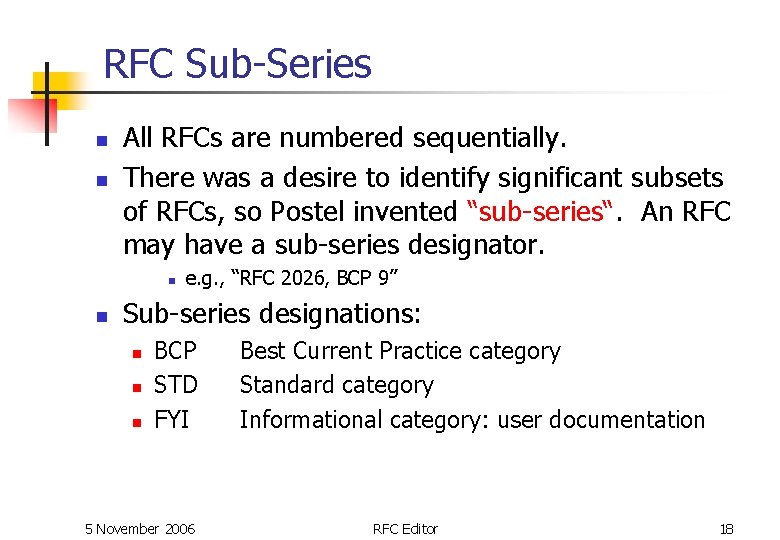
RFC Sub-Series n n All RFCs are numbered sequentially. There was a desire to identify significant subsets of RFCs, so Postel invented “sub-series“. An RFC may have a sub-series designator. n n e. g. , “RFC 2026, BCP 9” Sub-series designations: n n n BCP STD FYI 5 November 2006 Best Current Practice category Standard category Informational category: user documentation RFC Editor 18
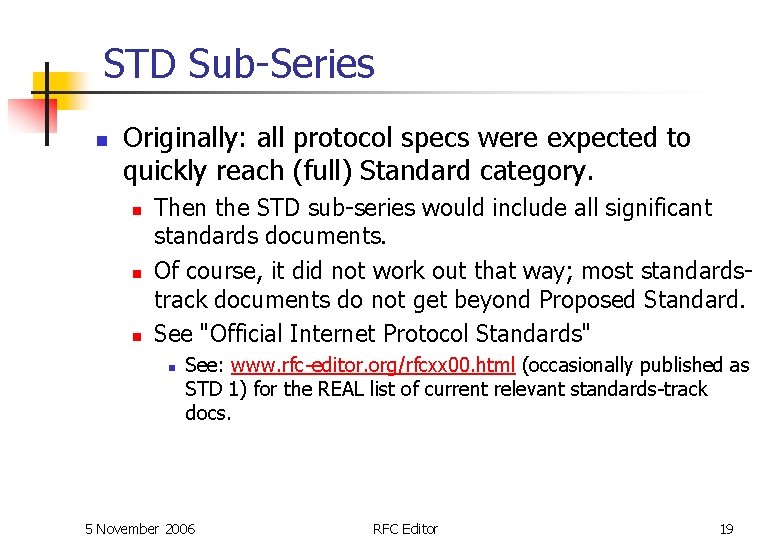
STD Sub-Series n Originally: all protocol specs were expected to quickly reach (full) Standard category. n n n Then the STD sub-series would include all significant standards documents. Of course, it did not work out that way; most standardstrack documents do not get beyond Proposed Standard. See "Official Internet Protocol Standards" n See: www. rfc-editor. org/rfcxx 00. html (occasionally published as STD 1) for the REAL list of current relevant standards-track docs. 5 November 2006 RFC Editor 19
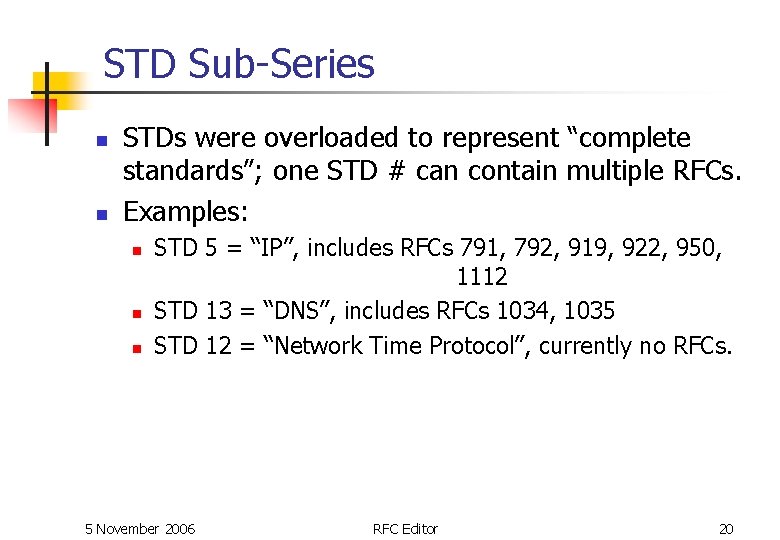
STD Sub-Series n n STDs were overloaded to represent “complete standards”; one STD # can contain multiple RFCs. Examples: n n n STD 5 = “IP”, includes RFCs 791, 792, 919, 922, 950, 1112 STD 13 = “DNS”, includes RFCs 1034, 1035 STD 12 = “Network Time Protocol”, currently no RFCs. 5 November 2006 RFC Editor 20
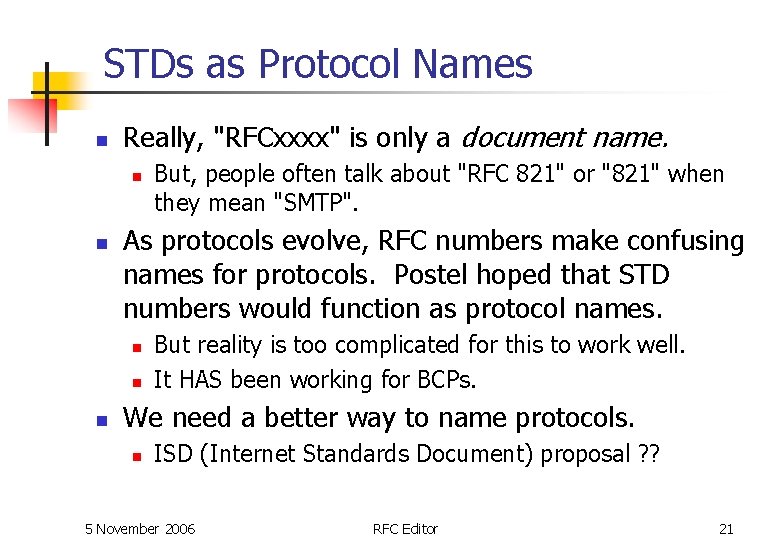
STDs as Protocol Names n Really, "RFCxxxx" is only a document name. n n As protocols evolve, RFC numbers make confusing names for protocols. Postel hoped that STD numbers would function as protocol names. n n n But, people often talk about "RFC 821" or "821" when they mean "SMTP". But reality is too complicated for this to work well. It HAS been working for BCPs. We need a better way to name protocols. n ISD (Internet Standards Document) proposal ? ? 5 November 2006 RFC Editor 21
2. RFC Publication Process n n n Overview Queue states AUTH 48 procedure 5 November 2006 RFC Editor 22
Publication Process: Overview (1) n First published as an Internet Draft n n A well-formed RFC starts with a well-formed I-D. n http: //www. ietf. org/ID-Checklist. html n http: //www. ietf. org/ietf/1 id-guidelines. txt Send us the xml 2 rfc or nroff -ms source, if available. 5 November 2006 RFC Editor 23
Publication Process: Overview (2) n RFC Editor n n n Edits and formats the document Makes many consistency checks IANA acts on IANA Considerations n n Creates new registries and assigns numbers. RFC Editor plugs assigned numbers into document. 5 November 2006 RFC Editor 24
Publication Process: Overview (3) n An RFC # is assigned. n Document and diff file sent to authors for final check n n “AUTH 48” state. n All named authors are responsible. Finished document added to archive and index. n Announcement on ietf-announce list. n Mirrored at IETF site, other sites. n Nroff, xml files archived, for later revisions. 5 November 2006 RFC Editor 25
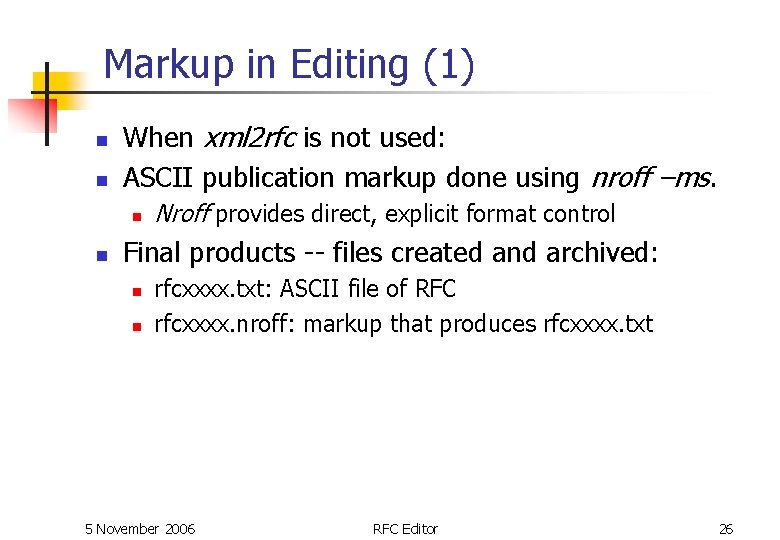
Markup in Editing (1) n n When xml 2 rfc is not used: ASCII publication markup done using nroff –ms. n n Nroff provides direct, explicit format control Final products -- files created and archived: n n rfcxxxx. txt: ASCII file of RFC rfcxxxx. nroff: markup that produces rfcxxxx. txt 5 November 2006 RFC Editor 26
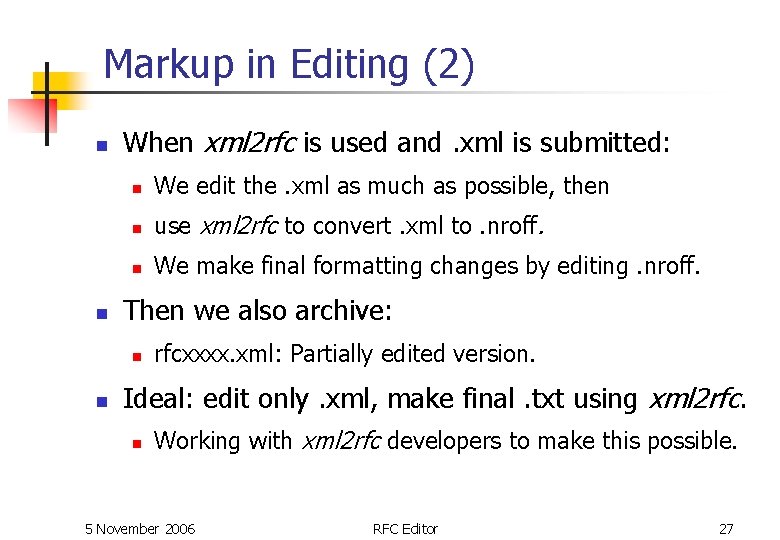
Markup in Editing (2) n n When xml 2 rfc is used and. xml is submitted: n We edit the. xml as much as possible, then n use xml 2 rfc to convert. xml to. nroff. n We make final formatting changes by editing. nroff. Then we also archive: n n rfcxxxx. xml: Partially edited version. Ideal: edit only. xml, make final. txt using xml 2 rfc. n Working with xml 2 rfc developers to make this possible. 5 November 2006 RFC Editor 27
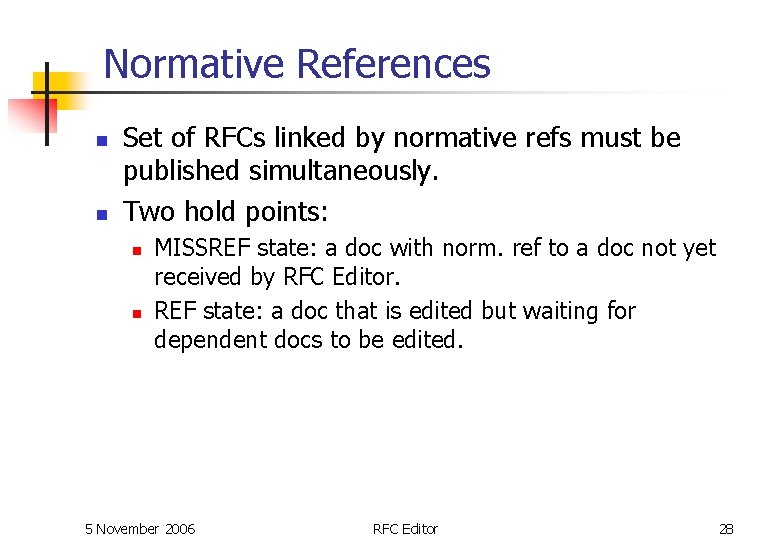
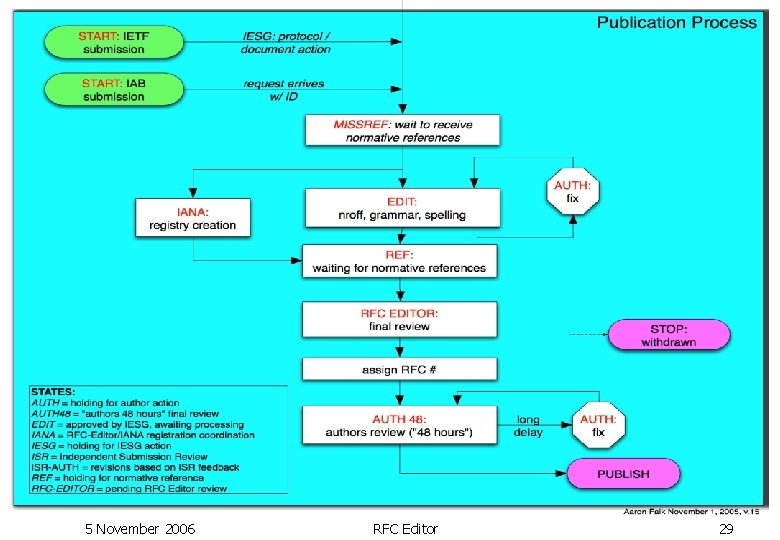
Normative References n n Set of RFCs linked by normative refs must be published simultaneously. Two hold points: n n MISSREF state: a doc with norm. ref to a doc not yet received by RFC Editor. REF state: a doc that is edited but waiting for dependent docs to be edited. 5 November 2006 RFC Editor 28
Process Flow Chart 5 November 2006 RFC Editor 29
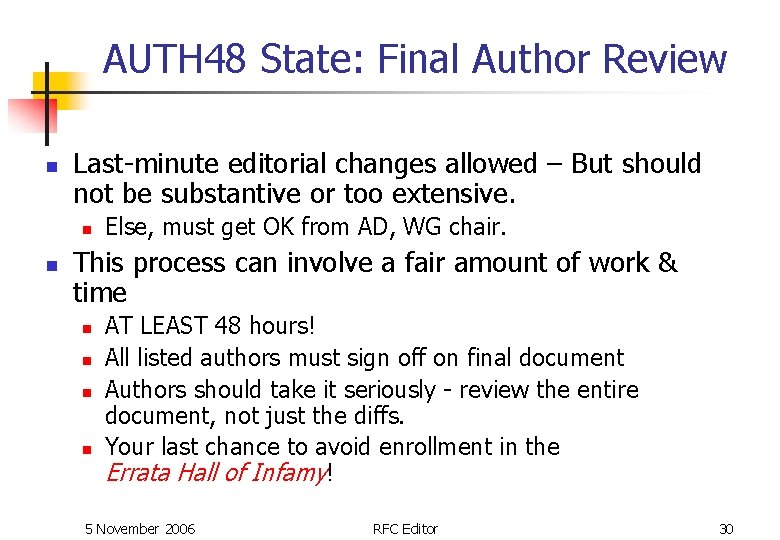
AUTH 48 State: Final Author Review n Last-minute editorial changes allowed – But should not be substantive or too extensive. n n Else, must get OK from AD, WG chair. This process can involve a fair amount of work & time n n AT LEAST 48 hours! All listed authors must sign off on final document Authors should take it seriously - review the entire document, not just the diffs. Your last chance to avoid enrollment in the Errata Hall of Infamy! 5 November 2006 RFC Editor 30
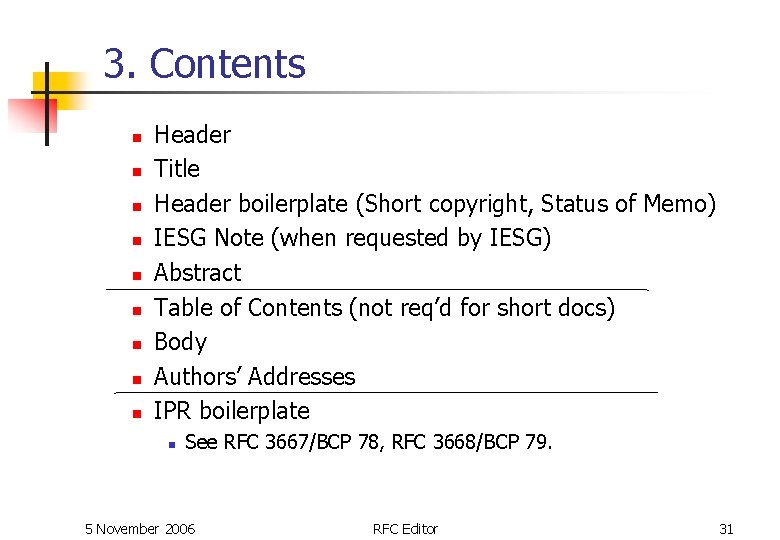
3. Contents n n n n n Header Title Header boilerplate (Short copyright, Status of Memo) IESG Note (when requested by IESG) Abstract Table of Contents (not req’d for short docs) Body Authors’ Addresses IPR boilerplate n See RFC 3667/BCP 78, RFC 3668/BCP 79. 5 November 2006 RFC Editor 31
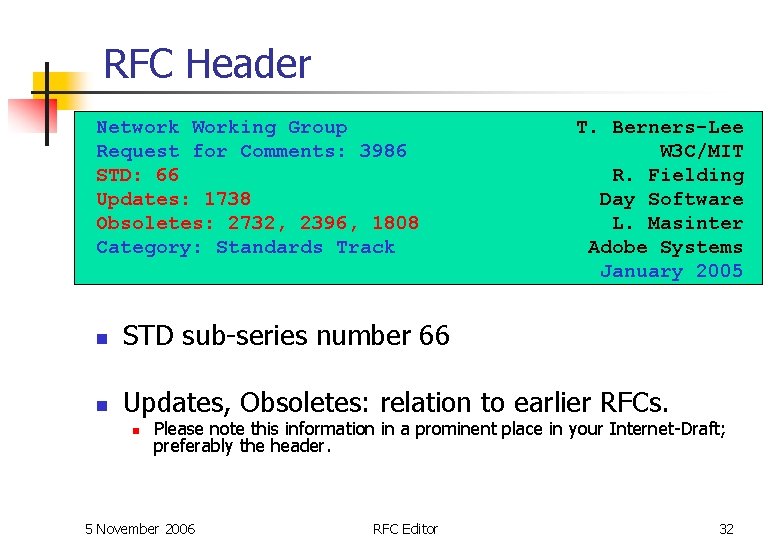
RFC Header Network Working Group Request for Comments: 3986 STD: 66 Updates: 1738 Obsoletes: 2732, 2396, 1808 Category: Standards Track T. Berners-Lee W 3 C/MIT R. Fielding Day Software L. Masinter Adobe Systems January 2005 n STD sub-series number 66 n Updates, Obsoletes: relation to earlier RFCs. n Please note this information in a prominent place in your Internet-Draft; preferably the header. 5 November 2006 RFC Editor 32
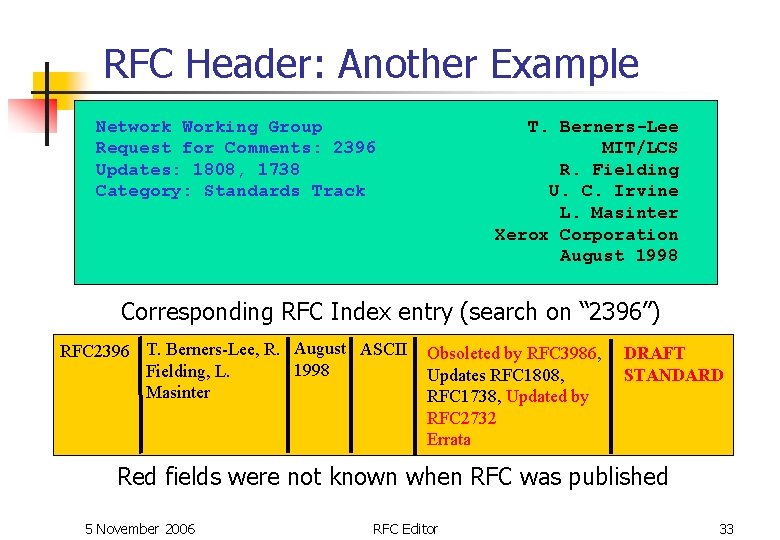
RFC Header: Another Example Network Working Group Request for Comments: 2396 Updates: 1808, 1738 Category: Standards Track T. Berners-Lee MIT/LCS R. Fielding U. C. Irvine L. Masinter Xerox Corporation August 1998 Corresponding RFC Index entry (search on “ 2396”) RFC 2396 T. Berners-Lee, R. August ASCII 1998 Fielding, L. Masinter Obsoleted by RFC 3986, Updates RFC 1808, RFC 1738, Updated by RFC 2732 Errata DRAFT STANDARD Red fields were not known when RFC was published 5 November 2006 RFC Editor 33
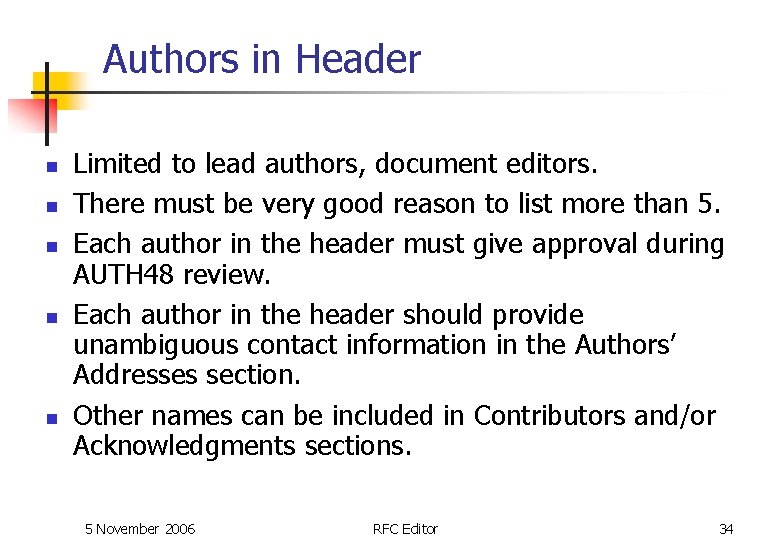
Authors in Header n n n Limited to lead authors, document editors. There must be very good reason to list more than 5. Each author in the header must give approval during AUTH 48 review. Each author in the header should provide unambiguous contact information in the Authors’ Addresses section. Other names can be included in Contributors and/or Acknowledgments sections. 5 November 2006 RFC Editor 34
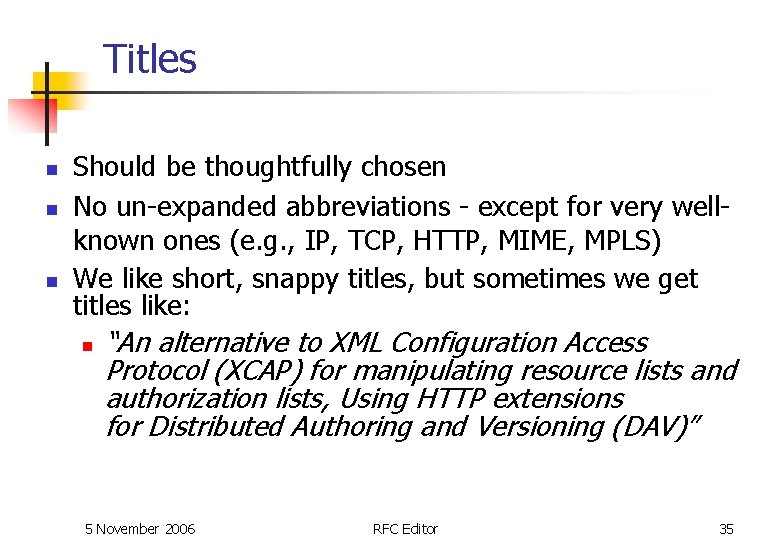
Titles n n n Should be thoughtfully chosen No un-expanded abbreviations - except for very well- known ones (e. g. , IP, TCP, HTTP, MIME, MPLS) We like short, snappy titles, but sometimes we get titles like: n “An alternative to XML Configuration Access Protocol (XCAP) for manipulating resource lists and authorization lists, Using HTTP extensions for Distributed Authoring and Versioning (DAV)” 5 November 2006 RFC Editor 35
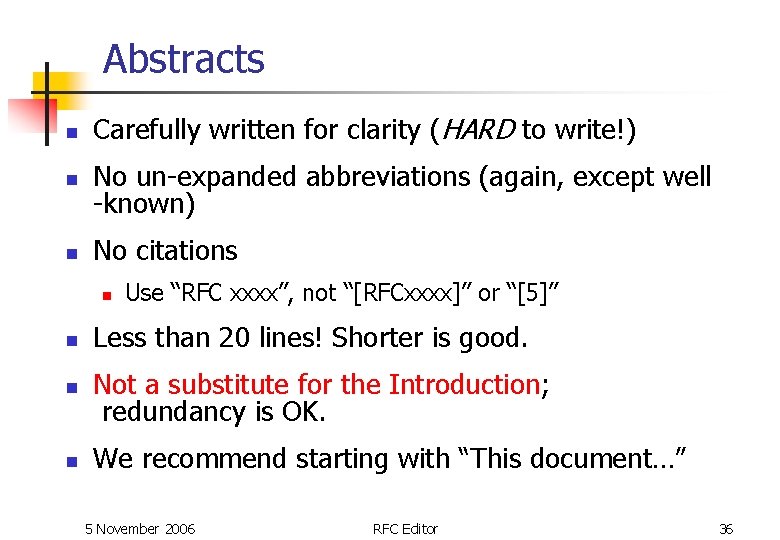
Abstracts n n n Carefully written for clarity (HARD to write!) No un-expanded abbreviations (again, except well -known) No citations n n Use “RFC xxxx”, not “[RFCxxxx]” or “[5]” Less than 20 lines! Shorter is good. Not a substitute for the Introduction; redundancy is OK. We recommend starting with “This document…” 5 November 2006 RFC Editor 36
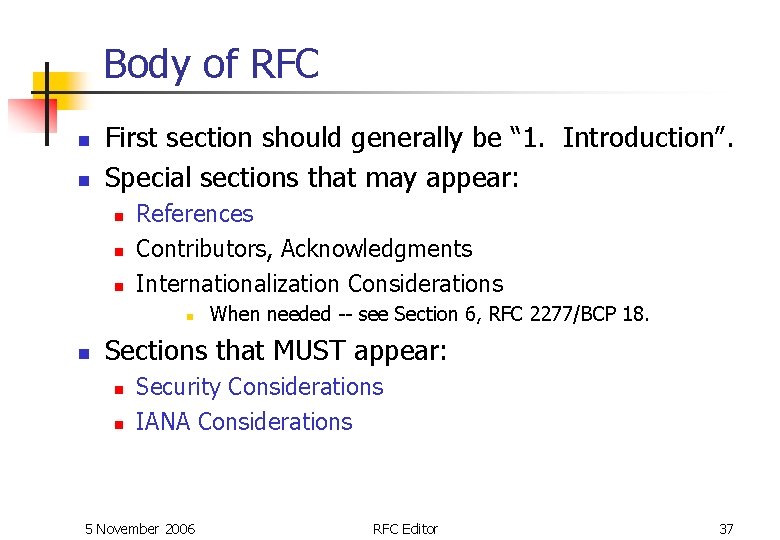
Body of RFC n n First section should generally be “ 1. Introduction”. Special sections that may appear: n n n References Contributors, Acknowledgments Internationalization Considerations n n When needed -- see Section 6, RFC 2277/BCP 18. Sections that MUST appear: n n Security Considerations IANA Considerations 5 November 2006 RFC Editor 37
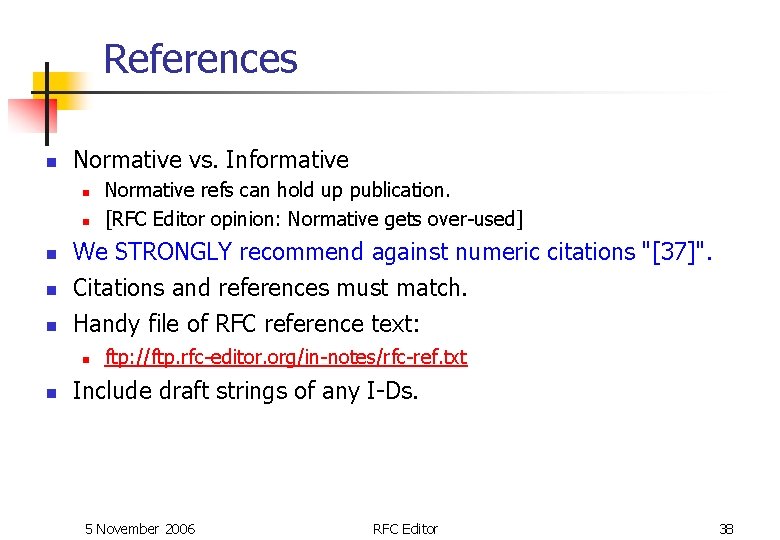
References n Normative vs. Informative n n n We STRONGLY recommend against numeric citations "[37]". Citations and references must match. Handy file of RFC reference text: n n Normative refs can hold up publication. [RFC Editor opinion: Normative gets over-used] ftp: //ftp. rfc-editor. org/in-notes/rfc-ref. txt Include draft strings of any I-Ds. 5 November 2006 RFC Editor 38
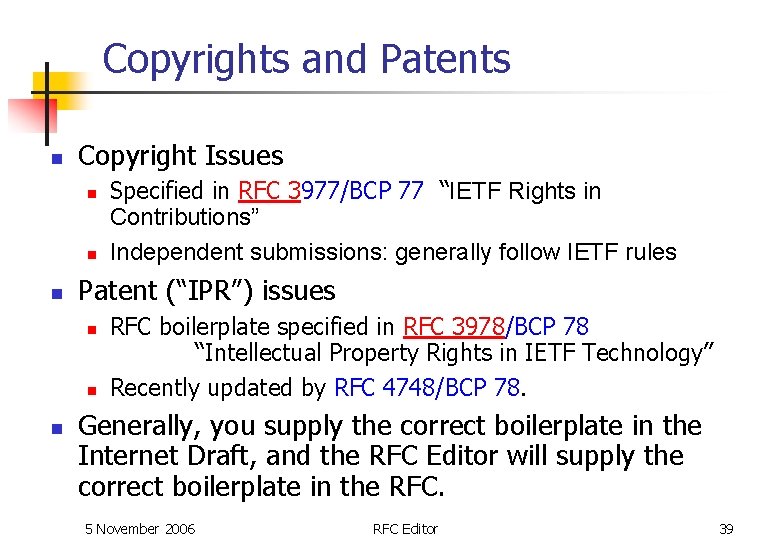
Copyrights and Patents n Copyright Issues n n n Patent (“IPR”) issues n n n Specified in RFC 3977/BCP 77 “IETF Rights in Contributions” Independent submissions: generally follow IETF rules RFC boilerplate specified in RFC 3978/BCP 78 “Intellectual Property Rights in IETF Technology” Recently updated by RFC 4748/BCP 78. Generally, you supply the correct boilerplate in the Internet Draft, and the RFC Editor will supply the correct boilerplate in the RFC. 5 November 2006 RFC Editor 39
Security Considerations Section n Security Considerations section required in every RFC. See RFC 3552: “Guidelines for Writing RFC Text on Security Considerations” Important! 5 November 2006 RFC Editor 40
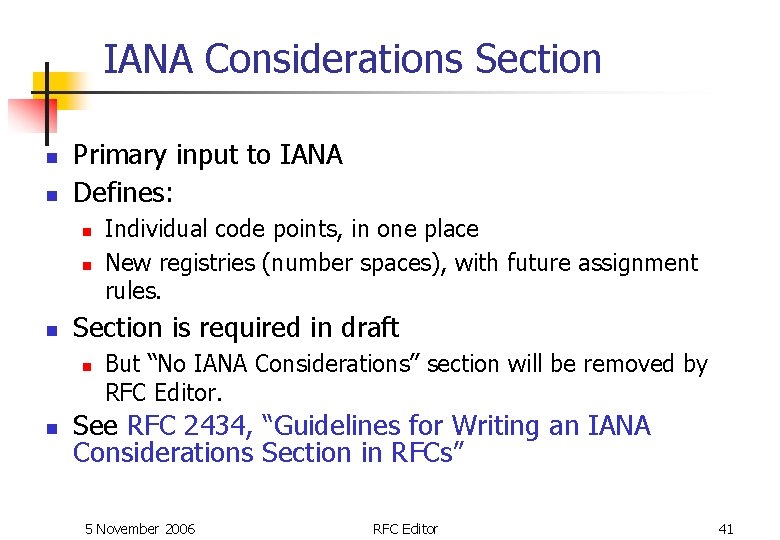
IANA Considerations Section n n Primary input to IANA Defines: n n n Section is required in draft n n Individual code points, in one place New registries (number spaces), with future assignment rules. But “No IANA Considerations” section will be removed by RFC Editor. See RFC 2434, “Guidelines for Writing an IANA Considerations Section in RFCs” 5 November 2006 RFC Editor 41
Current Internet Standards n “What are the current Internet standards? ” n n See STD 1: “Official Internet Protocol Standards” In practice, reality is so complex that this is probably not even a valid question. n n “Roadmaps” are desirable ISDs might be better 5 November 2006 RFC Editor 42
4. How to Write an RFC n n Some editorial guidelines Improving your writing Preparation tools MIBs and formal languages “Instructions to Request for Comments (RFC) Authors”. draft-rfc-editor-rfc 2223 bis-08. txt aka ftp. rfc-editor. org/in-notes/rfceditor/instructions 2 authors. txt 5 November 2006 RFC Editor 43
General Editorial Guidelines n n n Immutability – once published, never change Not all RFCs are standards All RFCs in English n n n RFC 2026 allows translations British English is allowed in principle, but there is some preference for American English. Consistent Publication Format n n ASCII (also. txt. pdf for Windows victims) Also. ps or. pdf (special process for handling) 5 November 2006 RFC Editor 44
RFC Formatting Rules n n n ASCII, 72 char/line. 58 lines per page, followed by FF (^L). No overstriking or underlining. No “filling” or (added) hyphenation across a line. <. ><sp> between sentences. No footnotes. 5 November 2006 RFC Editor 45
RFC Editing n For correct syntax, spelling, punctuation: always. n n To improve clarity and consistency: sometimes. n n n Sometimes exposes ambiguities e. g. , expand each abbreviation when first used. To improve quality of the technical prose: occasionally. By general publication standards, we edit lightly. n Balance: author preferences against consistency and accepted standards of technical English. 5 November 2006 RFC Editor 46
Preserving the Meaning A comment that does not faze us: “How dare you change my perfect prose? ” n n n Just doing our job as editors! A comment that concerns us very much: “You have changed the meaning of what I wrote”. n n n Often, because we misunderstood what you meant. That implies that your prose is ambiguous. You should recast the sentence/paragraph to make it clear and unambiguous, so even the RFC Editor cannot mistake the meaning. ; -) 5 November 2006 RFC Editor 47
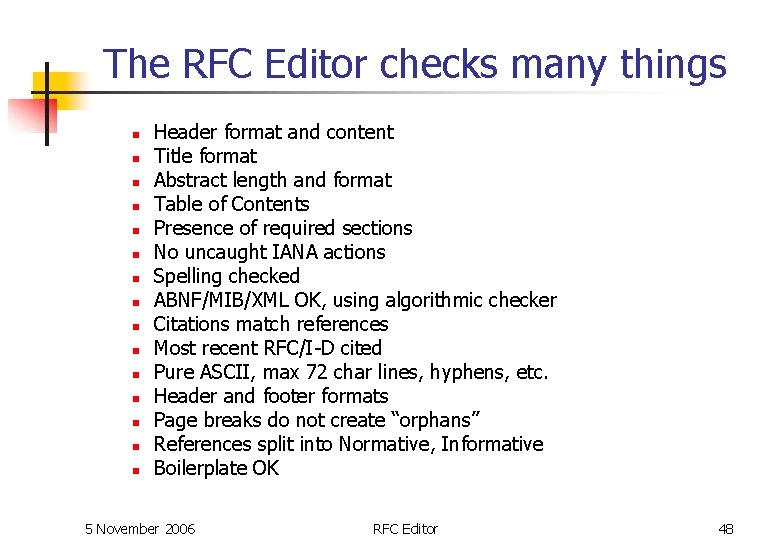
The RFC Editor checks many things n n n n Header format and content Title format Abstract length and format Table of Contents Presence of required sections No uncaught IANA actions Spelling checked ABNF/MIB/XML OK, using algorithmic checker Citations match references Most recent RFC/I-D cited Pure ASCII, max 72 char lines, hyphens, etc. Header and footer formats Page breaks do not create “orphans” References split into Normative, Informative Boilerplate OK 5 November 2006 RFC Editor 48
Writing RFCs n n Simple fact: writing clear, unambiguous technical prose is very HARD !! Not literary English, but comprehensibility would be nice! n n Avoid ambiguity. Use consistent terminology and notation. n n n If you choose “ 4 -bit”, then use it throughout (not “four-bit”). Define each term and abbreviation at first use. Expand every abbreviation at first use. 5 November 2006 RFC Editor 49
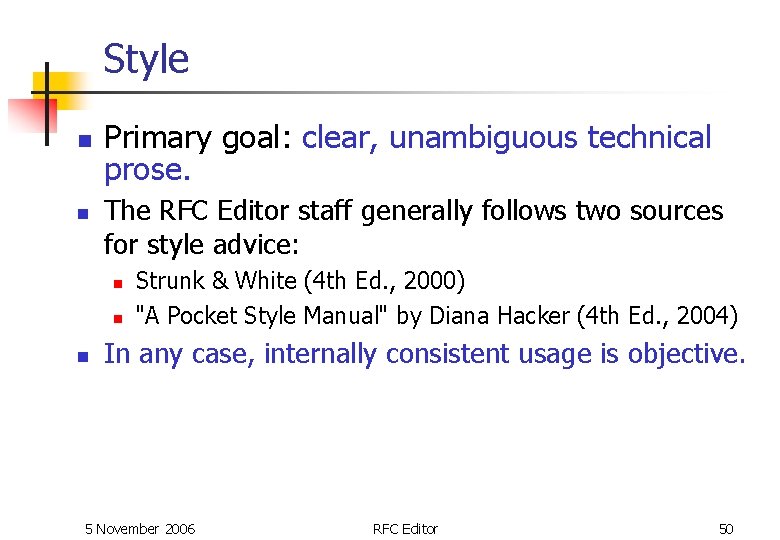
Style n n Primary goal: clear, unambiguous technical prose. The RFC Editor staff generally follows two sources for style advice: n n n Strunk & White (4 th Ed. , 2000) "A Pocket Style Manual" by Diana Hacker (4 th Ed. , 2004) In any case, internally consistent usage is objective. 5 November 2006 RFC Editor 50
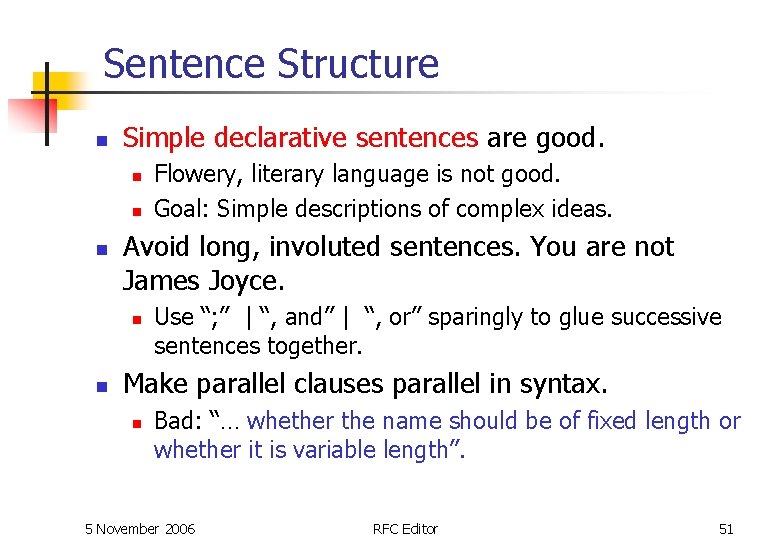
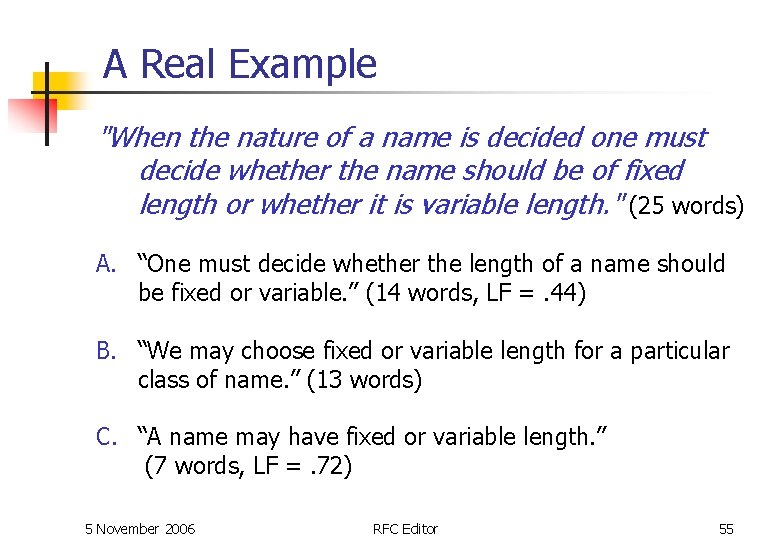
Sentence Structure n Simple declarative sentences are good. n n n Avoid long, involuted sentences. You are not James Joyce. n n Flowery, literary language is not good. Goal: Simple descriptions of complex ideas. Use “; ” | “, and” | “, or” sparingly to glue successive sentences together. Make parallel clauses parallel in syntax. n Bad: “… whether the name should be of fixed length or whether it is variable length”. 5 November 2006 RFC Editor 51
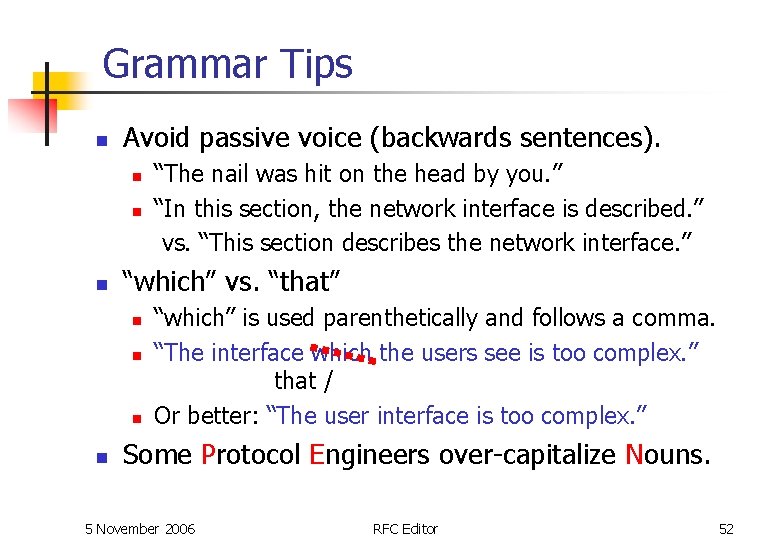
Grammar Tips n Avoid passive voice (backwards sentences). “The nail was hit on the head by you. ” n “In this section, the network interface is described. ” vs. “This section describes the network interface. ” n n “which” vs. “that” n n “which” is used parenthetically and follows a comma. “The interface which the users see is too complex. ” that / Or better: “The user interface is too complex. ” Some Protocol Engineers over-capitalize Nouns. 5 November 2006 RFC Editor 52
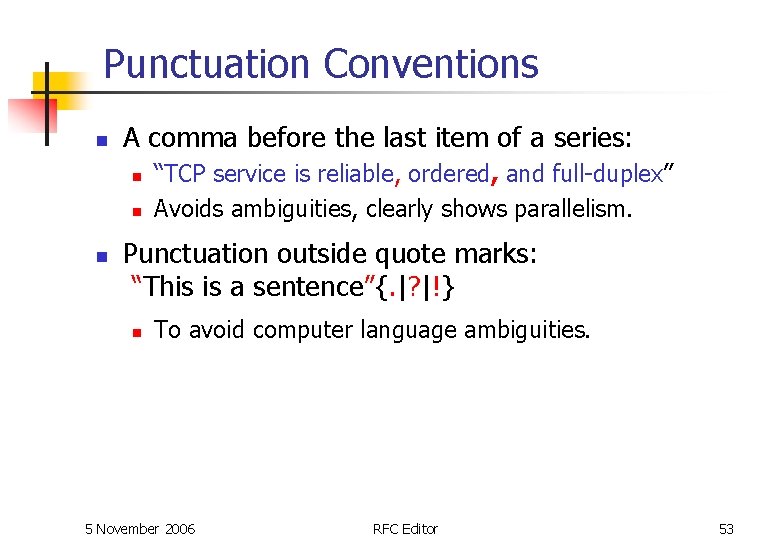
Punctuation Conventions n A comma before the last item of a series: n n n “TCP service is reliable, ordered, and full-duplex” Avoids ambiguities, clearly shows parallelism. Punctuation outside quote marks: “This is a sentence”{. |? |!} n To avoid computer language ambiguities. 5 November 2006 RFC Editor 53
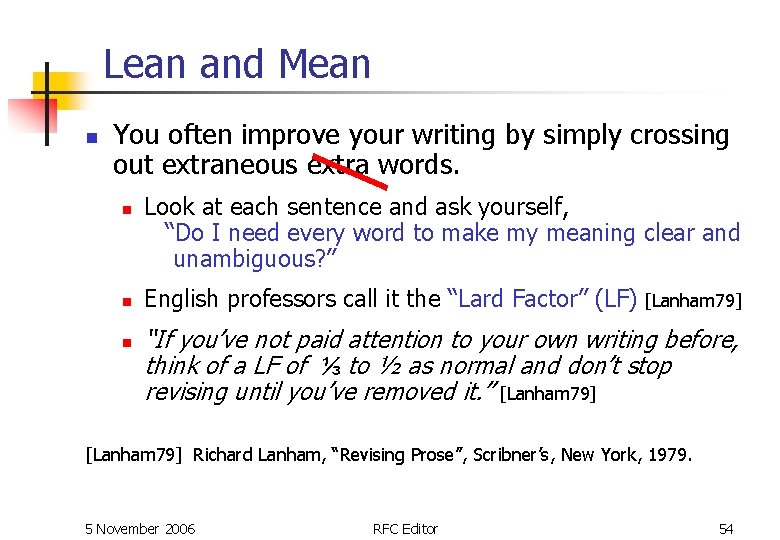
Lean and Mean n You often improve your writing by simply crossing out extraneous extra words. n n n Look at each sentence and ask yourself, “Do I need every word to make my meaning clear and unambiguous? ” English professors call it the “Lard Factor” (LF) [Lanham 79] “If you’ve not paid attention to your own writing before, think of a LF of ⅓ to ½ as normal and don’t stop revising until you’ve removed it. ” [Lanham 79] Richard Lanham, “Revising Prose”, Scribner’s, New York, 1979. 5 November 2006 RFC Editor 54
A Real Example "When the nature of a name is decided one must decide whether the name should be of fixed length or whether it is variable length. " (25 words) A. “One must decide whether the length of a name should be fixed or variable. ” (14 words, LF =. 44) B. “We may choose fixed or variable length for a particular class of name. ” (13 words) C. “A name may have fixed or variable length. ” (7 words, LF =. 72) 5 November 2006 RFC Editor 55
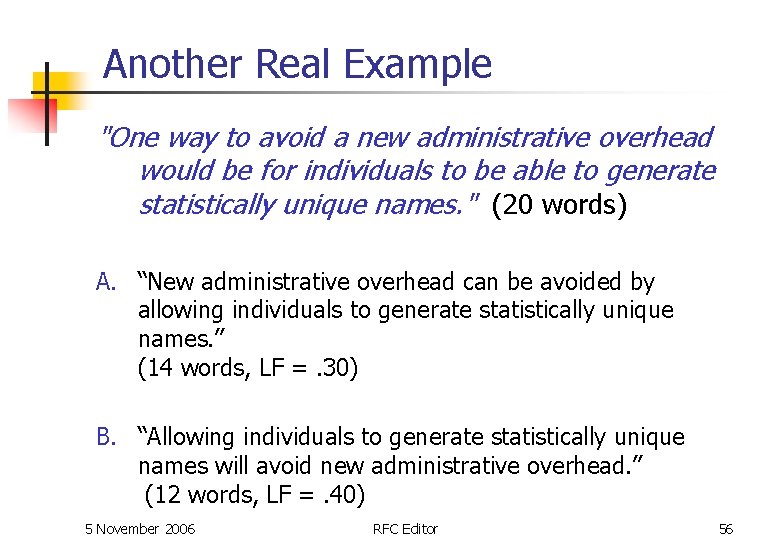
Another Real Example "One way to avoid a new administrative overhead would be for individuals to be able to generate statistically unique names. " (20 words) A. “New administrative overhead can be avoided by allowing individuals to generate statistically unique names. ” (14 words, LF =. 30) B. “Allowing individuals to generate statistically unique names will avoid new administrative overhead. ” (12 words, LF =. 40) 5 November 2006 RFC Editor 56
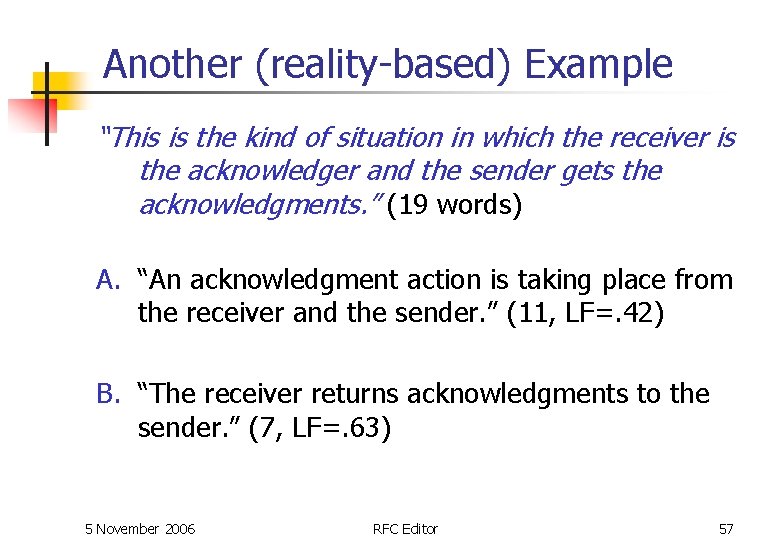
Another (reality-based) Example “This is the kind of situation in which the receiver is the acknowledger and the sender gets the acknowledgments. ” (19 words) A. “An acknowledgment action is taking place from the receiver and the sender. ” (11, LF=. 42) B. “The receiver returns acknowledgments to the sender. ” (7, LF=. 63) 5 November 2006 RFC Editor 57
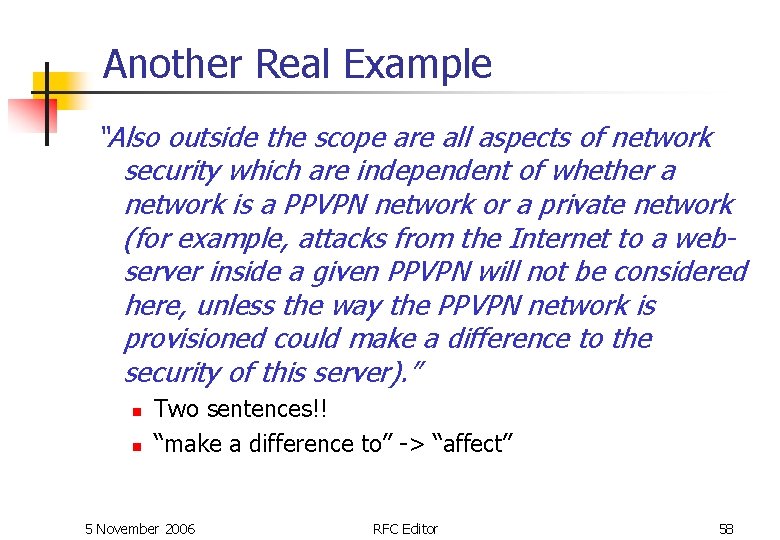
Another Real Example “Also outside the scope are all aspects of network security which are independent of whether a network is a PPVPN network or a private network (for example, attacks from the Internet to a webserver inside a given PPVPN will not be considered here, unless the way the PPVPN network is provisioned could make a difference to the security of this server). ” n n Two sentences!! “make a difference to” -> “affect” 5 November 2006 RFC Editor 58
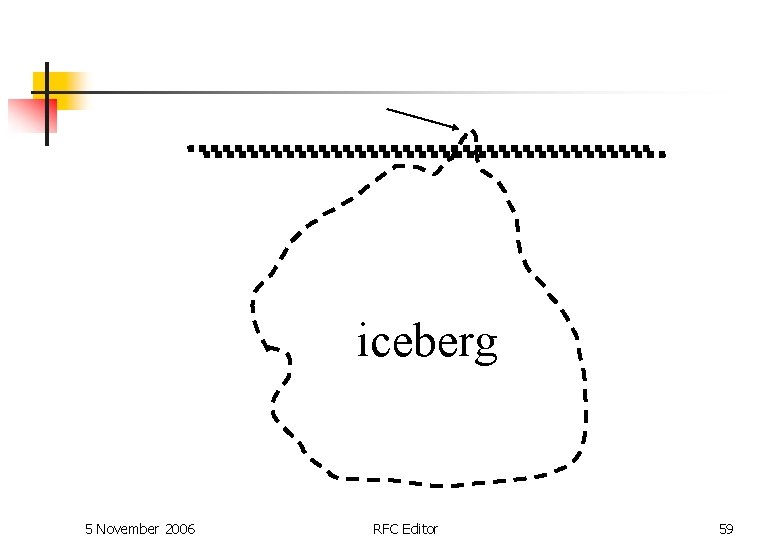
iceberg 5 November 2006 RFC Editor 59
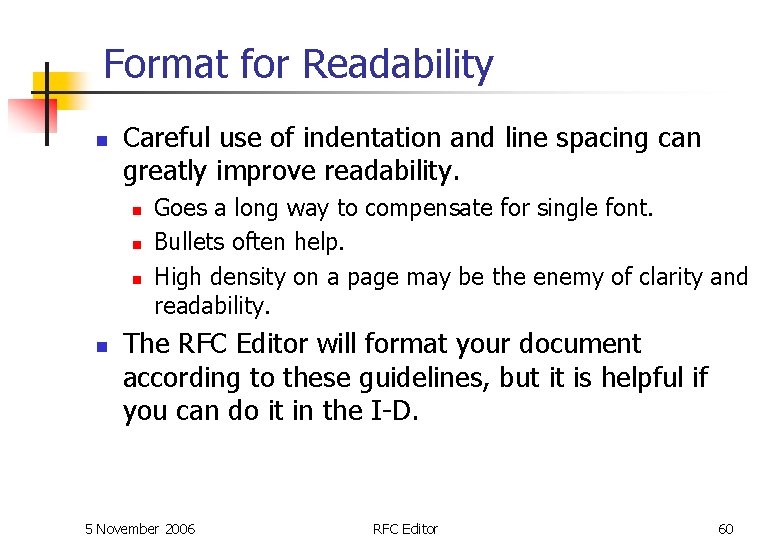
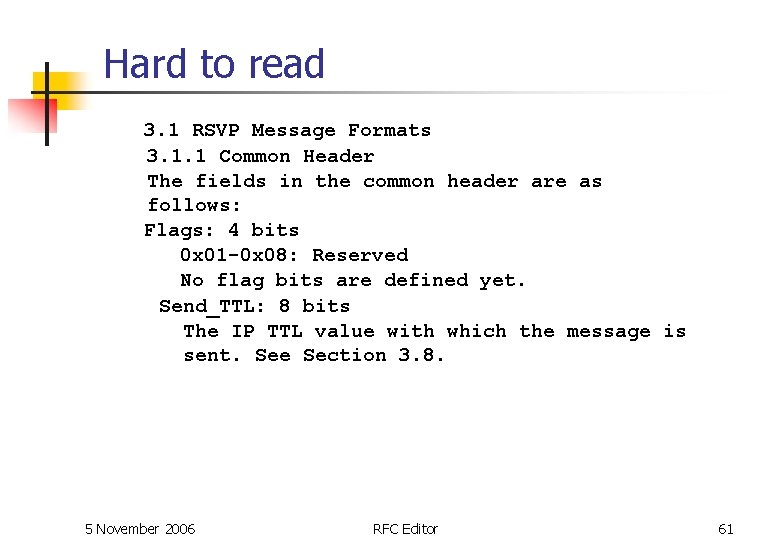
Format for Readability n Careful use of indentation and line spacing can greatly improve readability. n n Goes a long way to compensate for single font. Bullets often help. High density on a page may be the enemy of clarity and readability. The RFC Editor will format your document according to these guidelines, but it is helpful if you can do it in the I-D. 5 November 2006 RFC Editor 60
Hard to read 3. 1 RSVP Message Formats 3. 1. 1 Common Header The fields in the common header are as follows: Flags: 4 bits 0 x 01 -0 x 08: Reserved No flag bits are defined yet. Send_TTL: 8 bits The IP TTL value with which the message is sent. See Section 3. 8. 5 November 2006 RFC Editor 61
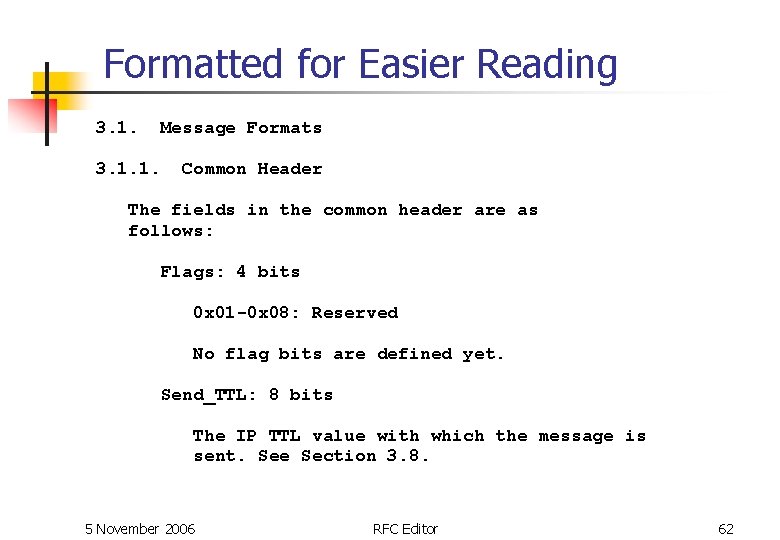
Formatted for Easier Reading 3. 1. Message Formats 3. 1. 1. Common Header The fields in the common header are as follows: Flags: 4 bits 0 x 01 -0 x 08: Reserved No flag bits are defined yet. Send_TTL: 8 bits The IP TTL value with which the message is sent. See Section 3. 8. 5 November 2006 RFC Editor 62
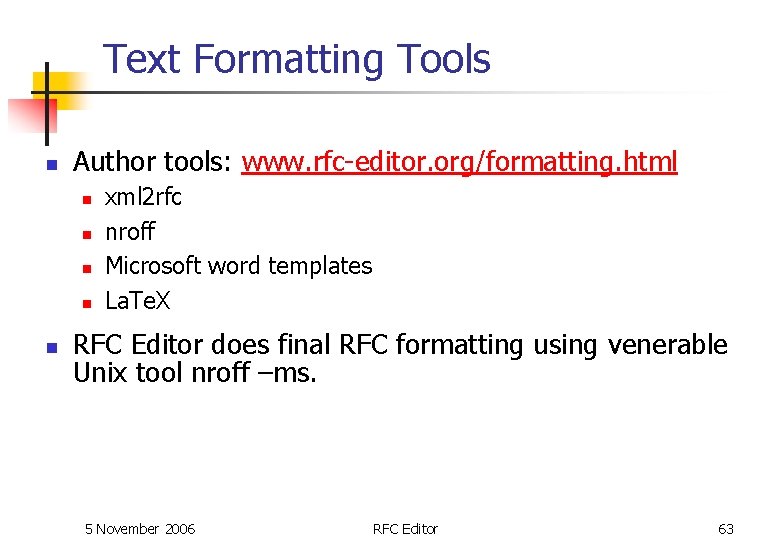
Text Formatting Tools n Author tools: www. rfc-editor. org/formatting. html n n n xml 2 rfc nroff Microsoft word templates La. Te. X RFC Editor does final RFC formatting using venerable Unix tool nroff –ms. 5 November 2006 RFC Editor 63
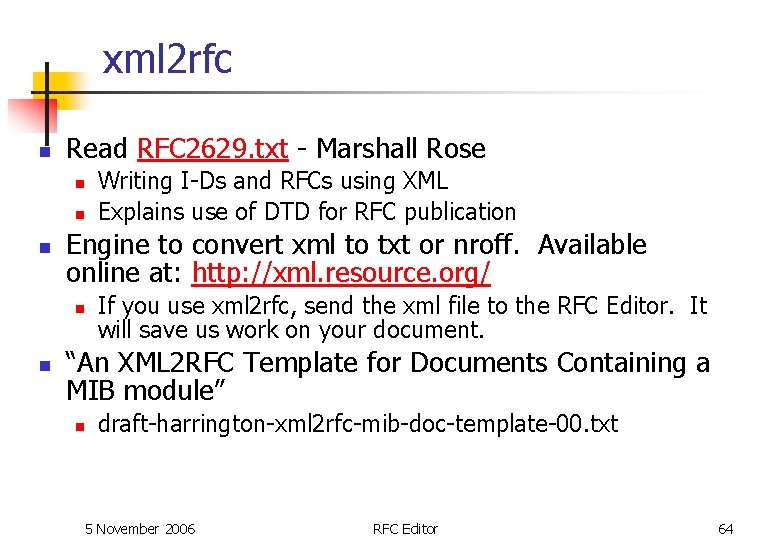
xml 2 rfc n Read RFC 2629. txt - Marshall Rose n n n Engine to convert xml to txt or nroff. Available online at: http: //xml. resource. org/ n n Writing I-Ds and RFCs using XML Explains use of DTD for RFC publication If you use xml 2 rfc, send the xml file to the RFC Editor. It will save us work on your document. “An XML 2 RFC Template for Documents Containing a MIB module” n draft-harrington-xml 2 rfc-mib-doc-template-00. txt 5 November 2006 RFC Editor 64
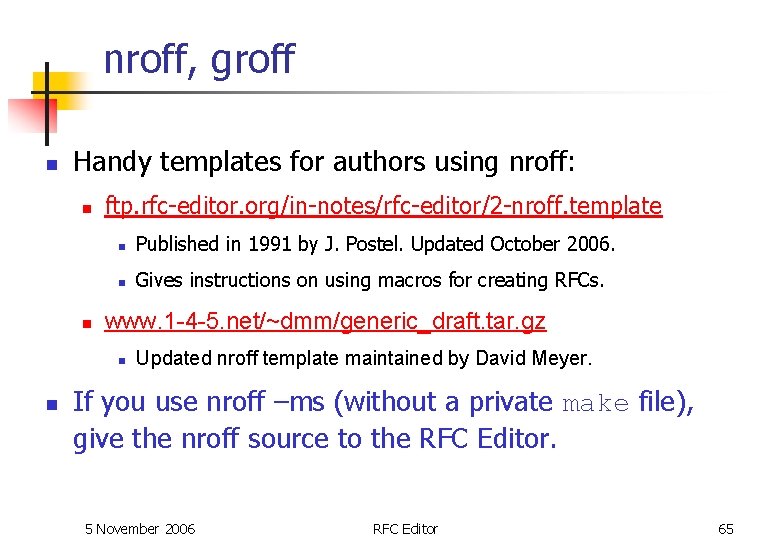
nroff, groff n Handy templates for authors using nroff: n n ftp. rfc-editor. org/in-notes/rfc-editor/2 -nroff. template n Published in 1991 by J. Postel. Updated October 2006. n Gives instructions on using macros for creating RFCs. www. 1 -4 -5. net/~dmm/generic_draft. tar. gz n n Updated nroff template maintained by David Meyer. If you use nroff –ms (without a private make file), give the nroff source to the RFC Editor. 5 November 2006 RFC Editor 65
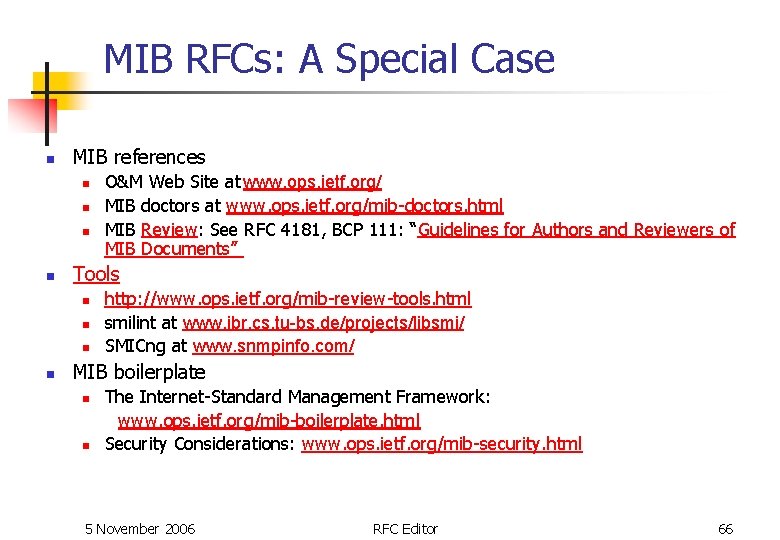
MIB RFCs: A Special Case n MIB references n n Tools n n O&M Web Site at www. ops. ietf. org/ MIB doctors at www. ops. ietf. org/mib-doctors. html MIB Review: See RFC 4181, BCP 111: “Guidelines for Authors and Reviewers of MIB Documents” http: //www. ops. ietf. org/mib-review-tools. html smilint at www. ibr. cs. tu-bs. de/projects/libsmi/ SMICng at www. snmpinfo. com/ MIB boilerplate n n The Internet-Standard Management Framework: www. ops. ietf. org/mib-boilerplate. html Security Considerations: www. ops. ietf. org/mib-security. html 5 November 2006 RFC Editor 66
Use of Formal Languages n Formal languages and pseudo-code can be useful as an aid in explanations, although English remains the primary method of describing protocols. n Pseudo-code judged on the basis of clarity. n Formal Languages (e. g. , ABNF, XML, ASN. 1 (MIBs)) n n n Requires a normative reference to language specification n RFC Editor will run verifier program. www. ietf. org/IESG/STATEMENTS/pseudo-code-in-specs. txt ftp. rfc-editor. org/in-notes/rfc-editor/Using. Pseudo. Code. txt 5 November 2006 RFC Editor 67
5. Conclusion: Problem Areas (1) n Normative references n n Practical effect: can hold up publication MUST/MAY/SHOULD/… requirement words n n n Do they belong in Informative documents at all? Tend to overuse – makes it sound important. Worse, often inconsistent use 5 November 2006 RFC Editor 68
Problem Areas (2) n URLs in RFCs n n Some are more stable than others… Updates and Obsoletes relationships n n n Some disagreement on what they mean At best, only high-order bit of complex relationship RFC Editor hopes ISD (Internet Standard Document) [Newtrk] will be more systematic and complete. 5 November 2006 RFC Editor 69
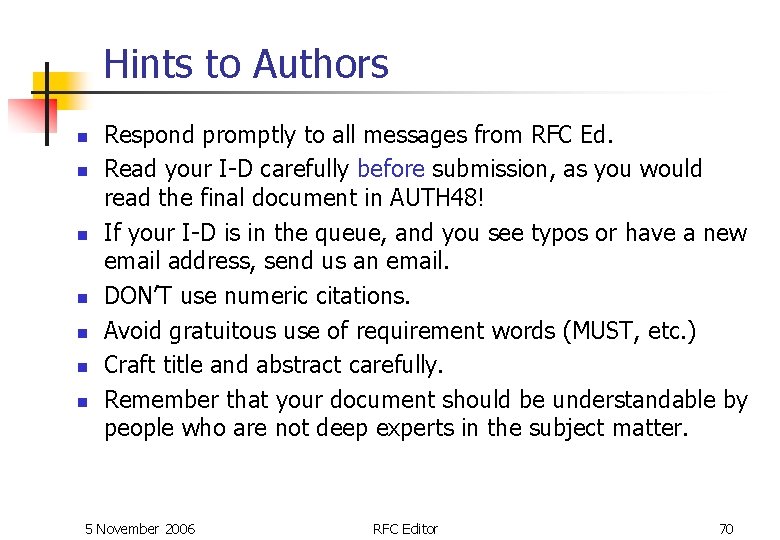
Hints to Authors n n n n Respond promptly to all messages from RFC Ed. Read your I-D carefully before submission, as you would read the final document in AUTH 48! If your I-D is in the queue, and you see typos or have a new email address, send us an email. DON’T use numeric citations. Avoid gratuitous use of requirement words (MUST, etc. ) Craft title and abstract carefully. Remember that your document should be understandable by people who are not deep experts in the subject matter. 5 November 2006 RFC Editor 70
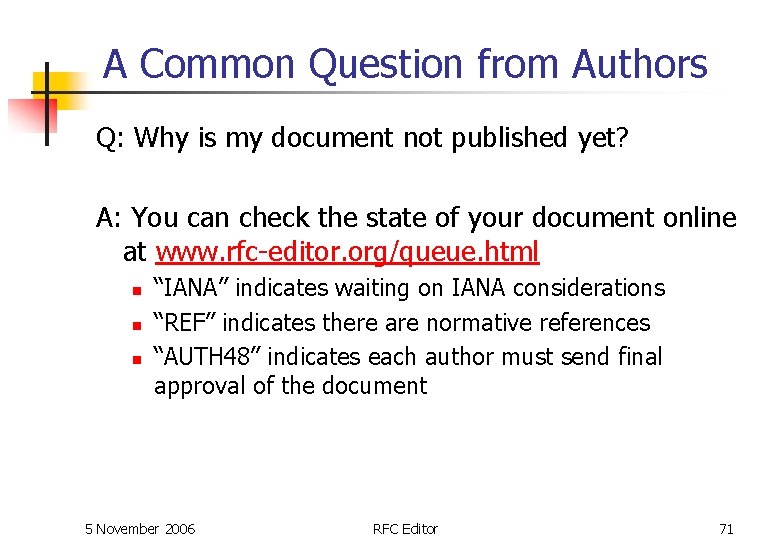
A Common Question from Authors Q: Why is my document not published yet? A: You can check the state of your document online at www. rfc-editor. org/queue. html n n n “IANA” indicates waiting on IANA considerations “REF” indicates there are normative references “AUTH 48” indicates each author must send final approval of the document 5 November 2006 RFC Editor 71
Authoritative References n n Overview of RFC publication: www. rfc-editor. org/howtopub. html “Instructions to Request for Comments (RFC) Authors”. draft-rfc-editor-rfc 2223 bis-08. txt aka ftp. rfc-editor. org/in-notes/rfc-editor/instructions 2 authors. txt 5 November 2006 RFC Editor 72
Thank you … n n n Questions? Comments? mailto: rfc-editor@rfc-editor. org mailto: rfc-interest@rfc-editor. org 5 November 2006 RFC Editor 73