
RFC 3361 DHCP Option for SIP Servers Speaker
- Slides: 18
RFC 3361: DHCP Option for SIP Servers Speaker: Chung yu Wu Teacher: Quincy Wu CSIE
Outline Introduction n DHCP n DNS n SIP server DHCP option n Security Considerations n Conclusion n References n CSIE 2
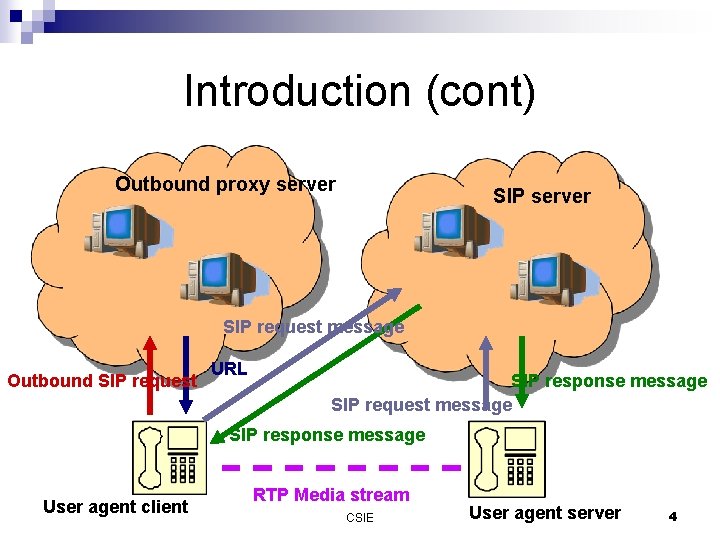
Introduction n This document defines a DHCP option that contains a list of domains or IPv 4 address that can be mapped to one or more SIP outbound proxy servers。 CSIE 3
Introduction (cont) Outbound proxy server SIP request message Outbound SIP request URL SIP response message SIP request message SIP response message User agent client RTP Media stream CSIE User agent server 4
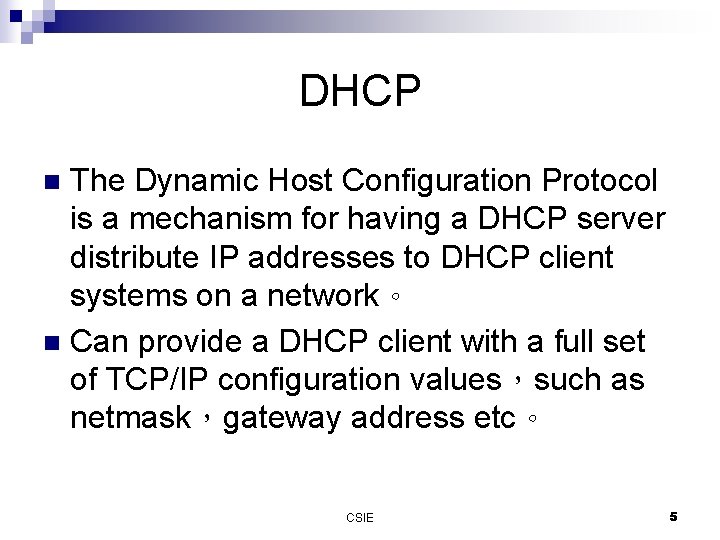
DHCP The Dynamic Host Configuration Protocol is a mechanism for having a DHCP server distribute IP addresses to DHCP client systems on a network。 n Can provide a DHCP client with a full set of TCP/IP configuration values,such as netmask,gateway address etc。 n CSIE 5
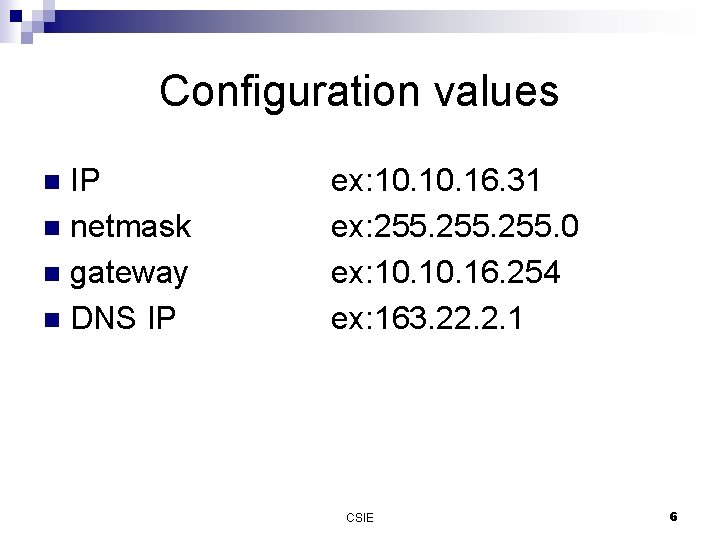
Configuration values IP n netmask n gateway n DNS IP n ex: 10. 16. 31 ex: 255. 0 ex: 10. 16. 254 ex: 163. 22. 2. 1 CSIE 6
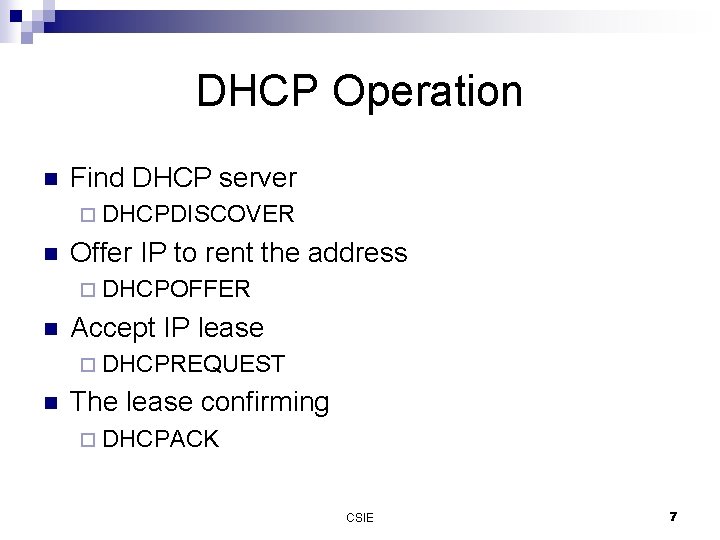
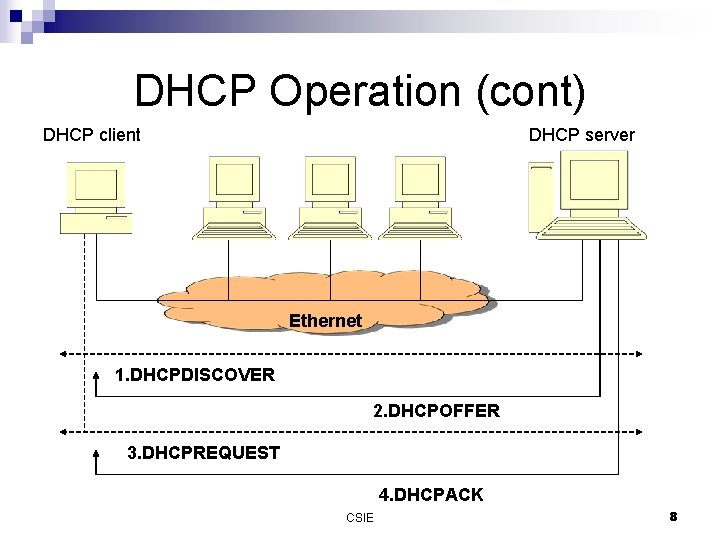
DHCP Operation n Find DHCP server ¨ DHCPDISCOVER n Offer IP to rent the address ¨ DHCPOFFER n Accept IP lease ¨ DHCPREQUEST n The lease confirming ¨ DHCPACK CSIE 7
DHCP Operation (cont) DHCP client DHCP server Ethernet 1. DHCPDISCOVER 2. DHCPOFFER 3. DHCPREQUEST 4. DHCPACK CSIE 8
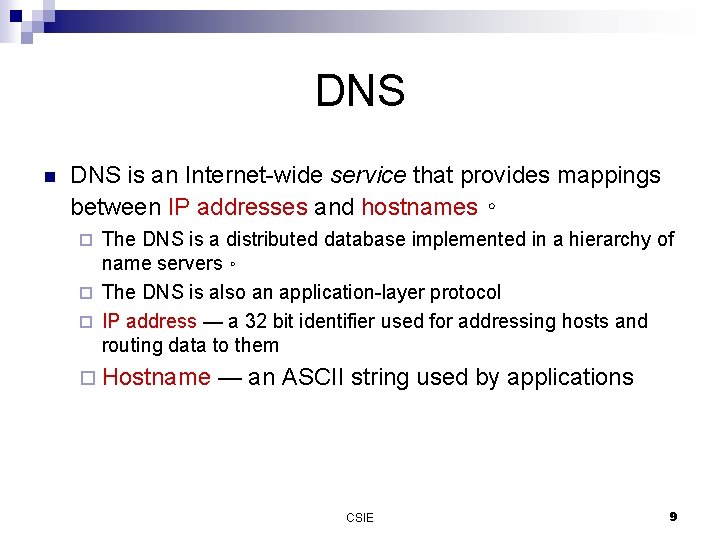
DNS n DNS is an Internet-wide service that provides mappings between IP addresses and hostnames。 The DNS is a distributed database implemented in a hierarchy of name servers。 ¨ The DNS is also an application-layer protocol ¨ IP address — a 32 bit identifier used for addressing hosts and routing data to them ¨ ¨ Hostname — an ASCII string used by applications CSIE 9
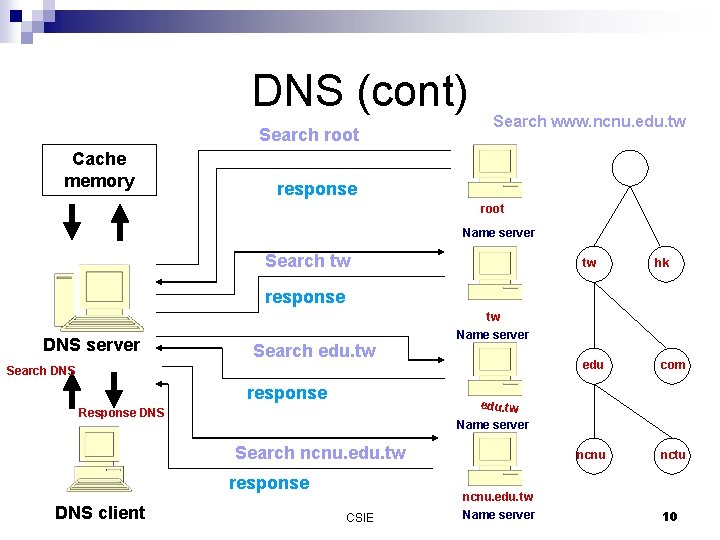
DNS (cont) Search root Cache memory Search www. ncnu. edu. tw response root Name server Search tw tw hk response DNS server Search edu. tw tw Name server Search DNS response com ncnu nctu edu. tw Response DNS Name server Search ncnu. edu. tw response DNS client edu CSIE ncnu. edu. tw Name server 10
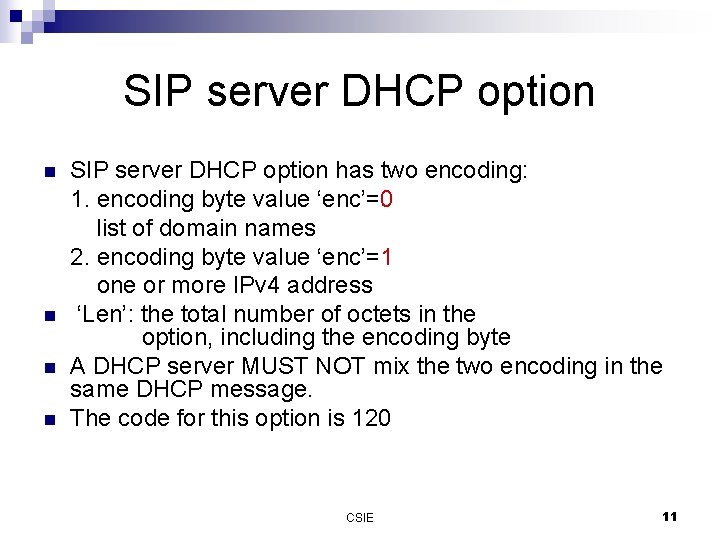
SIP server DHCP option n n SIP server DHCP option has two encoding: 1. encoding byte value ‘enc’=0 list of domain names 2. encoding byte value ‘enc’=1 one or more IPv 4 address ‘Len’: the total number of octets in the option, including the encoding byte A DHCP server MUST NOT mix the two encoding in the same DHCP message. The code for this option is 120 CSIE 11
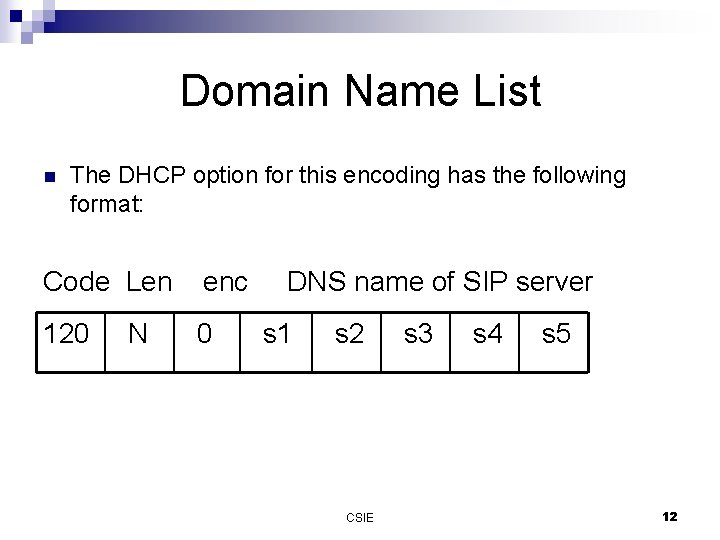
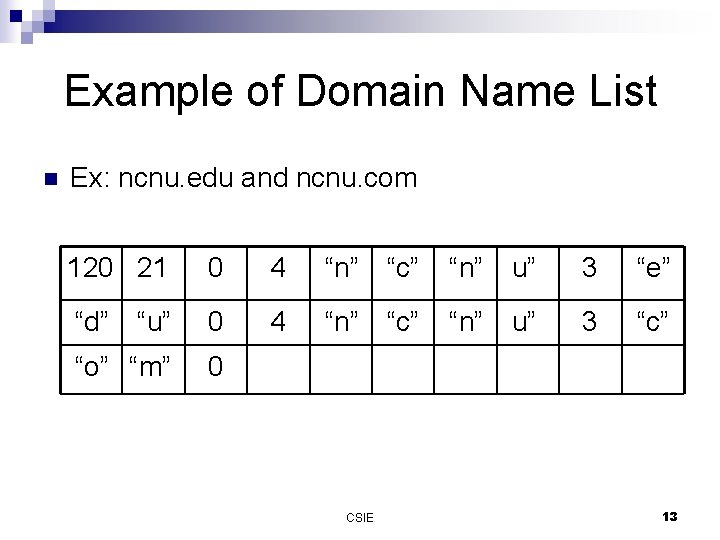
Domain Name List n The DHCP option for this encoding has the following format: Code Len enc 120 0 N DNS name of SIP server s 1 s 2 CSIE s 3 s 4 s 5 12
Example of Domain Name List n Ex: ncnu. edu and ncnu. com 120 21 0 4 “n” “c” “n” u” 3 “e” “d” “u” 0 4 “n” “c” “n” u” 3 “c” “o” “m” 0 CSIE 13
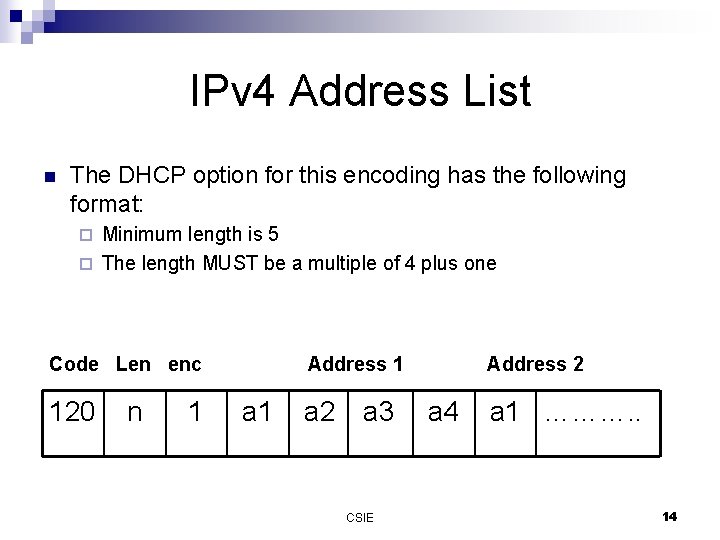
IPv 4 Address List n The DHCP option for this encoding has the following format: Minimum length is 5 ¨ The length MUST be a multiple of 4 plus one ¨ Code Len enc 120 n 1 Address 1 a 2 a 3 CSIE Address 2 a 4 a 1 ………. . 14
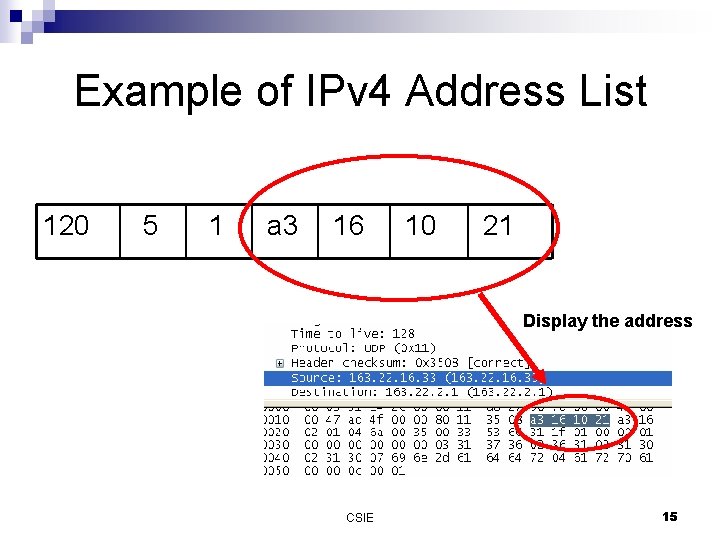
Example of IPv 4 Address List 120 5 1 a 3 16 10 21 Display the address CSIE 15
Security Considerations Modify the response from a DHCP server n SIP user agent could be led to contact a rogue SIP server, possibly one that then intercepts call requests or denies service。 n CSIE 16
Conclusion Defines DHCP option: -List of domain names -IPv 4 address n Can be mapped to one or more SIP outbound proxy servers n CSIE 17
References n RFC 2131 Dynamic Host Configuration Protocol n RFC 3261 Session Initiation Protocol n RFC 2119 Key words for use in RFCs to indicate requirement levels CSIE 18