
RF system integration status Kevin Li 7 th
- Slides: 13
RF system integration status Kevin Li 7 th October 2020
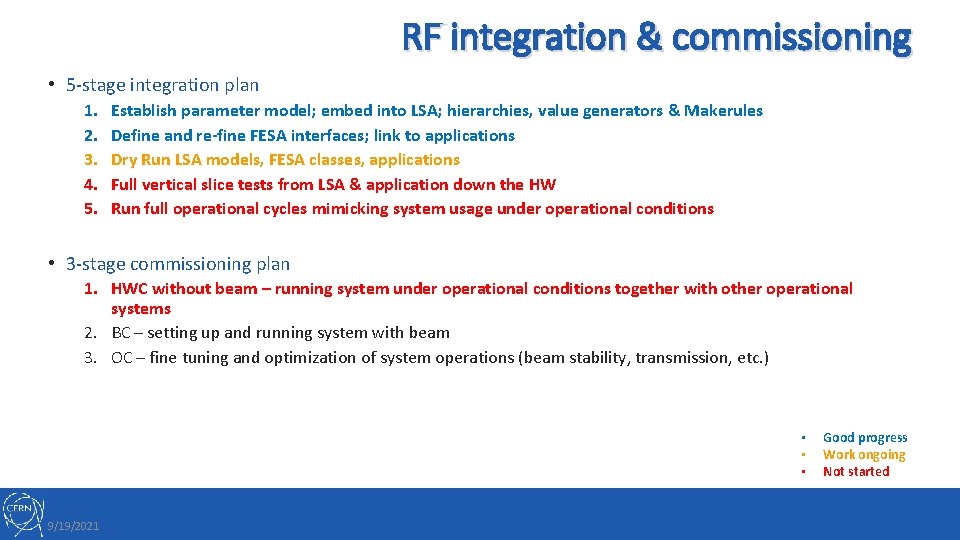
RF integration & commissioning • 5 -stage integration plan 1. 2. 3. 4. 5. Establish parameter model; embed into LSA; hierarchies, value generators & Makerules Define and re-fine FESA interfaces; link to applications Dry Run LSA models, FESA classes, applications Full vertical slice tests from LSA & application down the HW Run full operational cycles mimicking system usage under operational conditions • 3 -stage commissioning plan 1. HWC without beam – running system under operational conditions together with other operational systems 2. BC – setting up and running system with beam 3. OC – fine tuning and optimization of system operations (beam stability, transmission, etc. ) • • • 9/19/2021 Good progress Work ongoing Not started
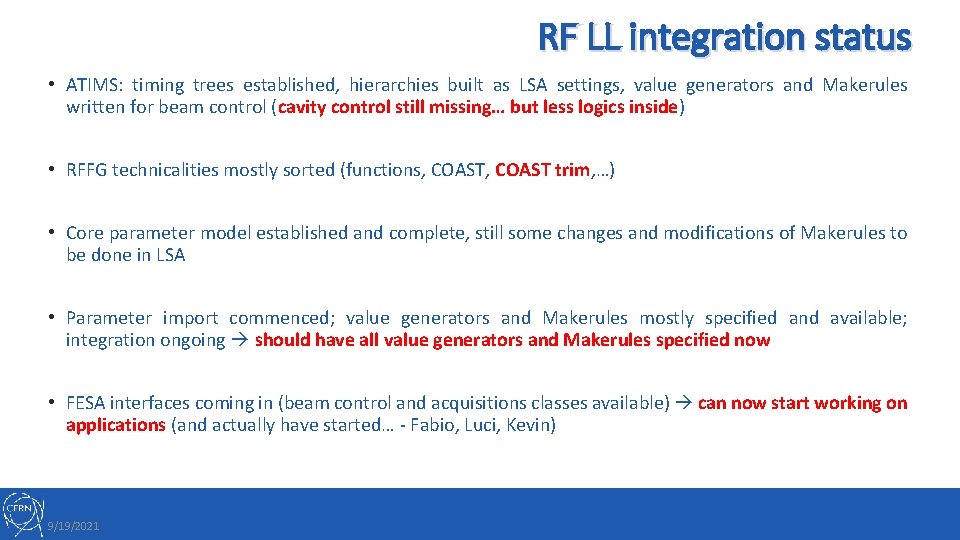
RF LL integration status • ATIMS: timing trees established, hierarchies built as LSA settings, value generators and Makerules written for beam control (cavity control still missing… but less logics inside) • RFFG technicalities mostly sorted (functions, COAST trim, …) • Core parameter model established and complete, still some changes and modifications of Makerules to be done in LSA • Parameter import commenced; value generators and Makerules mostly specified and available; integration ongoing should have all value generators and Makerules specified now • FESA interfaces coming in (beam control and acquisitions classes available) can now start working on applications (and actually have started… - Fabio, Luci, Kevin) 9/19/2021
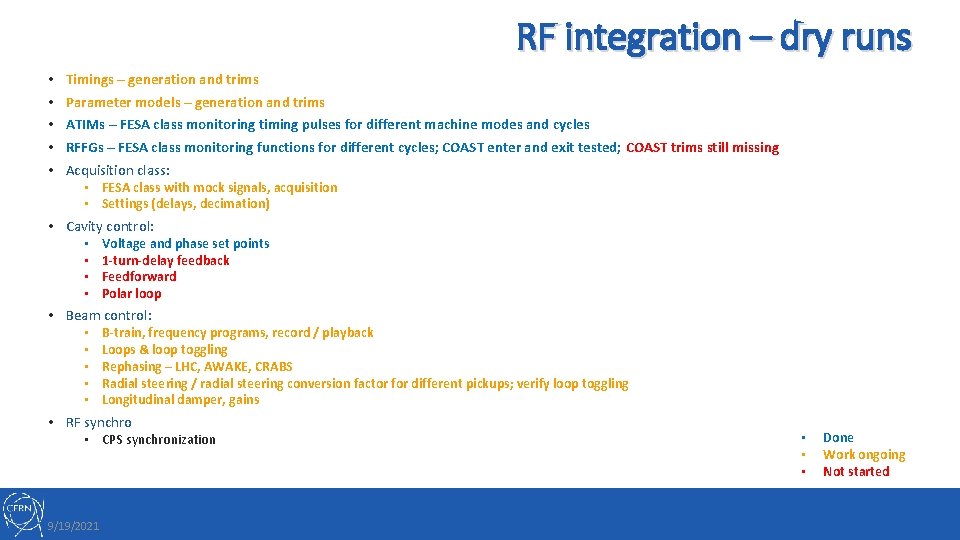
RF integration – dry runs • • • Timings – generation and trims Parameter models – generation and trims ATIMs – FESA class monitoring timing pulses for different machine modes and cycles RFFGs – FESA class monitoring functions for different cycles; COAST enter and exit tested; COAST trims still missing Acquisition class: • FESA class with mock signals, acquisition • Settings (delays, decimation) • Cavity control: • Voltage and phase set points • 1 -turn-delay feedback • Feedforward • Polar loop • Beam control: • B-train, frequency programs, record / playback • Loops & loop toggling • Rephasing – LHC, AWAKE, CRABS • Radial steering / radial steering conversion factor for different pickups; verify loop toggling • Longitudinal damper, gains • RF synchro • CPS synchronization 9/19/2021 • • • Done Work ongoing Not started
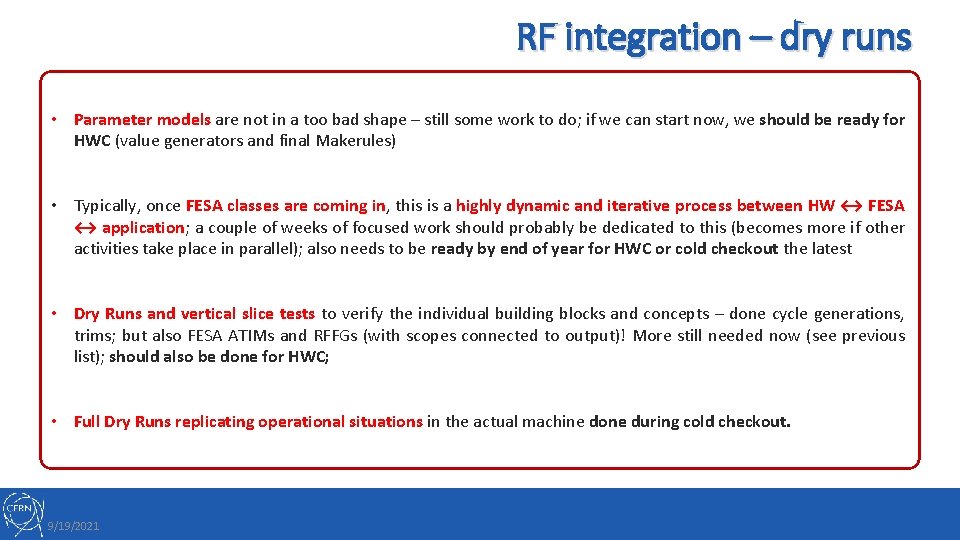
RF integration – dry runs • • • Timings – generation and trims Parameter models are not in a pulses too bad – still some workand tocycles do; if we can start now, we should be ready for ATIMs – FESA class monitoring timing for shape different machine modes HWC–(value generators final Makerules) RFFGs FESA class monitoringand functions for different cycles; COAST enter and exit tested; COAST trims still missing Acquisition class: • FESA class with mock signals, acquisition • Settingsonce (delays, decimation) • Typically, FESA classes are coming in, this is a highly dynamic and iterative process between HW ↔ FESA • Cavity control: ↔ application; a couple of weeks of focused work should probably be dedicated to this (becomes more if other • Voltage and phase activities take placesetinpoints parallel); also needs to be ready by end of year for HWC or cold checkout the latest • 1 -turn-delay feedback • Feedforward • Polar loop Dry control: Runs and vertical slice tests to verify the individual building blocks and concepts – done cycle generations, • • Beam • B-train, programs, / playback trims; but frequency also FESA ATIMsrecord and RFFGs (with scopes connected to output)! More still needed now (see previous • Loops & loop toggling list); should also be done for HWC; • Rephasing – LHC, AWAKE, CRABS • Radial steering / radial steering conversion factor for different pickups; verify loop toggling • Longitudinal damper, gains • • RFFull synchro Dry Runs replicating operational situations in the actual machine done during cold checkout. • CPS synchronization 9/19/2021
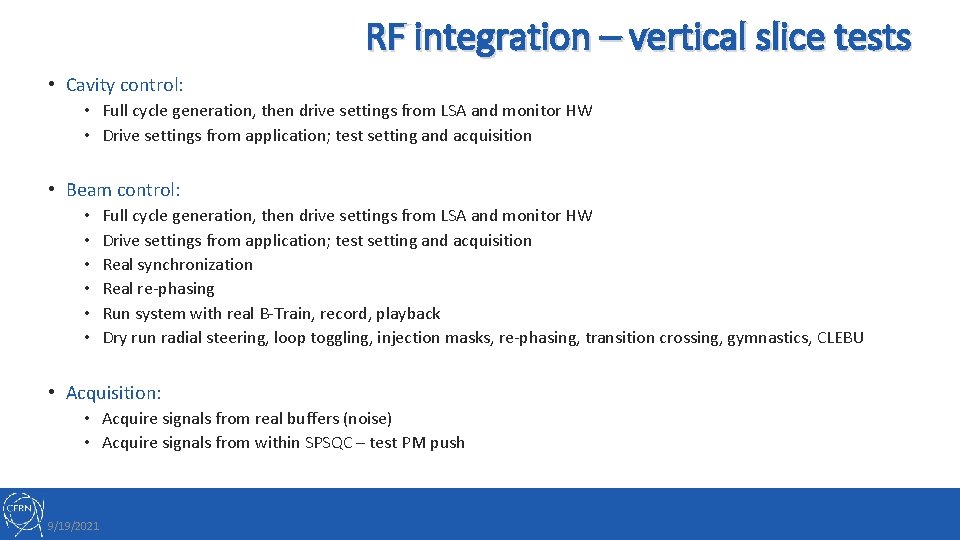
RF integration – vertical slice tests • Cavity control: • Full cycle generation, then drive settings from LSA and monitor HW • Drive settings from application; test setting and acquisition • Beam control: • • • Full cycle generation, then drive settings from LSA and monitor HW Drive settings from application; test setting and acquisition Real synchronization Real re-phasing Run system with real B-Train, record, playback Dry run radial steering, loop toggling, injection masks, re-phasing, transition crossing, gymnastics, CLEBU • Acquisition: • Acquire signals from real buffers (noise) • Acquire signals from within SPSQC – test PM push 9/19/2021
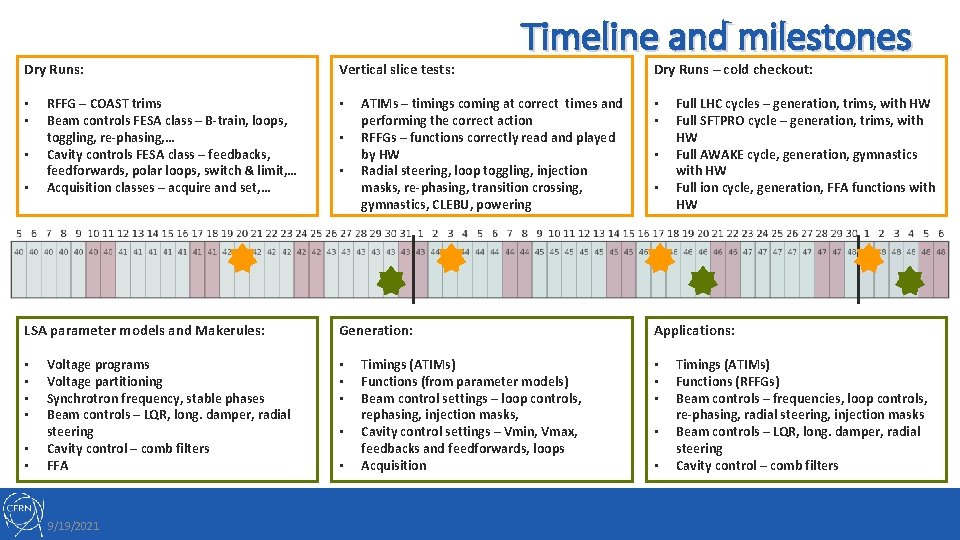
Dry Runs: • • RFFG – COAST trims Beam controls FESA class – B-train, loops, toggling, re-phasing, … Cavity controls FESA class – feedbacks, feedforwards, polar loops, switch & limit, … Acquisition classes – acquire and set, … LSA parameter models and Makerules: • • • Voltage programs Voltage partitioning Synchrotron frequency, stable phases Beam controls – LQR, long. damper, radial steering Cavity control – comb filters FFA 9/19/2021 Vertical slice tests: • • • Timeline and milestones ATIMs – timings coming at correct times and performing the correct action RFFGs – functions correctly read and played by HW Radial steering, loop toggling, injection masks, re-phasing, transition crossing, gymnastics, CLEBU, powering Generation: • • • Timings (ATIMs) Functions (from parameter models) Beam control settings – loop controls, rephasing, injection masks, Cavity control settings – Vmin, Vmax, feedbacks and feedforwards, loops Acquisition Dry Runs – cold checkout: • • Full LHC cycles – generation, trims, with HW Full SFTPRO cycle – generation, trims, with HW Full AWAKE cycle, generation, gymnastics with HW Full ion cycle, generation, FFA functions with HW Applications: • • • Timings (ATIMs) Functions (RFFGs) Beam controls – frequencies, loop controls, re-phasing, radial steering, injection masks Beam controls – LQR, long. damper, radial steering Cavity control – comb filters
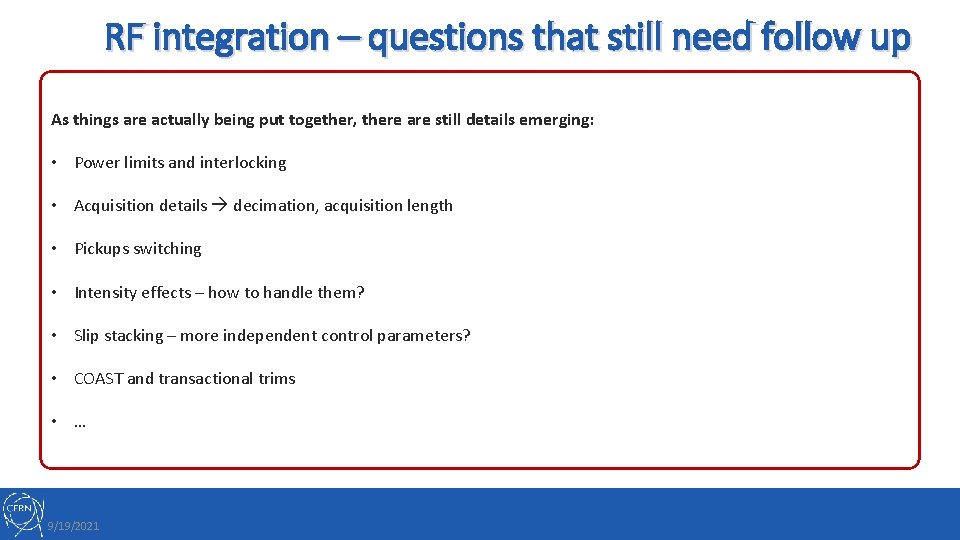
RF integration – questions that still need follow up • Timings – generation and trims • Parameter models – generation and trims things are actually being timing put together, aremachine still details • As. ATIMs – FESA class monitoring pulses forthere different modesemerging: and cycles • RFFGs – FESA class monitoring functions for different cycles; COAST enter and exit tested; COAST trims still missing Power limits • • Acquisition class: and interlocking • • FESA class with mock signals, acquisition • Settings (delays, Acquisition detailsdecimation) decimation, acquisition length • Cavity control: • Voltage and phase set points • Pickups switching • • 1 -turn-delay feedback • Feedforward Intensity effects – how to handle them? • Polar loop • Beam control: • B-train, frequency programs, record / control playback parameters? • Slip stacking – more independent • • Loops & loop toggling • Rephasing – LHC, AWAKE, CRABS COAST and transactional trimsconversion factor for different pickups; verify loop toggling • Radial steering / radial steering • Longitudinal damper, gains • • RF…synchro • CPS synchronization 9/19/2021
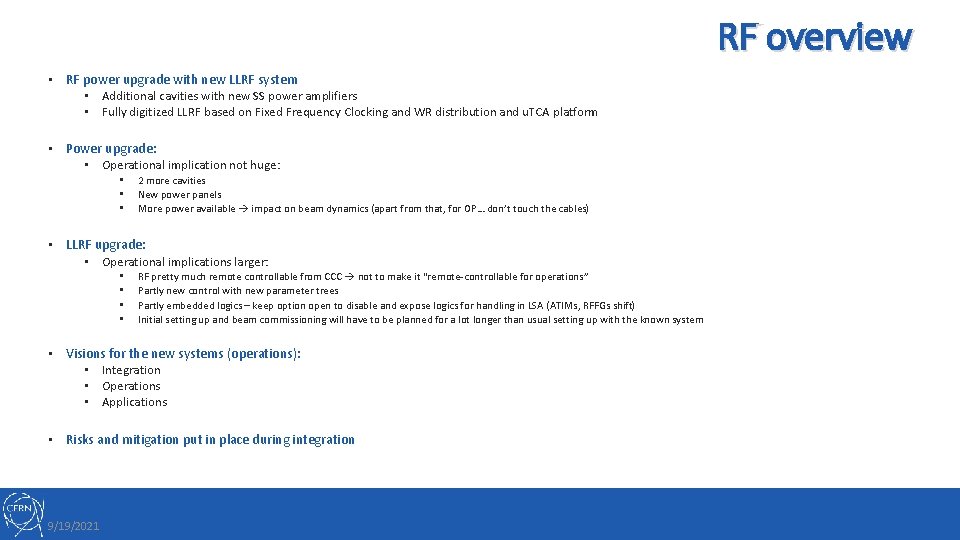
RF overview • RF power upgrade with new LLRF system • Additional cavities with new SS power amplifiers • Fully digitized LLRF based on Fixed Frequency Clocking and WR distribution and u. TCA platform • Power upgrade: • Operational implication not huge: • • • 2 more cavities New power panels More power available impact on beam dynamics (apart from that, for OP… don’t touch the cables) • LLRF upgrade: • Operational implications larger: • • RF pretty much remote controllable from CCC not to make it “remote-controllable for operations” Partly new control with new parameter trees Partly embedded logics – keep option open to disable and expose logics for handling in LSA (ATIMs, RFFGs shift) Initial setting up and beam commissioning will have to be planned for a lot longer than usual setting up with the known system • Visions for the new systems (operations): • Integration • Operations • Applications • Risks and mitigation put in place during integration 9/19/2021
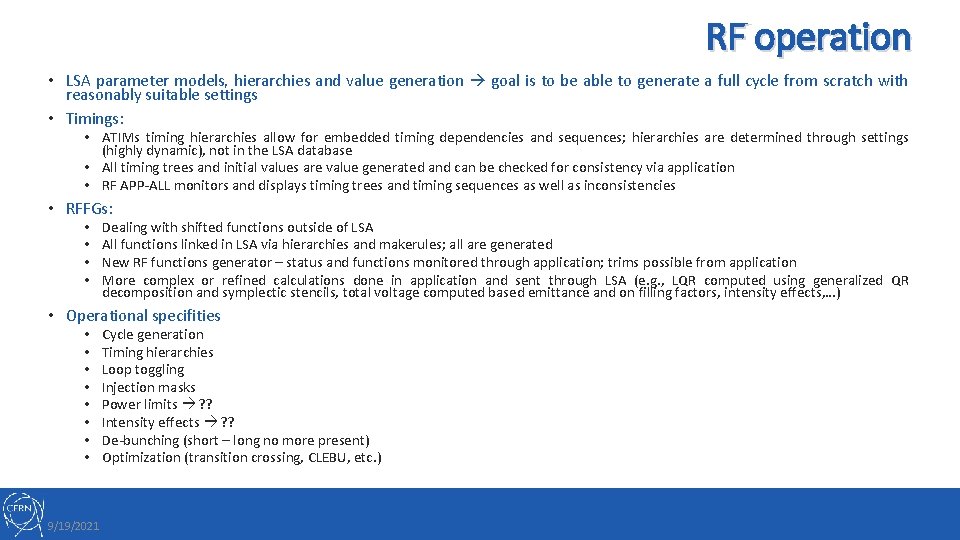
RF operation • LSA parameter models, hierarchies and value generation goal is to be able to generate a full cycle from scratch with reasonably suitable settings • Timings: • ATIMs timing hierarchies allow for embedded timing dependencies and sequences; hierarchies are determined through settings (highly dynamic), not in the LSA database • All timing trees and initial values are value generated and can be checked for consistency via application • RF APP-ALL monitors and displays timing trees and timing sequences as well as inconsistencies • RFFGs: • • Dealing with shifted functions outside of LSA All functions linked in LSA via hierarchies and makerules; all are generated New RF functions generator – status and functions monitored through application; trims possible from application More complex or refined calculations done in application and sent through LSA (e. g. , LQR computed using generalized QR decomposition and symplectic stencils, total voltage computed based emittance and on filling factors, intensity effects, …) • Operational specifities • • 9/19/2021 Cycle generation Timing hierarchies Loop toggling Injection masks Power limits ? ? Intensity effects ? ? De-bunching (short – long no more present) Optimization (transition crossing, CLEBU, etc. )
Summary 9/19/2021
Summary 9/19/2021