
RF Path Loss Tutorial Dan Minear Boeing Amateur
RF Path Loss Tutorial Dan Minear Boeing Amateur Radio Club – HB 2006 -02 -07 12/16/2021 1 Copyright 1996 -98 © Dale Carnegie & Associates, Inc.
Link Budgets and Planning • How much power do I need? • How much antenna gain do I need? • Will what I have do the job? • Is my system out of tune? 12/16/2021 2
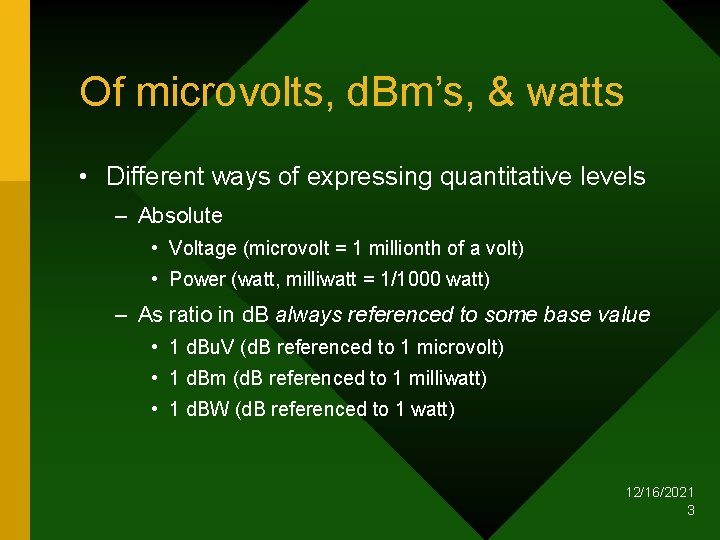
Of microvolts, d. Bm’s, & watts • Different ways of expressing quantitative levels – Absolute • Voltage (microvolt = 1 millionth of a volt) • Power (watt, milliwatt = 1/1000 watt) – As ratio in d. B always referenced to some base value • 1 d. Bu. V (d. B referenced to 1 microvolt) • 1 d. Bm (d. B referenced to 1 milliwatt) • 1 d. BW (d. B referenced to 1 watt) 12/16/2021 3
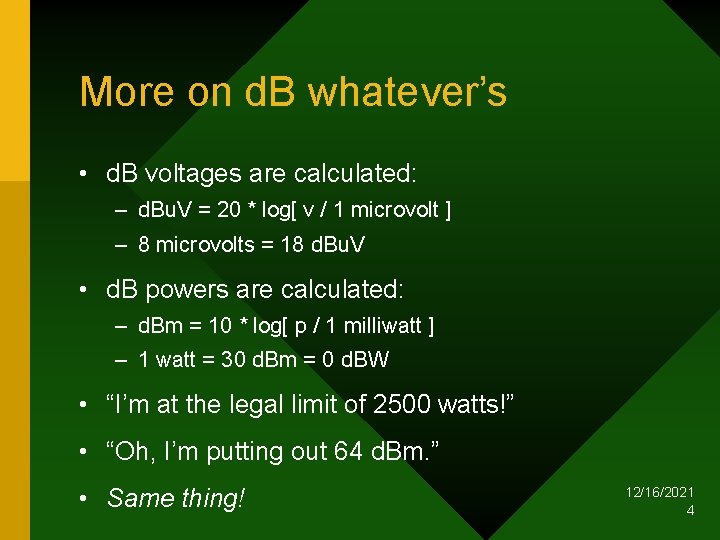
More on d. B whatever’s • d. B voltages are calculated: – d. Bu. V = 20 * log[ v / 1 microvolt ] – 8 microvolts = 18 d. Bu. V • d. B powers are calculated: – d. Bm = 10 * log[ p / 1 milliwatt ] – 1 watt = 30 d. Bm = 0 d. BW • “I’m at the legal limit of 2500 watts!” • “Oh, I’m putting out 64 d. Bm. ” • Same thing! 12/16/2021 4
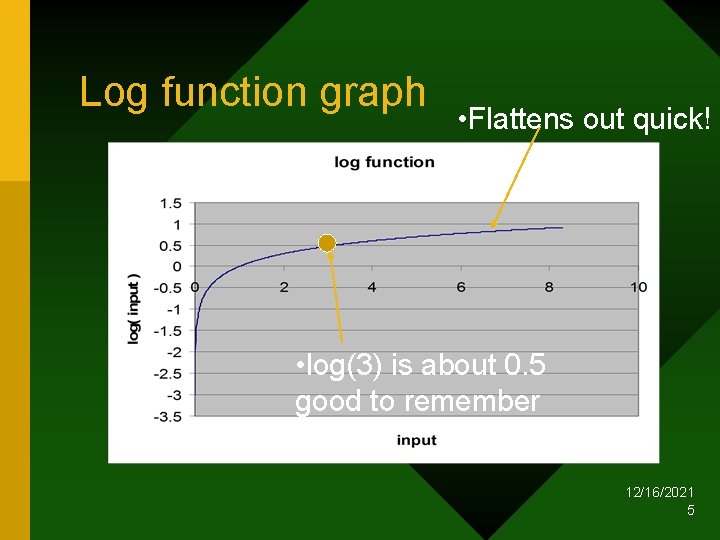
Log function graph • Flattens out quick! • log(3) is about 0. 5 good to remember 12/16/2021 5
How can we tie volts to power? • P = V * A, P = I 2 * R, P = V 2/R ah, hah! • If you assume 50 ohm impedance (convenient for antenna work), then you can tie volts to power levels, and compare d. Bu. V with d. Bm, etc. • Excel calculator download at http: //rfsolutions. com/rfcalc 1. htm • Comprehensive conversion table at http: //www. microvolt. com/table. html 12/16/2021 6
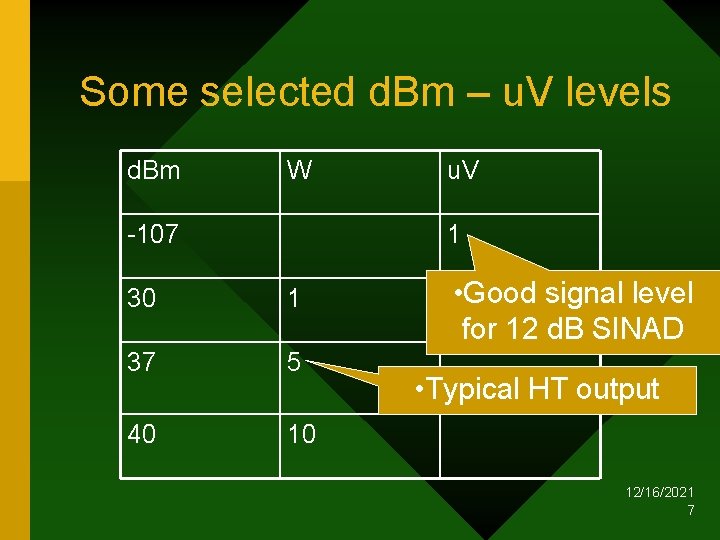
Some selected d. Bm – u. V levels d. Bm W -107 u. V 1 30 1 37 5 40 10 • Good signal level for 12 d. B SINAD • Typical HT output 12/16/2021 7
What’s good about d. B’s? • With volts and watts you have to multiply and divide, conversions, – messy math! • d. B’s just add or subtract! – Gains add – Losses subtract • So, lets check out a rf path link! 12/16/2021 8
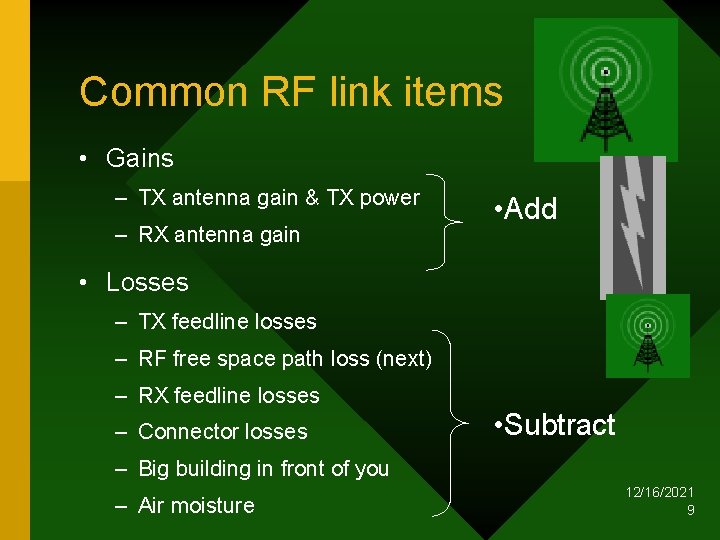
Common RF link items • Gains – TX antenna gain & TX power – RX antenna gain • Add • Losses – TX feedline losses – RF free space path loss (next) – RX feedline losses – Connector losses • Subtract – Big building in front of you – Air moisture 12/16/2021 9

Free Space Path Loss • As the transmitted signal traverses the atmosphere its power level decreases at a rate inversely proportional to the distance traveled and proportional to the wavelength of the signal. • Loss = 20 * log 10[4*pi*d/L] {db} – d = distance – L = wavelength = c / freq – Pi = 3. 142… 12/16/2021 10
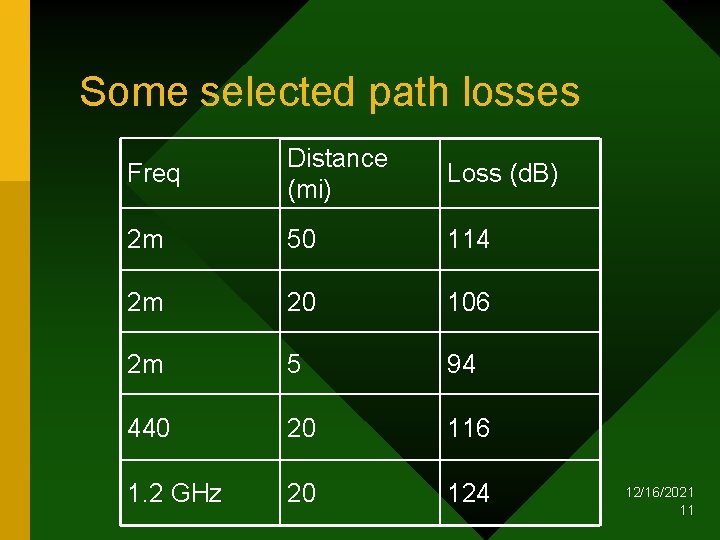
Some selected path losses Freq Distance (mi) Loss (d. B) 2 m 50 114 2 m 20 106 2 m 5 94 440 20 116 1. 2 GHz 20 124 12/16/2021 11
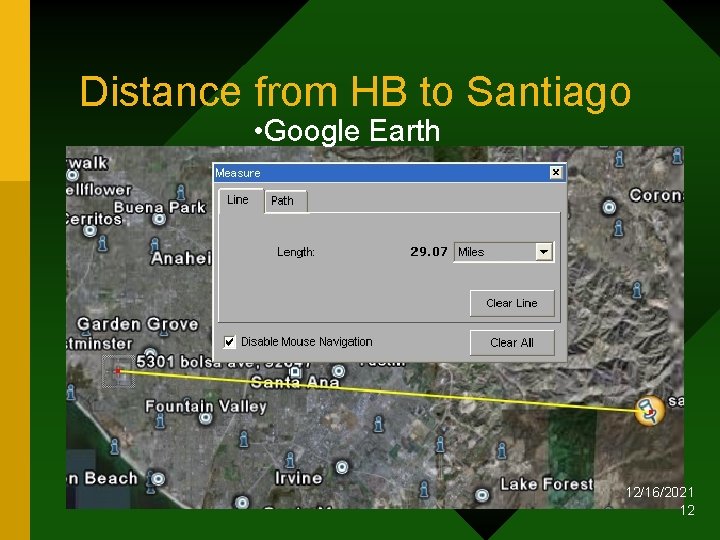
Distance from HB to Santiago • Google Earth 12/16/2021 12
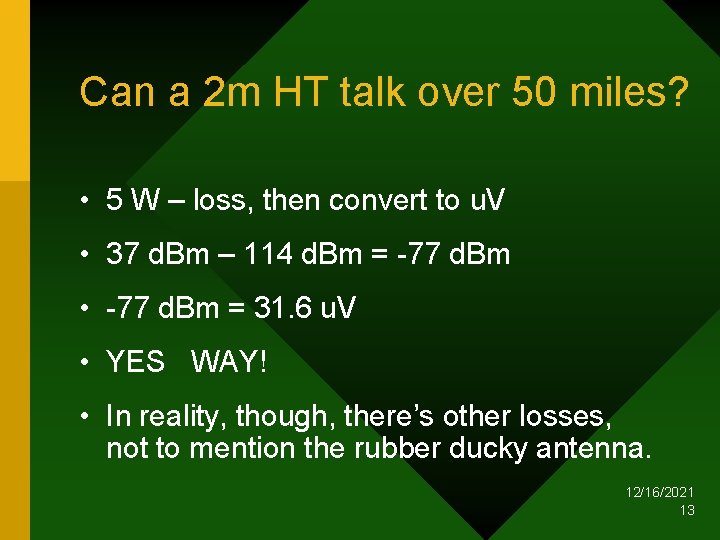
Can a 2 m HT talk over 50 miles? • 5 W – loss, then convert to u. V • 37 d. Bm – 114 d. Bm = -77 d. Bm • -77 d. Bm = 31. 6 u. V • YES WAY! • In reality, though, there’s other losses, not to mention the rubber ducky antenna. 12/16/2021 13
Other losses • HT antenna (negative gain about – 3 d. B) • Ground interference (buildings, walls) • Air moisture (tends to absorb RF) • Phase noise (signal bouncing off something else – mountain, car, …) • Receive feedline and connectors 12/16/2021 14
Reality check • Given a good path without too much obstruction • Antenna – 3, feedline – 3, moisture – 6 = 12 • Still at – 77 – 12 = -89 d. Bm = 8 u. V = OK! • Just watch out for something in the way. 12/16/2021 15
How can you improve your signal? • Higher TX antenna gain • More TX power • Less feedline losses • Get that antenna UP out of the way. • Move to dry air – Cold air is pretty dry, anyone for Denver? 12/16/2021 16
Current example: Suit. Sat • Bob King, VE 6 BLD, in Alberta, who's managed to copy Suit. Sat fairly well on several passes, also noted that the signal's strength had declined from what it was during the previous two passes he'd heard. Located in DO 32, King says he's using an FT-847 transceiver with the preamplifier on and a 22 -element crossed Yagi with right and left circular polarization providing 19 d. B of gain. A preamp at the antenna feeds into half-inch hardline to the shack. "The bird was almost overhead, so the signals were about S 6 when clear, " he reported over the weekend. "I also received the SSTV signal with some noise. " 12/16/2021 17
RF Path Loss Conclusion • Nice way to rough calculate if you have a good communication link. • Validate the performance of your system – If things don’t work, probably something wrong – check cables, especially when working satellites (sadly, the voice of experience)! 12/16/2021 18
- Slides: 18