
RF Amplifiers Biasing of Transistors The Base Emitter
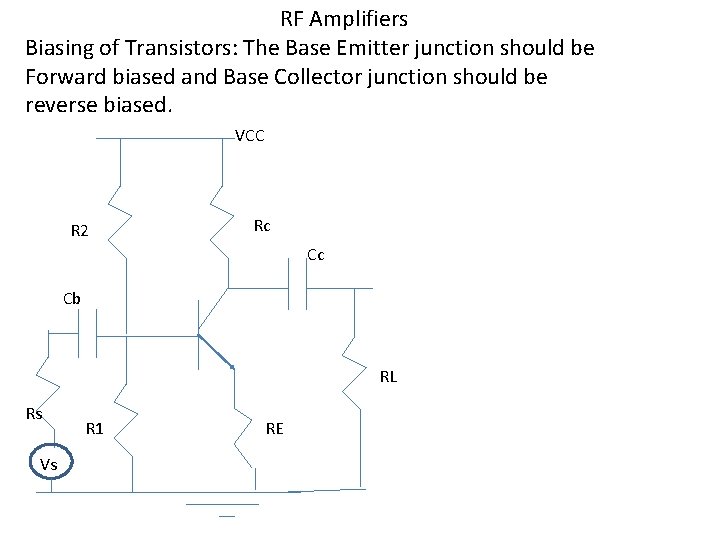
RF Amplifiers Biasing of Transistors: The Base Emitter junction should be Forward biased and Base Collector junction should be reverse biased. VCC R 2 Rc Cc Cb RL Rs Vs R 1 RE
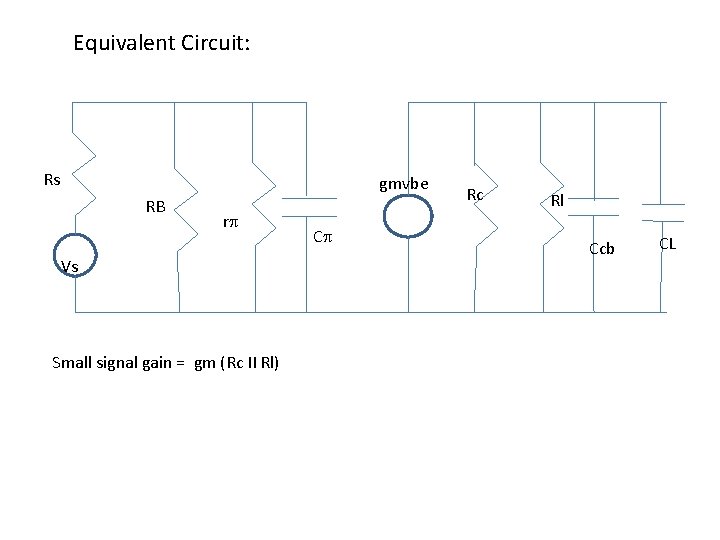
Equivalent Circuit: Rs gmvbe RB rp V Vs Small signal gain = gm (Rc II Rl) Cp Rc Rl Ccb CL
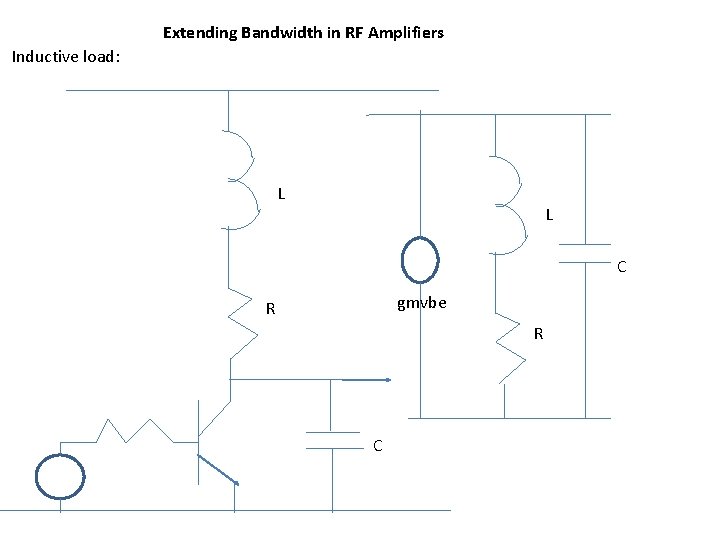
Extending Bandwidth in RF Amplifiers Inductive load: L L C gmvbe R R C
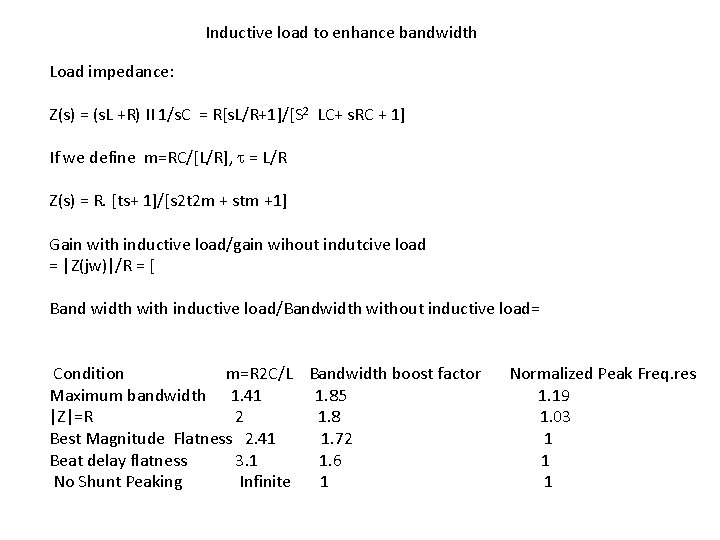
Inductive load to enhance bandwidth Load impedance: Z(s) = (s. L +R) II 1/s. C = R[s. L/R+1]/[S 2 LC+ s. RC + 1] If we define m=RC/[L/R], t = L/R Z(s) = R. [ts+ 1]/[s 2 t 2 m + stm +1] Gain with inductive load/gain wihout indutcive load = |Z(jw)|/R = [ Band width with inductive load/Bandwidth without inductive load= Condition m=R 2 C/L Bandwidth boost factor Maximum bandwidth 1. 41 1. 85 |Z|=R 2 1. 8 Best Magnitude Flatness 2. 41 1. 72 Beat delay flatness 3. 1 1. 6 No Shunt Peaking Infinite 1 Normalized Peak Freq. res 1. 19 1. 03 1 1 1
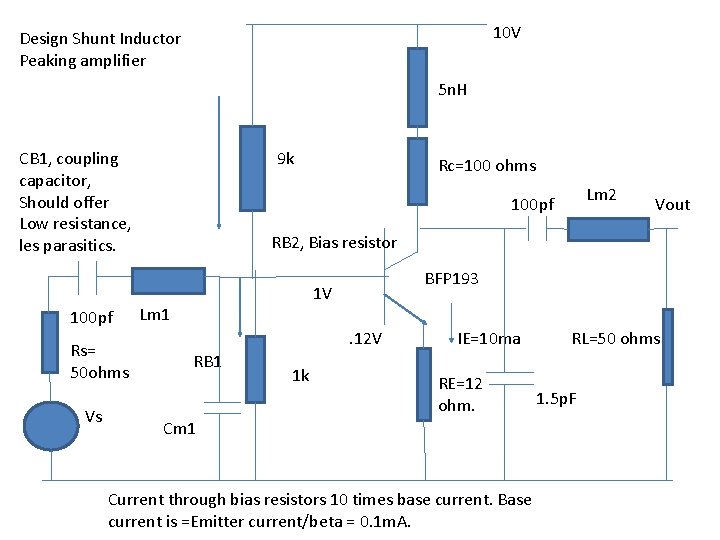
10 V Design Shunt Inductor Peaking amplifier 5 n. H CB 1, coupling capacitor, Should offer Low resistance, les parasitics. 100 pf Rs= 50 ohms Vs 9 k Rc=100 ohms Lm 2 100 pf Vout RB 2, Bias resistor BFP 193 1 V Lm 1 . 12 V RB 1 1 k IE=10 ma RE=12 ohm. Cm 1 Current through bias resistors 10 times base current. Base current is =Emitter current/beta = 0. 1 m. A. RL=50 ohms 1. 5 p. F
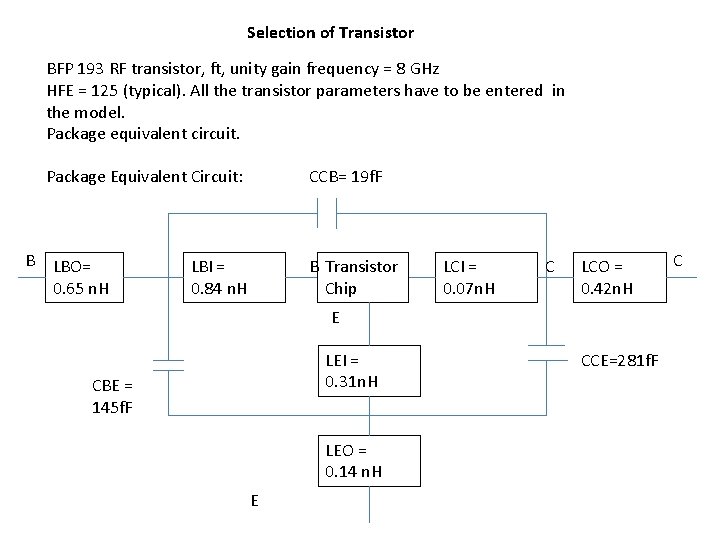
Selection of Transistor BFP 193 RF transistor, ft, unity gain frequency = 8 GHz HFE = 125 (typical). All the transistor parameters have to be entered in the model. Package equivalent circuit. Package Equivalent Circuit: B LBO= 0. 65 n. H CCB= 19 f. F B Transistor Chip LBI = 0. 84 n. H LCI = 0. 07 n. H C LCO = 0. 42 n. H E LEI = 0. 31 n. H CBE = 145 f. F LEO = 0. 14 n. H E CCE=281 f. F C
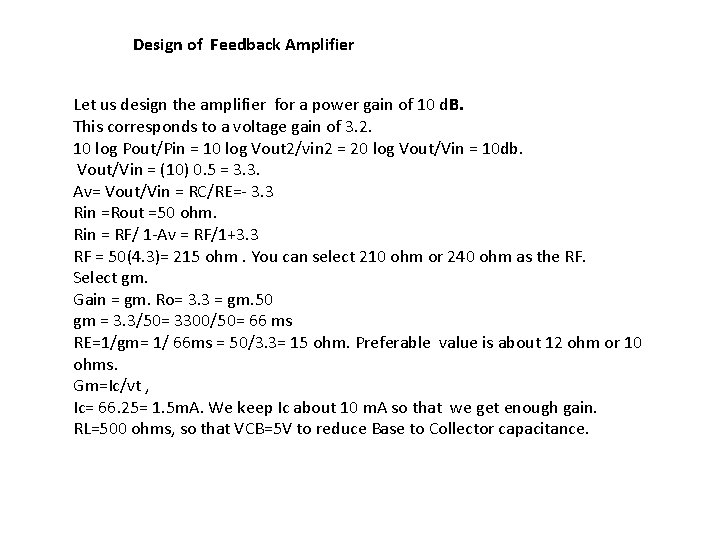
Design of Feedback Amplifier Let us design the amplifier for a power gain of 10 d. B. This corresponds to a voltage gain of 3. 2. 10 log Pout/Pin = 10 log Vout 2/vin 2 = 20 log Vout/Vin = 10 db. Vout/Vin = (10) 0. 5 = 3. 3. Av= Vout/Vin = RC/RE=- 3. 3 Rin =Rout =50 ohm. Rin = RF/ 1 -Av = RF/1+3. 3 RF = 50(4. 3)= 215 ohm. You can select 210 ohm or 240 ohm as the RF. Select gm. Gain = gm. Ro= 3. 3 = gm. 50 gm = 3. 3/50= 3300/50= 66 ms RE=1/gm= 1/ 66 ms = 50/3. 3= 15 ohm. Preferable value is about 12 ohm or 10 ohms. Gm=Ic/vt , Ic= 66. 25= 1. 5 m. A. We keep Ic about 10 m. A so that we get enough gain. RL=500 ohms, so that VCB=5 V to reduce Base to Collector capacitance.
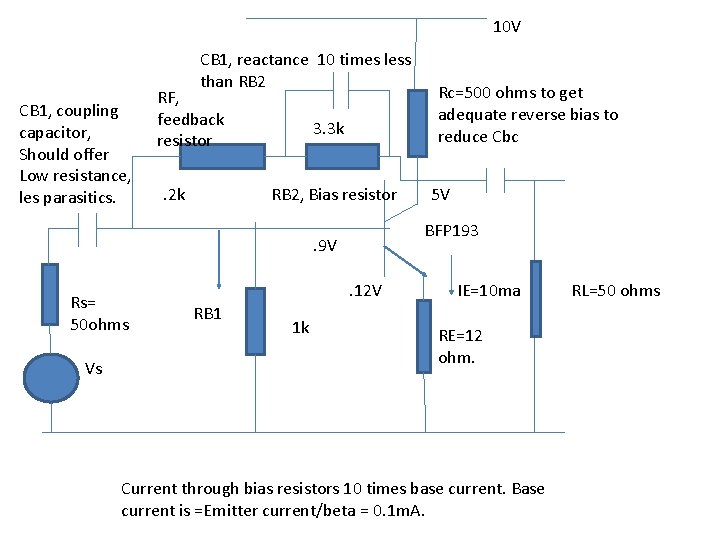
10 V CB 1, reactance 10 times less than RB 2 CB 1, coupling capacitor, Should offer Low resistance, les parasitics. RF, feedback resistor. 2 k 3. 3 k RB 2, Bias resistor Vs . 12 V RB 1 1 k 5 V BFP 193 . 9 V Rs= 50 ohms Rc=500 ohms to get adequate reverse bias to reduce Cbc IE=10 ma RE=12 ohm. Current through bias resistors 10 times base current. Base current is =Emitter current/beta = 0. 1 m. A. RL=50 ohms
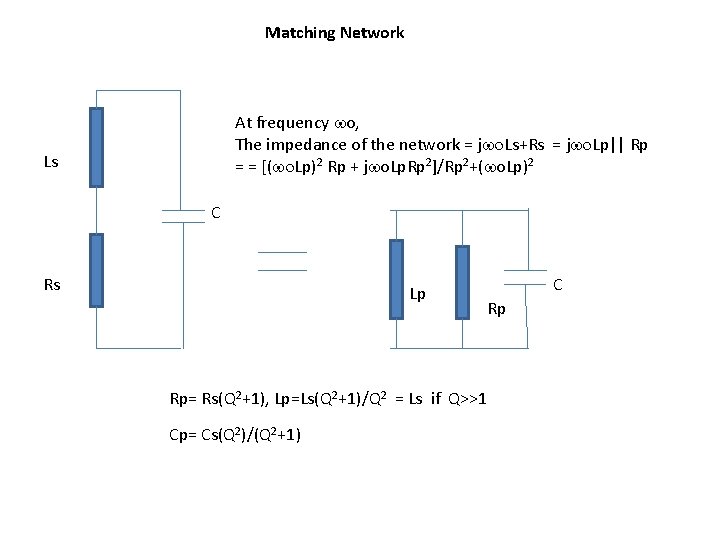
Matching Network At frequency wo, The impedance of the network = jwo. Ls+Rs = jwo. Lp|| Rp = = [(wo. Lp)2 Rp + jwo. Lp. Rp 2]/Rp 2+(wo. Lp)2 Ls C Rs Lp C Rp Rp= Rs(Q 2+1), Lp=Ls(Q 2+1)/Q 2 = Ls if Q>>1 Cp= Cs(Q 2)/(Q 2+1)
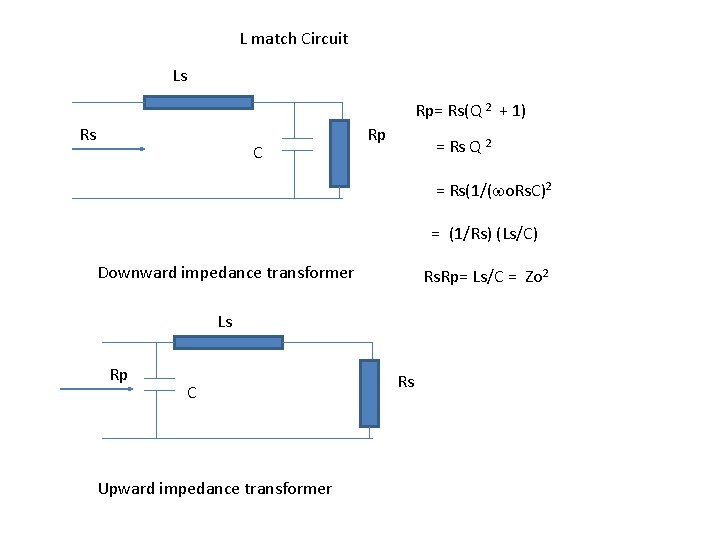
L match Circuit Ls Rp= Rs(Q 2 + 1) Rs C Rp = Rs Q 2 = Rs(1/(wo. Rs. C)2 = (1/Rs) (Ls/C) Downward impedance transformer Rs. Rp= Ls/C = Zo 2 Ls Rp C Upward impedance transformer Rs
Gain x bandwidth = constant Tuned Amplifiers If we reduce the bandwidth, gain can be high. G (BW) = gm. R. (1/RC) = gm/C
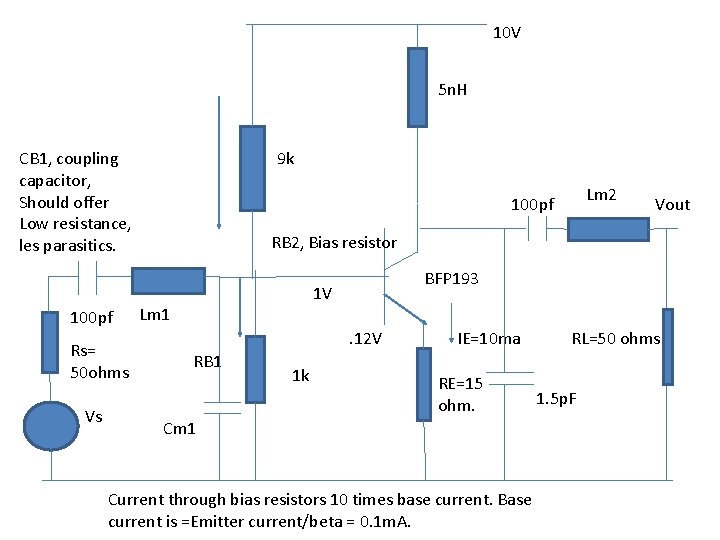
10 V 5 n. H CB 1, coupling capacitor, Should offer Low resistance, les parasitics. 100 pf Rs= 50 ohms Vs 9 k Lm 2 100 pf Vout RB 2, Bias resistor BFP 193 1 V Lm 1 . 12 V RB 1 1 k IE=10 ma RE=15 ohm. Cm 1 Current through bias resistors 10 times base current. Base current is =Emitter current/beta = 0. 1 m. A. RL=50 ohms 1. 5 p. F
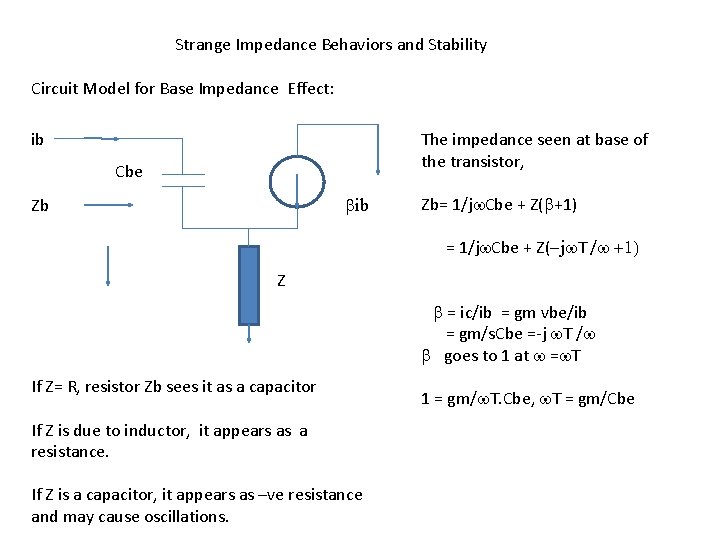
Strange Impedance Behaviors and Stability Circuit Model for Base Impedance Effect: ib The impedance seen at base of the transistor, Cbe bib Zb Zb= 1/jw. Cbe + Z(b+1) = 1/jw. Cbe + Z(-jw. T /w +1) Z b = ic/ib = gm vbe/ib = gm/s. Cbe =-j w. T /w b goes to 1 at w =w. T If Z= R, resistor Zb sees it as a capacitor If Z is due to inductor, it appears as a resistance. If Z is a capacitor, it appears as –ve resistance and may cause oscillations. 1 = gm/w. T. Cbe, w. T = gm/Cbe
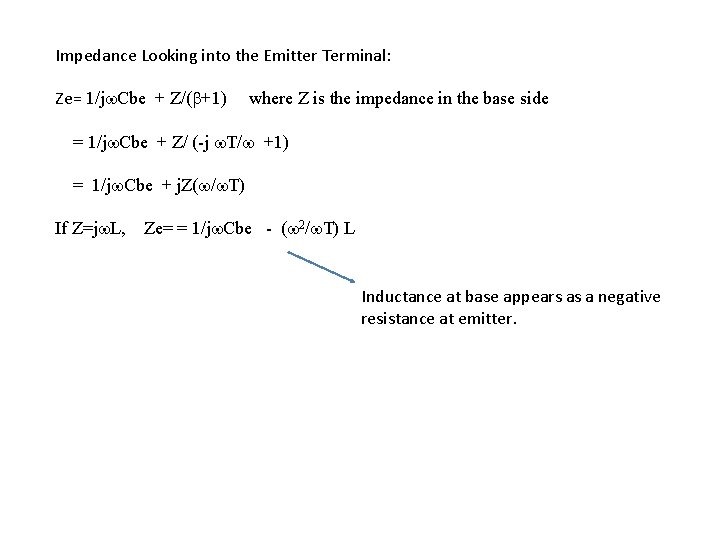
Impedance Looking into the Emitter Terminal: Ze= 1/jw. Cbe + Z/(b+1) where Z is the impedance in the base side = 1/jw. Cbe + Z/ (-j w. T/w +1) = 1/jw. Cbe + j. Z(w/w. T) If Z=jw. L, Ze= = 1/jw. Cbe - (w 2/w. T) L Inductance at base appears as a negative resistance at emitter.
- Slides: 14