
Revolutionary War Battles in Georgia Unit 3 http
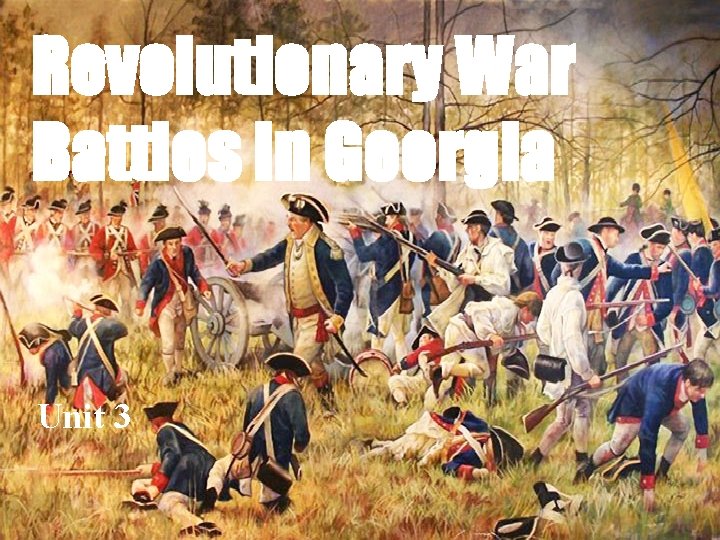
Revolutionary War Battles in Georgia Unit 3
http: //www. gpb. org/files/big-question After viewing the video, which side would you be on. Give examples from what was said in the video. Activating the Lesson
• The desire for independence was not as strong in Georgia as in other colonies. • Why? • Georgia had prospered under British rule. • Georgia needed protection from Native Americans. • Many of the laws and taxes imposed on the colonies had little effect on Georgia. Mixed Feelings in Georgia
• There were some Georgians that were dissatisfied with British policies. • Georgia did not send a representative to the meeting opposing the Stamp Act. • The publisher of the Georgia Gazette, Georgia’s only newspaper, stopped publication for a year in protest to the tax. Mixed Feelings in Georgia
• In 1774, the First Continental Congress met in Philadelphia. • Georgia was the only colony to not send a delegate. • The delegates decided to cut off trade with England until taxes and trade regulations were repealed. • Before a second Continental Congress could meet, fighting broke out – Lexington and Concord, Massachusetts. Independence
• In 1775, the Second Continental Congress met; Georgia was represented this time. • A committee headed by Thomas Jefferson wrote the Declaration of Independence. • It was adopted on July 4, 1776. • Georgia signers of the Declaration were: • Button Gwinnett • Lyman Hall • George Walton Independence
1. Battle of Lexington and Concord 2. Button Gwinnett 3. 2 nd Continental Congress 4. Thomas Jefferson 5. Redcoats 6. Declaration of Independence Matching Key People & Events A. Author of the Declaration of Independence B. British soldiers C. Georgia’s delegate to the 2 nd Continental Congress D. Statement of American Independence from England E. First armed conflict of the Revolutionary War F. Meeting where colonists listed reasons for independence from England
1. All Georgians were in favor of American independence from Britain. 2. Georgia was not represented at the 1 st Continental Congress. 3. The first armed conflict of the American Revolution took place in Massachusetts. 4. Georgia was not represented at the 2 nd Continental Congress. 5. Both the 1 st and 2 nd Continental Congresses took place before the Revolutionary War began. 6. Thomas Jefferson was the primary author of the Declaration of Independence. 7. Georgians Button Gwinnett, Lyman Hall, and George Walton signed the Declaration of Independence. True/False Make False statements True
• Loyalties in Georgia were split. • Loyalists or Tories were people loyal to England. • Patriots were those supporting independence. • In 1778, British regiments began moving inland from the Georgia coast. • The first major battle in the South took place in Savannah. • Savannah fell to the British on December 29, 1778. • Augusta fell a month later. War comes to Georgia
1. “England has supported the colony since the beginning. Some of these colonists are not grateful for that, but I certainly am!” 2. “I believe in this battle for independence and am willing to fight for it. ” 3. “I hope the British troops overwhelm the local, untrained militia. ” 4. “I was born in England remain loyal to her. ” 5. “It’s time to take a stand. We will no longer pay those taxes imposed on the colonies!” 6. “Losing Savannah and Augusta to the British is a bad blow, but we must continue to fight!” Point of View Loyalist or Patriot?
• Although not as important as other American victories, this battle was important to Georgia patriots. • To raise morale • To give them much needed supplies • To set the stage for several victories. Battle of Kettle Creek
• It took place on February 14, 1779. • Elijah Clarke and Thomas Dooly led the Georgia militia on an attack of an encampment of 600 British Loyalists. • Although outnumbered, the Patriots routed the Loyalist troops with a surprise attack. • Heroic actions of Elijah Clarke and Austin Dabney during this battle made them Georgia heroes. Battle of Kettle Creek
• In October 1779, a joint force of French and Patriot troops attacked Savannah in hopes of regaining it. • The French fleet was commanded by Count Charles Henri D’Estaing. • The battle lasted only 90 minutes but led to the deaths of 800 allied troops to Britain’s 18. • Count Casimir Pulaski, a famous Polish soldier who came to fight for freedom, died in a cavalry charge. Siege of Savannah
• The attack failed. • Savannah remained under British control until 1782. • This battle was the second bloodiest battle of the Revolutionary War. • http: //www. gpb. org/georgiastories/s avannah_under_attack Siege of Savannah
• The treaty that ended the Revolutionary War. • It granted the United States independence from England. Treaty of Paris of 1783
1. Were Loyalists allied with the British? 2. Was the Battle of Kettle Creek an American defeat? 3. Was the siege of Savannah the bloodiest battle in the Revolution? 4. Were the French allied with the British during the siege of Savannah? 5. Did the Treaty of Paris of 1783 give America independence from England? Yes or No Explain why or why not.
• Elijah Clarke • Early in the war, he fought the Creeks and Cherokee who had sided with the British. • He led a small group of men disrupting the British and Loyalists with surprise attacks behind enemy lines. • The surprise attacks were called guerilla tactics. • He helped recapture Augusta in 1781. • Not only did he battle the Loyalists but also wounds, small pox, and the mumps. Heroic Georgians
• Austin Dabney • He was a slave who fought under Elijah Clarke. • He took the place of his master, substituting for him in the war. • He thought to be the only African-American to fight in the Battle of Kettle Creek. Heroic Georgians
• Austin Dabney • After the war, Dabney lived with one of his fellow soldiers, Giles Harris who took care of Dabney after he was wounded. • In 1786, Georgia’s General Assembly gave Dabney his freedom. • This prevented Dabney’s former master from taking advantage of Dabney’s fame. • The state also granted him 50 acres of land for his service during the Revolution. Heroic Georgians

• https: //www. pbs. org/video/georgia-stories-nancy-hartstory/ Heroic Georgians
• Nancy Hart: six foot tall, red-head • She is most well-known for capturing and killing several Loyalist soldiers who food and quarters. • As they were eating and drinking, Nancy Hart was hiding their weapons. • When they realized that their weapons were gone, they charged her. • She killed one, wounding another, and holding the others at gunpoint until her husband got home. Heroic Georgians
• Nancy Hart: • The rumor… • The soldiers were hanged and buried on her property. • In 1912, railroad workers came across a grave on the Hart property with six skeletons. • She served as a Patriot spy during the war. • It is also rumored that she fought in the Battle of Kettle Creek. Heroic Georgians
• Compare the video to what we learned in class. In great detail, describe Nancy Hart and why she was important to Georgia during the Revolutionary War. Heroic Georgians
1. In what 1779 battle did Elijah Clarke fight? 2. What kind of tactics did Elijah Clarke use so effectively against the British? Explain how they worked. 3. What city did Clarke help recapture in 1781? 4. Name two diseases that Clarke battled during the Revolutionary War. How well do you know our Georgia Heroes?
5. Why was Austin Dabney serving as a soldier? 6. Why did the General Assembly give Dabney his freedom? 7. In what battle did Dabney suffer his wounds? How well do you know our Georgia Heroes?
8. Why did British soldiers charge at Nancy Hart? 9. What was found in a grave near Nancy Hart’s property in 1912? 10. Who was Hart County named after? Why is that significant? 11. What physical characteristic may have helped Nancy Hart pose as a man? How well do you know our Georgia Heroes?
• Button Gwinnett • He was a delegate to the Second Continental Congress. • He signed the Declaration of Independence. • He was the chairman of the committee that wrote the Georgia Constitution of 1777. • He became governor in 1777. • Gwinnett feuded with his bitter enemy Lachlan Mc. Intosh. • Gwinnett challenged Mc. Intosh to a duel and died from his injuries three days later. Georgia’s Political Leaders
• Lyman Hall • He was a minister and a doctor. • He was also a delegate of the Second Continental Congress and signed the Declaration of Independence. • Hall was elected governor in 1783. • He was instrumental in founding the University of Georgia’s Political Leaders
• George Walton • Walton was the most politically successful of the three signers. • He was a successful lawyer. • He was wounded and captured by the British during the assault on Savannah. • During his 30 -year political career, Walton served as representative to Congress, circuit court judge, chief justice of Georgia, governor of Georgia, and U. S. Senator. Georgia’s Political Leaders
1. This patriot was a minister and a doctor. 2. This lawyer was wounded during the Revolutionary War. 3. This patriot was killed in a duel. 4. Gwinnett, Hall, and Walton all held this Georgia political office. 5. What document did Gwinnett, Hall, and Walton sign? Who’s Who
• Groups of 6 • Each group is going to create a Who’s Who poster. Include: • Elijah Clarke • Austin Dabney • Nancy Hart • Button Gwinnett • Lyman Hall • George Walton • It must have their contributions to the State of Georgia and a picture. Who’s Who
- Slides: 31