
REVOLUTIONARY LITERATURE Rise to Rationalism THE SECRET TO
- Slides: 21
REVOLUTIONARY LITERATURE Rise to Rationalism
THE SECRET TO UNDERSTANDING AMERICAN LITERATURE: Every literary period is a reaction to the period that came before it.
RECAP: COLONIAL LITERATURE 1620 -1750 New colonists attempted to establish their government and protest European ways Influenced by Puritan way of life and religion § Hard work, simple life, and Christianity § Man is inherently evil Amateur writers (ordinary people) They wrote about what they knew best: their own life Types of Writing: § Diaries/journals, personal narratives, sermons Representative Authors: § William Bradford, Jonathan Edwards, Mary Rowlandson
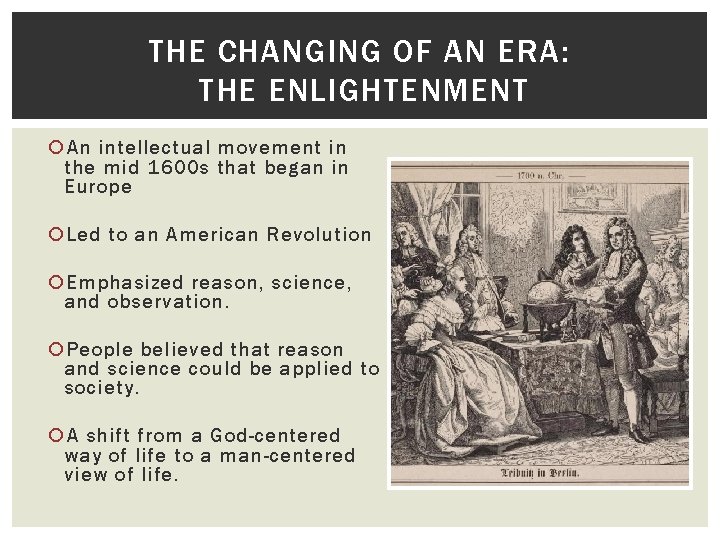
THE CHANGING OF AN ERA: THE ENLIGHTENMENT An intellectual movement in the mid 1600 s that began in Europe Led to an American Revolution Emphasized reason, science, and observation. People believed that reason and science could be applied to society. A shift from a God-centered way of life to a man-centered view of life.
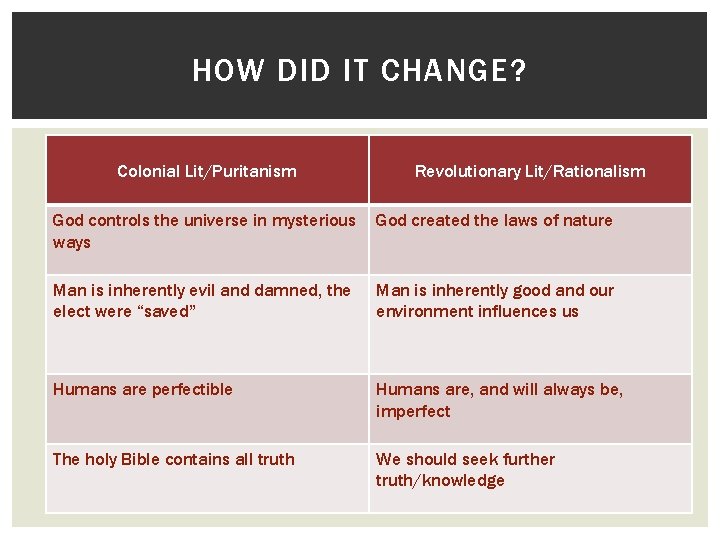
HOW DID IT CHANGE? Colonial Lit/Puritanism Revolutionary Lit/Rationalism God controls the universe in mysterious ways God created the laws of nature Man is inherently evil and damned, the elect were “saved” Man is inherently good and our environment influences us Humans are perfectible Humans are, and will always be, imperfect The holy Bible contains all truth We should seek further truth/knowledge
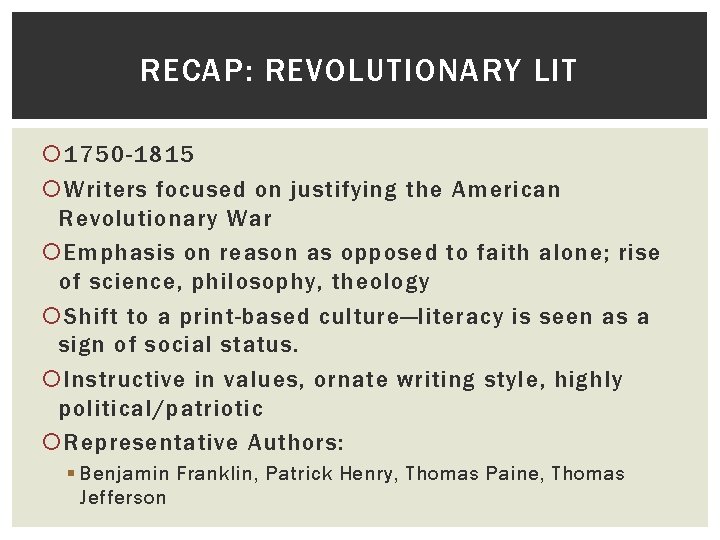
RECAP: REVOLUTIONARY LIT 1750 -1815 Writers focused on justifying the American Revolutionary War Emphasis on reason as opposed to faith alone; rise of science, philosophy, theology Shift to a print-based culture—literacy is seen as a sign of social status. Instructive in values, ornate writing style, highly political/patriotic Representative Authors: § Benjamin Franklin, Patrick Henry, Thomas Paine, Thomas Jefferson
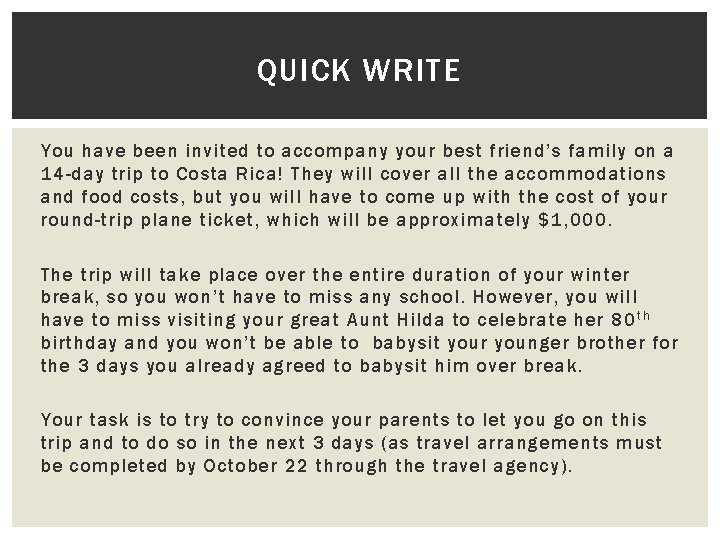
QUICK WRITE You have been invited to accompany your best friend’s family on a 14 -day trip to Costa Rica! They will cover all the accommodations and food costs, but you will have to come up with the cost of your round-trip plane ticket, which will be approximately $1, 000. The trip will take place over the entire duration of your winter break, so you won’t have to miss any school. However, you will have to miss visiting your great Aunt Hilda to celebrate her 80 t h birthday and you won’t be able to babysit your younger brother for the 3 days you already agreed to babysit him over break. Your task is to try to convince your parents to let you go on this trip and to do so in the next 3 days (as travel arrangements must be completed by October 22 through the travel agency).
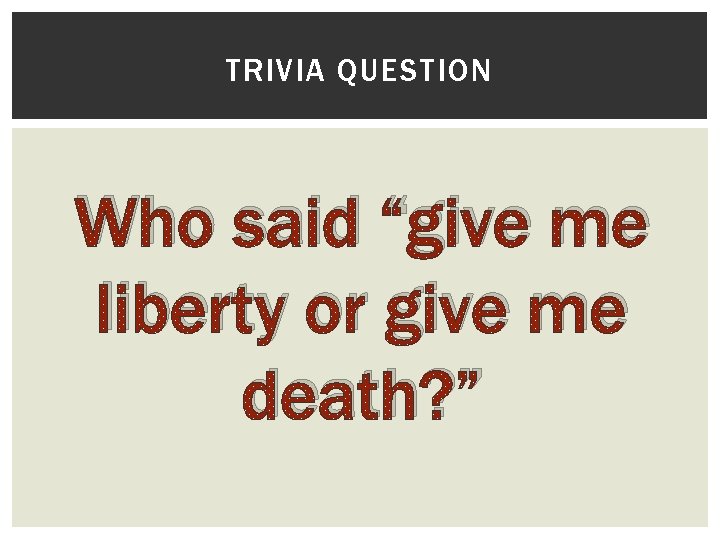
TRIVIA QUESTION Who said “give me liberty or give me death? ”
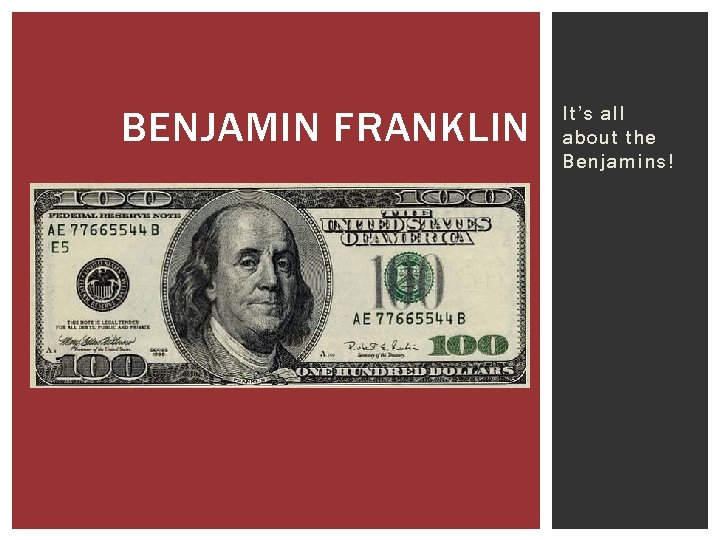
BENJAMIN FRANKLIN It’s all about the Benjamins!
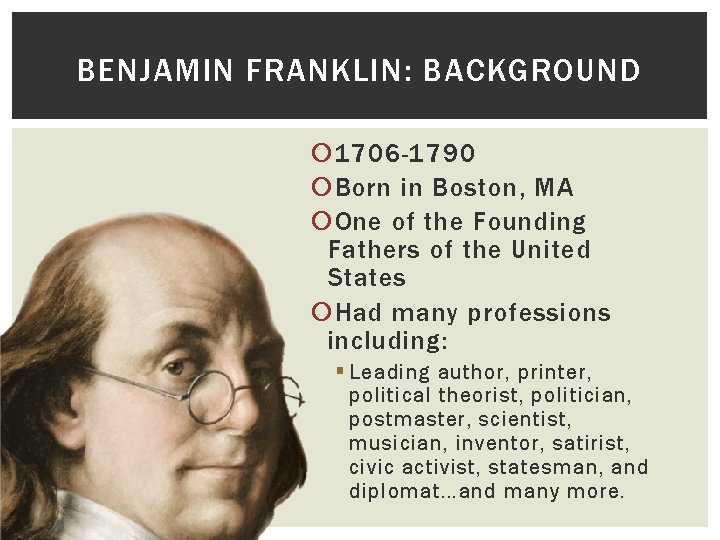
BENJAMIN FRANKLIN: BACKGROUND 1706 -1790 Born in Boston, MA One of the Founding Fathers of the United States Had many professions including: § Leading author, printer, political theorist, politician, postmaster, scientist, musician, inventor, satirist, civic activist, statesman, and diplomat…and many more.
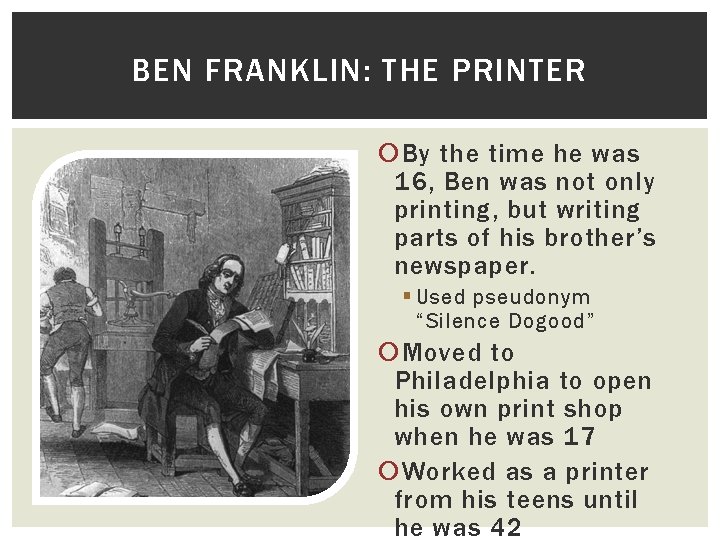
BEN FRANKLIN: THE PRINTER By the time he was 16, Ben was not only printing, but writing parts of his brother’s newspaper. § Used pseudonym “Silence Dogood” Moved to Philadelphia to open his own print shop when he was 17 Worked as a printer from his teens until he was 42
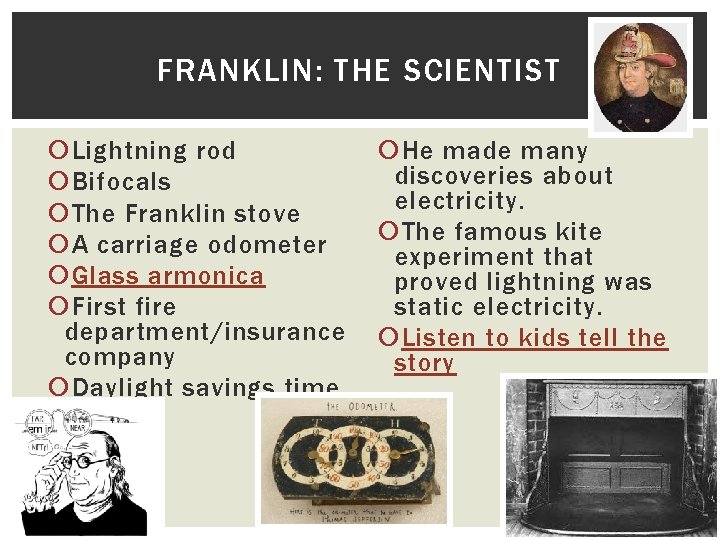
FRANKLIN: THE SCIENTIST Lightning rod Bifocals The Franklin stove A carriage odometer Glass armonica First fire department/insurance company Daylight savings time He made many discoveries about electricity. The famous kite experiment that proved lightning was static electricity. Listen to kids tell the story
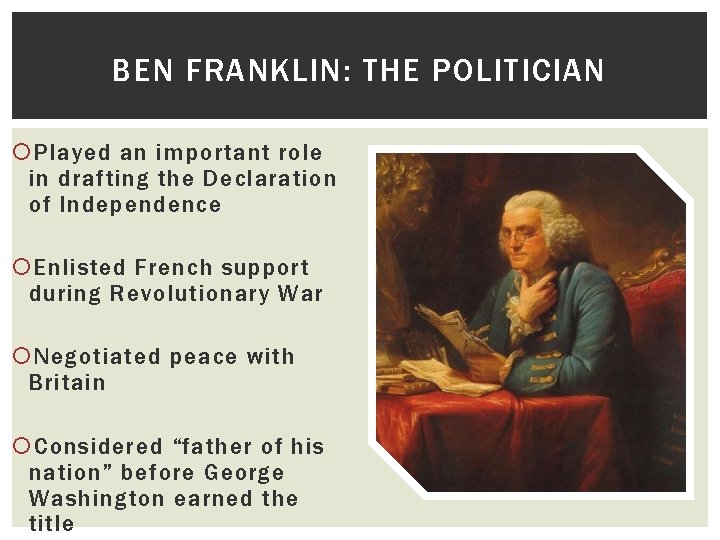
BEN FRANKLIN: THE POLITICIAN Played an important role in drafting the Declaration of Independence Enlisted French support during Revolutionary War Negotiated peace with Britain Considered “father of his nation” before George Washington earned the title
BEN FRANKLIN: THE WRITER As an old man Ben Franklin wrote his life story to serve as an example for younger people and to offer advice. § He titled it The Autobiography of Benjamin Franklin 1 st section written in 1771 when he was 65 Eventually wrote three more sections and still did not finish § Only accounted his life up to 1759
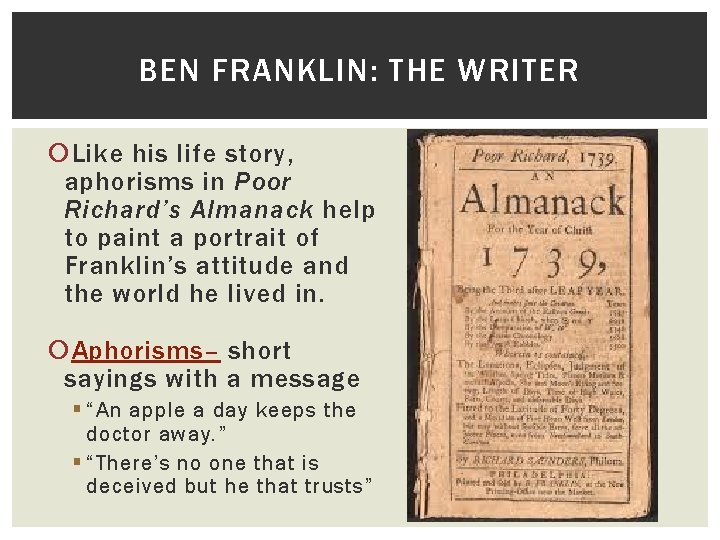
BEN FRANKLIN: THE WRITER Like his life story, aphorisms in Poor Richard’s Almanack help to paint a portrait of Franklin’s attitude and the world he lived in. Aphorisms– short sayings with a message § “An apple a day keeps the doctor away. ” § “There’s no one that is deceived but he that trusts”
JUNIORS Get out your notebook, a piece of paper, and something to write with– you have an open-note quiz. It’s two questions.
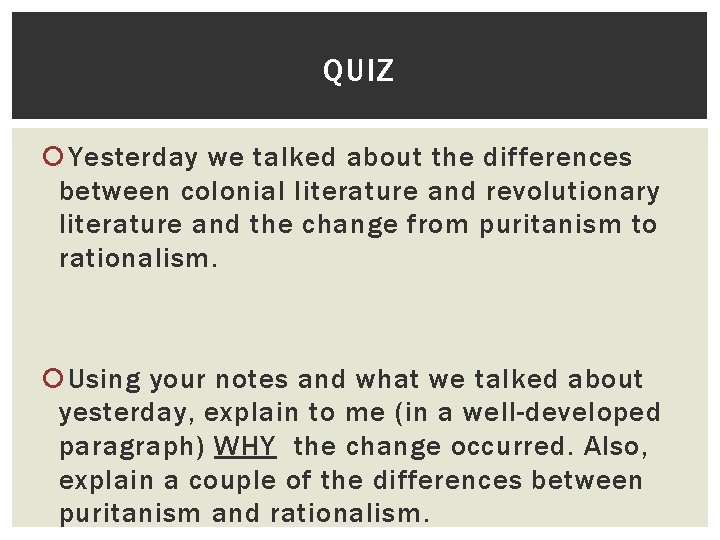
QUIZ Yesterday we talked about the differences between colonial literature and revolutionary literature and the change from puritanism to rationalism. Using your notes and what we talked about yesterday, explain to me (in a well-developed paragraph) WHY the change occurred. Also, explain a couple of the differences between puritanism and rationalism.
APHORISM PROJECT/SPEECH A speech! What?
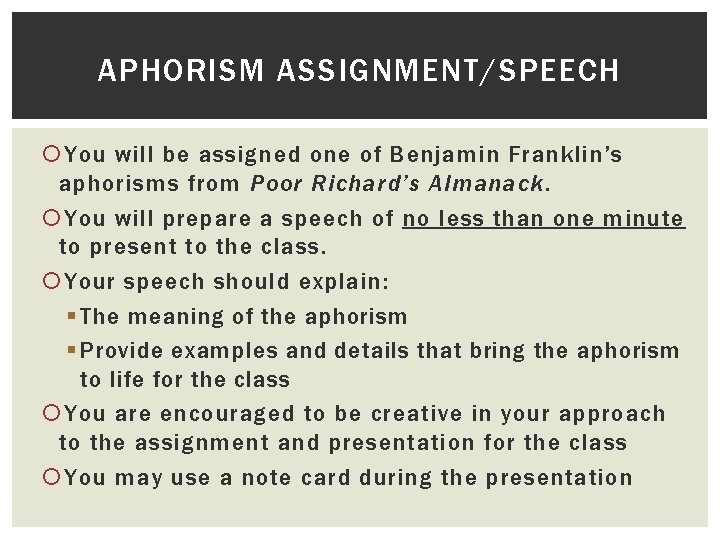
APHORISM ASSIGNMENT/SPEECH You will be assigned one of Benjamin Franklin’s aphorisms from Poor Richard’s Almanack. You will prepare a speech of no less than one minute to present to the class. Your speech should explain: § The meaning of the aphorism § Provide examples and details that bring the aphorism to life for the class You are encouraged to be creative in your approach to the assignment and presentation for the class You may use a note card during the presentation
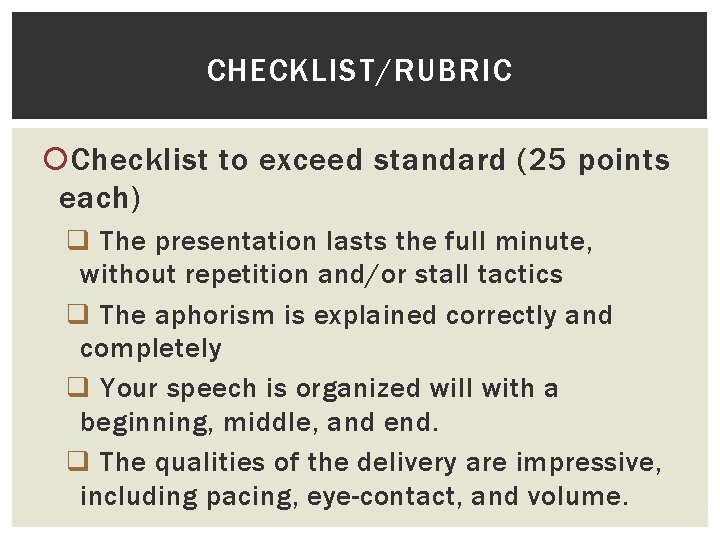
CHECKLIST/RUBRIC Checklist to exceed standard (25 points each) q The presentation lasts the full minute, without repetition and/or stall tactics q The aphorism is explained correctly and completely q Your speech is organized will with a beginning, middle, and end. q The qualities of the delivery are impressive, including pacing, eye-contact, and volume.
LAWS OF LIFE ESSAY Yes, you get the opportunity to write this… again.