
Revolution vs Rotation Revolution When a celestial body
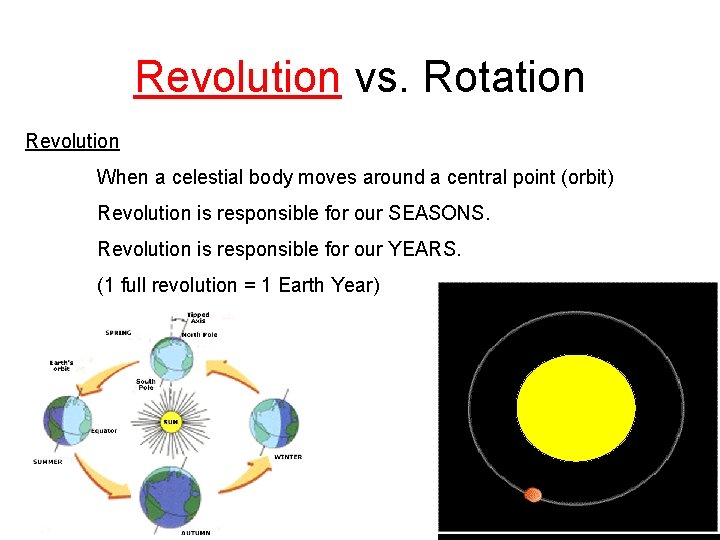
Revolution vs. Rotation Revolution When a celestial body moves around a central point (orbit) Revolution is responsible for our SEASONS. Revolution is responsible for our YEARS. (1 full revolution = 1 Earth Year)
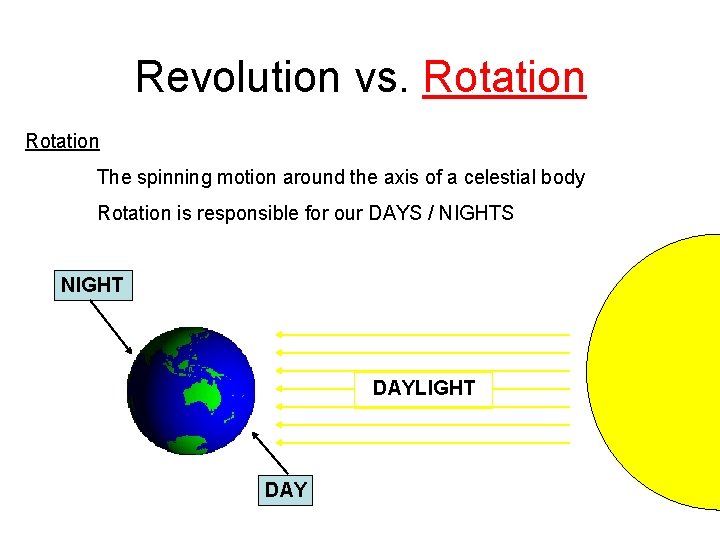
Revolution vs. Rotation The spinning motion around the axis of a celestial body Rotation is responsible for our DAYS / NIGHTS NIGHT DAYLIGHT DAY
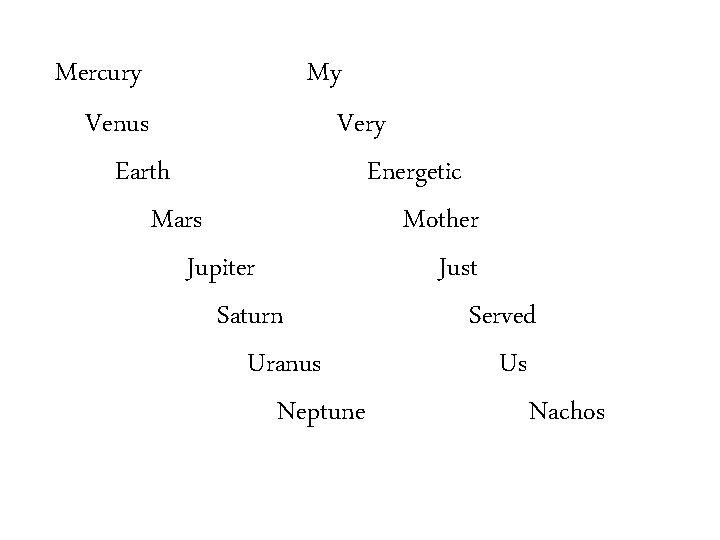
Mercury My Venus Very Earth Energetic Mars Mother Jupiter Just Saturn Served Uranus Us Neptune Nachos
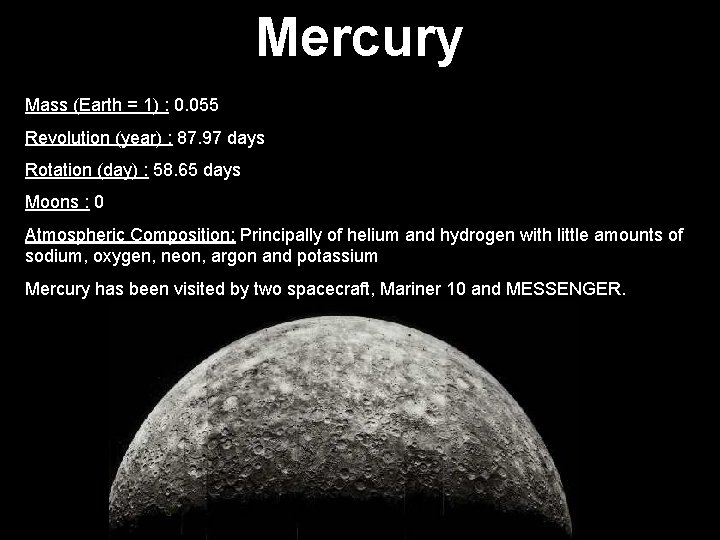
Mercury Mass (Earth = 1) : 0. 055 Revolution (year) : 87. 97 days Rotation (day) : 58. 65 days Moons : 0 Atmospheric Composition: Principally of helium and hydrogen with little amounts of sodium, oxygen, neon, argon and potassium Mercury has been visited by two spacecraft, Mariner 10 and MESSENGER.
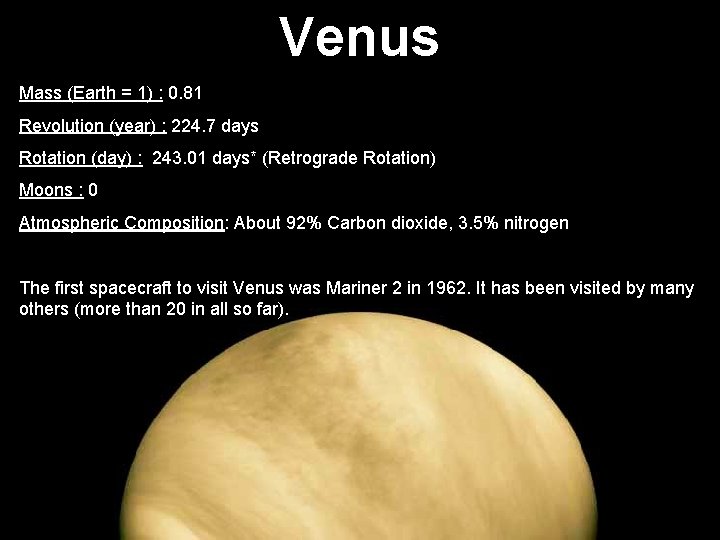
Venus Mass (Earth = 1) : 0. 81 Revolution (year) : 224. 7 days Rotation (day) : 243. 01 days* (Retrograde Rotation) Moons : 0 Atmospheric Composition: About 92% Carbon dioxide, 3. 5% nitrogen The first spacecraft to visit Venus was Mariner 2 in 1962. It has been visited by many others (more than 20 in all so far).
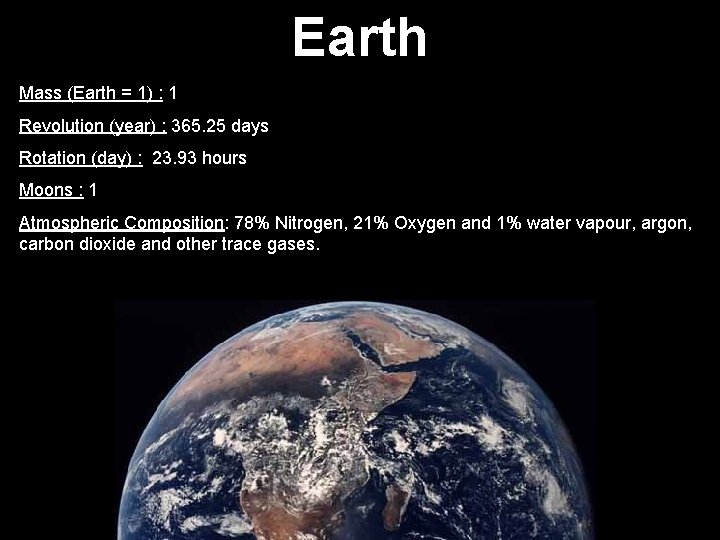
Earth Mass (Earth = 1) : 1 Revolution (year) : 365. 25 days Rotation (day) : 23. 93 hours Moons : 1 Atmospheric Composition: 78% Nitrogen, 21% Oxygen and 1% water vapour, argon, carbon dioxide and other trace gases.
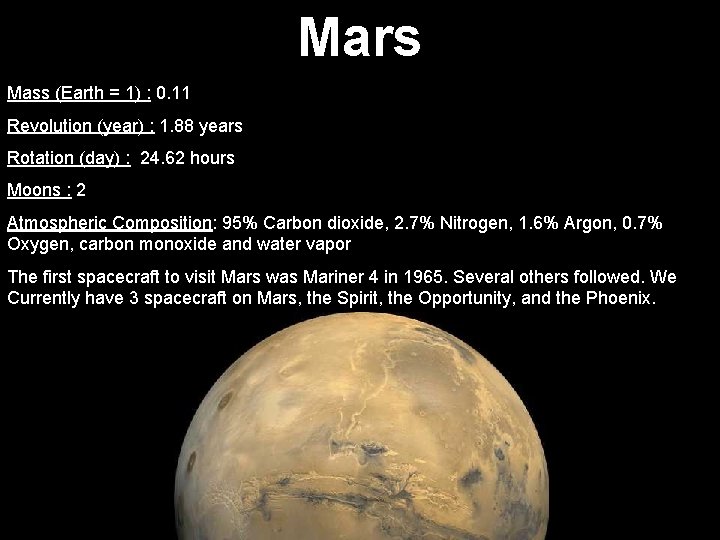
Mars Mass (Earth = 1) : 0. 11 Revolution (year) : 1. 88 years Rotation (day) : 24. 62 hours Moons : 2 Atmospheric Composition: 95% Carbon dioxide, 2. 7% Nitrogen, 1. 6% Argon, 0. 7% Oxygen, carbon monoxide and water vapor The first spacecraft to visit Mars was Mariner 4 in 1965. Several others followed. We Currently have 3 spacecraft on Mars, the Spirit, the Opportunity, and the Phoenix.
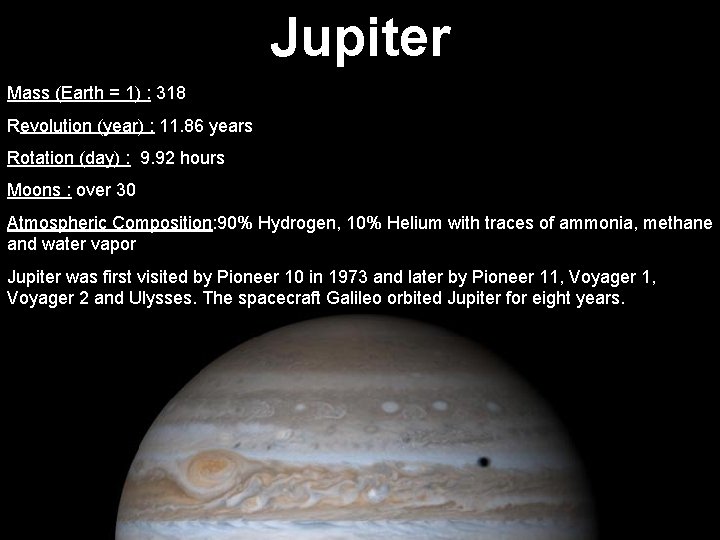
Jupiter Mass (Earth = 1) : 318 Revolution (year) : 11. 86 years Rotation (day) : 9. 92 hours Moons : over 30 Atmospheric Composition: 90% Hydrogen, 10% Helium with traces of ammonia, methane and water vapor Jupiter was first visited by Pioneer 10 in 1973 and later by Pioneer 11, Voyager 2 and Ulysses. The spacecraft Galileo orbited Jupiter for eight years.
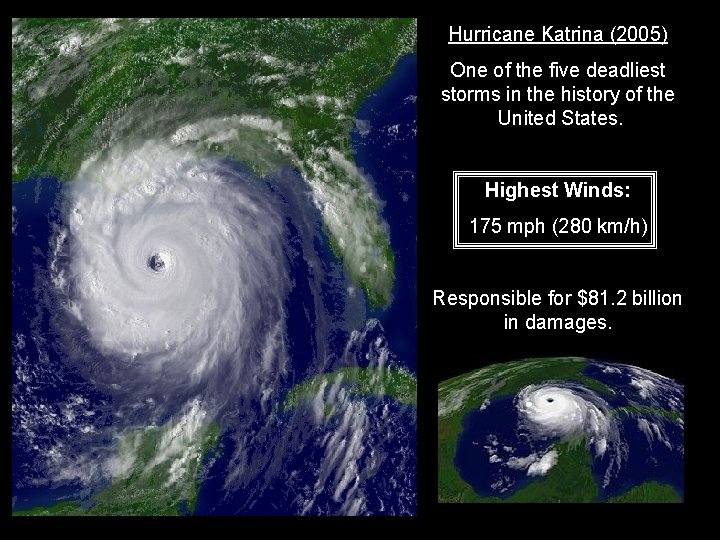
Hurricane Katrina (2005) One of the five deadliest storms in the history of the United States. Highest Winds: 175 mph (280 km/h) Responsible for $81. 2 billion in damages.
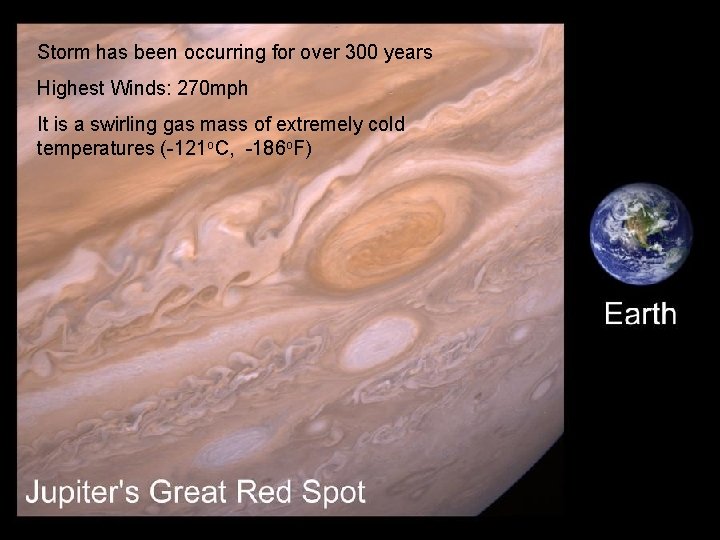
Storm has been occurring for over 300 years Highest Winds: 270 mph It is a swirling gas mass of extremely cold temperatures (-121 o. C, -186 o. F)
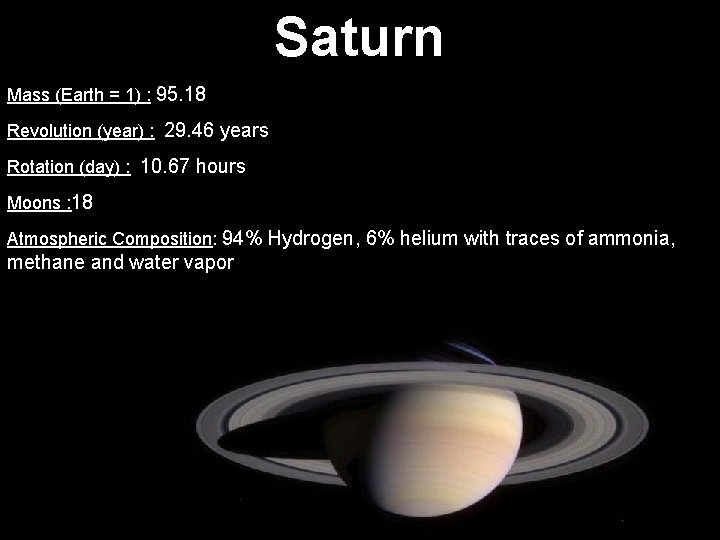
Saturn Mass (Earth = 1) : 95. 18 Revolution (year) : 29. 46 years Rotation (day) : 10. 67 hours Moons : 18 Atmospheric Composition: 94% Hydrogen, 6% helium with traces of ammonia, methane and water vapor
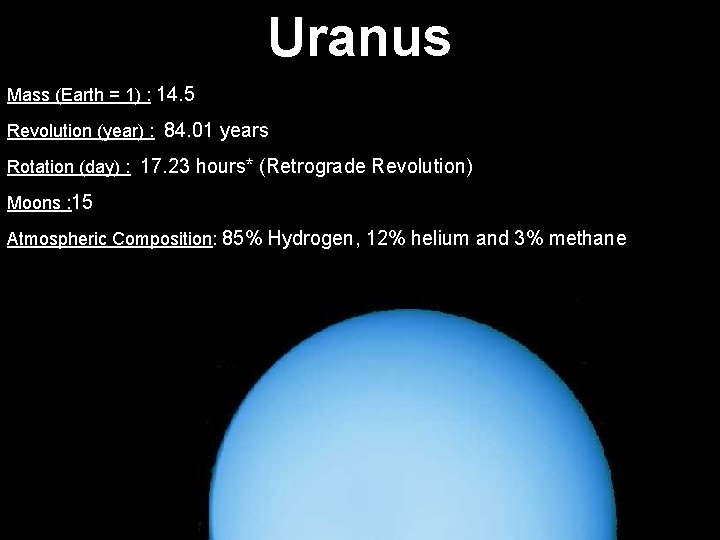
Uranus Mass (Earth = 1) : 14. 5 Revolution (year) : 84. 01 years Rotation (day) : 17. 23 hours* (Retrograde Revolution) Moons : 15 Atmospheric Composition: 85% Hydrogen, 12% helium and 3% methane
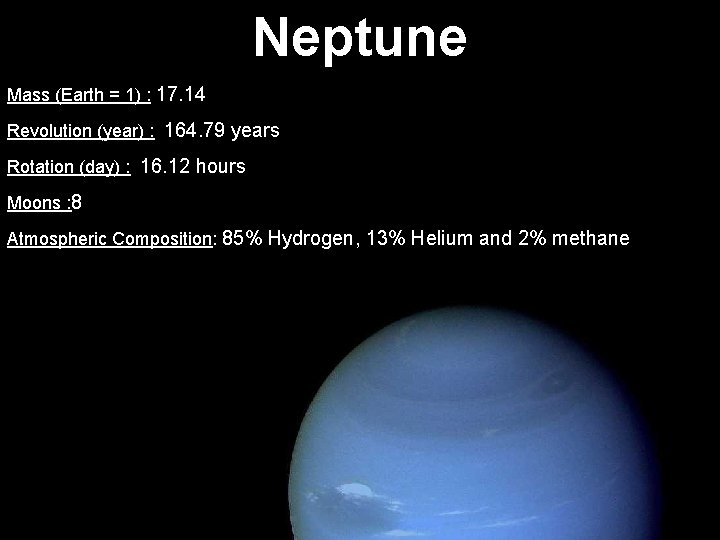
Neptune Mass (Earth = 1) : 17. 14 Revolution (year) : 164. 79 years Rotation (day) : 16. 12 hours Moons : 8 Atmospheric Composition: 85% Hydrogen, 13% Helium and 2% methane
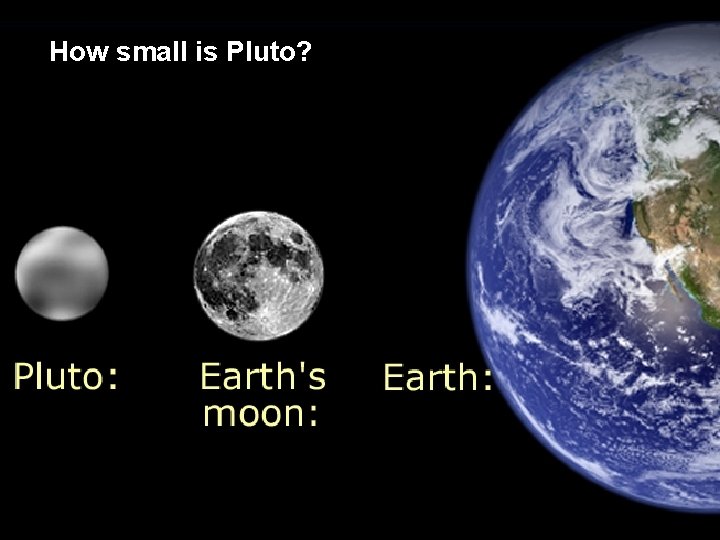
How small is Pluto?
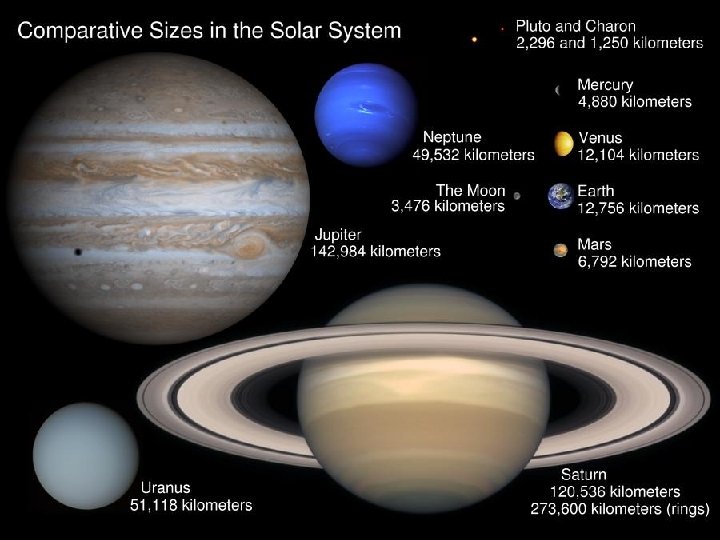
Planets around Other Stars • Current count (so far) – Over 100 planetary systems – Over 200 planets – Over 20 multiple planet systems • At least 15% of sun-like stars have planets
- Slides: 16