
Revista Informatica Economic nr 2462008 Dynamic Programming Algorithms
![References [1] Benoit Legrand, C. S. Chang, S. H. Ong, Soek-Ying Neo, Nallasivam Palanisamy,](https://slidetodoc.com/presentation_image_h2/1e7ef5b160b7c8f49e1b138c94315d33/image-15.jpg "References [1] Benoit Legrand, C. S. Chang, S. H. Ong, Soek-Ying Neo, Nallasivam Palanisamy,")
- Slides: 16
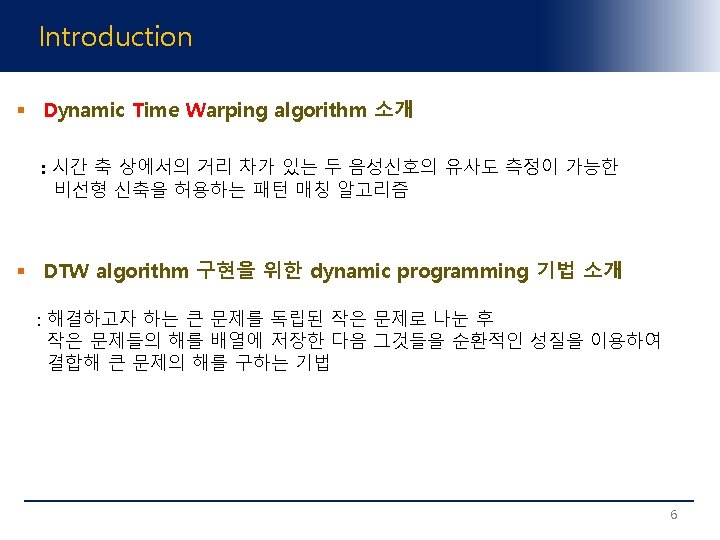
Revista Informatica Economică nr. 2(46)/2008 Dynamic Programming Algorithms in Speech Recognition Titus Felix FURTUNA Academy of Economic Studies, Bucharest titus@ase. ro 2012. 10 발표자 : 김윤지
Contents § Background(Speech recognition) § Introduction § Dynamic Time Warping(DTW) algorithm § Applications 2021 -12 -20 2
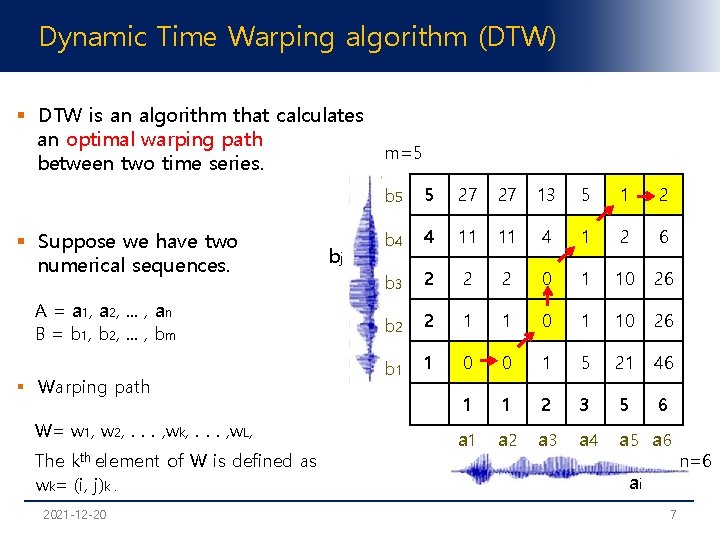
Dynamic Time Warping algorithm (DTW) § DTW is an algorithm that calculates an optimal warping path between two time series. § Suppose we have two numerical sequences. A = a 1, a 2, . . . , an B = b 1, b 2, . . . , bm § Warping path W= w 1, w 2, . . . , wk, . . . , w. L, The kth element of W is defined as wk= (i, j)k. 2021 -12 -20 bj m=5 b 5 5 27 27 13 5 1 2 b 4 4 11 11 4 1 2 6 b 3 2 2 2 0 1 10 26 b 2 2 1 1 0 1 10 26 b 1 1 0 0 1 5 21 46 1 1 2 3 5 6 a 1 a 2 a 3 a 4 a 5 a 6 ai 7 n=6
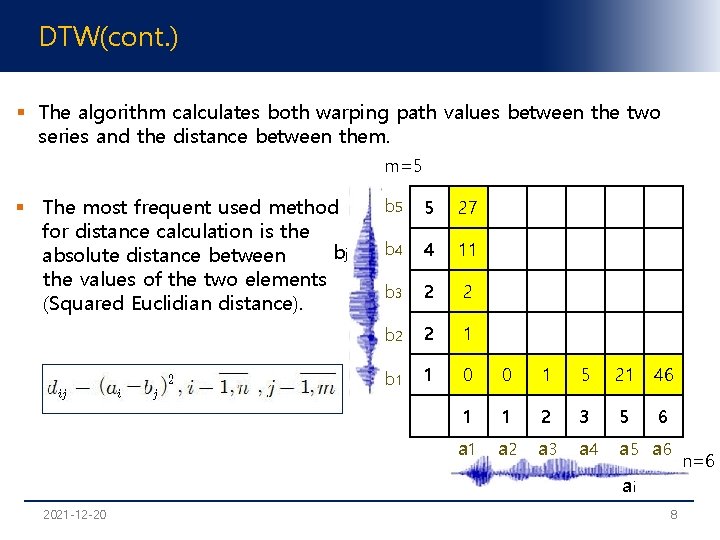
DTW(cont. ) § The algorithm calculates both warping path values between the two series and the distance between them. m=5 § The most frequent used method for distance calculation is the bj absolute distance between the values of the two elements (Squared Euclidian distance). b 5 5 27 b 4 4 11 b 3 2 2 b 2 2 1 b 1 1 0 0 1 5 21 46 1 1 2 3 5 6 a 1 a 2 a 3 a 4 a 5 a 6 ai 2021 -12 -20 8 n=6
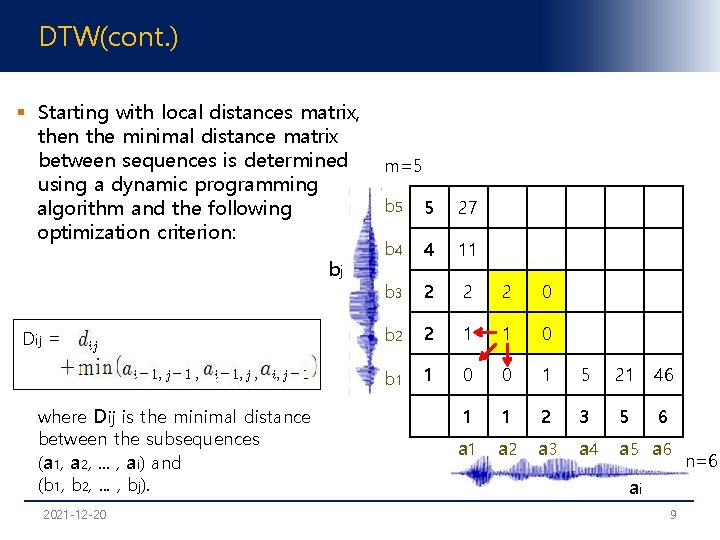
DTW(cont. ) § Starting with local distances matrix, then the minimal distance matrix between sequences is determined using a dynamic programming algorithm and the following optimization criterion: bj D ij where Dij is the minimal distance between the subsequences (a 1, a 2, . . . , ai) and (b 1, b 2, . . . , bj). 2021 -12 -20 m=5 b 5 5 27 b 4 4 11 b 3 2 2 2 0 b 2 2 1 1 0 b 1 1 0 0 1 5 21 46 1 1 2 3 5 6 a 1 a 2 a 3 a 4 a 5 a 6 n=6 ai ai 9
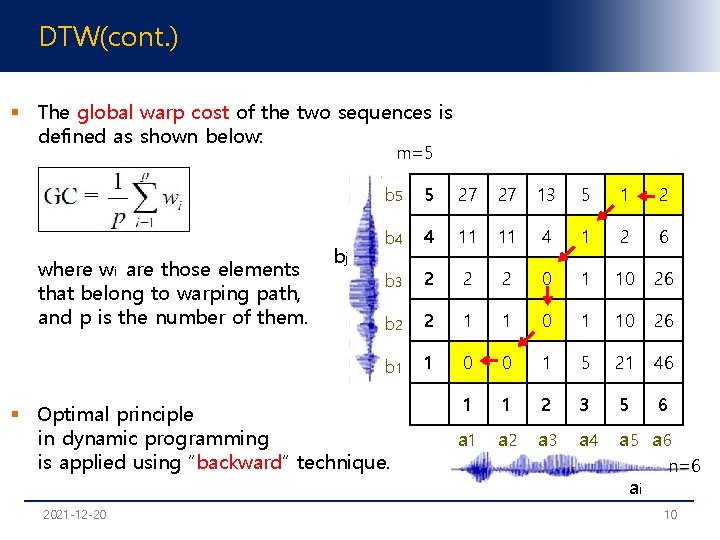
DTW(cont. ) § The global warp cost of the two sequences is defined as shown below: m=5 where wi are those elements that belong to warping path, and p is the number of them. bj b 5 5 27 27 13 5 1 2 b 4 4 11 11 4 1 2 6 b 3 2 2 2 0 1 10 26 b 2 2 1 1 0 1 10 26 b 1 1 0 0 1 5 21 46 1 1 2 3 5 6 a 1 a 2 a 3 a 4 a 5 a 6 § Optimal principle in dynamic programming is applied using “backward” technique. 2021 -12 -20 ai n=6 10
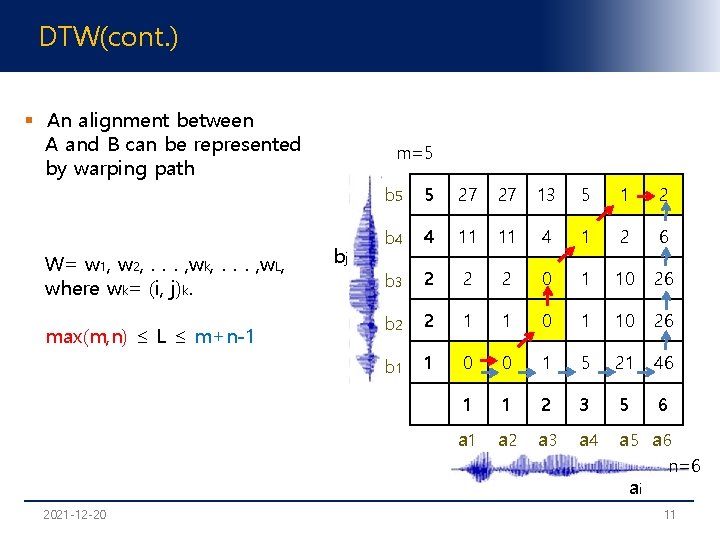
DTW(cont. ) § An alignment between A and B can be represented by warping path W= w 1, w 2, . . . , wk, . . . , w. L, where wk= (i, j)k. max(m, n) ≤ L ≤ m+n-1 m=5 bj b 5 5 27 27 13 5 1 2 b 4 4 11 11 4 1 2 6 b 3 2 2 2 0 1 10 26 b 2 2 1 1 0 1 10 26 b 1 1 0 0 1 5 21 46 1 1 2 3 5 6 a 1 a 2 a 3 a 4 a 5 a 6 ai 2021 -12 -20 n=6 11
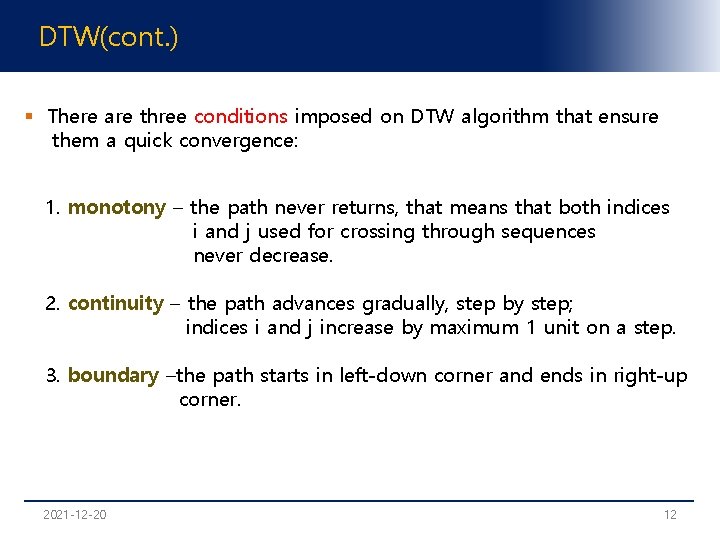
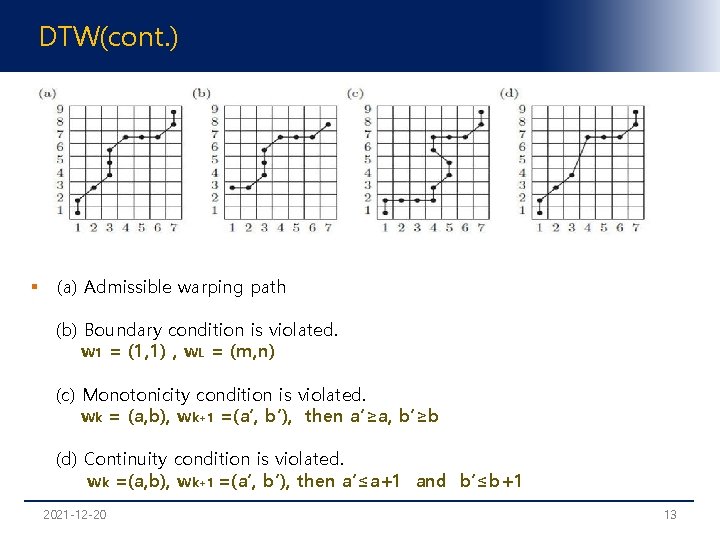
DTW(cont. ) § There are three conditions imposed on DTW algorithm that ensure them a quick convergence: 1. monotony – the path never returns, that means that both indices i and j used for crossing through sequences never decrease. 2. continuity – the path advances gradually, step by step; indices i and j increase by maximum 1 unit on a step. 3. boundary –the path starts in left-down corner and ends in right-up corner. 2021 -12 -20 12
DTW(cont. ) § (a) Admissible warping path (b) Boundary condition is violated. w 1 = (1, 1) , w. L = (m, n) (c) Monotonicity condition is violated. wk = (a, b), wk+1 =(a’, b’), then a’≥a, b’≥b (d) Continuity condition is violated. wk =(a, b), wk+1 =(a’, b’), then a’≤a+1 and b’≤b+1 2021 -12 -20 13
References [1] Benoit Legrand, C. S. Chang, S. H. Ong, Soek-Ying Neo, Nallasivam Palanisamy, Chromosome classification using dynamic time warping, Science. Direct Pattern Recognition Letters 29 (2008) 215– 222 [2] Cory Myers, Lawrence R. Rabiner, Aaron E. Rosenberg, Performance Tradeoffs in Dynamic Time Warping Algorithms for Isolated Word Recognition, Ieee Transactions On Acoustics, Speech, And Signal Processing, Vol. Assp-28, No. 6, December 1980 [3] F. Jelinek. "Continuous Speech Recognition by Statisical Methods. " IEEE Proceedings 64: 4(1976): 532 -556 [4] Rabiner, L. R. , A Tutorial on Hidden Markov Models and Selected Applications in Speech Recognition, Proc. of IEEE, Feb. 1989 [5] Rabiner, L. R. , Schafer, R. W. , Digital Processing of Speech Signals, Prentice Hall, 1978. [6] Stan Salvador, Chan, Fast. DTW: Toward Accurate Dynamic Time Warping in Linear Time and Space, IEEE Transactions on Biomedical. Engineering, vol. 43, no. 4 [7] Young, S. , A Review of Large-Vocabulary Continuous Speech Recognition, IEEE Signal Processing Magazine, pp. 4557, Sep. 1996 [8] Sakoe, H. & S. Chiba. (1978) Dynamic programming algorithm optimization for spoken word recognition. IEEE, Trans. Acoustics, Speech, and Signal Proc. , Vol. ASSP-26. [9] Furtună, F. , Dârdală, M. , Using Discriminant Analisys in Speech Recognition, The Proceedings Of The Fourth National Conference Humman Computer Interaction Rochi 2007, Universitatea Ovidius Constanţa, 2007, Matrix. Rom, Bucharest, 2007 [10] * * *, Speech Separation by Humans and Machines, Kluwer Academic Publishers, 2005 2021 -12 -20 15
감사합니다 2021 -12 -20 16