
Revisit CMOS Power Dissipation Digital inverter Active dynamic
- Slides: 22
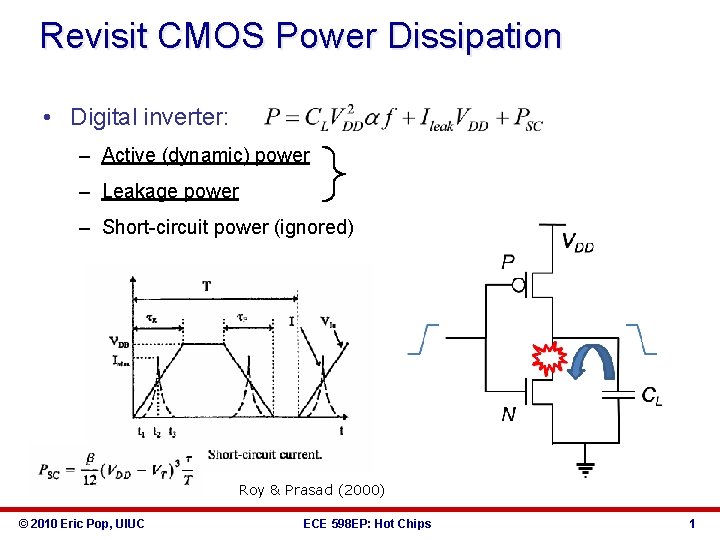
Revisit CMOS Power Dissipation • Digital inverter: – Active (dynamic) power – Leakage power – Short-circuit power (ignored) Roy & Prasad (2000) © 2010 Eric Pop, UIUC ECE 598 EP: Hot Chips 1
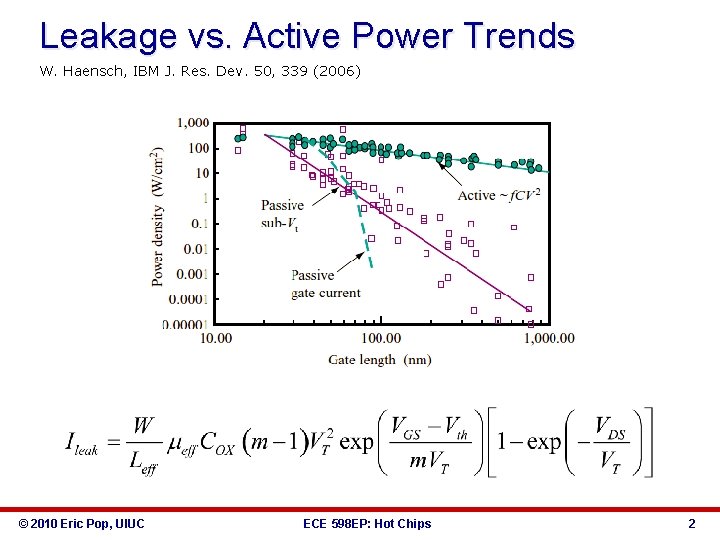
Leakage vs. Active Power Trends W. Haensch, IBM J. Res. Dev. 50, 339 (2006) © 2010 Eric Pop, UIUC ECE 598 EP: Hot Chips 2
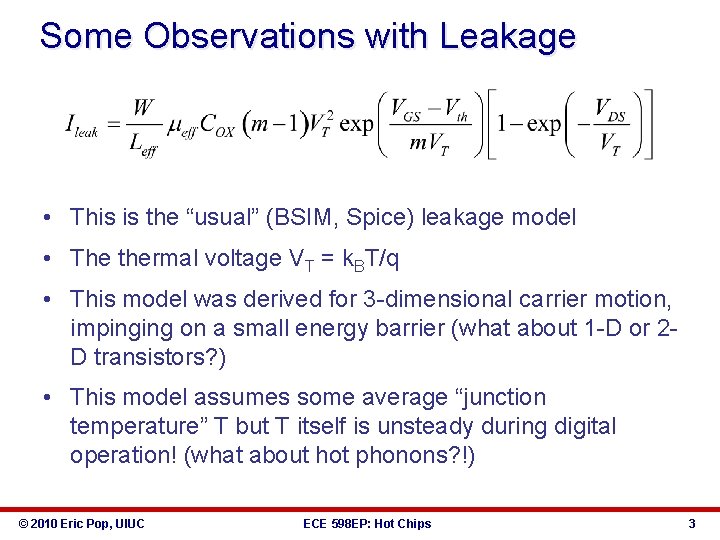
Some Observations with Leakage • This is the “usual” (BSIM, Spice) leakage model • The thermal voltage VT = k. BT/q • This model was derived for 3 -dimensional carrier motion, impinging on a small energy barrier (what about 1 -D or 2 D transistors? ) • This model assumes some average “junction temperature” T but T itself is unsteady during digital operation! (what about hot phonons? !) © 2010 Eric Pop, UIUC ECE 598 EP: Hot Chips 3
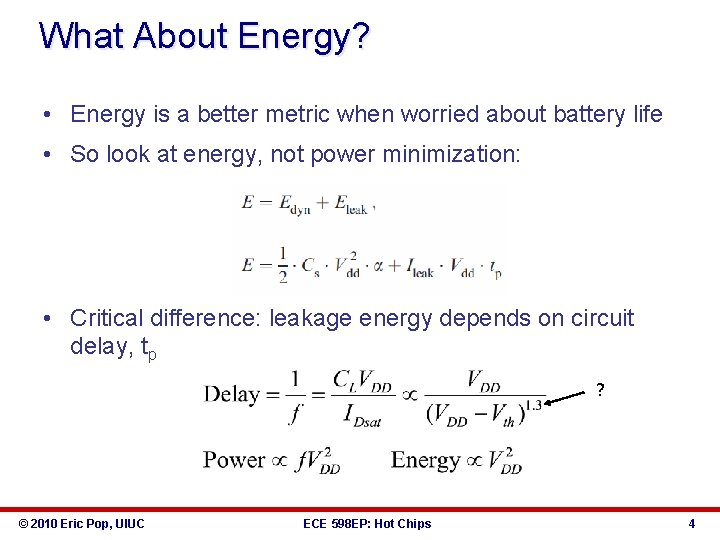
What About Energy? • Energy is a better metric when worried about battery life • So look at energy, not power minimization: • Critical difference: leakage energy depends on circuit delay, tp ? © 2010 Eric Pop, UIUC ECE 598 EP: Hot Chips 4
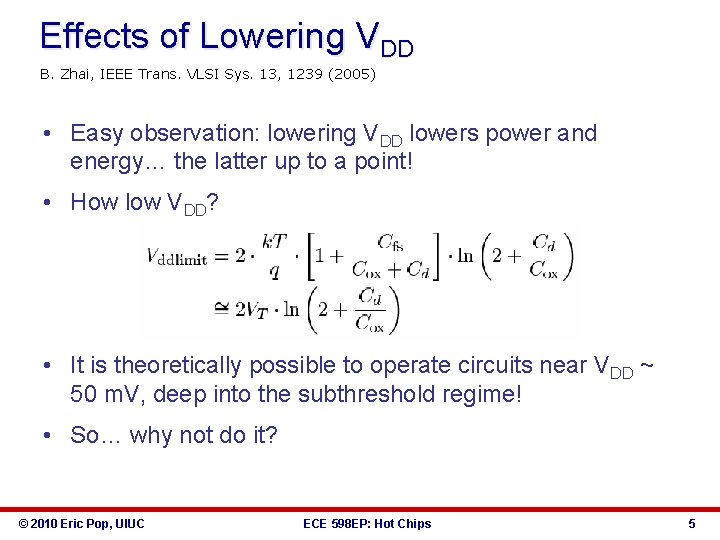
Effects of Lowering VDD B. Zhai, IEEE Trans. VLSI Sys. 13, 1239 (2005) • Easy observation: lowering VDD lowers power and energy… the latter up to a point! • How low VDD? • It is theoretically possible to operate circuits near VDD ~ 50 m. V, deep into the subthreshold regime! • So… why not do it? © 2010 Eric Pop, UIUC ECE 598 EP: Hot Chips 5
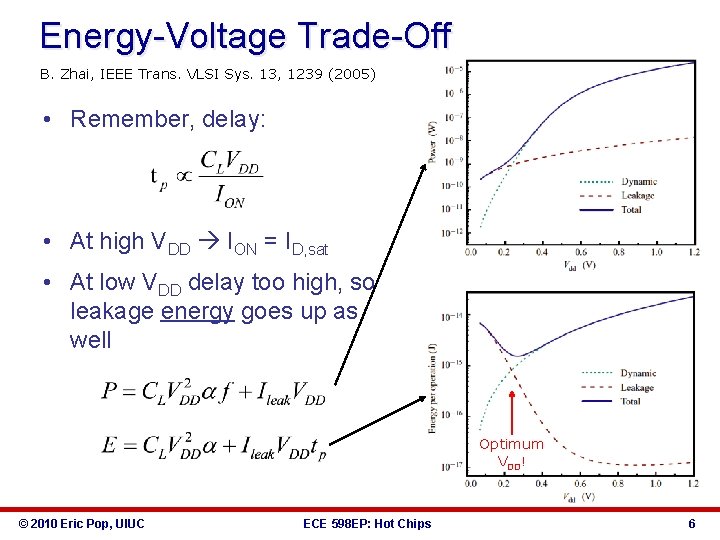
Energy-Voltage Trade-Off B. Zhai, IEEE Trans. VLSI Sys. 13, 1239 (2005) • Remember, delay: • At high VDD ION = ID, sat • At low VDD delay too high, so leakage energy goes up as well Optimum VDD! © 2010 Eric Pop, UIUC ECE 598 EP: Hot Chips 6
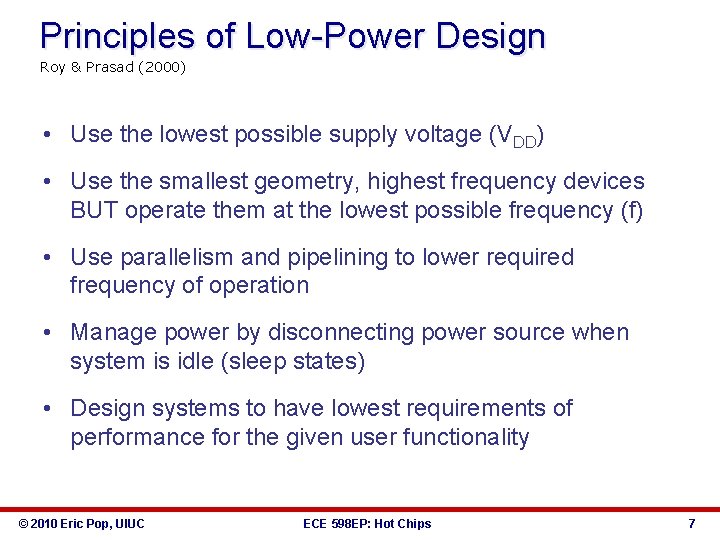
Principles of Low-Power Design Roy & Prasad (2000) • Use the lowest possible supply voltage (VDD) • Use the smallest geometry, highest frequency devices BUT operate them at the lowest possible frequency (f) • Use parallelism and pipelining to lower required frequency of operation • Manage power by disconnecting power source when system is idle (sleep states) • Design systems to have lowest requirements of performance for the given user functionality © 2010 Eric Pop, UIUC ECE 598 EP: Hot Chips 7
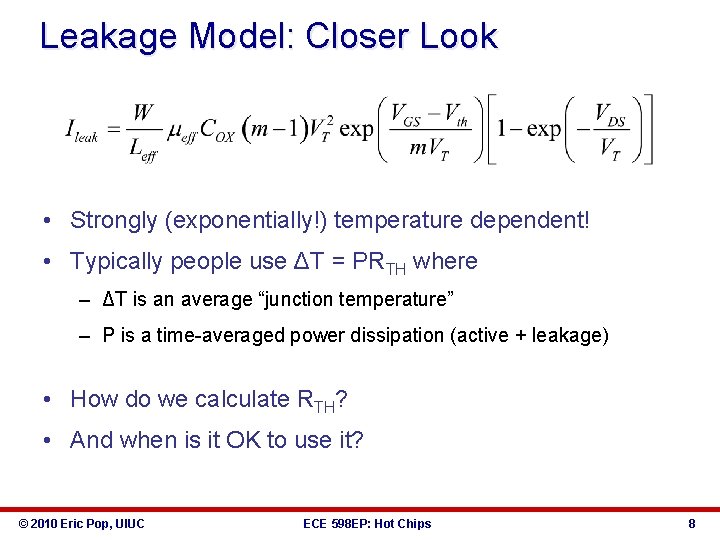
Leakage Model: Closer Look • Strongly (exponentially!) temperature dependent! • Typically people use ΔT = PRTH where – ΔT is an average “junction temperature” – P is a time-averaged power dissipation (active + leakage) • How do we calculate RTH? • And when is it OK to use it? © 2010 Eric Pop, UIUC ECE 598 EP: Hot Chips 8
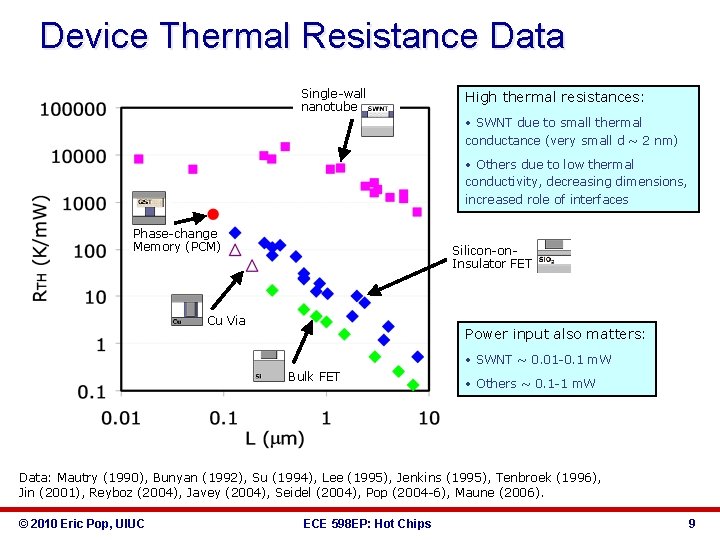
Device Thermal Resistance Data Single-wall nanotube High thermal resistances: • SWNT due to small thermal conductance (very small d ~ 2 nm) • Others due to low thermal conductivity, decreasing dimensions, increased role of interfaces Phase-change Memory (PCM) Silicon-on. Insulator FET Cu Via Power input also matters: • SWNT ~ 0. 01 -0. 1 m. W Bulk FET • Others ~ 0. 1 -1 m. W Data: Mautry (1990), Bunyan (1992), Su (1994), Lee (1995), Jenkins (1995), Tenbroek (1996), Jin (2001), Reyboz (2004), Javey (2004), Seidel (2004), Pop (2004 -6), Maune (2006). © 2010 Eric Pop, UIUC ECE 598 EP: Hot Chips 9
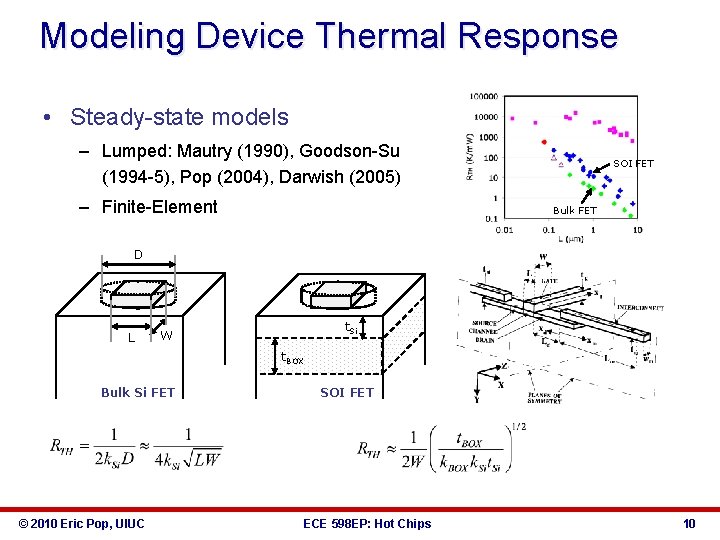
Modeling Device Thermal Response • Steady-state models – Lumped: Mautry (1990), Goodson-Su (1994 -5), Pop (2004), Darwish (2005) – Finite-Element SOI FET Bulk FET D L t. Si W t. BOX Bulk Si FET © 2010 Eric Pop, UIUC SOI FET ECE 598 EP: Hot Chips 10
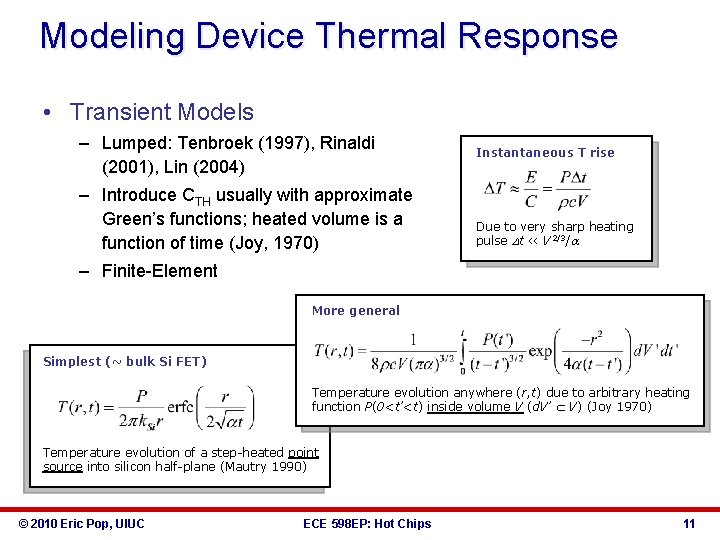
Modeling Device Thermal Response • Transient Models – Lumped: Tenbroek (1997), Rinaldi (2001), Lin (2004) – Introduce CTH usually with approximate Green’s functions; heated volume is a function of time (Joy, 1970) Instantaneous T rise Due to very sharp heating pulse t ‹‹ V 2/3/ – Finite-Element More general Simplest (~ bulk Si FET) Temperature evolution anywhere (r, t) due to arbitrary heating function P(0<t’<t) inside volume V (d. V’ V) (Joy 1970) Temperature evolution of a step-heated point source into silicon half-plane (Mautry 1990) © 2010 Eric Pop, UIUC ECE 598 EP: Hot Chips 11
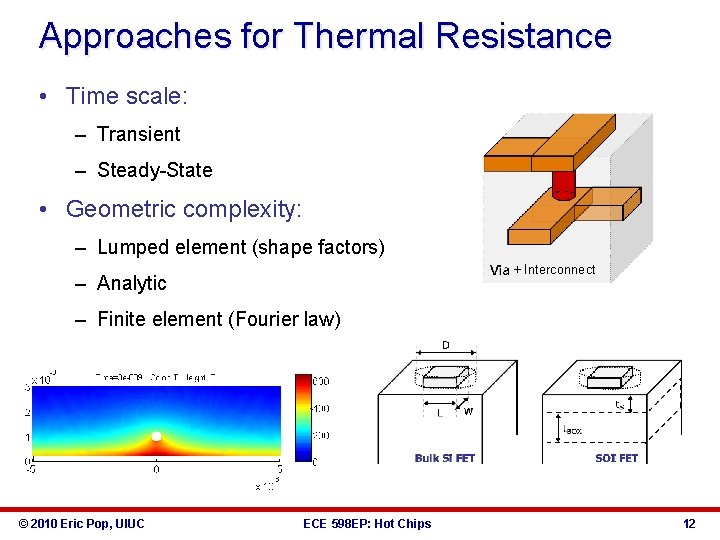
Approaches for Thermal Resistance • Time scale: – Transient – Steady-State • Geometric complexity: – Lumped element (shape factors) + Interconnect – Analytic – Finite element (Fourier law) © 2010 Eric Pop, UIUC ECE 598 EP: Hot Chips 12
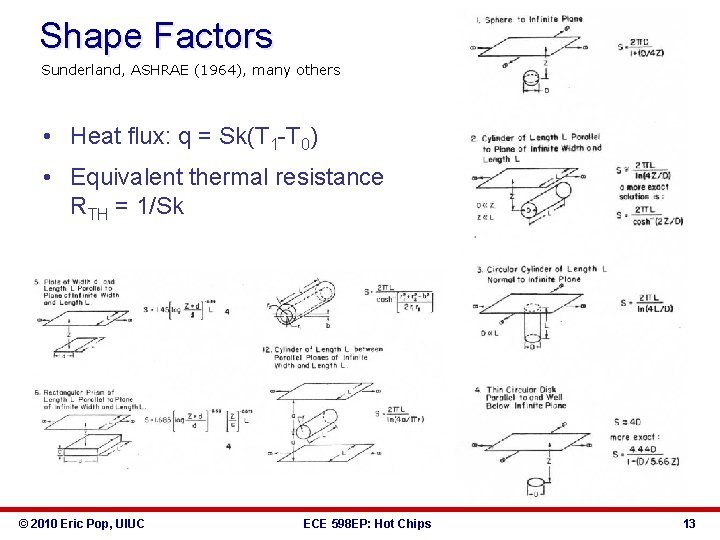
Shape Factors Sunderland, ASHRAE (1964), many others • Heat flux: q = Sk(T 1 -T 0) • Equivalent thermal resistance RTH = 1/Sk © 2010 Eric Pop, UIUC ECE 598 EP: Hot Chips 13
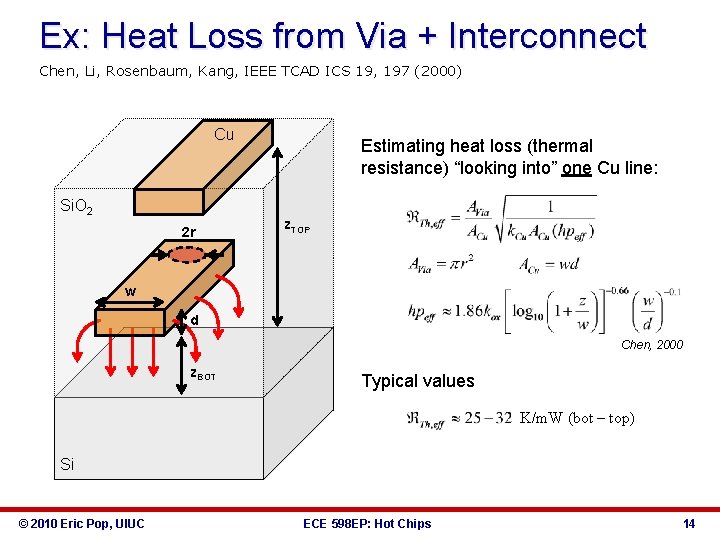
Ex: Heat Loss from Via + Interconnect Chen, Li, Rosenbaum, Kang, IEEE TCAD ICS 19, 197 (2000) Cu Si. O 2 2 r Estimating heat loss (thermal resistance) “looking into” one Cu line: z. TOP w d Chen, 2000 z. BOT Typical values K/m. W (bot – top) Si © 2010 Eric Pop, UIUC ECE 598 EP: Hot Chips 14
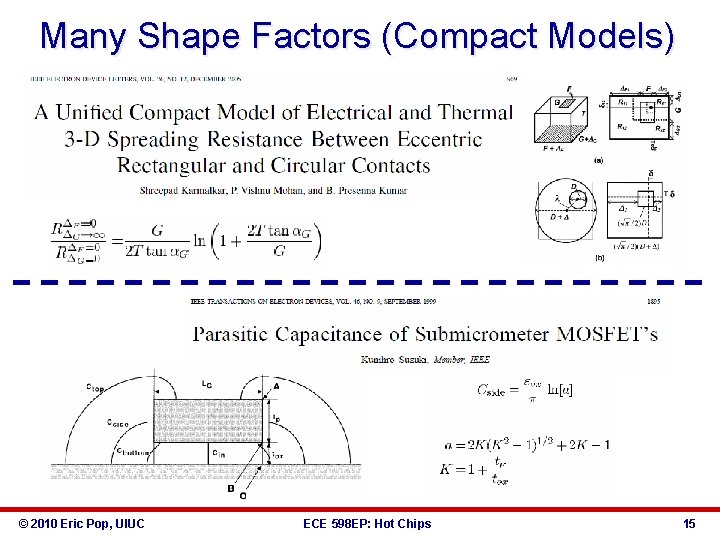
Many Shape Factors (Compact Models) © 2010 Eric Pop, UIUC ECE 598 EP: Hot Chips 15
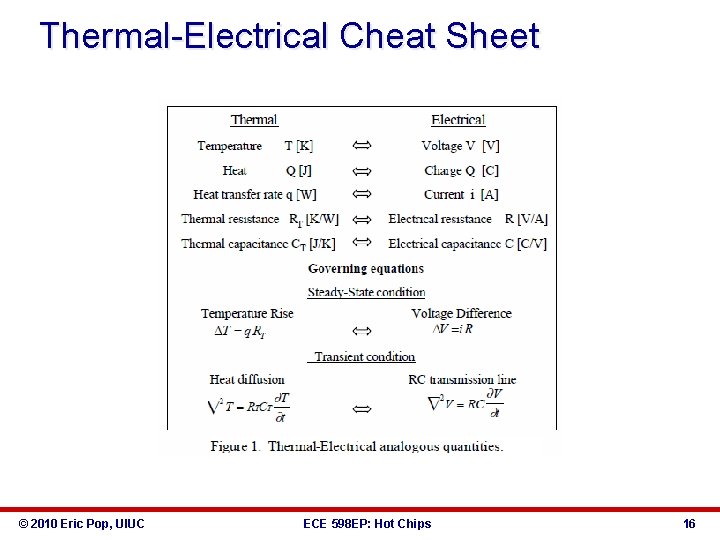
Thermal-Electrical Cheat Sheet © 2010 Eric Pop, UIUC ECE 598 EP: Hot Chips 16
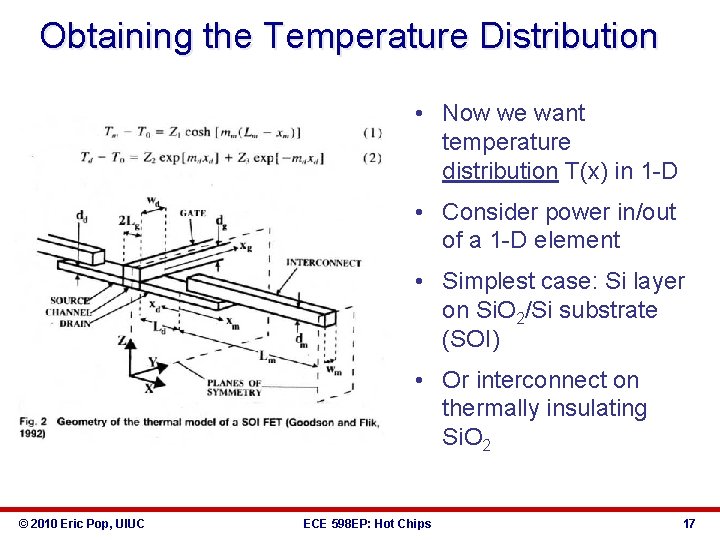
Obtaining the Temperature Distribution • Now we want temperature distribution T(x) in 1 -D • Consider power in/out of a 1 -D element • Simplest case: Si layer on Si. O 2/Si substrate (SOI) • Or interconnect on thermally insulating Si. O 2 © 2010 Eric Pop, UIUC ECE 598 EP: Hot Chips 17
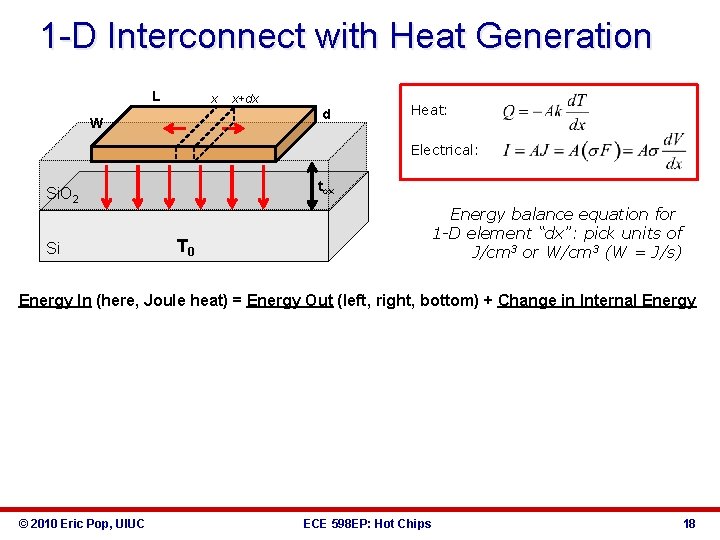
1 -D Interconnect with Heat Generation L x x+dx d W Heat: Electrical: tox Si. O 2 Si Energy balance equation for 1 -D element “dx”: pick units of J/cm 3 or W/cm 3 (W = J/s) T 0 Energy In (here, Joule heat) = Energy Out (left, right, bottom) + Change in Internal Energy © 2010 Eric Pop, UIUC ECE 598 EP: Hot Chips 18
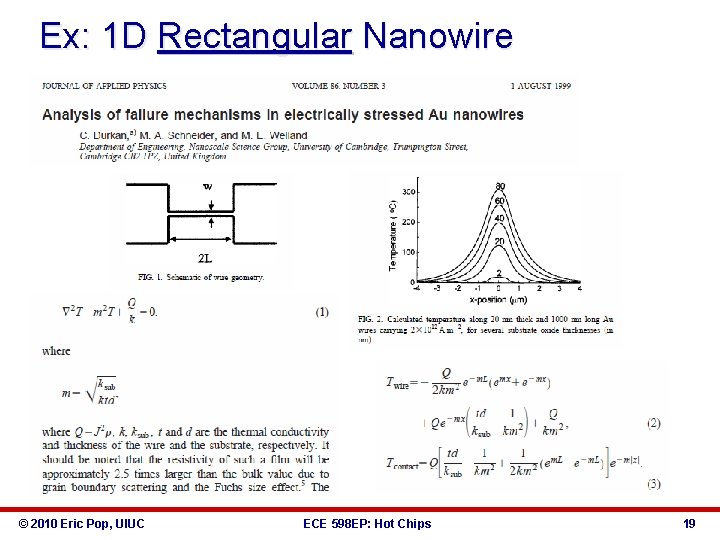
Ex: 1 D Rectangular Nanowire © 2010 Eric Pop, UIUC ECE 598 EP: Hot Chips 19
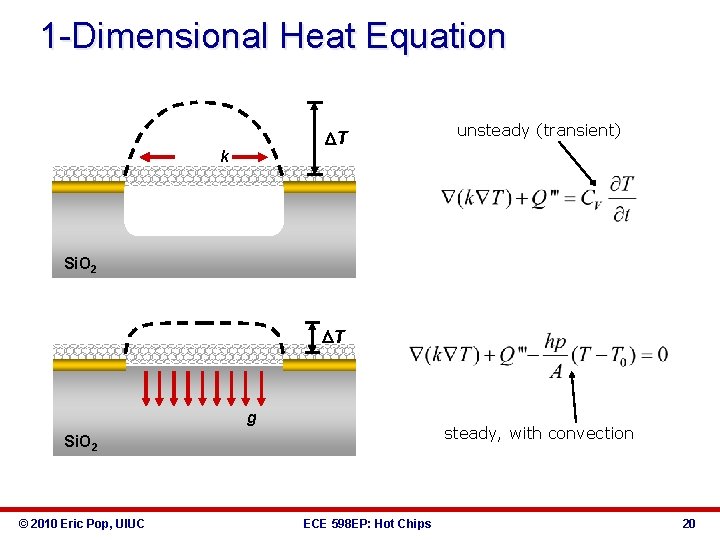
1 -Dimensional Heat Equation DT k unsteady (transient) Si. O 2 DT g steady, with convection Si. O 2 © 2010 Eric Pop, UIUC ECE 598 EP: Hot Chips 20
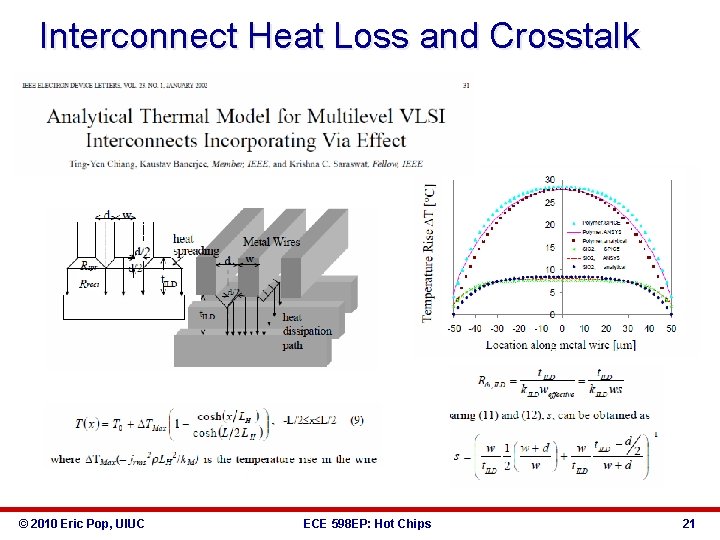
Interconnect Heat Loss and Crosstalk © 2010 Eric Pop, UIUC ECE 598 EP: Hot Chips 21
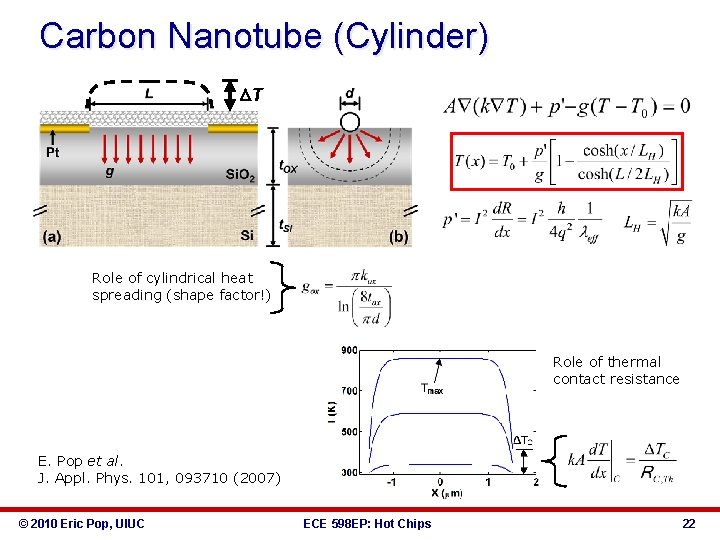
Carbon Nanotube (Cylinder) DT Role of cylindrical heat spreading (shape factor!) Role of thermal contact resistance E. Pop et al. J. Appl. Phys. 101, 093710 (2007) © 2010 Eric Pop, UIUC ECE 598 EP: Hot Chips 22