
Revision the Resurrection Nature of the resurrected body

Revision – the Resurrection • Nature of the resurrected body. Biblical texts. Reliability? • NT Wright – historicity of resurrection • Bultmann – mythology of resurrection
Nature of the Resurrection • John 20 -21 Resurrection appearances of Jesus show that • • Unlimited by space/ time: appears in locked rooms, relevant moments Physical, but by choice: does not eat of necessity Humble form: not like transfiguration, glowing white Characteristics of original earthly body: wounds, identifying as the same person, by voice (several accounts where not recognized by sight) Mary Magdalene, disciples on road to Emmaus. • 1 Corinthians 15 Paul is asked, what sort of body will we have? • • • Different: seed dies and is raised a plant (not the seed, but related to it) Powerful: not limited by physical constraints Incorruptible: no decay, deterioration, disease, pain etc Glorious: shares glory of risen Christ Spiritual : follows & lives by the spirit of Jesus, not by the desires of the flesh Paul contrasts the spiritual body we will have “from” Jesus, vs. the body of flesh we have inherited “from” Adam. As Adam died, so we die, but as Christ lives, so we will live in him. In Philippians, Paul expresses his desire to be “with” Christ, as that is so much better. • Matthew 20: 28 Devil can threaten and destroy the body, and even the soul with the body, if it is lead to mortal sin. Soul is immortal, but spiritually vulnerable.
Explain NT teachings about the resurrected body
Historical Reliability of resurrection accounts Unreliable: Differences in gospels - Mark ends with women running away after seeing empty tomb: puzzle. - Matthew, Luke: who is seen in the tomb. Story of disciples on way to Emmaus. Both refer to giving of Holy Spirit, in Jerusalem, to give them power to do the works of Jesus. - John: has stories others don’t. Mary Madgalene, doubting Thomas, breakfast Sea of Tiberias, with ‘reinstating’ of Peter. John emphasizes faith, rather than sight, as bringing blessing. Central facts agree: - Very early in the morning - Stone is rolled away/ tomb empty - Women, Mary Madgalene finds empty tomb first - Women tell the others , but not believed. (not reliable witnesses in those days) – true detail? Incredulity of women & disciples is main feature. Jesus needs to show himself, to explain the prophecies, to break bread for them. - Resurrection was not expected or believable. Likely to be genuine.
Evaluate the extent to which the resurrection accounts are historical. Examine what the New Testament reveals about the resurrection.
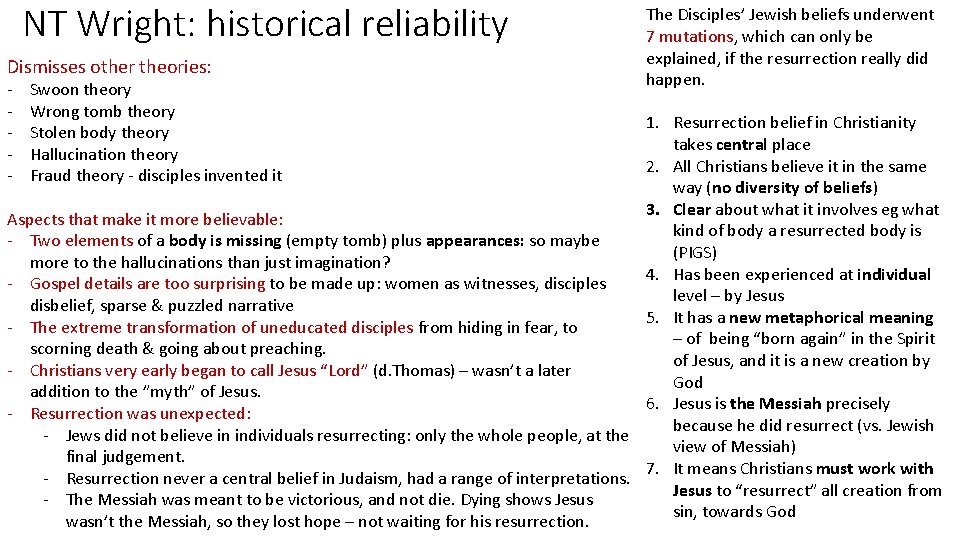
NT Wright: historical reliability Dismisses other theories: - Swoon theory Wrong tomb theory Stolen body theory Hallucination theory Fraud theory - disciples invented it The Disciples’ Jewish beliefs underwent 7 mutations, which can only be explained, if the resurrection really did happen. 1. Resurrection belief in Christianity takes central place 2. All Christians believe it in the same way (no diversity of beliefs) 3. Clear about what it involves eg what Aspects that make it more believable: kind of body a resurrected body is - Two elements of a body is missing (empty tomb) plus appearances: so maybe (PIGS) more to the hallucinations than just imagination? 4. Has been experienced at individual - Gospel details are too surprising to be made up: women as witnesses, disciples level – by Jesus disbelief, sparse & puzzled narrative 5. It has a new metaphorical meaning - The extreme transformation of uneducated disciples from hiding in fear, to – of being “born again” in the Spirit scorning death & going about preaching. of Jesus, and it is a new creation by - Christians very early began to call Jesus “Lord” (d. Thomas) – wasn’t a later God addition to the ”myth” of Jesus. 6. Jesus is the Messiah precisely - Resurrection was unexpected: because he did resurrect (vs. Jewish - Jews did not believe in individuals resurrecting: only the whole people, at the view of Messiah) final judgement. 7. It means Christians must work with - Resurrection never a central belief in Judaism, had a range of interpretations. Jesus to “resurrect” all creation from - The Messiah was meant to be victorious, and not die. Dying shows Jesus sin, towards God wasn’t the Messiah, so they lost hope – not waiting for his resurrection.
Outline NT Wright’s arguments in support of the truth of Jesus’ resurrection.

Bultmann: Myth
- Slides: 8