
Revision Strategies Booklet Learning Styles Symbols Visual Mathemati
Revision Strategies Booklet
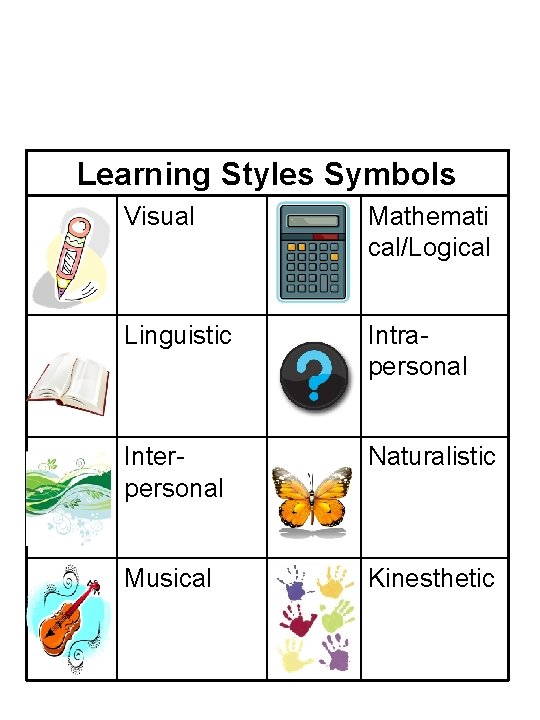
Learning Styles Symbols Visual Mathemati cal/Logical Linguistic Intrapersonal Interpersonal Naturalistic Musical Kinesthetic
Reading Out Loud Read your revision notes out loud to a particular rhythm – this could be set by music playing in the background or tapping your foot or by walking calmly and steadily. This is a sort of walk and talk.
Order/Sequence Have a look through your notes/books and order or sequence the notes. Place them in a logical sequence so you can see how things progress. You may find a more logical way of seeing things.
Note cards Use small note cards to record your revision notes. There should be only one topic on one card. There could be key words/ideas/symbols/pictures on them– it depends on you. The hard part will be reducing the notes from a number of pages onto a small card.
Underlining As you read through the work in your exercise book underline key words. You could come up with a predicted list before you start or you could make a list of the key words at the end. You could underline in different colours, patterns or lines like wiggly, thick etc.
Why? Try to find out why you are learning this particular topic. Then try to make it more interesting for yourself. In other words find out why it is important. Find a context for learning it.
Visuals Make good use of drawings/diagrams in your revision. Use different colours. Replace keywords/ideas/people/places with pictures. Create and put posters up around your home.
Games Use guessing games as part of your revision. Things like Pictionary, Scrabble and Taboo work as well. You only have to change the rules so the words you can use that are only those linked to the topic you are learning. Make your own cards to play with for e. g. Taboo but you can use ordinary Scrabble letters and just spell relevant words.
Teach it Take a topic and prepare to teach it to a friend. Put yourself in the position of the teacher, think about how your friend learns best and decide how you could do it. Plan it and then if possible teach it to your friend.
Symbols/ abbreviations Look at all the key words in a particular topic and come up with a symbol or abbreviation instead – think hard about each word an appropriate symbol or abbreviation. Write out revision notes using these symbols/abbreviations instead of the key words.
Highlighters As you read through your notes use different coloured highlighters to pick out key words /themes/ideas/ points etc. You could try a different colour for each theme or topic. There are revision websites where you can read revision notes and highlight as you go. You can use very small post-its to highlight things as well.
Questions Ask questions before you revise anything. Think about the topic to be studied and take some time out to think about the questions you would like to have some-one answer for you. Write them down and as you read through your notes jot down any answers you find. The brain likes looking for answers. Go and get help for any answers you do not find.
Posters Make a poster of each topic – you pick the size A 5 – A 1. After reading all the notes/information condense it all down onto one poster. Use lots of different colours and pictures but limit yourself to a number of words. Think before you start which words you will use.
Q&A Devise questions and answers about a topic for other people and quiz each other. You could think of doing a “Who wants to be a millionaire” where the questions are graded according to the difficulty you choose.
The real world Look at a topic and think about how that topic relates to the real world. You may want to think before you start any revision, about the context of the topic and how the issues it deals with impacts on the world around you. Is there an environmental or social issue it addresses?
Walking Make your notes onto small note cards that fit into your pockets and go for a walk in the fresh air. You can read as you walk by looking at the card then putting it away and then trying to: • Recite the ideas out loud • Picture it in your head • Think through the ideas Try this when travelling in the car or on the bus.
Rhythms Take your notes and after revising sections make them into a song, rap, poem or rhyme. You could look for a rhythm within the text and find patterns. You could take key words/ideas or themes and look for rhymes at try to make small poems to help you remember. Also putting ideas to music in the forms of raps and stealing tunes and swapping lyrics for the topic.
Straight Away As you read through your work, notes or exercise books start to make notes straight away – don’t wait for it to become clear. Get your thoughts and ideas down quickly as you read and just record the small details. At the end you may look back over what you have done to look for patterns or bigger things.
Card Games Make up a card game to test your knowledge about a topic. It could be based on an existing card game, with a tweak to the rules, or made up completely. It could involved collecting sets like in the game rummy where you have the cards face down and have to find pairs.
Mimes The sounds every silly but try and make up some silly mimes for key words, people, places etc. You need to think through what mimes are suitable for the work you are revising. Each character in a book can have an over all mime that fits them. A chemical group could have a linked mime to remember all the elements in it.
Tapes Make a tape for yourself to revise from. It could be you reading your notes out loud. It could be you singing your notes. It could be you reading and then stopping to summarise what you have read (key words, ideas, phrases, quotations) or asking questions on what you have covered. Listen to the tape as you lie in bed, walk to school, travel on the bus.
Favourite Places Put any revision notes/post-its around the house especially in your favourite places like the fridge, backs of doors etc. When you pass these places stop and consider what’s on the notes there.
Flashcards These can be done for all sorts of topics and can be quite small. The idea here is to put key words/ideas on the cards. At the end you can shuffle them and then turn them over quickly one at a time explaining each key word or idea quickly out loud or to someone else.
What I know Spend some time before your revision to record what you already know. This could be in the form of a mind map or list etc. As you read through your notes and revise, check what you thought you knew. Are there things you have forgotten? If so, add them in. Are there things that aren’t right? If so, correct them
Grouping Try to group revision notes into groups or categories and hierarchies. Put your notes or note cards into particular groupings based on bigger themes.
Sound-alike Use sound-alikes when trying to revise a foreign language e. g. French for rabbit is lapin so remember a rabbit lapping and try to picture it doing this. You can split words up and have a series of pictures e. g. chromatogram =crow/mat/gram a crow sitting on a mat with a gram weight all on a coloured strip of paper.
Post-its Write information on post-it notes and place them on the wall, door, large sheets of paper etc. You can then rearrange them according to a variety of ideas: • Group various things together • Organise them into what you know and don’t know – rearrange as you learn more • Follow trends or themes
Problem Page Before you start to revise a topic make a list of the typical problems you think other students would have. Make a note of them. Now go through your notes and try to find answers to them. Once you think you have some ideas, try to compose an answer that would make everything seem clear.
Concept Mapping Go through a topic and pick out key words/ideas/symbols/pictures and write them on different pieces of paper or post-its. Group them together if they have any connections. Arrange them on sheet of A 3 with blue-tac so you can rearrange them. Add arrows between words etc and add phrases along them to show the connections.
Mind maps Take a topic and mind map it onto one page. Make sure you follow the basic rules: • Plain paper • Landscape • Central Images • Branches going out • Key words only • Symbols • Pictures
Reduction Set yourself a challenge of reducing the amount of notes you have by half you need to decide what is important and what is not. You can set the number and challenge yourself to beat personal scores. So you could reduce 3 pages of notes down to 1 or 200 words down to 70 ect. You must be careful not to lose the overall meaning of the topic.
Colour Coding Your brain just adores colour and will remember things much more easily if you use it. e. g. put all the important words in red, the important concepts in green, important dates in purple etc.
Aliens Imagine at the end of your revising a particular topic that you will have to explain to someone else – an alien (it could be a younger bother or sister or someone in a different class). Think how you would phrase your notes to them.
- Slides: 34