
Revision Skills Session 1 What works and why

- Slides: 41
Revision Skills – Session 1 What works and why
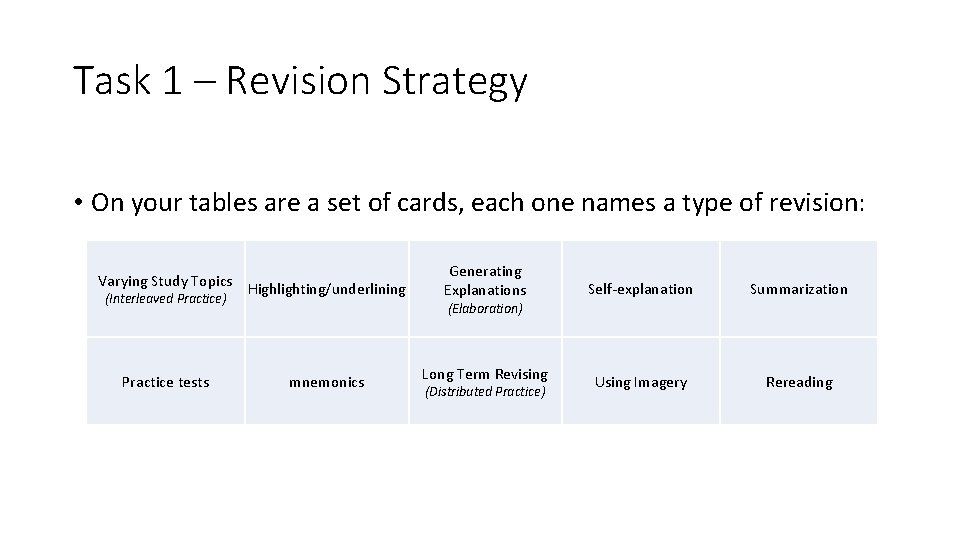
Task 1 – Revision Strategy • On your tables are a set of cards, each one names a type of revision: Varying Study Topics (Interleaved Practice) Practice tests Highlighting/underlining Generating Explanations Self-explanation Summarization Using Imagery Rereading (Elaboration) mnemonics Long Term Revising (Distributed Practice)
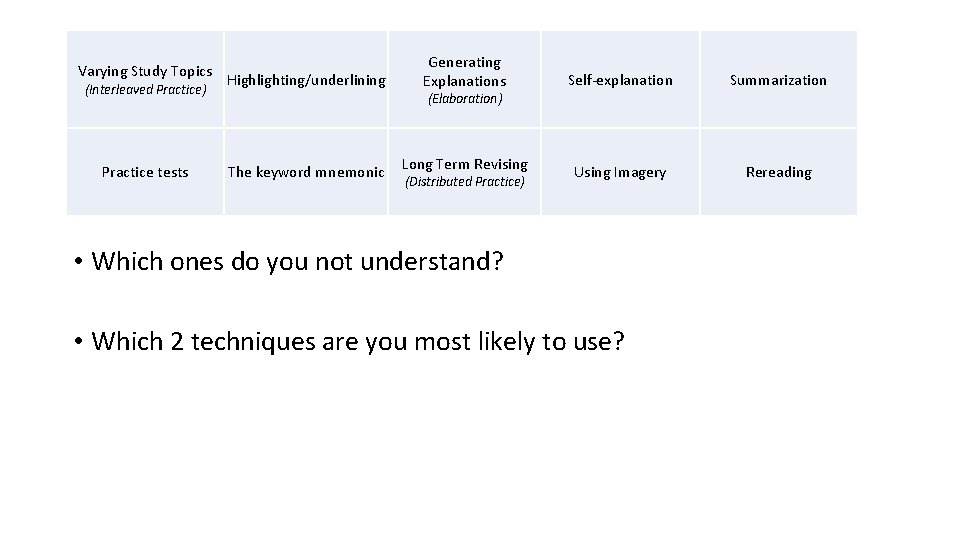
Varying Study Topics (Interleaved Practice) Practice tests Highlighting/underlining Generating Explanations Self-explanation Summarization Using Imagery Rereading (Elaboration) The keyword mnemonic Long Term Revising (Distributed Practice) • Which ones do you not understand? • Which 2 techniques are you most likely to use?
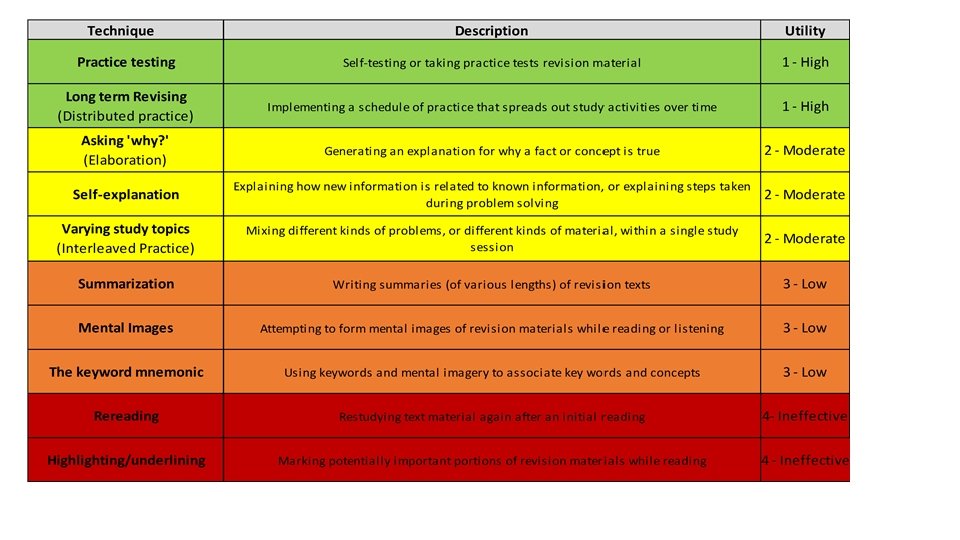
What the research says… • In a recent study each of these revision strategies were ranked according to how effective they were…
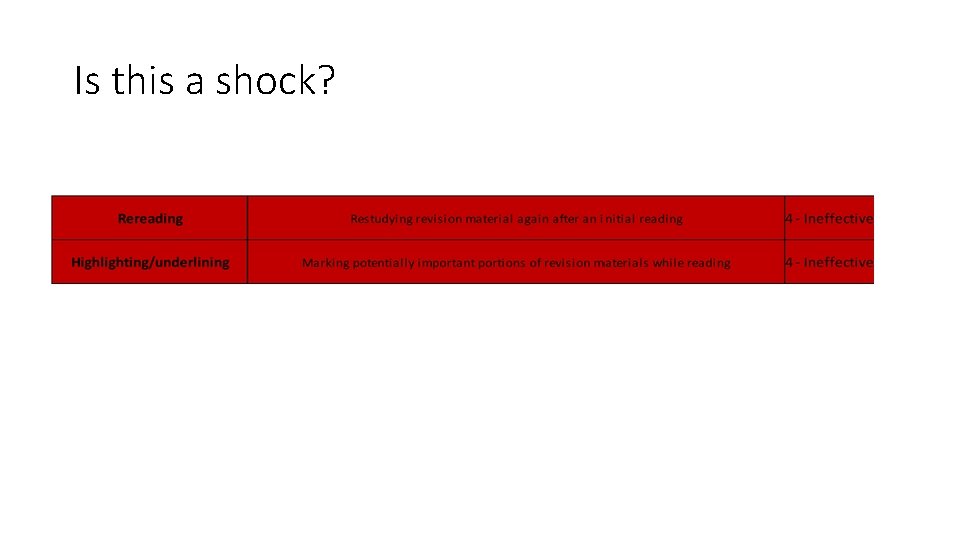
Is this a shock?
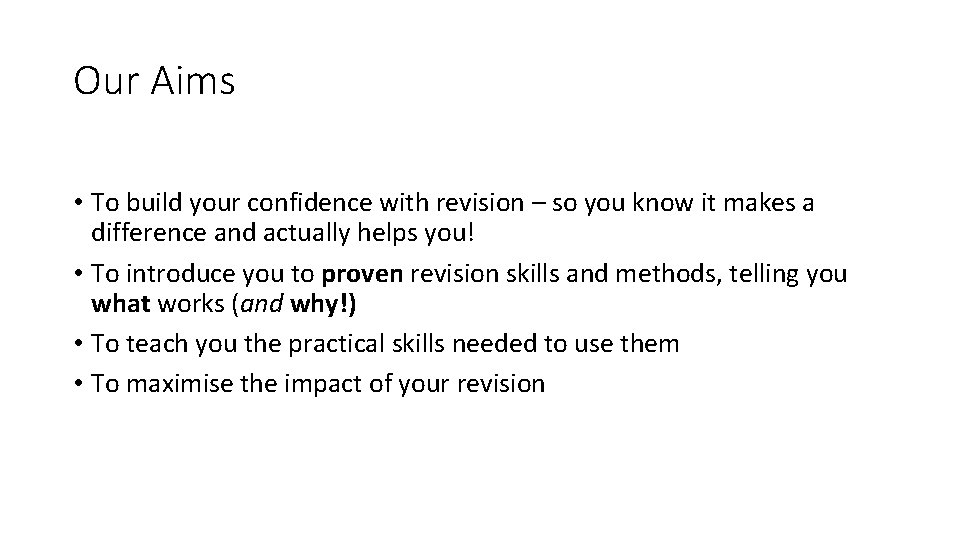
Our Aims • To build your confidence with revision – so you know it makes a difference and actually helps you! • To introduce you to proven revision skills and methods, telling you what works (and why!) • To teach you the practical skills needed to use them • To maximise the impact of your revision
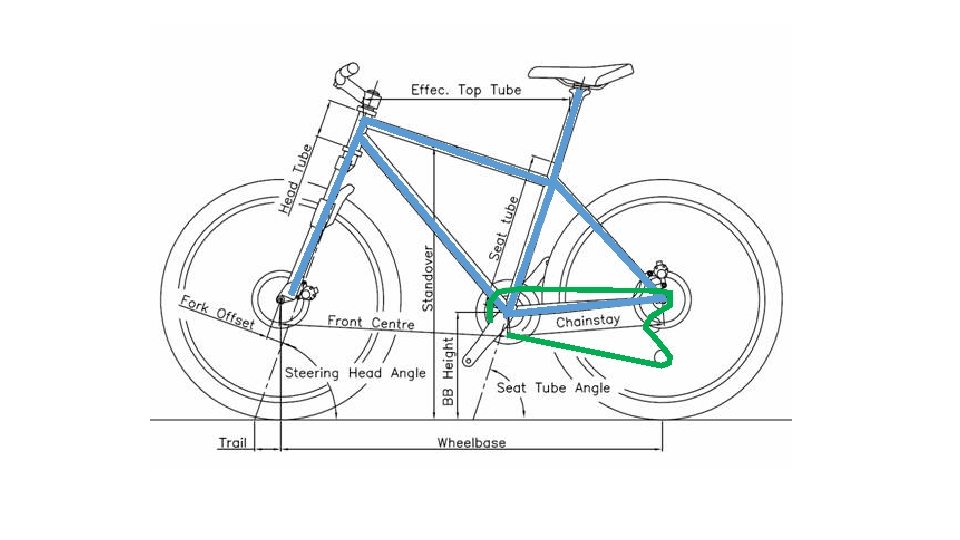
Task 2 – Familiar? • Draw a bicycle. • Give your drawing as much detail as you can. • Label it.
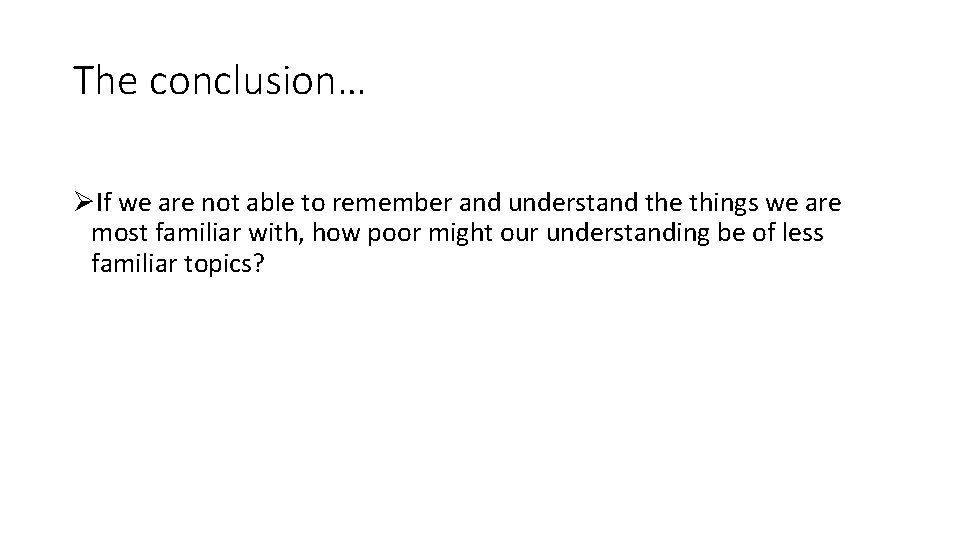
The conclusion… ØIf we are not able to remember and understand the things we are most familiar with, how poor might our understanding be of less familiar topics?
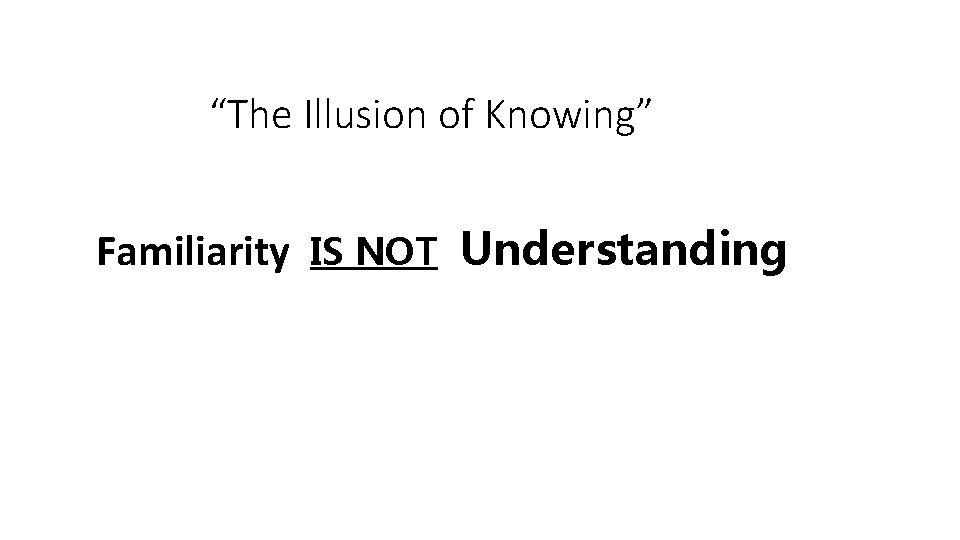
“The Illusion of Knowing” Familiarity IS NOT Understanding
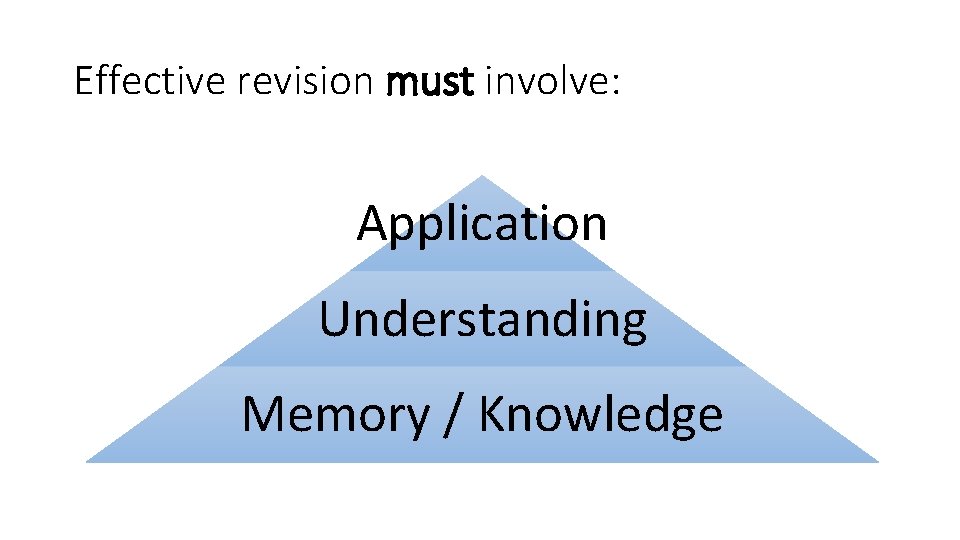
Effective revision must involve: Application Understanding Memory / Knowledge
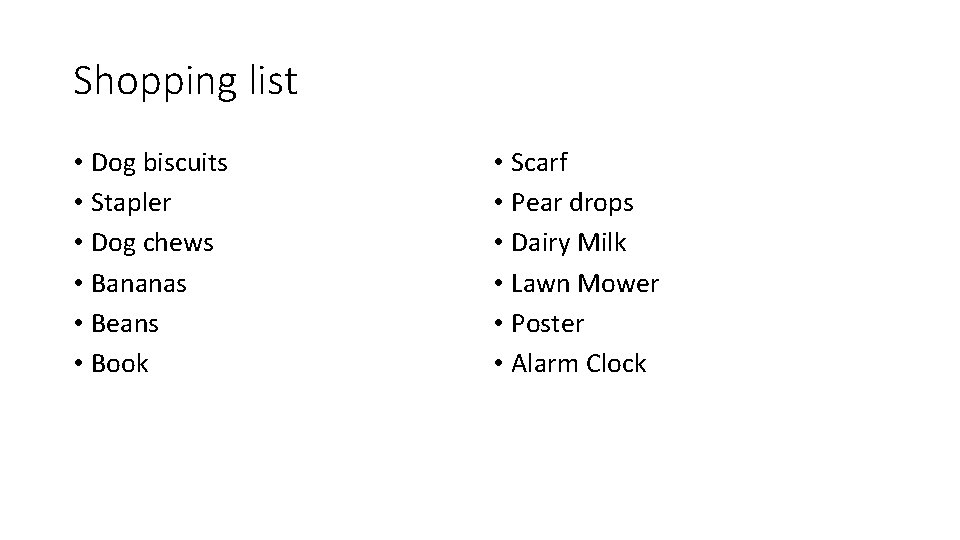
Shopping list • Dog biscuits • Stapler • Dog chews • Bananas • Beans • Book • Scarf • Pear drops • Dairy Milk • Lawn Mower • Poster • Alarm Clock
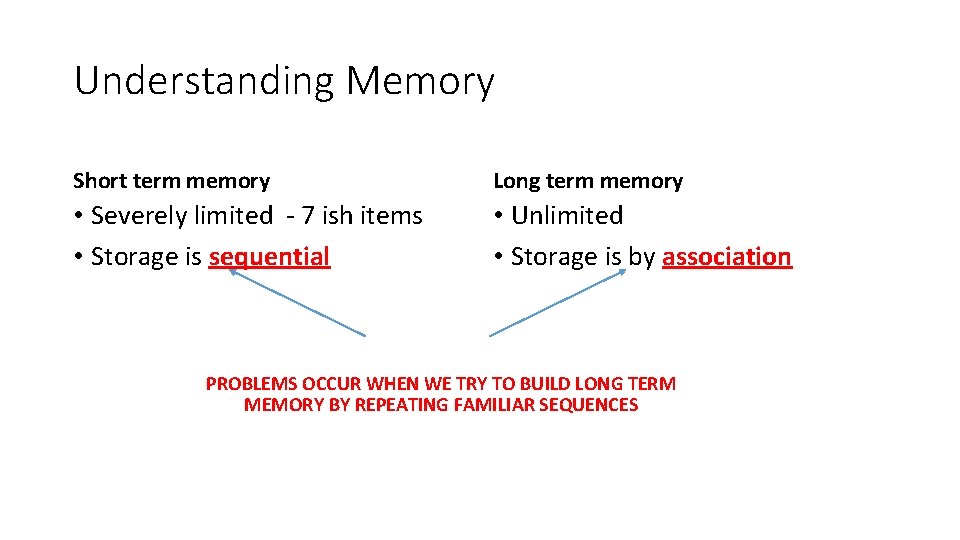
Understanding Memory Short term memory Long term memory • Severely limited - 7 ish items • Storage is sequential • Unlimited • Storage is by association PROBLEMS OCCUR WHEN WE TRY TO BUILD LONG TERM MEMORY BY REPEATING FAMILIAR SEQUENCES
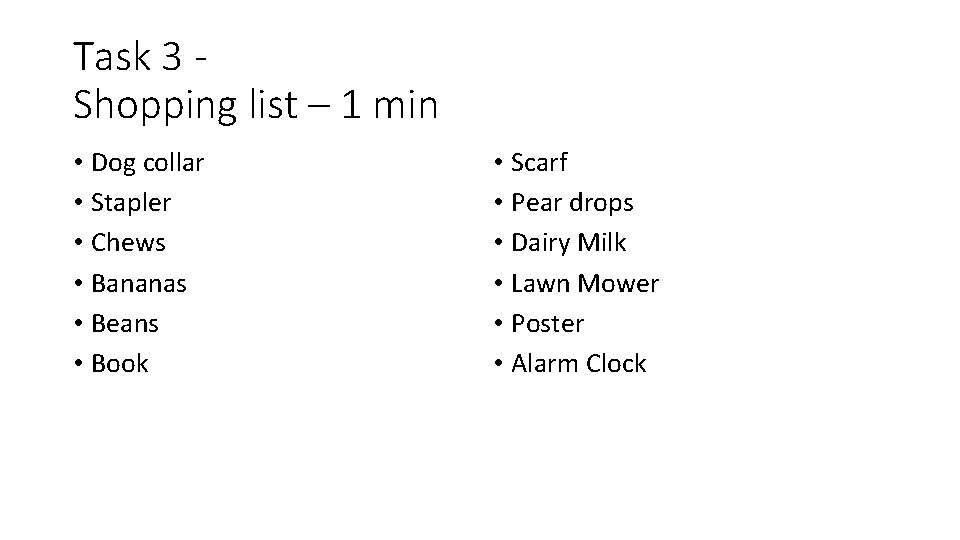
Task 3 Shopping list – 1 min • Dog collar • Stapler • Chews • Bananas • Beans • Book • Scarf • Pear drops • Dairy Milk • Lawn Mower • Poster • Alarm Clock
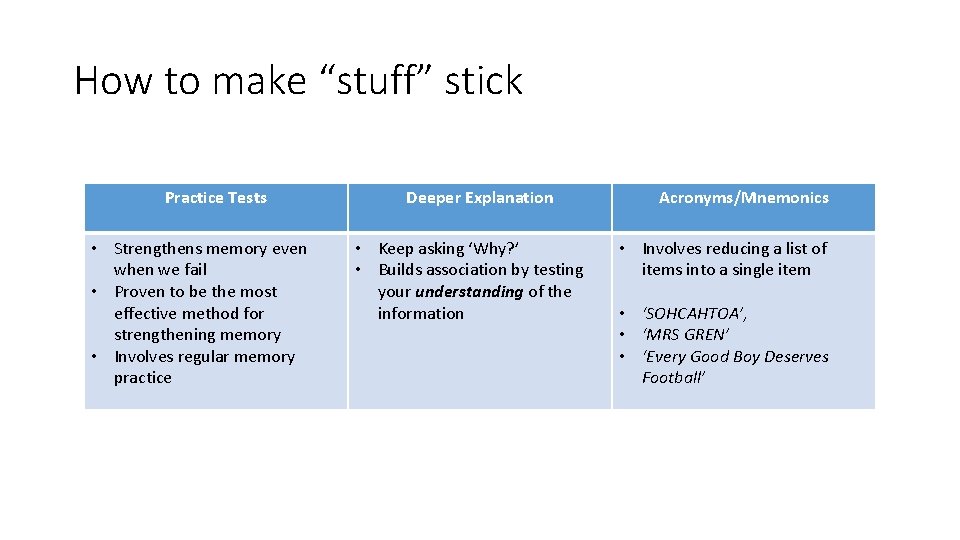
How to make “stuff” stick Practice Tests • Strengthens memory even when we fail • Proven to be the most effective method for strengthening memory • Involves regular memory practice Deeper Explanation • Keep asking ‘Why? ’ • Builds association by testing your understanding of the information Acronyms/Mnemonics • Involves reducing a list of items into a single item • ‘SOHCAHTOA’, • ‘MRS GREN’ • ‘Every Good Boy Deserves Football’
Flash cards • What are they used for? ? • • • Subject content Case studies Key words and definitions Key questions Examples e. g. Maths
Flash cards – DO: DO NOT: • Shuffle the stack regularly • Have others test you on their content • Write prompts on one side and answers on the other • Elaborate on the basic information presented on each card • Just repeatedly read through the stack • Spend hours meticulously crafting each card • Squeeze every last detail onto a card in the smallest handwriting possible
Task 4 – Creating Memory Prompts Look at the science topic presented on your tables 1. How might some/all of this information be revised using an acronym, mnemonic, spidergram or original image? 2. Try and draw one of the above as if you were revising one of the topics
Final questions from today’s session: Write this down on named A 4 paper • 1. Which study skills/approaches do you think you will use for the mocks? • 2. If you have to say one thing you’ll remember from today - what is it? • 3. Are there anything approaches to revision that you will now bin?
Study Skills – Session 2 Retrieval Practice
Task 1 – Memory retrieval • What did we cover in our last session? • You have 2 minutes to recall as much information as possible. • Some “volunteers” will be asked to share with the room.
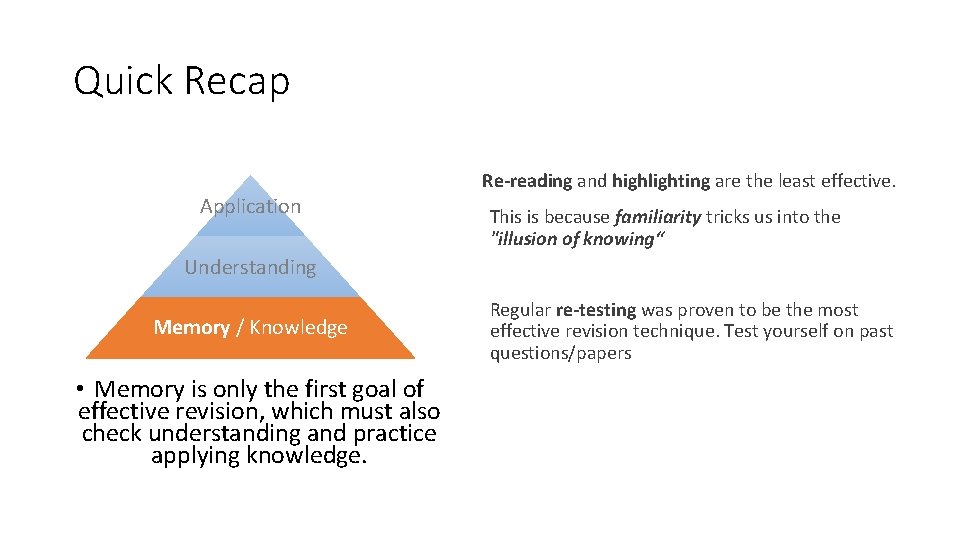
Quick Recap Application Re-reading and highlighting are the least effective. This is because familiarity tricks us into the "illusion of knowing“ Understanding Memory / Knowledge • Memory is only the first goal of effective revision, which must also check understanding and practice applying knowledge. Regular re-testing was proven to be the most effective revision technique. Test yourself on past questions/papers
What is retrieval practice?
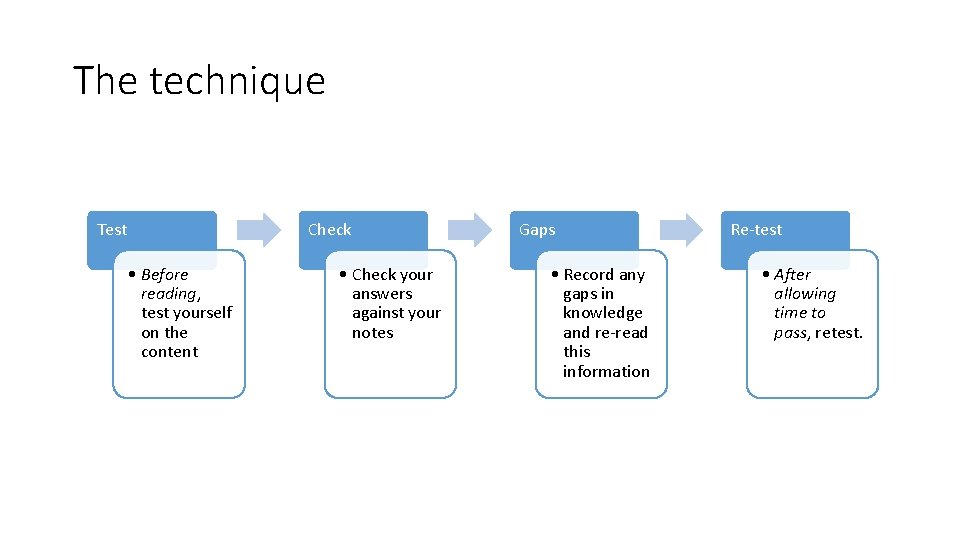
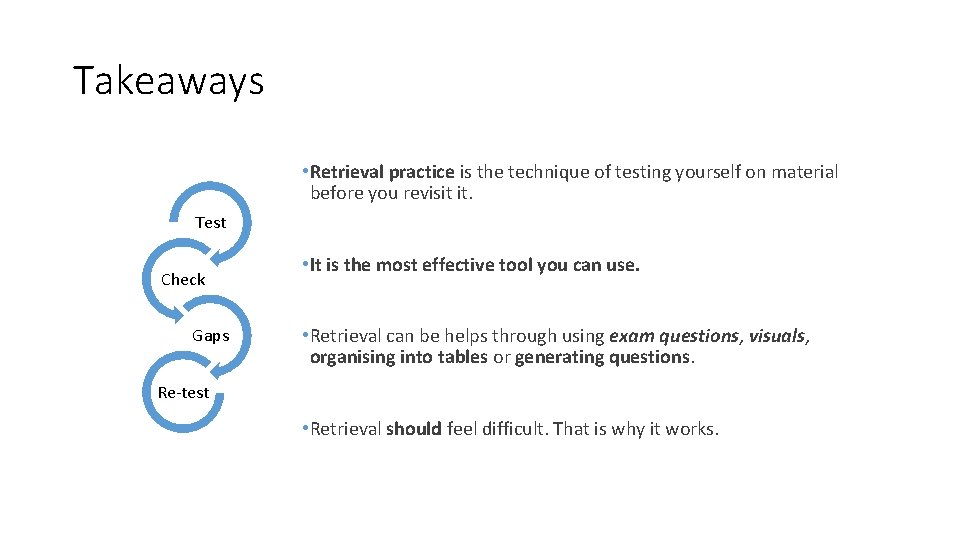
The technique Test Check • Before reading, test yourself on the content • Check your answers against your notes Gaps • Record any gaps in knowledge and re-read this information Re-test • After allowing time to pass, retest.
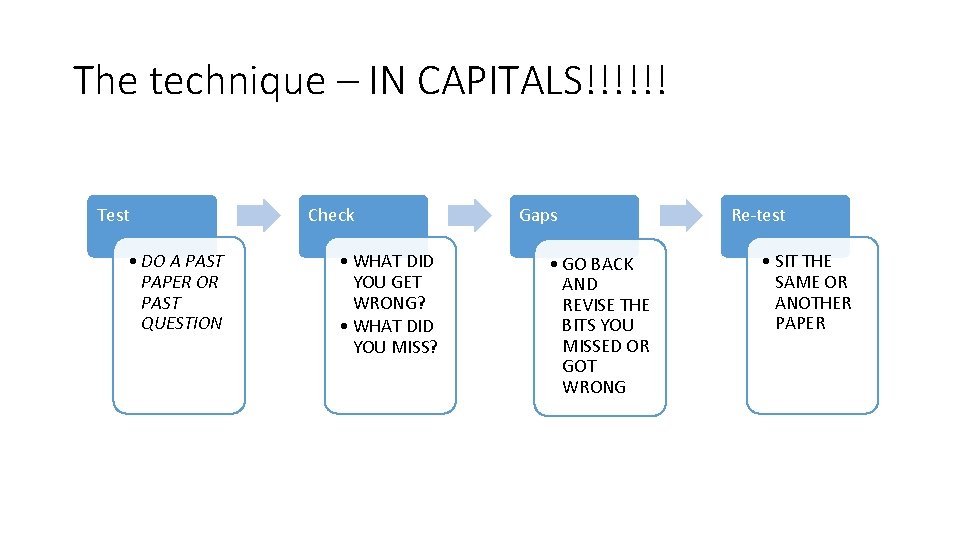
The technique – IN CAPITALS!!!!!! Test • DO A PAST PAPER OR PAST QUESTION Check • WHAT DID YOU GET WRONG? • WHAT DID YOU MISS? Gaps • GO BACK AND REVISE THE BITS YOU MISSED OR GOT WRONG Re-test • SIT THE SAME OR ANOTHER PAPER
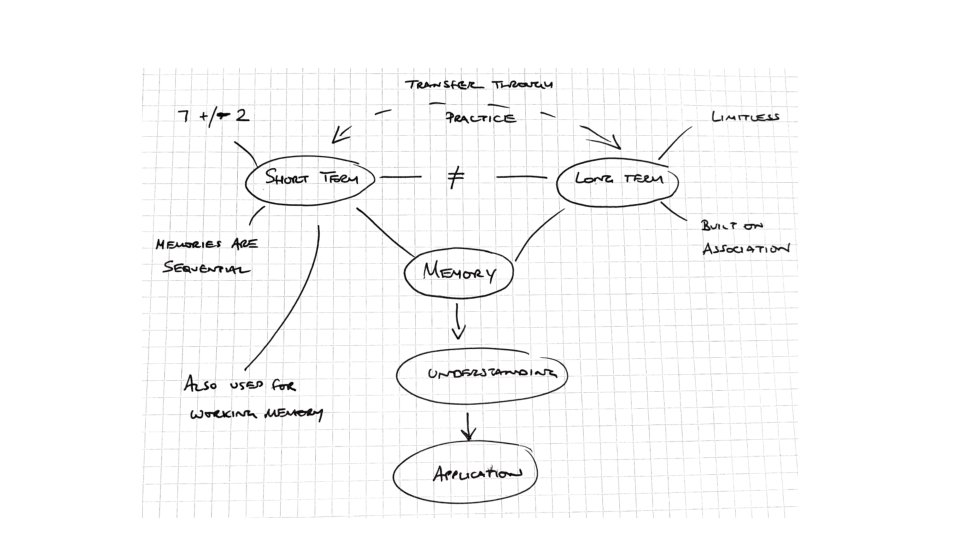
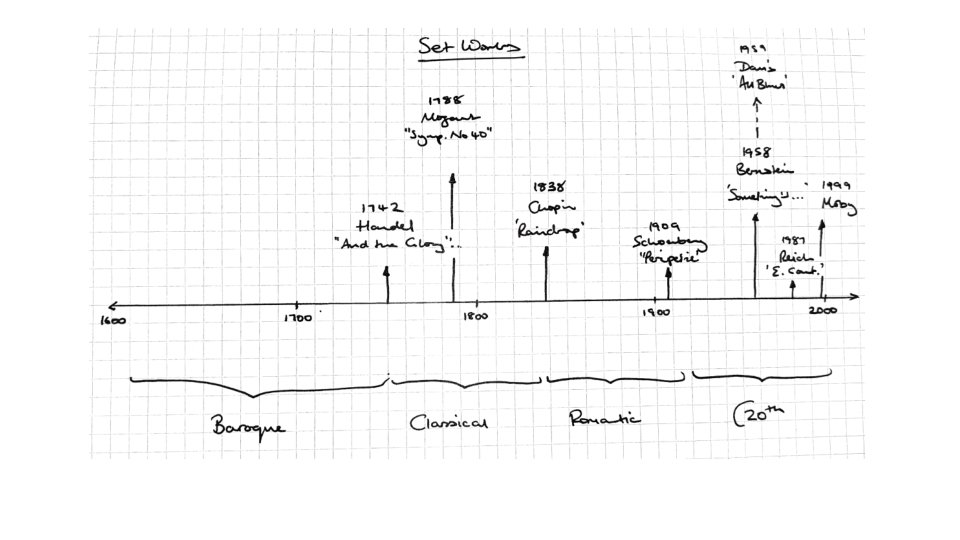
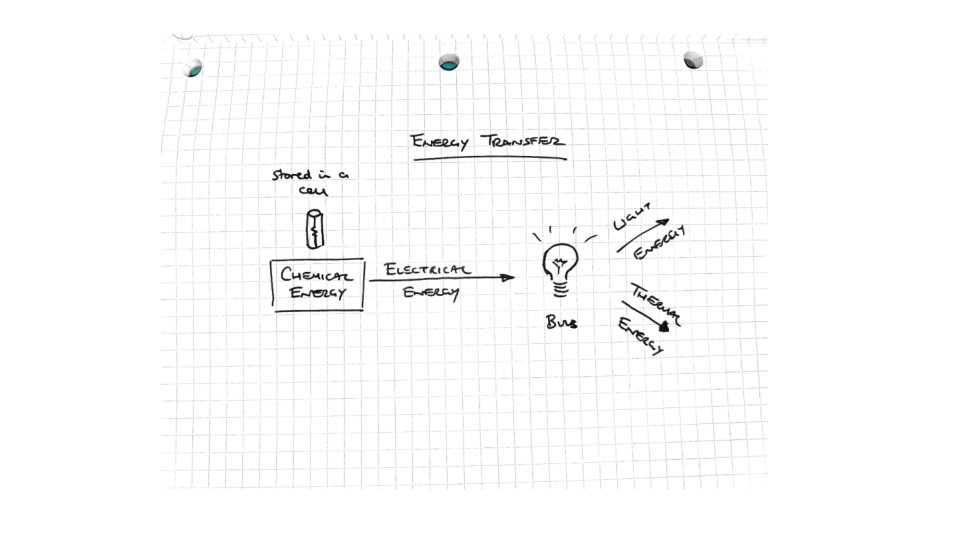
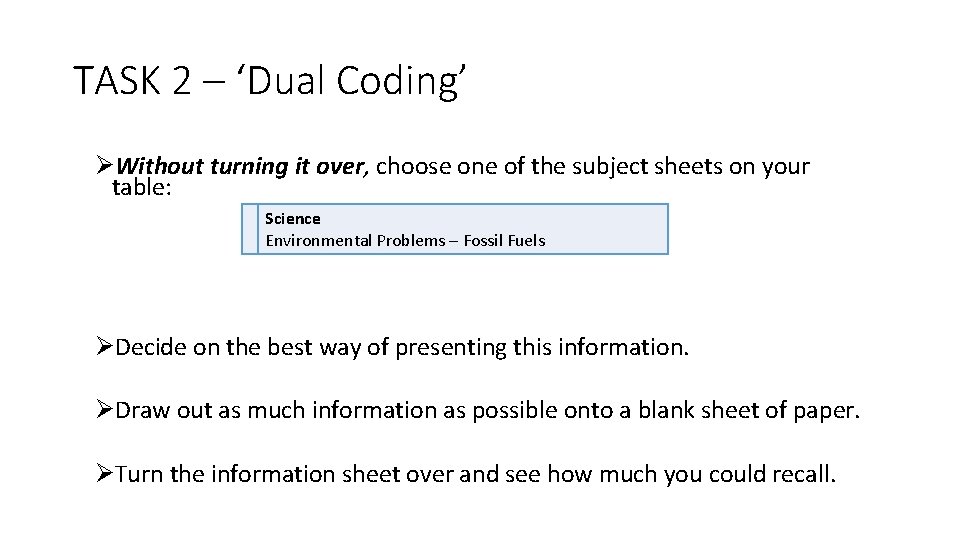
How to remember #1 – Dual Coding • Choose a suitable visual way to represent a concept / topic:
Retrieval Tool #1 – Dual Coding • Choose a suitable visual way to represent a concept / topic: ØSpidergram / concept map ØTimeline ØDiagram
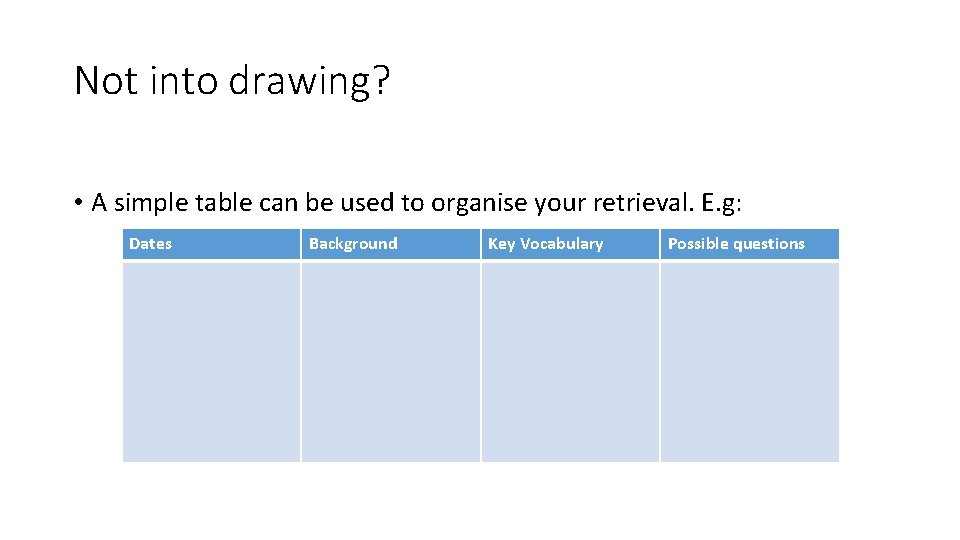
Not into drawing? • A simple table can be used to organise your retrieval. E. g: Dates Background Key Vocabulary Possible questions
TASK 2 – ‘Dual Coding’ ØWithout turning it over, choose one of the subject sheets on your table: Science Environmental Problems – Fossil Fuels ØDecide on the best way of presenting this information. ØDraw out as much information as possible onto a blank sheet of paper. ØTurn the information sheet over and see how much you could recall.
Seeking Feedback • Retrieval practice is an excellent tool for highlighting weak areas. • If you find a gap in your knowledge that cannot be filled from your revision notes, ask for help. • By completing this task first, you will avoid asking your teachers vague questions, or resorting to “I don’t get it!”
But it feels difficult… • DISCLAIMER: Retrieval practice feels harder than just rereading your notes. • THIS IS EXACTLY WHY IT IS MORE EFFECTIVE. • When your brain work harder, it retains more. • REMEMBER: This is effective even when you cannot remember
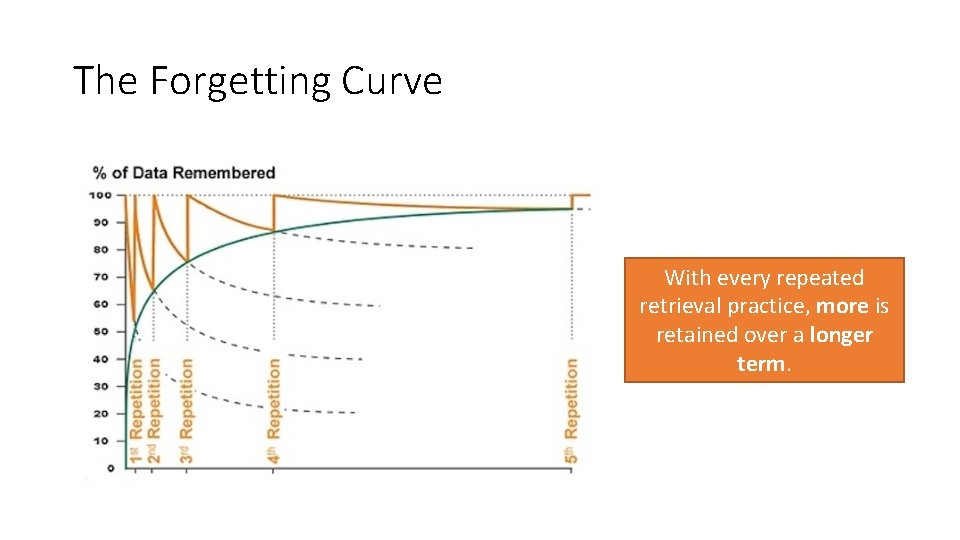
The Forgetting Curve With every repeated retrieval practice, more is retained over a longer term.
Retrieval Tool #2 – Generating Questions ØPast papers are the best source of practice questions, but they can be limited ØIt is better to isolate questions, rather than complete entire papers (interleaved practice) ØFor essay-type questions, it might be quicker just to plan the essay for retrieval practice ØCreating your own questions will add to your practice material and is good practice in itself
TASK 3 – Generating Questions ØPick one of the topics on your table. ØCome up with 5 closed questions on the topic. ØNow, come up with at least 3 open questions. FLASHCARDS Remember: Flashcards should have questions / prompts on one side, answers / information on the other ØFinally, share your questions with the rest of the table.
Takeaways • Retrieval practice is the technique of testing yourself on material before you revisit it. Test Check Gaps • It is the most effective tool you can use. • Retrieval can be helps through using exam questions, visuals, organising into tables or generating questions. Re-test • Retrieval should feel difficult. That is why it works.
Final questions from today’s session: • 1. What skills/approaches do you think you will use when revising for mocks? • 2. When will you revise? • 3. Where will you revise? 4. If you have to say one thing you’ll remember from today - what is it? 5. Are there any approaches to revision that you will now bin?