
Revision on the PPC Maximum Production Possibilities with
Revision on the PPC • Maximum Production Possibilities with given resources and technology. • Assumes two goods, fixed technology and resources. • Shapes – Straight (constant costs - due to interchangeable resources)or bowed out shape where costs are increasing due to lack of interchangeable resources and costs to switch production. • Expanding the PPC needs new technology or resources to push out the PPC.
Basis of Trade • Trade between two countries. If both goods produced are traded each country can be better off with trade. • Absolute Advantage – the advantage gained by a country who can produce the goods with the lowest costs of production, therefore can sell the goods the cheapest. • Countries can have Absolute Advantage due to the resource advantages offered i. e. Resource Allocations e. g. climate, fertile soils, open land for farming means NZ have AA for Agriculture.
Comparative advantage • Occurs when a country looks like it is good at producing both goods (on a PPC) but both countries can gain from trade through specialisation in areas of advantage. • Countries specialise and export the surplus to gain the imports not produced. • Country with the lowest opportunity cost ratio has the comparative advantage in the production. • This means they can consume beyond the PPC • Comparative Advantage is an economic model that has key assumptions.

Assumptions to the model The trade theory assumes: Two goods only No Transport costs Free Trade – No tariffs or quotas are used on imported goods or faced by exporters abroad. • Mobility of Resources – within a country people and capital goods can move around. • Constant costs/ constant opportunity cost – resources are interchangeable between goods. • No Diminishing Returns – (effect of having one fixed factor of production impacting on output and costs. • •
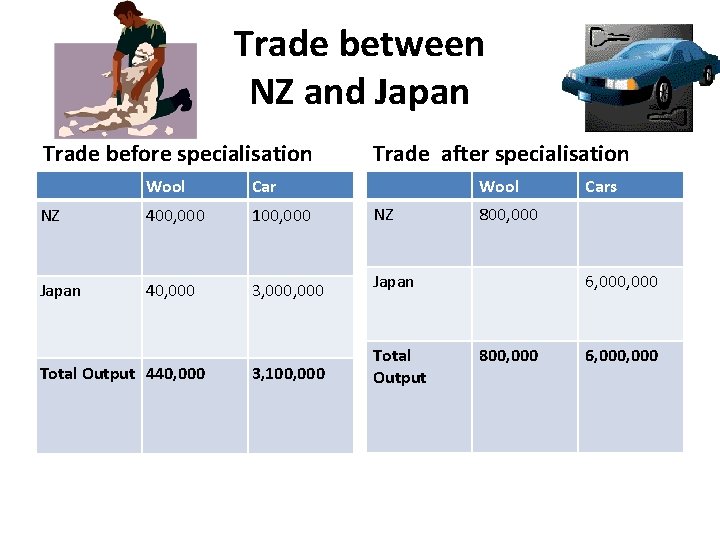
Trade between NZ and Japan Trade before specialisation Wool Car NZ 400, 000 100, 000 Japan 40, 000 3, 000 Total Output 440, 000 3, 100, 000 Trade after specialisation Wool NZ 800, 000 Japan Total Output Cars 6, 000 800, 000 6, 000
Graphing Before Trade – each country makes both goods so can only consume what is produced (within the frontier or on it). Trade after specialisation means that surplus is exported so imports are purchased resulting in consumption beyond the PPC.
- Slides: 6