
Revision of the Long Island Sound Study Comprehensive
- Slides: 27
Revision of the Long Island Sound Study Comprehensive Conservation and Management Plan (CCMP) CT Public Listening Session June 26, 2013
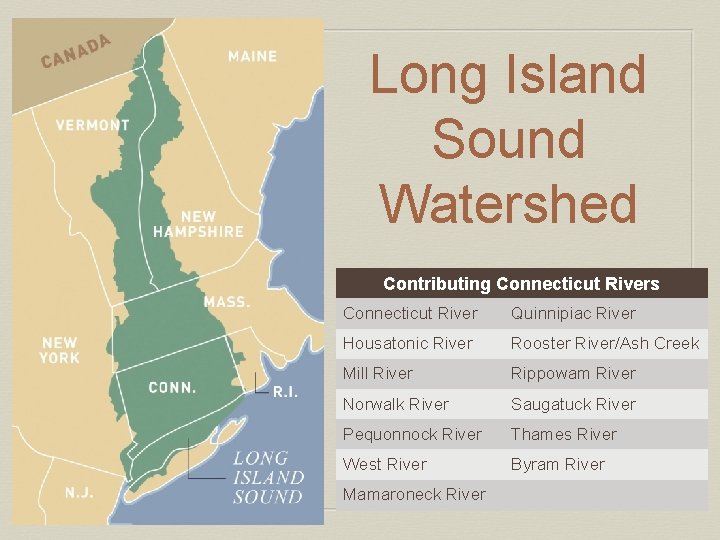
Long Island Sound Watershed Contributing Connecticut Rivers Connecticut River Quinnipiac River Housatonic River Rooster River/Ash Creek Mill River Rippowam River Norwalk River Saugatuck River Pequonnock River Thames River West River Byram River Mamaroneck River
What is a CCMP? The Comprehensive Conservation and Management Plan identifies the specific commitments and recommendations for actions to improve water quality, protect habitat and living resources, educate and involve the public, improve the longterm understanding of how to manage the Sound, monitor progress, and direct management efforts. The Long Island Sound Study uses the CCMP as a blueprint to develop management implementation strategies for short and long term goals. The first CCMP, together with the TMDL, was instrumental in leveraging major infrastructure improvements leading to dramatic decreases in nitrogen loading.
If It Ain’t Broke Why Fix It? First CCMP completed in 1994 Focused on 6 elements: Main accomplishments It established a framework for protection of LIS Low DO (hypoxia) Toxic contamination Pathogens Floatable debris Water quality effects on habitat and living marine resources Development effects on water quality Not addressed or only noted briefly in 1994: v v Climate change Ecosystem services Harbors and embayments of LIS Bioextraction
Why revise the 1994 CCMP? Incorporate advances in management Incorporate advances in science Incorporate new drivers and environmental pressures
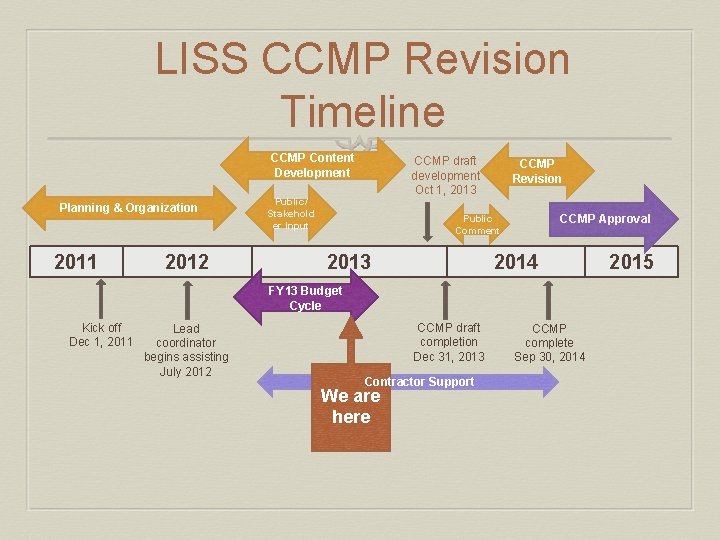
LISS CCMP Revision Timeline CCMP Content Development Planning & Organization 2011 2012 CCMP draft development Oct 1, 2013 Public/ Stakehold er Input CCMP Revision Public Comment 2013 CCMP Approval 2014 FY 13 Budget Cycle Kick off Dec 1, 2011 Lead coordinator begins assisting July 2012 CCMP draft completion Dec 31, 2013 Contractor Support We are here CCMP complete Sep 30, 2014 2015
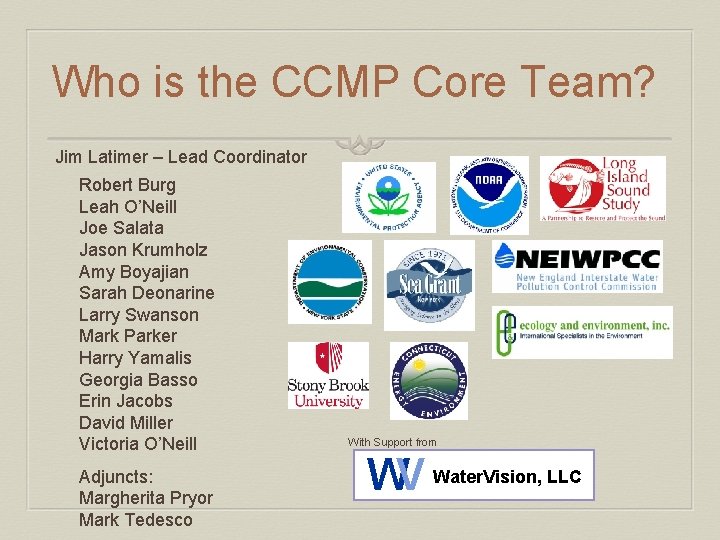
Who is the CCMP Core Team? Jim Latimer – Lead Coordinator Robert Burg Leah O’Neill Joe Salata Jason Krumholz Amy Boyajian Sarah Deonarine Larry Swanson Mark Parker Harry Yamalis Georgia Basso Erin Jacobs David Miller Victoria O’Neill Adjuncts: Margherita Pryor Mark Tedesco With Support from WV Water. Vision, LLC
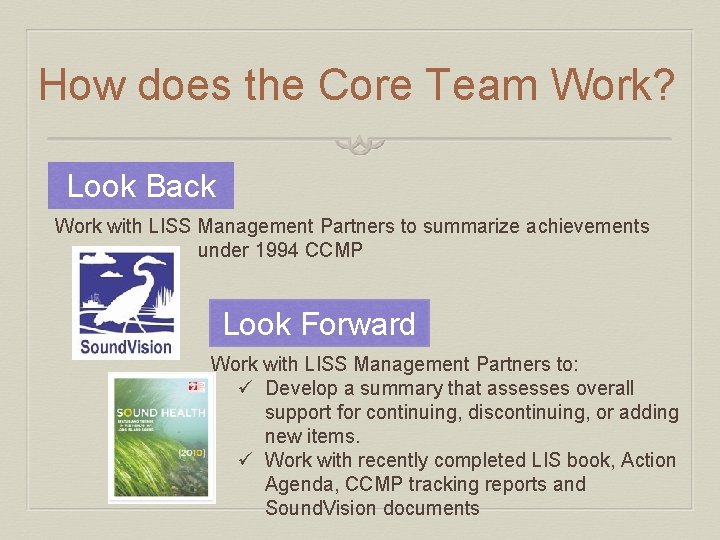
How does the Core Team Work? Look Back Work with LISS Management Partners to summarize achievements under 1994 CCMP Look Forward Work with LISS Management Partners to: ü Develop a summary that assesses overall support for continuing, discontinuing, or adding new items. ü Work with recently completed LIS book, Action Agenda, CCMP tracking reports and Sound. Vision documents
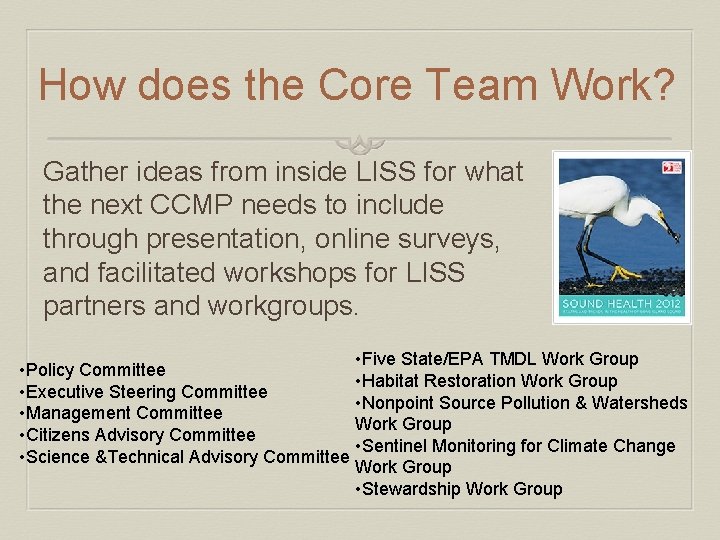
How does the Core Team Work? Gather ideas from inside LISS for what the next CCMP needs to include through presentation, online surveys, and facilitated workshops for LISS partners and workgroups. • Policy Committee • Executive Steering Committee • Management Committee • Citizens Advisory Committee • Science &Technical Advisory Committee • Five State/EPA TMDL Work Group • Habitat Restoration Work Group • Nonpoint Source Pollution & Watersheds Work Group • Sentinel Monitoring for Climate Change Work Group • Stewardship Work Group
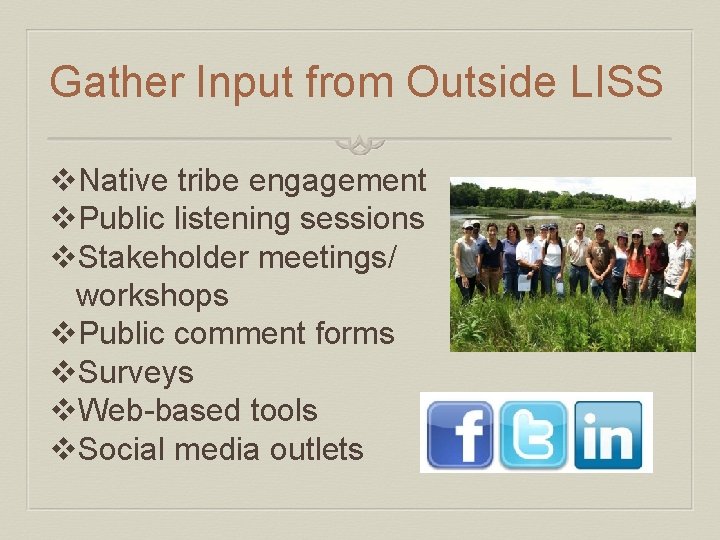
Gather Input from Outside LISS v. Native tribe engagement v. Public listening sessions v. Stakeholder meetings/ workshops v. Public comment forms v. Surveys v. Web-based tools v. Social media outlets
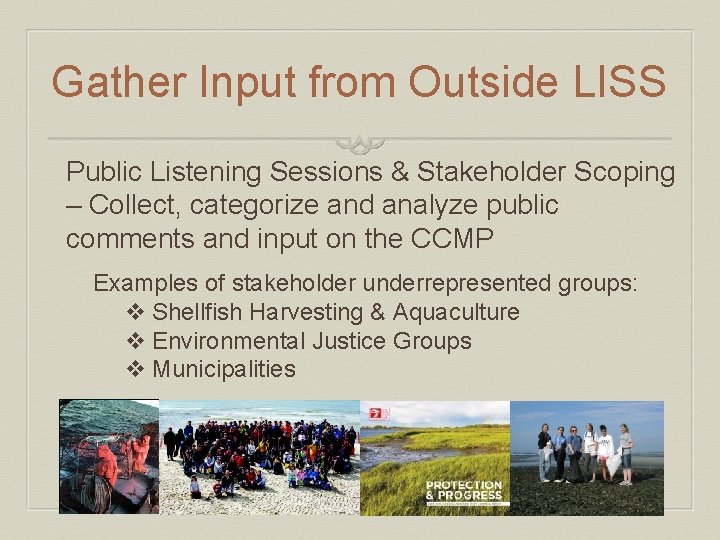
Gather Input from Outside LISS Public Listening Sessions & Stakeholder Scoping – Collect, categorize and analyze public comments and input on the CCMP Examples of stakeholder underrepresented groups: v Shellfish Harvesting & Aquaculture v Environmental Justice Groups v Municipalities
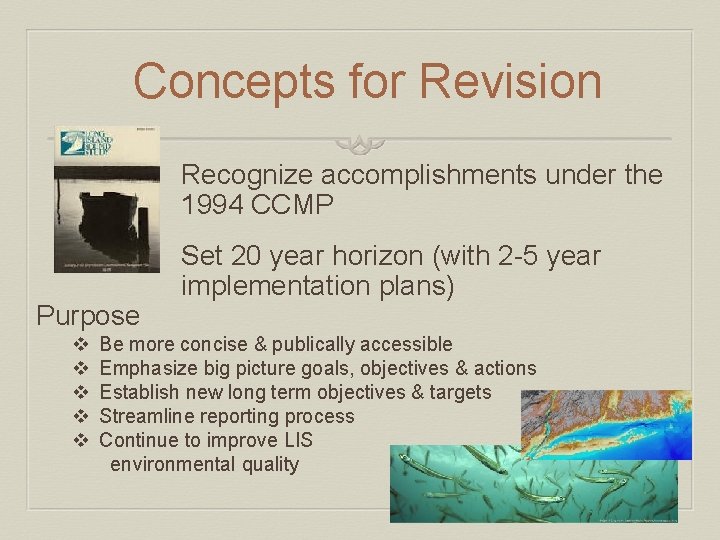
Concepts for Revision Recognize accomplishments under the 1994 CCMP Purpose v v v Set 20 year horizon (with 2 -5 year implementation plans) Be more concise & publically accessible Emphasize big picture goals, objectives & actions Establish new long term objectives & targets Streamline reporting process Continue to improve LIS environmental quality
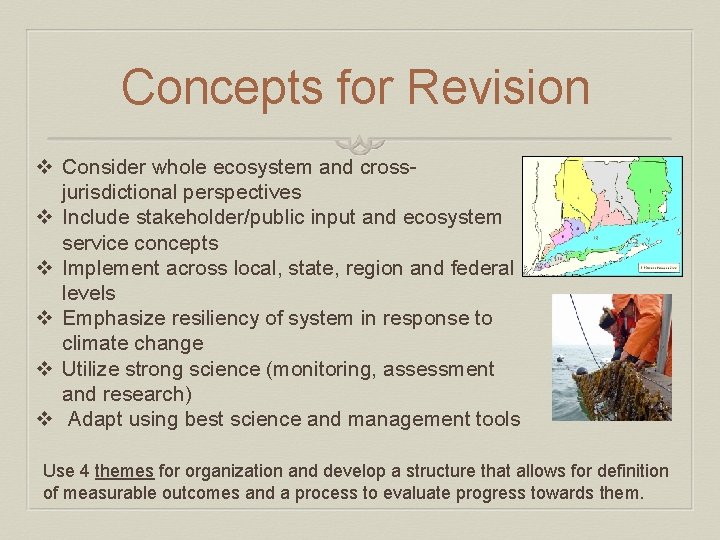
Concepts for Revision v Consider whole ecosystem and crossjurisdictional perspectives v Include stakeholder/public input and ecosystem service concepts v Implement across local, state, region and federal levels v Emphasize resiliency of system in response to climate change v Utilize strong science (monitoring, assessment and research) v Adapt using best science and management tools Use 4 themes for organization and develop a structure that allows for definition of measurable outcomes and a process to evaluate progress towards them.
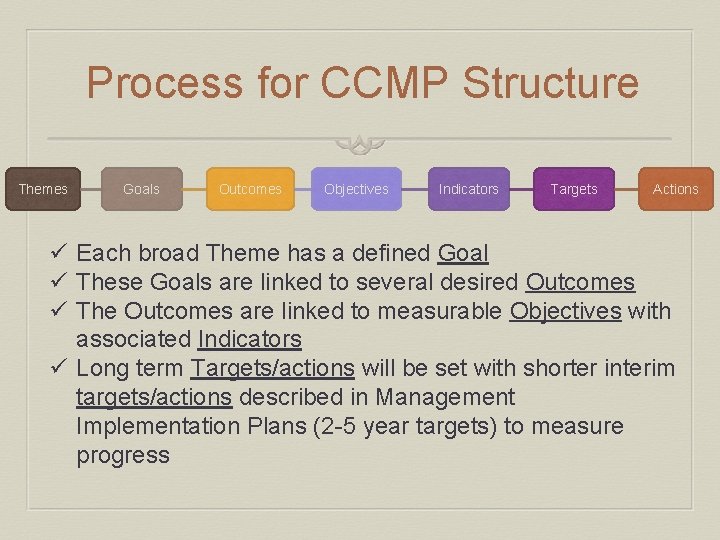
Process for CCMP Structure Themes Goals Outcomes Objectives Indicators Targets Actions ü Each broad Theme has a defined Goal ü These Goals are linked to several desired Outcomes ü The Outcomes are linked to measurable Objectives with associated Indicators ü Long term Targets/actions will be set with shorter interim targets/actions described in Management Implementation Plans (2 -5 year targets) to measure progress
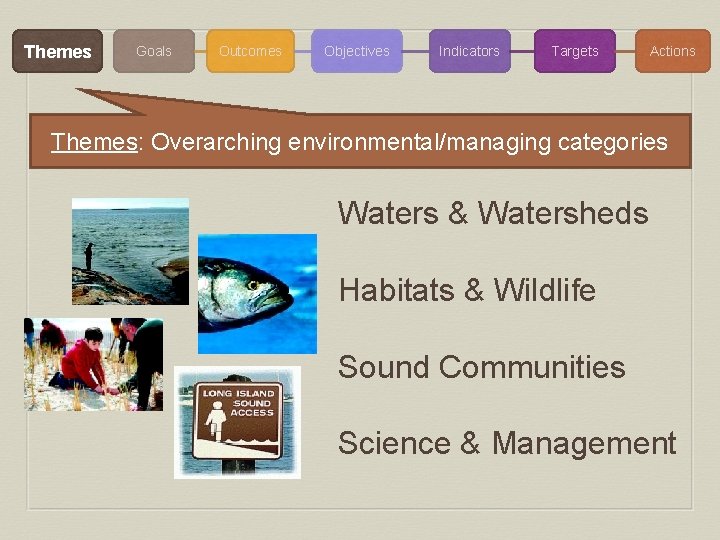
Themes Goals Outcomes Objectives Indicators Targets Actions Themes: Overarching environmental/managing categories Waters & Watersheds Habitats & Wildlife Sound Communities Science & Management
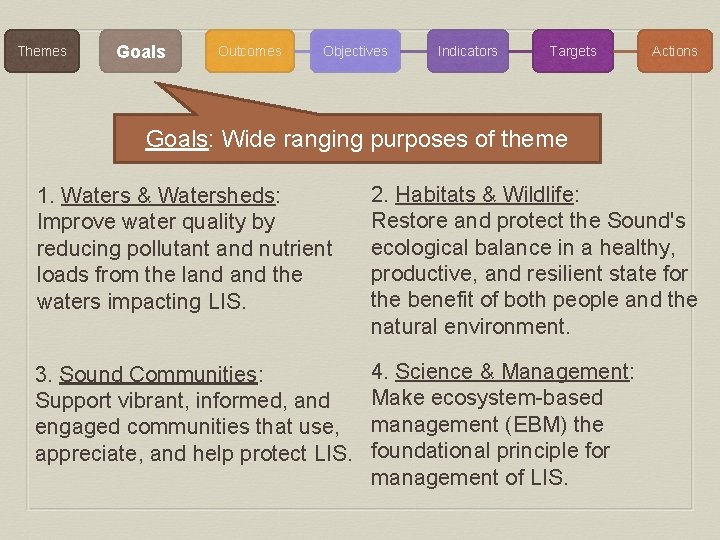
Themes Goals Outcomes Objectives Indicators Targets Actions Goals: Wide ranging purposes of theme 1. Waters & Watersheds: Improve water quality by reducing pollutant and nutrient loads from the land the waters impacting LIS. 2. Habitats & Wildlife: Restore and protect the Sound's ecological balance in a healthy, productive, and resilient state for the benefit of both people and the natural environment. 3. Sound Communities: Support vibrant, informed, and engaged communities that use, appreciate, and help protect LIS. 4. Science & Management: Make ecosystem-based management (EBM) the foundational principle for management of LIS.
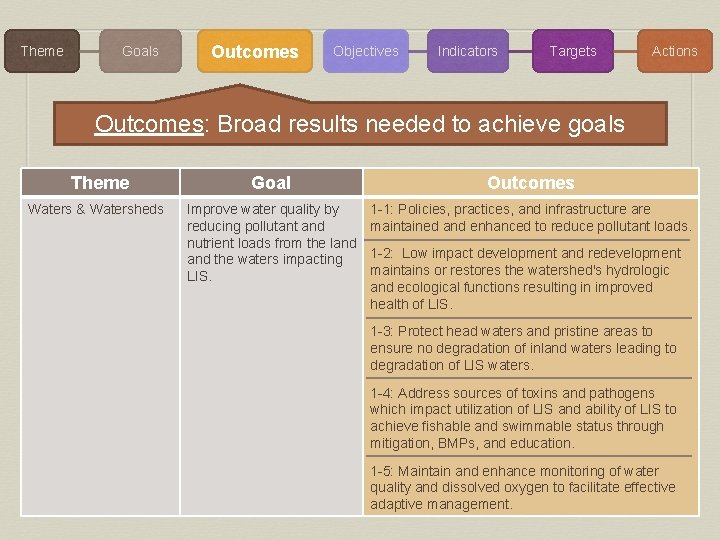
Theme Goals Outcomes Objectives Indicators Targets Actions Outcomes: Broad results needed to achieve goals Theme Goal Outcomes Waters & Watersheds Improve water quality by reducing pollutant and nutrient loads from the land the waters impacting LIS. 1 -1: Policies, practices, and infrastructure are maintained and enhanced to reduce pollutant loads. 1 -2: Low impact development and redevelopment maintains or restores the watershed's hydrologic and ecological functions resulting in improved health of LIS. 1 -3: Protect head waters and pristine areas to ensure no degradation of inland waters leading to degradation of LIS waters. 1 -4: Address sources of toxins and pathogens which impact utilization of LIS and ability of LIS to achieve fishable and swimmable status through mitigation, BMPs, and education. 1 -5: Maintain and enhance monitoring of water quality and dissolved oxygen to facilitate effective adaptive management.
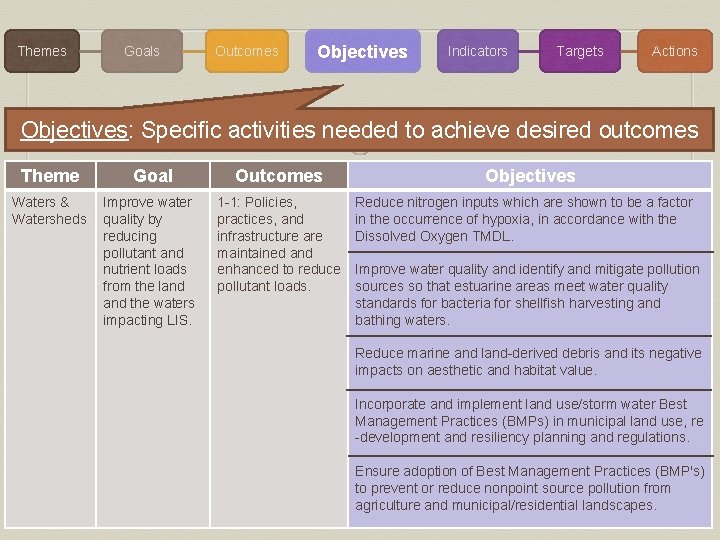
Themes Goals Outcomes Objectives Indicators Targets Actions Objectives: Specific activities needed to achieve desired outcomes Theme Goal Outcomes Waters & Watersheds Improve water quality by reducing pollutant and nutrient loads from the land the waters impacting LIS. 1 -1: Policies, practices, and infrastructure are maintained and enhanced to reduce pollutant loads. Objectives Reduce nitrogen inputs which are shown to be a factor in the occurrence of hypoxia, in accordance with the Dissolved Oxygen TMDL. Improve water quality and identify and mitigate pollution sources so that estuarine areas meet water quality standards for bacteria for shellfish harvesting and bathing waters. Reduce marine and land-derived debris and its negative impacts on aesthetic and habitat value. Incorporate and implement land use/storm water Best Management Practices (BMPs) in municipal land use, re -development and resiliency planning and regulations. Ensure adoption of Best Management Practices (BMP's) to prevent or reduce nonpoint source pollution from agriculture and municipal/residential landscapes.
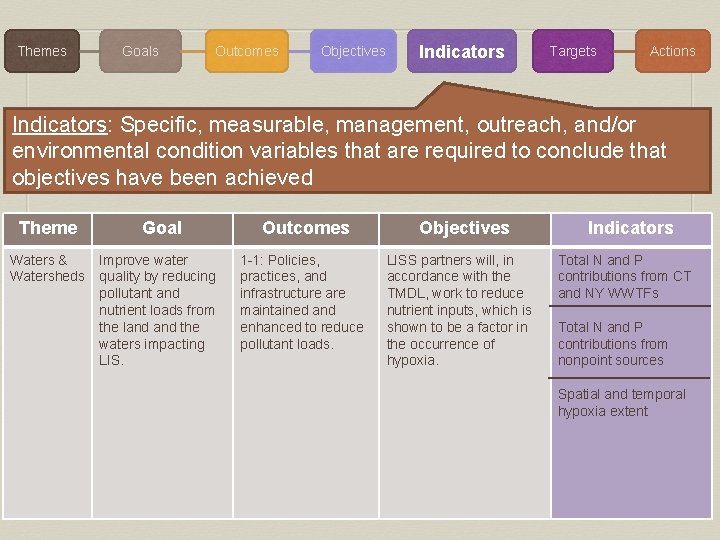
Themes Goals Outcomes Objectives Indicators Targets Actions Indicators: Specific, measurable, management, outreach, and/or environmental condition variables that are required to conclude that objectives have been achieved Theme Waters & Watersheds Goal Improve water quality by reducing pollutant and nutrient loads from the land the waters impacting LIS. Outcomes 1 -1: Policies, practices, and infrastructure are maintained and enhanced to reduce pollutant loads. Objectives LISS partners will, in accordance with the TMDL, work to reduce nutrient inputs, which is shown to be a factor in the occurrence of hypoxia. Indicators Total N and P contributions from CT and NY WWTFs Total N and P contributions from nonpoint sources Spatial and temporal hypoxia extent
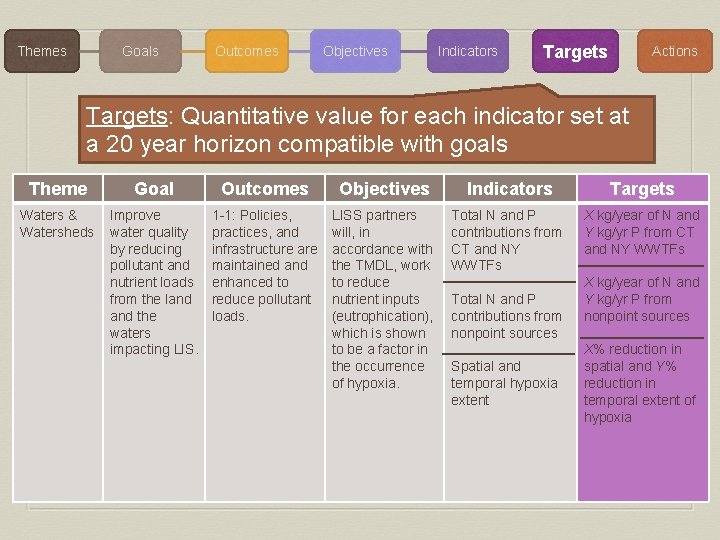
Themes Goals Outcomes Objectives Indicators Targets Actions Targets: Quantitative value for each indicator set at a 20 year horizon compatible with goals Theme Goal Outcomes Objectives Indicators Targets Waters & Watersheds Improve water quality by reducing pollutant and nutrient loads from the land the waters impacting LIS. 1 -1: Policies, practices, and infrastructure are maintained and enhanced to reduce pollutant loads. LISS partners will, in accordance with the TMDL, work to reduce nutrient inputs (eutrophication), which is shown to be a factor in the occurrence of hypoxia. Total N and P contributions from CT and NY WWTFs X kg/year of N and Y kg/yr P from CT and NY WWTFs Total N and P contributions from nonpoint sources Spatial and temporal hypoxia extent X kg/year of N and Y kg/yr P from nonpoint sources X% reduction in spatial and Y% reduction in temporal extent of hypoxia
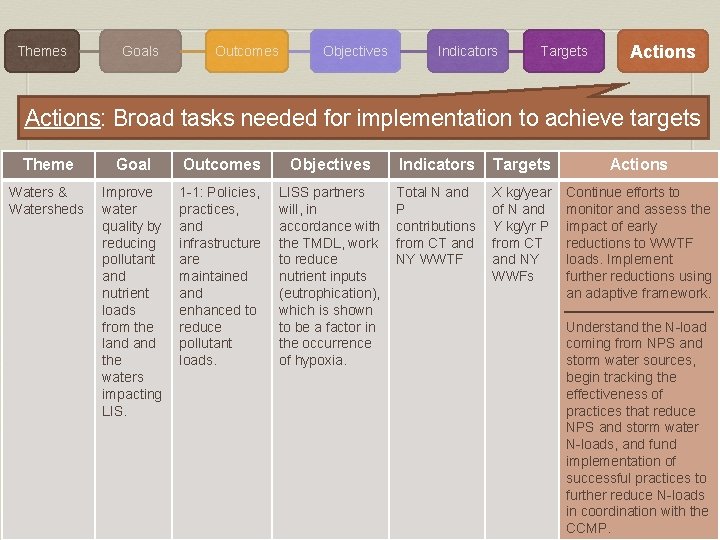
Themes Goals Outcomes Objectives Indicators Targets Actions: Broad tasks needed for implementation to achieve targets Theme Goal Outcomes Objectives Indicators Targets Actions Waters & Watersheds Improve water quality by reducing pollutant and nutrient loads from the land the waters impacting LIS. 1 -1: Policies, practices, and infrastructure are maintained and enhanced to reduce pollutant loads. LISS partners will, in accordance with the TMDL, work to reduce nutrient inputs (eutrophication), which is shown to be a factor in the occurrence of hypoxia. Total N and P contributions from CT and NY WWTF X kg/year of N and Y kg/yr P from CT and NY WWFs Continue efforts to monitor and assess the impact of early reductions to WWTF loads. Implement further reductions using an adaptive framework. Understand the N-load coming from NPS and storm water sources, begin tracking the effectiveness of practices that reduce NPS and storm water N-loads, and fund implementation of successful practices to further reduce N-loads in coordination with the CCMP.
Examples of Indicators and Trends
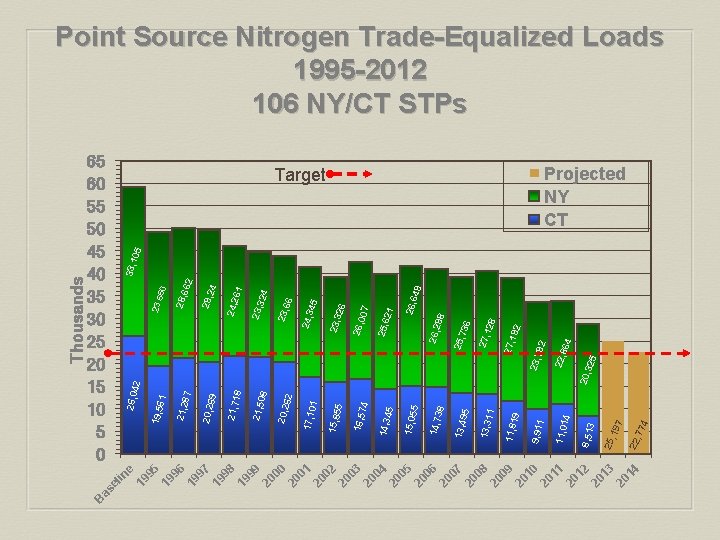
95 19 96 19 97 19 98 19 99 20 00 20 01 20 02 20 03 20 04 20 05 20 06 20 07 20 08 20 09 20 10 20 11 20 12 20 13 20 14 e 3 74 22, 7 97 25, 1 8, 51 14 25 20, 3 64 22, 8 92 23, 7 92 27, 1 28 27, 1 36 25, 7 98 26, 2 49 26, 6 21 25, 6 07 26, 0 26 23, 3 6 45 24, 3 23, 6 24 23, 3 4 61 24, 2 29, 2 62 28, 6 60 23. 6 05 33, 1 Target 11, 0 1 9, 91 19 11, 8 11 13, 3 95 13, 4 38 14, 7 55 15, 0 45 14, 3 74 16, 5 55 15, 8 01 17, 1 62 20, 2 08 21, 5 18 21, 7 69 20, 2 87 21, 2 61 19, 5 42 26, 0 65 60 55 50 45 40 35 30 25 20 15 10 5 0 19 lin as e B Thousands Point Source Nitrogen Trade-Equalized Loads 1995 -2012 106 NY/CT STPs Projected NY CT
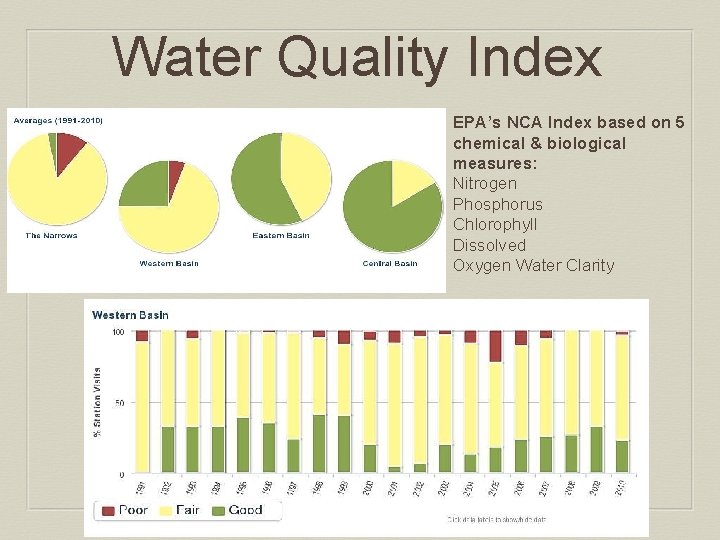
Water Quality Index EPA’s NCA Index based on 5 chemical & biological measures: Nitrogen Phosphorus Chlorophyll Dissolved Oxygen Water Clarity
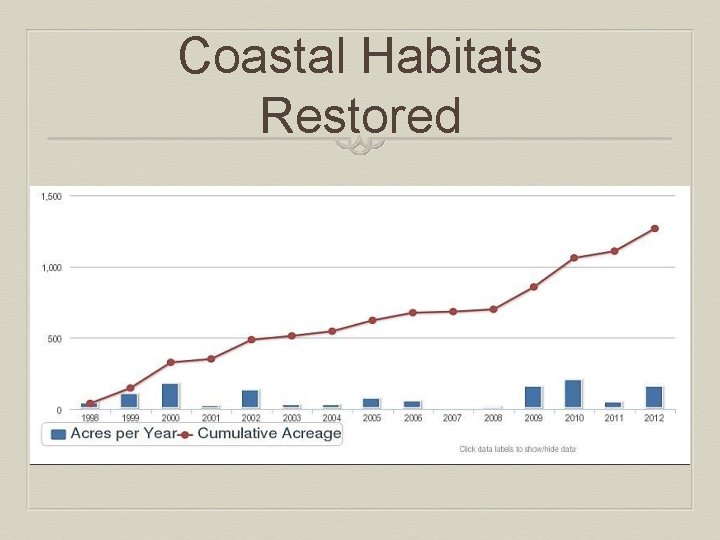
Coastal Habitats Restored
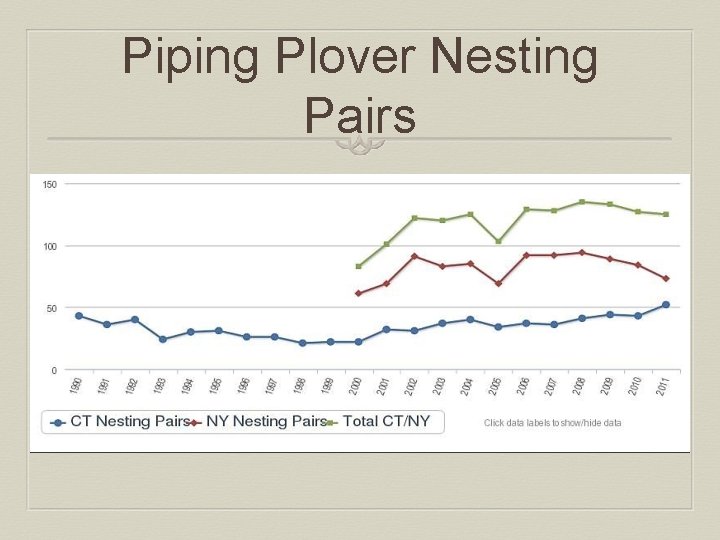
Piping Plover Nesting Pairs
Where can I learn more and how can I provide input? LISS CCMP Website: http: //longislandsoundstudy. net/ look at “plan update” in the News Room Long Island Sound Study Update Facebook https: //www. facebook. com/LISSplanupdate Join the Long Island Sound Study Update discussion on Linked. In http: //www. linkedin. com/groups/Long-Island-Sound-Study-Plan-4995384/about Follow us on Twitter @Plan. Update To provide input please send email to: contact@watervisionllc. com Theme Core Team Champion Waters and Watersheds Sarah Deonarine, Mark Parker & Jason Krumholz Habitats and Wildlife Harry Yamalis, Georgia Basso, & Victoria O’Neill Sound Communities Robert Burg , Amy Boyajian, & David Miller Science and Management Mark Tedesco, Larry Swanson, & Jim Latimer