
REVISION OF RISK ASSESSMENT METHODS FOR LNG TERMINAL

- Slides: 10
REVISION OF RISK ASSESSMENT METHODS FOR LNG TERMINAL SITE LOCATION Maciej Gucma, Ph. D. Eng. DSc. Lucjan Gucma Prof. Ph. D. Eng. DSc. Kinga Łazuga Ph. D. Eng. Renata Boć MSc. Eng. Maritime University of Szczecin, Poland, m. gucma@am. szczecin. pl Peter Vidmar, Ph. D. Eng. DSc. Marko Perkovic Ph. D. Eng. University of Ljubliana, Fakulteta za Pomorstvo in Promet, Porotroz, Slovenija
REVISION OF RISK ASSESSMENT METHODS FOR LNG TERMINAL SITE LOCATION During the process of LNG (Liquefied Natural Gas) site design (either off- and on-shore) one of the key factors are hazard identification and risk mitigation for potential spillage of liquified gas. Where the liquefied fuel cargo (low flashpoint liquids or gases) is concerned apart from modeling tools like HAZOP (Hazard and Operability Study), FMA, or FTA (Fault Tree Analysis) there is a need for detailed case modeling with the specific design criteria. The key factor determining the usefulness of a given method of hazard identification is its openness to the creation of scenarios connecting the chains of events and time series.
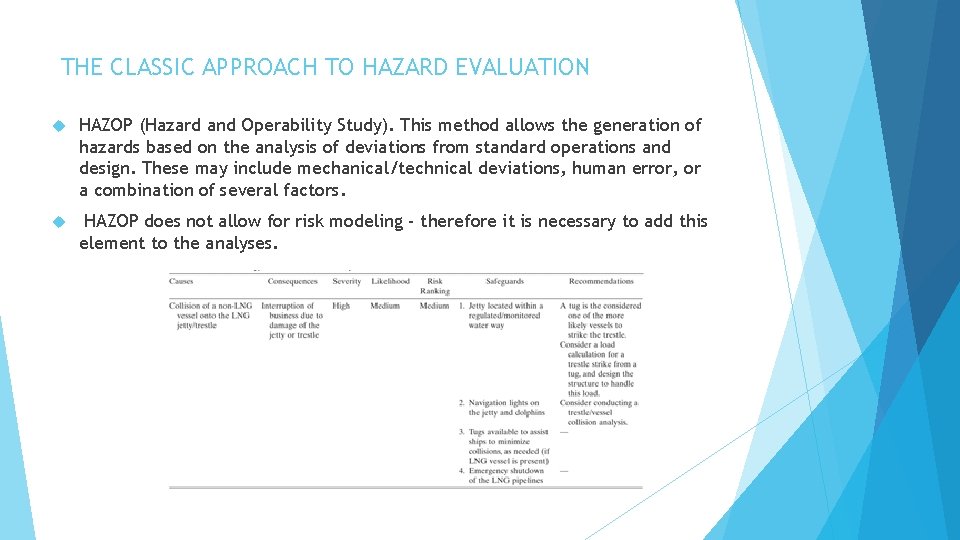
THE CLASSIC APPROACH TO HAZARD EVALUATION HAZOP (Hazard and Operability Study). This method allows the generation of hazards based on the analysis of deviations from standard operations and design. These may include mechanical/technical deviations, human error, or a combination of several factors. HAZOP does not allow for risk modeling - therefore it is necessary to add this element to the analyses.
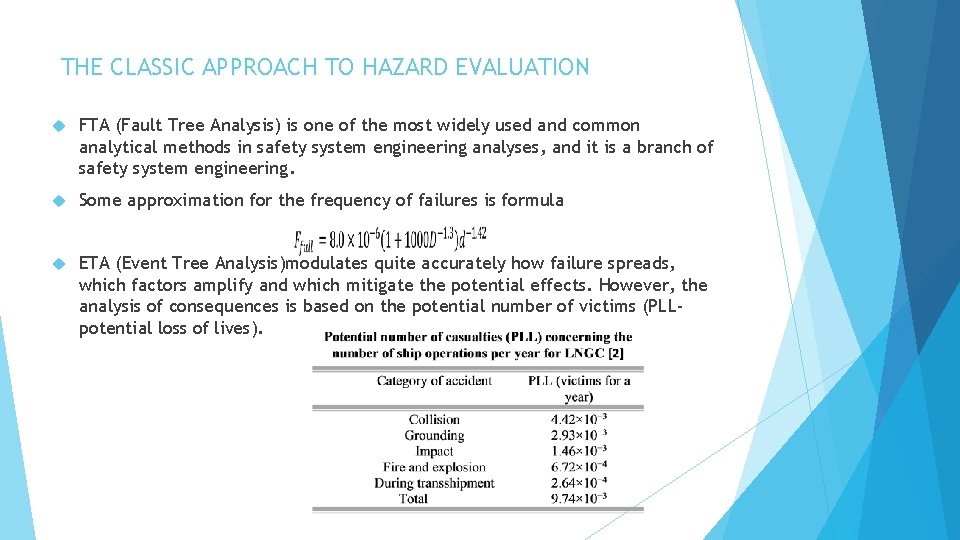
THE CLASSIC APPROACH TO HAZARD EVALUATION FTA (Fault Tree Analysis) is one of the most widely used and common analytical methods in safety system engineering analyses, and it is a branch of safety system engineering. Some approximation for the frequency of failures is formula ETA (Event Tree Analysis)modulates quite accurately how failure spreads, which factors amplify and which mitigate the potential effects. However, the analysis of consequences is based on the potential number of victims (PLLpotential loss of lives).
CFD MODELLING Computer numerical CFD (Computational Fluid Dynamics) fluid modeling is based on the mechanics of liquids and gases in continuous media. The following elements should be defined: Liquid density Specific gravity Specific volume The compressibility of a fluid (the ability to change its volume at a given temperature and pressure) is measured by the compressibility factor Thermal expansion - the ability of a fluid to change its volume at a change in temperature (at constant pressure) Diffusion (molecular) in fluids - a process of molecular concentration compensation Viscosity - the ability to transmit tangential stresses when its components move with each other at different
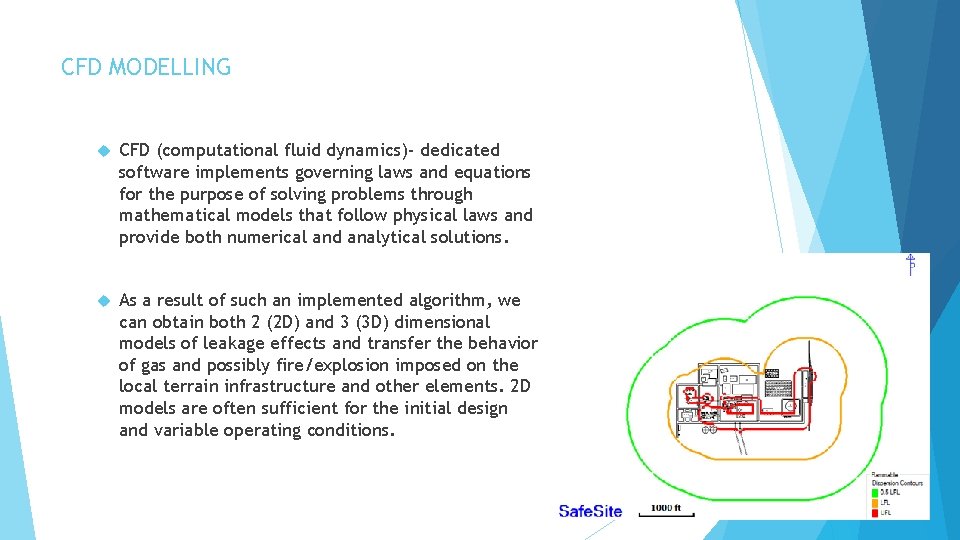
CFD MODELLING CFD (computational fluid dynamics)- dedicated software implements governing laws and equations for the purpose of solving problems through mathematical models that follow physical laws and provide both numerical and analytical solutions. As a result of such an implemented algorithm, we can obtain both 2 (2 D) and 3 (3 D) dimensional models of leakage effects and transfer the behavior of gas and possibly fire/explosion imposed on the local terrain infrastructure and other elements. 2 D models are often sufficient for the initial design and variable operating conditions.
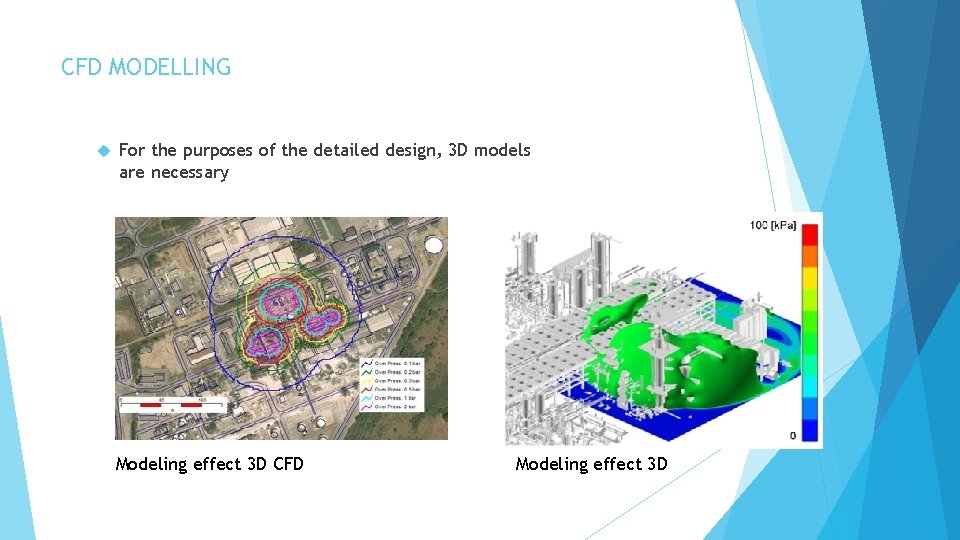
CFD MODELLING For the purposes of the detailed design, 3 D models are necessary Modeling effect 3 D CFD Modeling effect 3 D
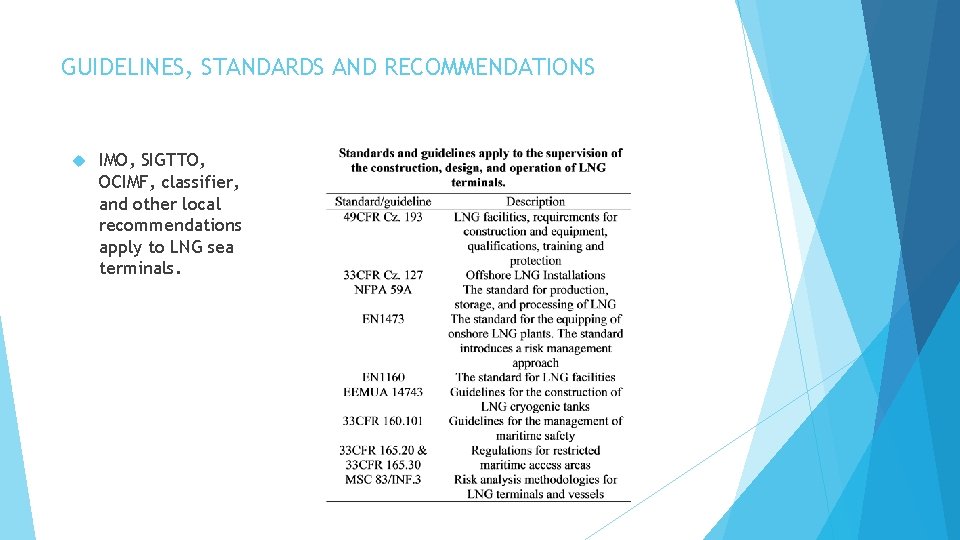
GUIDELINES, STANDARDS AND RECOMMENDATIONS IMO, SIGTTO, OCIMF, classifier, and other local recommendations apply to LNG sea terminals.
SUMMARY The design of the new or expanding existing LNG terminal is always a demanding and wide approach. Having in mind national or international criteria is not always ‘the only way’ and new specific approaches must be applied by engineers. The necessity for this article was to summarize the existing methods and show their combinations in LNG terminal design in safety of processing areas.
THANK YOU FOR YOUR ATTENTION