
Revision Numbers and place value Objectives Day 1
Revision Numbers and place value Objectives Day 1 Y 5: Compare and order negative numbers; Count back in steps through zero. Y 6: Place and order negative numbers; calculate differences across 0. Day 2 Y 5: Round 6 -digit numbers to the nearest 1000, 10, 000, and 100, 000. Y 6: Understand place value in numbers to 10, 000; rounding. © hamilton-trust. org. uk 1 Year 5/6

Revision Numbers and place value Short Mental Workouts Day 1 Count back through 0 Day 2 Place value in 6 -digit numbers © hamilton-trust. org. uk 2 Year 5/6
Revision Numbers and place value Short Mental Workout Count back through 0 © hamilton-trust. org. uk 3 Year 5/6
Revision Numbers and place value Short Mental Workout Place value in 6 -digit numbers © hamilton-trust. org. uk 4 Year 5/6
Revision Numbers and place value Day 1 Y 5: Compare and order negative numbers; Count back in steps through zero. Y 6: Place and order negative numbers; calculate differences across 0. © hamilton-trust. org. uk 5 Year 5/6
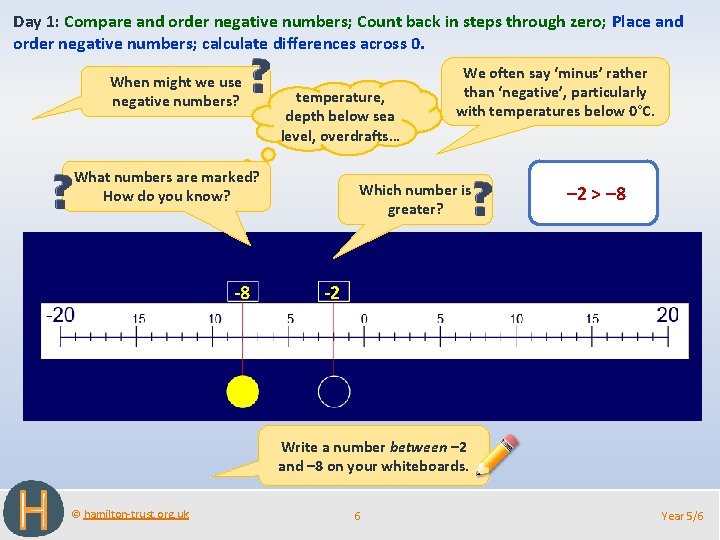
Day 1: Compare and order negative numbers; Count back in steps through zero; Place and order negative numbers; calculate differences across 0. When might we use negative numbers? temperature, depth below sea level, overdrafts… What numbers are marked? How do you know? -8 We often say ‘minus’ rather than ‘negative’, particularly with temperatures below 0°C. Which number is greater? -– 2 > – 8 -2 Write a number between – 2 and – 8 on your whiteboards. © hamilton-trust. org. uk 6 Year 5/6
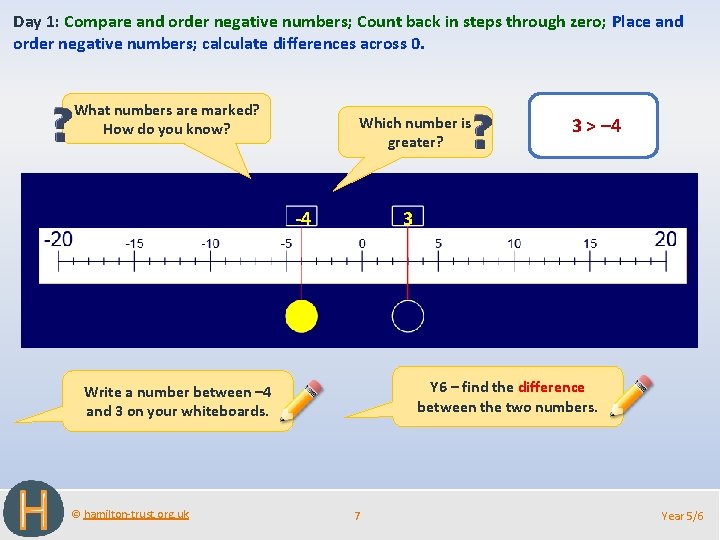
Day 1: Compare and order negative numbers; Count back in steps through zero; Place and order negative numbers; calculate differences across 0. What numbers are marked? How do you know? Which number is greater? -4 3 Y 6 – find the difference between the two numbers. Write a number between – 4 and 3 on your whiteboards. © hamilton-trust. org. uk -3 > – 4 7 Year 5/6
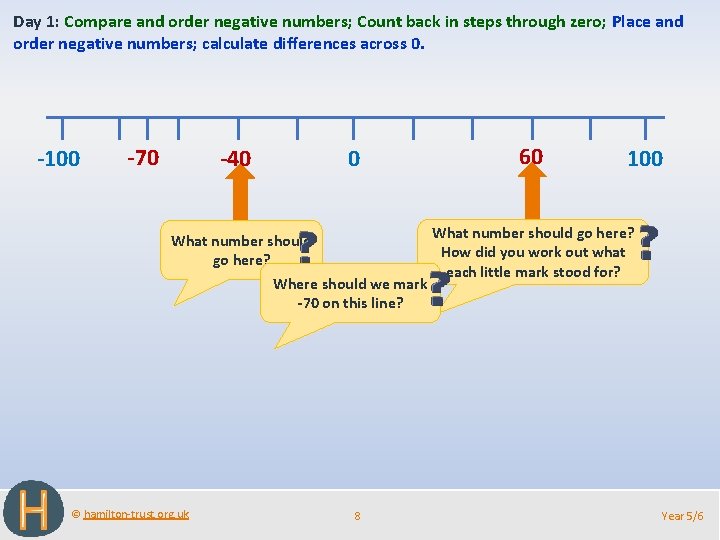
Day 1: Compare and order negative numbers; Count back in steps through zero; Place and order negative numbers; calculate differences across 0. -100 -70 -40 0 60 100 What number should go here? What number should How did you work out what go here? each little mark stood for? Where should we mark -70 on this line? © hamilton-trust. org. uk 8 Year 5/6
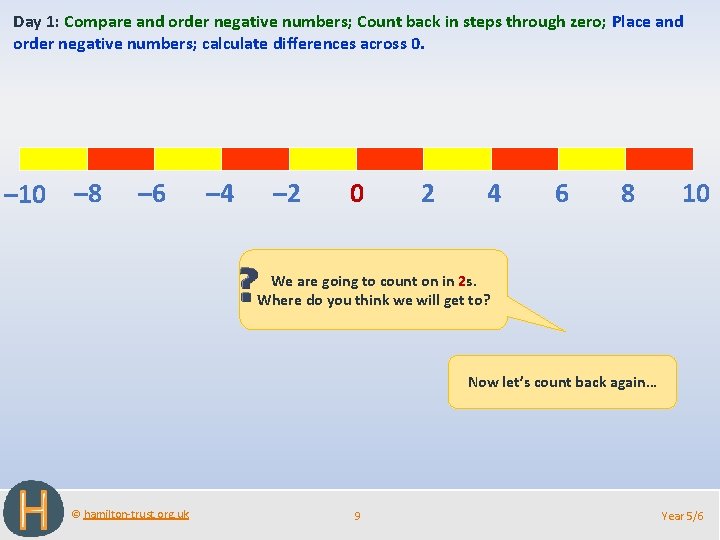
Day 1: Compare and order negative numbers; Count back in steps through zero; Place and order negative numbers; calculate differences across 0. – 10 – 8 – 6 – 4 – 2 0 2 4 6 8 10 We are going to count on in 2 s. Where do you think we will get to? Now let’s count back again… © hamilton-trust. org. uk 9 Year 5/6
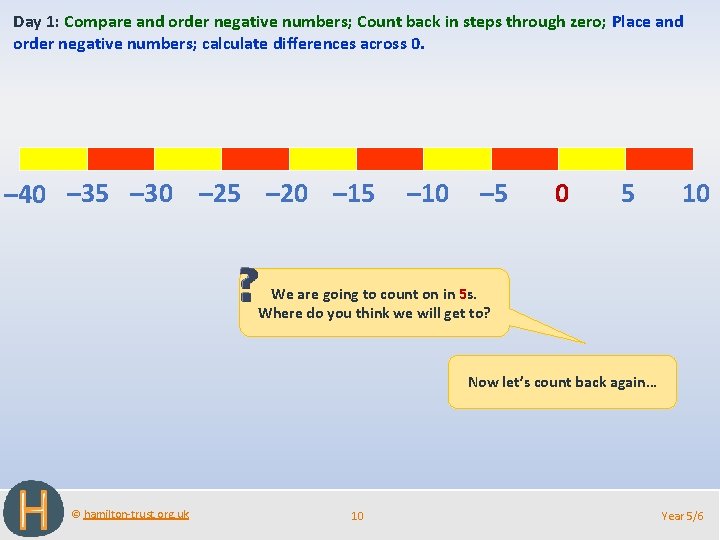
Day 1: Compare and order negative numbers; Count back in steps through zero; Place and order negative numbers; calculate differences across 0. – 40 – 35 – 30 – 25 – 20 – 15 – 10 – 5 0 5 10 We are going to count on in 5 s. Where do you think we will get to? Now let’s count back again… © hamilton-trust. org. uk 10 Year 5/6
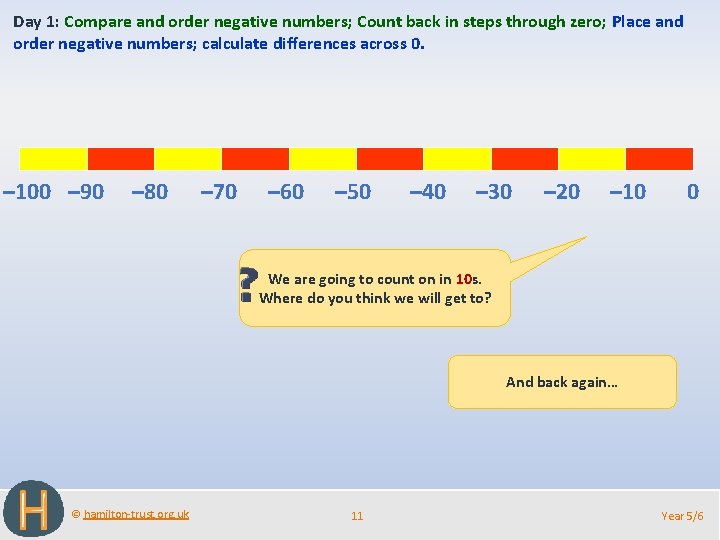
Day 1: Compare and order negative numbers; Count back in steps through zero; Place and order negative numbers; calculate differences across 0. – 100 – 90 – 80 – 70 – 60 – 50 – 40 – 30 – 20 – 10 0 We are going to count on in 10 s. Where do you think we will get to? And back again… © hamilton-trust. org. uk 11 Year 5/6
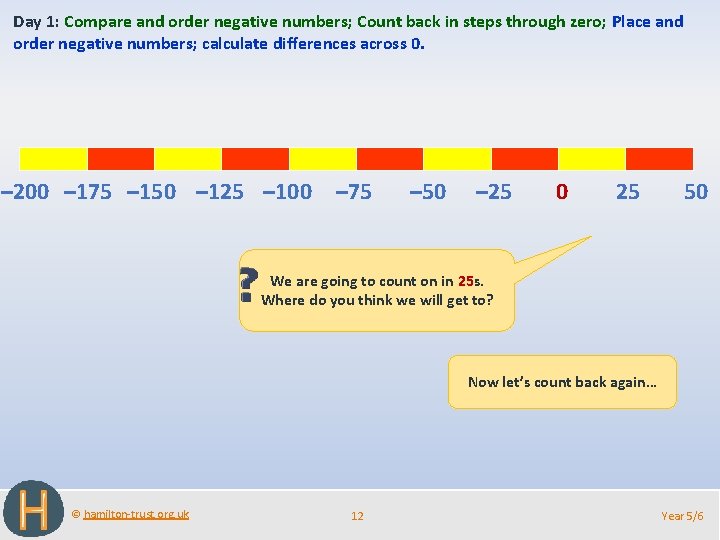
Day 1: Compare and order negative numbers; Count back in steps through zero; Place and order negative numbers; calculate differences across 0. – 200 – 175 – 150 – 125 – 100 – 75 – 50 – 25 0 25 50 We are going to count on in 25 s. Where do you think we will get to? Now let’s count back again… © hamilton-trust. org. uk 12 Year 5/6
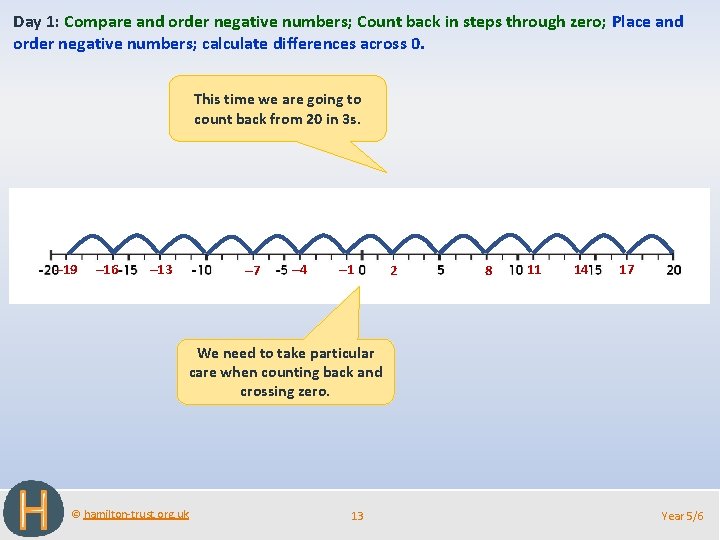
Day 1: Compare and order negative numbers; Count back in steps through zero; Place and order negative numbers; calculate differences across 0. This time we are going to count back from 20 in 3 s. – 19 – 16 – 13 – 7 – 4 – 1 2 8 11 14 17 We need to take particular care when counting back and crossing zero. © hamilton-trust. org. uk 13 Year 5/6
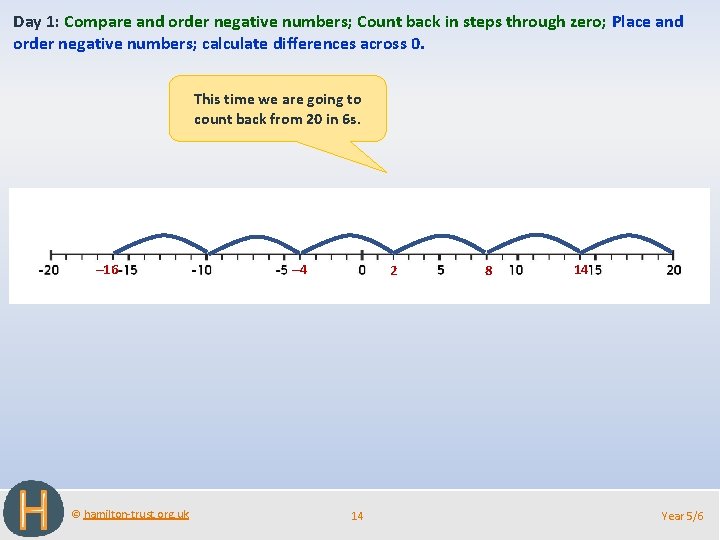
Day 1: Compare and order negative numbers; Count back in steps through zero; Place and order negative numbers; calculate differences across 0. This time we are going to count back from 20 in 6 s. – 16 © hamilton-trust. org. uk – 4 2 14 8 14 Year 5/6
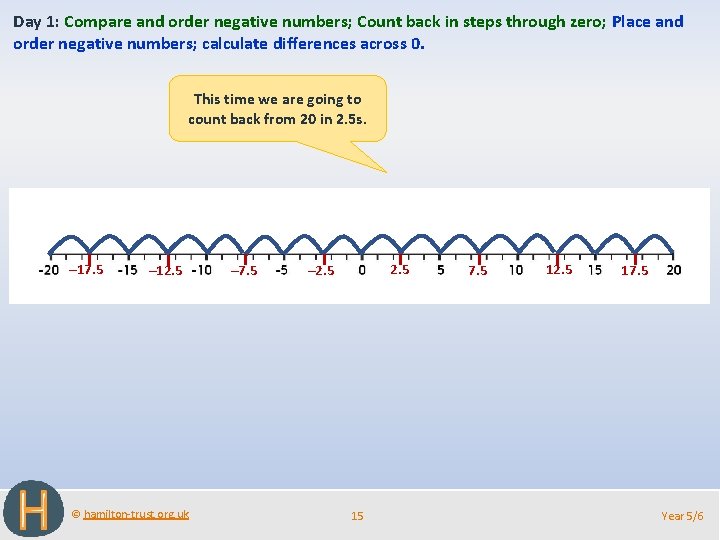
Day 1: Compare and order negative numbers; Count back in steps through zero; Place and order negative numbers; calculate differences across 0. This time we are going to count back from 20 in 2. 5 s. – 17. 5 – 12. 5 © hamilton-trust. org. uk – 7. 5 2. 5 – 2. 5 15 7. 5 12. 5 17. 5 Year 5/6
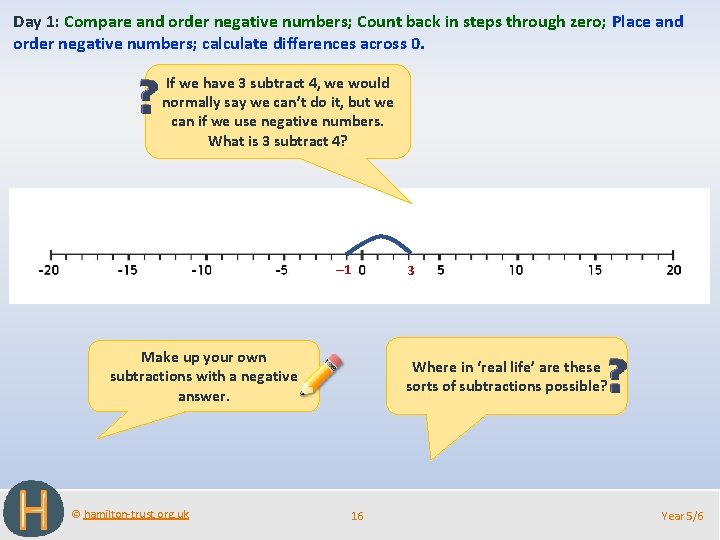
Day 1: Compare and order negative numbers; Count back in steps through zero; Place and order negative numbers; calculate differences across 0. If we have 3 subtract 4, we would normally say we can’t do it, but we can if we use negative numbers. What is 3 subtract 4? – 1 3 Make up your own subtractions with a negative answer. © hamilton-trust. org. uk Where in ‘real life’ are these sorts of subtractions possible? 16 Year 5/6
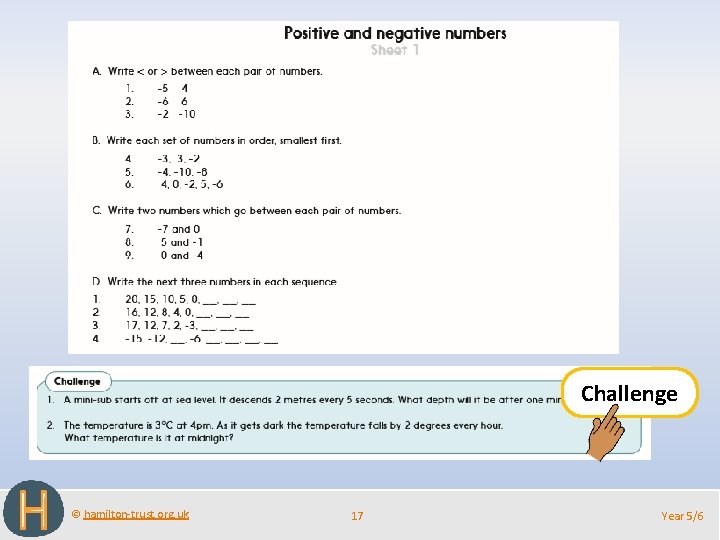
Challenge © hamilton-trust. org. uk 17 Year 5/6
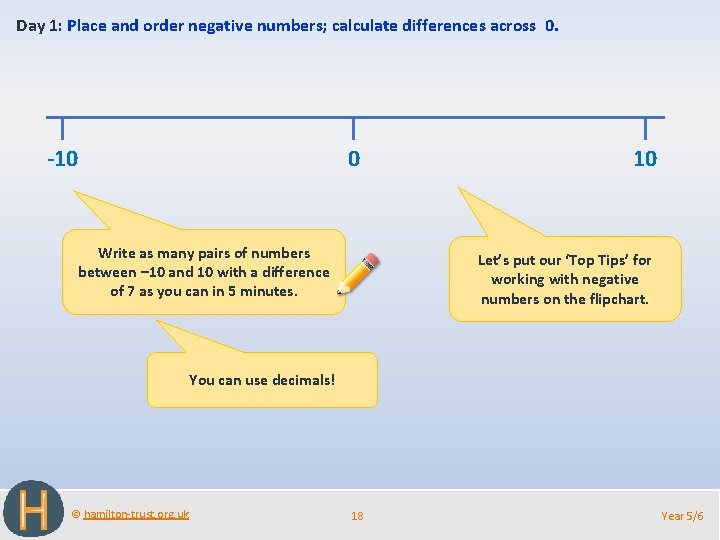
Day 1: Place and order negative numbers; calculate differences across 0. -10 0 Write as many pairs of numbers between – 10 and 10 with a difference of 7 as you can in 5 minutes. 10 Let’s put our ‘Top Tips’ for working with negative numbers on the flipchart. You can use decimals! © hamilton-trust. org. uk 18 Year 5/6
© hamilton-trust. org. uk 19 Year 5/6
Revision Numbers and place value Day 2 Y 5: Round 6 -digit numbers to the nearest 1000, 10, 000, and 100, 000. Y 6: Understand place value in numbers to 10, 000; rounding. © hamilton-trust. org. uk 20 Year 5/6
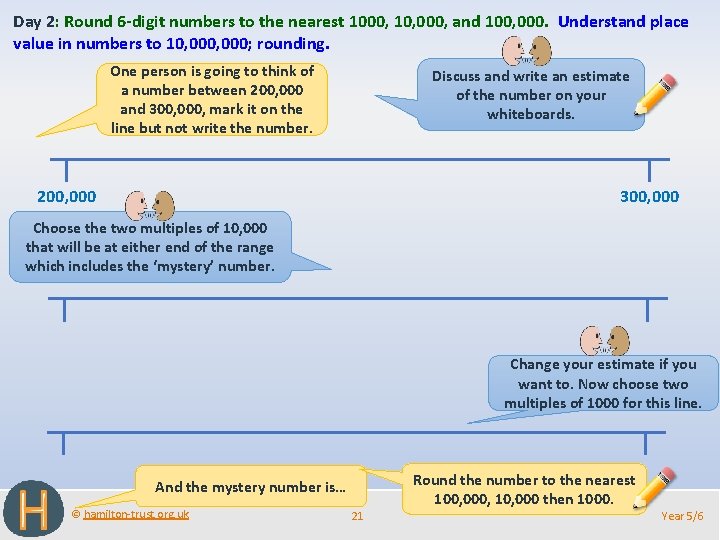
Day 2: Round 6 -digit numbers to the nearest 1000, 10, 000, and 100, 000. Understand place value in numbers to 10, 000; rounding. One person is going to think of a number between 200, 000 and 300, 000, mark it on the line but not write the number. Discuss and write an estimate of the number on your whiteboards. 200, 000 300, 000 Choose the two multiples of 10, 000 that will be at either end of the range which includes the ‘mystery’ number. Change your estimate if you want to. Now choose two multiples of 1000 for this line. Round the number to the nearest 100, 000, 10, 000 then 1000. And the mystery number is… © hamilton-trust. org. uk 21 Year 5/6
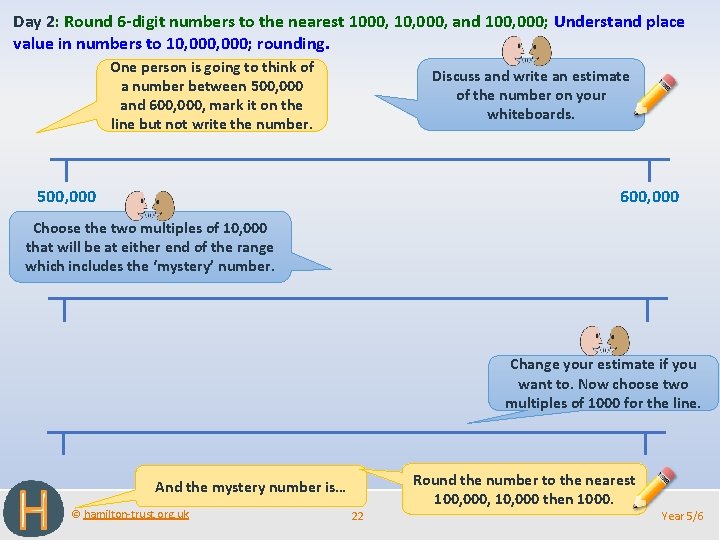
Day 2: Round 6 -digit numbers to the nearest 1000, 10, 000, and 100, 000; Understand place value in numbers to 10, 000; rounding. One person is going to think of a number between 500, 000 and 600, 000, mark it on the line but not write the number. Discuss and write an estimate of the number on your whiteboards. 500, 000 600, 000 Choose the two multiples of 10, 000 that will be at either end of the range which includes the ‘mystery’ number. Change your estimate if you want to. Now choose two multiples of 1000 for the line. Round the number to the nearest 100, 000, 10, 000 then 1000. And the mystery number is… © hamilton-trust. org. uk 22 Year 5/6
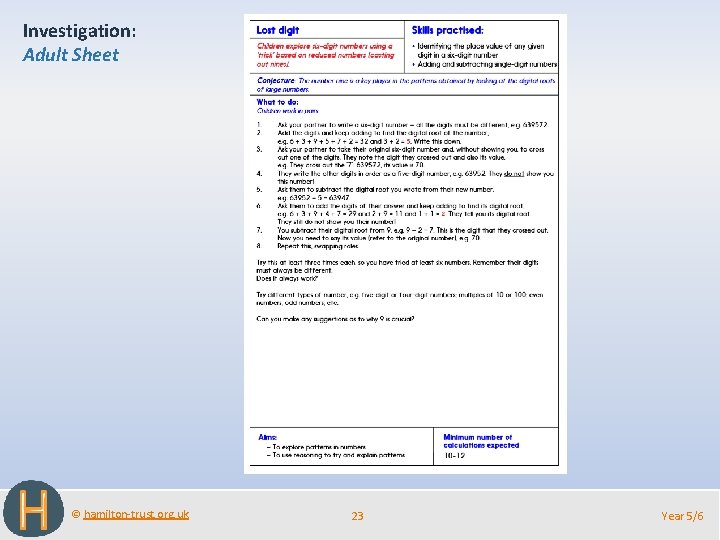
Investigation: Adult Sheet © hamilton-trust. org. uk 23 Year 5/6
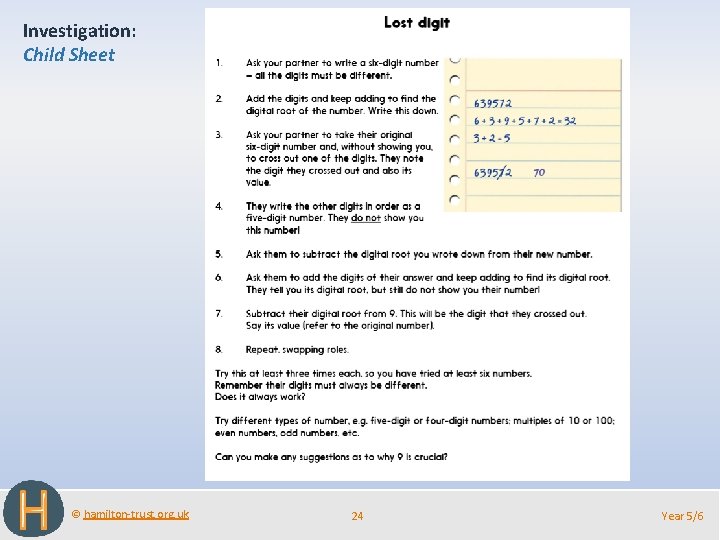
Investigation: Child Sheet © hamilton-trust. org. uk 24 Year 5/6
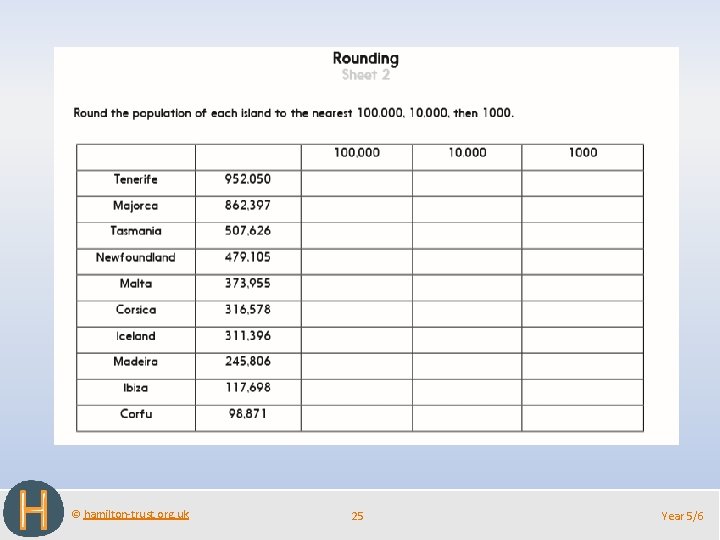
© hamilton-trust. org. uk 25 Year 5/6
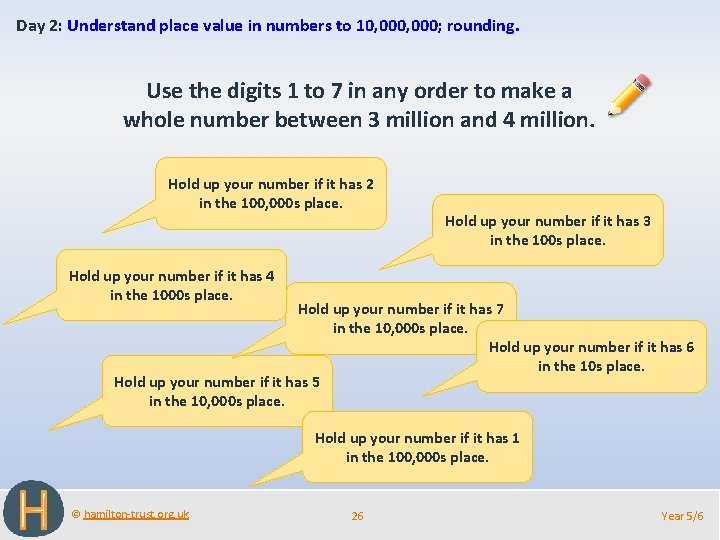
Day 2: Understand place value in numbers to 10, 000; rounding. Use the digits 1 to 7 in any order to make a whole number between 3 million and 4 million. Hold up your number if it has 2 in the 100, 000 s place. Hold up your number if it has 3 in the 100 s place. Hold up your number if it has 4 in the 1000 s place. Hold up your number if it has 7 in the 10, 000 s place. Hold up your number if it has 6 in the 10 s place. Hold up your number if it has 5 in the 10, 000 s place. Hold up your number if it has 1 in the 100, 000 s place. © hamilton-trust. org. uk 26 Year 5/6
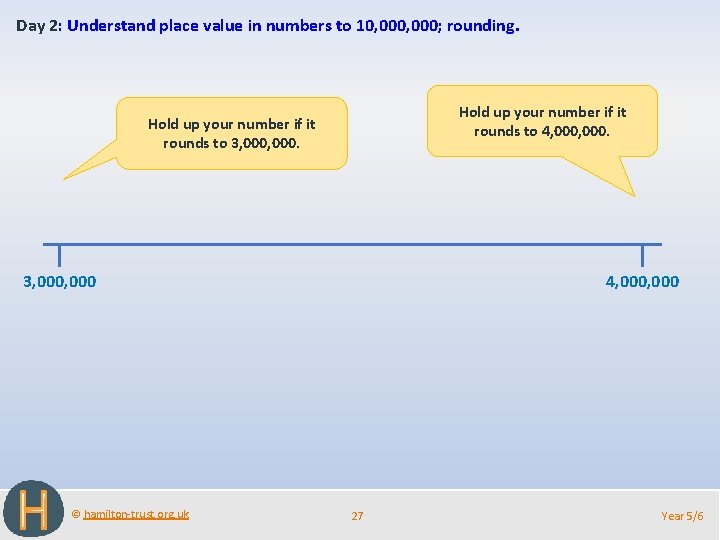
Day 2: Understand place value in numbers to 10, 000; rounding. Hold up your number if it rounds to 4, 000. Hold up your number if it rounds to 3, 000 © hamilton-trust. org. uk 4, 000 27 Year 5/6
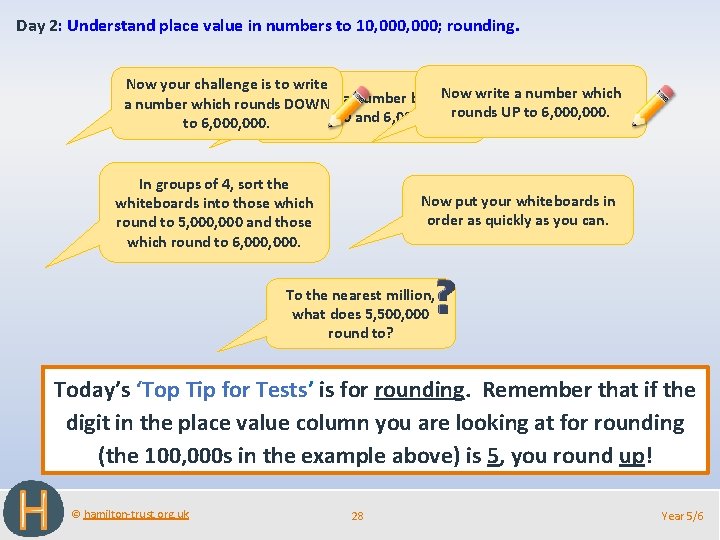
Day 2: Understand place value in numbers to 10, 000; rounding. Now your challenge is to write Now write a number which Now write a number between a number which rounds DOWN rounds UP to 6, 000, 000. 5, 000 and 6, 000. In groups of 4, sort the whiteboards into those which round to 5, 000 and those which round to 6, 000. Now put your whiteboards in order as quickly as you can. To the nearest million, what does 5, 500, 000 round to? Today’s ‘Top Tip for Tests’ is for rounding. Remember that if the digit in the place value column you are looking at for rounding (the 100, 000 s in the example above) is 5, you round up! © hamilton-trust. org. uk 28 Year 5/6
© hamilton-trust. org. uk 29 Year 5/6
Revision Numbers and place value Well Done! You’ve completed this unit. Objectives Day 1 Y 5: Compare and order negative numbers; Count back in steps through zero. Y 6: Place and order negative numbers; calculate differences across 0. Day 2 Y 5: Round 6 -digit numbers to the nearest 1000, 10, 000, and 100, 000. Y 6: Understand place value in numbers to 10, 000; rounding. © hamilton-trust. org. uk 30 Year 5/6
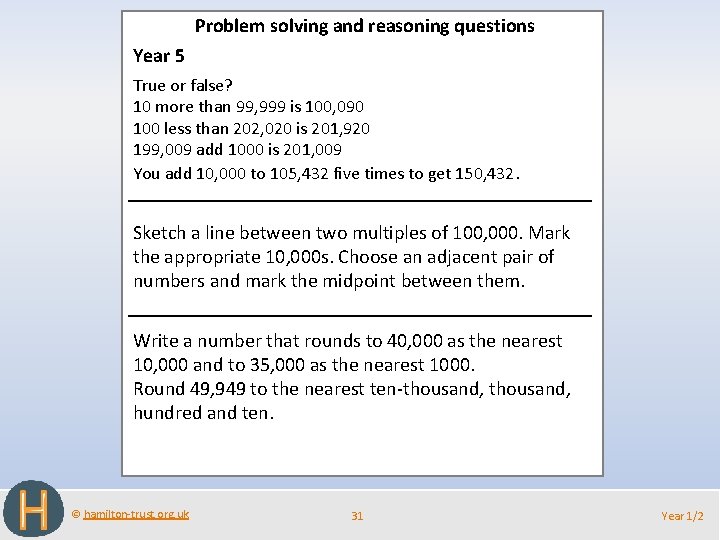
Problem solving and reasoning questions Year 5 True or false? 10 more than 99, 999 is 100, 090 100 less than 202, 020 is 201, 920 199, 009 add 1000 is 201, 009 You add 10, 000 to 105, 432 five times to get 150, 432. Sketch a line between two multiples of 100, 000. Mark the appropriate 10, 000 s. Choose an adjacent pair of numbers and mark the midpoint between them. Write a number that rounds to 40, 000 as the nearest 10, 000 and to 35, 000 as the nearest 1000. Round 49, 949 to the nearest ten-thousand, hundred and ten. © hamilton-trust. org. uk 31 Year 1/2
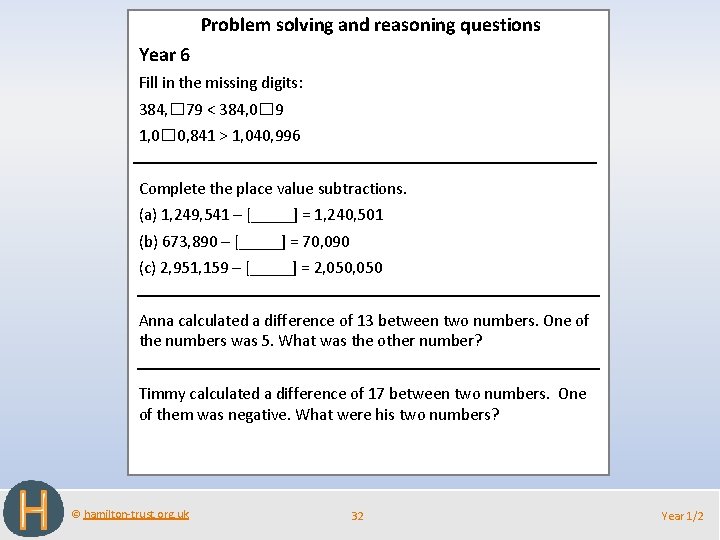
Problem solving and reasoning questions Year 6 Fill in the missing digits: 384, ☐ 79 < 384, 0☐ 9 1, 0☐ 0, 841 > 1, 040, 996 Complete the place value subtractions. (a) 1, 249, 541 – [_____] = 1, 240, 501 (b) 673, 890 – [_____] = 70, 090 (c) 2, 951, 159 – [_____] = 2, 050 Anna calculated a difference of 13 between two numbers. One of the numbers was 5. What was the other number? Timmy calculated a difference of 17 between two numbers. One of them was negative. What were his two numbers? © hamilton-trust. org. uk 32 Year 1/2
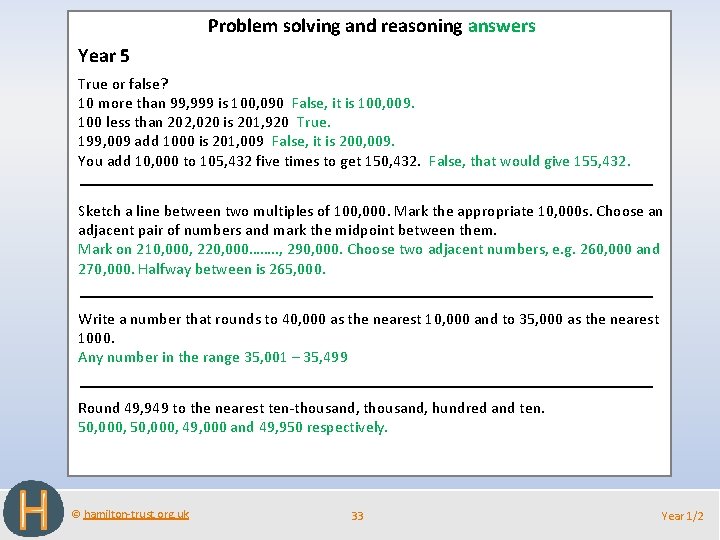
Problem solving and reasoning answers Year 5 True or false? 10 more than 99, 999 is 100, 090 False, it is 100, 009. 100 less than 202, 020 is 201, 920 True. 199, 009 add 1000 is 201, 009 False, it is 200, 009. You add 10, 000 to 105, 432 five times to get 150, 432. False, that would give 155, 432. Sketch a line between two multiples of 100, 000. Mark the appropriate 10, 000 s. Choose an adjacent pair of numbers and mark the midpoint between them. Mark on 210, 000, 220, 000……. . , 290, 000. Choose two adjacent numbers, e. g. 260, 000 and 270, 000. Halfway between is 265, 000. Write a number that rounds to 40, 000 as the nearest 10, 000 and to 35, 000 as the nearest 1000. Any number in the range 35, 001 – 35, 499 Round 49, 949 to the nearest ten-thousand, hundred and ten. 50, 000, 49, 000 and 49, 950 respectively. © hamilton-trust. org. uk 33 Year 1/2
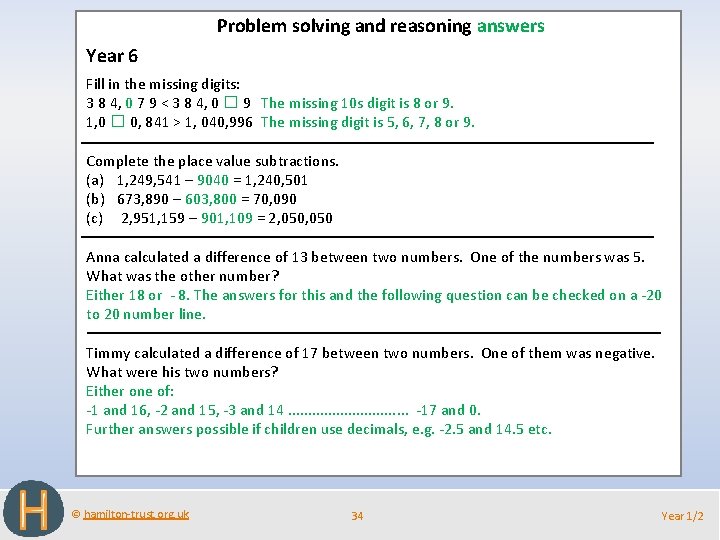
Problem solving and reasoning answers Year 6 Fill in the missing digits: 3 8 4, 0 7 9 < 3 8 4, 0 ☐ 9 The missing 10 s digit is 8 or 9. 1, 0 ☐ 0, 841 > 1, 040, 996 The missing digit is 5, 6, 7, 8 or 9. Complete the place value subtractions. (a) 1, 249, 541 – 9040 = 1, 240, 501 (b) 673, 890 – 603, 800 = 70, 090 (c) 2, 951, 159 – 901, 109 = 2, 050 Anna calculated a difference of 13 between two numbers. One of the numbers was 5. What was the other number? Either 18 or - 8. The answers for this and the following question can be checked on a -20 to 20 number line. Timmy calculated a difference of 17 between two numbers. One of them was negative. What were his two numbers? Either one of: -1 and 16, -2 and 15, -3 and 14. . . . -17 and 0. Further answers possible if children use decimals, e. g. -2. 5 and 14. 5 etc. © hamilton-trust. org. uk 34 Year 1/2
- Slides: 34