
Revision essentials 12 th June Plan your Revision





- Slides: 37
Revision essentials § 12 th June § Plan your Revision timetable § Revision environment § 20 minute chunks § Vary the practice
Revision strategies Ø Read your notes Ø Notes on your Notes Ø Chunk cards Ø Keywords Ø Question Practice Ø Top up Reading Ø Writing practice
Historical Study Setting the Scene Sport reflects the Society in which it is played
Sports are as old as time ! • “SPORT” is young • PE is a modern phenomenon 1939 syllabus “sport = high organisation and highly sophisticated
Sports development • Sports are developmental • They come from : • CONQUEST e. g. Colonialisation OR SOCIAL HIERARCHY e. g. gentry
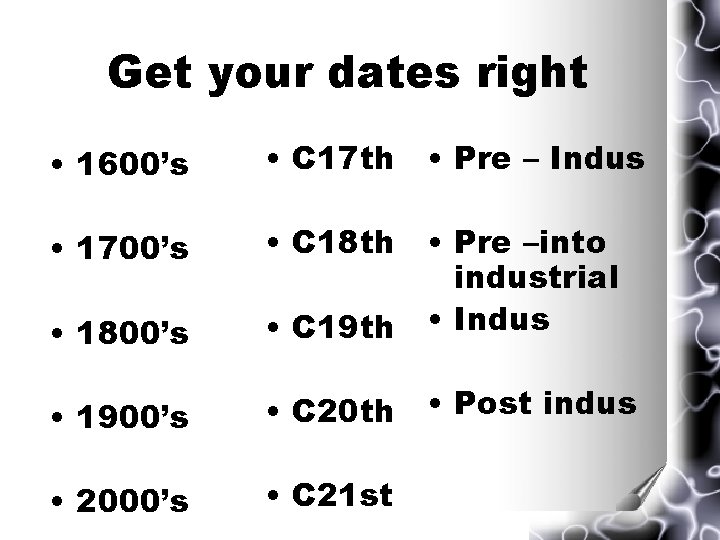
Get your dates right • 1600’s • C 17 th • Pre – Indus • 1700’s • 1800’s • C 18 th • Pre –into industrial • C 19 th • Indus • 1900’s • C 20 th • Post indus • 2000’s • C 21 st
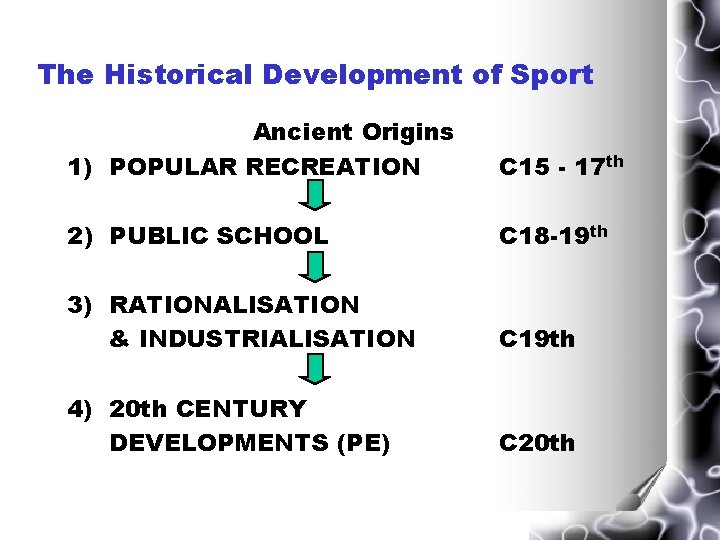
The Historical Development of Sport Ancient Origins 1) POPULAR RECREATION C 15 - 17 th 2) PUBLIC SCHOOL C 18 -19 th 3) RATIONALISATION & INDUSTRIALISATION C 19 th 4) 20 th CENTURY DEVELOPMENTS (PE) C 20 th
Revision Chunks q Popular Recreation q Athleticism q Rational Recreation q Development of P. E.
Overview of sport before 1800’s Festival games and the role of the church, court and peasant - Popular recreations 2 -3 examples - characteristics of games (x 8) - characteristics of society (x 8) - difference between gentry and peasant sport (Real tennis v mob football) - Patronage of church/local gentry
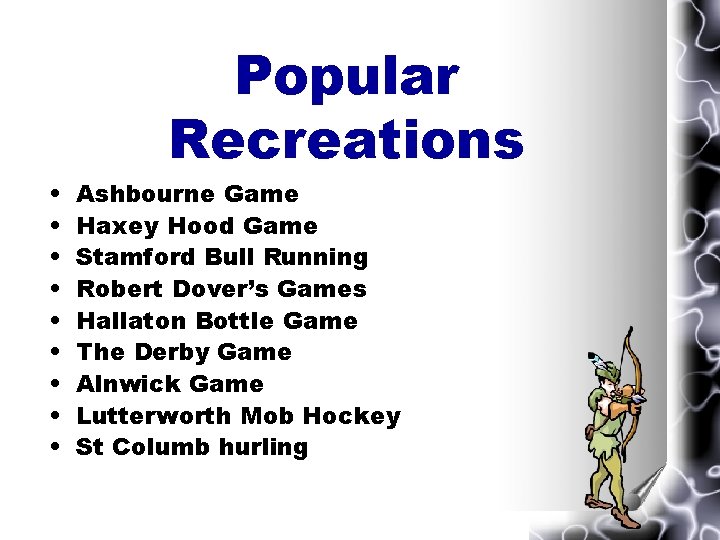
Popular Recreations • • • Ashbourne Game Haxey Hood Game Stamford Bull Running Robert Dover’s Games Hallaton Bottle Game The Derby Game Alnwick Game Lutterworth Mob Hockey St Columb hurling
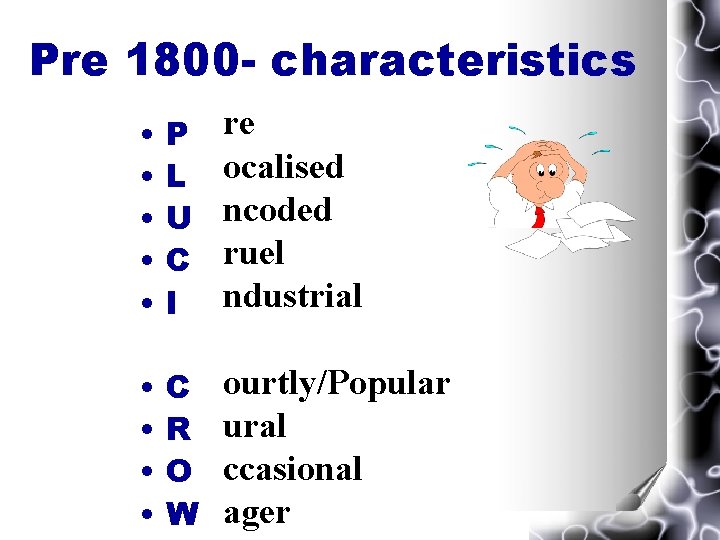
Pre 1800 - characteristics • • • P L U C I re ocalised ncoded ruel ndustrial • • C R O W ourtly/Popular ural ccasional ager
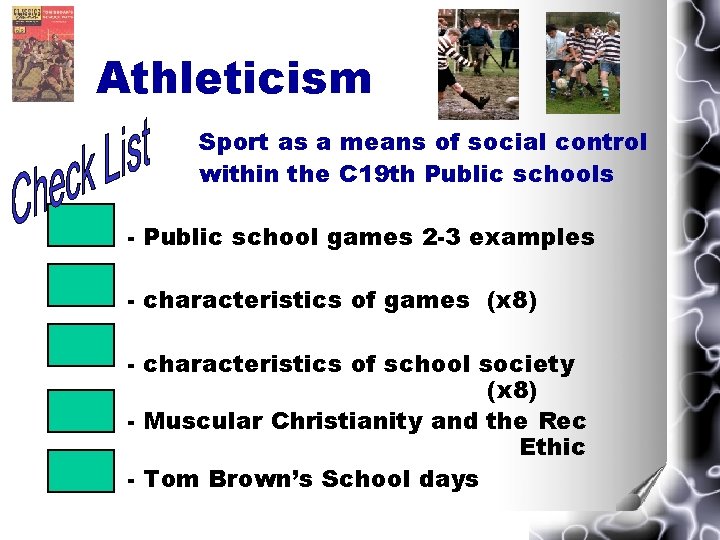
Athleticism Sport as a means of social control within the C 19 th Public schools - Public school games 2 -3 examples - characteristics of games (x 8) - characteristics of school society (x 8) - Muscular Christianity and the Rec Ethic - Tom Brown’s School days
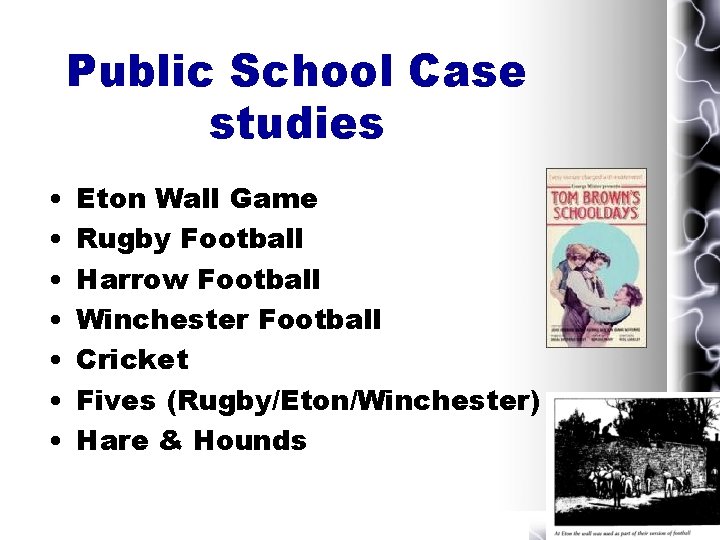
Public School Case studies • • Eton Wall Game Rugby Football Harrow Football Winchester Football Cricket Fives (Rugby/Eton/Winchester) Hare & Hounds
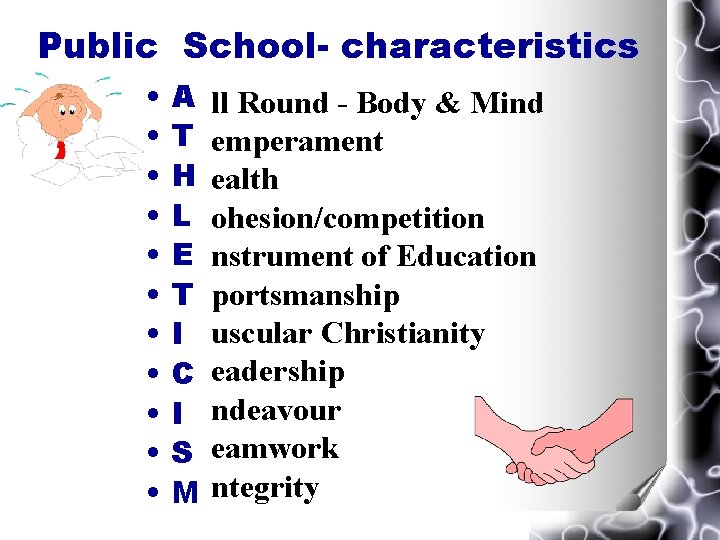
Public School- characteristics • • • A T H L E T I C I S M ll Round - Body & Mind emperament ealth ohesion/competition nstrument of Education portsmanship uscular Christianity eadership ndeavour eamwork ntegrity
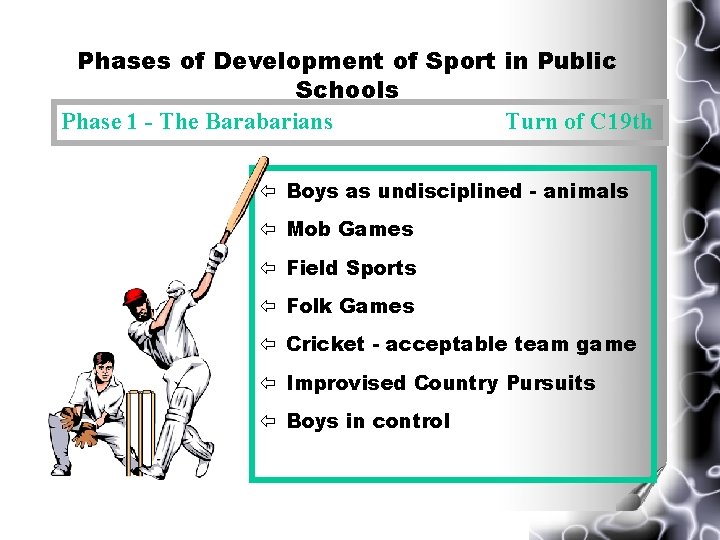
Phases of Development of Sport in Public Schools Phase 1 - The Barabarians Turn of C 19 th ï Boys as undisciplined - animals ï Mob Games ï Field Sports ï Folk Games ï Cricket - acceptable team game ï Improvised Country Pursuits ï Boys in control
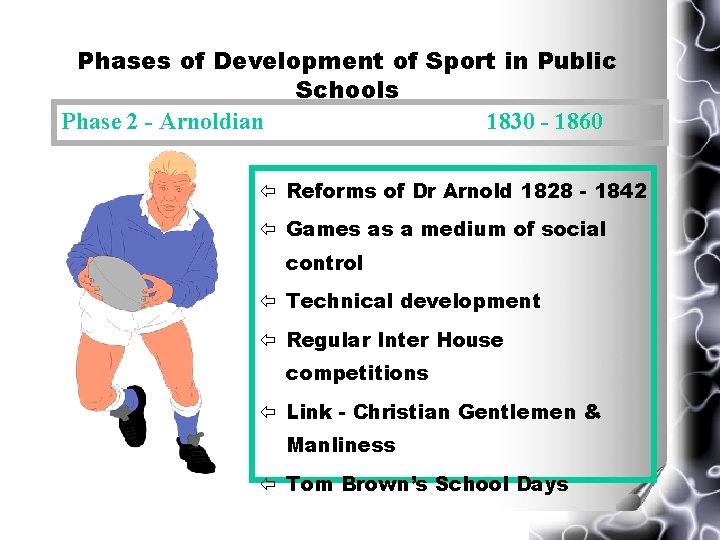
Phases of Development of Sport in Public Schools Phase 2 - Arnoldian 1830 - 1860 ï Reforms of Dr Arnold 1828 - 1842 ï Games as a medium of social control ï Technical development ï Regular Inter House competitions ï Link - Christian Gentlemen & Manliness ï Tom Brown’s School Days
Phases of Development of Sport in Public Schools Phase 3 - The Cult & Philistine Copies - 1860 + ï Athleticism - the “Cult” ï Regular Inter - school fixtures ï “Oxbridge” as the melting pot ï Spread of Middle Class Schools ï Excellent facilities ï Values of Athleticism ï Impact on Society
Rational Sport Impact of changes in society; industrial, transport and urban - characteristics of Rational games (x 8) - characteristics of Rational society (x 8) - case studies (football/tennis/athletics) - spectatorism = professionals =commercialism
This confusion led to the most important meeting in footballs development held at the Free Masons Tavern in London. Actually took 6 meetings to eventually agree on a common set of rules This was not an easy process and their was much debate and votes which at on meting led to a splinter group led bay the Black heath Club leaving to form the Rugby Football Union
A National set of Rules • Quickly spread across the country • Facilitated by an advanced industrial society • Also began to exported around the British Empire and via trade links
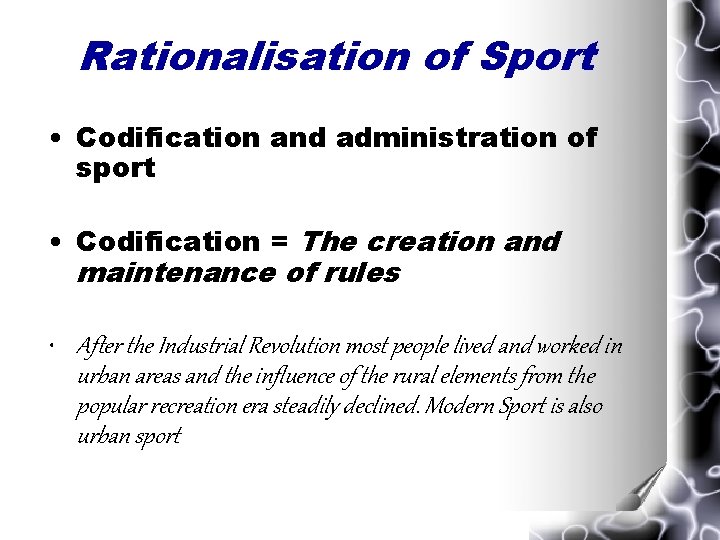
Rationalisation of Sport • Codification and administration of sport • Codification = The creation and maintenance of rules • After the Industrial Revolution most people lived and worked in urban areas and the influence of the rural elements from the popular recreation era steadily declined. Modern Sport is also urban sport
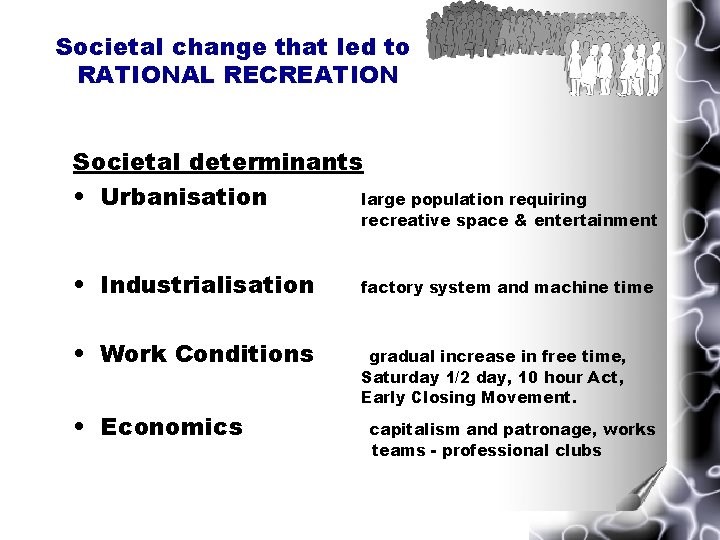
Societal change that led to RATIONAL RECREATION Societal determinants • Urbanisation large population requiring recreative space & entertainment • Industrialisation • Work Conditions • Economics factory system and machine time gradual increase in free time, Saturday 1/2 day, 10 hour Act, Early Closing Movement. capitalism and patronage, works teams - professional clubs
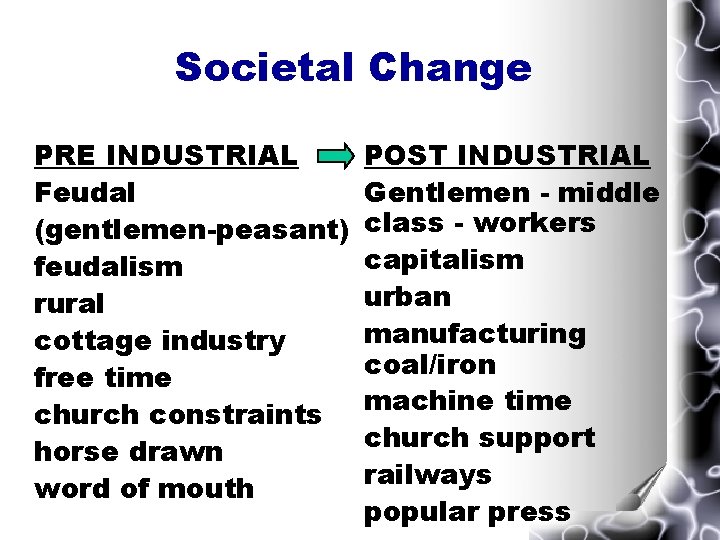
Societal Change PRE INDUSTRIAL Feudal (gentlemen-peasant) feudalism rural cottage industry free time church constraints horse drawn word of mouth POST INDUSTRIAL Gentlemen - middle class - workers capitalism urban manufacturing coal/iron machine time church support railways popular press
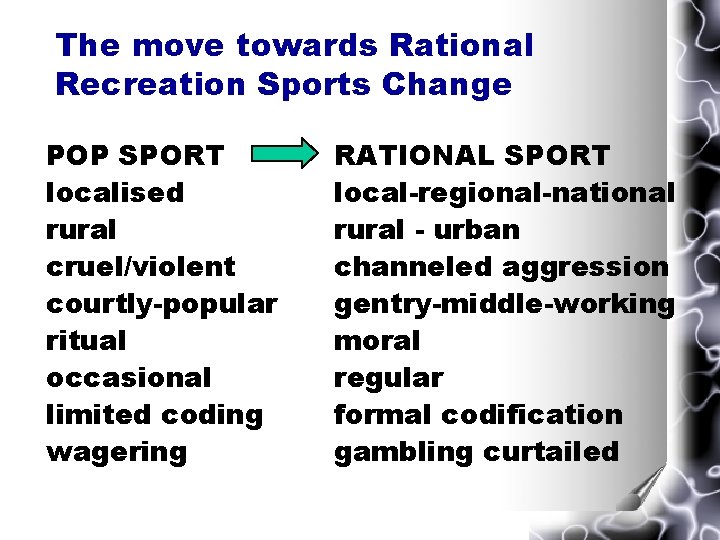
The move towards Rational Recreation Sports Change POP SPORT localised rural cruel/violent courtly-popular ritual occasional limited coding wagering RATIONAL SPORT local-regional-national rural - urban channeled aggression gentry-middle-working moral regular formal codification gambling curtailed
The spread of the Games Ethic - Oxbridge melting pot - Cambridge Football Rules - Role of the ‘Blues’ and Varsity matches - Spread of the ‘Games ethic’ - Sport followed the flag - De Coubertin and international sport
Oxbridge Melting Pots • The Universities of Cambridge and Oxford played an important role in the development of sport • They were the first place where compromise rules were developed. • They also developed regular fixtures - Varsity matches • Blues became important role models & teachers
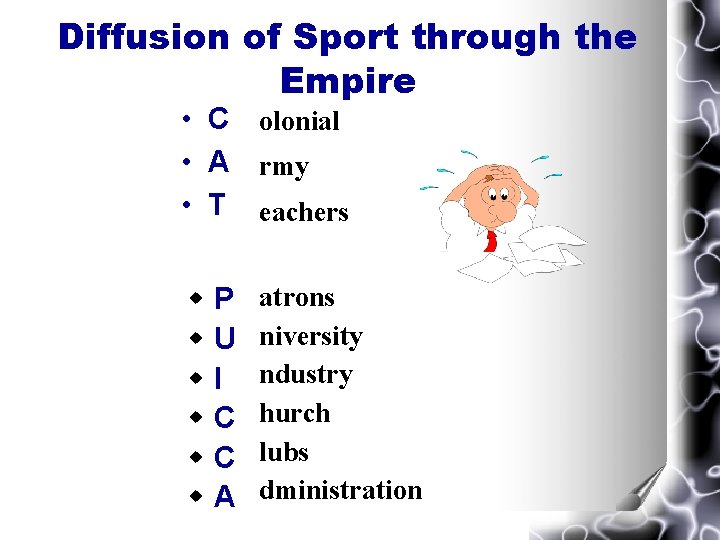
Diffusion of Sport through the Empire • C olonial • A rmy • T eachers w w w P U I C C A atrons niversity ndustry hurch lubs dministration
The need for more regular fixtures led to the formation of the Football League in 1888 The first twelve clubs were Accrington Stanley, Aston Villa, Blackburn Rovers, Bolton Wanderers, Burnley, Derby County, Everton, Notts County, Preston North End, Stoke City, West Bromwich Albion, Wolverhampton Wanderers. These were all from the Midlands and North West, all professional and all dominated by working class players
Major Games and the Working Classes “Games return to the people” 1) Why were elementary children given drill instead of games? 2) Why did factory owners promote football & cricket for their workers? 3) Why is league football played on a Saturday afternoon? 4) Why has professional Sunday cricket only recently become legalised 5) Why didn’t working class girls play football? 6) What has “Broken Time” got to do with rugby and the lower classes? 7) What effect did the growth of the railways have on the spread of major games? 8) What was the Church’s attitude to sport? 9) Why are English batsmen still encouraged to “walk” if they think they’re out?
20 th Century developments • Spectatorism • Professionalism • commercialisation • Influence of the media
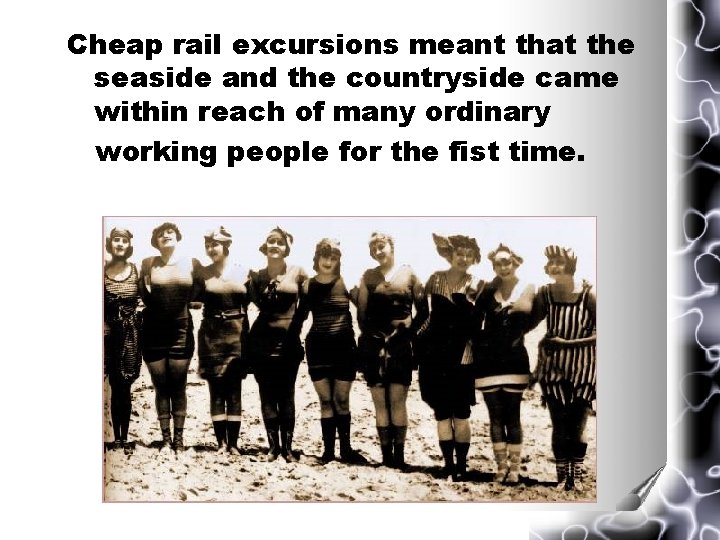
Cheap rail excursions meant that the seaside and the countryside came within reach of many ordinary working people for the fist time.
The development of PE Development of PE in state schools (Elementary) during C 20 th European influences (Swedish/German/De Coubertin) - Forster Education Act - Adoption of German Gymnastics/Mc. Claren - Increasing influence of Ling/Osterberg - Boer War – Model Course Military PT - ‘Tug of War’- Military/Education/Medical - 1933 last syllabus/WW II influence
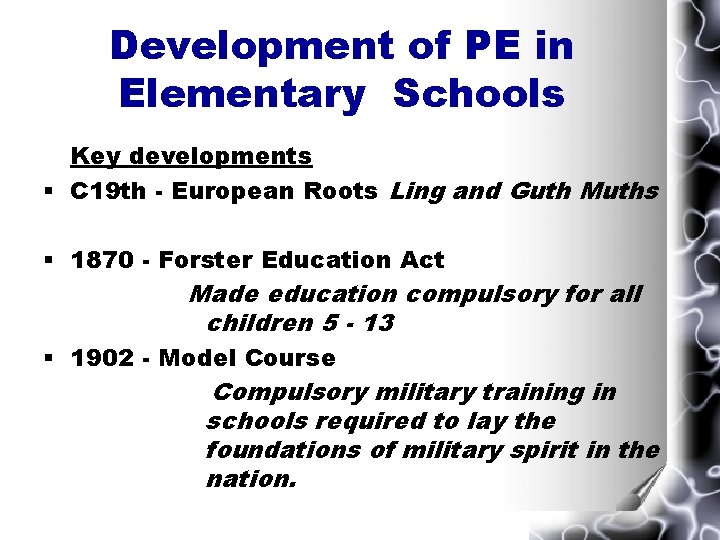
Development of PE in Elementary Schools Key developments § C 19 th - European Roots Ling and Guth Muths § 1870 - Forster Education Act Made education compulsory for all children 5 - 13 § 1902 - Model Course Compulsory military training in schools required to lay the foundations of military spirit in the nation.
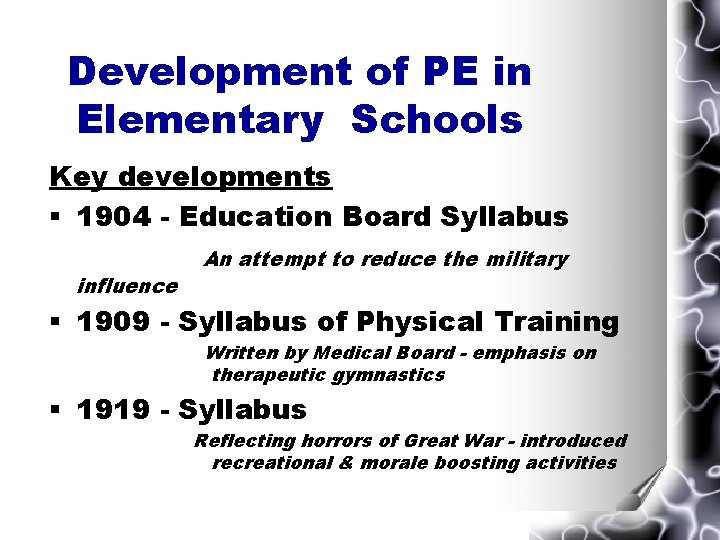
Development of PE in Elementary Schools Key developments § 1904 - Education Board Syllabus influence An attempt to reduce the military § 1909 - Syllabus of Physical Training Written by Medical Board - emphasis on therapeutic gymnastics § 1919 - Syllabus Reflecting horrors of Great War - introduced recreational & morale boosting activities
Development of PE in Elementary Schools Key developments § 1933 - Syllabus of Physical Training Last Board of education syllabus split into 2 sections 5 - 11 years and 11 - 14 years § 1944 - Education Act Made secondary education was available to all children - rebuild of schools after “ Blitz” § 1952 - Moving & Growing Ministry of Education advisory PE publication followed by PLANNING THE PROGRAME (1954)
History - Example During the 19 th Century Oxford and Cambridge Universities acted as “melting pots” in terms of the historical development of sport. Using examples, explain the role these universities played in the development of sport (6 marks) June 2000
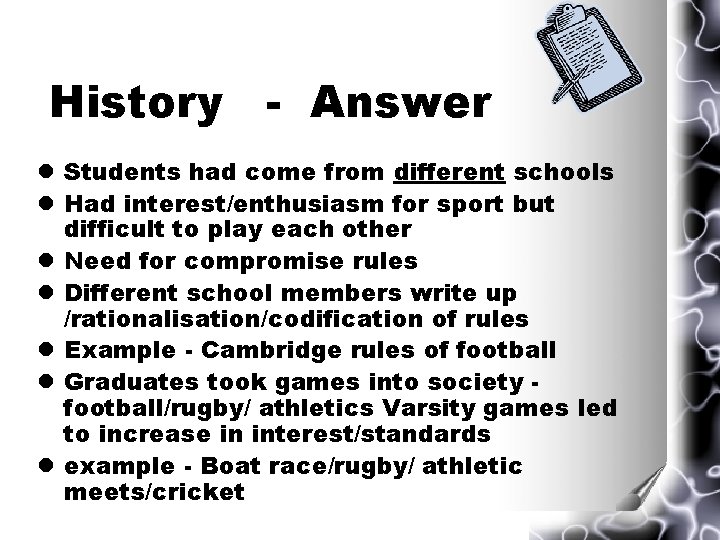
History - Answer l Students had come from different schools l Had interest/enthusiasm for sport but difficult to play each other l Need for compromise rules l Different school members write up /rationalisation/codification of rules l Example - Cambridge rules of football l Graduates took games into society football/rugby/ athletics Varsity games led to increase in interest/standards l example - Boat race/rugby/ athletic meets/cricket