
Revision Details for Year 8 Geography All Year
- Slides: 8
Revision Details for Year 8 Geography All Year 8 groups except 8 S 2 are doing this paper.
Superpowers Revision
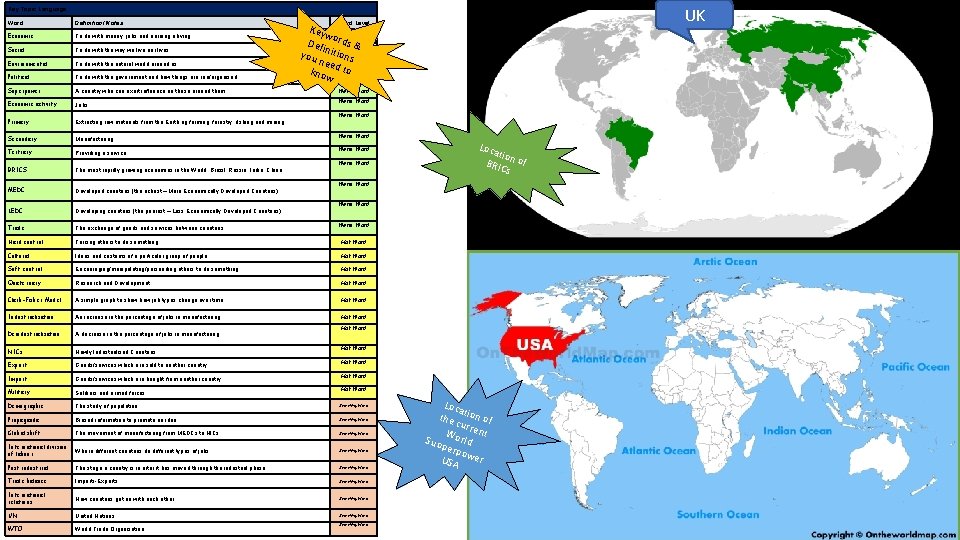
UK Key Topic Language Word Definition/ Notes Word Level Economic To do with money, jobs and earning a living. Social To do with the way we live our lives. Environmental To do with the natural world around us. Political To do with the government and how things are run/organised. Superpower A country who can exert influence on those around them. Economic activity Jobs. Primary Extracting raw materials from the Earth eg farming, forestry, fishing and mining. Secondary Manufacturing. Tertiary Providing a service. BRICS The most rapidly growing economies in the World: Brazil, Russia, India, China. MEDC Developed countries (the richest – More Economically Developed Countries) LEDC Developing countries (the poorest – Less Economically Developed Countries) Trade The exchange of goods and services between countries. Hard control Forcing others to do something. Hot Word Cultural Ideas and customs of a particular group of people. Hot Word Soft control Encouraging/manipulating/persuading others to do something. Hot Word Quaternary Research and Development. Hot Word Clark-Fisher Model A simple graph to show job types change over time. Hot Word Industrialisation An increase in the percentage of jobs in manufacturing. Hot Word Deindustrialisation A decrease in the percentage of jobs in manufacturing. NICs Newly Industrialised Countries. Export Goods/services which are sold to another country. Import Goods/services which are bought from another country. Military Soldiers and armed forces. Demographic The study of population. Scorching Word Propaganda Biased information to promote an idea. Scorching Word Global shift The movement of manufacturing from MEDCs to NICs. Scorching Word International division of labour Where different countries do different types of jobs. Scorching Word Post industrial The stage a country is in after it has moved through the industrial phase. Scorching Word Trade balance Imports-Exports Scorching Word International relations How countries get on with each other. Scorching Word UN United Nations Scorching Word WTO World Trade Organisation Keyw Warm Word Defi ords & n ons Word you iti. Warm nee Warm Word to kno d. Warm Word w Warm Word Warm Word Loca tion BRIC of s Warm Word Hot Word Hot Word Scorching Word Loca the tion of curr Wor ent l Suo perp d owe r USA
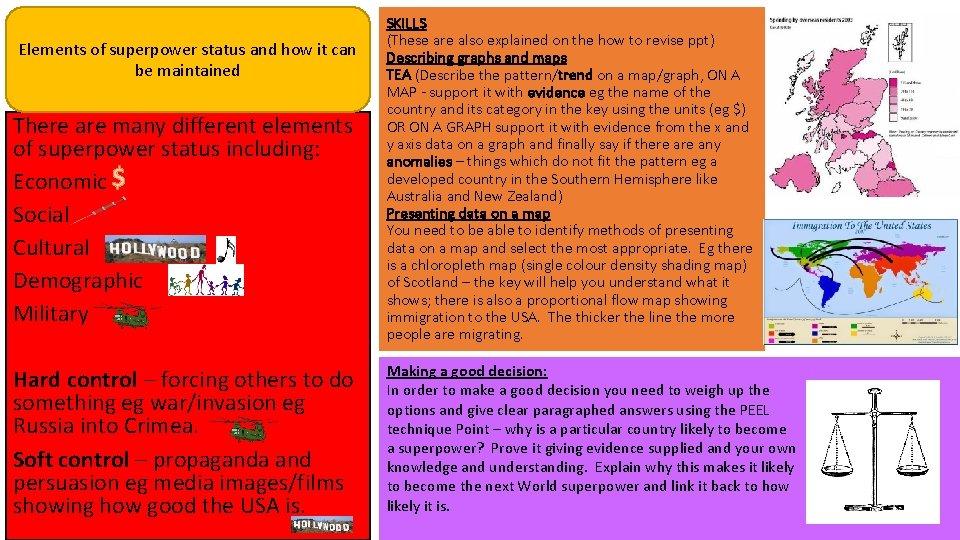
Elements of superpower status and how it can be maintained There are many different elements of superpower status including: Economic $ Social Cultural Demographic Military Hard control – forcing others to do something eg war/invasion eg Russia into Crimea. Soft control – propaganda and persuasion eg media images/films showing how good the USA is. SKILLS (These are also explained on the how to revise ppt) Describing graphs and maps TEA (Describe the pattern/trend on a map/graph, ON A MAP - support it with evidence eg the name of the country and its category in the key using the units (eg $) OR ON A GRAPH support it with evidence from the x and y axis data on a graph and finally say if there any anomalies – things which do not fit the pattern eg a developed country in the Southern Hemisphere like Australia and New Zealand) Presenting data on a map You need to be able to identify methods of presenting data on a map and select the most appropriate. Eg there is a chloropleth map (single colour density shading map) of Scotland – the key will help you understand what it shows; there is also a proportional flow map showing immigration to the USA. The thicker the line the more people are migrating. Making a good decision: In order to make a good decision you need to weigh up the options and give clear paragraphed answers using the PEEL technique Point – why is a particular country likely to become a superpower? Prove it giving evidence supplied and your own knowledge and understanding. Explain why this makes it likely to become the next World superpower and link it back to how likely it is.
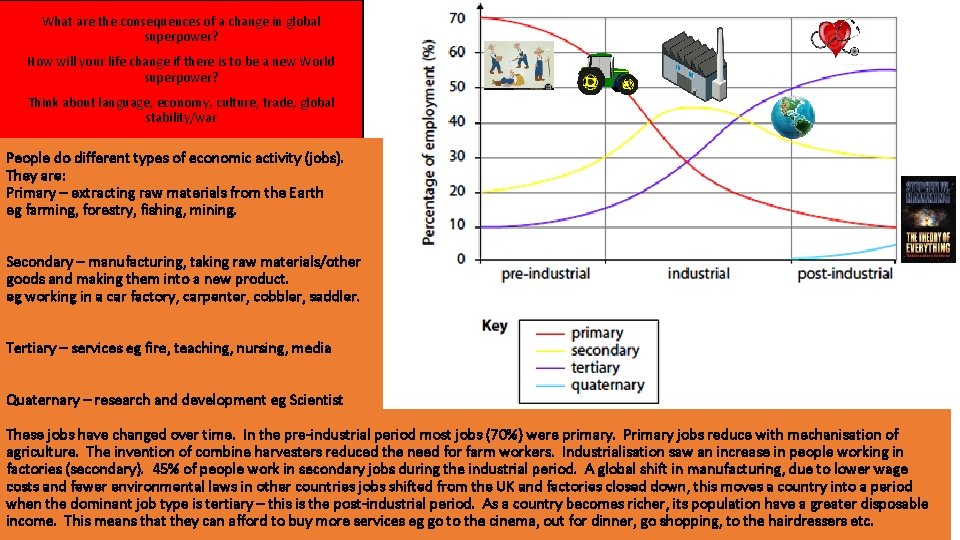
What are the consequences of a change in global superpower? How will your life change if there is to be a new World superpower? Think about language, economy, culture, trade, global stability/war People do different types of economic activity (jobs). They are: Primary – extracting raw materials from the Earth eg farming, forestry, fishing, mining. Secondary – manufacturing, taking raw materials/other goods and making them into a new product. eg working in a car factory, carpenter, cobbler, saddler. Tertiary – services eg fire, teaching, nursing, media Quaternary – research and development eg Scientist These jobs have changed over time. In the pre-industrial period most jobs (70%) were primary. Primary jobs reduce with mechanisation of agriculture. The invention of combine harvesters reduced the need for farm workers. Industrialisation saw an increase in people working in factories (secondary). 45% of people work in secondary jobs during the industrial period. A global shift in manufacturing, due to lower wage costs and fewer environmental laws in other countries jobs shifted from the UK and factories closed down, this moves a country into a period when the dominant job type is tertiary – this is the post-industrial period. As a country becomes richer, its population have a greater disposable income. This means that they can afford to buy more services eg go to the cinema, out for dinner, go shopping, to the hairdressers etc.
Oceans Revision
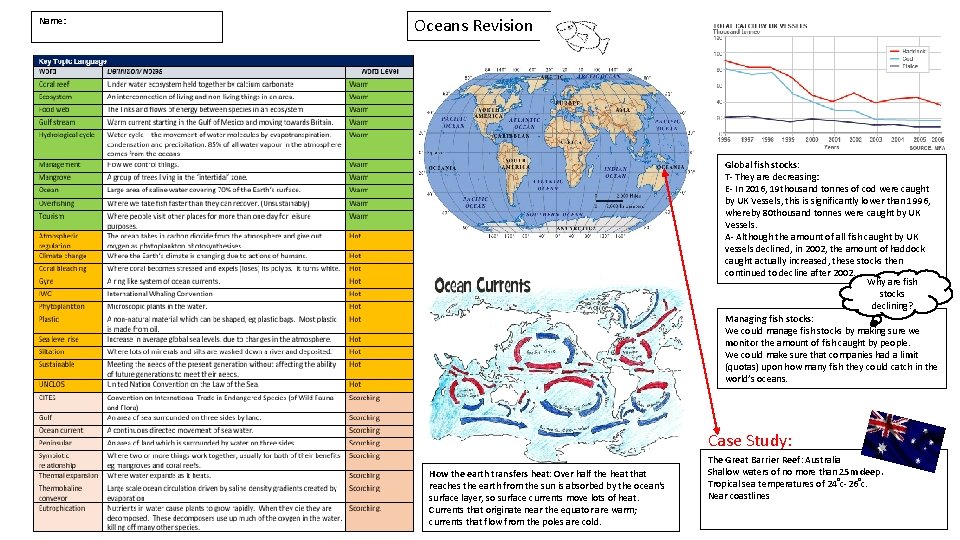
Name: Oceans Revision Global fish stocks: T- They are decreasing: E- In 2016, 19 thousand tonnes of cod were caught by UK Vessels, this is significantly lower than 1996, whereby 80 thousand tonnes were caught by UK Vessels. A- Although the amount of all fish caught by UK vessels declined, in 2002, the amount of haddock caught actually increased, these stocks then continued to decline after 2002. Why are fish stocks declining? Managing fish stocks: We could manage fish stocks by making sure we monitor the amount of fish caught by people. We could make sure that companies had a limit (quotas) upon how many fish they could catch in the world’s oceans. Case Study: How the earth transfers heat: Over half the heat that reaches the earth from the sun is absorbed by the ocean's surface layer, so surface currents move lots of heat. Currents that originate near the equator are warm; currents that flow from the poles are cold. The Great Barrier Reef: Australia Shallow waters of no more than 25 m deep. Tropical sea temperatures of 24˚c-26˚c. Near coastlines
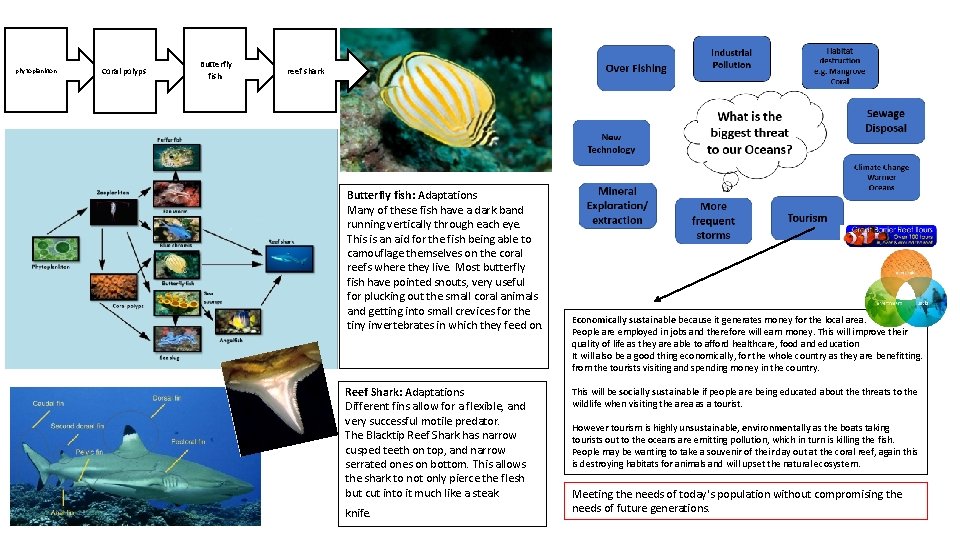
phytoplankton Coral polyps Butterfly fish reef shark Butterfly fish: Adaptations Many of these fish have a dark band running vertically through each eye. This is an aid for the fish being able to camouflage themselves on the coral reefs where they live. Most butterfly fish have pointed snouts, very useful for plucking out the small coral animals and getting into small crevices for the tiny invertebrates in which they feed on. Reef Shark: Adaptations Different fins allow for a flexible, and very successful motile predator. The Blacktip Reef Shark has narrow cusped teeth on top, and narrow serrated ones on bottom. This allows the shark to not only pierce the flesh but cut into it much like a steak knife. Economically sustainable because it generates money for the local area. People are employed in jobs and therefore will earn money. This will improve their quality of life as they are able to afford healthcare, food and education It will also be a good thing economically, for the whole country as they are benefitting. from the tourists visiting and spending money in the country. This will be socially sustainable if people are being educated about the threats to the wildlife when visiting the area as a tourist. However tourism is highly unsustainable, environmentally as the boats taking tourists out to the oceans are emitting pollution, which in turn is killing the fish. People may be wanting to take a souvenir of their day out at the coral reef, again this is destroying habitats for animals and will upset the natural ecosystem. Meeting the needs of today's population without compromising the needs of future generations.