
REVISION 5 GRAMMAR AND VOCABULARY with key Revision
REVISION 5 GRAMMAR AND VOCABULARY (with key)
Revision 5 reviews grammar and vocabulary from Units 9 and 10. • Unit 9: • Grammar – Passive voice (please refer to page 63 in your books) • Vocabulary – Visual impairments (pages 59 and 60) • Unit 10: • Grammar – Relative pronouns (please refer to page 67 in your books) • Vocabulary – Autism spectrum disorders (pages 64 and 65)
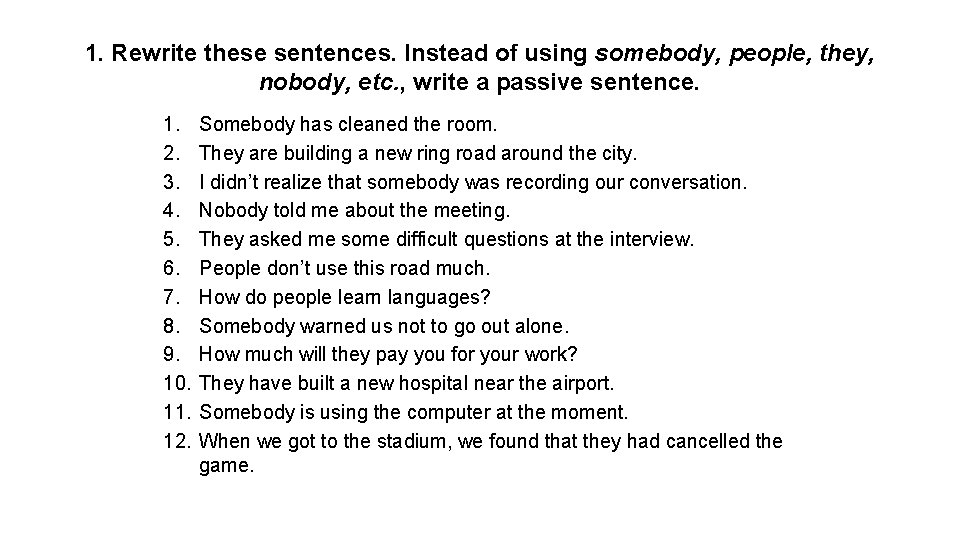
1. Rewrite these sentences. Instead of using somebody, people, they, nobody, etc. , write a passive sentence. 1. 2. 3. 4. 5. 6. 7. 8. 9. 10. 11. 12. Somebody has cleaned the room. They are building a new ring road around the city. I didn’t realize that somebody was recording our conversation. Nobody told me about the meeting. They asked me some difficult questions at the interview. People don’t use this road much. How do people learn languages? Somebody warned us not to go out alone. How much will they pay you for your work? They have built a new hospital near the airport. Somebody is using the computer at the moment. When we got to the stadium, we found that they had cancelled the game.
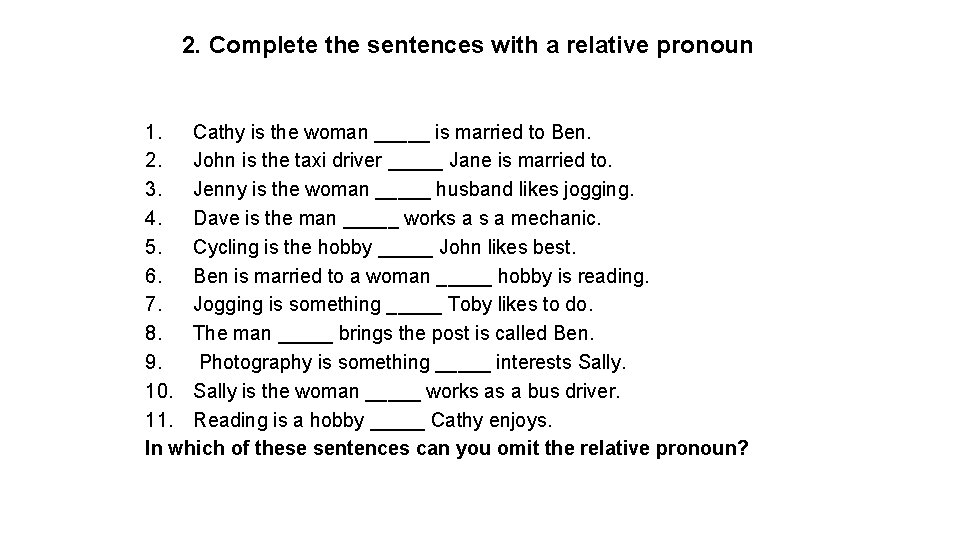
2. Complete the sentences with a relative pronoun 1. Cathy is the woman _____ is married to Ben. 2. John is the taxi driver _____ Jane is married to. 3. Jenny is the woman _____ husband likes jogging. 4. Dave is the man _____ works a mechanic. 5. Cycling is the hobby _____ John likes best. 6. Ben is married to a woman _____ hobby is reading. 7. Jogging is something _____ Toby likes to do. 8. The man _____ brings the post is called Ben. 9. Photography is something _____ interests Sally. 10. Sally is the woman _____ works as a bus driver. 11. Reading is a hobby _____ Cathy enjoys. In which of these sentences can you omit the relative pronoun?
3. Find and correct the mistakes in the following sentences 1. 2. 3. 4. Braille has used by blind people. A lot known nowadays about causes of some disabilities. Some modifications will be requiring for students with low vision. Autism spectrum disorder is a term who is used nowadays for autism and other disorders similar to it. 5. Children that identical twins have autism are more likely to have autism themselves. 6. Most professionals which are involved in educational programming for students with autism spectrum disorders agree that students with autism primarily need instruction in communication skills.

4. Write the appropriate term or phrase for each definition • • • A partial or total inability to see Ability to see clearly People who are unable to see anything People who can read print with adaptations (e. g. magnifying devices) A system of raised dots by which people who are blind read with their fingertips Bending of the light rays as they pass through various structures of the eye Nearsightedness Farsightedness Blurred vision A visual impairment resulting from damage to parts of the brain responsible for vision
• A visual impairment caused by premature birth • A visual impairment caused by improper muscle functioning • Instructing individuals with visual impairment to move through the environment • Mobility aids used by people with visual impairment • A group of similar disorders that involve problems with communication skills, social interactions, and repetitive and stereotyped behavior • A disorder characterized by extreme social withdrawal and impairment in communication • A milder form of autism characterized by primary problems in social interaction
KEY
1. Rewrite these sentences. Instead of using somebody, people, they, nobody, etc. , write a passive sentence. 1. 2. 3. 4. 5. 6. 7. 8. 9. 10. 11. 12. The room has been cleaned. A new ring road is being built around the city. I didn’t realize that our conversation was being recorded. I wasn’t told about the meeting. I was asked some difficult questions at the interview. This road isn’t used much. How are languages learnt? We were warned not to go out alone. How much will you be paid for your work? A new hospital has been built near the airport. The computer is being used at the moment. When we got to the stadium, we found that the game had been cancelled.
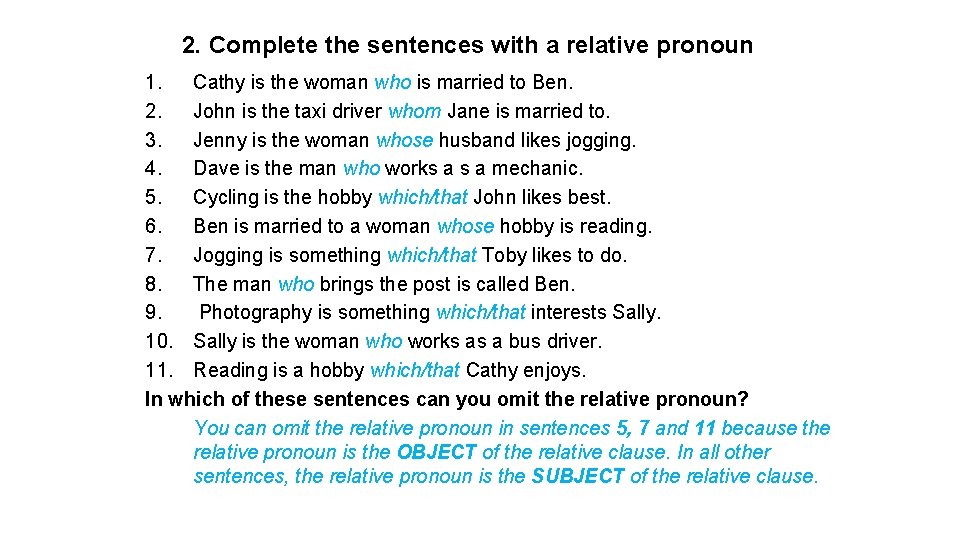
2. Complete the sentences with a relative pronoun 1. Cathy is the woman who is married to Ben. 2. John is the taxi driver whom Jane is married to. 3. Jenny is the woman whose husband likes jogging. 4. Dave is the man who works a mechanic. 5. Cycling is the hobby which/that John likes best. 6. Ben is married to a woman whose hobby is reading. 7. Jogging is something which/that Toby likes to do. 8. The man who brings the post is called Ben. 9. Photography is something which/that interests Sally. 10. Sally is the woman who works as a bus driver. 11. Reading is a hobby which/that Cathy enjoys. In which of these sentences can you omit the relative pronoun? You can omit the relative pronoun in sentences 5, 7 and 11 because the relative pronoun is the OBJECT of the relative clause. In all other sentences, the relative pronoun is the SUBJECT of the relative clause.
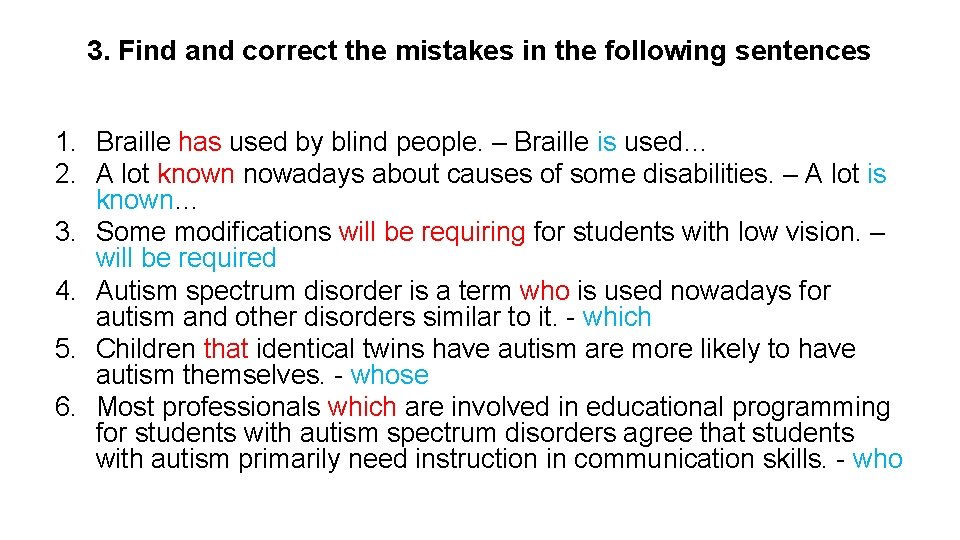
3. Find and correct the mistakes in the following sentences 1. Braille has used by blind people. – Braille is used… 2. A lot known nowadays about causes of some disabilities. – A lot is known… 3. Some modifications will be requiring for students with low vision. – will be required 4. Autism spectrum disorder is a term who is used nowadays for autism and other disorders similar to it. - which 5. Children that identical twins have autism are more likely to have autism themselves. - whose 6. Most professionals which are involved in educational programming for students with autism spectrum disorders agree that students with autism primarily need instruction in communication skills. - who
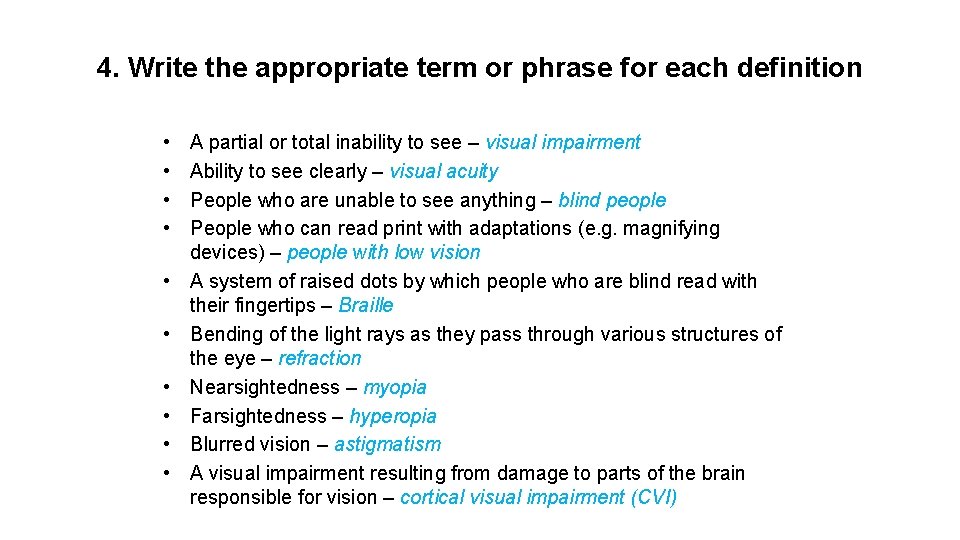
4. Write the appropriate term or phrase for each definition • • • A partial or total inability to see – visual impairment Ability to see clearly – visual acuity People who are unable to see anything – blind people People who can read print with adaptations (e. g. magnifying devices) – people with low vision A system of raised dots by which people who are blind read with their fingertips – Braille Bending of the light rays as they pass through various structures of the eye – refraction Nearsightedness – myopia Farsightedness – hyperopia Blurred vision – astigmatism A visual impairment resulting from damage to parts of the brain responsible for vision – cortical visual impairment (CVI)
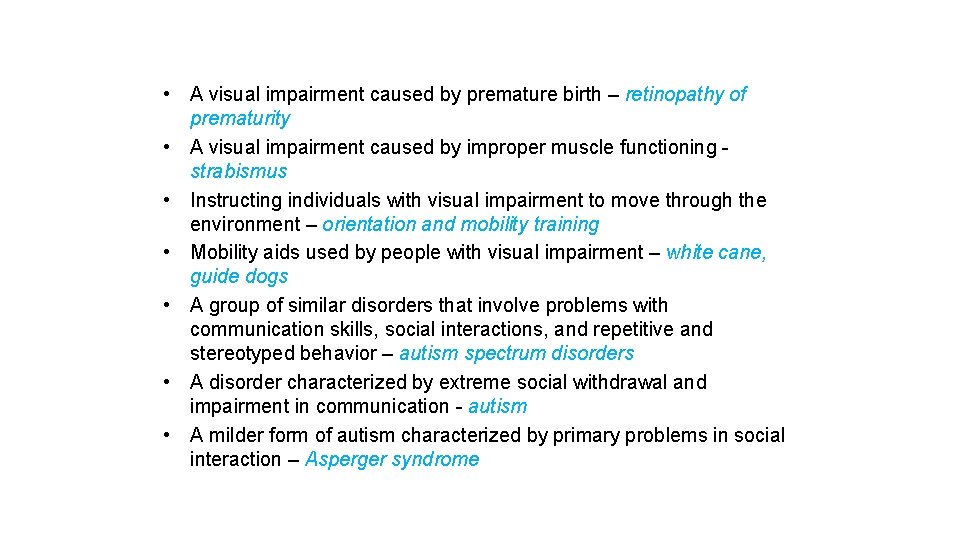
• A visual impairment caused by premature birth – retinopathy of prematurity • A visual impairment caused by improper muscle functioning strabismus • Instructing individuals with visual impairment to move through the environment – orientation and mobility training • Mobility aids used by people with visual impairment – white cane, guide dogs • A group of similar disorders that involve problems with communication skills, social interactions, and repetitive and stereotyped behavior – autism spectrum disorders • A disorder characterized by extreme social withdrawal and impairment in communication - autism • A milder form of autism characterized by primary problems in social interaction – Asperger syndrome
- Slides: 13