
Revising Your Manuscript Submission To Revise or Not
Revising Your Manuscript Submission
To Revise or Not to Revise Virtually never accept first drafts Revision letter is an indication of interest Revision increases odds of eventual publication Must revise to resubmit elsewhere May see the same reviewer at another journal Review process is didactic; improves the paper
Approaching the Revisions Distancing strategy But be prompt Respond with a clear and constructive revision and response letter Respond to all comments Be systematic; a table format is helpful Juxtapose divergent comments Revision process is a conversation amongst peers
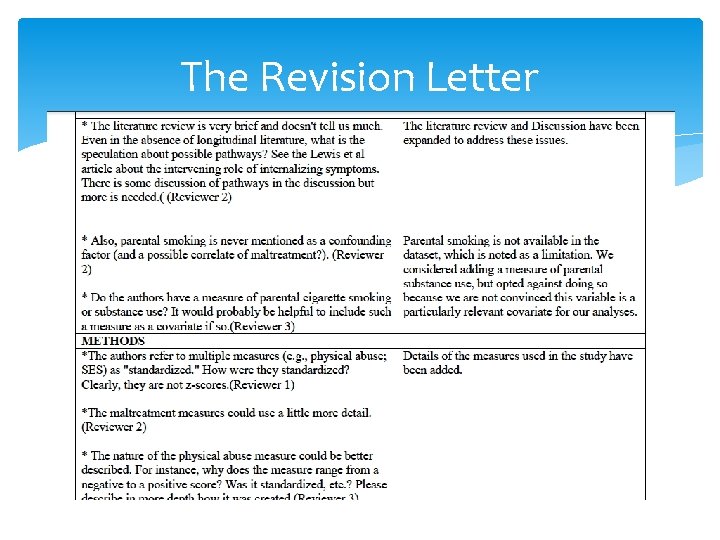
The Revision Letter
Resubmit Checklist of documents necessary for revision Response letter Revised manuscript Revised tables and figures Re-review by editors and/or original reviewers Final acceptance at editors discretion
Accepting Rejection
Common reasons for rejection Poor English usage. Replicative, confirmatory, or localized findings Causation ascribed to associations Poorly contextualized results
English usage English is a difficult language Scientific vocabulary and usage can idiosyncratic and archaic Attempt to enlist the help of a native English speaker Professional editors specializing in technical English Can be expensive Establish links to individuals and organizations that already publish in English UNICEF, UNFPA, WHO, etc.
Novelty Replicative and confirmatory results, while important, are generally not published in top journals Findings from a specific local population might be most useful to a local audience
Correlational data JAH publishes very few studies that are based only on correlational or cross-sectional data In most cases, longitudinal data is necessary to inform interventions and clinical work Associations, correlations, and prevalence are nearly always most useful to a local or regional audience
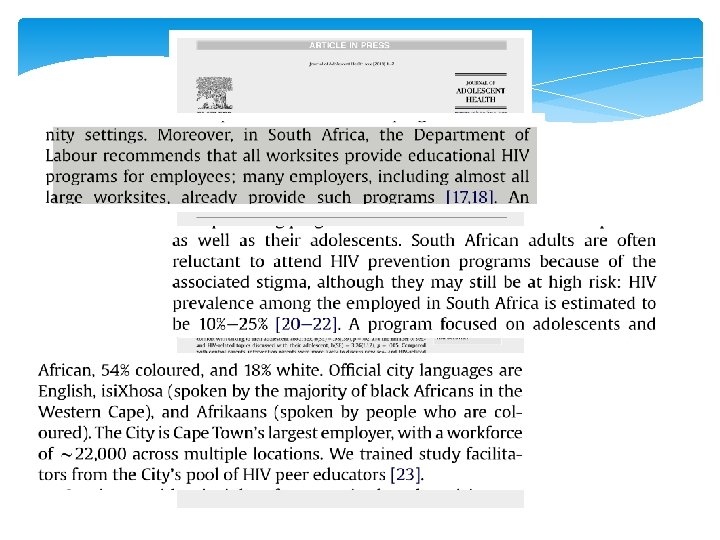
Poorly contextualized results Emerging research from LMICs is interesting to an international audience if it is properly contextualized Describe the local context and how it relates to the results The dilemma is well-described in PA Michaud’s JAH editorial, “The International Journal of Adolescent Health, ” JAH 2010; 42: 421 -422. Same dilemma occurs in papers from HICs
The Role of the Reviewer
Content of a JAH Review A single decision recommendation: Accept, Revise, or Reject A checklist covering basic issues: Is it novel? Human subjects approval? Is it clearly written? Etc. Two narrative evaluations: Confidential addressed to the editors Open comments to the authors
Role of the Reviewer Judge whether the manuscript merits publication by providing a global rating Accept (minor/ major revision), Revise & resubmit, Reject Offer constructive criticisms helpful to authors, regardless of whether the manuscript is deemed acceptable for publication see what the authors have not seen be helpful and positive correct errors in logic or analysis Suggest additional perspectives and/or references
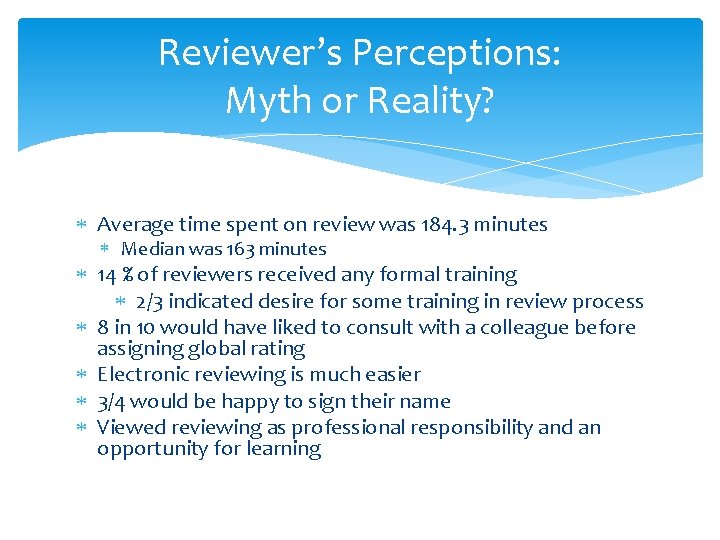
Reviewer’s Perceptions: Myth or Reality? Average time spent on review was 184. 3 minutes Median was 163 minutes 14 % of reviewers received any formal training 2/3 indicated desire for some training in review process 8 in 10 would have liked to consult with a colleague before assigning global rating Electronic reviewing is much easier 3/4 would be happy to sign their name Viewed reviewing as professional responsibility and an opportunity for learning
Reviewer Responsibilities Agree to review only those manuscripts that can be completed on time Only accept manuscripts for review in area of expertise Write reviews in a collegial, constructive manner Provide an honest, critical assessment of research
Reviewer Dos & Don’ts Reviewer must Avoid or disclose any conflicts of interest Report suspected duplicate publication, fraud, plagiarism, or ethical concerns about the use of animals or human subjects in the research meeting being submitted Maintain confidentiality about the existence and substance of manuscript Editor must grant permission junior colleague Reviewer must not: Participate in plagiarism, i. e, taking idea, data, findings, or idea from someone else to advance your own work
Informative Review demonstrates to the Editor that reviewer has read manuscript closely Provided constructive review Tone positive and suggest ways in which manuscript could be improved Rating is consistent with written comments
Noninformative Review Snapshot verdict I read the manuscript and liked it. I don’t think that this has been done before. This manuscript should be published. Mixed-signals review Discordance between your rating and your written comments Hidden-agenda review Confidential opinions expressed to Editor differ substantially from the comments to the authors.
Common Sense Rules Reviewers should treat the manuscript as they would like their own work treated Avoid statements that are demeaning or insulting Never use sarcasm Direct all statements to the manuscript, not the authors
Cross-Cutting Issues Reviewer must not participate in plagiarism Take data or idea from someone else to advance your own work Must report suspected duplicate publication, fraud, plagiarism, or ethical concerns about the use of animals or human subject in the research being submitted
Before Reviewing the Manuscript Evaluate your bias Conflict of interest? Close colleague? Notorious nemesis? Do you have sufficient scientific background to offer an opinion? Define the scope of your review
General Considerations Is the manuscript concise? Word limits are usually 3, 500 minus references and tables/figures Paper well written, properly organized, and easy to follow? Was the information presented in an open-minded and objective manner? Significant conflict of financial or scientific interest? Have these data been presented before?
The Basics Journal Topic appropriate for the journal? Would another journal be more appropriate? Compare stated mission of journal with what is being presented Title accurately reflects the purpose, design, results, and conclusions? Cross-sectional studies should not be entitled with “Effects of …”
Abstract Is it succinct, clear, and comprehensive; are subheadings consistent with format requirements? Is the content consistent with what is presented in text? Are data or other key information presented here but not in main text? Are the conclusions supported by the evidence?
Introduction Sufficient review of previous research? Any important findings from previous studies omitted or misrepresented? occurs frequently, must be vigilant Scientific framework or paradigm of the authors well accepted or built on personal or ideological bias? Functional, biological, and/or clinical significance of topic established? Why is it important to conduct this study? Does the introduction succinctly state what is known and unknown about the topic?
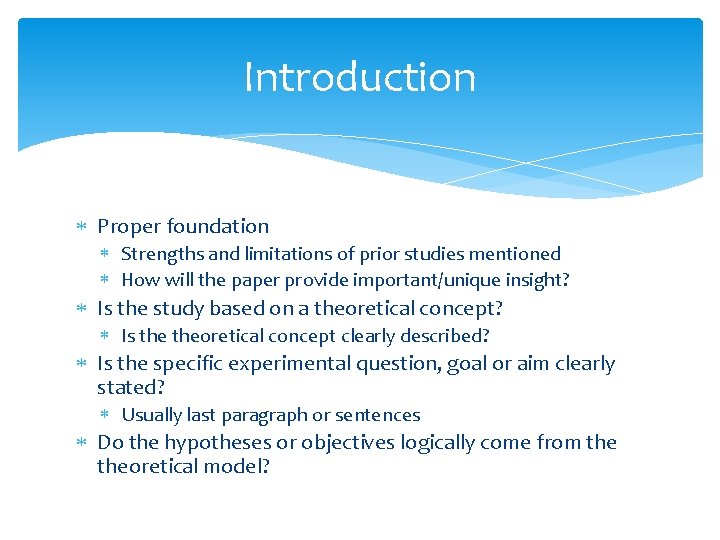
Introduction Proper foundation Strengths and limitations of prior studies mentioned How will the paper provide important/unique insight? Is the study based on a theoretical concept? Is theoretical concept clearly described? Is the specific experimental question, goal or aim clearly stated? Usually last paragraph or sentences Do the hypotheses or objectives logically come from theoretical model?
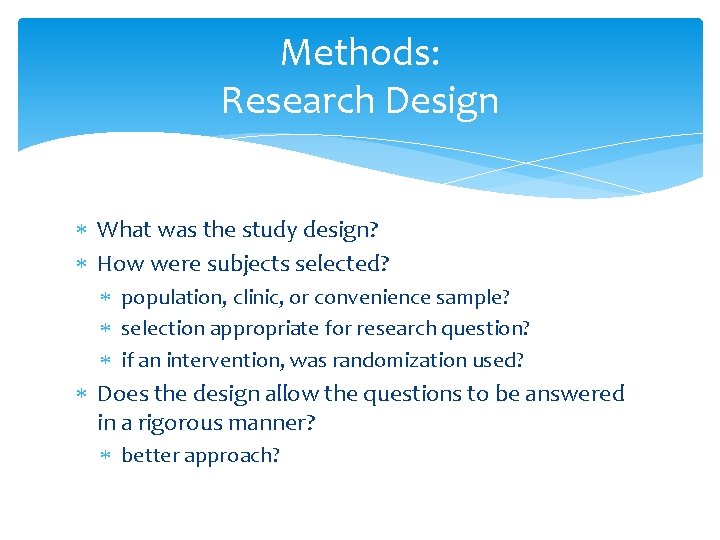
Methods: Research Design What was the study design? How were subjects selected? population, clinic, or convenience sample? selection appropriate for research question? if an intervention, was randomization used? Does the design allow the questions to be answered in a rigorous manner? better approach?
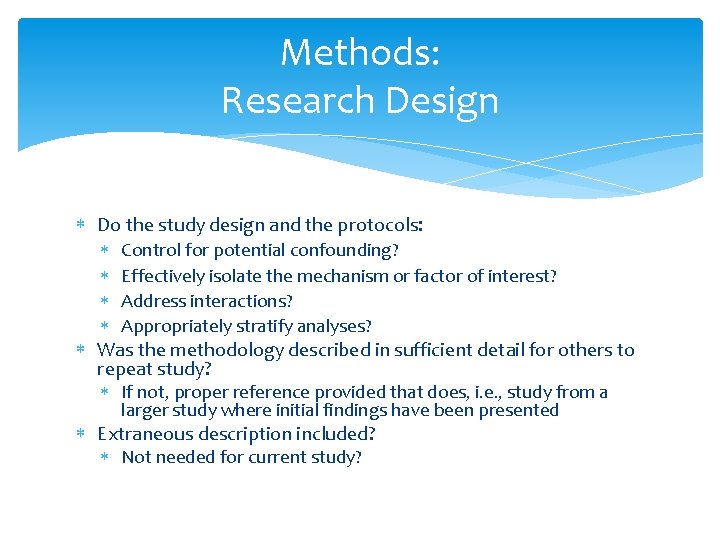
Methods: Research Design Do the study design and the protocols: Control for potential confounding? Effectively isolate the mechanism or factor of interest? Address interactions? Appropriately stratify analyses? Was the methodology described in sufficient detail for others to repeat study? If not, proper reference provided that does, i. e. , study from a larger study where initial findings have been presented Extraneous description included? Not needed for current study?
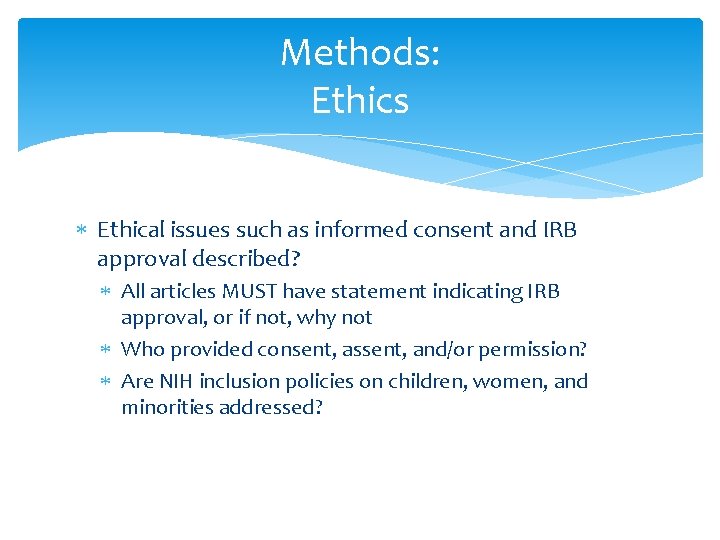
Methods: Ethics Ethical issues such as informed consent and IRB approval described? All articles MUST have statement indicating IRB approval, or if not, why not Who provided consent, assent, and/or permission? Are NIH inclusion policies on children, women, and minorities addressed?
Methods: Sample and Sampling Sample adequately described? population-based or clinic-based? all suspected confounders explained or presented Subject population appropriate for the question posed? Sample large enough = necessary statistical power? minimize type II error Will the subject population allow extensive or limited generalizability?
Methods: Data Collection & Manipulation Measurement techniques reliable, precise, and valid? Rationale for making each measurement either obvious or explained? Are uncommon variables fully described? Scales appropriate and tested for reliability?
Methods: Data Analysis Data analyzed in most appropriate manner? Statistical techniques appropriate for the research design? Are uncommon analytic techniques referenced? Details of data calculations adequately explained? Confirmed by the reviewer? Reproduced by future investigators? Critical assumptions of the statistical techniques (i. e. , independence, homogeneity, normality) violated? ’ Alpha-levels (significance levels) to determine statistical significance clearly stated? Clear how data interpreted to support or refute the hypotheses?
Methods: Qualitative Studies Appropriate use of qualitative method? Unique human subjects protection issues? Details of data analytic method described? Statistical software or other methods used? Theoretical framework described? (e. g. Grounded Theory)
Results Data reported in a clear, concise, logical, and well-organized manner? Data presented on any measurement that was not described in the Methods? Data on all presented? Findings internally consistent? Do the numbers add up? (e. g. text and tables) Analysis sufficient to exclude the possibility of significant findings due to lack of comparability of groups? Data presented in appropriate units or properly adjusted? Where necessary, are standard deviations or standard errors reported for each variable? Excessive variability in one or more of the measurements for a particular condition compared with others? During analysis, were appropriate variables controlled for? Were potential confounders handled appropriately?
Results: Tables & Figures Have tables, figures, and text been used effectively? Figures used to emphasize most important results Tables and figures properly labeled with correct units? Scaling appropriate and unbiased? Labels on both axes readable after reduction for print? Are data presented more than once?
Results Data seem reasonable from your perspective? Sample size: Large enough to avoid Type II error (false negative)? Was it too large? Can result in Type I error (false positive). How do the group differences or responses shown compare with the measurement error? A 5% difference in mean group responses for an outcome variable that is associated with a 10% measurement error/variability would need to be interpreted with caution
Discussion Summary: Major new findings of the study clearly described and properly emphasized? Key conclusions adequately supported by the data? Other ways to interpret and/or explain the data other than that suggested by the authors? Significance of the present results described? Clear how findings extend previous knowledge in a meaningful way?
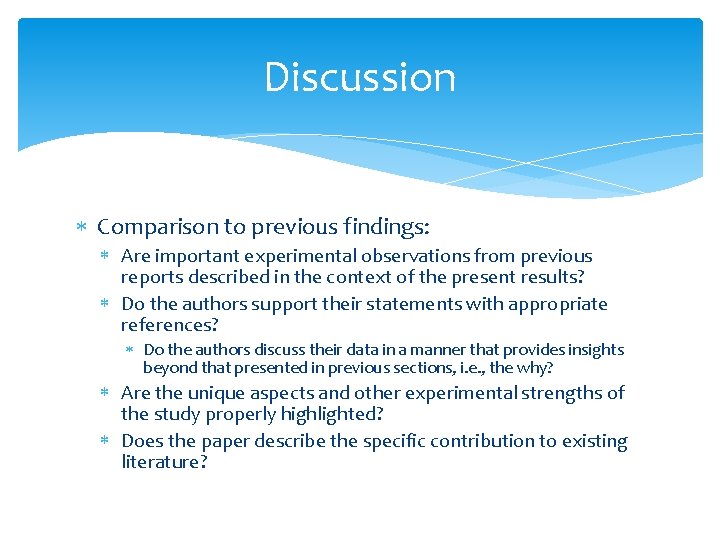
Discussion Comparison to previous findings: Are important experimental observations from previous reports described in the context of the present results? Do the authors support their statements with appropriate references? Do the authors discuss their data in a manner that provides insights beyond that presented in previous sections, i. e. , the why? Are the unique aspects and other experimental strengths of the study properly highlighted? Does the paper describe the specific contribution to existing literature?
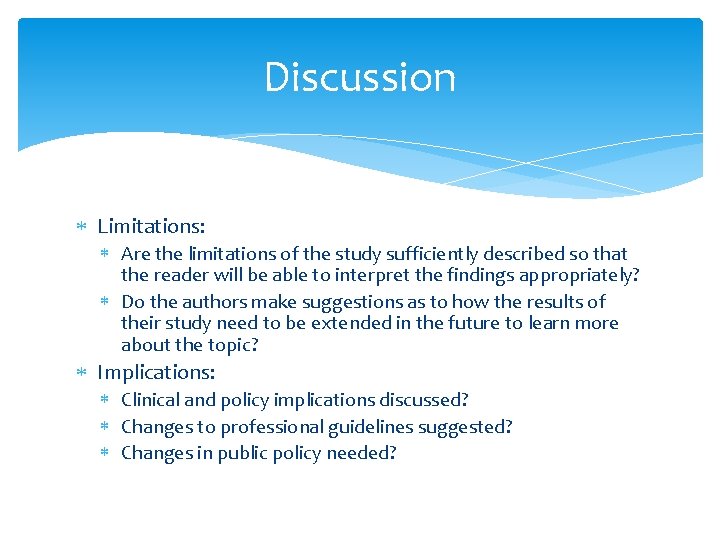
Discussion Limitations: Are the limitations of the study sufficiently described so that the reader will be able to interpret the findings appropriately? Do the authors make suggestions as to how the results of their study need to be extended in the future to learn more about the topic? Implications: Clinical and policy implications discussed? Changes to professional guidelines suggested? Changes in public policy needed?
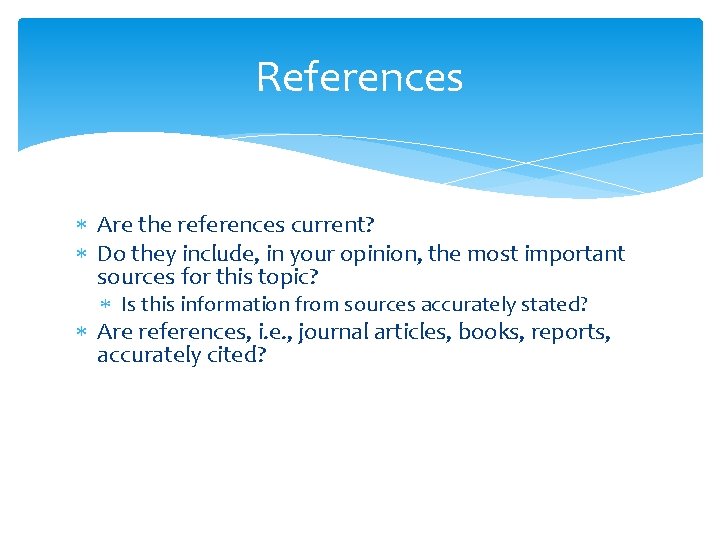
References Are the references current? Do they include, in your opinion, the most important sources for this topic? Is this information from sources accurately stated? Are references, i. e. , journal articles, books, reports, accurately cited?
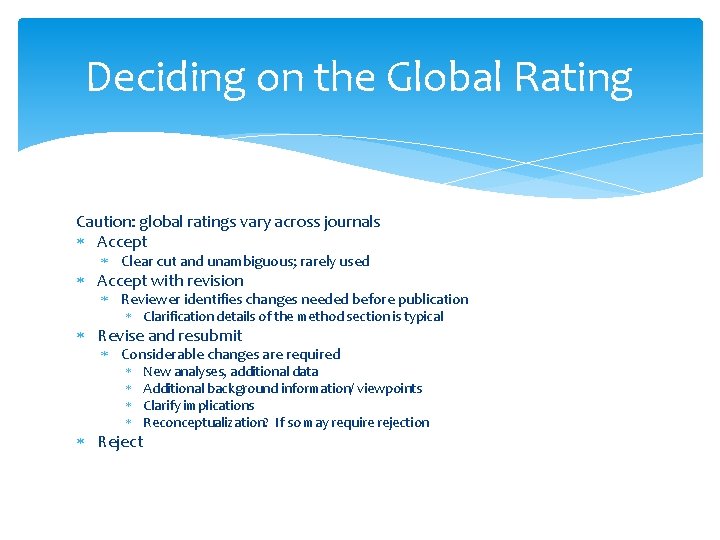
Deciding on the Global Rating Caution: global ratings vary across journals Accept Clear cut and unambiguous; rarely used Accept with revision Reviewer identifies changes needed before publication Clarification details of the method section is typical Revise and resubmit Considerable changes are required Reject New analyses, additional data Additional background information/ viewpoints Clarify implications Reconceptualization? If so may require rejection
Review Element Checklist Title reflects the essence of the manuscript Abstract accurately reflects key elements of the manuscript Readership will think content is interesting and worthwhile Review is directed to the manuscript not the authors Have provided ideas, perspectives, references that will be useful to revision Confidential notes to Editor are consist with comments to the authors Global rating matches comments to authors No demeaning, insulting, or sarcastic comments The authors will be inspired to revise the manuscript

Acknowledgements This presentation was prepared with the invaluable assistance and insights of: Linda Holm Bearinger, Ph. D. , M. S. , R. N. , University of Minnesota, Minneapolis Charles E. Irwin, Jr. , M. D. , University of California, San Francisco Bonnie Halpern-Felsher, Ph. D. , University of California, San Francisco Donald Payne, M. B. B. Ch. , M. D. , University of Western Australia, Crawley Vaughn I. Rickert, Psy. D. , Indiana University School of Medicine, Indianapolis John S. Santelli, M. D. , M. P. H. , Columbia University, New York
- Slides: 46