
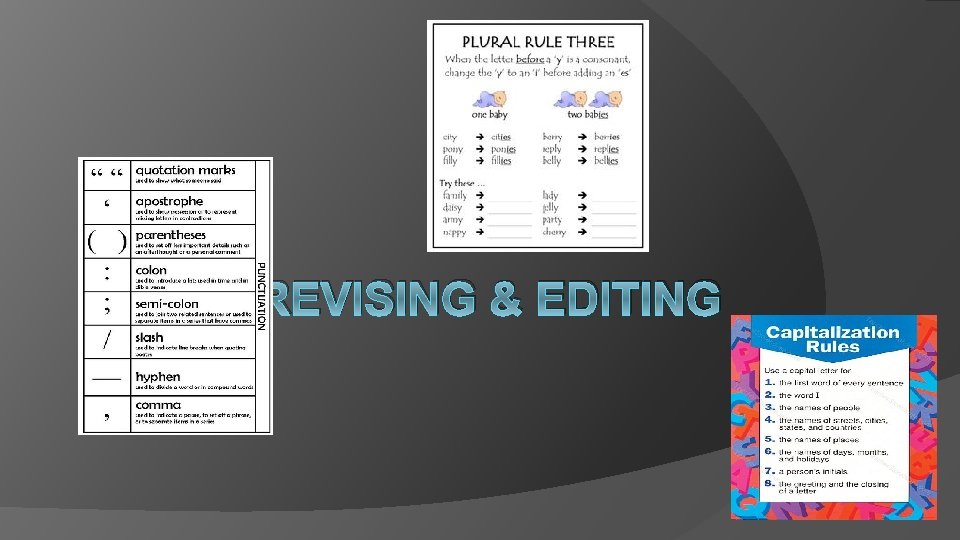
REVISING EDITING Spelling Rules The i before e
REVISING & EDITING
Spelling Rules: The “i before e except after c” rule example: believe – receive 2. Changing “y” to “ies” You might not know the spelling rule but you might know the spelling – most people do. The word ends in a vowel + y just add s example: key to keys delay to delays Or you can replace ‘y’ to ‘ies’ example: baby to babies company to companies 1.
Spelling Rules: 3. Drop the ‘e’ rule Usually we drop the final silent “e” when we add vowel suffix endings examples Write + ing = Writing Hope + ed = hoped Excite + able = excitable Opposite + ion = opposition Imagine = ation = imagination �
Spelling Rules: 4. Ending in –ful The suffix –FUL is always spelt with one L… examples Grate + ful = grateful Faith + ful = Faithful Careful Helpful Useful Grateful Beautiful The “y” becomes “i”
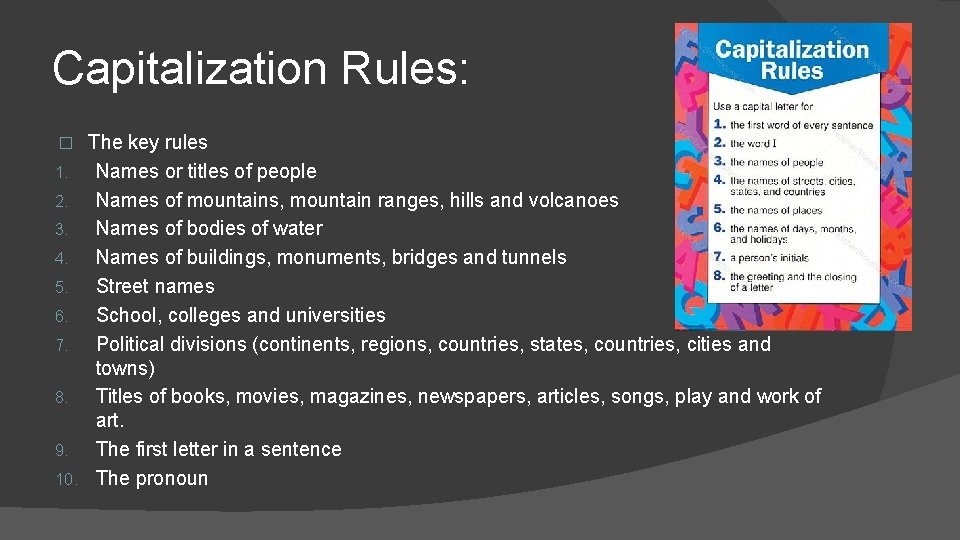
Capitalization Rules: � 1. 2. 3. 4. 5. 6. 7. 8. 9. 10. The key rules Names or titles of people Names of mountains, mountain ranges, hills and volcanoes Names of bodies of water Names of buildings, monuments, bridges and tunnels Street names School, colleges and universities Political divisions (continents, regions, countries, states, countries, cities and towns) Titles of books, movies, magazines, newspapers, articles, songs, play and work of art. The first letter in a sentence The pronoun
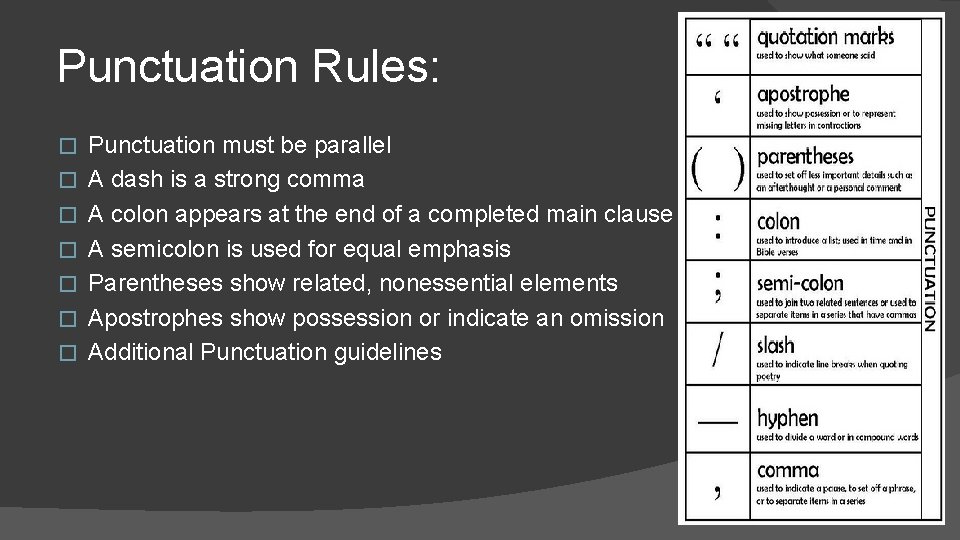
Punctuation Rules: � � � � Punctuation must be parallel A dash is a strong comma A colon appears at the end of a completed main clause A semicolon is used for equal emphasis Parentheses show related, nonessential elements Apostrophes show possession or indicate an omission Additional Punctuation guidelines
- Slides: 6