
REVISED WASTE CLASSIFICATION AND MANAGEMENT SYSTEM FOR SOUTH























- Slides: 64
REVISED WASTE CLASSIFICATION AND MANAGEMENT SYSTEM FOR SOUTH AFRICA Waste Classification System and Standards for Waste Disposal KZN Stakeholder Workshop 30 July 2010
Contents Revised Waste Classification System (Current vs. New) Waste Categorisation for Reporting Standard for Disposal of Waste to Landfill Standard for Leach Tests & Waste Risk Profiling
Revised Waste Classification System
Waste Classification Regulation Classification of waste is a legal requirement Waste Generators must ensure their waste is correctly classified (not necessarily done self) Classification in accordance with SANS 10234: 2008 – Globally Harmonized System of classification & labelling of chemicals (GHS) Waste Classification = Establishing i. t. o. SANS 10234 whether (i) a waste is hazardous based on physical, health and environmental hazardous properties (hazard classes), and (ii) the degree or severity of hazard posed (hazard categories) Minister may require peer review of classification done ‘Pre-classified’ wastes in Schedule 1 to the Regulations do not require classification
Purpose of Classification First step in waste management to determine whether a waste is hazardous or not Raises initial ‘red flag’ to inform: Appropriate consideration of suitable waste management options Adequate and safe storage and handling Distinguishes first level of Categorisation (General vs. Hazardous) for reporting to the South African Waste Information System (SAWIS) Classification does not pre-dispose particular waste management option, e. g. classification as hazardous does not mean the waste cannot be re-used, recycled or recovered
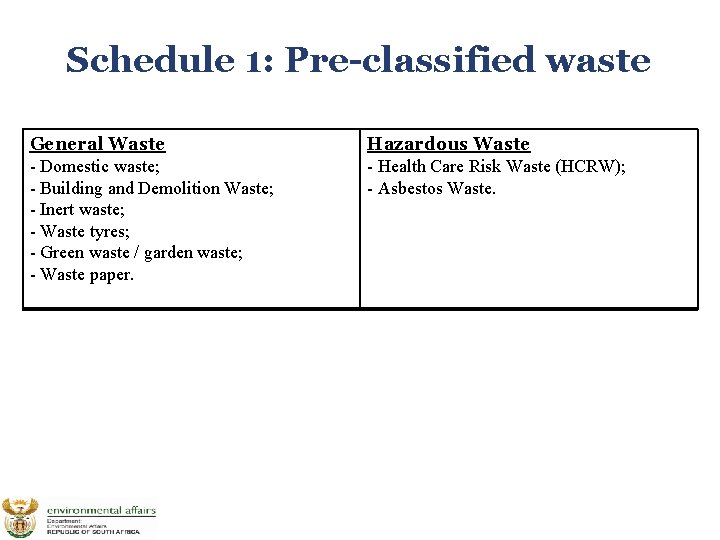
Schedule 1: Pre-classified waste General Waste - Domestic waste; - Building and Demolition Waste; - Inert waste; - Waste tyres; - Green waste / garden waste; - Waste paper. Hazardous Waste - Health Care Risk Waste (HCRW); - Asbestos Waste.
SA Waste & Chemicals Classification NEM: Waste Act (59 of 2008): Definitions & Hazardous waste management Minimum Requirements for the Handling, Classification and Disposal of Hazardous Waste (MRHW); 2 nd Ed. 1998 (draft 3 rd Ed. 2005) SANS 10228: 2006 (Ed. 4): Identification & classification of dangerous goods for transport SANS 10265: 1999 (Ed. 1 amended 2002): Code of Practice - Classification & labelling of dangerous substances and preparations for sale and handling. SANS 10234: 2008 (Edition 1. 1): Globally Harmonized System of classification & labelling of chemicals (GHS). Supplement to SANS 10234 (Edition 1; Dec. 2008): List of classification and labelling of chemicals in accordance with the Globally Harmonized System (GHS).
SA National Standards SANS Title Status 10228: 2006 Identification and Classification Updated i. t. o. UN Model Regulations: Recommendations on Transport of of Dangerous Goods for Dangerous Goods (Orange Book). transport Legislated (Road Traffic Act Regulations). 10265: 1999 (a. k. a. SABS 0265) 10234: 2008 The Classification and Labelling of Dangerous Substances and Preparations for Sale & Handling Globally Harmonized System (GHS) of Classification and Labelling of Chemicals Updated 2002. To be withdrawn when SANS 10234 is legislated. Not Legislated. Amendment & Supplement published 2008 -12 -08. Not Legislated (yet) – expected end 2010.
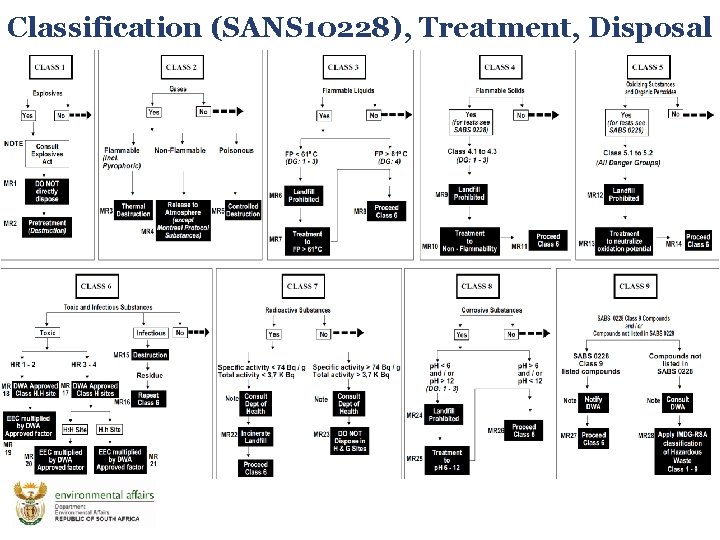
Minimum Requirements (MRHW) Classification Based on 4 key steps/principles, similar to Basel Convention and many other waste classification systems: 1. Identification of the waste or waste stream as ‘probably’ Hazardous (source based). 2. Testing and analysis to determine the hazardous properties, characteristics and components of a waste. This will confirm whether the waste is Hazardous or not. 3. Classification in accordance with SANS 10228: "The Identification and Classification of Dangerous Substances And Goods". 4. Analysis and Hazard Rating of the waste or its residue, in order to determine the Hazard Rating and the Requirements for disposal.
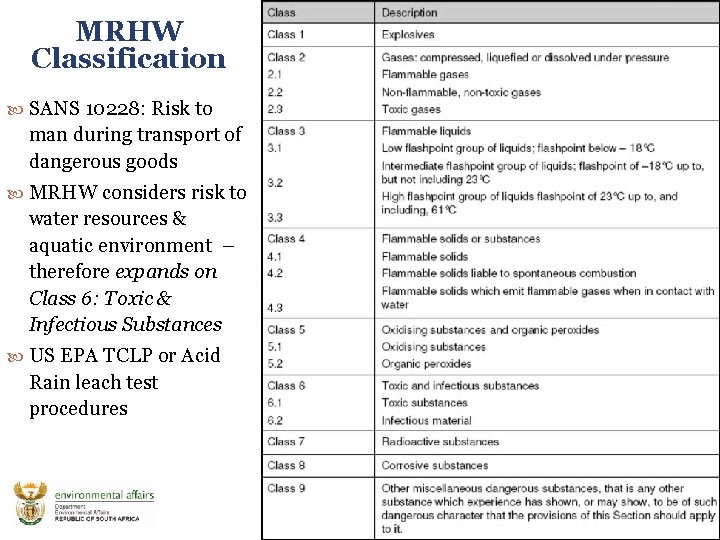
MRHW Classification SANS 10228: Risk to man during transport of dangerous goods MRHW considers risk to water resources & aquatic environment – therefore expands on Class 6: Toxic & Infectious Substances US EPA TCLP or Acid Rain leach test procedures
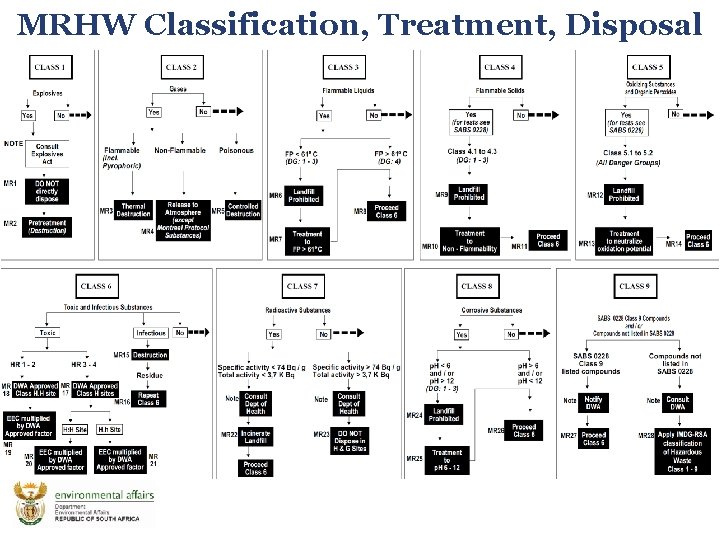
Classification (SANS 10228), Treatment, Disposal
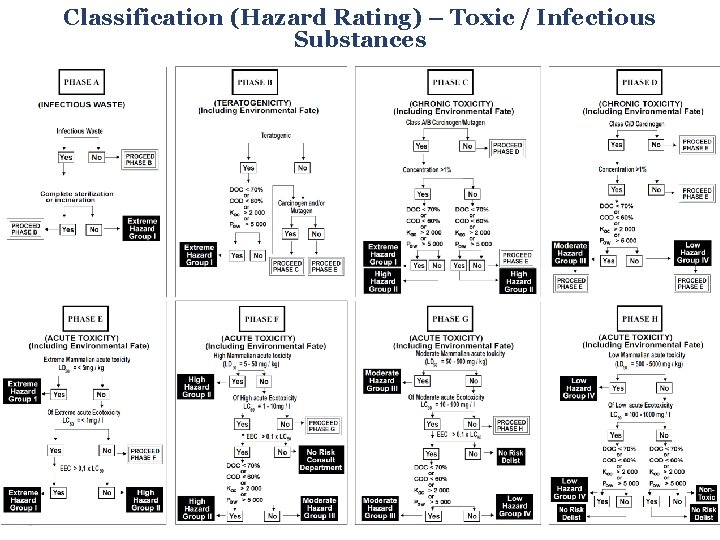
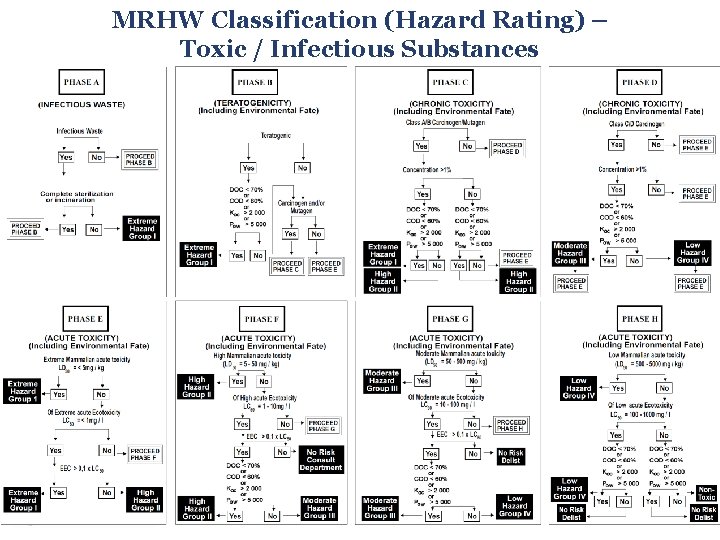
Classification (Hazard Rating) – Toxic / Infectious Substances
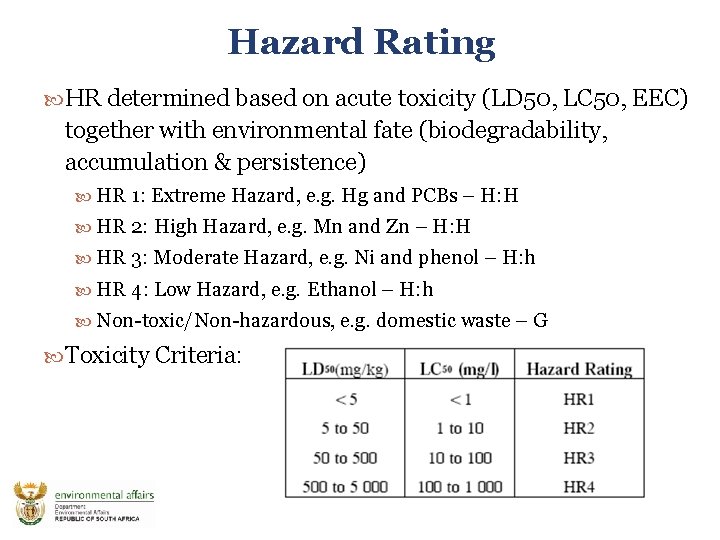
Hazard Rating HR determined based on acute toxicity (LD 50, LC 50, EEC) together with environmental fate (biodegradability, accumulation & persistence) HR 1: Extreme Hazard, e. g. Hg and PCBs – H: H HR 2: High Hazard, e. g. Mn and Zn – H: H HR 3: Moderate Hazard, e. g. Ni and phenol – H: h HR 4: Low Hazard, e. g. Ethanol – H: h Non-toxic/Non-hazardous, e. g. domestic waste – G Toxicity Criteria:
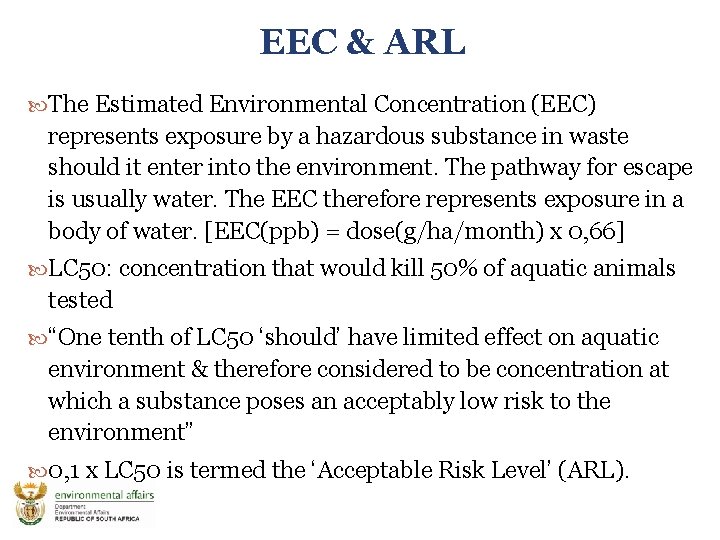
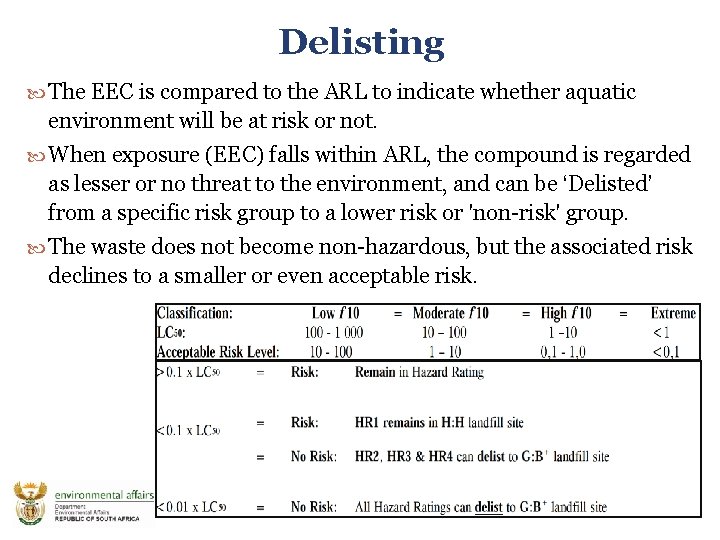
EEC & ARL The Estimated Environmental Concentration (EEC) represents exposure by a hazardous substance in waste should it enter into the environment. The pathway for escape is usually water. The EEC therefore represents exposure in a body of water. [EEC(ppb) = dose(g/ha/month) x 0, 66] LC 50: concentration that would kill 50% of aquatic animals tested “One tenth of LC 50 ‘should’ have limited effect on aquatic environment & therefore considered to be concentration at which a substance poses an acceptably low risk to the environment” 0, 1 x LC 50 is termed the ‘Acceptable Risk Level’ (ARL).
Delisting The EEC is compared to the ARL to indicate whether aquatic environment will be at risk or not. When exposure (EEC) falls within ARL, the compound is regarded as lesser or no threat to the environment, and can be ‘Delisted’ from a specific risk group to a lower risk or 'non-risk' group. The waste does not become non-hazardous, but the associated risk declines to a smaller or even acceptable risk.
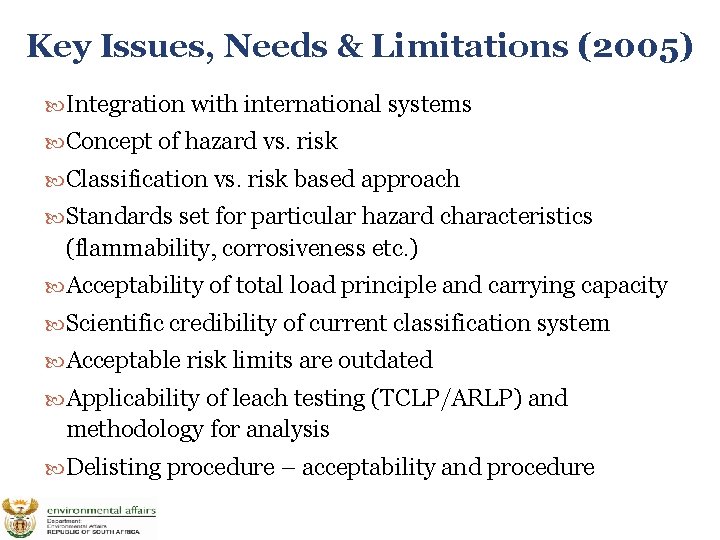
Key Issues, Needs & Limitations (2005) Integration with international systems Concept of hazard vs. risk Classification vs. risk based approach Standards set for particular hazard characteristics (flammability, corrosiveness etc. ) Acceptability of total load principle and carrying capacity Scientific credibility of current classification system Acceptable risk limits are outdated Applicability of leach testing (TCLP/ARLP) and methodology for analysis Delisting procedure – acceptability and procedure
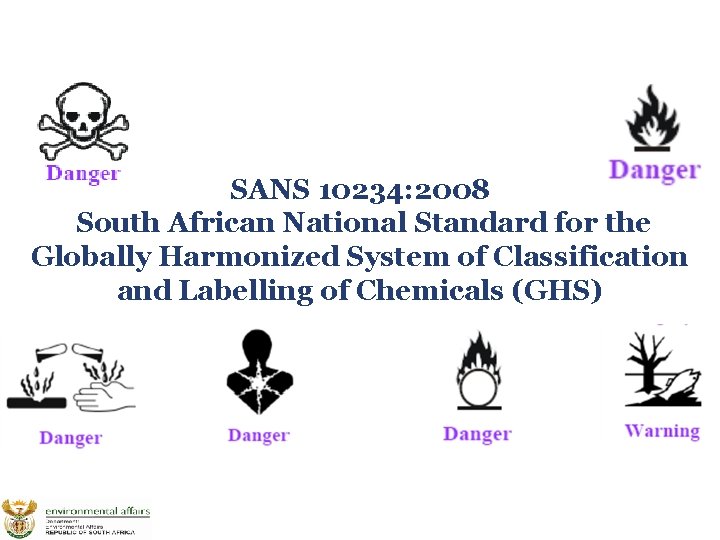
SANS 10234: 2008 South African National Standard for the Globally Harmonized System of Classification and Labelling of Chemicals (GHS)
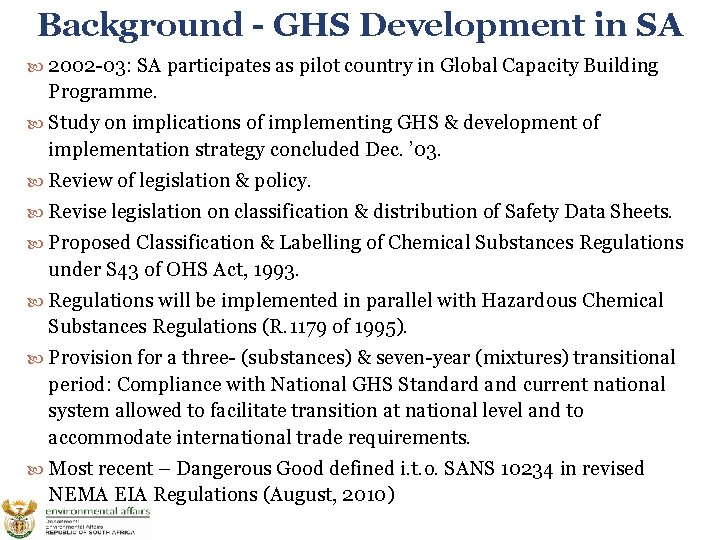
Background - GHS Development in SA 2002 -03: SA participates as pilot country in Global Capacity Building Programme. Study on implications of implementing GHS & development of implementation strategy concluded Dec. ’ 03. Review of legislation & policy. Revise legislation on classification & distribution of Safety Data Sheets. Proposed Classification & Labelling of Chemical Substances Regulations under S 43 of OHS Act, 1993. Regulations will be implemented in parallel with Hazardous Chemical Substances Regulations (R. 1179 of 1995). Provision for a three- (substances) & seven-year (mixtures) transitional period: Compliance with National GHS Standard and current national system allowed to facilitate transition at national level and to accommodate international trade requirements. Most recent – Dangerous Good defined i. t. o. SANS 10234 in revised NEMA EIA Regulations (August, 2010)
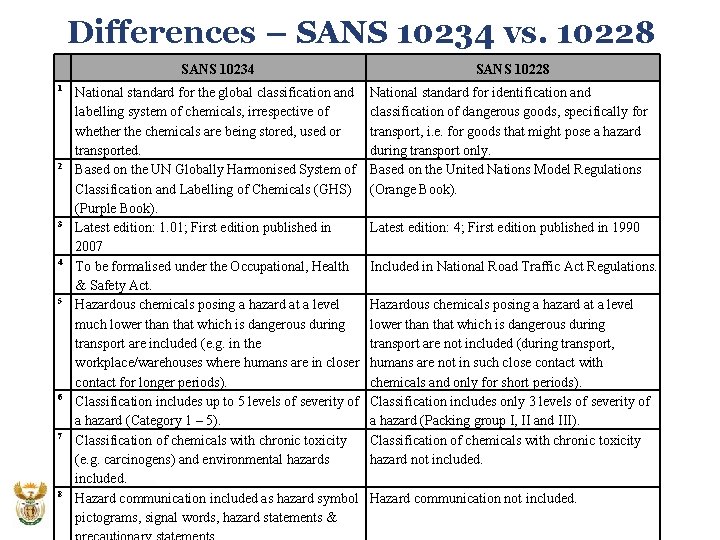
Differences – SANS 10234 vs. 10228 1 2 3 4 5 6 7 8 SANS 10234 SANS 10228 National standard for the global classification and labelling system of chemicals, irrespective of whether the chemicals are being stored, used or transported. Based on the UN Globally Harmonised System of Classification and Labelling of Chemicals (GHS) (Purple Book). Latest edition: 1. 01; First edition published in 2007 To be formalised under the Occupational, Health & Safety Act. Hazardous chemicals posing a hazard at a level much lower than that which is dangerous during transport are included (e. g. in the workplace/warehouses where humans are in closer contact for longer periods). Classification includes up to 5 levels of severity of a hazard (Category 1 – 5). Classification of chemicals with chronic toxicity (e. g. carcinogens) and environmental hazards included. Hazard communication included as hazard symbol pictograms, signal words, hazard statements & National standard for identification and classification of dangerous goods, specifically for transport, i. e. for goods that might pose a hazard during transport only. Based on the United Nations Model Regulations (Orange Book). Latest edition: 4; First edition published in 1990 Included in National Road Traffic Act Regulations. Hazardous chemicals posing a hazard at a level lower than that which is dangerous during transport are not included (during transport, humans are not in such close contact with chemicals and only for short periods). Classification includes only 3 levels of severity of a hazard (Packing group I, II and III). Classification of chemicals with chronic toxicity hazard not included. Hazard communication not included.
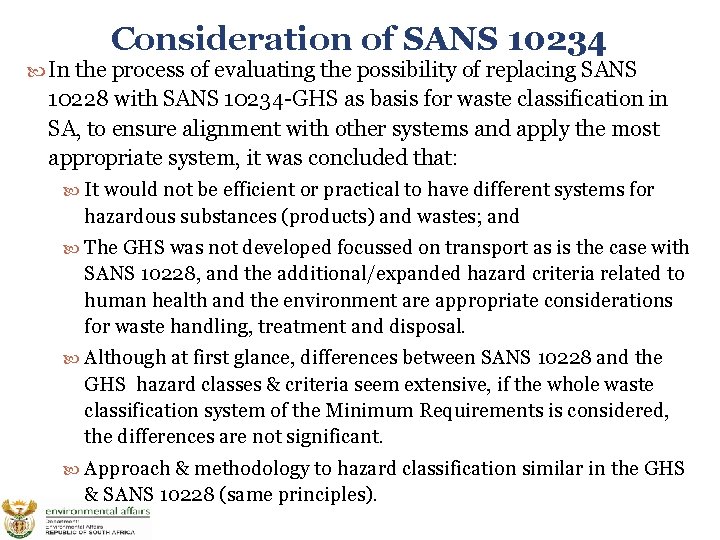
Consideration of SANS 10234 In the process of evaluating the possibility of replacing SANS 10228 with SANS 10234 -GHS as basis for waste classification in SA, to ensure alignment with other systems and apply the most appropriate system, it was concluded that: It would not be efficient or practical to have different systems for hazardous substances (products) and wastes; and The GHS was not developed focussed on transport as is the case with SANS 10228, and the additional/expanded hazard criteria related to human health and the environment are appropriate considerations for waste handling, treatment and disposal. Although at first glance, differences between SANS 10228 and the GHS hazard classes & criteria seem extensive, if the whole waste classification system of the Minimum Requirements is considered, the differences are not significant. Approach & methodology to hazard classification similar in the GHS & SANS 10228 (same principles).
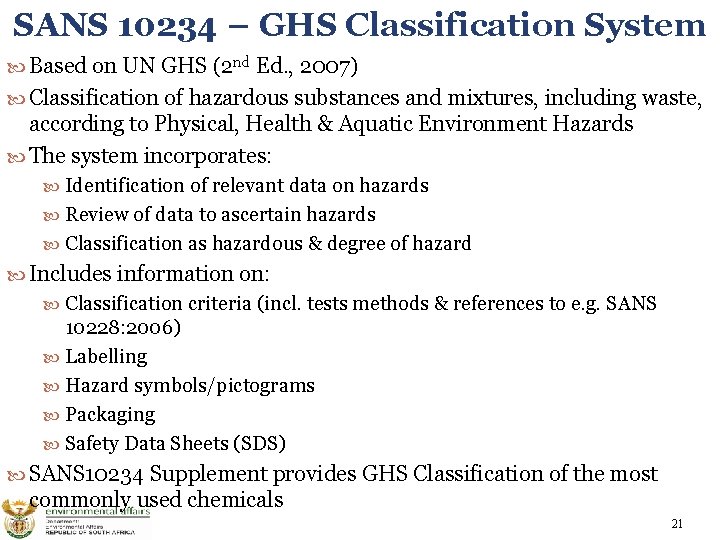
SANS 10234 – GHS Classification System Based on UN GHS (2 nd Ed. , 2007) Classification of hazardous substances and mixtures, including waste, according to Physical, Health & Aquatic Environment Hazards The system incorporates: Identification of relevant data on hazards Review of data to ascertain hazards Classification as hazardous & degree of hazard Includes information on: Classification criteria (incl. tests methods & references to e. g. SANS 10228: 2006) Labelling Hazard symbols/pictograms Packaging Safety Data Sheets (SDS) SANS 10234 Supplement provides GHS Classification of the most commonly used chemicals 21
SANS 10234 Physical Hazard Classes
SANS 10234 Physical Hazard Classes
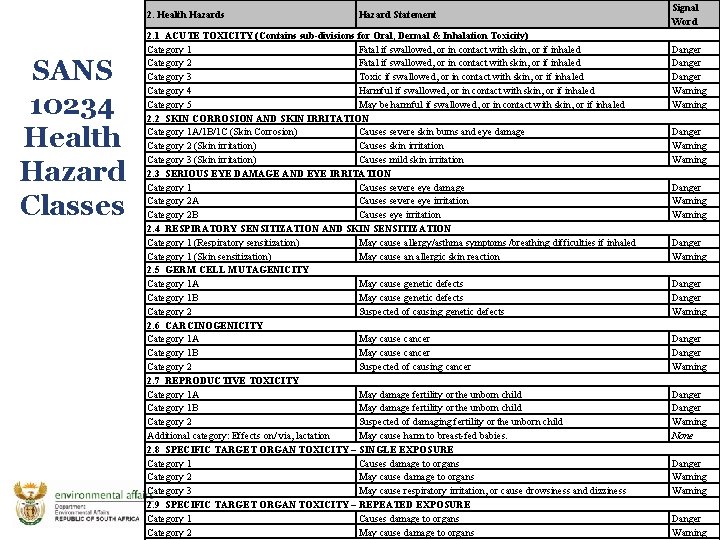
2. Health Hazards SANS 10234 Health Hazard Classes Hazard Statement 2. 1 ACUTE TOXICITY (Contains sub-divisions for Oral, Dermal & Inhalation Toxicity) Category 1 Fatal if swallowed, or in contact with skin, or if inhaled Category 2 Fatal if swallowed, or in contact with skin, or if inhaled Category 3 Toxic if swallowed, or in contact with skin, or if inhaled Category 4 Harmful if swallowed, or in contact with skin, or if inhaled Category 5 May be harmful if swallowed, or in contact with skin, or if inhaled 2. 2 SKIN CORROSION AND SKIN IRRITATION Category 1 A/1 B/1 C (Skin Corrosion) Causes severe skin burns and eye damage Category 2 (Skin irritation) Causes skin irritation Category 3 (Skin irritation) Causes mild skin irritation 2. 3 SERIOUS EYE DAMAGE AND EYE IRRITATION Category 1 Causes severe eye damage Category 2 A Causes severe eye irritation Category 2 B Causes eye irritation 2. 4 RESPIRATORY SENSITIZATION AND SKIN SENSITIZATION Category 1 (Respiratory sensitization) May cause allergy/asthma symptoms /breathing difficulties if inhaled Category 1 (Skin sensitization) May cause an allergic skin reaction 2. 5 GERM CELL MUTAGENICITY Category 1 A May cause genetic defects Category 1 B May cause genetic defects Category 2 Suspected of causing genetic defects 2. 6 CARCINOGENICITY Category 1 A May cause cancer Category 1 B May cause cancer Category 2 Suspected of causing cancer 2. 7 REPRODUCTIVE TOXICITY Category 1 A May damage fertility or the unborn child Category 1 B May damage fertility or the unborn child Category 2 Suspected of damaging fertility or the unborn child Additional category: Effects on/ via, lactation May cause harm to breast-fed babies. 2. 8 SPECIFIC TARGET ORGAN TOXICITY – SINGLE EXPOSURE Category 1 Causes damage to organs Category 2 May cause damage to organs Category 3 May cause respiratory irritation, or cause drowsiness and dizziness 2. 9 SPECIFIC TARGET ORGAN TOXICITY – REPEATED EXPOSURE Category 1 Causes damage to organs Category 2 May cause damage to organs Signal Word Danger Warning Danger Warning Danger Warning Danger Warning None Danger Warning
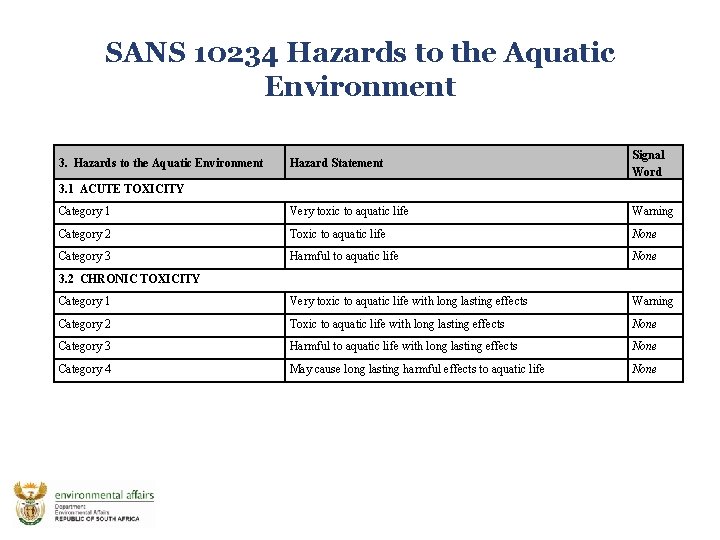
SANS 10234 Hazards to the Aquatic Environment Hazard Statement Signal Word Category 1 Very toxic to aquatic life Warning Category 2 Toxic to aquatic life None Category 3 Harmful to aquatic life None Category 1 Very toxic to aquatic life with long lasting effects Warning Category 2 Toxic to aquatic life with long lasting effects None Category 3 Harmful to aquatic life with long lasting effects None Category 4 May cause long lasting harmful effects to aquatic life None 3. Hazards to the Aquatic Environment 3. 1 ACUTE TOXICITY 3. 2 CHRONIC TOXICITY
MRHW Classification, Treatment, Disposal
MRHW Classification (Hazard Rating) – Toxic / Infectious Substances
SANS 10234 -GHS vs. SANS 10228 & MRHW 1. Physical Hazards - Explosives - Flammable gases - Flammable aerosols - Oxidizing gases - Gases under pressure - Flammable liquids (up to 93ºC) - Flammable solids - Self-reactive substances and mixtures - Pyrophoric substances - Self-heating substances and mixtures - Substances and mixtures that, on contact with water, emit flammable gases - Oxidizing substances and mixtures - Organic peroxides - Corrosive to metals KEY: SANS 10234 -GHS & SANS 10228 & MRHW SANS 10234 Only (Also SABS 0265 though) 2. Health Hazards - Acute toxicity - Skin corrosion and skin irritation - Serious eye damage and eye irritation - Respiratory sensitization and skin sensitization - Germ cell mutagenicity - Carcinogenicity - Reproductive toxicity (Teratogenicity in MRHW) - Specific target organ toxicity – single exposure - Specific target organ toxicity – repeated exposure - Aspiration hazards 3. Hazards to the Aquatic Environment - Acute aquatic toxicity - Chronic aquatic toxicity
Example: Chronic Environmental Hazard SANS 10234 (GHS) SANS 10228 / MINIMUM REQUIREMENTS / SABS 0265 Aquatic Environment Hazard Classes & Criteria 2. CHRONIC TOXICITY SANS 10228 (Class 9: Miscellaneous; SABS 0265 (Aquatic environmental Minimum Requirements Environmentally hazardous effects): (Class 6, Phase E-H: Acute substances): toxicity) 1 Very toxic: a) 96 h LC 50 (fish): ≤ 1 mg/l; and/or b) 48 h EC 50 (crustacea): ≤ 1 mg/l; and/or c) 72 h/96 h Er. C 50 (algae/aquatic plants): ≤ 1 mg/l; and/or d) the substance is not rapidly degradable; and/or e) the log Kow ≥ 4 (unless the experimentally determined BCF < 500). Category 1 (Chronic aquatic toxicity): a) 96 h LC 50 (fish): ≤ 1 mg/l; and/or b) 48 h EC 50 (crustacea): ≤ 1 mg/l; and/or c) 72 h/96 h Er. C 50 (algae/aquatic plants): ≤ 1 mg/l, and the substance is not rapidly degradable; and/or d) log Kow ≥ 4 (unless the experimentally determined BCF < 500). 1 (Very toxic; May cause long-term adverse effects): a) 96 h LC 50 (fish): ≤ 1 mg/l; or b) 48 h EC 50 (daphnia): ≤ 1 mg/l; or c) 72 h IC 50 (algae): ≤ 1 mg/l; and d) is not readily degradable; or e) log Pow ≥ 3, 0 unless the experimentally determined BCF ≤ 100. 1 Extreme Hazard (HR 1): a) LC 50 (fish; Acute): < 1 mg/l, and b) EEC > 0, 1 x LC 50. 2 Toxic: a) 96 h LC 50 (fish): > 1 ≤ 10 mg/l; and/or b) 48 h EC 50 (crustacea): > 1 ≤ 10 mg/l; and/or c) 72 h / 96 h Er. C 50 (algae/aquatic plants): > 1 ≤ 10 mg/l; and d) the substance is not rapidly degradable; and/or e) the log Kow ≥ 4 (unless the experimentally determined BCF < 500); and f) unless the chronic NOECs are > 1 mg/l. Category 2 (Chronic aquatic toxicity): a) 96 h LC 50 (fish): > 1 ≤ 10 mg/l; and/or b) 48 h EC 50 (crustacea): > 1 ≤ 10 mg/l; and/or c) 72 h/96 h Er. C 50 (algae/aquatic plants): > 1 ≤ 10 mg/l, and the substance is not rapidly degradable; and/or d) log Kow ≥ 4 (unless the experimentally determined BCF <500), unless the chronic toxicity NOECs are > 1 mg/l. 2 (Toxic; May cause long-term adverse effects): a) 96 h LC 50 (fish): > 1 ≤ 10 mg/l; or b) 48 h EC 50 (daphnia): > 1 ≤ 10 mg/l; or c) 72 h IC 50 (algae): > 1 ≤ 10 mg/l; and d) is not readily degradable; or e) log Pow ≥ 3, 0 unless the experimentally determined BCF ≤ 100. 2 High Hazard (HR 2): a) LC 50 (fish; Acute): < 1 mg/l, and b) EEC < 0, 1 x LC 50. or a) LC 50 (fish; Acute): 1 – 10 mg/l, and b) EEC > 0, 1 x LC 50, and c) not readily biodegradable (DOC < 70% or COD < 60%), or high persistence potential (K∝ > 2000), or high accumulation potential (Pow > 5000).
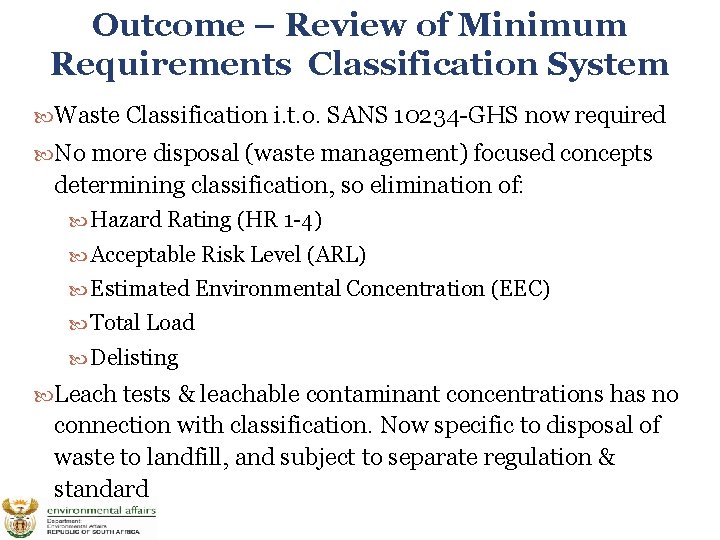
Outcome – Review of Minimum Requirements Classification System Waste Classification i. t. o. SANS 10234 -GHS now required No more disposal (waste management) focused concepts determining classification, so elimination of: Hazard Rating (HR 1 -4) Acceptable Risk Level (ARL) Estimated Environmental Concentration (EEC) Total Load Delisting Leach tests & leachable contaminant concentrations has no connection with classification. Now specific to disposal of waste to landfill, and subject to separate regulation & standard
Waste Categorisation for Reporting
Objectives • DEA Objectives – – To report on the success of national waste policy in moving waste up the hierarchy from landfilling to reuse, recycling and recovery – Identify the impact of policies and waste management interventions – Identify waste streams requiring further management intervention • To achieve this objective, DEA needs to know – – What waste are currently generated in SA? – How much waste are we generating? – How is the waste currently being managed ? • Can answer questions by generating the following reports: – Tonnages of waste finally treated, recycled, recovered or landfilled • Achieved by waste management facilities reporting under specific waste management category • Reporting on specific waste types managed 32
Waste Categorisation • Identifies waste management facilities that must report • Identifies codes under which the facilities must report • Provides a list of waste types which must be reported on • Identifies waste generators that are required to register • Requirements are implemented through the WIS regulations 33
Who registers? 34
Registration • All waste management facilities are required to register under specific codes and sub-codes – Codes: • R: for recycling and recovery of waste • T: for treatment of waste not for disposal i. e. final treatment • D: for disposal of waste – Sub – codes • R 1 - R 6 • T 1 - T 4 • D 1 - D 5 • All generators of hazardous waste generating in excess of 20 kg of hazardous waste/day are required to register and receive a registration number • All major generators of HCRW (i. e. > 20 kg/day) are required to register and receive a registration number 35
Waste Management facilities required to register & registration codes 36
Who reports on what? 37
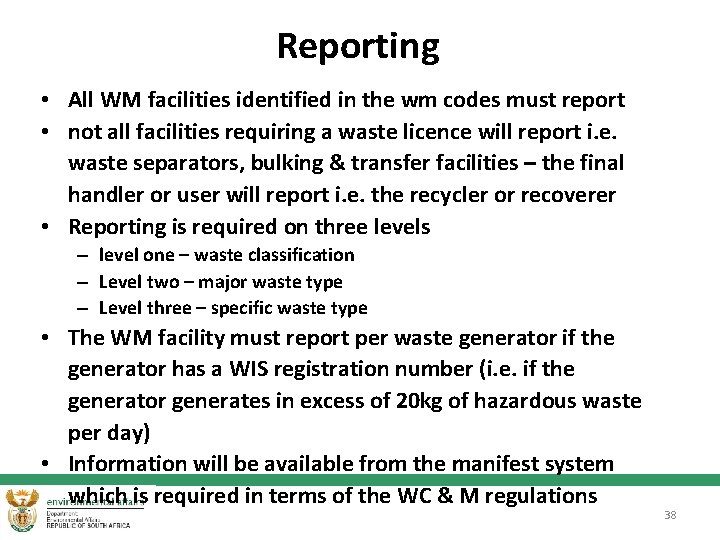
Reporting • All WM facilities identified in the wm codes must report • not all facilities requiring a waste licence will report i. e. waste separators, bulking & transfer facilities – the final handler or user will report i. e. the recycler or recoverer • Reporting is required on three levels – level one – waste classification – Level two – major waste type – Level three – specific waste type • The WM facility must report per waste generator if the generator has a WIS registration number (i. e. if the generator generates in excess of 20 kg of hazardous waste per day) • Information will be available from the manifest system which is required in terms of the WC & M regulations 38
Information required to be reported Data Description DEAT Reg. No DEAT Registration number: Unique reference to a registered facility Year to which waste data applies Month to which waste data applies Province from which the waste comes Municipality from which the waste comes DEA Reg number Generator from which the waste comes Waste Type Recycled, recovered treated etc. Waste type in terms of the reporting categories; Level 1 level 2 and level 3 Quantity in tonnes Quantity of waste in tonnes 39
LEVEL 1 General Waste Reporting Categories LEVEL 2 – Major waste type No Name GW 01 Municipal Waste GW 10 Commercial and Industrial waste LEVEL 3 – specific waste tyre No Name 01 01 GW 13 GW 14 Brine Fly ash and dust from miscellaneous filter sources 01 01 GW 15 Bottom ash 01 GW 16 Slag 01 02 Others Foundry sand Refractory waste Others GW 18 03 Mineral Waste 01 02 03 Waste of Electric and Electronic Equipment (WEEE) 01 GW 20 Organic waste Garden Waste Food waste GW 21 GW 30 Sewage sludge Construction and demolition waste 01 02 01 01 GW 50 Paper 01 Newsprint and magazines 02 03 04 01 02 01 01 Brown grades White grades Mixed grades PETE Others GW 17 GENERAL WASTE Ferrous metal Slag Non-ferrous metal slag GW 51 Plastic GW 52 GW 53 Glass Metals GW 54 GW 99 Tyres Other Ferrous Non - ferrous
Hazardous Waste Reporting Categories
Hazardous Waste Reporting Categories
Standard for Leach Tests & Waste Risk Profiling
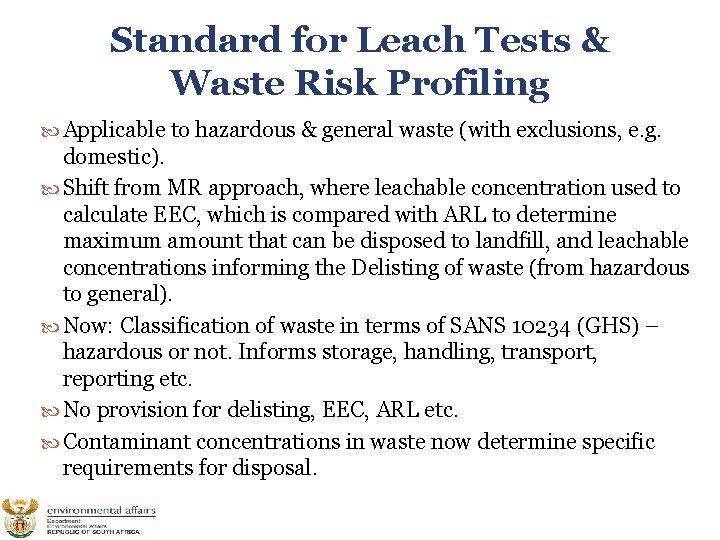
Standard for Leach Tests & Waste Risk Profiling Applicable to hazardous & general waste (with exclusions, e. g. domestic). Shift from MR approach, where leachable concentration used to calculate EEC, which is compared with ARL to determine maximum amount that can be disposed to landfill, and leachable concentrations informing the Delisting of waste (from hazardous to general). Now: Classification of waste in terms of SANS 10234 (GHS) – hazardous or not. Informs storage, handling, transport, reporting etc. No provision for delisting, EEC, ARL etc. Contaminant concentrations in waste now determine specific requirements for disposal.
Approach Leachable Concentration (LC) and Total Concentration (TC) are compared with three levels of threshold values, which in combination, determines the Risk Profile of the waste. The Waste Risk Profile reflects degree of potential risk associated with disposal where waste could impact on groundwater. Risk profiling designates four types (risk levels) of hazardous waste, each with specific landfill design requirements (management linked with the existing Minimum Requirements for Landfill).
Terminology Leachable concentration thresholds = SA Standard Leaching Procedure values = SASLP 0, SASLP 1 and SASLP 2. Total concentration thresholds = SA Standard Total Concentration values = SASTC 0, SASTC 1 and SASTC 2. LC = Leachable concentration (mg/l) of a specific contaminant - compared with SASLP threshold values. TC = Total concentration (mg/kg) of a specific contaminant - compared with SASTC threshold values.
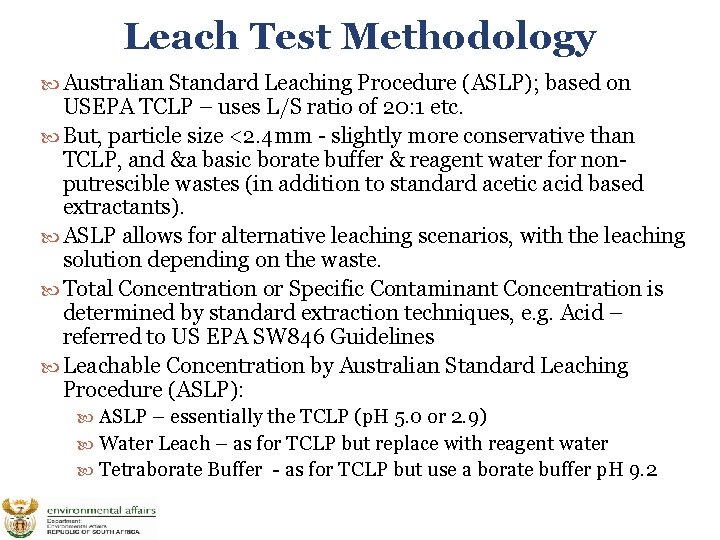
Leach Test Methodology Australian Standard Leaching Procedure (ASLP); based on USEPA TCLP – uses L/S ratio of 20: 1 etc. But, particle size <2. 4 mm - slightly more conservative than TCLP, and &a basic borate buffer & reagent water for nonputrescible wastes (in addition to standard acetic acid based extractants). ASLP allows for alternative leaching scenarios, with the leaching solution depending on the waste. Total Concentration or Specific Contaminant Concentration is determined by standard extraction techniques, e. g. Acid – referred to US EPA SW 846 Guidelines Leachable Concentration by Australian Standard Leaching Procedure (ASLP): ASLP – essentially the TCLP (p. H 5. 0 or 2. 9) Water Leach – as for TCLP but replace with reagent water Tetraborate Buffer - as for TCLP but use a borate buffer p. H 9. 2
Leach Test Methodology ASLP allows for alternative leaching scenarios, with the leaching solution depending on the waste: o Waste to be disposed with or contain putrescible wastes: Standard TCLP solutions with altered p. H 5. 0 or p. H 2. 9 (0. 1 M acetic acid) depending on acid neutrilisation capacity of waste. o Waste to be co-disposed with non-putrescible material: A basic solution consisting of a 0. 1 M sodium tetraborate decahydrate of p. H 9. 2± 0. 1 (alkaline test identifies contaminants that are leached at high p. H). o Waste that is to be left undisturbed on-site, or dispersed over land without confinement, or non-putrescible material, e. g. mono-disposal scenario: Reagent water solution (also relate to contaminated land assessment; in-situ).
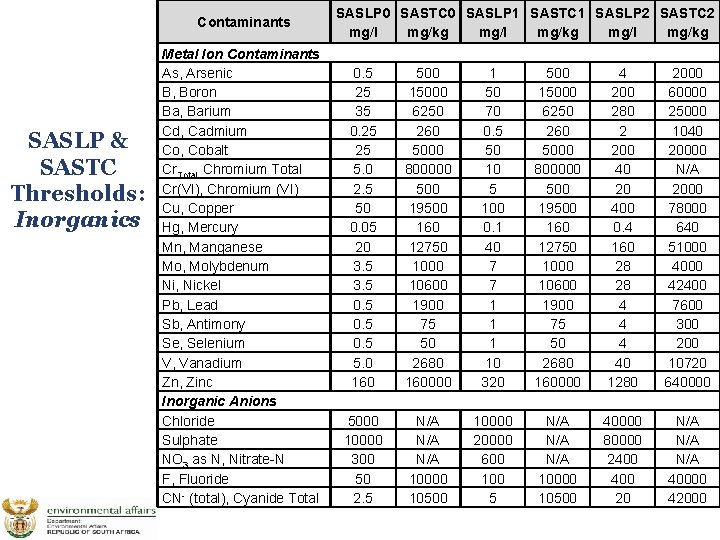
SASLP & SASTC Thresholds Leachable concentration based on DWAF, SANS, WHO & USEPA drinking water standards, muliplied by dilution attenuation factor (DAF) of 50, as Victoria EPA (NSW & USEPA – DAF of 100). DAF value of 50 for lowest or base level leachable concentration (SASLP 0) – on basis of precautionary principle. SASLP 1 = 2 x SASLP 0; SASLP 2 = 4 x SASLP 1. Represents a conservative assessment of the decrease in risk achieved by the increase in environmental protection provided by landfill construction and landfill operating requirements (Minimum Requirements = factor 5; attenuation due to liner & leachate management). SASTC values derived from Contaminated land Standards, but consideration given to different risk exposure pathways. SASLP & SASTC values are aligned with international standards (US, EU, Australia, UK, New Zealand etc. )
Contaminants SASLP & SASTC Thresholds: Inorganics Metal Ion Contaminants As, Arsenic B, Boron Ba, Barium Cd, Cadmium Co, Cobalt Cr. Total, Chromium Total Cr(VI), Chromium (VI) Cu, Copper Hg, Mercury Mn, Manganese Mo, Molybdenum Ni, Nickel Pb, Lead Sb, Antimony Se, Selenium V, Vanadium Zn, Zinc Inorganic Anions Chloride Sulphate NO 3 as N, Nitrate-N F, Fluoride CN- (total), Cyanide Total SASLP 0 SASTC 0 SASLP 1 SASTC 1 SASLP 2 SASTC 2 mg/l mg/kg 0. 5 25 35 0. 25 25 5. 0 2. 5 50 0. 05 20 3. 5 0. 5 5. 0 160 500 15000 6250 260 5000 800000 500 19500 160 12750 1000 10600 1900 75 50 2680 160000 1 50 70 0. 5 50 10 5 100 0. 1 40 7 7 1 10 320 500 15000 6250 260 5000 800000 500 19500 160 12750 1000 10600 1900 75 50 2680 160000 4 200 280 2 200 40 20 400 0. 4 160 28 28 4 40 1280 2000 60000 25000 1040 20000 N/A 2000 78000 640 51000 42400 7600 300 200 10720 640000 5000 10000 300 50 2. 5 N/A N/A 10000 10500 10000 20000 600 100 5 N/A N/A 10000 10500 40000 80000 2400 20 N/A N/A 40000 42000
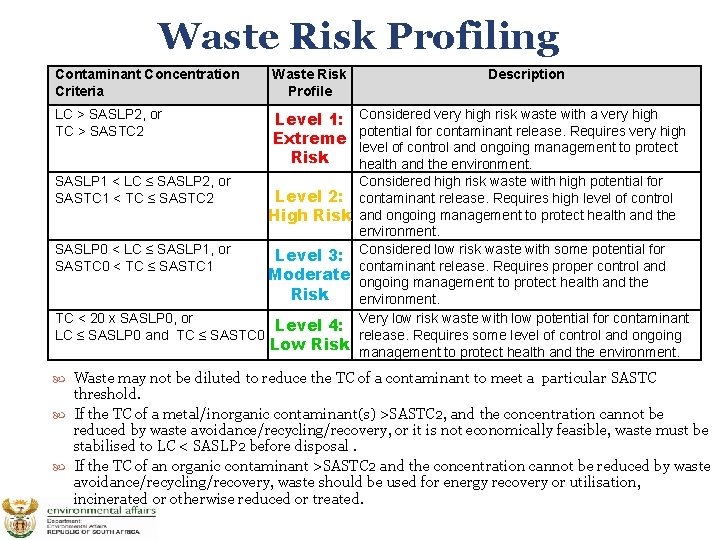
Waste Risk Profiling Contaminant Concentration Criteria Waste Risk Profile LC > SASLP 2, or TC > SASTC 2 Level 1: Extreme Risk Description Considered very high risk waste with a very high potential for contaminant release. Requires very high level of control and ongoing management to protect health and the environment. SASLP 1 < LC ≤ SASLP 2, or Considered high risk waste with high potential for Level 2: contaminant release. Requires high level of control SASTC 1 < TC ≤ SASTC 2 High Risk and ongoing management to protect health and the environment. SASLP 0 < LC ≤ SASLP 1, or Level 3: Considered low risk waste with some potential for SASTC 0 < TC ≤ SASTC 1 contaminant release. Requires proper control and Moderate ongoing management to protect health and the Risk environment. TC < 20 x SASLP 0, or Level 4: Very low risk waste with low potential for contaminant LC ≤ SASLP 0 and TC ≤ SASTC 0 release. Requires some level of control and ongoing Low Risk management to protect health and the environment. Waste may not be diluted to reduce the TC of a contaminant to meet a particular SASTC threshold. If the TC of a metal/inorganic contaminant(s) >SASTC 2, and the concentration cannot be reduced by waste avoidance/recycling/recovery, or it is not economically feasible, waste must be stabilised to LC < SASLP 2 before disposal. If the TC of an organic contaminant >SASTC 2 and the concentration cannot be reduced by waste avoidance/recycling/recovery, waste should be used for energy recovery or utilisation, incinerated or otherwise reduced or treated.
Waste Risk Profiling Analyse a Representative Sample(s) of the Waste for TC (mg/kg) for required Inorganic and Organic Parameters and Compare to Thresholds TC is always less than twenty times SASLP 0, i. e. TC < 20 x SASLP 0 Yes Level 4 Waste No Analyse Representative Sample(s) of the Waste using the SASLP 1) If TC > 20 X SASLP 0 for any inorganic contaminant(s) analyse for inorganic compounds. 2) If TC > 20 X SASLP 0 for any organic contaminant(s) analyse for organic compounds. LC > SASLP 2 or TC > SASTC 2 Level 1 Waste SASLP 1 < LC = SASLP 2 or SASTC 1 < TC = SASTC 2 Level 2 Waste SASLP 0 < LC = SASLP 1 or SASTC 0 < TC = SASTC 1 Level 3 Waste LC = SASLP 0 and TC = SASTC 0 Level 4 Waste
Standard for Disposal of Waste to Landfill
Standard for Disposal of Waste to Landfill Specific requirements for disposal based on risk profile of waste Containment Barrier (Landfill liner) design requirements – not Minimum Requirements specifications Waste Acceptance Criteria Disposal Restrictions
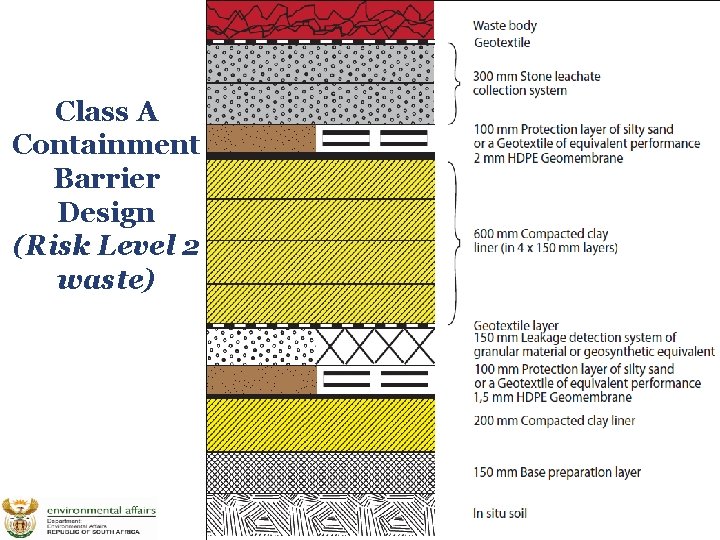
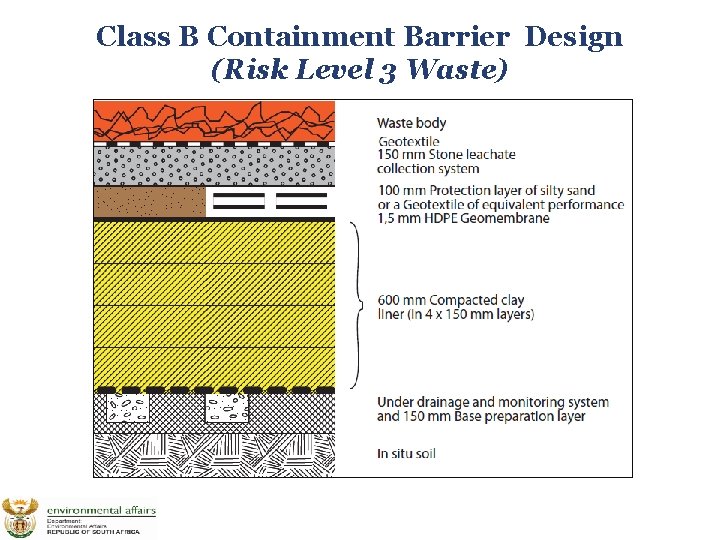
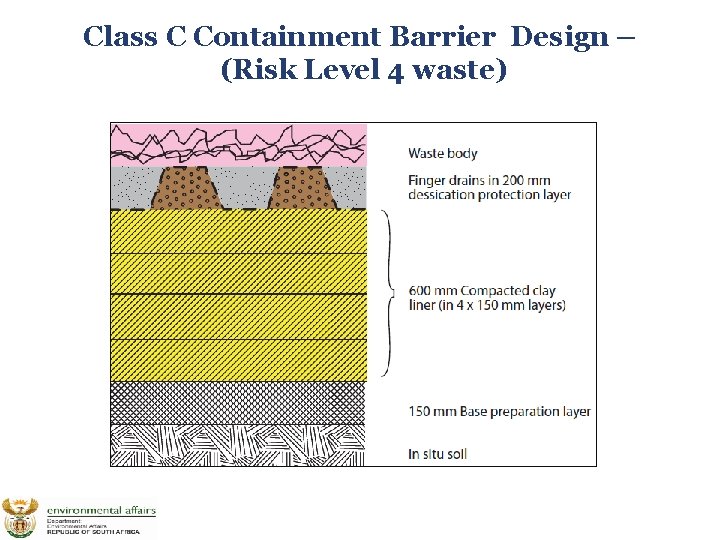
Landfill Acceptance Criteria Permitted landfills may accept wastes in any currently operating cells, but the design and operation of future cells must be upgraded to the new containment barrier designs.
Revised Containment Barriers ‘Containment Barrier’ Designs = Revised Landfill Liner Designs Developed by Department of Water Affairs, June 2010 Focused on waste for risk profiling Currently review of domestic and other pre-classified general waste disposal requirements Question on inert waste
Class A Containment Barrier Design (Risk Level 2 waste)
Class B Containment Barrier Design (Risk Level 3 Waste)
Class C Containment Barrier Design – (Risk Level 4 waste)
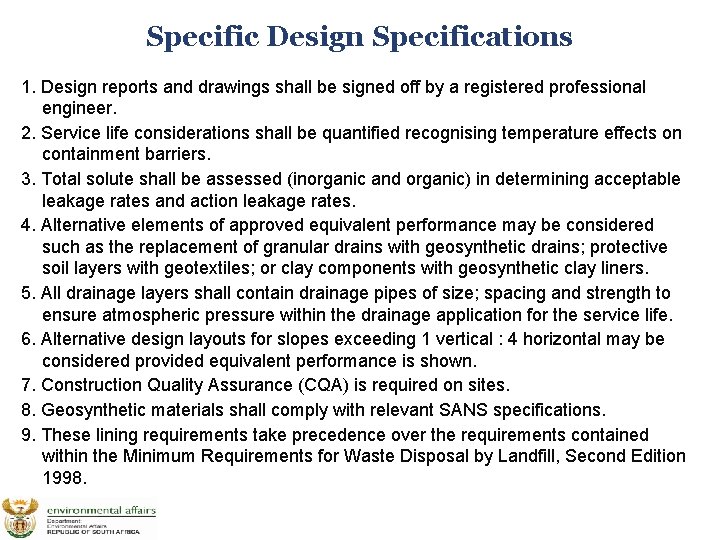
Specific Design Specifications 1. Design reports and drawings shall be signed off by a registered professional engineer. 2. Service life considerations shall be quantified recognising temperature effects on containment barriers. 3. Total solute shall be assessed (inorganic and organic) in determining acceptable leakage rates and action leakage rates. 4. Alternative elements of approved equivalent performance may be considered such as the replacement of granular drains with geosynthetic drains; protective soil layers with geotextiles; or clay components with geosynthetic clay liners. 5. All drainage layers shall contain drainage pipes of size; spacing and strength to ensure atmospheric pressure within the drainage application for the service life. 6. Alternative design layouts for slopes exceeding 1 vertical : 4 horizontal may be considered provided equivalent performance is shown. 7. Construction Quality Assurance (CQA) is required on sites. 8. Geosynthetic materials shall comply with relevant SANS specifications. 9. These lining requirements take precedence over the requirements contained within the Minimum Requirements for Waste Disposal by Landfill, Second Edition 1998.
Landfill Restrictions
Landfill Restrictions
Landfill Restrictions
THANK YOU